
P0351 Trouble Code: Meaning, Causes, Symptoms & Fixes
In This Guide
One-line meaning: P0351: Ignition Coil A Primary/Secondary Circuit Malfunction.
What the P0351 Code Means
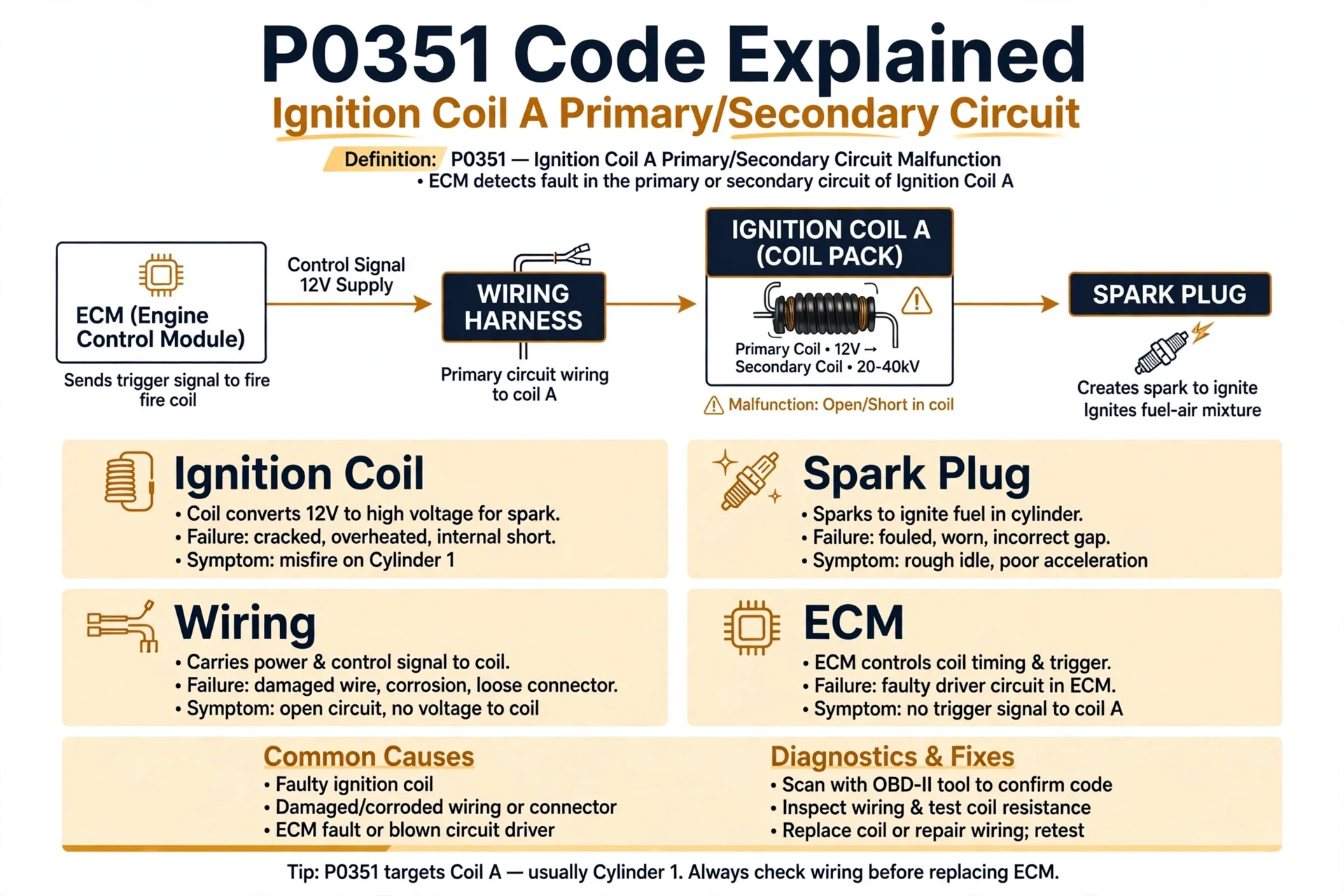
The P0351 code is a diagnostic trouble code that stands for “Ignition Coil A Primary/Secondary Circuit Malfunction.” In plain English, your car’s engine computer (ECM/PCM) has detected an electrical fault in the circuit that fires one of your ignition coils. Every ignition coil contains two windings: a primary winding that the computer pulses with 12 volts, and a secondary winding that steps that pulse up to the tens of thousands of volts needed to jump the spark plug gap. The computer watches both sides of the circuit, and when the signal comes back open, shorted, or out of range, it stores the engine code P0351.
“Coil A” almost always refers to the ignition coil for cylinder number one. That said, coil lettering follows each manufacturer’s own layout, so confirm which coil is “A” on your specific engine before buying parts. The p0351 code is a generic powertrain code, which means it carries the same basic meaning on every make and model, from a Ford F-150 to a Toyota Camry to a Honda Civic.
Here is what is actually happening inside. The computer sends a precisely timed pulse to the coil’s primary winding and watches the voltage spike that returns. A healthy coil answers with a crisp, strong spike. If the secondary winding is shorted internally, that spike comes back weak, and the computer flags the circuit. Because the coil never builds a proper spark, that cylinder misfires, which is why the p0351 code so often arrives with a rough-running engine and a flashing check engine light.
Symptoms of the P0351 Code
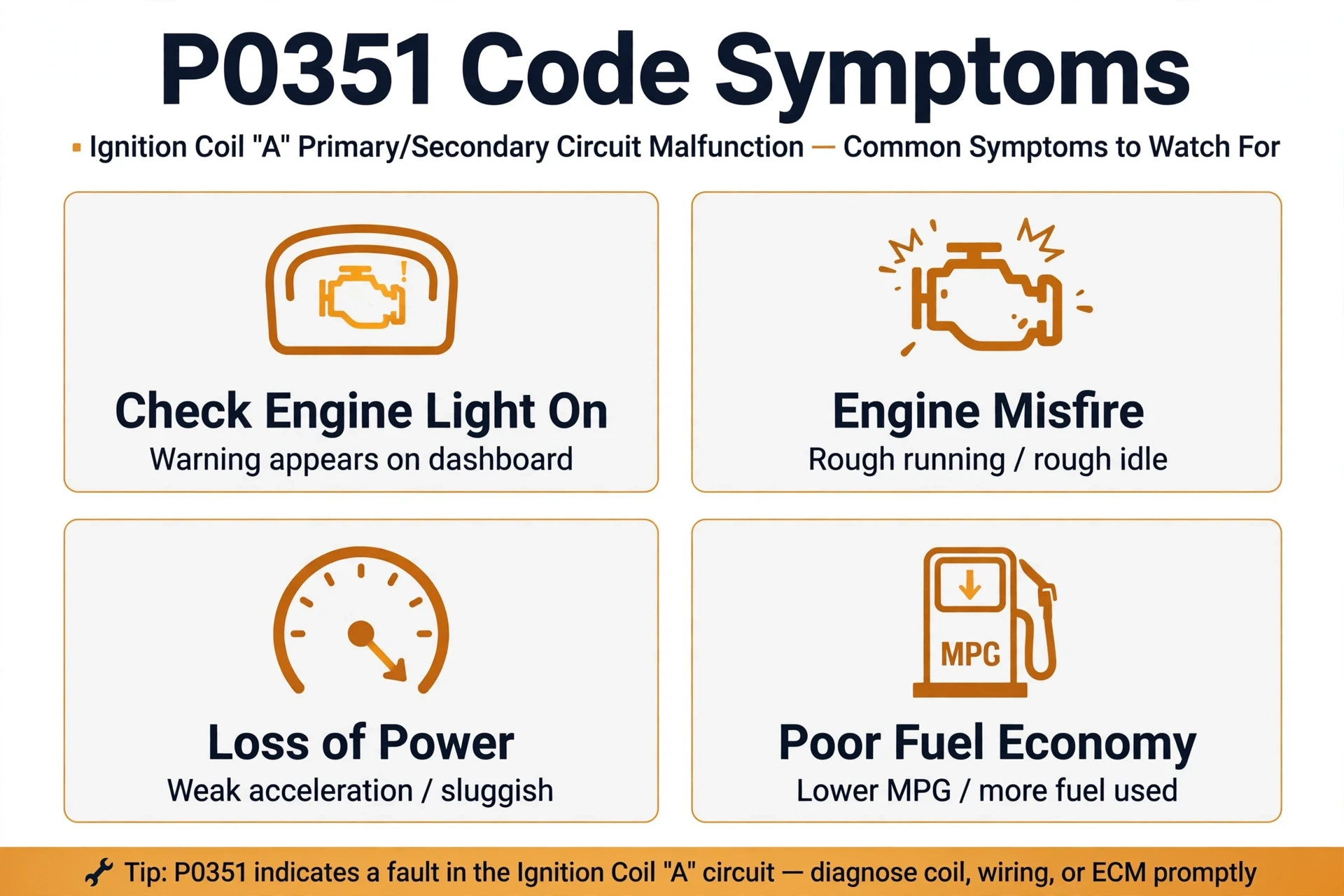
The P0351 code rarely hides. Because the affected cylinder is not firing correctly, you will usually feel it. The most common symptoms are:
- Check engine light, either steady or flashing (flashing means an active misfire is happening right now)
- Rough idle, the engine shakes, stumbles, or vibrates when stopped
- Engine misfires, with hesitation or a loss of power when you press the gas pedal
- Poor acceleration and noticeably reduced engine power
- Poor fuel economy, because the computer injects extra fuel trying to compensate for the weak cylinder
- Difficulty starting the engine in some cases
- In severe cases, a sulfur smell or overheating from the exhaust as unburned fuel reaches the catalytic converter
What is the engine code p0351 trying to tell you? In short: one cylinder’s ignition circuit is electrically sick, and the engine is effectively running on fewer than all cylinders. Do not ignore a flashing check engine light, because ongoing misfires can overheat and destroy the catalytic converter.
Common Causes of P0351
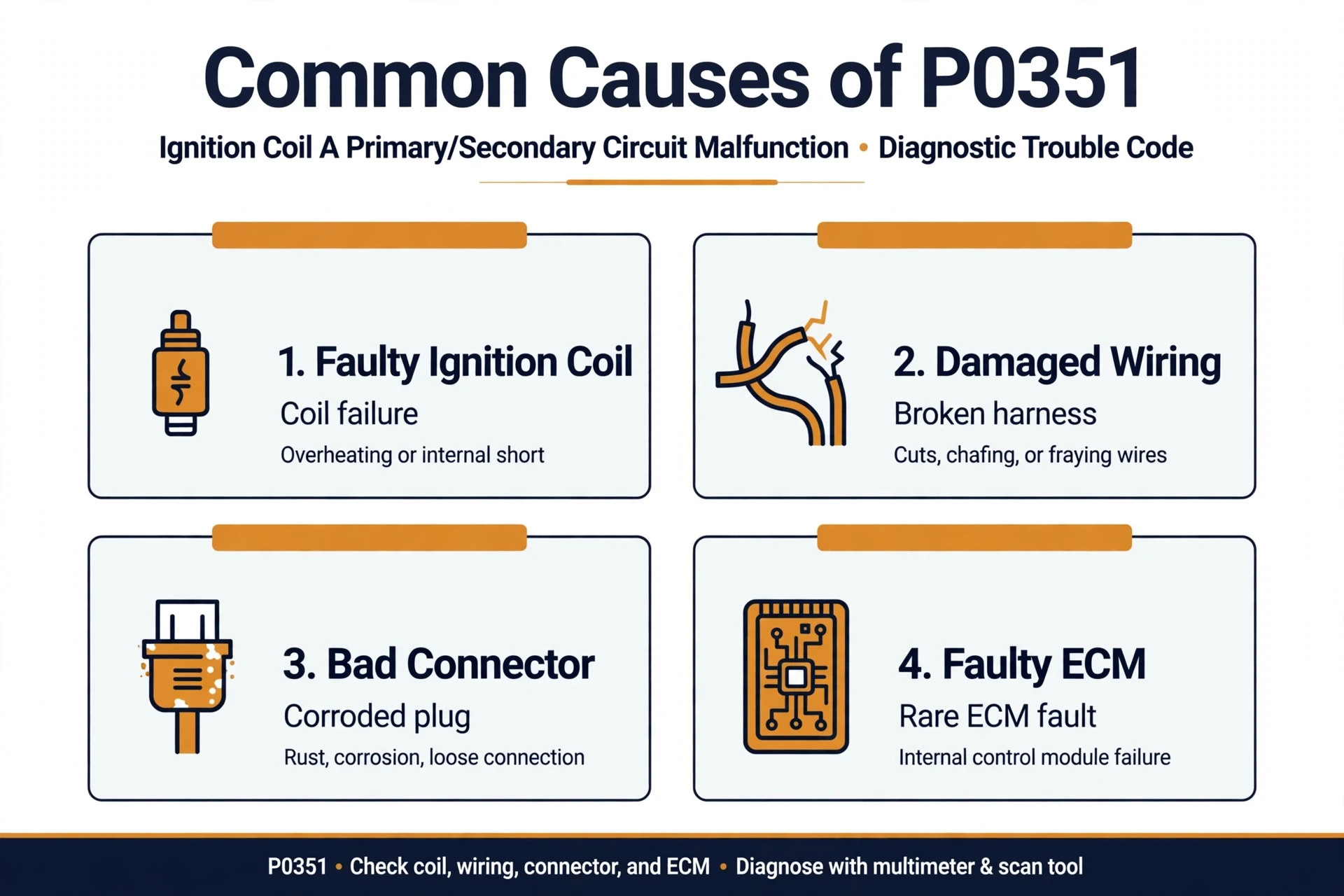
The P0351 code sets when the computer sees an electrical problem in coil A’s primary or secondary circuit. Here are the causes, roughly in order of likelihood:
- Failed ignition coil: the internal primary or secondary winding has worn out, shorted, or gone open. Heat cycles and age are the usual killers, and this is the single most common cause.
- Damaged wiring or connectors: frayed wires, loose pins, corroded terminals, or melted insulation at the coil connector interrupt the circuit and corrupt the signal.
- Fouled or worn spark plug: an over-gapped, oil-fouled, or cracked plug, or a bad coil boot, forces the coil to work far harder than designed and can drag the circuit out of range.
- Blown fuse or bad relay: a power-supply fault that cuts the 12-volt feed to the ignition circuit, so the coil never gets the voltage it needs.
- Faulty ECM/PCM coil driver: the computer’s internal transistor that pulses the coil can fail, so the trigger signal never arrives. Uncommon, but it happens.
- Software or calibration glitch: outdated ECM software misreading the coil signal. Rare, and usually covered by a manufacturer bulletin.
- A bad coil on another cylinder (Toyota/Lexus): on some models the coils share a feedback line, so a failing coil elsewhere can short it and make the computer blame coil A. If coil A tests fine, check the rest.
How to Diagnose P0351 (Do This Before Buying Parts)
P0351 is one of the most misdiagnosed codes because drivers replace coil A without ever checking the circuit. Work through these steps in order:
- Scan for other codes first. Note any misfire codes such as P0301 (cylinder 1 misfire) or companion coil codes like P0352. They confirm which cylinder is actually in trouble.
- Inspect the wiring and connector at coil A. Look for corrosion, broken locking tabs, chafed wires, and melted insulation. With the engine running, gently wiggle the harness and watch for the idle to change.
- Swap coils to test. Move coil A to another cylinder (cylinder 2, for example), clear the codes, and drive. If the code follows the coil and becomes P0352, the coil is bad. If P0351 stays on cylinder 1, the fault is in the wiring, the power supply, or the computer.
- Test power, ground, and the trigger signal. With a multimeter, verify 12-volt power at the coil connector, a solid ground, and a pulsing trigger signal from the ECM while cranking.
- Check the coil’s resistance. Measure the primary and secondary winding resistance and compare against the manufacturer’s spec. An open circuit or an out-of-spec reading condemns the coil.
- Inspect the spark plug for cylinder 1. Pull it and check for excessive gap, oil fouling, cracks, or wear. A bad plug can mimic a coil circuit fault, and it is cheap to rule out.
- Suspect the ECM last. If the coil, wiring, power feed, and plug all check out, the computer’s coil driver may have failed. Confirm with a scope on the trigger wire before condemning the ECM.

How to Fix the P0351 Code
The right fix depends on what your diagnosis found:
- Replace the faulty ignition coil: if the swap test or resistance check condemned coil A, install a new coil. Choose OEM or a quality aftermarket brand, since cheap coils tend to fail early.
- Repair the wiring and connectors: clean corroded terminals, repair frayed wires, and replace a heat-damaged connector pigtail so the circuit is solid again.
- Replace the spark plug and boot: if the cylinder 1 plug is fouled, over-gapped, or cracked, replace it. If the plugs are old, replacing the full set is smart preventive work.
- Replace a blown fuse or faulty relay: restore the 12-volt feed to the ignition circuit, then find out what overloaded it so it does not blow again.
- Update the ECM software: if a manufacturer service bulletin covers false P0351 faults on your model, a reflash may resolve it.
- Replace the ECM/PCM: only after proving the coil, wiring, power, and plug are all good. A remanufactured, VIN-matched programmed unit is the usual route, and it needs proper programming to your vehicle.

P0351 Repair Costs
Drivers always ask how much it costs to fix the p0351 code, and the answer depends entirely on the cause. Here are realistic ranges:
| Repair | Cost Range |
|---|---|
| Ignition coil replacement (single coil) | $120 – $300 |
| Spark plug replacement | $100 – $250 |
| Wiring or connector repair | $100 – $350 |
| ECM/PCM replacement (programmed) | $800 – $1,500 |
This is why the swap test matters. A $150 coil job and a $1,000 computer job share the same code, and only testing tells you which one you are paying for.
DIY vs Mechanic Verdict
You can do this at home: reading codes with an OBD2 scanner, visual inspection of the coil wiring and connector, the coil swap test, replacing an ignition coil or spark plug (usually a few bolts and one electrical connector), and checking fuses. If the swap test points at the coil, the replacement is one of the friendliest DIY repairs there is.
See a mechanic for: wiring harness repairs buried deep in the loom, ECM driver diagnosis with an oscilloscope, ECM replacement and programming, and any fault that persists after the coil and plug have been proven good. Computer-level faults need professional-grade tools.
Bottom line: diagnose it yourself with the ten-minute swap test, fix the simple stuff yourself, but let a pro handle anything involving the computer.
Can You Drive With a P0351 Code?
Short distances, maybe, but it is not advisable. A dead cylinder washes raw fuel past the piston rings and into the exhaust, where it can overheat and destroy the catalytic converter. That turns a $150 coil job into a $1,500 exhaust repair. A flashing check engine light means the misfire is active right now: reduce speed, avoid hard acceleration, and get it fixed promptly. Even if the car feels drivable, fix the p0351 code soon.
P0351 on Popular Vehicles
P0351 shows up across all brands, but some patterns are worth knowing:
- Ford (F-150, Escape, Explorer): the p0351 ford code (ford p0351) is common on coil-on-plug Fords. The coil swap test works perfectly here, and detailed P0351-P0360 diagnostic walkthroughs exist for these trucks.
- Toyota and Lexus (Camry, Corolla, RX): the p0351 toyota code (toyota p0351) can be misleading. Because the coils share a feedback circuit on some models, a failing coil on a different cylinder can short the line and set P0351. If coil A tests fine, check every coil.
- Chevy (Silverado, Cruze, Malibu): for the p0351 chevy code (p0351 code chevy, p0351 code chevy silverado), inspect the coil connector closely. Heat damage at the connector is a known issue on these models.
- Nissan (Altima, Sentra): the p0351 code nissan (nissan p0351) usually traces to the coil itself or its wiring. Swap-test before buying.
- Toyota 86 / Subaru BRZ / Scion FR-S: owners report the p0351 code appearing after heavy track use, where sustained heat kills coil packs. If you track the car, treat coils as a wear item.
P0351 is a generic OBD-II code, so its core definition never changes. Only the coil layout and the exact test specs vary by manufacturer.
P0351 vs Related Codes
P0351 is coil A, which is usually cylinder 1. Its siblings P0352 through P0358 describe the identical fault on coils B through H, covering cylinders 2 through 8. P0350 is the general “Ignition Coil Primary/Secondary Circuit” fault the computer stores when it cannot isolate the problem to one coil. If you see P0351 together with P0301 (cylinder 1 misfire detected), the two codes are telling the same story: cylinder 1 is not firing because its coil circuit is bad. Diagnose them as a single problem, not two.
Related Codes
- P0350: Ignition Coil Primary/Secondary Circuit (general fault, not isolated to one coil)
- P0352 – P0358: Ignition Coil B through H Primary/Secondary Circuit Malfunction (same fault, other cylinders)
- P0301: Cylinder 1 Misfire Detected (the usual companion to P0351)
- P0300: Random/Multiple Cylinder Misfire Detected
Video Walkthrough
Watch the video above for a visual walkthrough of P0351 causes and diagnosis before you read on.
Frequently Asked Questions
What does the P0351 code mean?
It means the engine computer has detected an electrical malfunction in the ignition coil A primary or secondary circuit. Coil A is usually the coil for cylinder 1, so that cylinder is not firing properly and the engine misfires.
How do I fix error code P0351?
Start with the coil swap test: move coil A to another cylinder, clear the code, and drive. If the code follows the coil, replace the coil. If P0351 stays on cylinder 1, inspect the wiring, test power and ground, check the spark plug, and suspect the ECM only after everything else checks out.
Can I drive with a P0351 code?
Only short distances. The misfire sends unburned fuel into the exhaust, which can overheat and destroy the catalytic converter. A flashing check engine light means active misfire, so slow down and repair it soon.
Can a bad spark plug cause a P0351 code?
Yes. A worn, fouled, or over-gapped plug, or a bad coil boot, strains the coil and can trigger the circuit fault. Always inspect the cylinder 1 spark plug during diagnosis.
How much does it cost to fix P0351?
A single ignition coil replacement typically runs $120-$300 parts and labor. Wiring repairs run $100-$350. If the ECM coil driver has failed, a programmed replacement can cost $800-$1,500.
Will P0351 clear itself?
Rarely. The code may disappear briefly if the fault is intermittent, but it returns until the bad coil, damaged wiring, or computer fault is actually repaired.
How do you know if engine code P0351 is the coil or the circuit?
The swap test tells you. Move coil A to another cylinder and clear the code. If the fault follows the coil to the new cylinder, the coil is bad. If P0351 stays on cylinder 1, the problem is in the wiring, the power supply, or the ECM.
Conclusion
The P0351 code looks alarming, but it is really your car pointing at one cylinder’s ignition circuit. Run the coil swap test before you buy anything: it takes ten minutes and tells you whether the coil or the circuit is at fault. Fix what you find, clear the code, and confirm the misfire is gone on a test drive. Either way, you stop guessing and start fixing.
About the author: Written by the OBD2 Code Hub editorial team. Our diagnostic guides are built from real OBD-II data, manufacturer service procedures, and hands-on troubleshooting experience, then reviewed for technical accuracy before publishing. We drive the same cars you do.
