
P0431 Trouble Code: Meaning, Causes, Symptoms & Fixes
In This Guide
One-line meaning: Your car’s computer has detected that the warm-up catalytic converter on bank 2 is not cleaning exhaust gases efficiently enough during engine warm-up.
What the P0431 Code Means
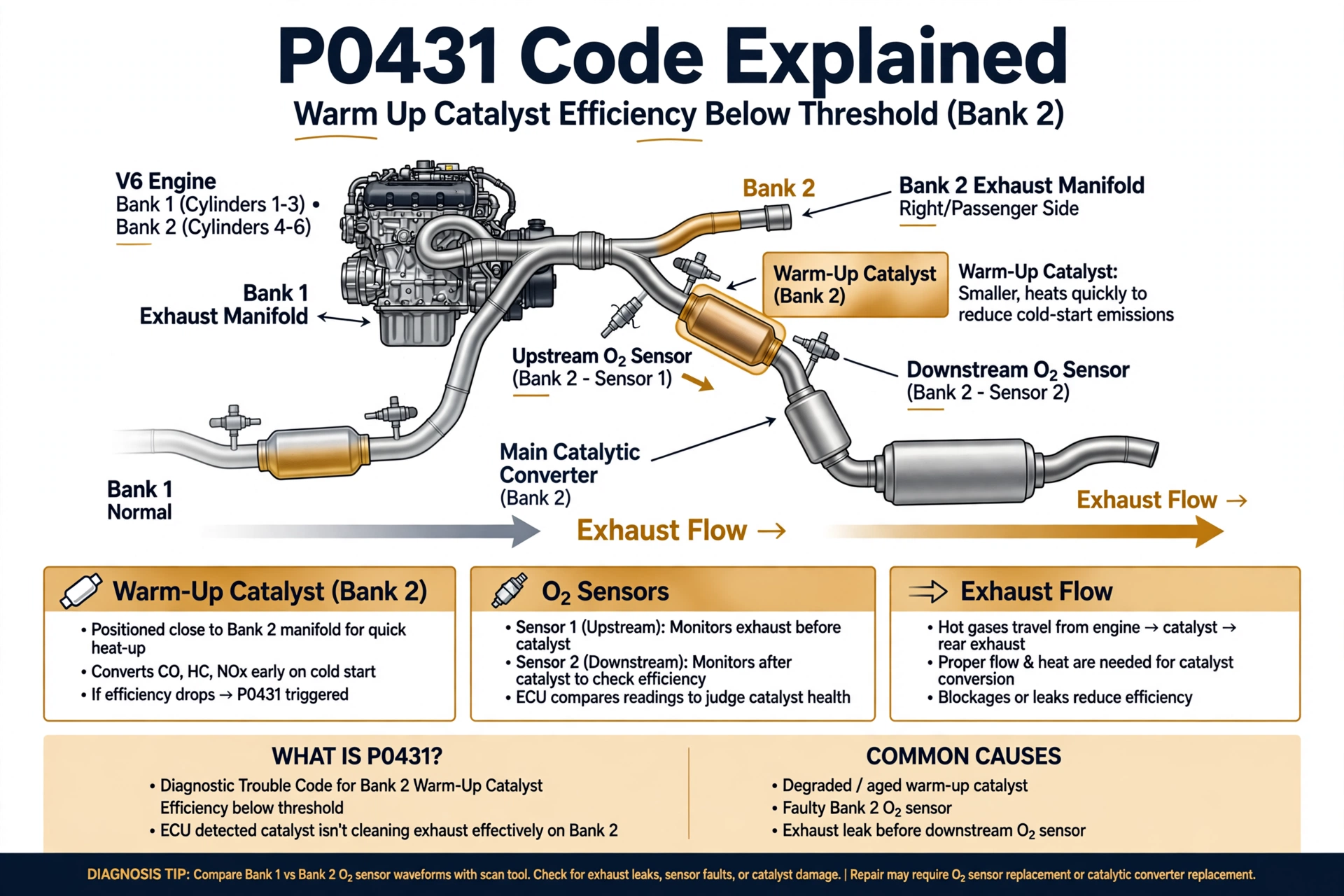
The P0431 code is a check engine light code drivers often search for after a cold-start emissions fault. Its full definition is “Warm Up Catalyst Efficiency Below Threshold (Bank 2)” (p0431 warm up catalyst efficiency below threshold bank 2). In plain English, your car’s engine computer (ECM/PCM) has decided that the small warm-up catalytic converter on bank 2, the side of the engine opposite cylinder number one, is no longer scrubbing exhaust gases well enough in the first minutes after a cold start.
Here is how your car figures this out. Most V6 and V8 engines have a small pre-cat, the warm-up catalyst, bolted close to each exhaust manifold so it heats up fast and starts working within seconds of startup. An oxygen sensor sits before it and another after it. The upstream sensor’s voltage jumps up and down constantly as the engine runs. The downstream sensor, on the other hand, should stay fairly steady once the warm-up cat is lit off, because a healthy converter smooths out those swings. When the computer sees the two bank 2 sensors reading too similarly during the warm-up window, it knows the converter has lost efficiency and stores the P0431 code.
P0431 (p0431 obd ii, p0431 code bank 2) is a generic powertrain code, which means it has the same meaning on every make and model, from a Honda Odyssey to a Ford F-150 to a Nissan Pathfinder. Its close relatives are the P0430 code, the same efficiency fault for bank 2’s main underfloor converter, and the P0421 code, the warm-up catalyst fault for bank 1.
Symptoms of the P0431 Code
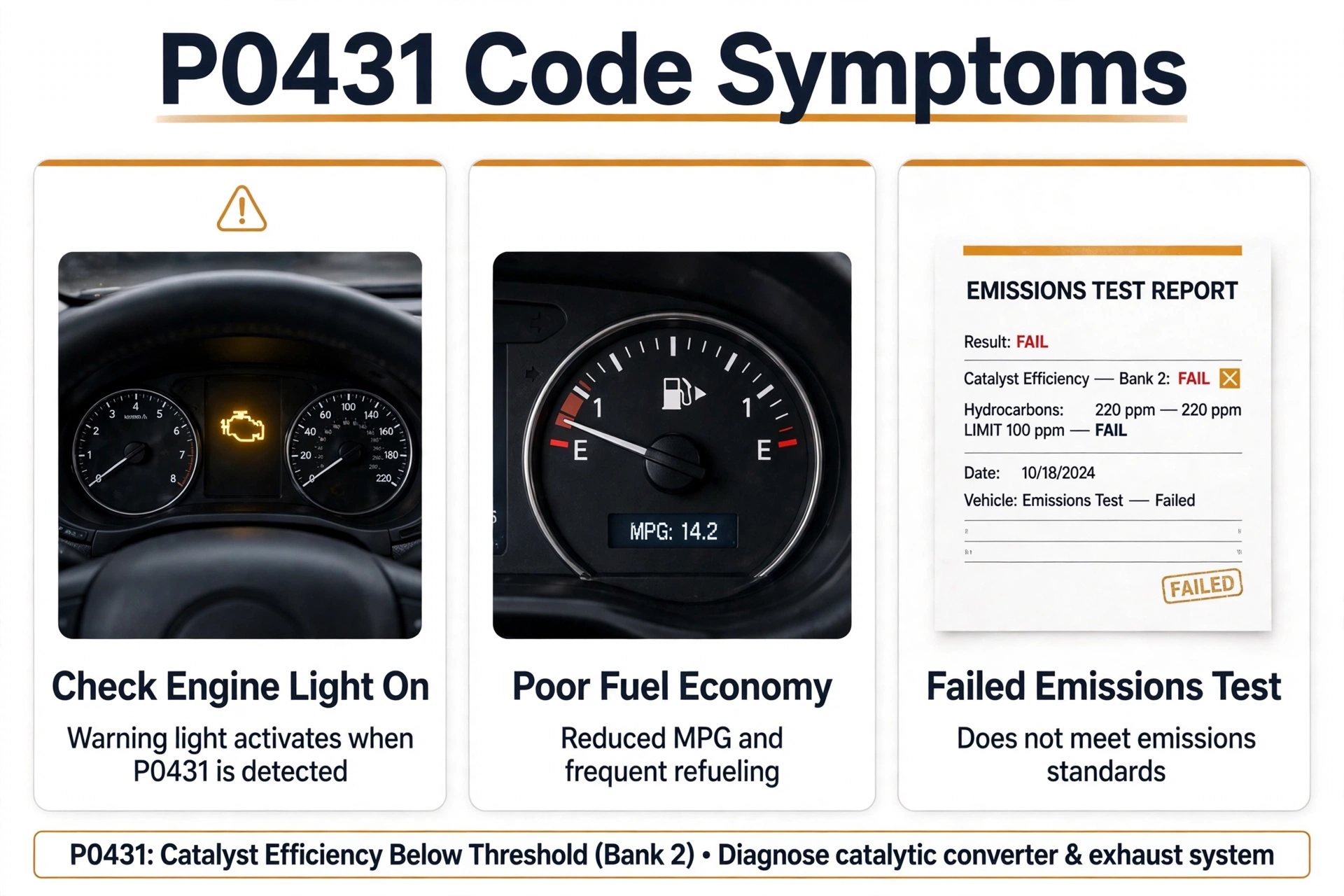
In many cases, the check engine light is the only symptom you will notice, because the main underfloor converter keeps doing most of the cleanup once the engine is warm. The car may drive exactly the same as before. That is one reason the P0431 code surprises so many drivers. However, depending on what is causing it, you might also notice:
- Reduced fuel economy, you are filling up more often than usual
- A rotten egg or sulfur smell from the exhaust, especially right after a cold start
- Rough or hard idling in cold weather
- Slightly reduced engine power under load in severe cases
- Failed emissions test, which matters a lot in strict states like California
What is code P0431? What is car code P0431 trying to tell you? In short: the bank 2 warm-up converter is not pulling its weight during the cold-start phase, so more pollutants slip through until the engine is fully warm. Do not ignore it just because the car still drives.
Common Causes of P0431
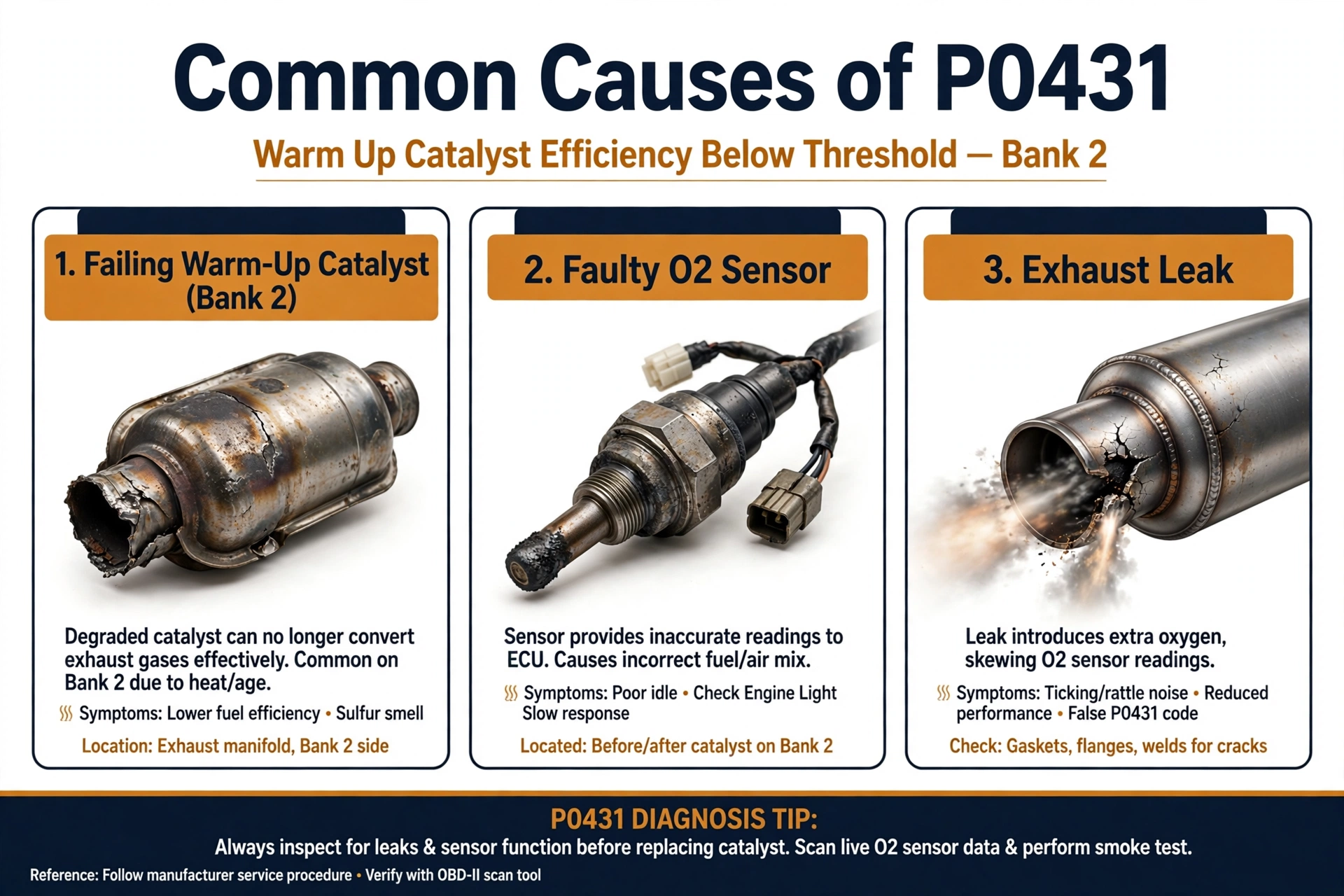
The most common cause of a P0431 code is a failing bank 2 warm-up catalytic converter, usually one whose internal coating is worn out, melted, or contaminated. But a bad converter is far from the only cause, and replacing it without testing is the most expensive mistake drivers make with this code. Here are the causes, roughly in order of likelihood:
- Failing warm-up catalytic converter (bank 2): the small pre-cat’s coating wears out with age and heat cycles, or melts after prolonged misfires. Once its surface is gone, efficiency during warm-up drops below the threshold.
- Exhaust leaks near bank 2: cracks, rust holes, or loose gaskets at the bank 2 exhaust manifold, flange, or flex pipe let outside air in and make the O2 sensors read incorrectly.
- Faulty oxygen sensors: a slow or dead upstream or downstream O2 sensor on bank 2, or damaged O2 sensor wiring and connectors, sends bad data that looks like converter failure.
- Engine misfires: misfiring spark plugs or bad ignition coils dump unburned fuel into the exhaust, which overheats and destroys the warm-up catalyst from the inside. Drivers on forums often trace p0431 back to a misfire that ran too long.
- Rich or lean fuel conditions: leaking fuel injectors, high fuel pressure, vacuum leaks, or a faulty MAF sensor upset the chemistry the converter needs to light off properly.
- Oil or coolant contamination: engine oil or coolant leaking into the exhaust coats the converter’s surface and ruins it over time.
- Engine coolant temperature sensor issues: if the computer gets wrong temperature readings, the fuel mixture goes off during warm-up and the converter suffers.
- Failing PCM (rare): in very rare cases the engine computer itself misreads the sensors. Rule out everything else first.
How to Diagnose P0431 (Do This Before Buying Parts)
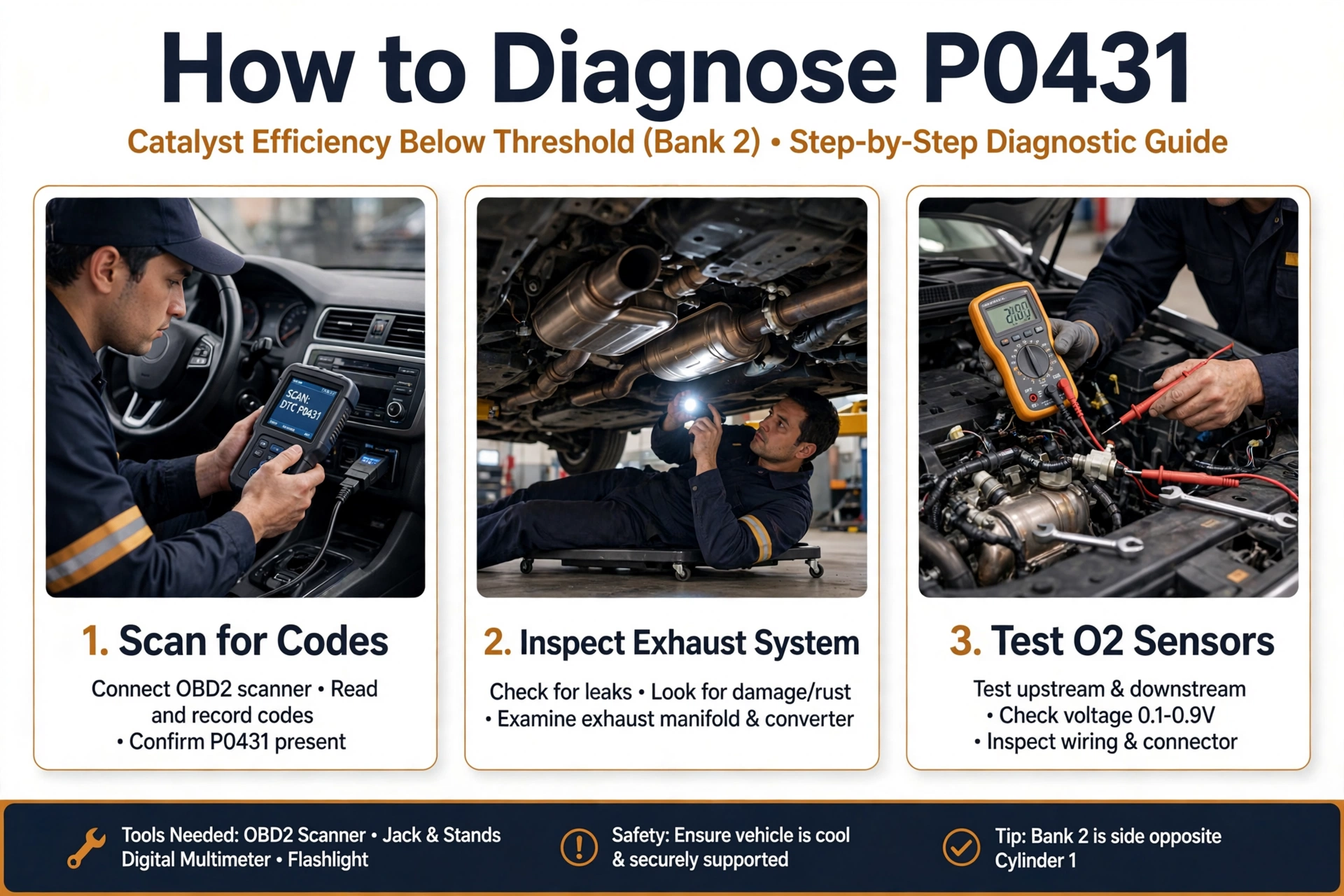
Mechanics see the P0431 code misdiagnosed constantly. The code points at warm-up converter efficiency, but the real fault is often upstream. Follow this order:
- Scan for other codes first. If you also have misfire codes (P0300 series) or fuel trim codes (P0171/P0174), fix those first. They are probably the root cause, and the P0431 may clear on its own.
- Visually inspect the bank 2 exhaust. Look for rust, cracks, holes, and black soot marks around the bank 2 manifold, flange gasket, and flex pipe. Listen for hissing or ticking that signals a leak, especially when the engine is cold.
- Check O2 sensor live data. With any OBD2 scanner that shows live data, graph the bank 2 upstream and downstream O2 sensor voltages during a cold start and at 2,500 RPM. If the downstream mirrors the upstream, the warm-up converter is weak. If the upstream is lazy or flat, suspect the sensor, not the converter.
- Check for converter damage. Tap the warm-up converter (when cold) and listen for rattling inside. Look for discoloration from overheating.
- Rule out engine issues. Check spark plugs, fuel trims, and coolant temperature readings before condemning the converter. If you still get a p0431 code after replacing the catalytic converter, the new unit may be a low-quality universal type, or the real fault (exhaust leak, bad O2 sensor) was never fixed.
How to Fix the P0431 Code
The right fix depends on what your diagnosis found:
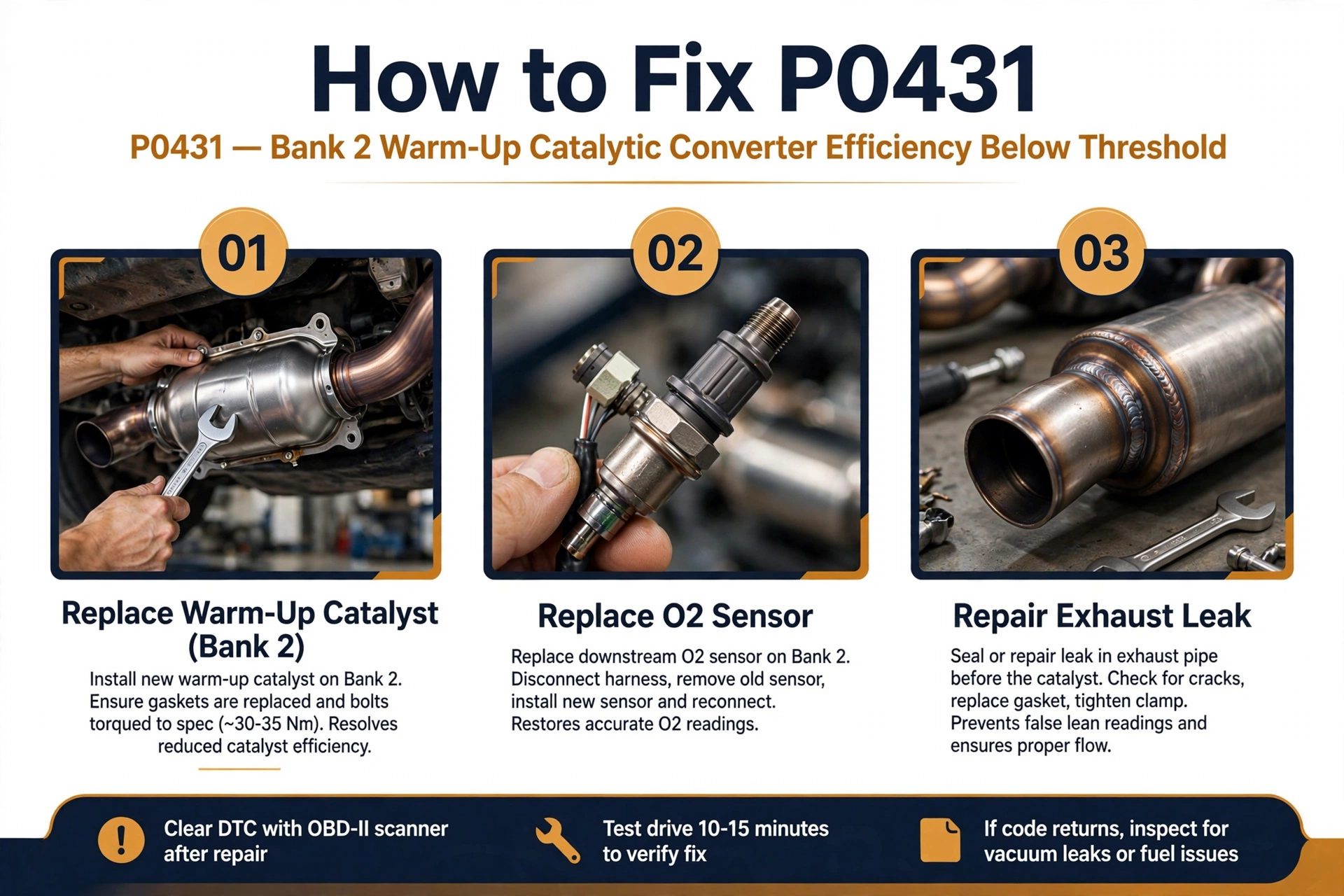
- Repair exhaust leaks on bank 2: weld or replace the leaking manifold, gasket, or pipe section. This is often the cheapest fix and solves many P0431 cases.
- Replace faulty O2 sensors: many technicians replace the bank 2 upstream and downstream sensors together since they age at the same rate.
- Fix misfires and fuel problems: new spark plugs, coils, injectors, or vacuum leak repairs, whatever the companion codes point to.
- Replace the bank 2 warm-up catalytic converter: only after confirming it has actually failed. Many ask how to fix p0431 code without replacing the catalytic converter; the answer is to rule out every other cause first (the p0431 code is often a sensor or leak issue, not a dead converter). Use an OEM or OEM-equivalent converter. Cheap universal converters often trigger the code again.
- Software update: rare, but some manufacturers have released ECU updates that change how warm-up converter efficiency is measured.
P0431 Repair Costs
Drivers always ask how much it costs to fix P0431, and the answer depends entirely on the cause. Here are realistic ranges:
| Repair | Cost Range |
|---|---|
| Exhaust leak repair (bank 2) | $100 – $300 |
| O2 sensor replacement (per sensor) | $150 – $350 |
| Spark plugs / coils (misfire fix) | $150 – $500 |
| Warm-up catalytic converter replacement (bank 2) | $800 – $2,500+ |
This is why diagnosis matters. A $200 O2 sensor job and a $2,000 converter job share the same code. Drivers looking for a p0431 code fix permanent easy cheap solution should always start with the bank 2 exhaust inspection and O2 sensor tests, not the parts catalog.
DIY vs Mechanic Verdict
You can do this at home: visual inspection of the bank 2 exhaust for leaks and damage, reading codes with an OBD2 scanner, graphing O2 sensor live data, replacing spark plugs, and replacing an accessible downstream O2 sensor. If you find an obvious exhaust leak or a dead O2 sensor, those are reasonable DIY repairs for anyone comfortable with basic tools.
See a mechanic for: warm-up catalytic converter replacement (requires cutting/welding near the manifold and emissions compliance), diagnosing intermittent misfires, fuel injector testing, and any repair where the diagnosis is unclear after the basic checks. A shop with a lift and a professional scan tool can confirm warm-up converter failure in under an hour, which is cheaper than guessing with a $1,500 part.
Bottom line: diagnose it yourself, fix the simple stuff yourself, but let a pro handle the warm-up converter swap.
Can You Drive With a P0431 Code?
Generally yes, for a short time. The car will usually run normally once warmed up, because the main converter handles most of the cleanup. But driving long term with P0431 is not advisable: fuel economy drops, emissions rise, you will fail any emissions or smog test, and the underlying problem (like a misfire) can destroy a still-good converter, turning a small repair into a big one. Get it diagnosed soon, even if the car feels fine.
P0431 on Popular Vehicles
P0431 only appears on engines with two cylinder banks, mostly V6s and V8s. Some patterns are worth knowing:
- Nissan (Altima V6, Maxima, Pathfinder, Frontier): The p0431 nissan code (nissan p0431, p0431 code nissan) is common on higher-mileage VQ V6 engines; check the bank 2 manifold for cracks, a known weak spot that mimics converter failure.
- Honda (Accord V6, Odyssey, Pilot): The p0431 honda code (honda p0431, p0431 code honda) often traces to the bank 2 warm-up converter itself after high mileage, but check for exhaust leaks at the front manifold first.
- Toyota (Camry V6, Sienna, Highlander): The p0431 toyota code (toyota p0431, p0431 code toyota) often traces to a tired bank 2 warm-up converter, but the brand’s sensitive O2 sensor logic means a marginal downstream sensor can set it too.
- Ford (F-150, Explorer, Expedition): The p0431 ford code (ford code p0431) can follow misfire episodes, so pull the full code list. A single misfire code plus P0431 usually means fix the misfire first.
- Chevy/GMC (Silverado, Tahoe, Sierra): The p0431 chevy code (p0431 code chevy, code p0431 chevy) often involves both the warm-up converter and aging O2 sensors together. The P0431 code on a Chevy truck deserves a bank 2 exhaust leak check before anything else.
- Subaru (Outback 3.6R, Legacy 3.6R, Tribeca): The p0431 subaru code shows up on the H6 models; exhaust leaks at the bank 2 manifold and aging warm-up converters are the usual suspects.
EOBD P0431 and OBD P0431 are the same code under different naming (European vs generic OBD-II). DTC P0431 and OBD-II P0431 also refer to the identical fault.
P0431 vs P0430
P0431 is the bank 2 warm-up (pre) catalytic converter, the small unit near the manifold that works hardest in the first minute after a cold start. P0430 is the mirror efficiency fault for bank 2’s main underfloor converter: “Catalyst System Efficiency Below Threshold (Bank 2).” Both codes use the same O2-sensor comparison logic, and both can be triggered by exhaust leaks or bad sensors, but P0431 specifically points at the warm-up unit while P0430 points at the main converter. Diagnose them the same way, but make sure you replace the correct converter.
Related Codes
- P0430: Catalyst System Efficiency Below Threshold (Bank 2)
- P0421: Warm Up Catalyst Efficiency Below Threshold (Bank 1)
- P0420: Catalyst System Efficiency Below Threshold (Bank 1)
- P0300: Random/Multiple Cylinder Misfire Detected (a common companion)
Video Walkthrough
Watch the video above for a visual walkthrough of P0431 causes and diagnosis before you read on.
Frequently Asked Questions
What is the most common cause of a P0431 code?
A worn or damaged bank 2 warm-up catalytic converter is the single most common cause. But exhaust leaks, bad O2 sensors, and engine misfires are close behind, which is why testing before replacing parts saves so much money.
Can I still drive my car with a P0431 code?
Yes, short term. The car usually drives normally once warm. Long term, you risk worse fuel economy, failed emissions tests, and turning a small problem into a warm-up converter replacement.
How do you fix the code P0431?
Diagnose first: check for companion codes, inspect the bank 2 exhaust for leaks, test O2 sensor live data. Then repair what you find: seal leaks, replace bad sensors, fix misfires, or replace the bank 2 warm-up converter if it has truly failed.
How much does it cost to fix P0431?
From about $100-$300 for a bank 2 exhaust leak repair, $150-$350 per O2 sensor, up to $800-$2,500+ for a bank 2 warm-up catalytic converter replacement depending on the vehicle.
Will P0431 clear itself?
Rarely. If the underlying fault was temporary (like a one-time misfire), it might. Usually the code returns until the real problem is fixed.
Can a bad O2 sensor cause P0431?
Yes. A lazy or dead bank 2 O2 sensor makes the computer think the warm-up converter is not working, even when it is fine. Always test sensors before replacing the converter.
How to pass emissions with P0431 code?
You cannot pass with an active P0431 in most states. Fix the underlying cause, clear the code, complete a drive cycle so the monitors run, then test.
Conclusion
The P0431 code looks scary, but it is really your car asking for a proper diagnosis, not an automatic converter replacement. Check for other codes, inspect the bank 2 exhaust, test the O2 sensors, and fix what you find. Do that, and you will either solve it cheaply or know for certain the warm-up converter is done. Either way, you stop guessing and start fixing.
About the author: Written by the OBD2 Code Hub editorial team. Our diagnostic guides are built from real OBD-II data, manufacturer service procedures, and hands-on troubleshooting experience, then reviewed for technical accuracy before publishing. We drive the same cars you do.