
P0505 Trouble Code: Meaning, Causes, Symptoms & Fixes
In This Guide
One-line meaning: P0505: Idle Air Control System Malfunction.
What the P0505 Code Means
The P0505 code is one of the most searched idle complaints in the OBD-II world. Its full definition is “Idle Air Control System Malfunction” (p0505 idle air control system malfunction). In plain English, your car’s engine computer (ECM/PCM) has decided it can no longer hold the engine at a steady idle speed.
Here is how idle control works. When you take your foot off the gas, the throttle plate closes, which cuts off almost all the air going into the engine. The engine still needs a small, precisely measured amount of air to keep running at idle. On older cars, a separate idle air control (IAC) valve opens a bypass passage around the closed throttle plate and meters that air. On newer cars with drive-by-wire, the computer opens the electronic throttle plate itself a tiny amount. The computer watches the actual idle RPM, compares it to the target idle (usually around 650 to 750 RPM on a warm engine), and constantly adjusts the airflow to hold it steady.
The p0505 code sets when the computer detects that the actual idle speed will not respond to its commands, or that the idle air control system has an electrical or performance fault. P0505 (p0505 obd ii, p0505 code) is a generic powertrain code, which means it has the same meaning on every make and model, from a Honda Civic to a Ford F-150 to a Toyota Camry. Its close relatives are P0506 (idle RPM lower than expected) and P0507 (idle RPM higher than expected), which narrow the fault down to a specific direction.

Symptoms of the P0505 Code
The p0505 code rarely hides. The check engine light comes on, and the idle misbehaves in ways you can feel from the driver’s seat:
- Rough, fluctuating, or surging idle, with the RPM needle bouncing up and down
- Engine stalling when you come to a stop or sit at a traffic light
- Idle speed stuck too high, even after the engine is fully warm
- Idle speed too low, with the engine shaking or feeling like it is about to quit
- Hard starting, or the engine dying when electrical loads such as the A/C or headlights kick on
What is code P0505? What is car code P0505 trying to tell you? In short: the computer has lost control of the idle. Do not ignore it just because the car still moves. A stall in traffic is a safety issue, not just an annoyance.

Common Causes of P0505
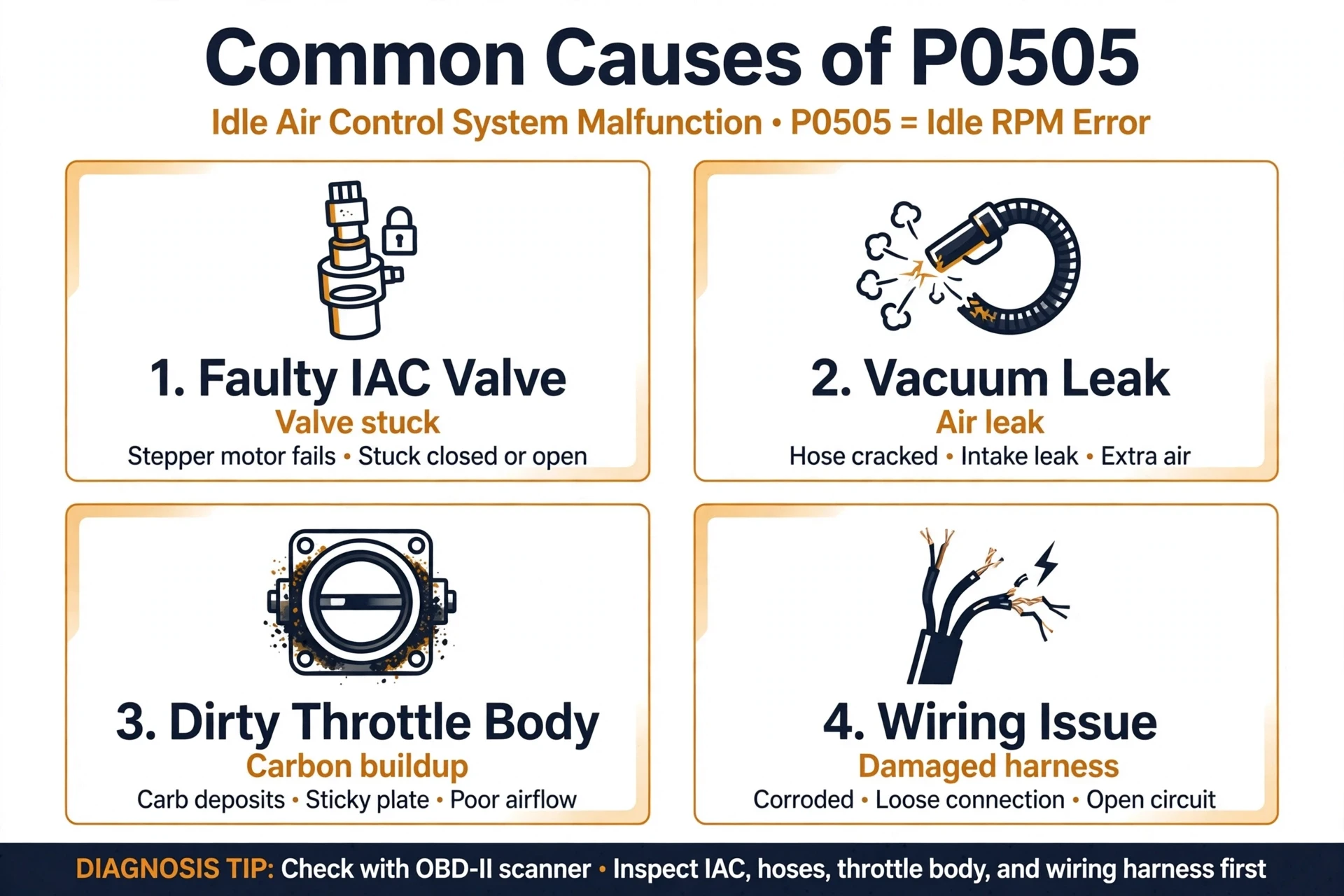
The most common cause of a P0505 code is a carbon-fouled or electrically failed idle air control valve. But the valve is far from the only suspect, and replacing it without testing is the most common way drivers waste money on this code. Here are the causes, roughly in order of likelihood:
- Faulty idle air control (IAC) valve: carbon buildup jams the valve’s pintle open or closed, or its internal motor or solenoid fails electrically. On older cars with a separate IAC valve, this is the number one cause.
- Vacuum leaks: cracked intake hoses, a torn intake boot, leaking manifold gaskets, or split PCV lines let unmetered air into the engine after the airflow sensor. The computer cannot meter air it cannot see.
- Carbon-clogged throttle body: gunk around the throttle plate and bore chokes off the small amount of air the engine needs at idle, so the idle control system cannot do its job.
- Wiring or connector problems: corroded pins, loose plugs, or chafed wires in the idle control circuit break the signal between the computer and the valve or throttle actuator.
- Idle speed out of calibration: after a battery disconnect, a throttle body cleaning, or a part replacement, many cars need an idle relearn procedure before the idle stabilizes. Skip it and P0505 can set.
- Faulty PCM: rare, but the engine computer itself can fail to command the idle system correctly or misread its feedback.
How to Diagnose P0505 (Do This Before Buying Parts)
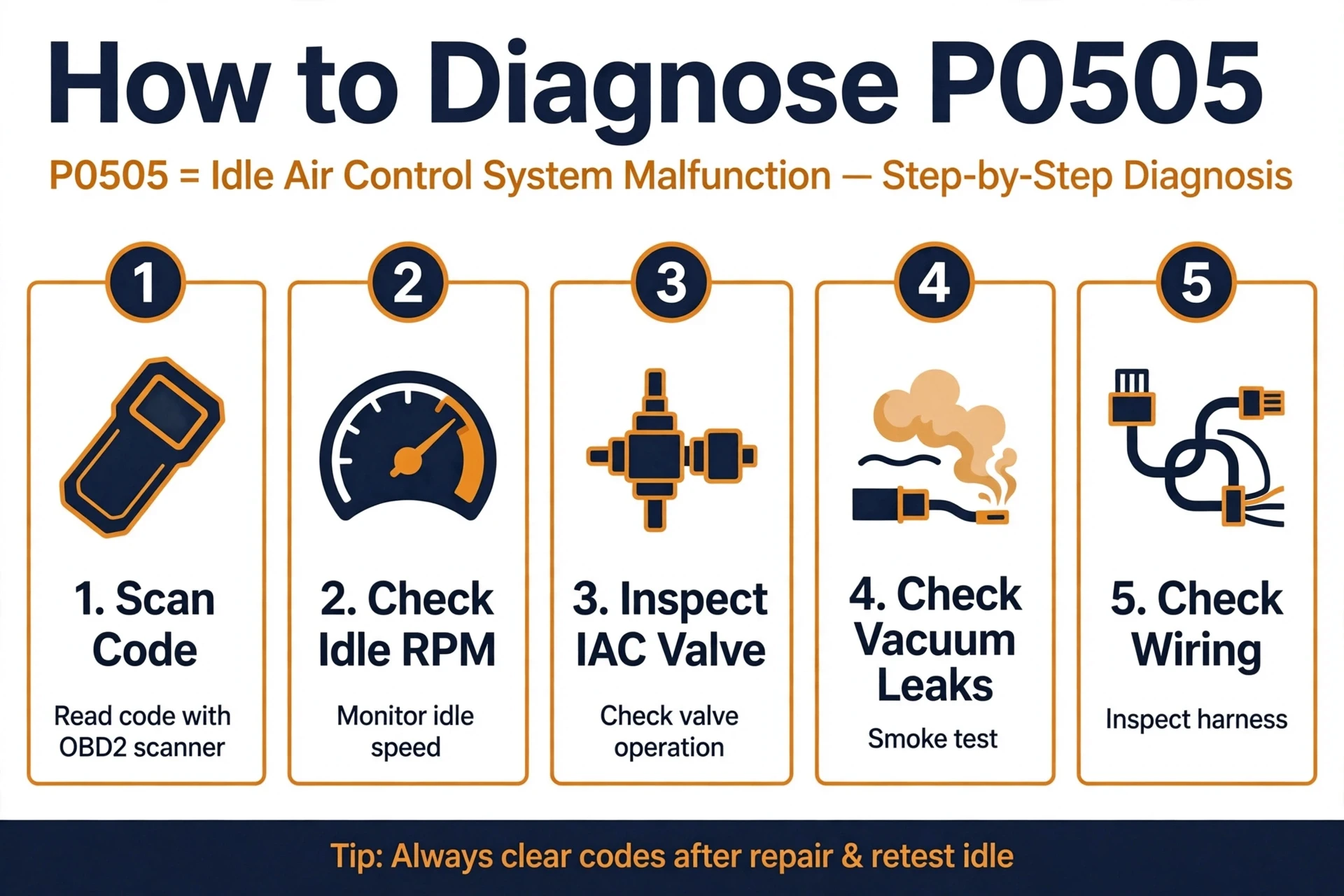
Mechanics see the P0505 code misdiagnosed constantly. The code says the idle control system failed, but the real fault is often a leak or carbon, not a dead part. Follow this order:
- Scan for other codes first. If you also have lean codes (P0171/P0174), a MAF code (P0101), or throttle actuator codes, fix those first. They are probably the root cause, and the P0505 may clear once they are resolved.
- Do a visual inspection. With the engine off, check every vacuum hose, the intake boot, and the PCV lines for cracks, splits, or loose connections. Wiggle the IAC valve or throttle body connector and look for corrosion or bent pins.
- Clean the throttle body and IAC valve. Carbon is the most common fixable cause of p0505. Remove the IAC valve (usually two bolts near the throttle body), spray the pintle and passages with throttle body cleaner, and scrub the throttle plate and bore. Reinstall and see if the idle settles down.
- Hunt for vacuum leaks with the engine running. Listen for hissing around hoses and the intake manifold. A smoke machine is the professional way to find small leaks. The DIY alternative is to spray short bursts of carb cleaner around suspect spots and watch for an RPM change.
- Test the IAC valve electrically. Many IAC valves can be checked with a multimeter for coil resistance across their terminals, compared against the spec in a repair manual. If the coil reads open or shorted, the valve is done.
- Compare desired vs actual idle RPM. With a scan tool that shows live data, look at “Desired Idle RPM” and “Actual Idle RPM.” If they are far apart while the IAC duty cycle is maxed out, the computer is trying hard but something mechanical (carbon, a leak) is beating it.
- Run the idle relearn. If you cleaned or replaced parts, or disconnected the battery, perform the manufacturer’s idle relearn procedure (usually a specific sequence of idling with electrical loads on and off). On many Hondas, Nissans, and Toyotas, skipping this step is exactly what sets the p0505 code in the first place.
How to Fix the P0505 Code
The right fix depends on what your diagnosis found:
- Clean the throttle body and IAC valve: the first thing to try for p0505, and it resolves a large share of cases for the price of a can of cleaner.
- Repair vacuum leaks: replace cracked hoses, a torn intake boot, or leaking gaskets. Even a small leak can keep the idle out of range.
- Replace a failed IAC valve: if cleaning does not help and the valve fails the resistance test or does not respond to scan tool commands.
- Repair wiring and connectors: clean corroded pins, repair broken wires, and reseat loose plugs in the idle control circuit.
- Replace the electronic throttle body: on drive-by-wire cars with no separate IAC valve, a worn throttle actuator means replacing the whole throttle body assembly.
- Perform the idle relearn procedure: required after most of the above on many makes, or the code can return immediately.
- Reprogram or replace the PCM: the last resort, only when every sensor, wire, and mechanical part tests good.

P0505 Repair Costs
Drivers always ask how much it costs to fix P0505, and the answer depends entirely on the cause. Here are realistic ranges:
| Repair | Cost Range |
|---|---|
| Throttle body and IAC valve cleaning (DIY) | $10 – $25 |
| Idle air control (IAC) valve replacement | $150 – $400 |
| Vacuum leak diagnosis and repair | $100 – $350 |
| Electronic throttle body replacement | $300 – $800 |
| PCM reprogramming or replacement | $150 – $1,000+ |
This is why diagnosis matters. A $15 can of cleaner and a $400 valve replacement share the same code. Drivers looking for a p0505 code fix on the cheap should always start with cleaning and a vacuum leak check, not the parts catalog.
DIY vs Mechanic Verdict
You can do this at home: cleaning the throttle body and IAC valve, visual inspection of vacuum hoses, replacing an accessible IAC valve, and running the idle relearn procedure. If you find cracked hoses or heavy carbon, those are reasonable DIY repairs for anyone comfortable with basic tools.
See a mechanic for: smoke-test vacuum leak diagnosis, electronic throttle body replacement, wiring faults buried in the harness, and PCM reprogramming or replacement. A shop can also command the IAC valve with a professional scan tool to confirm it responds.
Bottom line: clean it and inspect it yourself first, because that fixes most P0505 cases. Hand it to a pro if the code survives the basics.
Can You Drive With a P0505 Code?
Short distances, maybe, but be careful. The faulty idle system will most likely show up as stalling, with the engine shutting down when you lift off the gas or come to a stop. That is hazardous in traffic, and the car may end up stalled somewhere you do not want to be. Get it diagnosed promptly rather than driving on it for weeks.
P0505 on Popular Vehicles
P0505 shows up across all brands, but some patterns are worth knowing:
- Honda (Civic, Accord, CR-V): The p0505 honda code (honda p0505, p0505 code honda) is often a carbon-clogged IAC valve on older models. Honda idle relearns after a battery disconnect are also a classic trigger.
- Toyota (Camry, Corolla, RAV4): The p0505 toyota code (toyota p0505, p0505 code toyota) often traces to throttle body carbon on electronic-throttle models. Cleaning plus the relearn usually sorts it.
- Nissan (Altima, Sentra, Rogue): For p0505 nissan (nissan p0505, p0505 code nissan), the code frequently appears right after a battery disconnect or throttle body cleaning when the idle relearn was skipped.
- Ford (F-150, Escape, Explorer): The p0505 ford code (ford code p0505, p0505 code ford) on older models is frequently a failed IAC valve, a known wear item on Ford trucks and SUVs.
- Dodge/Ram (Ram 1500, Dakota, Durango): The p0505 dodge code often comes from IAC valve failure or intake leaks on the older V8 trucks. Owner videos document P0505 diagnosis on the 5.2L and 5.9L engines.
- Chevy (Silverado, Malibu, Equinox): The p0505 chevy code (p0505 code chevy) often traces to throttle body carbon or intake boot leaks.
EOBD P0505 and OBD P0505 are the same code under different naming (European vs generic OBD-II). DTC P0505 and OBD-II P0505 also refer to the identical fault.
P0505 vs P0506 & P0507
P0505 is the general fault: “Idle Air Control System Malfunction.” It means the idle control system has failed or the computer cannot bring the idle under control. P0506 (“Idle Air Control System RPM Lower Than Expected”) and P0507 (“Idle Air Control System RPM Higher Than Expected”) are its more specific siblings: they tell you which direction the idle went wrong. Think of P0505 as the umbrella code. All three share the same suspects (IAC valve, vacuum leaks, carbon, wiring, relearn) and the same diagnostic path, and you will sometimes see P0505 stored together with P0506 or P0507.
Related Codes
- P0506: Idle Air Control System RPM Lower Than Expected
- P0507: Idle Air Control System RPM Higher Than Expected
- P0171: System Too Lean (vacuum leaks that cause P0505 often set this too)
- P0101: Mass Airflow Sensor Range/Performance (unmetered air problems)
Video Walkthrough
Watch the video above for a visual walkthrough of P0505 diagnosis and repair on a real vehicle before you read on.
Frequently Asked Questions
What does the P0505 code mean?
It means the engine computer has detected a malfunction in the idle air control system and cannot hold the engine at the correct idle speed. The idle may surge, drop too low, or the engine may stall.
What is the most common cause of a P0505 code?
A carbon-fouled or electrically failed idle air control (IAC) valve is the most common cause, followed closely by vacuum leaks and a dirty throttle body. That is why cleaning is always the first step.
Can I drive with a P0505 code?
Short distances only, and with caution. The engine can stall when you come to a stop, which is dangerous in traffic. Get it diagnosed and fixed promptly.
How do you fix a P0505 code?
Clean the throttle body and IAC valve, check for vacuum leaks, inspect the wiring and connectors, and run the idle relearn procedure. Replace the IAC valve or throttle body only if testing shows they have failed.
How much does it cost to fix P0505?
Cleaning costs $10-$25 in cleaner if you do it yourself. Professional repair runs $150-$400 for an IAC valve replacement, $100-$350 for vacuum leak repair, and up to $800 or more for an electronic throttle body.
Will P0505 clear itself?
Sometimes, if the fault was temporary (for example, right after a battery disconnect, once the idle relearns). But if carbon buildup, a vacuum leak, or a dead valve is the cause, the code will keep coming back until you fix it.
How do I reset my idle air control valve?
There is no reset button. Cleaning the IAC valve and throttle body, then running the manufacturer’s idle relearn procedure (usually idling the engine through a specific sequence with electrical loads on and off), recalibrates the system.
Conclusion
The P0505 code looks alarming because the idle goes wild, but it is one of the most DIY-friendly codes there is. Carbon buildup and vacuum leaks cause most cases, and both are cheap to address. Clean the throttle body and IAC valve, check the hoses, run the idle relearn, and test before you replace. Do that, and you will either fix it for the price of a can of cleaner or know exactly which part has failed. Either way, you stop guessing and start fixing.
About the author: Written by the OBD2 Code Hub editorial team. Our diagnostic guides are built from real OBD-II data, manufacturer service procedures, and hands-on troubleshooting experience, then reviewed for technical accuracy before publishing. We drive the same cars you do.