
P0700 Trouble Code: Meaning, Causes, Symptoms & Fixes
In This Guide
One-line meaning: P0700: Transmission Control System (MIL Request) Malfunction.
What the P0700 Code Means
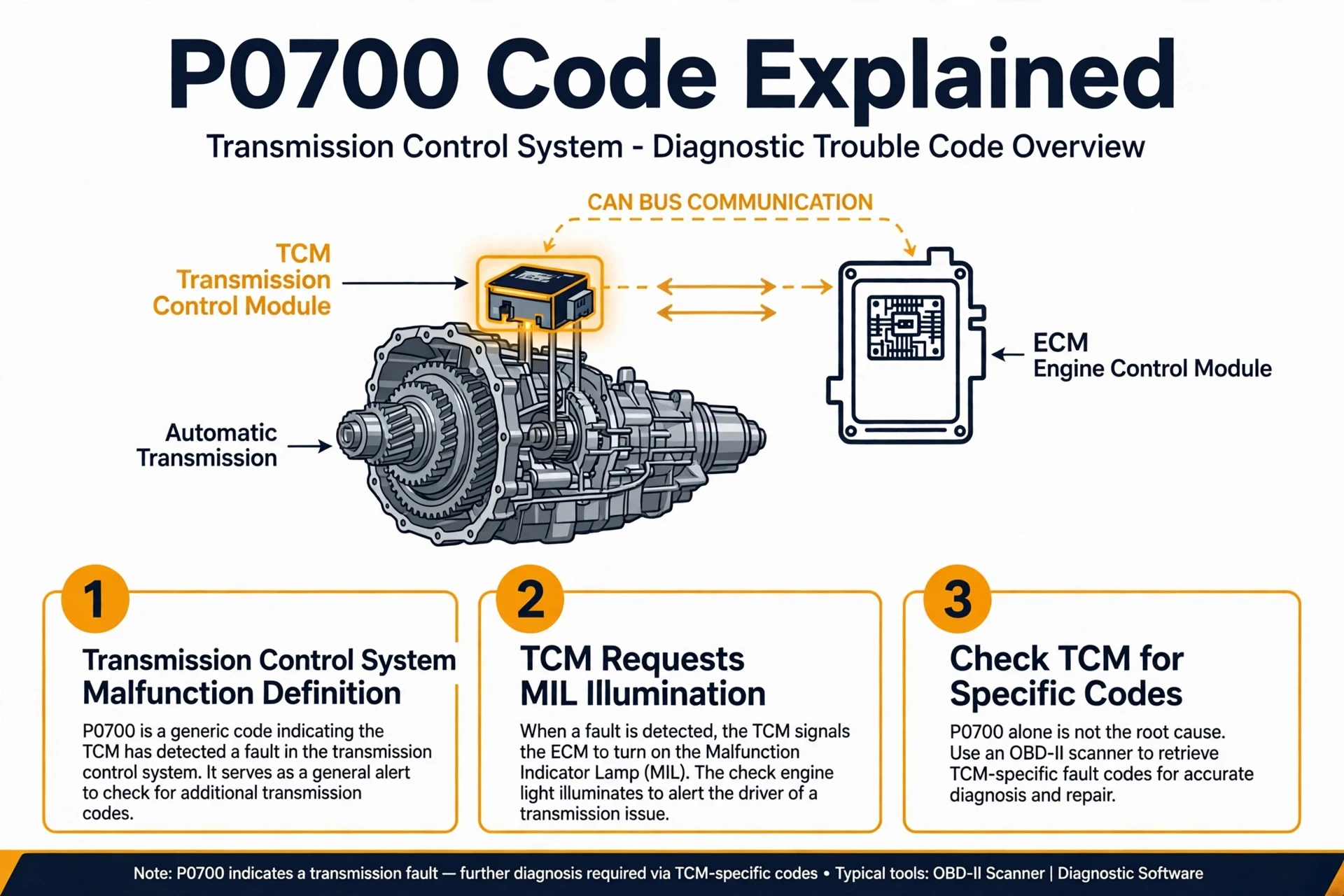
The P0700 code is one of the most searched transmission codes, and also one of the most misunderstood. Its full definition is “Transmission Control System (MIL Request) Malfunction” (p0700 transmission control system). In plain English, your car’s transmission control module (TCM) has detected a fault somewhere in the transmission system, and it has asked the engine computer (ECM/PCM) to turn on the check engine light.
Here is the part that confuses everyone. P0700 is an informational code, sometimes called a “gateway” code. It tells you a transmission fault exists, but it does not name the broken part. Think of it as a flag, not a diagnosis. The real diagnostic trouble code, the sub-code that identifies the actual failure, is stored inside the TCM memory, not in the engine computer. A basic engine-only code reader will only ever show you P0700, which is why so many drivers report “I got P0700 and nothing else.” The something else is there. Their scanner just cannot read the transmission module.
P0700 (p0700 obd ii, dtc p0700) is a generic powertrain code, which means it has the same meaning on every make and model, from a Chevy Silverado to a Dodge Ram to a Toyota Camry. On its own it never tells you what to replace. It tells you where to look: inside the TCM, for the companion code that names the real problem.
Symptoms of the P0700 Code
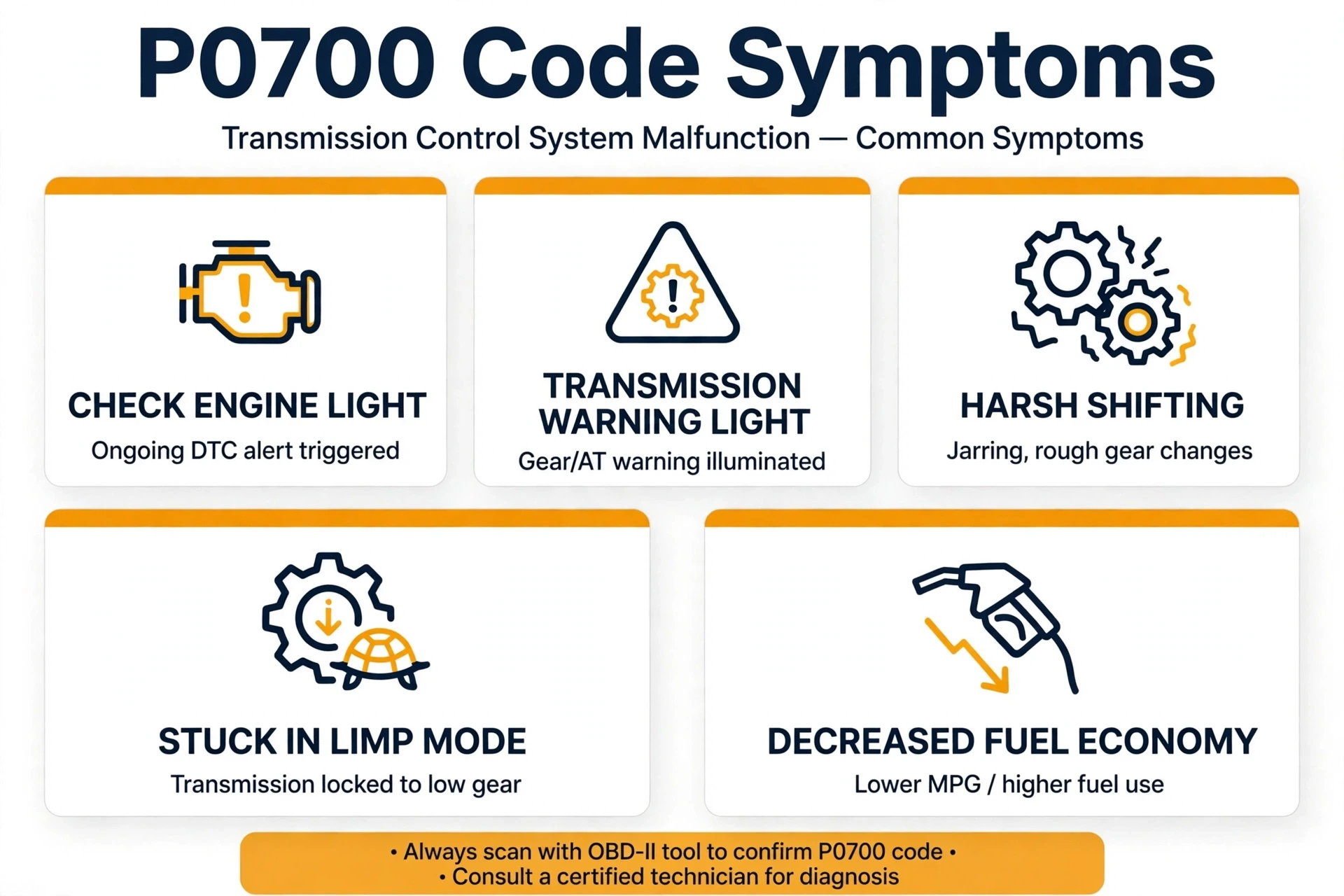
The check engine light is the symptom almost every driver notices first. Sometimes a transmission warning light or a gear/AT warning message joins it on the instrument cluster. Unlike some codes, P0700 often brings drivability symptoms with it, because the underlying transmission fault is real even when the code itself is vague. Watch for:
- Check engine light on, sometimes with a separate transmission warning light
- Harsh, delayed, or erratic shifting
- Limp mode: the transmission locks into a single gear to protect itself, and the car feels gutless
- Slipping: engine RPMs rise but the car does not accelerate to match
- Engine stalling or running poorly
- Poor fuel economy, you are filling up more often than usual
- Transmission overheating warning messages on the dashboard
What is code P0700 trying to tell you? In short: the transmission computer has found a problem it cannot fix on its own, and it wants the engine computer to warn you. Because P0700 almost always travels with a companion code, the symptoms you feel usually come from that hidden fault, not from the P0700 flag itself.
Common Causes of P0700
P0700 itself has no single cause, because it is only the messenger. But the faults hiding behind it follow familiar patterns. Here are the causes, roughly in order of likelihood:
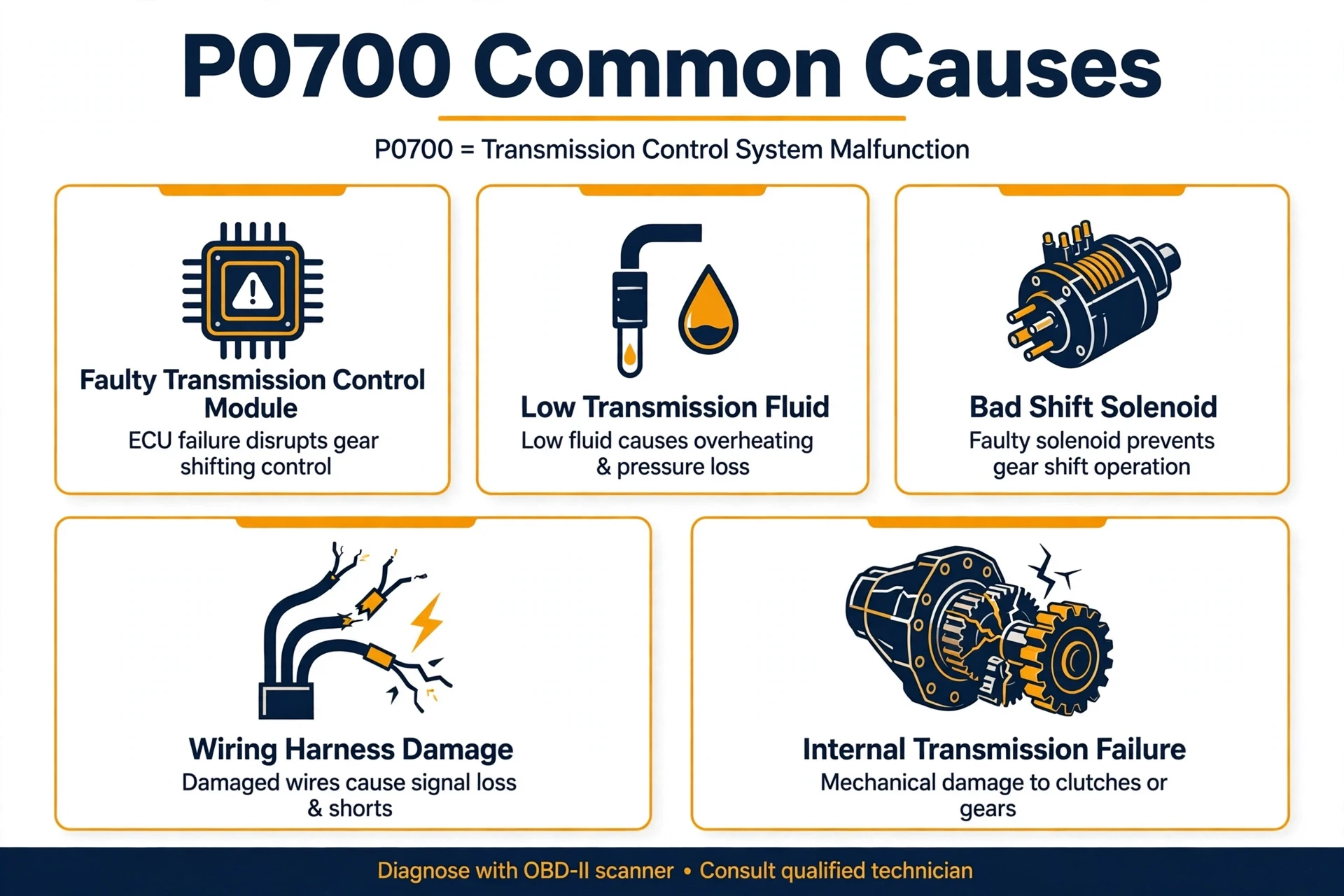
- Low or degraded transmission fluid: burnt, low, or dirty fluid causes pressure loss, overheating, and slipping. This is the first thing to check, and the cheapest to fix.
- Faulty shift solenoids: a stuck or dead solenoid cannot redirect hydraulic pressure, so shifts go harsh, late, or missing. Solenoid codes are among the most common companions to P0700.
- Sensor failures: bad input or output speed sensors, a failing transmission range sensor, or a faulty fluid temperature sensor feeds the TCM bad data, and it flags a fault.
- Wiring or connector issues: corroded pins, water intrusion, or chafed wires in the transmission harness interrupt signals between the TCM and the transmission.
- Faulty transmission control module: the TCM itself can fail internally. This is less common than the items above, but it happens, especially on high-mileage vehicles.
- Internal mechanical wear: worn clutch packs, a failing valve body, or a slipping torque converter clutch. Mechanical wear also sheds metal debris into the fluid, which you can see as glitter on the dipstick.
- Low battery or charging voltage: the check almost nobody runs. When system voltage drops, transmission electronics misbehave and set codes that look like transmission failures but are not.
How to Diagnose P0700 (Do This Before Buying Parts)
Mechanics see the P0700 code misdiagnosed constantly, usually because someone tries to fix the flag instead of the fault. Follow this order:
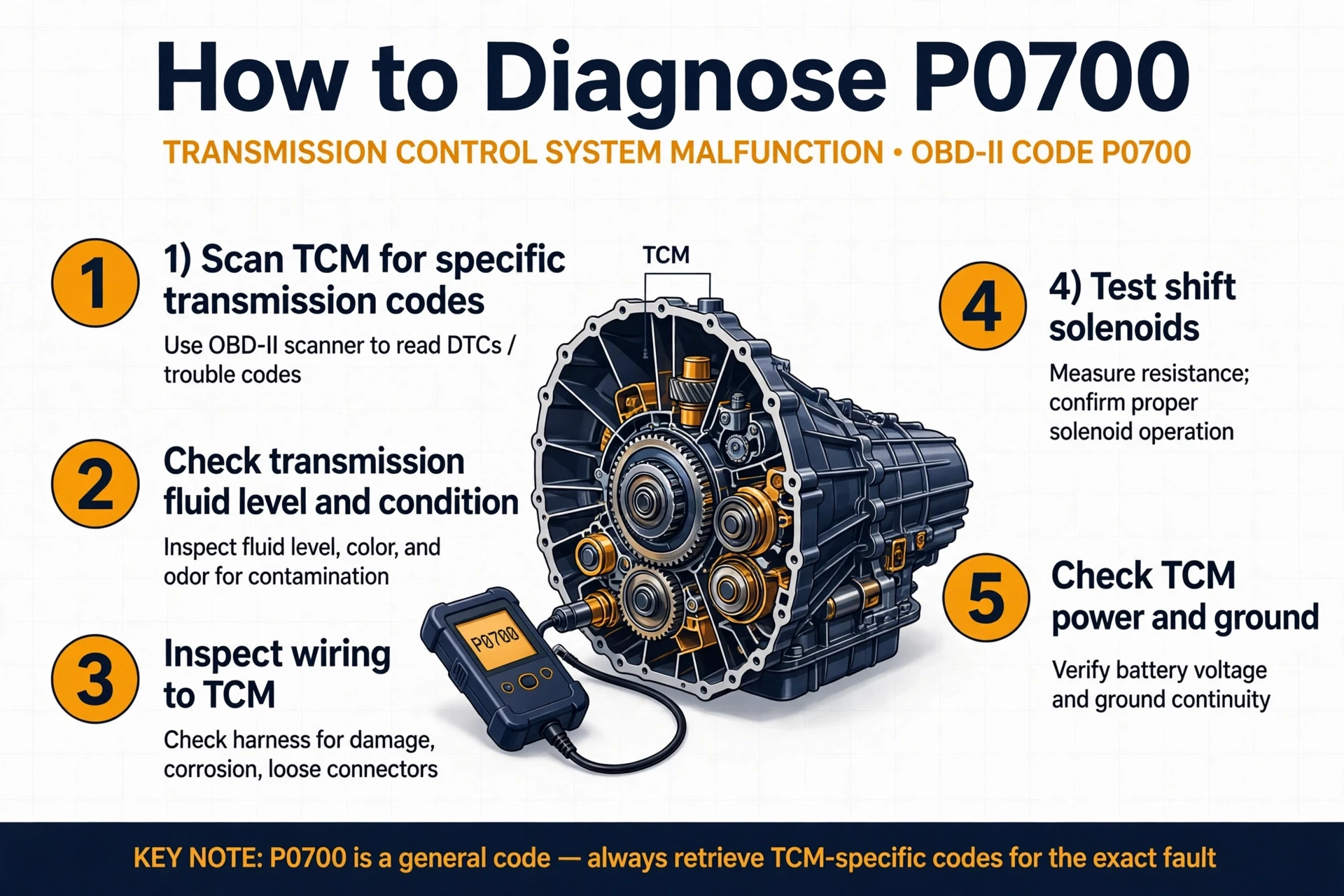
- Scan the TCM, not just the engine. Use a full-system scan tool that communicates with the transmission control module and pull the companion codes. A basic reader only talks to the engine computer, which is exactly why you see “P0700 and nothing else.” Record every code plus the freeze frame data before you clear anything.
- Check the transmission fluid. With the engine running and the vehicle positioned as the manual specifies, check level and condition. Bright red fluid at the right level is what you want. Brown or black fluid with a burnt smell means overheating. Fine metallic glitter means serious internal wear.
- Check battery and charging voltage. This free check takes two minutes. Low voltage causes phantom transmission codes, and no transmission part will fix a code caused by a weak battery or failing alternator.
- Inspect wiring and connectors. Look at the harness running to the transmission and the TCM connectors for corrosion, water damage, chafed insulation, and loose pins.
- Clear the code and road test. P0700 can be set by a one-time faulty reading. Clear it, drive normally, and see if it returns. If it stays away, you may have had a glitch. If it comes back, keep digging.
- Test the specific component. Use the companion code to guide you: command shift solenoids with a bidirectional scan tool and watch the response, compare vehicle speed readings across the engine and transmission modules, and test suspect sensors with a multimeter before replacing anything.
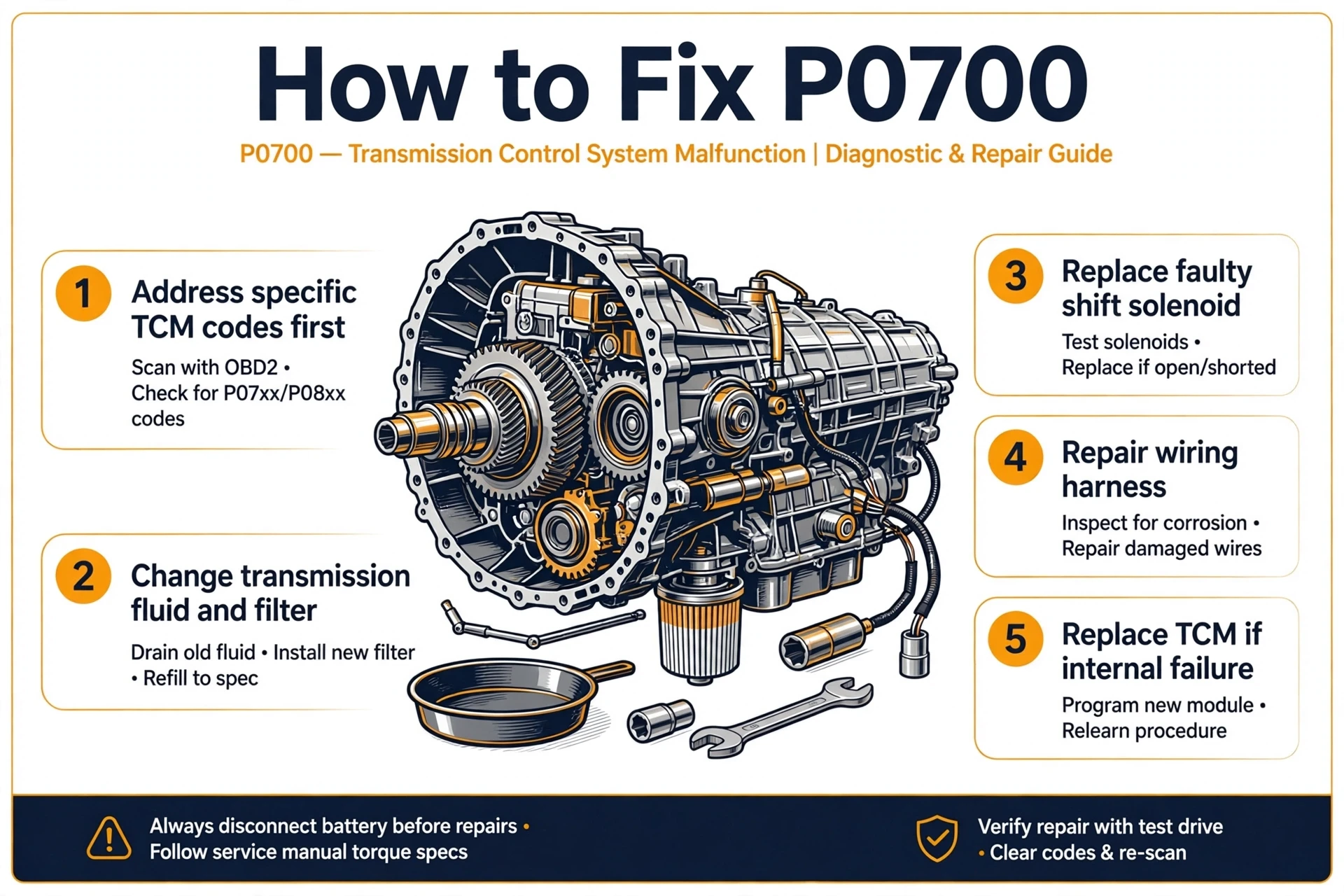
How to Fix the P0700 Code
The right fix depends on what your diagnosis found. There is no single “P0700 repair,” because P0700 is never the actual failure:
- Service the transmission fluid: top up low fluid, or drain and replace burnt or contaminated fluid along with the filter. This fixes a surprising number of P0700 cases.
- Replace the faulty shift solenoid: solenoids and solenoid packs are a common fix once the companion code points at one. Test before replacing.
- Replace failed sensors: input/output speed sensors, transmission range sensors, and fluid temperature sensors are all replaceable once testing confirms the failure.
- Repair wiring and connectors: clean corroded pins, seal out water, and repair chafed or broken wires in the transmission harness.
- Replace the valve body: when solenoids and wiring test fine but hydraulic control is still wrong, the valve body is the next suspect.
- Replace the TCM: only after ruling out fluid, sensors, solenoids, and wiring. A new module usually needs programming and a relearn procedure.
- Rebuild or replace the transmission: the last resort, for confirmed internal mechanical failure. Never accept a rebuild quote for “a P0700” without asking which companion code the shop is actually repairing.
P0700 Repair Costs
Drivers always ask how much it costs to fix P0700, and the honest answer is that the range is huge, because the code itself names no part. Here are realistic ranges:
| Repair | Cost Range |
|---|---|
| Professional diagnosis | $100 – $200 |
| Transmission fluid and filter service | $100 – $350 |
| Speed sensor replacement / wiring repair | $150 – $400 |
| Shift solenoid / solenoid pack replacement | $250 – $700 |
| TCM replacement (with programming) | $500 – $1,200 |
| Valve body replacement | $500 – $1,500 |
| Full transmission rebuild / replacement | $3,000 – $9,000+ |
This is why diagnosis matters. A $150 fluid service and a $5,000 rebuild share the same code. Most P0700 triggers turn out to be accessible electrical issues, a speed sensor, a solenoid pack, a chafed wire, rather than a failed transmission, so always get the companion code before approving big work.
DIY vs Mechanic Verdict
You can do this at home: checking transmission fluid level and condition, reading codes with an OBD2 scanner, inspecting wiring and connectors for visible damage, checking battery voltage, and clearing the code for a road test to see if it returns. If you find low or burnt fluid, a fluid and filter service is a reasonable DIY job on vehicles with a dipstick and a drain plug.
See a mechanic for: TCM-level scanning and bidirectional solenoid testing, internal wiring diagnosis, valve body replacement, TCM replacement and programming, and any internal transmission repair. A shop with a lift and a professional scan tool can pin down the companion code in under an hour, which is far cheaper than guessing with expensive parts.
Bottom line: do the free checks yourself, fluid, voltage, wiring, and a TCM scan if you can borrow the right tool, but let a pro handle anything inside the transmission.
Can You Drive With a P0700 Code?
Usually yes, for a short time, but take it seriously. If the transmission has dropped into limp mode, the car will feel sluggish and may not hold highway speeds, which is dangerous in fast traffic. Even when the car seems to drive fine, the underlying fault is still active: slipping clutches, overheating fluid, or erratic shifting can turn a small repair into a full rebuild if you keep driving. Get it diagnosed promptly, and avoid towing or hard acceleration until you know what the companion code says.
P0700 on Popular Vehicles
P0700 shows up across all brands, but some patterns are worth knowing:
- Chevy (Silverado, Malibu, Equinox): The p0700 chevy code (chevy p0700, p0700 code chevy) is extremely common. On trucks with the 6L80E transmission, check the TECHM (transmission electro-hydraulic control module) and its wiring, and always pull the companion codes before assuming the worst.
- Dodge / Ram: The p0700 dodge code often appears with limp mode complaints. On Ram trucks, TCM communication faults and solenoid pack issues are frequent companions.
- Ford (F-150, Escape, Explorer): The p0700 ford code (ford p0700) commonly traces to shift solenoid faults or speed sensor failures. Check for technical service bulletins, since some models have updated TCM calibrations.
- Toyota (Camry, Corolla, RAV4): The p0700 toyota code (toyota p0700) often comes down to a shift solenoid or a speed sensor. Toyota transmissions are generally durable, so wiring and sensor faults outnumber mechanical failures.
- Nissan (Altima, Sentra, Rogue): For p0700 nissan (nissan p0700, p0700 code nissan), CVT models deserve extra attention to fluid condition, since degraded CVT fluid triggers ratio and pressure faults that surface as P0700.
- Jeep / GMC: The p0700 jeep and p0700 gmc codes follow the same playbook: scan the TCM first, because the companion code does the real talking on these trucks and SUVs.
DTC P0700 and OBD-II P0700 refer to the identical fault under different naming. Code p0700 means the same thing on every brand: the TCM is asking for the check engine light, and the real answer is in the TCM memory.
P0700 vs Related Codes
P0700 is the messenger. The related codes below are the message. P0700 says “the transmission control system has a fault,” while codes like P0701, P0702, P0705, and P0715 name the specific system, circuit, or sensor involved. You will often see P0700 stored alongside one of these, the P0700 in the engine computer and the specific code in the TCM. Diagnose and repair the specific code; the P0700 clears with it.
Related Codes
- P0701: Transmission Control System Range/Performance
- P0702: Transmission Control System Electrical
- P0705: Transmission Range Sensor Circuit Malfunction (PRNDL input)
- P0715: Input/Turbine Speed Sensor Circuit Malfunction
- P0750-P0770 series: Shift solenoid circuit faults (common P0700 companions)
Video Walkthrough
Watch the video above for a visual overview of the P0700 transmission code, what it means, and where to start your diagnosis.
Frequently Asked Questions
What does the P0700 code actually mean?
P0700 means the transmission control module (TCM) detected a fault in the transmission system and asked the engine computer to turn on the check engine light. It is an informational or “gateway” code: it confirms a transmission fault exists but does not name the broken part. The specific fault code is stored in the TCM memory.
How do I fix error code P0700?
Scan the TCM with a full-system scan tool to find the companion code, then fix what that code points to. Start with the free checks: transmission fluid level and condition, battery voltage, and visible wiring damage. Common repairs include fluid service, shift solenoid replacement, sensor replacement, wiring repairs, and in rare cases TCM replacement.
Can I still drive with a P0700 code?
Usually for a short time, but get it diagnosed promptly. If the transmission is in limp mode, the car will be sluggish and may not be safe in fast traffic. Driving long term with the underlying fault can turn a small repair, like a solenoid or sensor, into a full transmission rebuild.
Can a bad battery cause a P0700 code?
Yes. Low system voltage makes transmission electronics misbehave and can set codes that look like transmission failures. Always check battery condition and charging voltage before buying transmission parts, because no transmission repair will fix a code caused by low voltage.
How much does it cost to fix a P0700 transmission code?
It depends on the companion code. Expect roughly $100-$200 for diagnosis, $100-$350 for a fluid and filter service, $250-$700 for a shift solenoid or solenoid pack, $500-$1,200 for TCM replacement, and $3,000-$9,000+ for a full rebuild in the worst cases.
Will P0700 clear itself?
Sometimes, if it was set by a one-time faulty reading. Clear the code and road test: if it stays away, it may have been a glitch. If it returns, the underlying fault is still active and needs a proper diagnosis of the TCM companion codes.
I only see P0700 with no other codes. What now?
You almost certainly do have other codes; your scanner just cannot read them. Basic code readers only communicate with the engine computer, while the real fault code lives in the transmission control module. Use a full-system scan tool, or visit an auto parts store that offers free TCM scanning, to pull the companion code.
Conclusion
The P0700 code looks alarming, but it is really your car pointing you toward the transmission computer, not handing you a repair bill. Scan the TCM for the companion code, check the fluid and the battery voltage, inspect the wiring, and fix what you find. Do that, and you will either solve it cheaply or know exactly what the transmission needs. Either way, you stop guessing and start fixing.
About the author: Written by the OBD2 Code Hub editorial team. Our diagnostic guides are built from real OBD-II data, manufacturer service procedures, and hands-on troubleshooting experience, then reviewed for technical accuracy before publishing. We drive the same cars you do.