
P0138 Trouble Code: Meaning, Causes, Symptoms & Fixes
In This Guide
One-line meaning: The downstream O2 sensor on Bank 1 is stuck reporting a high signal voltage (above about 0.9 volts), usually because of a failing sensor, damaged wiring, or an engine running rich.
What the P0138 Code Means
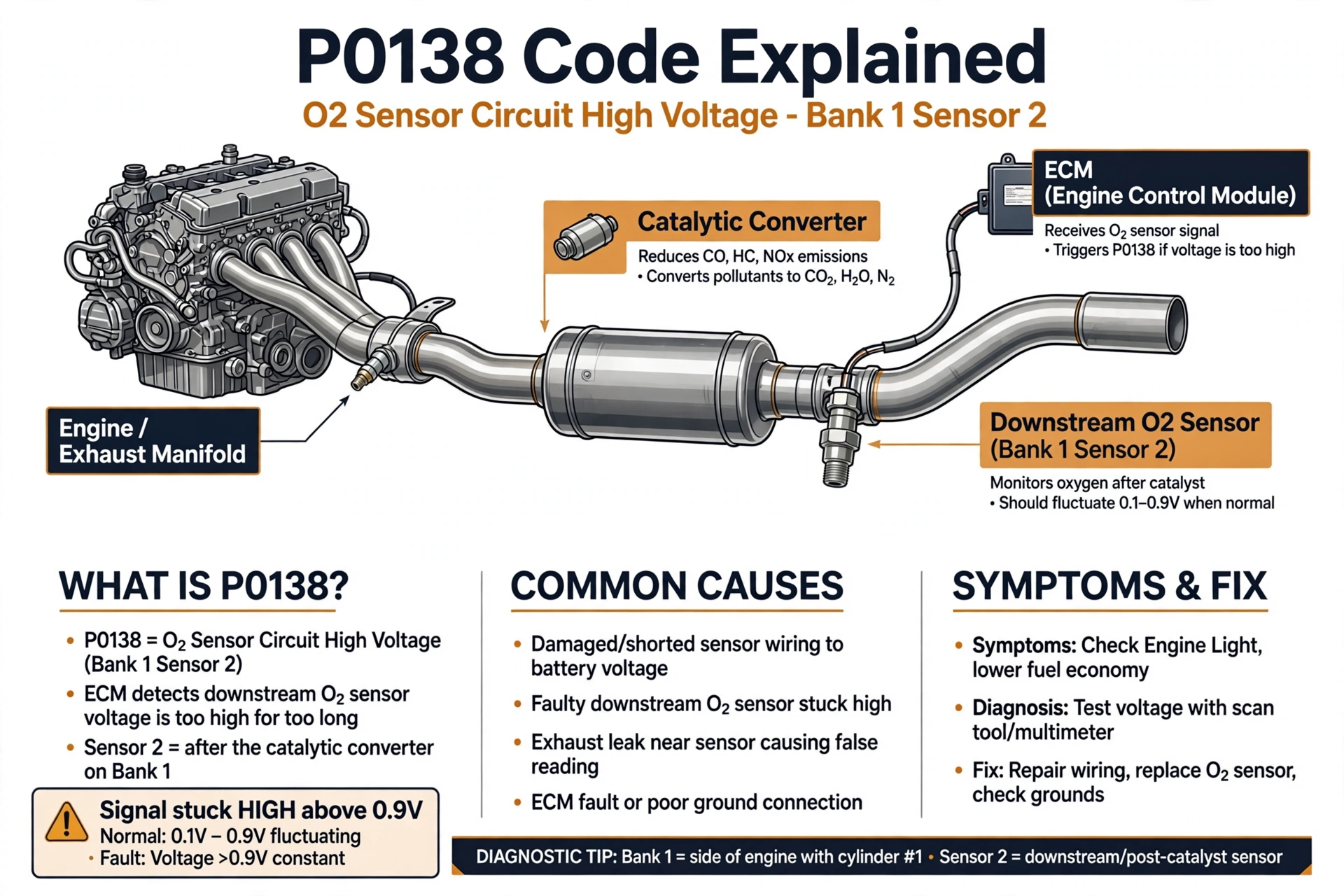
P0138 is a generic OBD-II powertrain code defined as “O2 Sensor Circuit High Voltage (Bank 1, Sensor 2).” So, if you scanned your vehicle and found the engine code p0138, this guide explains exactly what it means and how to fix it.
The code sets when the powertrain control module (PCM) sees the signal from the downstream oxygen sensor stay above roughly 0.9 volts for too long. A healthy O2 sensor constantly switches between about 0.1 and 0.9 volts as exhaust oxygen content changes. When the signal parks above 0.9 volts and refuses to move, the PCM knows something is wrong and stores P0138.
Bank 1 is the side of the engine that holds cylinder number 1, and sensor 2 is the downstream sensor, the one mounted after the catalytic converter. Here is the angle most guides miss: the downstream sensor does not steer the air-fuel mixture. Its job is to watch the catalytic converter and report how well it is cleaning the exhaust. That means P0138 almost never comes from a fuel strategy problem alone. It points to one of three things: a sensor whose sensing element has failed high, a signal wire that is chafed or melted into a voltage source, or an engine that is genuinely running rich and bathing the sensor in low-oxygen exhaust.
High voltage means low oxygen as far as the sensor is concerned, so a rich condition (too much fuel, not enough air) reads high. But an electrical short to battery voltage reads high too, even with a perfect air-fuel ratio. Sorting out which one you have is the whole diagnostic game.
Symptoms of the P0138 Code
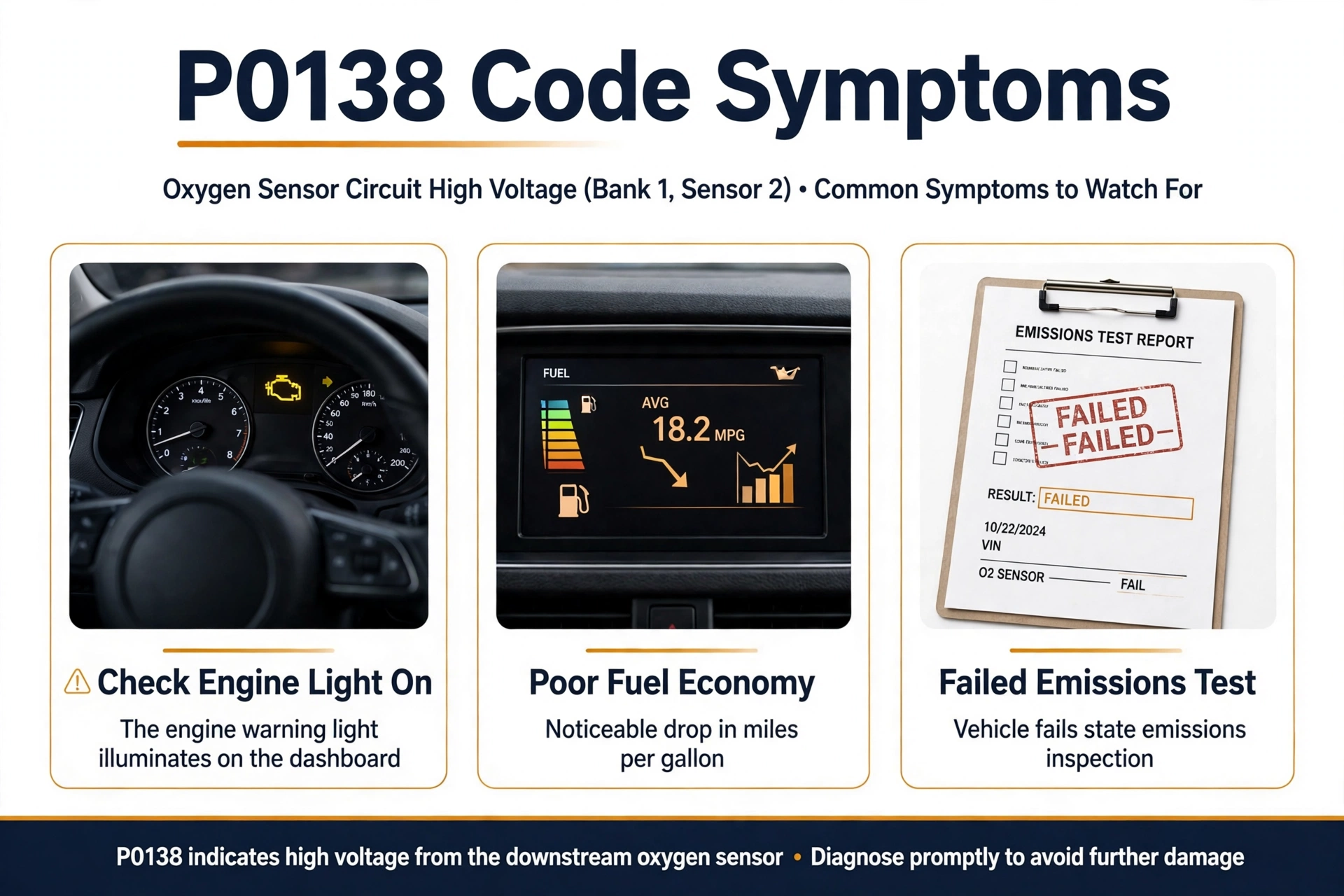
First, many drivers notice only the check engine light. Because the downstream sensor does not control fuel trim, the car often drives exactly as before. Watch for these symptoms:
- Check engine light on (often the only symptom)
- Noticeably worse fuel economy
- Rough idle, hesitation, or occasional misfires
- Sulfur or raw fuel smell from the exhaust
- Black smoke from the tailpipe in severe rich-running cases
- Failed state emissions inspection
If the car runs rough or smells of fuel, the engine is likely running rich, and that is the more urgent problem to chase.
Common Causes of P0138
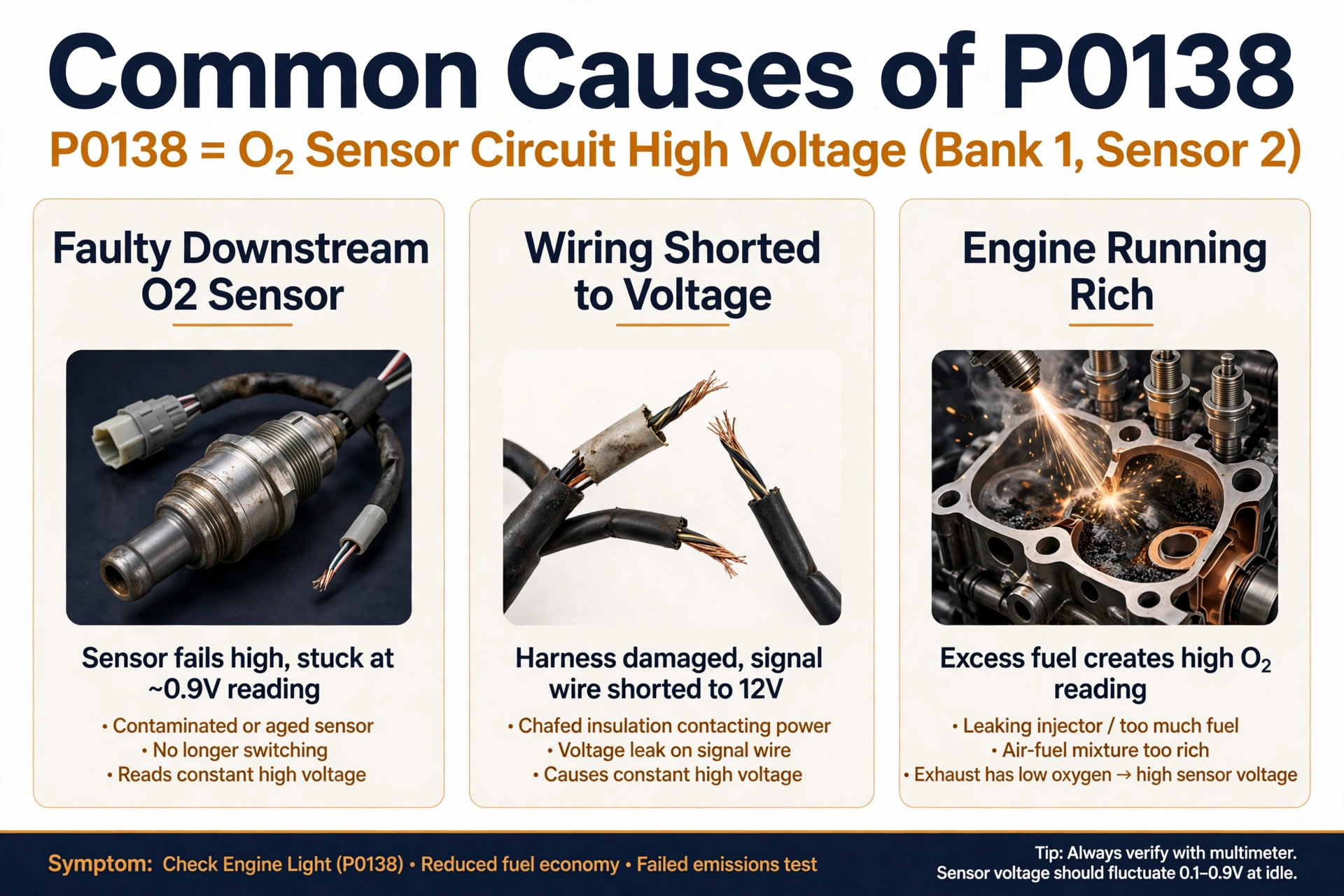
- Faulty downstream O2 sensor: the most common cause. The sensing element wears out (often past 90,000 to 120,000 miles), gets contaminated by coolant, oil, or silicone, and sticks at a constant high reading.
- Signal wire shorted to voltage: chafed, melted, or pinched wiring lets the sensor signal wire touch a 12-volt source, pegging the reading high.
- Damaged connector or poor ground: corroded, loose, or oil-fouled connectors at the sensor, or a weak ground, can distort the signal.
- Engine running rich: a leaking fuel injector, excessive fuel pressure, or a faulty fuel pressure regulator floods the exhaust with unburned fuel and drives the sensor voltage up.
- Exhaust leak near the sensor: a leak ahead of or around the downstream sensor can skew its reading.
- Failing catalytic converter: a converter that no longer stores oxygen properly can leave the downstream signal pegged.
- PCM or software issue: rare, but a module fault or outdated calibration can misread a good sensor.
Therefore, do not skip the wiring inspection. A surprising number of P0138 comebacks are fixed with a few inches of wire and a connector, not a new sensor.
How to Diagnose P0138 (Do This Before Buying Parts)
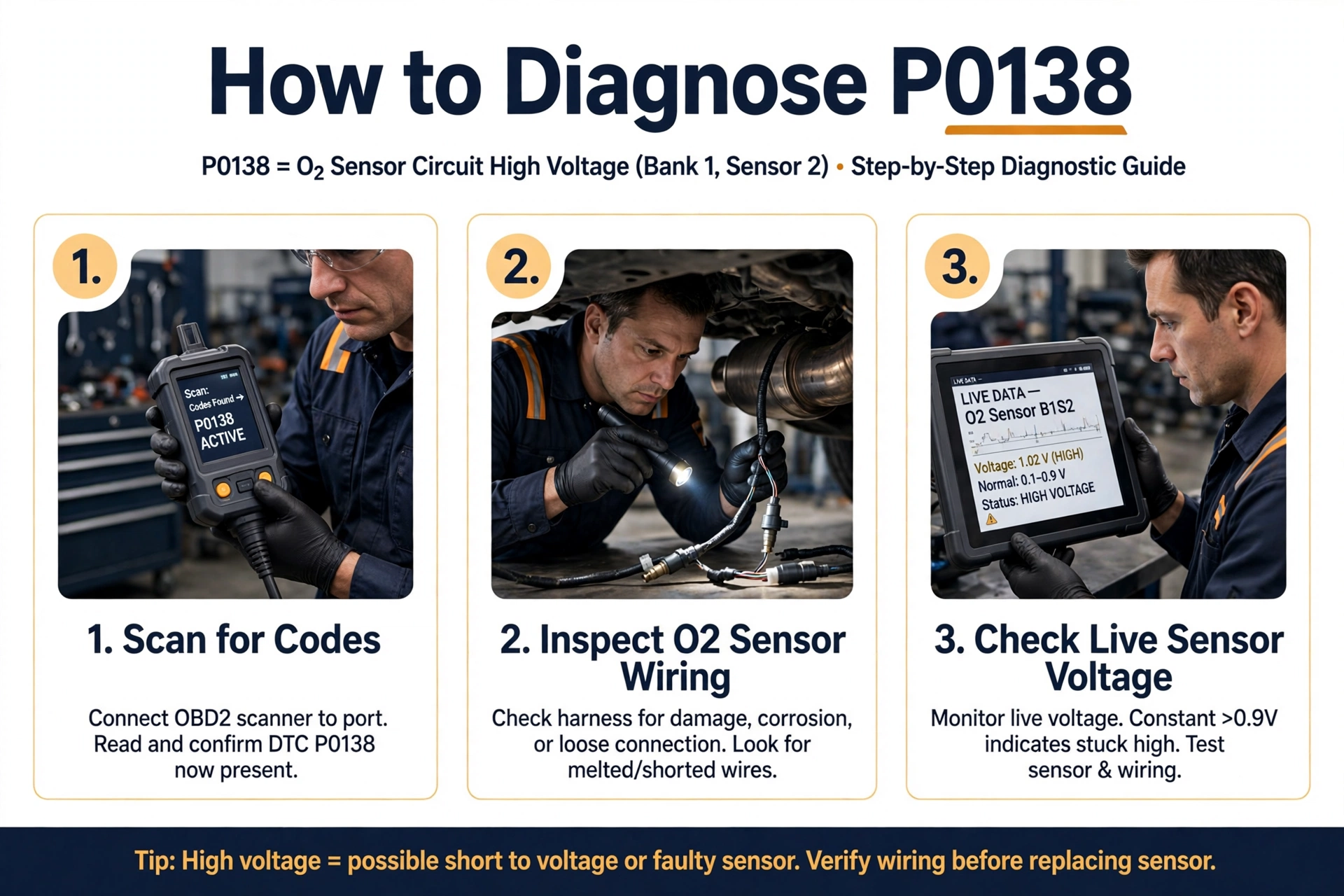
- Confirm the code and read the whole picture. First, verify P0138 is active with your scan tool and note any companion codes. P0172 or P0175 (system too rich) points at a rich condition, while P0137, P0139, or P0141 points at the sensor circuit itself.
- Inspect the wiring and connector. Follow the harness from the Bank 1 Sensor 2 connector toward the PCM. Look for chafed insulation, melted spots near the exhaust, corrosion, and loose pins.
- Watch live sensor data. Next, with the engine running, graph Bank 1 Sensor 2 voltage. A healthy sensor wanders between 0.1 and 0.9 volts. A flat line above 0.9 volts confirms the fault is real and current.
- Test the circuits with a multimeter. Back-probe the signal wire and check the ground and heater circuits against the service manual specs. If the signal wire shows battery voltage with the sensor unplugged, the harness is shorted to voltage.
- Rule out a rich condition. Check short- and long-term fuel trims and fuel pressure. Strongly negative trims plus high fuel pressure or a leaking injector mean the sensor is telling the truth and the engine is the problem.
- Clear, drive, and re-scan. Finally, after the repair, clear the code, complete a drive cycle, and confirm P0138 does not return.
How to Fix the P0138 Code
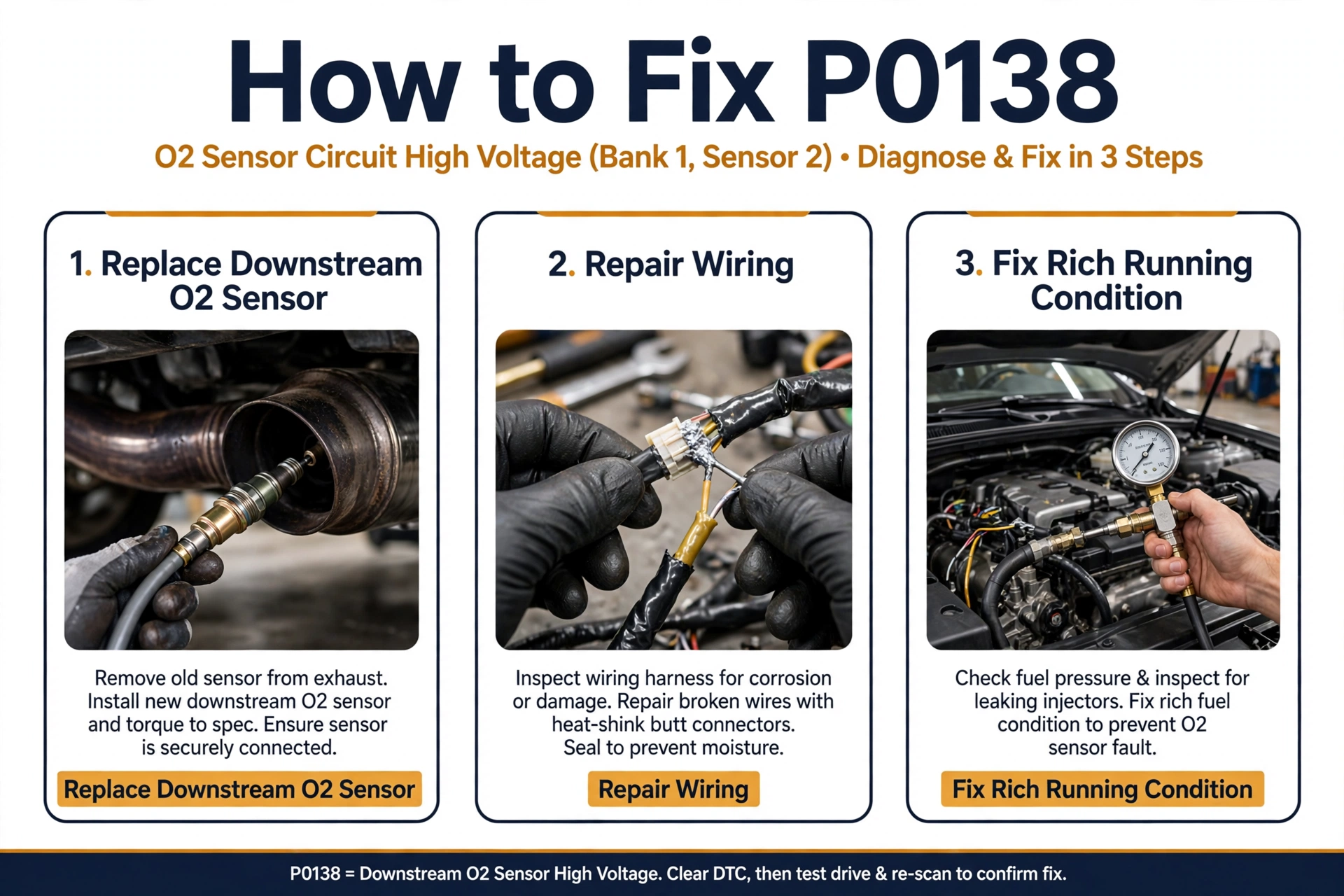
- First, replace the downstream O2 sensor (Bank 1 Sensor 2) when testing shows the sensor is stuck high with good wiring. Use an O2 sensor socket and torque the new sensor to spec.
- Repair damaged wiring and connectors: splice in fresh wire with heat-shrink butt connectors, replace corroded connectors, and reroute the harness away from hot exhaust parts.
- Fix a rich running condition: replace a leaking injector or faulty fuel pressure regulator and confirm fuel pressure is back in spec.
- Repair exhaust leaks near the downstream sensor so it samples clean exhaust.
- Replace the catalytic converter only after the sensor and wiring test good and the converter proves dead. It is the most expensive fix, so it comes last.
- Clear the code and verify with a test drive and a final scan. Finally, re-scan after a full drive cycle to make sure P0138 stays gone.
P0138 Repair Costs
In general, costs vary by vehicle and labor rates, but these ranges cover the most common P0138 repairs:
| Repair | Cost Range |
|---|---|
| Downstream O2 sensor replacement | $200 – $520 |
| Wiring or connector repair | $100 – $300 |
| Fuel pressure regulator replacement | $200 – $450 |
| Fuel injector replacement (per injector) | $150 – $400 |
| Exhaust leak repair | $100 – $300 |
| Catalytic converter replacement | $800 – $2,500 |
A downstream O2 sensor replacement is the most common fix, with national averages landing around $440 to $520 including parts and labor.
DIY vs Mechanic Verdict
You can do this at home: scanning the code, inspecting the sensor wiring and connector, replacing the Bank 1 Sensor 2 O2 sensor with basic hand tools and an O2 sensor socket, and clearing the code afterward.
See a mechanic for: tracing a short-to-voltage in the harness, fuel pressure and injector testing, catalytic converter diagnosis and replacement, and any PCM-related fault.
Bottom line: Overall, P0138 is one of the friendlier codes for DIYers, but do the diagnosis first. A ten-minute wiring inspection can save you the cost of a sensor you did not need.
Can You Drive With a P0138 Code?
For short trips, usually yes. P0138 will not strand you, and many cars drive normally with it. However, the risk is what hides behind the code: if the engine is running rich, unburned fuel can overheat and destroy the catalytic converter, turning a repair of a few hundred dollars into one over a thousand. Instead, keep trips short, avoid hard acceleration, and diagnose it within days rather than months.
P0138 on Popular Vehicles
Nissan: the p0138 nissan code is common on the Altima, Sentra, and Quest, where aged downstream sensors and brittle harness sections near the exhaust are frequent culprits. On the Quest, a faulty fuel pressure regulator causing a rich condition is a known trigger, so check fuel pressure before condemning the sensor.
Toyota and Honda: the p0138 toyota code (Camry, Corolla) and p0138 honda code (Accord, Civic) usually trace to a worn downstream sensor past 100,000 miles. Both brands’ sensors respond well to direct-fit replacements, and wiring faults are less common than on domestic trucks.
Ford, Chevrolet, and Jeep: the p0138 ford code (F-150), p0138 chevy code (Silverado), and p0138 jeep code (Wrangler) often involve the sensor harness rubbing against the frame or exhaust. Inspect the full harness run before buying parts, and on the Wrangler check the sensor heater circuit fuse as well.
P0138 vs P0137, P0136 and P0139
These four codes all describe the same sensor, Bank 1 Sensor 2, but different electrical behavior:
- P0138 vs P0137: P0138 means the signal is stuck high (above about 0.9V); P0137 means it is stuck low (below about 0.1V). For example, high points to a short to voltage, a failed-high sensor, or a rich condition. Low points to an open circuit, a dead sensor, or a lean condition.
- P0138 vs P0136: P0136 is a general circuit performance code for Bank 1 Sensor 2, while P0138 is the specific “stuck high” variant. A P0136 can mature into a P0138 as the sensor degrades.
- P0138 vs P0139: P0139 means the Bank 1 Sensor 2 signal responds too slowly; P0138 means it does not move at all and sits high. A slow sensor (P0139) is aging; a stuck-high sensor (P0138) has usually failed or lost its wiring.
The Bank 2 mirror of P0138 is P0158 (O2 Sensor Circuit High Voltage, Bank 2 Sensor 2).
Related Codes
- P0137: O2 Sensor Circuit Low Voltage (Bank 1, Sensor 2)
- P0136: O2 Sensor Circuit Malfunction (Bank 1, Sensor 2)
- P0139: O2 Sensor Circuit Slow Response (Bank 1, Sensor 2)
- P0141: O2 Sensor Heater Circuit Malfunction (Bank 1, Sensor 2)
- P0158: O2 Sensor Circuit High Voltage (Bank 2, Sensor 2)
- P0172: System Too Rich (Bank 1)
- P0420: Catalyst System Efficiency Below Threshold (Bank 1)
Video Walkthrough
Watch the video above for a visual walkthrough of P0138 causes and fixes before you read on.
Frequently Asked Questions
What is the most common cause of a P0138 code?
A failing downstream O2 sensor is the most common cause of P0138. After 90,000 to 120,000 miles, the sensing element can wear out or become contaminated and stick at a constant high reading. Damaged wiring shorted to voltage and an engine running rich are the next most common causes, which is why a quick wiring inspection should come before buying a new sensor.
Can I still drive my car with a P0138 code?
Usually yes, for short trips. P0138 will not leave you stranded, and the car often drives normally. The main risk is an underlying rich condition, which can overheat and ruin the catalytic converter. Keep driving to a minimum and diagnose the code within a few days.
How do you fix the code P0138?
Fix P0138 by first confirming the fault with live sensor data, then inspecting the Bank 1 Sensor 2 wiring and connector. Replace the downstream O2 sensor if it is stuck high, repair any damaged wiring, or fix the rich condition (leaking injector, faulty fuel pressure regulator) if the sensor is telling the truth. Clear the code and test drive to verify.
How much does it cost to fix P0138?
The most common fix, a downstream O2 sensor replacement, costs about $200 to $520 including parts and labor. Wiring repairs run $100 to $300, while a catalytic converter replacement (rarely needed for P0138) can cost $800 to $2,500.
More P0138 FAQs
Will P0138 clear itself?
P0138 can clear itself if the fault stops occurring for enough drive cycles, but a sensor stuck high or a wiring short will not heal on its own, so the light usually returns. Diagnose and repair the root cause, then clear the code with a scan tool and confirm it stays off.
Which O2 sensor is bank 1 sensor 2?
Bank 1 is the side of the engine containing cylinder number 1. Sensor 2 is the downstream sensor, mounted in the exhaust after the catalytic converter. On a four-cylinder engine there is only one bank, so Bank 1 Sensor 2 is the single rear O2 sensor behind the cat.
Will P0138 cause me to fail an emissions test?
Yes. An illuminated check engine light is an automatic failure in most state emissions programs, and P0138 is an emissions-system code. Fix the underlying fault, clear the code, and complete a drive cycle so all monitors read ready before testing.
Conclusion
P0138 means the Bank 1 Sensor 2 oxygen sensor signal is stuck high, and the fix is usually straightforward: inspect the wiring first, then replace the downstream sensor if it has failed. Above all, do not ignore the code, because a rich condition hiding behind it can destroy the catalytic converter. Finally, work through the diagnosis steps above, make the repair, and verify with a test drive so the check engine light stays off.
About the author: Written by the OBD2 Code Hub editorial team. Our diagnostic guides are built from real OBD-II data, manufacturer service procedures, and hands-on troubleshooting experience, then reviewed for technical accuracy before publishing. We drive the same cars you do.