
P0422 Trouble Code: Meaning, Causes, Symptoms & Fixes
In This Guide
One-line meaning: P0422: Main Catalyst Efficiency Below Threshold (Bank 1).
What the P0422 Code Means
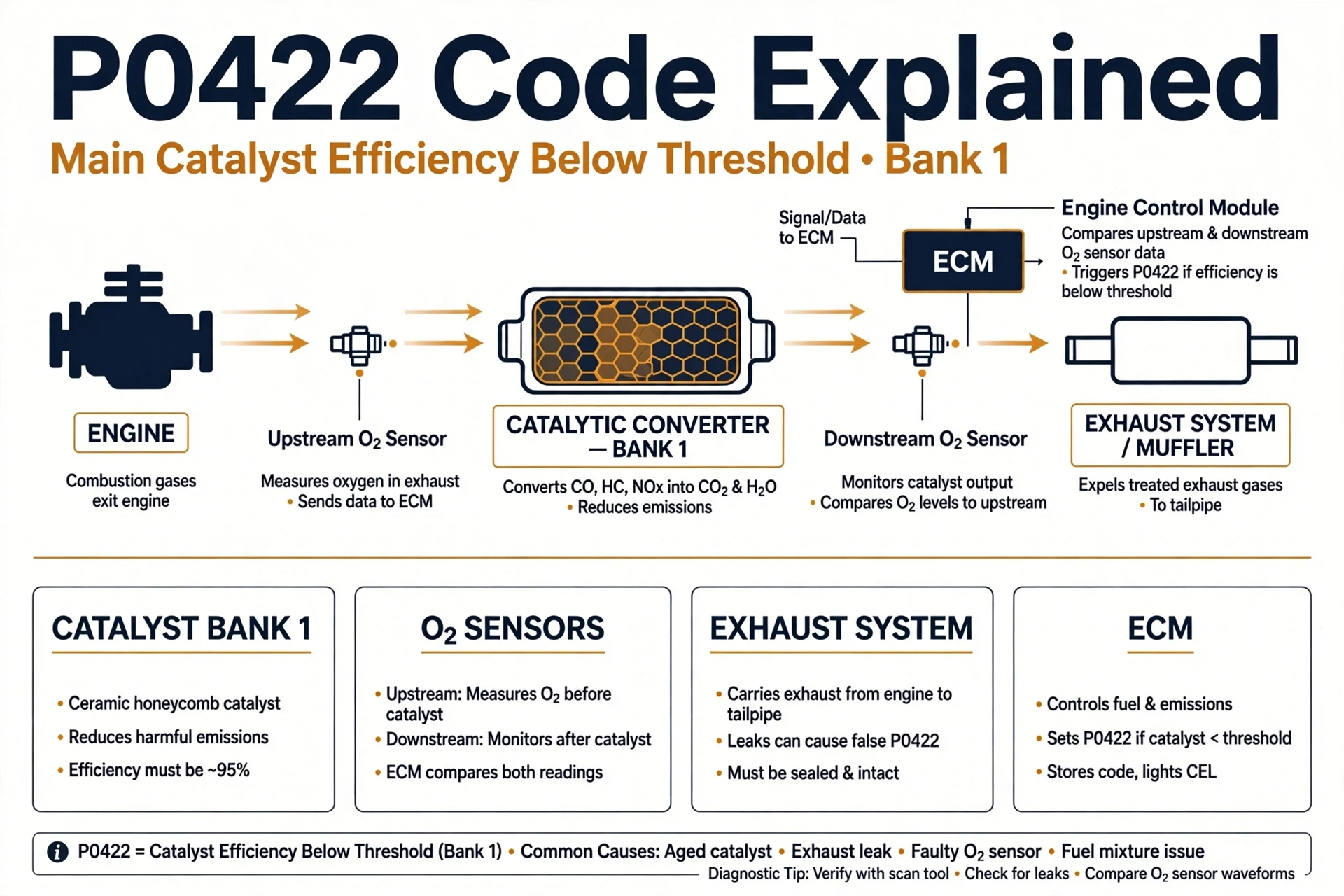
The P0422 code is the check engine light code that drivers search when their scanner reports “Main Catalyst Efficiency Below Threshold (Bank 1)” (p0422 main catalyst efficiency below threshold bank 1). In plain English, your car’s engine computer (ECM/PCM) has decided that the main catalytic converter on bank 1, the side of the engine that contains cylinder number one, is no longer cleaning exhaust gases well enough.
Here is how the computer reaches that verdict. Two oxygen sensors bracket the converter: one upstream (before it) and one downstream (after it). The upstream O2 sensor’s voltage swings up and down constantly as the engine runs. The downstream sensor should stay fairly steady, because a healthy converter smooths out those swings. When the computer sees the two sensors reading too much alike, it concludes the main catalyst has lost efficiency and stores the P0422 code.
The p0422 code is a generic powertrain code, so it means the same thing on every make and model. Some scan tools and manuals call it “Catalyst 2 Efficiency Below Threshold (Bank 1)”. On vehicles that have two converters on bank 1, a small warm-up catalyst near the manifold and a larger main catalyst under the floor, “Catalyst 2” refers to the main brick, the one doing most of the long-term cleanup work.
Symptoms of the P0422 Code
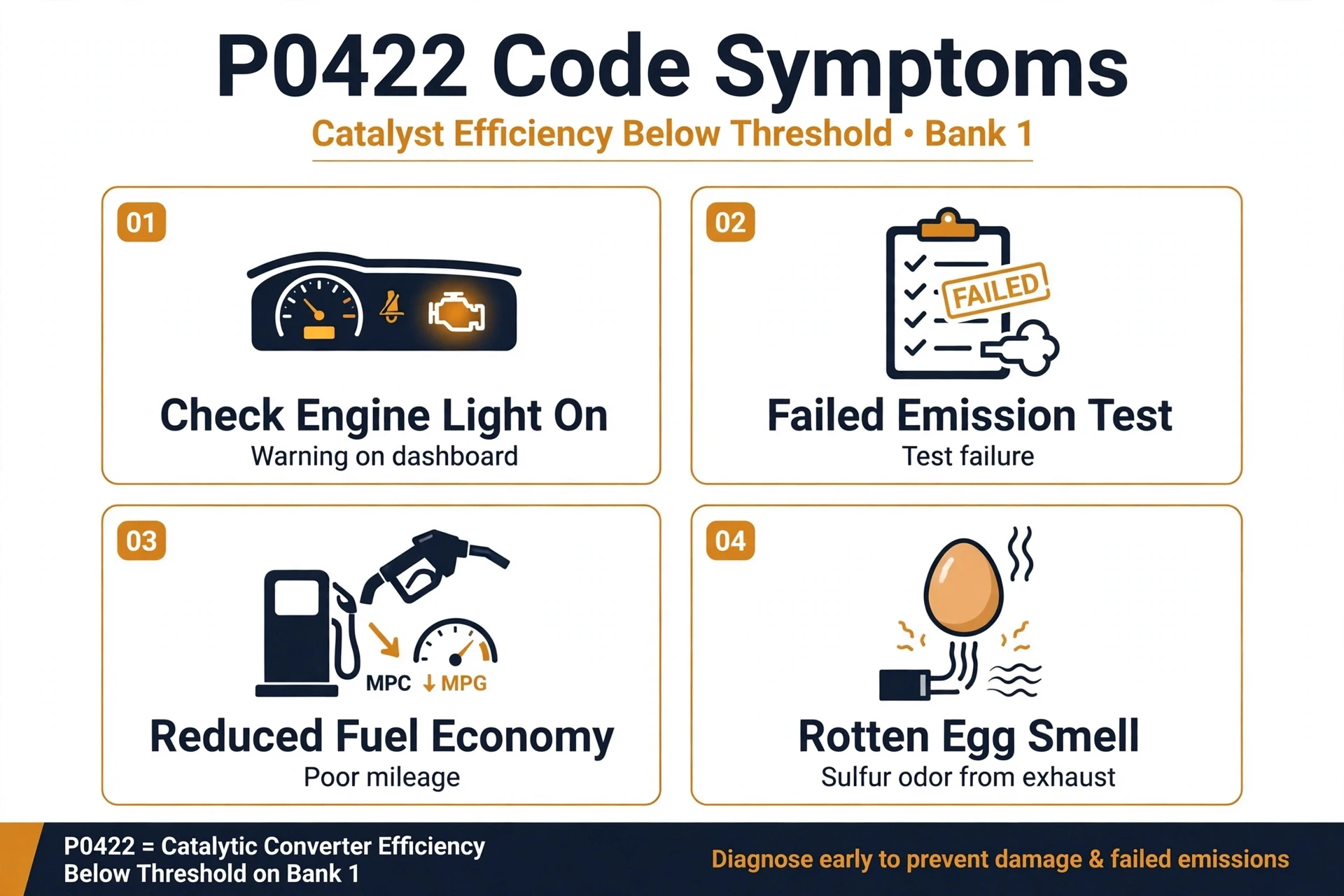
Often, the check engine light is the only symptom you will notice, and the car drives exactly the same as before. That is one reason the p0422 code catches drivers off guard. Depending on the root cause, you might also notice:
- Check engine light staying on, sometimes with a pending P0422 that returns after clearing
- Reduced fuel economy, with more frequent trips to the gas station
- A rotten egg or sulfur smell from the exhaust, a sign the converter is struggling
- Hesitation or reduced engine performance under acceleration
- A hissing noise from the exhaust, or stalling in more severe cases
- A failed emissions or smog test, which is how many drivers discover this code
What is the P0422 code trying to tell you? In short, the main catalyst on bank 1 is letting too many pollutants through. Do not ignore it just because the car still drives.
Common Causes of P0422
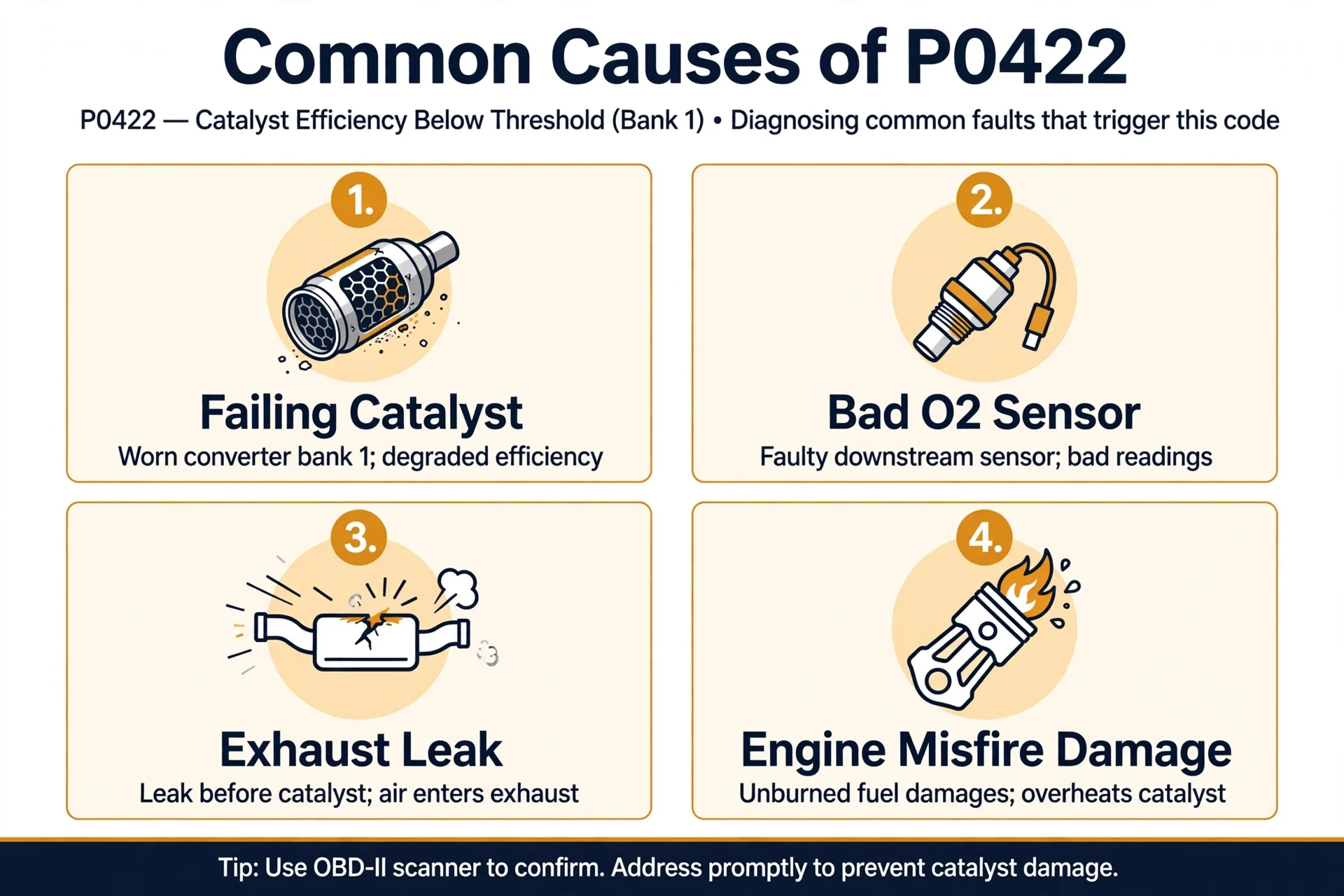
The most common cause of a P0422 code is a worn or damaged main catalytic converter. But the converter is far from the only suspect, and replacing it without testing is the most expensive mistake drivers make with this code. Here are the causes, roughly in order of likelihood:
- Failing main catalytic converter: the internal honeycomb is worn out, clogged, melted, or contaminated. Age, overheating from misfires, and oil or coolant contamination kill converters over time.
- Exhaust leaks: cracks, rust holes, or loose gaskets anywhere before or near the O2 sensors let outside air in and make the sensors read incorrectly.
- Faulty oxygen sensors: a slow or dead upstream or downstream O2 sensor, a failing sensor heater circuit, or damaged O2 sensor wiring sends bad data that looks like converter failure.
- Engine misfires: misfiring spark plugs or weak ignition coils dump unburned fuel into the exhaust, which overheats and destroys the converter from the inside.
- Fuel system problems: leaking fuel injectors or high fuel pressure create a rich running condition that overwhelms the catalyst.
- Oil consumption or head gasket leaks: internal engine damage that burns oil coats the converter’s surface and ruins its efficiency.
- Wrong fuel or contamination: the wrong fuel type or fluids leaking into the exhaust poison the catalyst over time.
How to Diagnose P0422 (Do This Before Buying Parts)
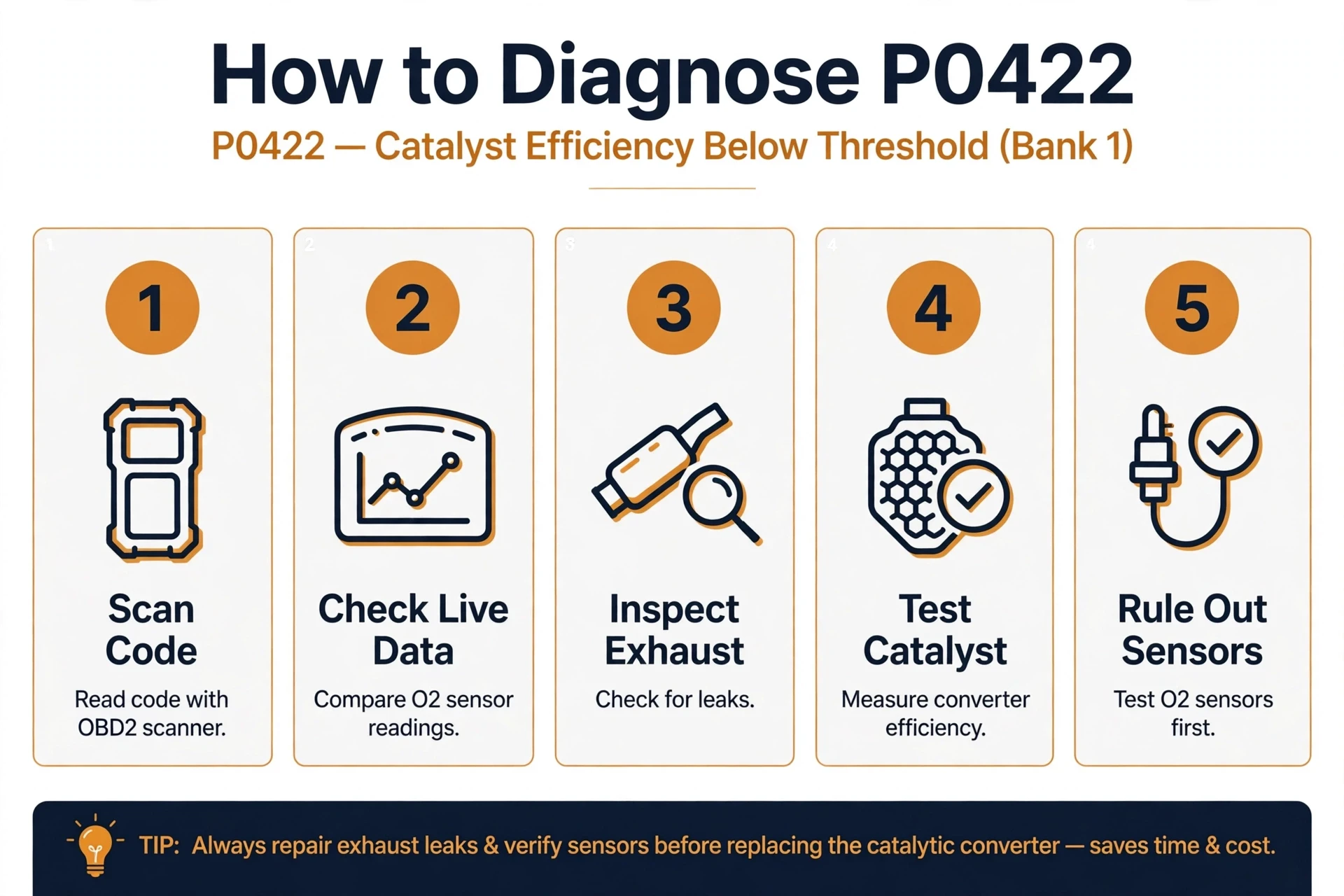
The p0422 code is misdiagnosed constantly. The code points at main catalyst efficiency, but the real fault is often upstream. Work through this order:
- Scan for other codes first. If you also have misfire codes (P0300 series) or fuel trim codes (P0171/P0174), fix those first. They are probably the root cause, and the P0422 may clear on its own.
- Visually inspect the exhaust. Look for rust, cracks, holes, and black soot marks around the manifold, flex pipe, and O2 sensor bungs. Listen for hissing or ticking that signals a leak.
- Check O2 sensor live data. With any OBD2 scanner that shows live data, compare the upstream and downstream O2 sensor waveforms at 2,500 RPM. If the downstream mirrors the upstream, the main catalyst is weak. If the upstream is lazy or flat, suspect the sensor, not the converter.
- Test the catalyst itself. Tap the converter (when cold) and listen for rattling inside, which means the honeycomb is breaking apart. Look for discoloration from overheating.
- Rule out engine issues. Check spark plugs, fuel trims, coolant temperature readings, and oil consumption before condemning the converter. A converter killed by a misfire or oil burning will fail again if you do not fix the root cause.
How to Fix the P0422 Code
The right fix depends on what your diagnosis found:
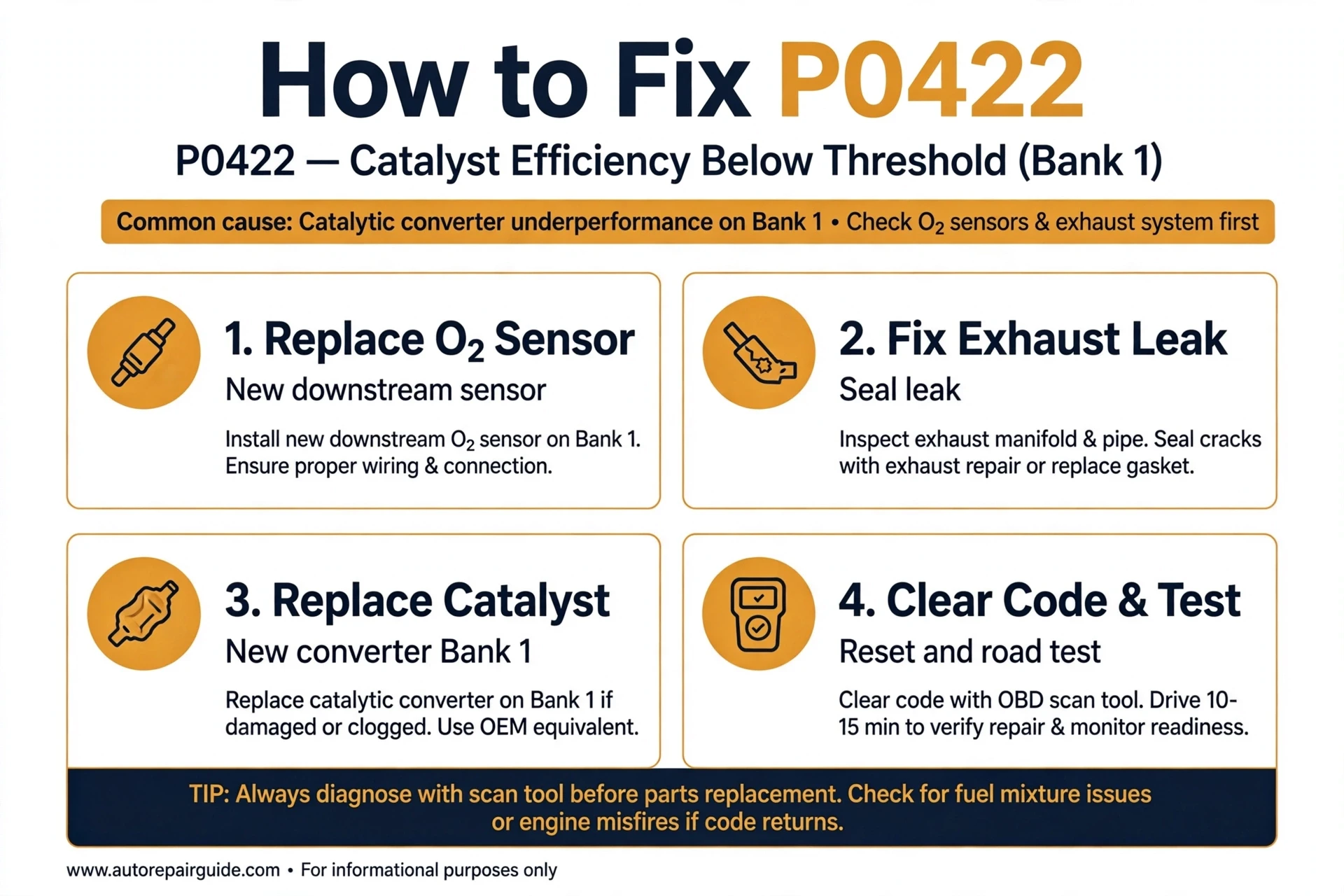
- Repair exhaust leaks: weld or replace the leaking section, or replace a failed gasket. This is often the cheapest fix and solves many P0422 cases.
- Replace faulty O2 sensors: install a new downstream sensor on bank 1 if it tests bad, and make sure the wiring and connectors are sound. Many technicians replace upstream and downstream sensors together since they age at the same rate.
- Fix misfires and fuel problems: new spark plugs, coils, injectors, or fuel pressure repairs, whatever the companion codes point to.
- Fix oil consumption: if the engine is burning oil or leaking coolant into the exhaust, address it before it ruins a new converter.
- Replace the catalytic converter: only after confirming the main catalyst has actually failed. Use an OEM or OEM-equivalent converter. Cheap universal converters often trigger the code again.
- Clear the code and road test: erase the code with your scanner, then drive for 10 to 15 minutes and confirm the monitors run clean.
P0422 Repair Costs
Drivers always ask how much it costs to fix the p0422 code, and the answer depends entirely on the cause. Here are realistic ranges:
| Repair | Cost Range |
|---|---|
| Exhaust leak repair | $100 – $300 |
| O2 sensor replacement (per sensor) | $150 – $350 |
| Spark plugs / coils (misfire fix) | $150 – $500 |
| Catalytic converter replacement | $1,200 – $3,200 |
This is why diagnosis matters. A $200 O2 sensor job and a $2,000 converter job share the same code. Always start with the exhaust inspection and O2 sensor tests, not the parts catalog.
DIY vs Mechanic Verdict
You can do this at home: visual exhaust inspection for leaks and damage, reading and clearing codes with an OBD2 scanner, checking O2 sensor live data waveforms, replacing spark plugs, and swapping a downstream O2 sensor. If you find an obvious exhaust leak or a dead O2 sensor, those are reasonable DIY repairs for anyone comfortable with basic tools.
See a mechanic for: catalytic converter replacement (requires cutting/welding and emissions compliance), diagnosing intermittent misfires, fuel injector testing, oil consumption diagnosis, and any repair where the diagnosis is unclear after the basic checks. A shop with a lift and a professional scan tool can confirm main catalyst failure in under an hour, which is cheaper than guessing with a costly part.
Bottom line: diagnose it yourself, fix the simple stuff yourself, but let a pro handle the converter swap.
Can You Drive With a P0422 Code?
Generally yes, for a short time. The car will usually run normally. But driving long term with the p0422 code is not advisable: fuel economy drops, emissions rise, you will fail any emissions or smog test, and the underlying problem (like a misfire or oil burning) can destroy a still-good converter, turning a small repair into a big one. Get it diagnosed soon, even if the car feels fine.
P0422 on Popular Vehicles
The p0422 code shows up across all brands, but some patterns are worth knowing:
- Honda (Accord, Civic, CR-V): the p0422 Honda code is frequently the main converter itself after high mileage, but check for exhaust leaks at the manifold first.
- Toyota (Camry, Corolla, RAV4): the p0422 Toyota code often traces to a tired converter, but this brand’s sensitive O2 sensor logic means a marginal downstream sensor can set it too.
- Nissan (Altima, Sentra, Rogue): for the p0422 Nissan code, check the exhaust manifold for cracks, a known weak spot that mimics converter failure.
- Chevy (Silverado, Malibu, Equinox): the p0422 Chevy code often involves both the converter and aging O2 sensors together. Silverado owners report this code frequently, so check for exhaust leaks before anything else.
- Ford (F-150, Escape, Explorer): the p0422 Ford code can follow misfire episodes, so pull the full code list. A single misfire code plus P0422 usually means fix the misfire first.
- Dodge and Jeep (Ram, Wrangler, Grand Cherokee): the p0422 code on these trucks and SUVs deserves an O2 sensor test first, since sensor issues are a common root cause here.
- Subaru: exhaust leaks at the manifold and aging converters are the usual suspects when the p0422 Subaru code appears.
P0422 vs Related Codes
Catalyst codes look alike but point at different parts. Here is how P0422 compares:
- P0422: Main Catalyst Efficiency Below Threshold (Bank 1). The main underfloor converter on the cylinder 1 side is underperforming.
- P0420: Catalyst System Efficiency Below Threshold (Bank 1). The general system-level catalyst code for bank 1; on many vehicles it describes the same overall condition as P0422.
- P0421: Warm Up Catalyst Efficiency Below Threshold (Bank 1). This one watches the small warm-up catalyst near the manifold, not the main converter. On vehicles with two bricks on bank 1, P0421 and P0422 point at different parts.
- P0430: Catalyst System Efficiency Below Threshold (Bank 2). The mirror image of P0420 for the other side of a V6 or V8 engine.
- P0431: Warm Up Catalyst Efficiency Below Threshold (Bank 2). The warm-up catalyst equivalent for bank 2.
Related Codes
- P0421: Warm Up Catalyst Efficiency Below Threshold (Bank 1)
- P0430: Catalyst System Efficiency Below Threshold (Bank 2)
- P0300: Random/Multiple Cylinder Misfire Detected (a common companion)
- P0171 / P0174: System Too Lean (fuel mixture faults that can trigger P0422)
Video Walkthrough
Watch the video above for a visual walkthrough of P0422 causes and diagnosis before you read on.
Frequently Asked Questions
What does the P0422 code mean?
P0422 means “Main Catalyst Efficiency Below Threshold (Bank 1)”. Your car’s computer has decided that the main catalytic converter on the cylinder 1 side of the engine is no longer cleaning exhaust gases efficiently enough.
What is the most common cause of a P0422 code?
A worn or damaged main catalytic converter is the single most common cause. But exhaust leaks, bad O2 sensors, engine misfires, and rich fuel conditions are close behind, which is why testing before replacing parts saves so much money.
Can I still drive my car with a P0422 code?
Yes, short term. The car usually drives normally. Long term, you risk worse fuel economy, failed emissions tests, and turning a small problem into a full converter replacement.
How do you fix the P0422 code?
Diagnose first: check for companion codes, inspect the exhaust for leaks, and test O2 sensor live data. Then repair what you find: seal leaks, replace bad sensors, fix misfires or fuel issues, or replace the main converter if it has truly failed.
How much does it cost to fix the P0422 code?
From about $100 to $300 for an exhaust leak repair, $150 to $350 per O2 sensor, up to $1,200 to $3,200 for a catalytic converter replacement depending on the vehicle.
Will the P0422 code clear itself?
Rarely. If the underlying fault was temporary, it might. Usually the code returns until the real problem is fixed, so clear it only after the repair and confirm with a road test.
Is P0422 an EVAP code, and how is it different from P0420?
No, P0422 has nothing to do with the EVAP system, even though the similar numbers confuse some drivers. It is strictly a catalyst efficiency code. Compared with P0420, which is the general catalyst system code for bank 1, P0422 specifically calls out the MAIN catalyst on bank 1.
Conclusion
The P0422 code looks scary, but it is really your car asking for a proper diagnosis, not an automatic converter replacement. Check for other codes, inspect the exhaust, test the O2 sensors, and fix what you find. Do that, and you will either solve it cheaply or know for certain the main catalyst is done. Either way, you stop guessing and start fixing.
About the author: Written by the OBD2 Code Hub editorial team. Our diagnostic guides are built from real OBD-II data, manufacturer service procedures, and hands-on troubleshooting experience, then reviewed for technical accuracy before publishing. We drive the same cars you do.