
P0134 Trouble Code: Meaning, Causes, Symptoms & Fixes
In This Guide
One-line meaning: P0134: O2 Sensor Circuit No Activity Detected (Bank 1, Sensor 1).
What the P0134 Code Means
The P0134 code is a generic OBD-II powertrain code, and its full definition is “O2 Sensor Circuit No Activity Detected (Bank 1, Sensor 1)” (p0134 code). In plain English, your car’s computer (PCM/ECM) is watching the upstream oxygen sensor and seeing no signal change at all, which tells it the sensor circuit has gone quiet.
Here is how your car figures this out. A healthy upstream O2 sensor constantly flips its voltage between about 0.1 and 0.9 volts as the engine runs, switching many times per second. The computer expects this activity. When the signal sits flat, usually stuck near the 0.45 volt reference, for longer than its calibrated window, the PCM concludes there is no activity and stores the P0134 code. Modern sensors are heated (HO2S) with four wires, and the computer ignores the signal until the internal heater warms the sensor up. It also watches how long that warmup takes, so a heater that never gets the sensor hot looks exactly like a dead sensor to the computer.
P0134 (p0134 obd2, p0134 code bank 1 sensor 1) is generic, so it means the same thing on every make and model, from a Honda Civic to a Ford F-150 to a Toyota Corolla. Bank 1 is the side of the engine that contains cylinder number one, and on a four-cylinder engine it is the only bank. Sensor 1 is the upstream sensor, mounted in the exhaust before the catalytic converter. Its job is to report oxygen levels so the computer can fine-tune the air-fuel mixture in real time.

Symptoms of the P0134 Code
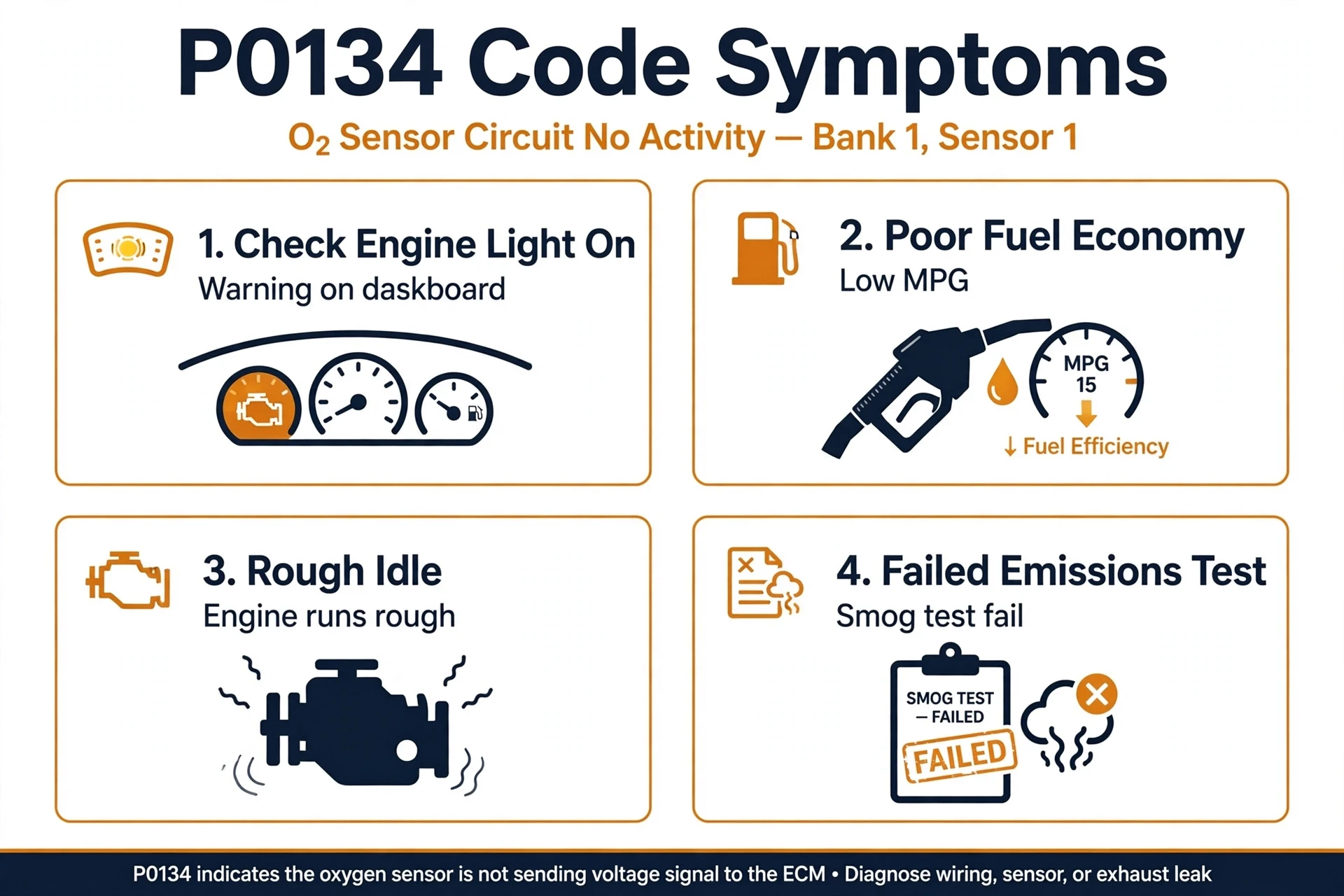
In many cases, the check engine light is the only symptom you will notice. Because the computer loses its main feedback for fuel control on bank 1, you might also notice:
- Illuminated check engine light (steady or flashing)
- Reduced fuel economy, often 5 to 10 percent worse MPG
- Rough engine idle or hesitation during low-speed driving
- Poor acceleration, with the engine running too rich or too lean
- Engine stalling in some cases
- Failed emissions test from increased emissions
What is code P0134? What is the p0134 code trying to tell you? In short: the computer is flying blind on fuel mixture for bank 1, so economy and emissions suffer even when the car feels normal. Some drivers report no symptoms at all beyond the light.
Common Causes of P0134
The most common cause of a P0134 code is a worn-out upstream O2 sensor whose sensing element has simply died with age and heat cycles. But the circuit has several other failure points worth checking:
- Faulty O2 sensor: the internal sensing element is worn out or dead. This is the single most common trigger.
- Heater circuit failure: the sensor’s internal heating element never warms it to operating temperature, so it never starts switching.
- Wiring or connector damage: broken wires, chewed insulation, loose pins, or corrosion in the harness running to Bank 1 Sensor 1.
- Blown fuse: the fuse feeding the O2 sensor heater circuit has popped, cutting heater power.
- Exhaust leaks: a leak near the upstream sensor lets outside air into the exhaust and skews the readings.
- Faulty MAF sensor: a bad mass airflow sensor can mimic O2 sensor faults, a known misdiagnosis trap.
- Intake air leaks or low fuel pressure: unmetered air or weak fuel delivery throws fuel control off.
- PCM issues: a software glitch or a failed PCM is rare, but it happens.

How to Diagnose P0134 (Do This Before Buying Parts)
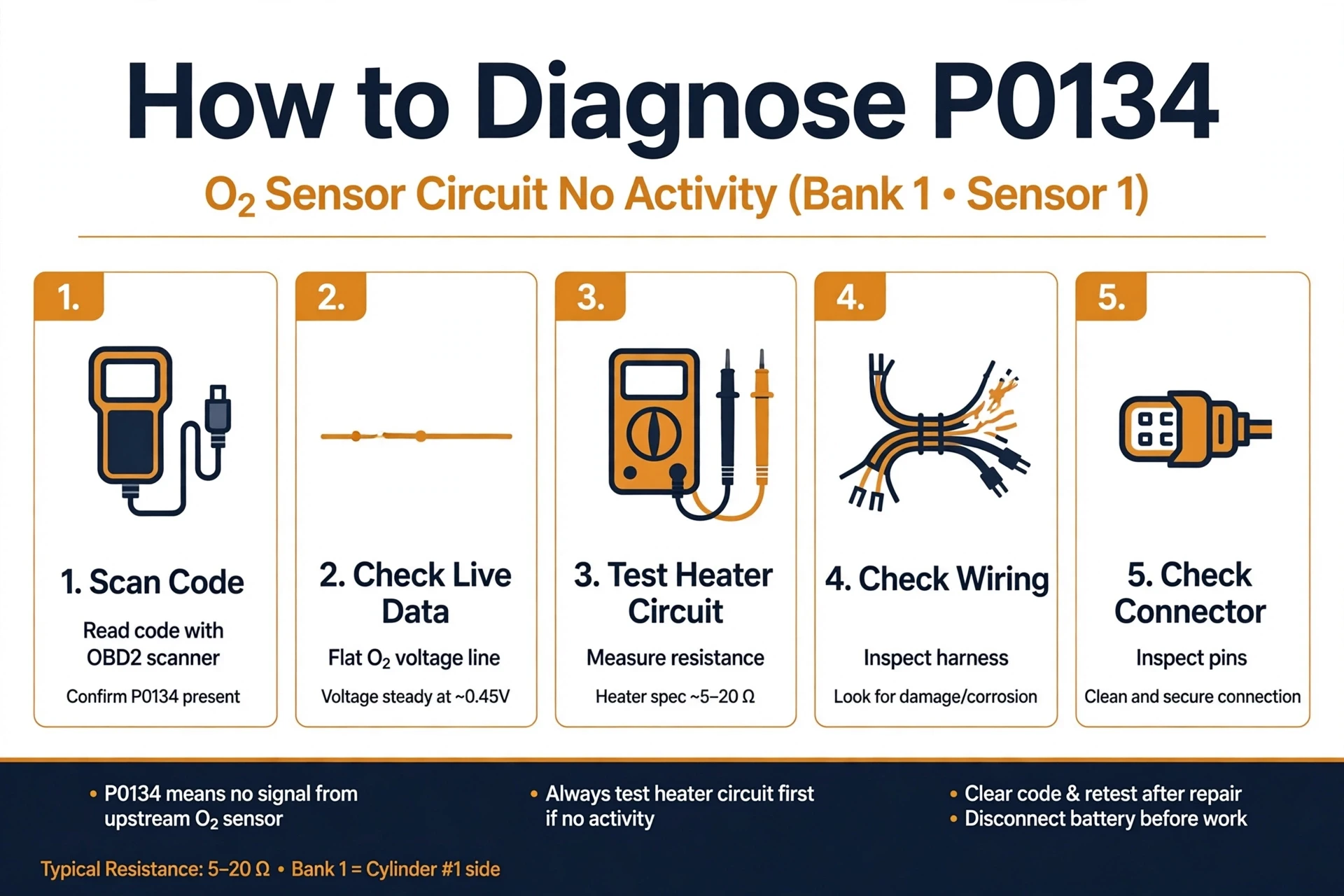
Do not just throw a sensor at it. Owners constantly report the P0134 code returning after a sensor swap, because the real fault was wiring, a fuse, or a companion issue. Follow this order:
- Scan for other codes first. Heater circuit codes (P0135) or MAF codes change the diagnosis completely. Fix companion codes first.
- Watch live data. With any OBD2 scanner that shows live data, look at Bank 1 Sensor 1 voltage. A healthy sensor switches rapidly between about 0.1 and 0.9 volts. A flat line near 0.45 volts confirms no activity.
- Inspect the wiring and connectors. Follow the harness to the upstream sensor. Look for melted insulation near the exhaust, chafed wires, green corrosion, or loose pins. Wiggle the connector while watching live data.
- Check the fuses. Find the fuse for the O2 sensor heater circuit in the under-hood fuse box and test it. A blown fuse is the cheapest fix there is.
- Test with a multimeter. Check for battery voltage at the heater power wire with the key on, verify a good ground, and check continuity on the signal wire back to the PCM.
- Check for exhaust leaks. Listen for ticking near the manifold and look for black soot marks around the upstream sensor.
- Consider the MAF and fuel trims. If fuel trims are far off or a MAF code is present, address that before condemning the sensor.
How to Fix the P0134 Code
The right fix depends on what your diagnosis found:
- Replace the upstream O2 sensor: if the sensing element is dead or the heater has failed, a new Bank 1 Sensor 1 is the fix. Use an OEM or quality direct-fit sensor.
- Repair wiring or connectors: solder and heat-shrink broken wires, clean corrosion, and reseat loose pins.
- Replace the blown fuse: then find out why it blew, or the new one will pop again.
- Seal exhaust leaks: replace the gasket or repair the cracked section near the sensor.
- Clean or replace the MAF sensor: if testing shows it is skewing fuel control.
- Update or reprogram the PCM: rare, but some models need a software update for sensor monitoring.
- Clear the code and test drive: after the repair, clear P0134 with your scanner and drive through a full warmup cycle to confirm the sensor switches and the code stays gone.

P0134 Repair Costs
Drivers always ask how much it costs to fix P0134, and the answer depends entirely on the cause. Here are realistic ranges:
| Repair | Cost Range |
|---|---|
| O2 sensor replacement (Bank 1 Sensor 1) | $150 – $350 |
| Wiring / connector repair | $100 – $250 |
| Blown fuse replacement | $10 – $30 |
| Exhaust leak repair | $100 – $300 |
| MAF sensor replacement | $150 – $400 |
| PCM reprogram or replacement | $150 – $1,000+ |
This is why diagnosis matters. A $15 fuse and a $350 sensor job share the same code.
DIY vs Mechanic Verdict
You can do this at home: reading codes and live data with an OBD2 scanner, visual wiring inspection, checking fuses, and replacing the upstream O2 sensor itself (usually one threaded bung and a connector, though rust can fight you).
See a mechanic for: intermittent wiring faults buried deep in the harness, PCM diagnosis or reprogramming, and exhaust manifold leak repairs that need welding.
Bottom line: diagnose it yourself with live data, fix the simple stuff yourself, and let a pro handle harness or computer faults.
Can You Drive With a P0134 Code?
Short trips, generally yes. The car will usually run, but fuel economy drops and the engine may run rich or lean without proper sensor feedback. Driving long term with P0134 is not advisable: uncontrolled fuel mixture can overheat and destroy the catalytic converter, turning a $200 sensor job into a $1,500-plus converter job, and you will fail any emissions test. Get it diagnosed soon, even if the car feels fine.
P0134 on Popular Vehicles
P0134 shows up across all brands, but some patterns are worth knowing:
- Honda (Accord, Civic): The p0134 honda code (honda p0134, p0134 code honda) is common on high-mileage Accords and Civics. On some models, such as the 2018 Accord, it points specifically at the Bank 1 Sensor 1 heater. The p0134 honda accord variant often clears with a quality upstream sensor.
- Toyota (Corolla, Camry): The p0134 toyota code (toyota p0134, p0134 code toyota) frequently traces to a tired upstream sensor. Check the heater fuse first, since it is a cheap win.
- Chevy (Silverado, Tahoe): The p0134 chevy code (p0134 code chevy, p0134 code chevy silverado) often involves wiring chafed near the hot exhaust manifold on trucks.
- Nissan (Altima, Sentra): For p0134 nissan (nissan p0134, p0134 code nissan), inspect the harness where it routes near hot exhaust parts.
- Ford (F-150, Escape, Explorer): The p0134 ford code (ford p0134, p0134 code ford) can follow exhaust manifold leaks, so listen for ticking before replacing parts.
EOBD P0134 and OBD P0134 are the same code under different naming (European vs generic OBD-II). DTC P0134 and OBD-II P0134 also refer to the identical fault.
P0134 vs P0154
P0134 is bank 1. P0154 is the mirror image for bank 2: “O2 Sensor Circuit No Activity Detected (Bank 2, Sensor 1).” On a four-cylinder engine there is only bank 1, so you will never see P0154. On V6 and V8 engines, the two codes point at the two separate upstream sensors. Diagnose them the same way. Do not confuse either with P0135, the heater circuit malfunction code for the same sensor: P0135 means the heater circuit failed its electrical test, while P0134 means the sensor signal itself shows no activity.
Related Codes
- P0154: O2 Sensor Circuit No Activity Detected (Bank 2, Sensor 1)
- P0135: O2 Sensor Heater Circuit Malfunction (Bank 1, Sensor 1)
- P0140: O2 Sensor Circuit No Activity Detected (Bank 1, Sensor 2)
- P0171: System Too Lean (Bank 1)
Video Walkthrough
Watch the video above for a visual walkthrough of P0134 causes and diagnosis before you read on.
Frequently Asked Questions
What is the most common cause of a P0134 code?
A dead upstream O2 sensor. The sensing element wears out with age and heat cycles until it stops switching entirely. Wiring damage, heater circuit failures, and blown fuses are the next most common causes, which is why you test the circuit before replacing the sensor.
Can I still drive my car with a P0134 code?
Short term, usually yes. The car will typically still run. Long term, you risk worse fuel economy, failed emissions tests, and catalytic converter damage from uncontrolled fuel mixture, so get it fixed soon.
How do you fix the code P0134?
Diagnose first: check for companion codes, watch the Bank 1 Sensor 1 live data, inspect the wiring and fuses, and test the heater circuit. Then repair what you find: replace the sensor, fix wiring, replace the fuse, or seal exhaust leaks. Clear the code and test drive to confirm.
How much does it cost to fix P0134?
From about $10 for a blown fuse to $150-$350 for an upstream O2 sensor replacement at a shop. Wiring repairs run $100-$250, and an exhaust leak repair runs $100-$300.
Will P0134 clear itself?
Rarely. If the underlying fault was temporary, it might. Usually the code returns until the real problem is fixed, because the computer retests the sensor on every drive cycle.
What does bank 1 sensor 1 mean?
Bank 1 is the side of the engine containing cylinder number one (the only bank on a four-cylinder). Sensor 1 is the upstream oxygen sensor, mounted in the exhaust before the catalytic converter. So P0134 points at the pre-cat O2 sensor on the cylinder-1 side.
How do I reset an oxygen sensor code like P0134?
Use an OBD2 scanner to clear the code after completing the repair, then drive through a full warmup cycle. If the sensor now switches normally, the code stays gone. Clearing the code without fixing the fault only buys time: it will return.
Conclusion
The P0134 code looks scary, but it is really your car asking for a proper diagnosis, not an automatic sensor replacement. Check for other codes, watch the sensor’s live data, inspect the wiring and fuses, and fix what you find. Do that, and you will either solve it cheaply or know for certain the sensor is done. Either way, you stop guessing and start fixing.
About the author: Written by the OBD2 Code Hub editorial team. Our diagnostic guides are built from real OBD-II data, manufacturer service procedures, and hands-on troubleshooting experience, then reviewed for technical accuracy before publishing. We drive the same cars you do.