
P2402 Trouble Code: Meaning, Causes, Symptoms & Fixes
In This Guide
One-line meaning: P2402: Evaporative Emission System Leak Detection Pump Control Circuit/Open.
What the P2402 Code Means
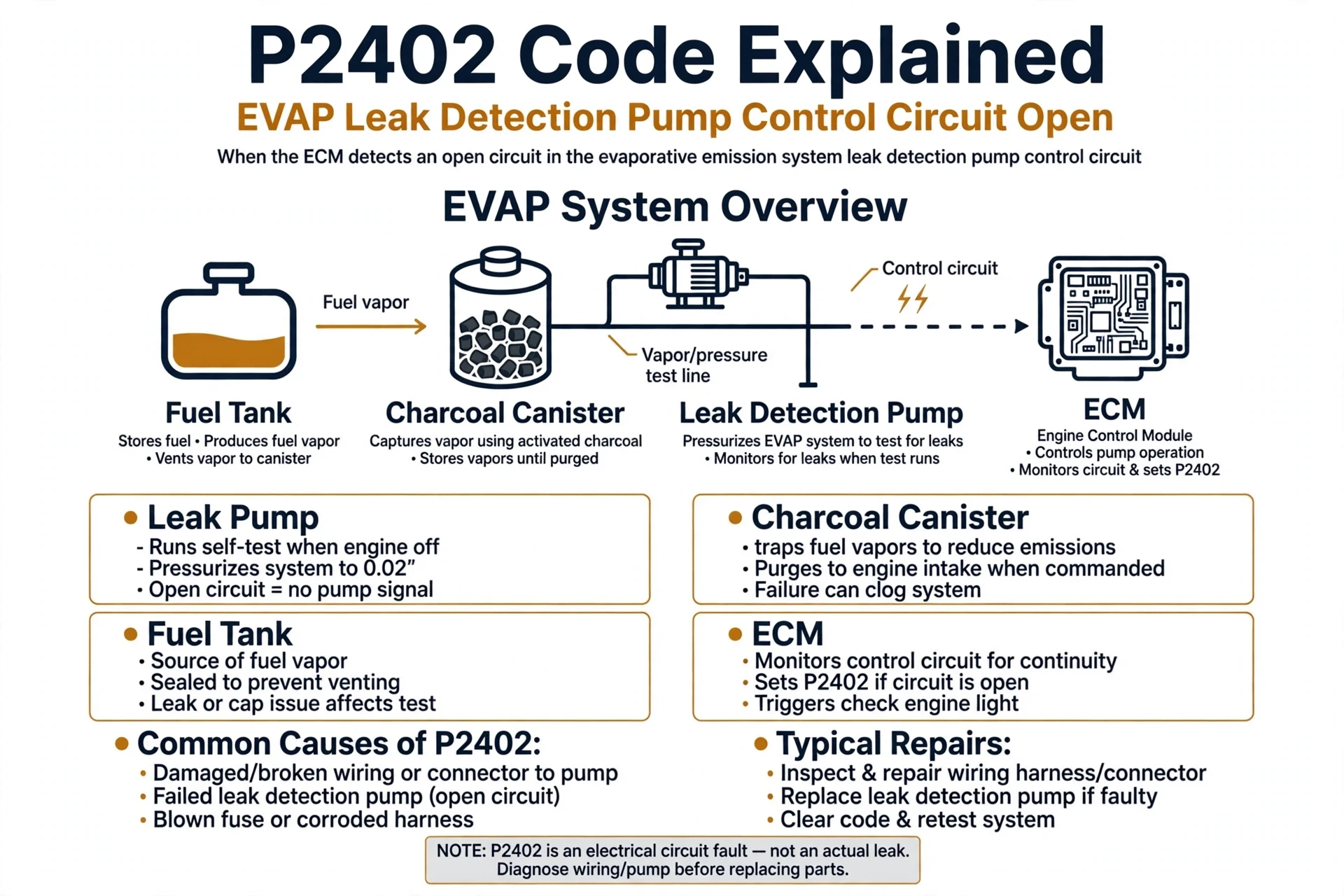
The P2402 code is an EVAP system trouble code that points at the leak detection pump circuit, not at a fuel vapor leak. Its full SAE definition is “Evaporative Emission System Leak Detection Pump Control Circuit/Open.” In plain English, your car’s computer has found an electrical fault in the wiring and control circuit that operates the EVAP leak detection pump.
Here is what that pump does. Your EVAP system traps fuel vapors from the gas tank so they do not escape into the air. The leak detection pump (LDP) pressurizes the sealed EVAP system so the computer can run its self-check for leaks. The computer (ECM/PCM) switches the pump on and watches the control circuit. If the circuit voltage reads higher than expected, or the circuit reads open, it stores the P2402 code and turns on the check engine light.
A quick note on the wording, because it confuses a lot of drivers. The generic SAE definition says “Circuit/Open,” but many scan tools and manufacturers (including BMW, Subaru, and Volkswagen) report P2402 as “Leak Detection Pump Control Circuit High.” Both wordings describe the same pump control circuit and the same electrical fault family. It is only a naming difference between the generic standard and the manufacturer description.
P2402 (p2402 code, dtc p2402, code p2402) is a generic powertrain code, which means it has the same basic meaning on every make and model, from a Volkswagen Jetta to a Toyota Camry.
Symptoms of the P2402 Code
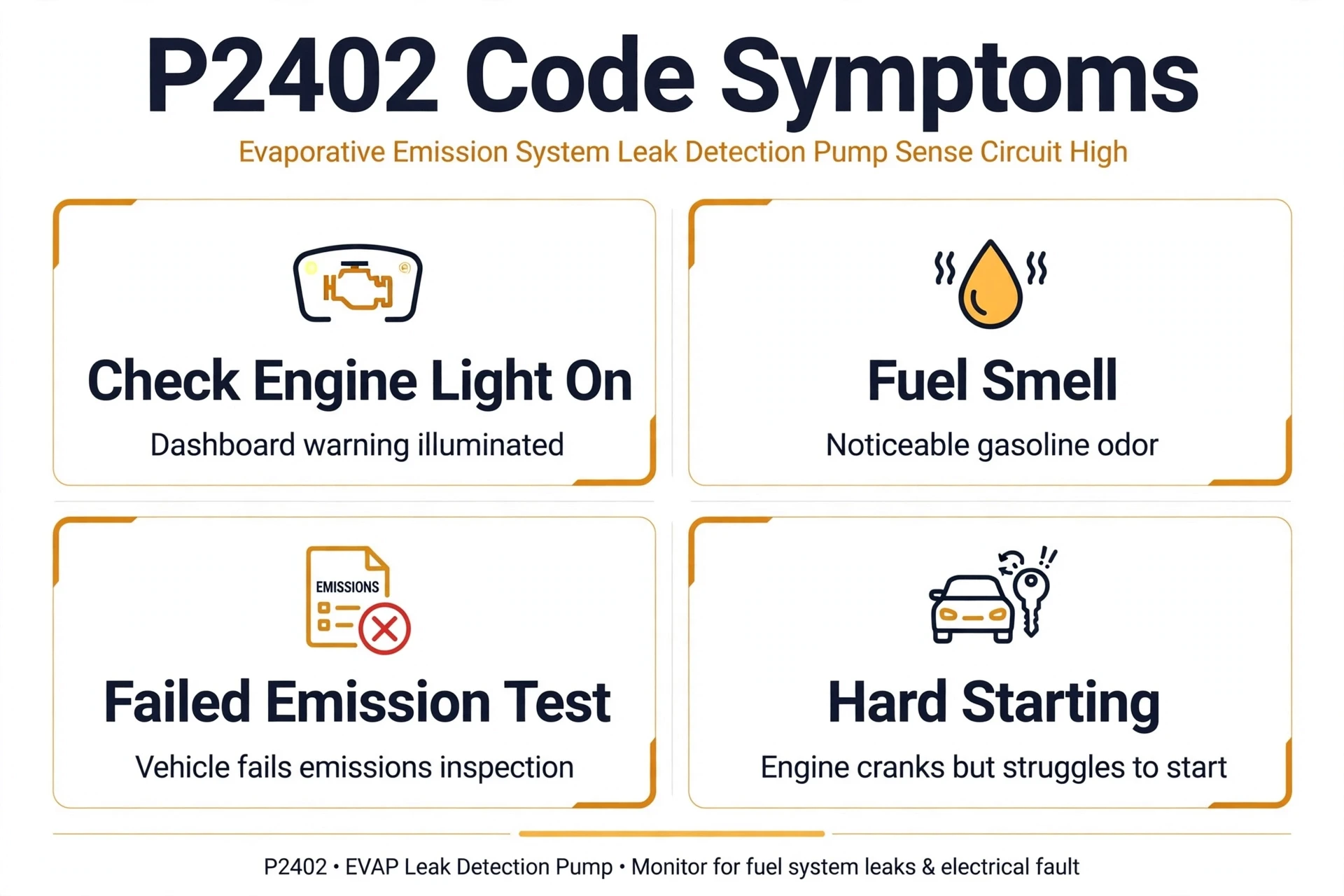
In most cases, the check engine light is the only symptom you will notice. The car will usually run and drive exactly the same as before, because this is an emissions circuit fault, not an engine performance fault. Still, depending on the situation, you might notice:
- Check engine light on (solid, not flashing)
- Failed emissions test, or the EVAP monitor stuck on “not ready” after several drive cycles
- The P2402 code keeps coming back right after you clear it
- A faint fuel or gasoline smell near the car (less common)
- Slightly reduced fuel economy (less common)
What is code P2402 trying to tell you? In short: this is an electrical problem in the pump control circuit. It does not mean your gas tank is leaking fuel vapors, and it is not caused by a loose gas cap.
Common Causes of P2402
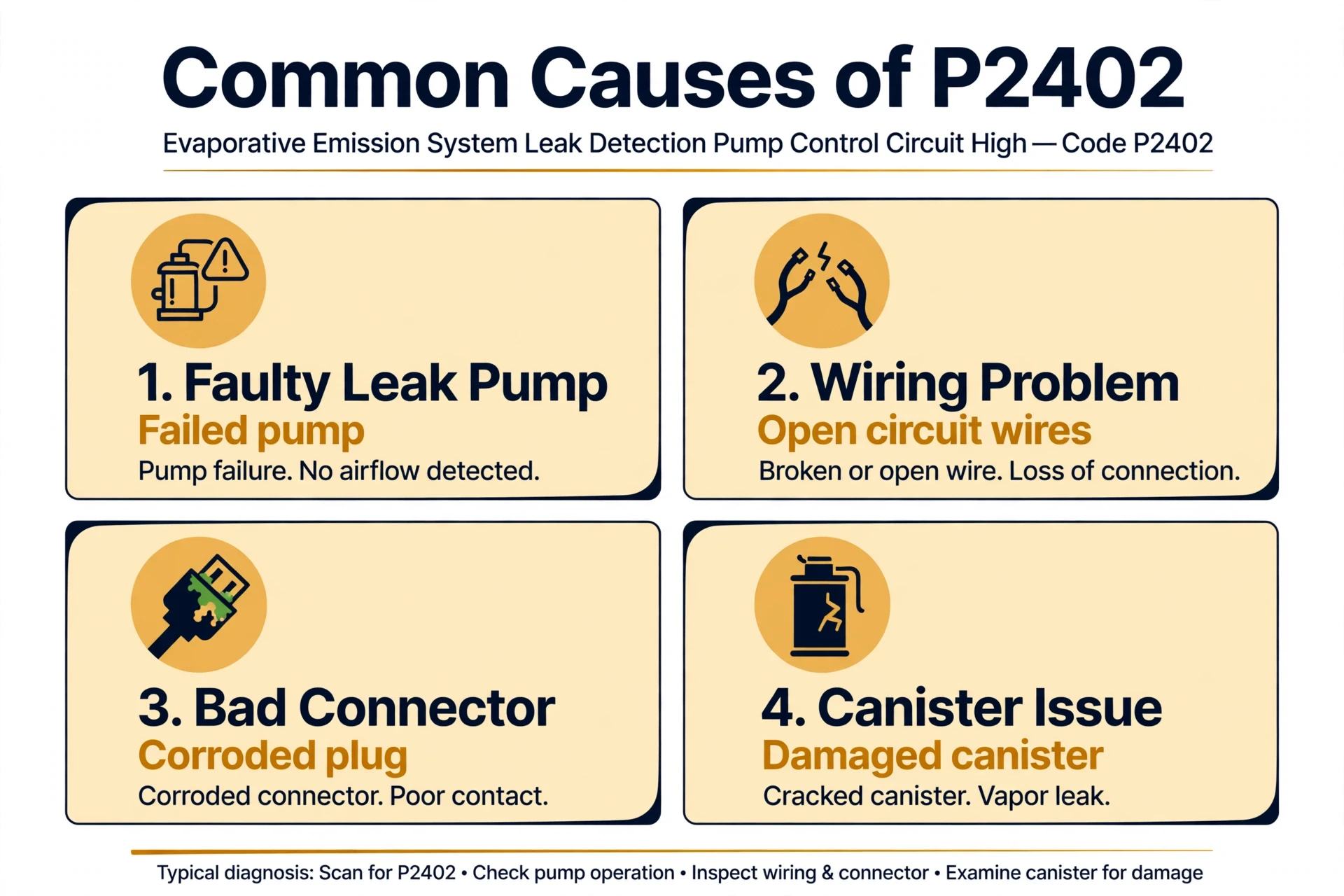
The most common cause of a P2402 code is a failed leak detection pump or damaged wiring to the pump. Here are the causes, roughly in order of likelihood:
- Faulty leak detection pump: an internal short or electrical/mechanical failure inside the pump itself. This is very common on Volkswagen and Audi models.
- Damaged wiring or connectors: frayed wires, a harness rubbed through on a sharp edge, corroded pins, or a short to power in the pump circuit.
- Blown fuse or bad relay: power supply problems feeding the EVAP circuit.
- Water intrusion or condensation: moisture inside the pump housing or connector boots can bridge circuits and skew the voltage reading.
- Faulty PCM/ECM output driver: the computer’s internal driver that commands the pump can fail, though this is rare.
- EVAP system blockage: clogged vapor lines or a stuck valve can overwork the pump and stress the circuit.
- PCM software or calibration issue: rarely, an outdated calibration misreads normal voltage as a fault, and a reflash fixes it.
One thing to rule out: a loose gas cap does not cause P2402. A loose cap triggers leak codes such as P0442. The P2402 code is strictly a control circuit issue.
How to Diagnose P2402 (Do This Before Buying Parts)
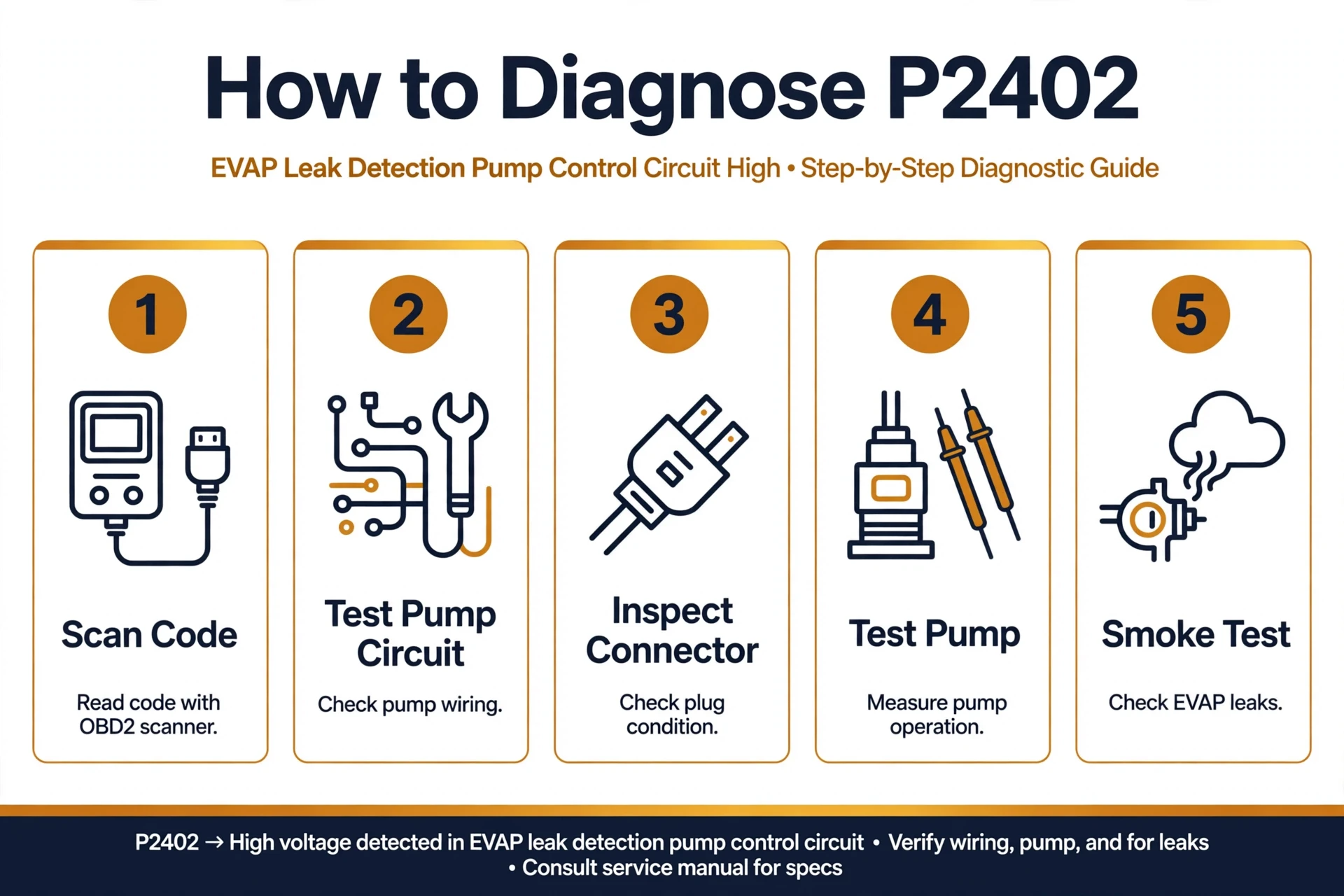
Mechanics see the P2402 code misdiagnosed often, usually because people replace the pump without checking the wiring first. Follow this order:
- Scan for other codes first. Note any companion EVAP codes such as P2401 (circuit low) or purge and vent valve codes, and check whether the EVAP readiness monitor shows not ready.
- Locate the leak detection pump. It is usually mounted on or near the charcoal canister, often tucked behind the rear passenger-side wheel area or close to the fuel tank.
- Visually inspect the wiring and connector. Look for frayed wires, rubbing, melted insulation, and green or white corrosion on the pins. Check the EVAP fuse and relay as well.
- Test the circuit with a multimeter. With the ignition on, verify power and ground at the pump connector and compare the control circuit voltage against the factory specification.
- Test the pump itself. Measure the pump coil resistance and compare it to the service manual specification. If you have a bi-directional scan tool, command the pump on and listen for it running.
- Check for water intrusion. If the connector or pump housing shows moisture or corrosion, dry it, clean the pins, and seal the connector with dielectric grease.
- Suspect the computer last. If the wiring, fuse, relay, and pump all test good, the PCM output driver or its calibration is the remaining suspect.
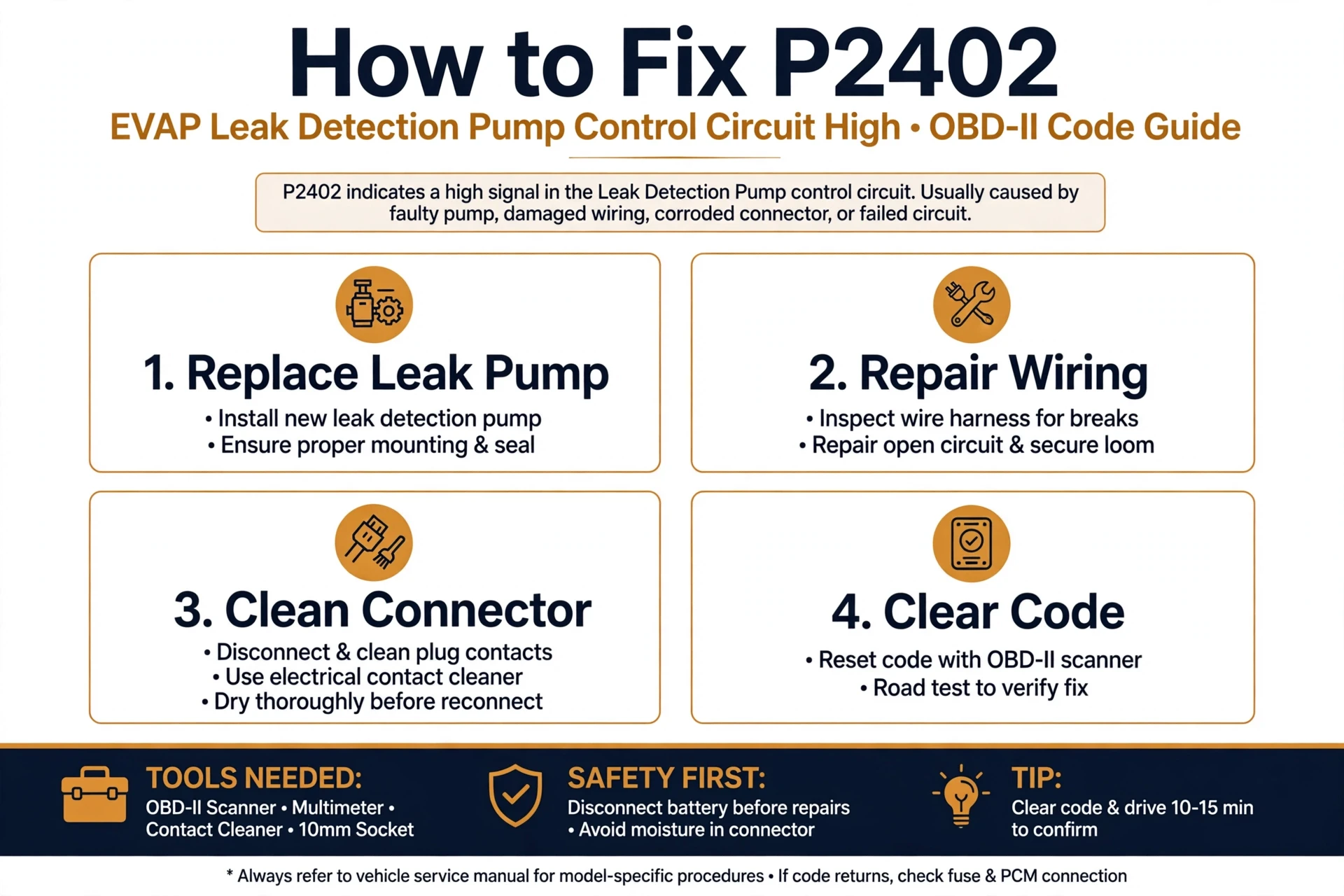
How to Fix the P2402 Code
The right fix depends on what your diagnosis found:
- Repair damaged wiring: fix frayed or shorted wires, clean corroded connectors, and protect the harness from rubbing. This solves many P2402 cases.
- Replace a blown fuse or faulty relay: cheap and quick, but always find out why the fuse blew.
- Replace the leak detection pump: if the pump is internally shorted or fails its resistance and activation tests, a new pump assembly is the fix. On many cars it is a simple bolt-on part near the canister.
- Dry out and seal the connector: if moisture caused the fault, clean the pins and apply dielectric grease to keep water out.
- Update the PCM software: if the manufacturer released a calibration update for this code, a reflash can resolve it.
- Replace the PCM: only as a last resort, when the computer’s pump driver is proven internally damaged.
After any repair, clear the P2402 code and run a full drive cycle (or an EVAP leak detection self-test with a scan tool) to confirm the code stays gone.
P2402 Repair Costs
Drivers always ask how much it costs to fix P2402, and the answer depends on the cause. Here are realistic ranges:
| Repair | Cost Range |
|---|---|
| Leak detection pump (part) | $100 – $300 |
| Pump replacement labor | $150 – $250 |
| Wiring repair / connector service | $100 – $250 |
| Fuse or relay replacement | $20 – $80 |
| PCM software update (reflash) | $100 – $200 |
| PCM replacement (rare) | $500 – $1,500+ |
This is why diagnosis matters. A $30 relay and a $400 pump job share the same P2402 code.
DIY vs Mechanic Verdict
You can do this at home: reading codes with an OBD2 scanner, locating the pump, visual wiring inspection, checking and replacing fuses and relays, and replacing the pump itself on cars where it is easily accessible.
See a mechanic for: multimeter circuit testing if you are not comfortable with electrical diagnosis, bi-directional pump testing, PCM reflashing or replacement, and EVAP testing with a smoke machine.
Bottom line: diagnose it yourself, fix the simple stuff yourself, but let a pro handle computer-level faults.
Can You Drive With a P2402 Code?
Generally yes. The P2402 code does not affect how the engine runs, so the car will drive normally. But there are two catches: you will fail an emissions test while the code is active (the EVAP monitor will show not ready), and ignoring it lets the EVAP system deteriorate. Get it fixed reasonably soon, especially if your state tests emissions.
P2402 on Popular Vehicles
P2402 shows up across all brands, but some patterns are worth knowing:
- Volkswagen (Passat, Jetta, Tiguan, Atlas): The p2402 VW code is one of the most reported EVAP codes. The pump often sits behind the rear passenger-side area, and pump replacement is a well-documented fix.
- Audi (Q5 and others): Audi shares the VW-group EVAP design, so the same pump and wiring failures appear here.
- Toyota (Camry, Corolla, RAV4, Tacoma): The p2402 Toyota code often appears with companion codes like P2401, P043E, or P043F. Check the pump and the charcoal canister area.
- BMW and Subaru: these makes often word the code as circuit high instead of circuit open. It is the same pump circuit family and the same diagnostic approach.
- Volvo (S60 and others): pump replacement is a known fix for the p2402 Volvo code.
- Land Rover / Range Rover: reported on several models. Inspect the pump and its harness for water intrusion.
P2402 vs Related Codes
These EVAP codes look similar but point at different parts of the system:
- P2402: leak detection pump control circuit open (SAE wording). Many scan tools and makes like BMW and Subaru report it as circuit high. Same pump circuit family either way.
- P2401: leak detection pump control circuit low. The twin of P2402: same pump, but the voltage reads too low instead of too high or open.
- P2419: EVAP switching valve control circuit low. A different component (the switching valve), in the same EVAP family.
- P2422 / P0446 / P0449: other EVAP codes covering vent and purge valve circuits, not the leak detection pump.
- P2400: leak detection pump control circuit open. A closely related sibling code for the same pump circuit.
Related Codes
- P2401: Evaporative Emission System Leak Detection Pump Control Circuit Low
- P2400: Evaporative Emission System Leak Detection Pump Control Circuit/Open
- P2419: Evaporative Emission System Switching Valve Control Circuit Low
- P0446: Evaporative Emission Control System Vent Control Circuit
- P0449: Evaporative Emission System Vent Valve/Solenoid Circuit
- P0455: Evaporative Emission System Leak Detected (Large Leak)
Video Walkthrough
Watch the video above for a visual walkthrough of P2402 causes, symptoms, and fixes before you read on.
Frequently Asked Questions
What does the P2402 code mean?
The P2402 code means the car’s computer detected an electrical fault (open or high voltage) in the control circuit for the EVAP leak detection pump. The pump pressurizes the evaporative emission system so the computer can check it for leaks, and P2402 says the circuit controlling that pump is not behaving normally.
What is the most common cause of a P2402 code?
A failed leak detection pump is the single most common cause, especially on Volkswagen and Audi models. Damaged wiring, corroded connectors, and blown fuses or relays in the pump circuit are the next most likely culprits.
Can I still drive my car with a P2402 code?
Yes. The P2402 code does not change how the engine runs, so normal driving is fine. Just know that you will fail an emissions test while the code is active, so plan the repair before your inspection is due.
How do you fix the code P2402?
Diagnose first: check for companion codes, inspect the pump wiring and connector, test the fuse and relay, and test the pump itself. Then repair the wiring, replace the fuse or relay, or replace the leak detection pump, depending on what failed. Clear the code and run a drive cycle to confirm the fix.
How much does it cost to fix P2402?
A new leak detection pump costs about $100 to $300 for the part, plus $150 to $250 in labor if a shop does it. Wiring repairs run $100 to $250, while a fuse or relay is under $80. PCM faults are rare but cost much more.
Will P2402 clear itself?
Rarely. If the underlying electrical fault is still there, the code comes back within a few drive cycles after clearing. Some drivers see it return immediately. Fix the circuit fault and the code will stay cleared.
Can a loose gas cap cause P2402?
No. A loose gas cap triggers leak codes such as P0442, not P2402. The P2402 code is strictly an electrical control circuit fault for the leak detection pump, so tightening the cap will not fix it.
Conclusion
The P2402 code looks technical, but it is really your car asking for a wiring check, not an expensive guess. Most of the time the fix is a new leak detection pump or a repaired wire, and the car never drove badly in the first place.
Work through the diagnosis steps before buying parts, clear the code after the repair, and confirm the EVAP monitor completes. That is the whole job.
About the author: Written by the OBD2 Code Hub editorial team. Our diagnostic guides are built from real OBD-II data, manufacturer service procedures, and hands-on troubleshooting experience, then reviewed for technical accuracy before publishing. We drive the same cars you do.