
P0036 Trouble Code: Meaning, Causes, Symptoms & Fixes
In This Guide
One-line meaning: The heater inside the downstream O2 sensor on Bank 1 is not working, usually because of a burned-out heater element, a blown heater fuse, or damaged heater wiring.
What the P0036 Code Means
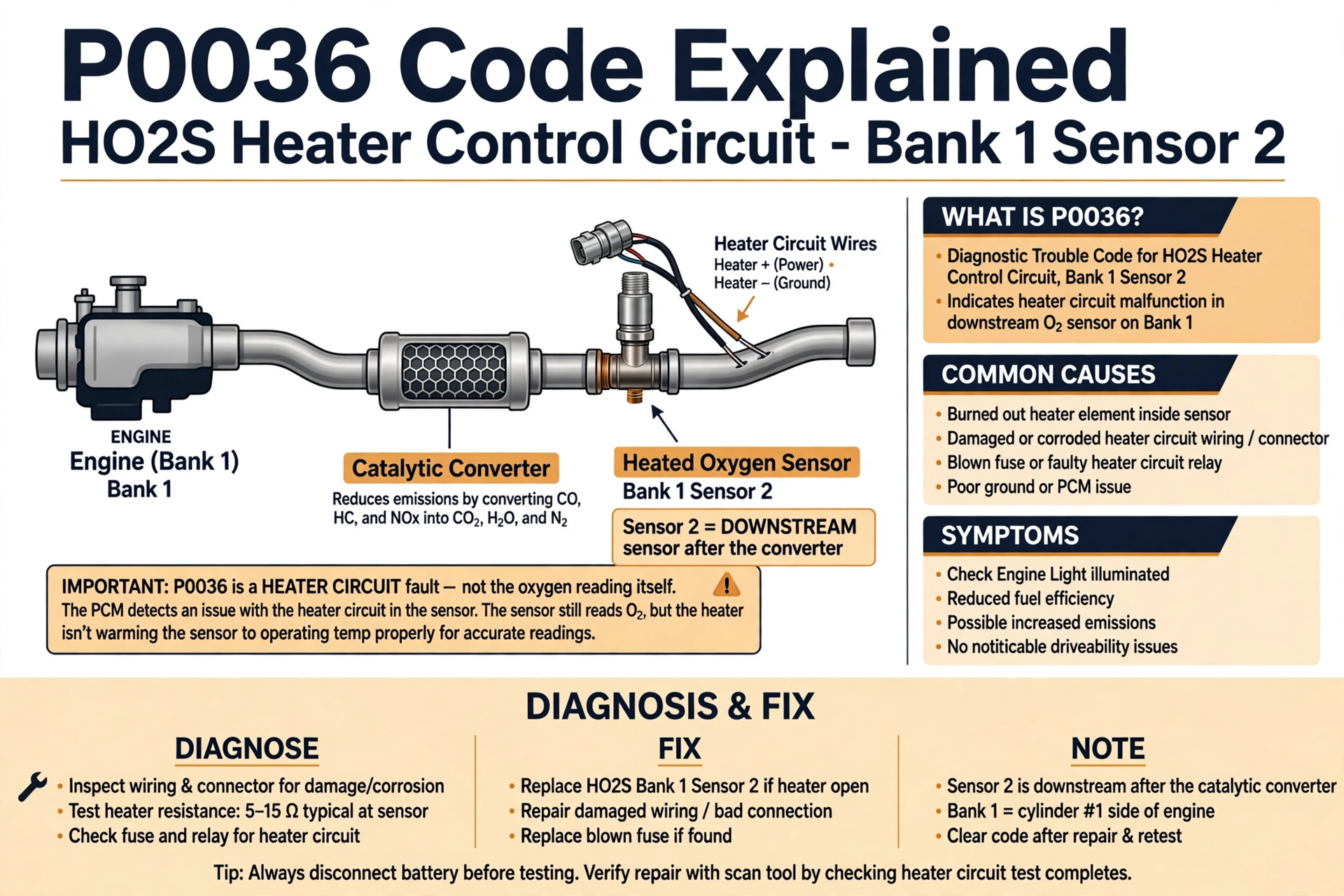
P0036 is a generic OBD-II powertrain code defined as “HO2S Heater Control Circuit (Bank 1, Sensor 2).” So, if you scanned your vehicle and found the p0036 engine code, this guide explains exactly what it means and how to fix it.
The code sets when the powertrain control module (PCM) detects that the heater current or voltage in the Bank 1 Sensor 2 heater circuit is out of range. Every modern O2 sensor contains a small ceramic or PTC heating element that draws roughly 0.5 to 2 amps, so the sensor can reach its operating temperature of about 600°F within a minute or two of a cold start. When that heater circuit fails electrically, the PCM stores the p0036 code and turns on the check engine light.
Bank 1 is the side of the engine that holds cylinder number 1, and sensor 2 is the downstream sensor, the one mounted after the catalytic converter. Here is the critical distinction most guides blur: P0036 is the GENERAL heater circuit code. It is not “Low” (that is P0037) and not “High” (that is P0038). P0036 simply means the heater control circuit is malfunctioning, whether the cause is an open circuit, a short, a blown fuse, or a dead heater element.
And here is the angle most guides miss: the fault is in the heater circuit, not in the oxygen reading itself. The sensor still reads O2, but its heater is not warming it to operating temperature. Because the downstream sensor only monitors catalyst efficiency and never steers the air-fuel mixture, the engine usually keeps running fine. The real damage is slower and quieter: without rapid heat-up, the catalyst monitor cannot run, your readiness flags will not set, and the car will fail an emissions test.
Symptoms of the P0036 Code
First, many drivers notice only the check engine light. Because the heater is only critical while the engine is cold, and the downstream sensor does not control fuel trim, the car often drives exactly as before. Watch for these symptoms of the p0036 code:
- Check engine light on (often the only symptom)
- Slightly worse fuel economy
- Failed state emissions or smog test
- O2 sensor and catalyst readiness monitors stuck at “Not Ready”
- Occasional cold-start hesitation (rare)
- Failsafe or reduced-power mode on some models
If the car runs normally otherwise, that is expected. The heater fault rarely changes how the engine feels, which is why so many drivers are surprised by the p0036 code on an otherwise healthy-feeling car.

Common Causes of P0036
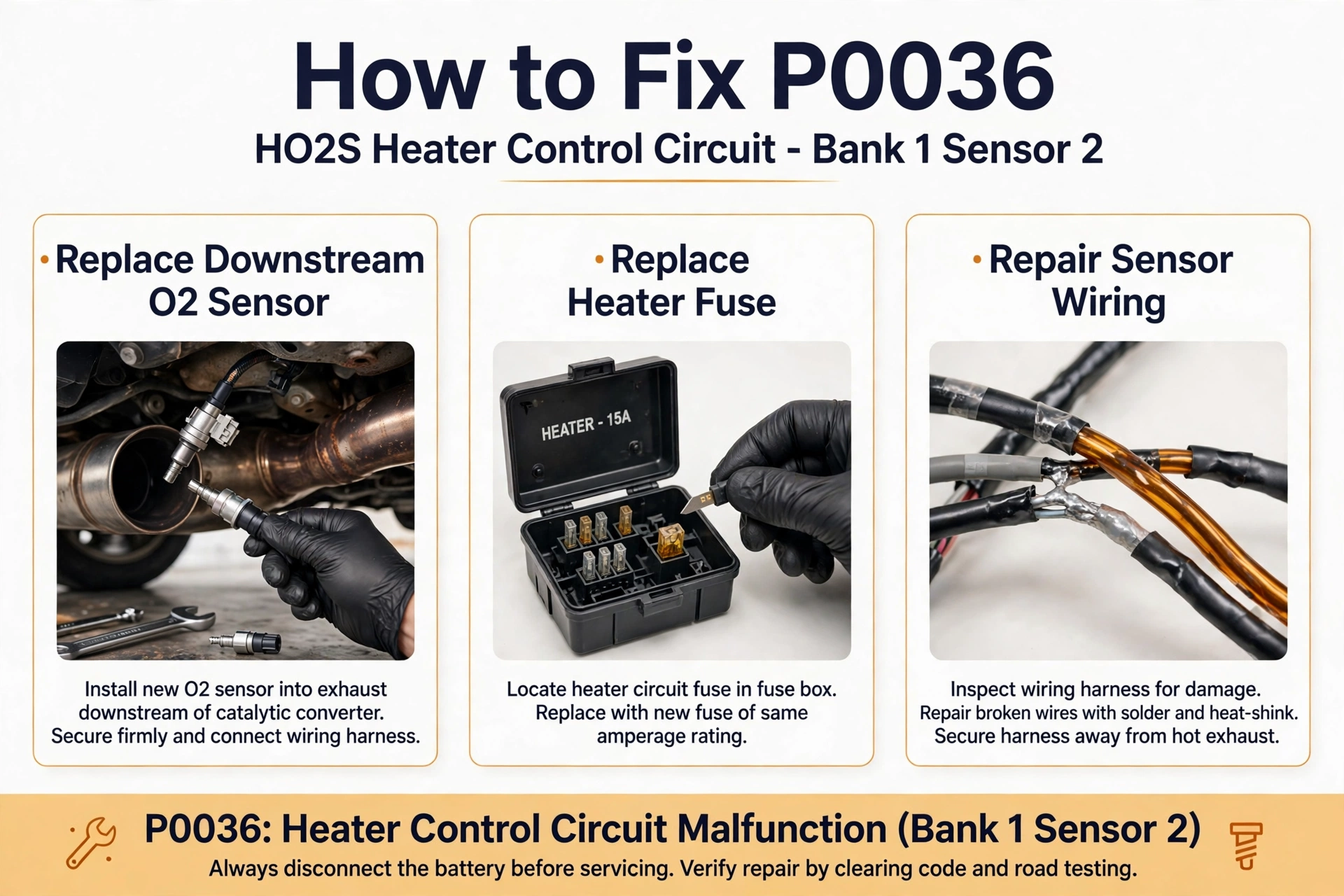
- Failed O2 sensor heater element: the most common cause. The internal heater coil burns out after high mileage, or fails early from oil or coolant contamination, leaving the sensor cold and slow.
- Blown heater fuse: many vehicles share one fuse across several O2 heaters. A blown fuse kills the Bank 1 Sensor 2 heater along with the others, so check this before buying parts.
- Damaged wiring or connector: the sensor lives in exhaust heat. Melted insulation, chafed or broken pigtail wires, and corroded connectors are frequent culprits.
- Open or shorted heater driver circuit: a short to ground or an open in the heater control wire between the PCM and the sensor sets P0036 immediately.
- Faulty heater relay: on vehicles that switch heater power through a relay, a stuck or burned relay cuts power to the heater circuit.
- PCM heater driver failure: rare, but the PCM’s internal heater driver transistor can fail, especially after a heater short. Rule out everything else first.
Therefore, check the fuse first. A surprising number of P0036 comebacks are fixed with a fuse that costs a few dollars, not a new sensor.
How to Diagnose P0036 (Do This Before Buying Parts)
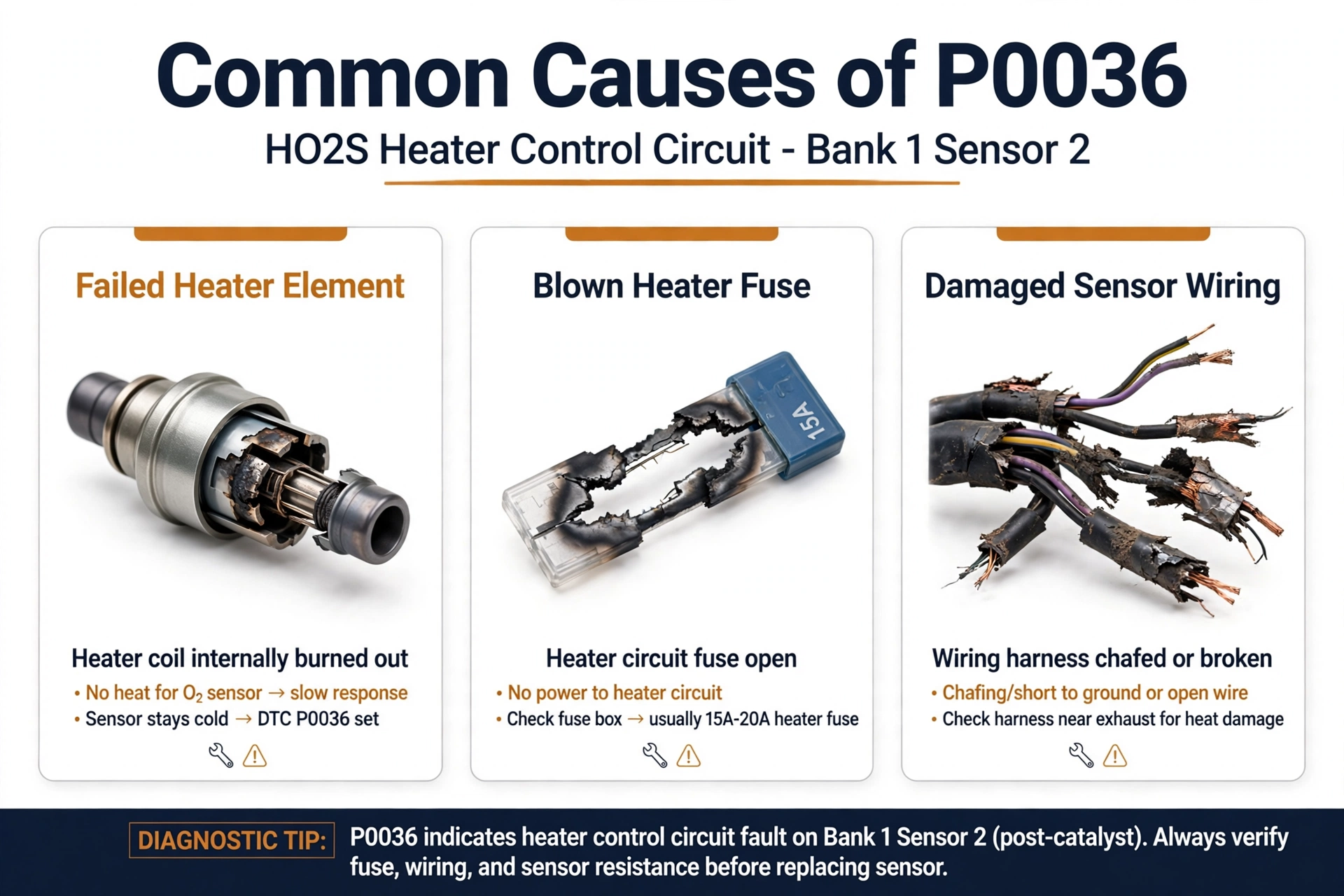
- Confirm the code and read the whole picture. First, verify the p0036 code is active with your scan tool and note any companion codes. Paired heater codes such as P0141, P0155, or P0161 point at a shared fuse or power feed, while P0036 alone points at the sensor or its single wire.
- Check the O2 heater fuse. Consult the underhood fuse box label and test the heater fuse. A blown fuse is a five-minute fix. If a new fuse blows immediately, unplug each O2 sensor one at a time to find the shorted leg.
- Inspect the wiring and connector. Follow the harness from the Bank 1 Sensor 2 connector toward the PCM. Look for melted insulation near the exhaust, chafed or broken wires, corrosion, and loose pins.
- Test the heater resistance. Unplug the sensor and measure resistance across the heater pins (usually the two same-colored wires, but check the diagram). Expect roughly 3 to 15 ohms depending on the vehicle. An open reading means a burned-out heater, and near zero means it is shorted.
- Check heater power and ground. With the sensor unplugged and the key on, check the heater power pin for battery voltage. Then back-probe the ground wire and compare its resistance against a known-good ground.
- Clear, drive, and re-scan. Finally, after the repair, clear the code, complete a full drive cycle (cold start, warm-up, highway, idle), and confirm P0036 does not return and the readiness monitors set.
How to Fix the P0036 Code
Once you know which part failed, fixing the p0036 code is usually straightforward:
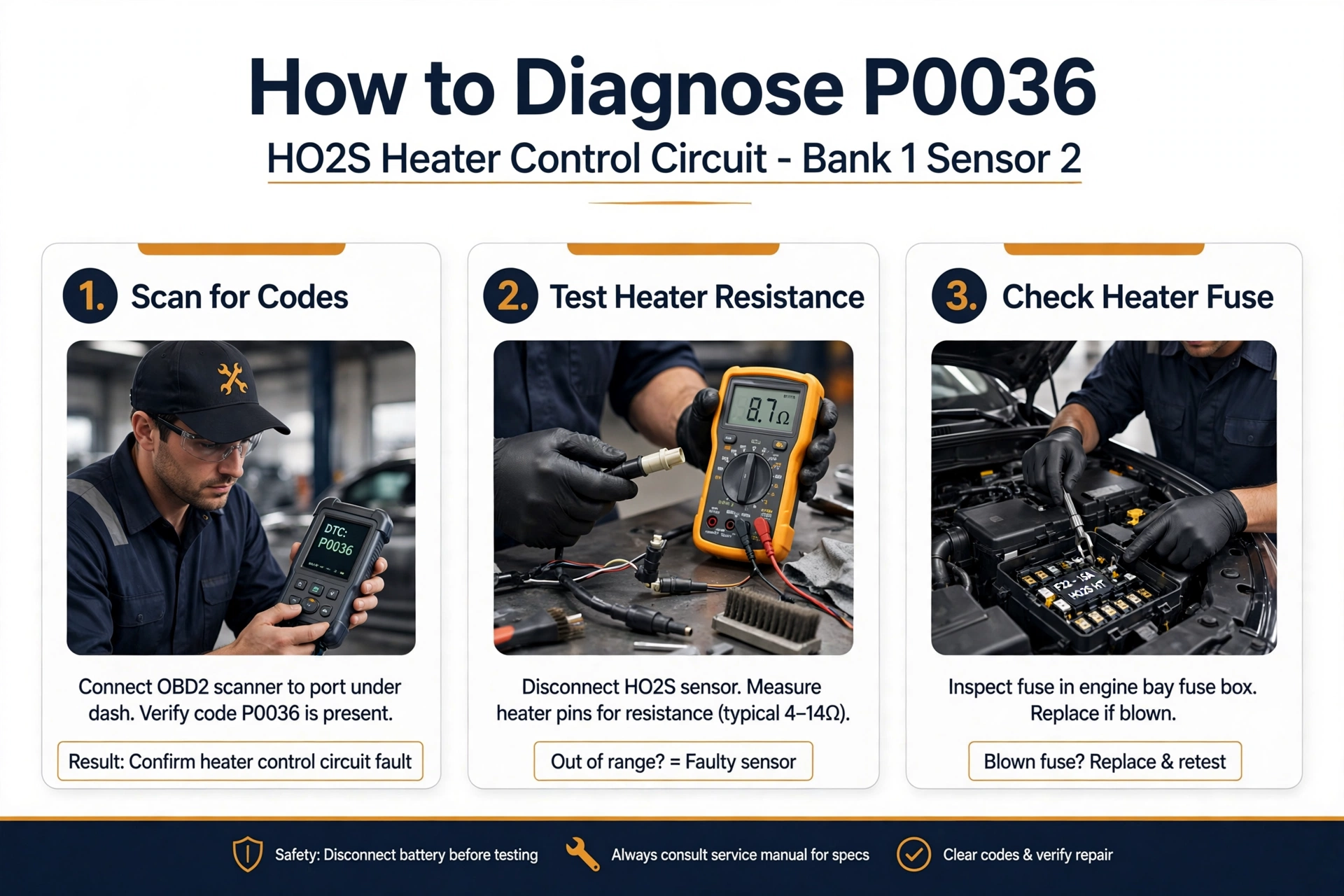
- First, replace the downstream O2 sensor (Bank 1 Sensor 2) when the heater resistance test shows the element is open or shorted. Use an OEM-quality or direct-fit sensor and an O2 sensor socket, and torque the new sensor to spec.
- Replace a blown heater fuse or faulty relay: use the correct amperage fuse. If the new fuse blows again, you have a short that must be found before anything else.
- Repair damaged wiring and connectors: splice in fresh wire with heat-shrink solder connectors rated for high-temperature use, replace corroded connectors, and reroute the harness away from hot exhaust parts.
- Replace a damaged pigtail when the sensor tests good but its pigtail is melted or brittle. On platforms prone to pigtail melt, replace the pigtail along with the sensor.
- Clear the code and verify with a test drive and a final scan. Finally, re-scan after a full drive cycle to make sure P0036 stays gone and the catalyst monitor runs to completion.
P0036 Repair Costs
In general, costs vary by vehicle and labor rates, but these ranges cover the most common P0036 repairs:
| Repair | Cost Range |
|---|---|
| Downstream O2 sensor replacement | $150 – $400 |
| Heater fuse replacement | $30 – $80 |
| Heater relay replacement | $80 – $180 |
| Wiring harness repair | $150 – $300 |
| Pigtail / connector replacement | $120 – $250 |
| PCM reflash / replacement (rare) | $500 – $1,500 |
A downstream O2 sensor replacement is the most common fix, with national averages landing around $150 to $400 including parts and labor. A DIY sensor swap can cost as little as $40 to $250 for the part alone, while a blown fuse fix costs just a few dollars if you do it yourself.
DIY vs Mechanic Verdict
You can do this at home: scanning the code, checking the heater fuse, inspecting the sensor wiring and connector, replacing the Bank 1 Sensor 2 O2 sensor with basic hand tools and an O2 sensor socket, and clearing the code afterward.
See a mechanic for: tracing a short in the heater driver circuit, PCM heater driver diagnosis and reflash, and any repair where a fresh fuse blows immediately.
Bottom line: Overall, the p0036 code is one of the friendlier codes for DIYers, but do the diagnosis first. A five-minute fuse check can save you the cost of a sensor you did not need.
Can You Drive With a P0036 Code?
For short trips, usually yes. P0036 will not strand you, and most cars drive normally with it because the downstream sensor does not control fuel delivery. However, there are two real risks: you will fail any emissions or smog test while the light is on, and some vehicles drop into a failsafe mode with reduced performance. Long term, a dead heater can shorten catalyst life by delaying accurate post-cat monitoring. Instead, keep trips short and diagnose the p0036 code within days rather than months.
P0036 on Popular Vehicles
- Toyota: the p0036 toyota code is very common on the Camry, Corolla, RAV4, and Tacoma, where Denso sensors tend to fail between 100,000 and 150,000 miles. Always use a Denso OE-equivalent replacement.
- Honda: the p0036 honda code shows up on the Civic, Accord, CR-V, and Pilot. On the Pilot and Odyssey, water intrusion at the sensor connector is a known pattern, so inspect the connector before condemning the sensor.
- Nissan: the p0036 nissan code is common on the Altima, Sentra, and Rogue, where aged downstream sensors and heat-damaged pigtails near the exhaust are the usual culprits.
- Ford: the p0036 ford code appears on the F-150, Escape, and Focus. On the F-150 with the 5.4L V8, pigtail melt is a known pattern, so replace the pigtail when you change the sensor.
- Chevrolet: the p0036 chevy code is common on the Silverado, Sierra, and Equinox, and it often arrives paired with P0141 because of a shared heater fuse. Check the fuse before condemning the sensor.
- Jeep: the p0036 jeep code shows up on the Wrangler and Grand Cherokee, where the sensor harness can rub against the frame or exhaust. Inspect the full harness run before buying parts.
P0036 vs P0037, P0038 and P0035
These codes all involve O2 sensor heater circuits, but they describe different faults:
- P0036 vs P0037: P0036 is the general heater control circuit malfunction for Bank 1 Sensor 2, while P0037 is the specific “Low” variant, meaning the heater circuit voltage reads low, often from a short to ground.
- P0036 vs P0038: P0038 is the specific “High” variant for Bank 1 Sensor 2, meaning the heater circuit voltage reads high, often from a short to power. P0036 covers any other heater circuit malfunction on the same sensor.
- P0036 vs P0035: P0035 is the same kind of heater control circuit code, but for Bank 1 Sensor 1, the upstream sensor ahead of the catalytic converter.
- P0036 vs P0141: P0141 is a heater PERFORMANCE code for the same Bank 1 Sensor 2 sensor, meaning the heater works but warms up too slowly. P0036 is a heater CIRCUIT code, meaning the circuit itself is electrically faulty.
The Bank 2 mirror of P0036 is P0161 (O2 Sensor Heater Circuit Malfunction, Bank 2 Sensor 2).
Related Codes
- P0037: HO2S Heater Control Circuit Low (Bank 1, Sensor 2)
- P0038: HO2S Heater Control Circuit High (Bank 1, Sensor 2)
- P0035: HO2S Heater Control Circuit (Bank 1, Sensor 1)
- P0141: O2 Sensor Heater Circuit Malfunction (Bank 1, Sensor 2)
- P0135: O2 Sensor Heater Circuit Malfunction (Bank 1, Sensor 1)
- P0161: O2 Sensor Heater Circuit Malfunction (Bank 2, Sensor 2)
- P0420: Catalyst System Efficiency Below Threshold (Bank 1)
Video Walkthrough
Watch the video above for a visual walkthrough of P0036 code causes and fixes before you read on.
Frequently Asked Questions
What is the most common cause of a P0036 code?
A burned-out heater element inside the downstream O2 sensor is the most common cause of P0036. After high mileage or contamination from oil or coolant, the internal heater coil fails open and the sensor stays cold. A blown heater fuse and damaged wiring near the exhaust are the next most common causes, which is why checking the fuse should come before buying a new sensor.
Can I still drive my car with a P0036 code?
Usually yes, for short trips. P0036 will not leave you stranded, and the car often drives normally because the downstream sensor does not control fuel delivery. The main risks are a guaranteed emissions test failure and possible failsafe mode on some models. Keep driving to a minimum and diagnose the code within a few days.
How do you fix the code P0036?
Fix P0036 by first checking the O2 heater fuse, then inspecting the Bank 1 Sensor 2 wiring and connector. Test the heater resistance with a multimeter and replace the downstream O2 sensor if the heater is open or shorted. Repair any damaged wiring, then clear the code and complete a drive cycle to verify.
How much does it cost to fix P0036?
The most common fix, a downstream O2 sensor replacement, costs about $150 to $400 including parts and labor. A DIY sensor swap runs $40 to $250 for the part, wiring repairs run $150 to $300 at a shop, and a blown fuse costs only a few dollars if you replace it yourself.
More P0036 FAQs
Will P0036 clear itself?
P0036 can clear itself if the fault stops occurring for enough drive cycles, but a burned-out heater or a blown fuse will not heal on its own, so the light usually returns. Diagnose and repair the root cause, then clear the code with a scan tool and confirm it stays off.
Which O2 sensor is bank 1 sensor 2?
Bank 1 is the side of the engine containing cylinder number 1. Sensor 2 is the downstream sensor, mounted in the exhaust after the catalytic converter. On a four-cylinder engine there is only one bank, so Bank 1 Sensor 2 is the single rear O2 sensor behind the cat.
Will P0036 cause me to fail an emissions test?
Yes. An illuminated check engine light is an automatic failure in most state emissions programs, and the dead heater keeps the O2 sensor and catalyst readiness monitors from setting to Ready. Fix the underlying fault, clear the code, and complete a drive cycle so all monitors read ready before testing.
Conclusion
P0036 means the heater circuit in the Bank 1 Sensor 2 oxygen sensor is malfunctioning, and the fix is usually straightforward: check the heater fuse first, then inspect the wiring, then replace the downstream sensor if its heater has failed. Above all, remember this is a heater circuit fault, not a fuel mixture problem, so do not chase fuel trim data. Finally, work through the diagnosis steps above, make the repair, and verify with a test drive so the check engine light stays off and the p0036 code stays cleared.
About the author: Written by the OBD2 Code Hub editorial team. Our diagnostic guides are built from real OBD-II data, manufacturer service procedures, and hands-on troubleshooting experience, then reviewed for technical accuracy before publishing. We drive the same cars you do.