
P0410 Trouble Code: Meaning, Causes, Symptoms & Fixes
In This Guide
One-line meaning: P0410: Secondary Air Injection System Malfunction.
What the P0410 Code Means
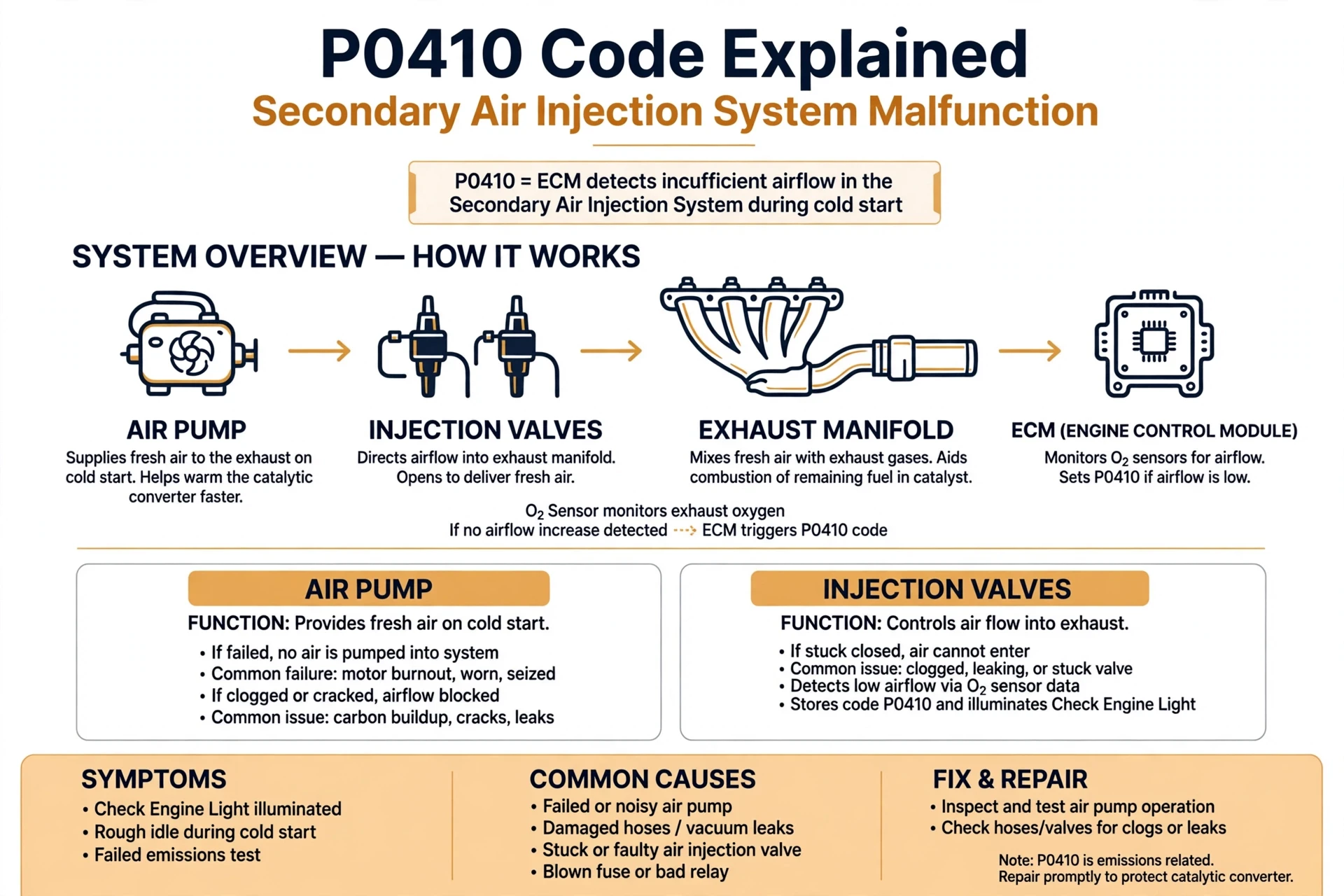
The P0410 code is a check engine light code that confuses a lot of drivers, because the part it points at only runs for a few seconds per drive. Its full definition is “Secondary Air Injection System Malfunction” (p0410 secondary air injection system malfunction). In plain English, your car’s engine computer (ECM/PCM) ran a self-test on the secondary air injection system, and the system failed it.
Here is what that system does. Right after a cold start, an electric air pump pushes fresh outside air into the exhaust stream for about 20 to 40 seconds. That extra oxygen helps burn off leftover unburned fuel and heats the catalytic converter faster, so the converter starts cleaning exhaust sooner and tailpipe emissions drop.
Here is how your car figures this out. An oxygen sensor watches the exhaust. The ECM runs the test in two stages: first a passive check, then an active test where it commands the air pump on and compares O2 readings with the system off versus on. If the sensor never sees the expected jump in oxygen when the pump runs, the computer stores the P0410 code.
P0410 (p0410 obd ii, code p0410) is a generic powertrain code, which means it has the same meaning on every make and model, from a Chevy Silverado to a Mercedes C-Class to a Ford F-150. Its close cousin is the P0411 code, which means the system ran but the measured airflow was wrong.
Symptoms of the P0410 Code
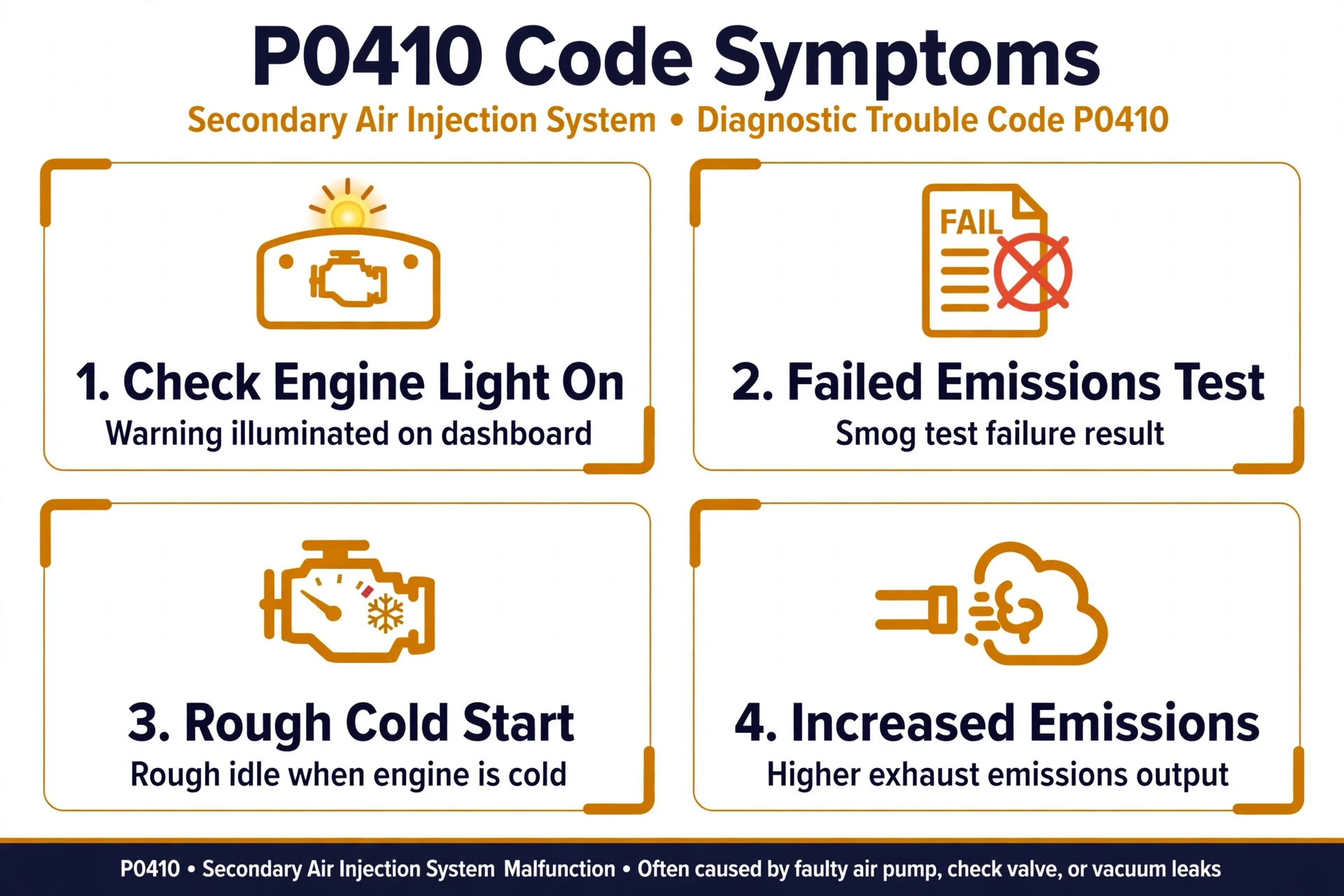
In many cases, the check engine light is the only symptom you will notice. The secondary air pump only runs for under a minute after a cold start, so the car usually drives exactly the same as before. However, depending on what is causing it, you might also notice:
- Check engine light on, with the code stored in ECM memory along with freeze frame data
- Failed emissions or smog test, which matters a lot in strict states like California
- Unusual noise from the air pump area at cold start: loud whining or grinding from worn pump bearings, or total silence when you should hear the pump hum
- Slight hesitation when accelerating from cold
- The engine running rich, with higher fuel consumption than usual
What is code P0410? What is the p0410 code trying to tell you? In short: the cold-start emissions system is not doing its job. Do not ignore it just because the car still drives.
Common Causes of P0410
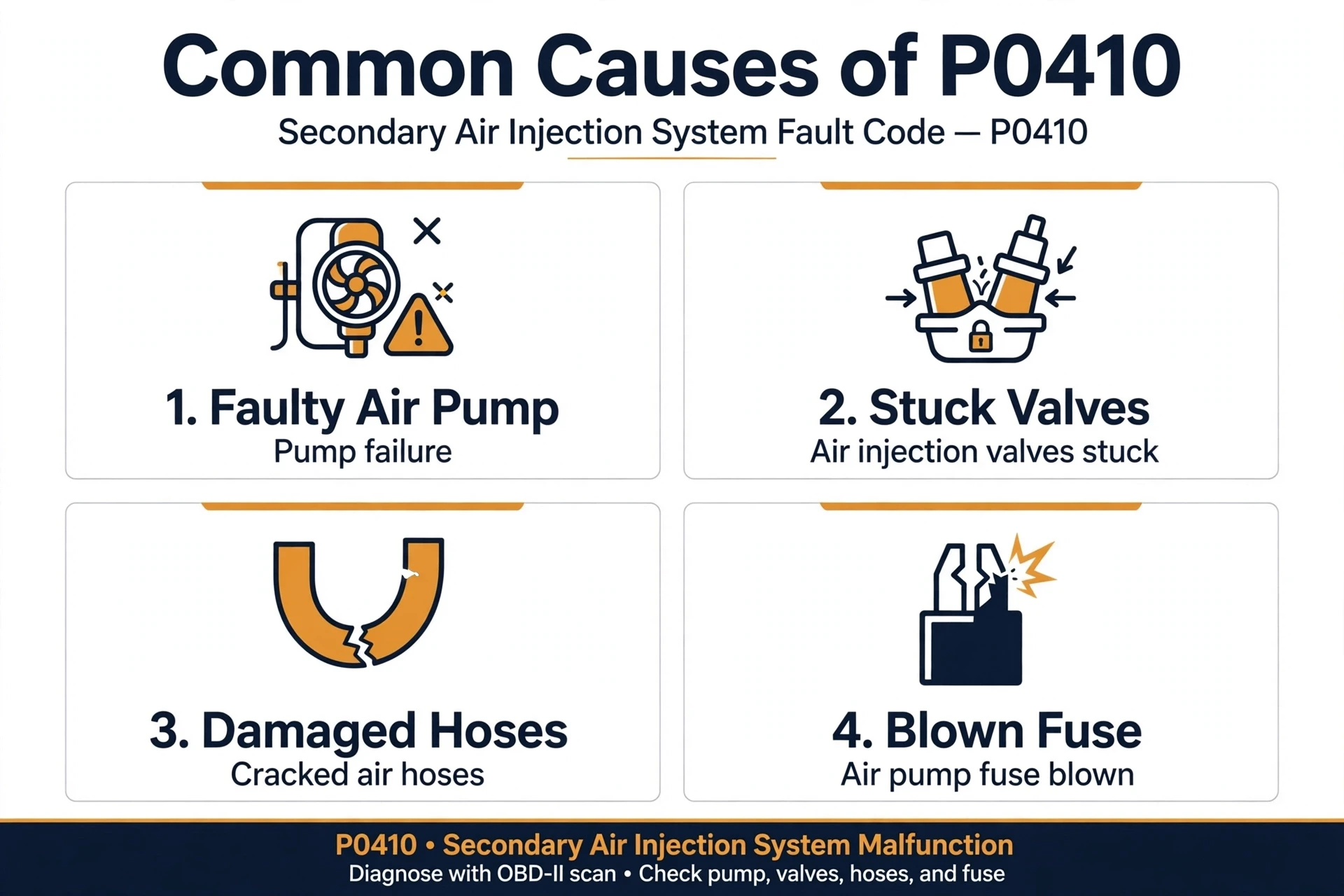
The most common cause of a P0410 code is a failed secondary air injection pump, often one that has taken in water and corroded inside. But the pump is far from the only cause, and replacing it without testing is the most expensive mistake drivers make with this code. Here are the causes, roughly in order of likelihood:
- Failed secondary air pump: the electric motor seizes, burns out, or wears out its impeller vanes. Water intrusion is the classic killer, especially on GM trucks where the inlet hose routing lets moisture in.
- Blown pump fuse: the high-amp fuse (often a 30A maxi fuse) feeding the pump. A dying pump draws excess current and keeps blowing new fuses.
- Bad air pump relay: burnt or pitted relay contacts, or a relay that never closes, so the pump never gets power.
- Stuck or clogged check valves: one-way valves cake up with carbon, rust, or water condensation and block airflow into the exhaust manifold. A failed valve also lets exhaust moisture back into the pump.
- Damaged air hoses or vacuum lines: cracked, melted, loose, or disconnected hoses reduce pressure and disrupt flow.
- Clogged pump inlet filter: the foam inlet filter can come apart and lock up the pump.
- Slow or faulty O2 sensor: a lazy sensor never reports the oxygen rise, so the ECM thinks the pump did nothing.
- Exhaust backpressure: a partly clogged catalytic converter changes exhaust flow enough to fail the test.
- Wiring problems: corroded connectors or damaged wiring between the relay, fuse, and pump.
How to Diagnose P0410 (Do This Before Buying Parts)
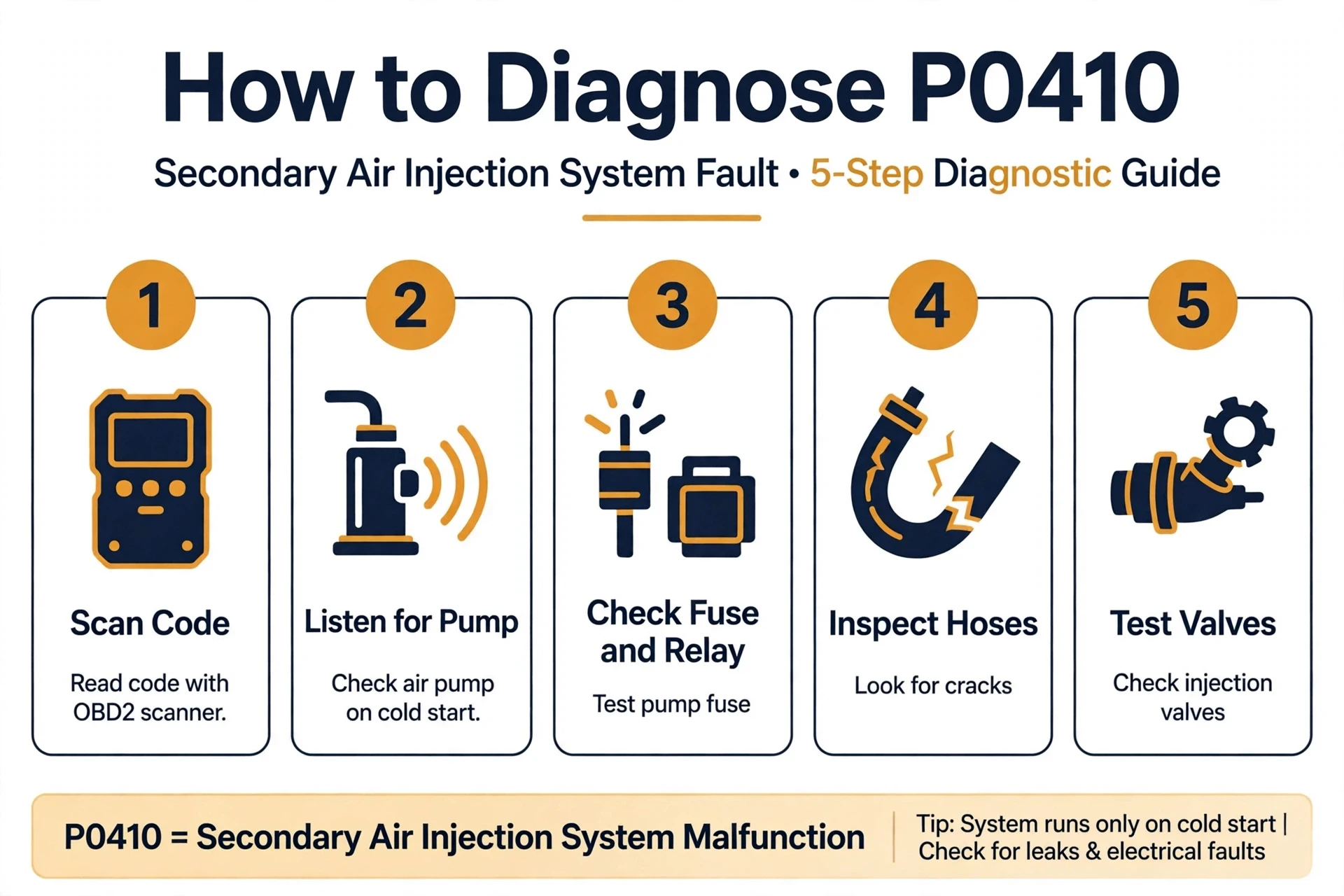
Mechanics see the P0410 code misdiagnosed constantly. The code says the system malfunctioned, but the real fault is often a cheap fuse or a relay. Follow this order:
- Scan for other codes first. If you also have O2 sensor codes or other engine codes, fix those first. They are probably the root cause, and the P0410 may clear on its own.
- Listen at cold start. Start the engine stone cold and listen near the front or undercarriage. You should hear the pump hum for 20 to 40 seconds. Grinding or loud whining means worn bearings. Silence means no power or a dead pump.
- Check the fuse and relay. Find the pump’s high-amp fuse and the pump relay in the fuse box. Test the fuse, and swap the relay with an identical one to test it.
- Test power at the pump. With a multimeter or test light on the pump connector, check for 12V when the system is commanded on. Also check the pump’s resistance between its power and ground pins.
- Inspect hoses, check valves, and the inlet filter. Look for cracked or melted hoses, loose connections, and water inside the hoses (a sign a check valve is letting exhaust moisture back in). Check the pump inlet filter for debris.
- Watch O2 sensor live data. With a scanner, monitor the O2 sensor PID while the pump runs. If the sensor is sluggish, replace the sensor and retest before condemning the pump.
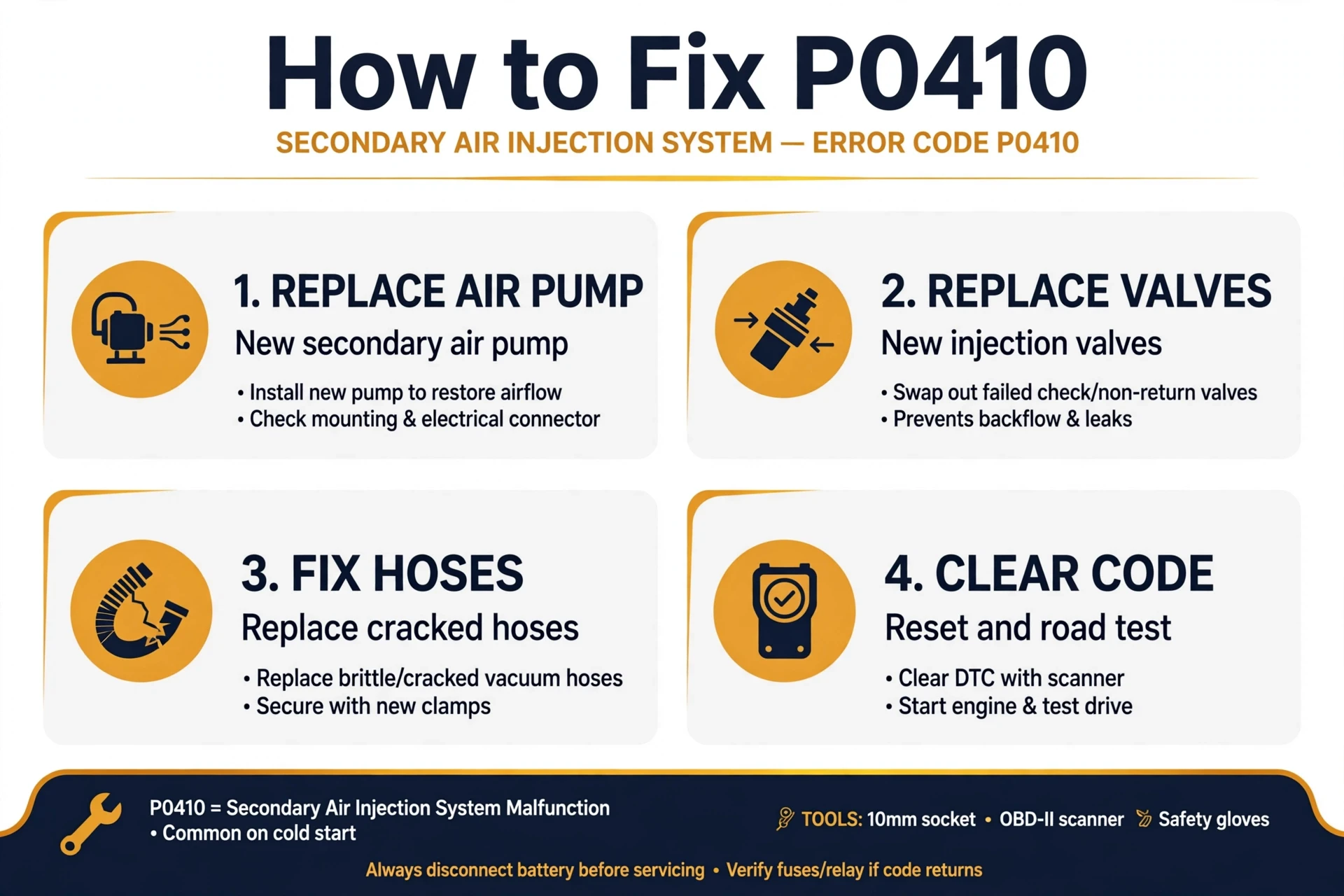
How to Fix the P0410 Code
The right fix depends on what your diagnosis found:
- Replace the blown fuse: if the new fuse blows again, the pump is drawing too much current and needs replacement.
- Replace the faulty pump relay: a common, cheap fix that solves many P0410 cases.
- Clean or replace the secondary air pump: some owners have revived a water-logged pump by opening it, forcing the water out, and cleaning debris from the housing, then bench-testing the motor on a 12V supply. Most of the time, a corroded or seized pump gets replaced along with its relay.
- Clean or replace stuck check valves: carbon-fouled valves can sometimes be cleaned; rusted-through valves get replaced.
- Repair or replace damaged air hoses and the inlet filter: replace cracked or melted hoses and a disintegrated inlet filter.
- Replace a lazy O2 sensor: if live data shows the sensor responding too slowly, a new sensor restores the test.
- Check for technical service bulletins: some GM trucks had the pump inlet hose rerouted under a bulletin to keep water out.
- Check your emissions warranty: this system is covered by the emissions warranty on some vehicles, so check before paying out of pocket.
P0410 Repair Costs
Drivers always ask how much it costs to fix P0410, and the answer depends entirely on the cause. Here are realistic ranges:
| Repair | Cost Range |
|---|---|
| Fuse or relay replacement | $20 – $80 |
| Air hose or check valve replacement | $80 – $250 |
| Secondary air pump replacement | $250 – $600 |
| O2 sensor replacement (per sensor) | $150 – $350 |
| Professional diagnosis | $100 – $175 |
This is why diagnosis matters. A $30 relay job and a $500 pump job share the same code. Drivers looking for a p0410 code fix on a budget should always start with the fuse and relay checks, not the parts catalog.
DIY vs Mechanic Verdict
You can do this at home: the cold-start listen test, checking and swapping the fuse and relay, visual inspection of hoses and wiring, cleaning the pump inlet filter, and clearing codes with an OBD2 scanner. If you find a blown fuse or a cracked hose, those are reasonable DIY repairs for anyone comfortable with basic tools.
See a mechanic for: pump replacement in tight engine bays, relay circuit electrical diagnosis, O2 sensor waveform analysis, and any repair where the diagnosis is unclear after the basic checks. A shop can confirm pump failure with a scan tool and a multimeter in under an hour, which is cheaper than guessing with a $400 part.
Bottom line: diagnose it yourself, fix the simple stuff yourself, but let a pro handle the electrical diagnosis and pump swap if the easy checks do not solve it.
Can You Drive With a P0410 Code?
Generally yes. The secondary air injection system only runs for under a minute after a cold start, so it does not affect normal driving, fuel delivery, or engine power. This is not a code that leaves you stranded. But there are two good reasons not to ignore it: a lit check engine light is an automatic failure at any emissions or smog test, and water inside a failing pump keeps corroding it until the pump seizes completely. Get it diagnosed before your next emissions test, even if the car feels fine.
P0410 on Popular Vehicles
P0410 shows up across all brands, but some patterns are worth knowing:
- Chevy / GMC (Silverado, Sierra, S-10, Blazer, Trailblazer, Envoy): The p0410 chevy code (chevy p0410, p0410 code chevy) is famously a water-in-the-pump problem. Check the 30A maxi fuse first, then the pump and relay. Some trucks had the inlet hose rerouted under a service bulletin.
- Mercedes (C-Class, E-Class, SL-Class): The p0410 mercedes code is common; test the pump, the changeover solenoid, the fuses, and the relays, and check for exhaust leaks at the manifold.
- Ford (F-150, Fusion, Escape): The p0410 ford code usually traces to the pump or its relay; the system layout is similar to GM trucks.
- Toyota (Camry, Corolla, Tundra): Less common, but check valves and the pump are the usual suspects when the p0410 toyota code appears.
- Mazda (RX-8): For p0410 mazda owners, the secondary air injection valves sticking open or shut is the classic cause.
OBD P0410, DTC P0410, and p0410 obd2 all refer to the identical fault under different naming.
P0410 vs Related Codes
P0410 means the secondary air injection system failed its self-test in a general way: the ECM commanded the pump on and never saw the expected oxygen rise. P0411 (Secondary Air Injection System Incorrect Flow Detected) is more specific: the system ran, but the measured airflow was wrong. In practice, P0410 points at the pump never running at all (blown fuse, bad relay, dead pump, broken wiring), while P0411 points at flow restrictions (clogged passages, stuck check valves, blocked hoses). Diagnose them with the same tests, but weight the electrical checks heavier for P0410.
Related Codes
P0411: Secondary Air Injection System Incorrect Flow Detected. This is the closest relative of P0410 and often appears with it; it means airflow was measured but out of range.
P0412: Secondary Air Injection System Switching Valve A Circuit Malfunction. This points at the electrical circuit of the air switching valve rather than the pump.
P0418: Secondary Air Injection System Relay A Circuit Malfunction. This narrows the fault to the pump relay circuit itself.
P0419: Secondary Air Injection System Relay B Circuit Malfunction. Same idea as P0418, for the second relay circuit on systems that have one.
Video Walkthrough
Watch the video above for a visual walkthrough of P0410 pump, relay, and fuse diagnosis before you read on.
Frequently Asked Questions
What does the P0410 code mean?
It means “Secondary Air Injection System Malfunction.” The ECM commanded the air pump on during its cold-start self-test, but the oxygen sensor never detected the expected rise in exhaust oxygen.
What is the most common cause of a P0410 code?
A failed secondary air pump, often damaged by water intrusion, or a blown pump fuse / bad pump relay. These three account for most cases.
Can I still drive my car with a P0410 code?
Yes. The system only runs for under a minute after a cold start, so normal driving is unaffected. But you will fail any emissions test with the light on, so fix it before your test is due.
How do you fix the code P0410?
Diagnose first: listen for the pump at cold start, check the high-amp fuse and the relay, test for 12V power at the pump, and inspect hoses and check valves. Then replace whichever part failed: fuse, relay, pump, valve, hose, or lazy O2 sensor.
How much does it cost to fix P0410?
From about $20-$80 for a fuse or relay, $80-$250 for hoses or check valves, $250-$600 for a secondary air pump replacement, and $150-$350 per O2 sensor.
Will P0410 clear itself?
Rarely. The ECM reruns the air injection self-test on every cold start, so the code comes back until the real fault is fixed. Clear it with a scanner after the repair and confirm it stays off through a few cold starts.
Can a blown fuse cause P0410?
Yes. The high-amp pump fuse (often a 30A maxi fuse) is one of the first things to check. If the replacement fuse blows again, the pump motor is drawing too much current and the pump itself needs attention.
Conclusion
The P0410 code looks alarming, but it is really your car telling you its cold-start emissions helper failed a self-test. Listen for the pump, check the fuse and relay, inspect the hoses and valves, and fix what you find. Do that, and you will either solve it for the price of a fuse or know for certain the pump is done. Either way, you stop guessing and start fixing.
About the author: Written by the OBD2 Code Hub editorial team. Our diagnostic guides are built from real OBD-II data, manufacturer service procedures, and hands-on troubleshooting experience, then reviewed for technical accuracy before publishing. We drive the same cars you do.