
P0401 Trouble Code: Meaning, Causes, Symptoms & Fixes
In This Guide
One-line meaning: P0401: Exhaust Gas Recirculation Flow Insufficient Detected.
What the P0401 Code Means
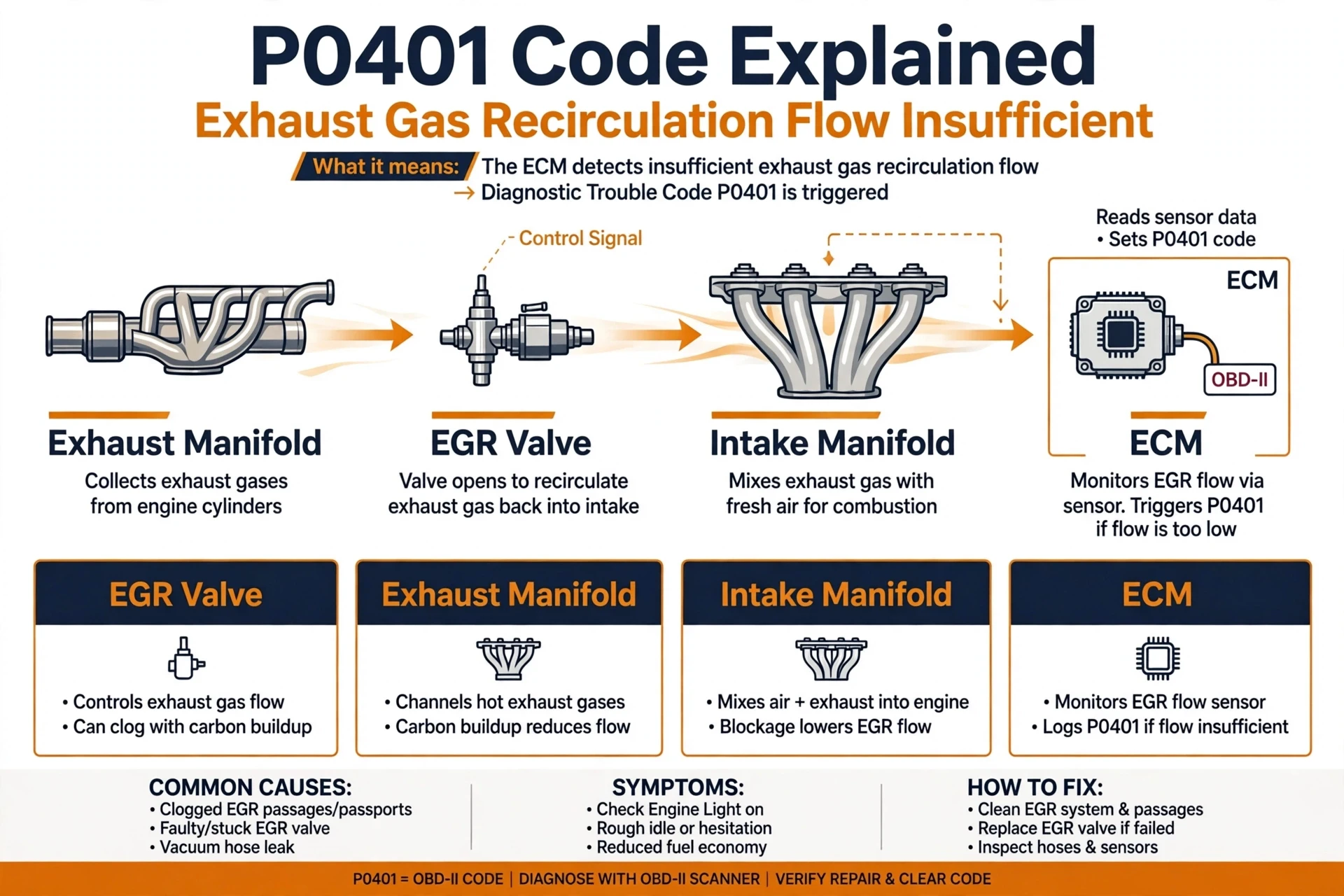
The P0401 code is one of the most searched EGR-related check engine codes. Its full definition is “Exhaust Gas Recirculation Flow Insufficient Detected” (p0401 exhaust gas recirculation flow insufficient detected). In plain English, when your scanner shows engine code p0401, it means your car’s engine computer (ECM/PCM) has decided that not enough exhaust gas is flowing back into the intake through the EGR system.
Here is the background. The EGR system routes a small, carefully measured amount of exhaust gas back into the intake manifold. That inert gas takes up space in the cylinders, which lowers peak combustion temperatures. Cooler combustion means far less nitrogen oxide (NOx) formation, and NOx is the pollutant the EGR system exists to control. The system only works under specific conditions, mostly at cruising speed and light to moderate load. It stays shut at idle and at wide-open throttle.
Here is how your car figures out something is wrong. When the computer commands the EGR valve open, it expects proof that exhaust gas actually moved: a small drop in engine RPM, a change in the DPFE (differential pressure feedback EGR) sensor reading on Fords, or a shift in manifold pressure. When the command goes out but the expected change never arrives, the computer concludes the flow is insufficient and stores the P0401 code.
P0401 (p0401 obd ii, p0401 code) is a generic powertrain code, which means it has the same meaning on every make and model, from a Ford F-150 to a Honda Accord to a Toyota Camry. Its close relatives are P0400 (general EGR flow malfunction) and P0402 (EGR flow excessive, the opposite problem).
Symptoms of the P0401 Code
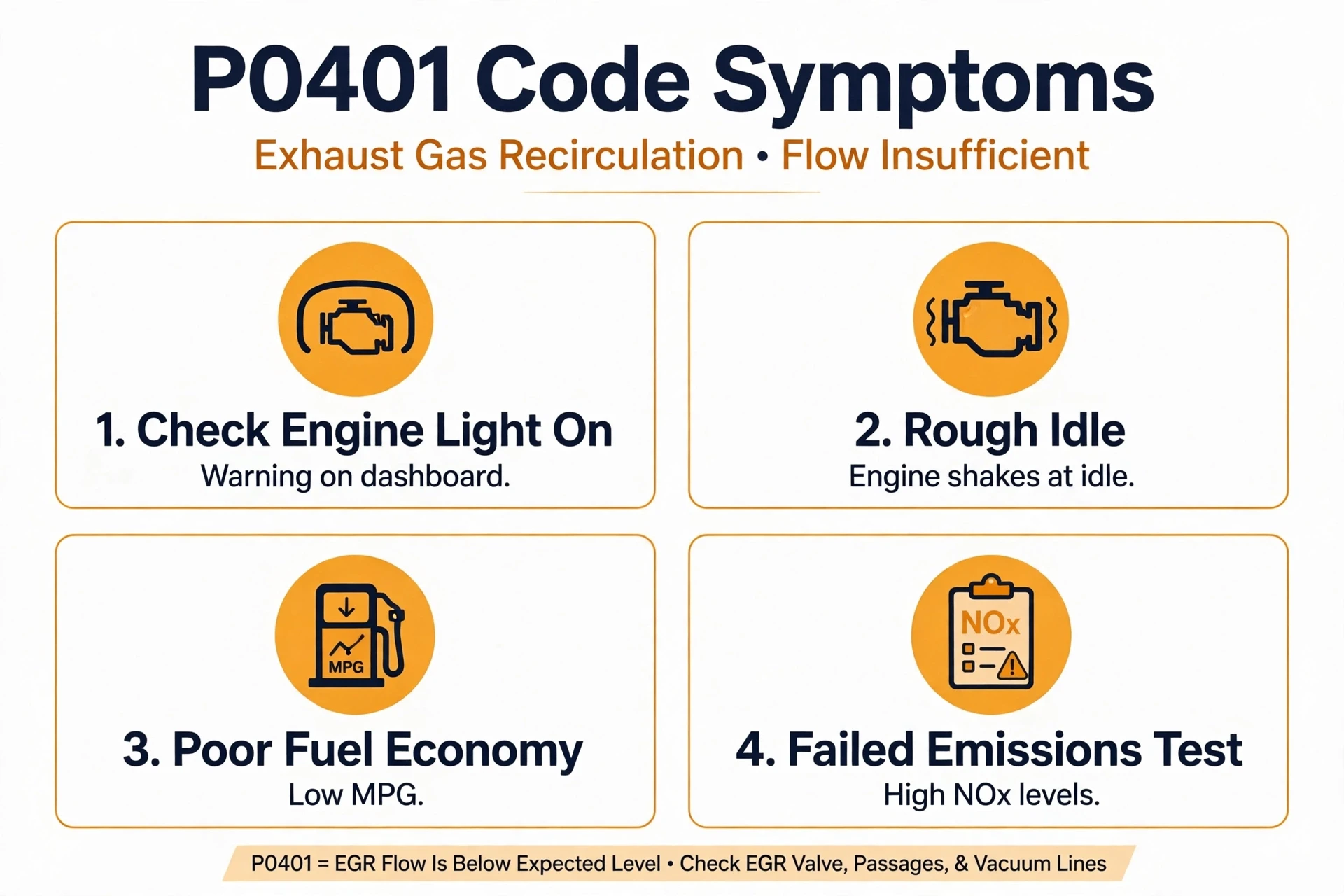
The check engine light is often the only symptom you will notice with the p0401 code. Many drivers feel nothing wrong at all, which is one reason this code surprises so many people. Depending on the cause and how long it has been present, you might also notice:
- Engine knocking or pinging, especially under load or at higher RPM. This is the classic sign: without inert exhaust gas cooling the charge, combustion runs hotter and the fuel can ignite too early
- Rough or unstable idle, sometimes stalling at stoplights
- Hesitation or sluggish acceleration when you press the throttle
- Reduced fuel economy, you are filling up more often than usual
- Failed emissions test, since NOx readings climb when the EGR system is not doing its job
What is code P0401 trying to tell you? In short: the emissions system is not getting the exhaust flow it asked for, combustion is running hotter than designed, and the cause is usually buildup or a part that is not opening as commanded. Do not ignore it just because the car still drives.
Common Causes of P0401
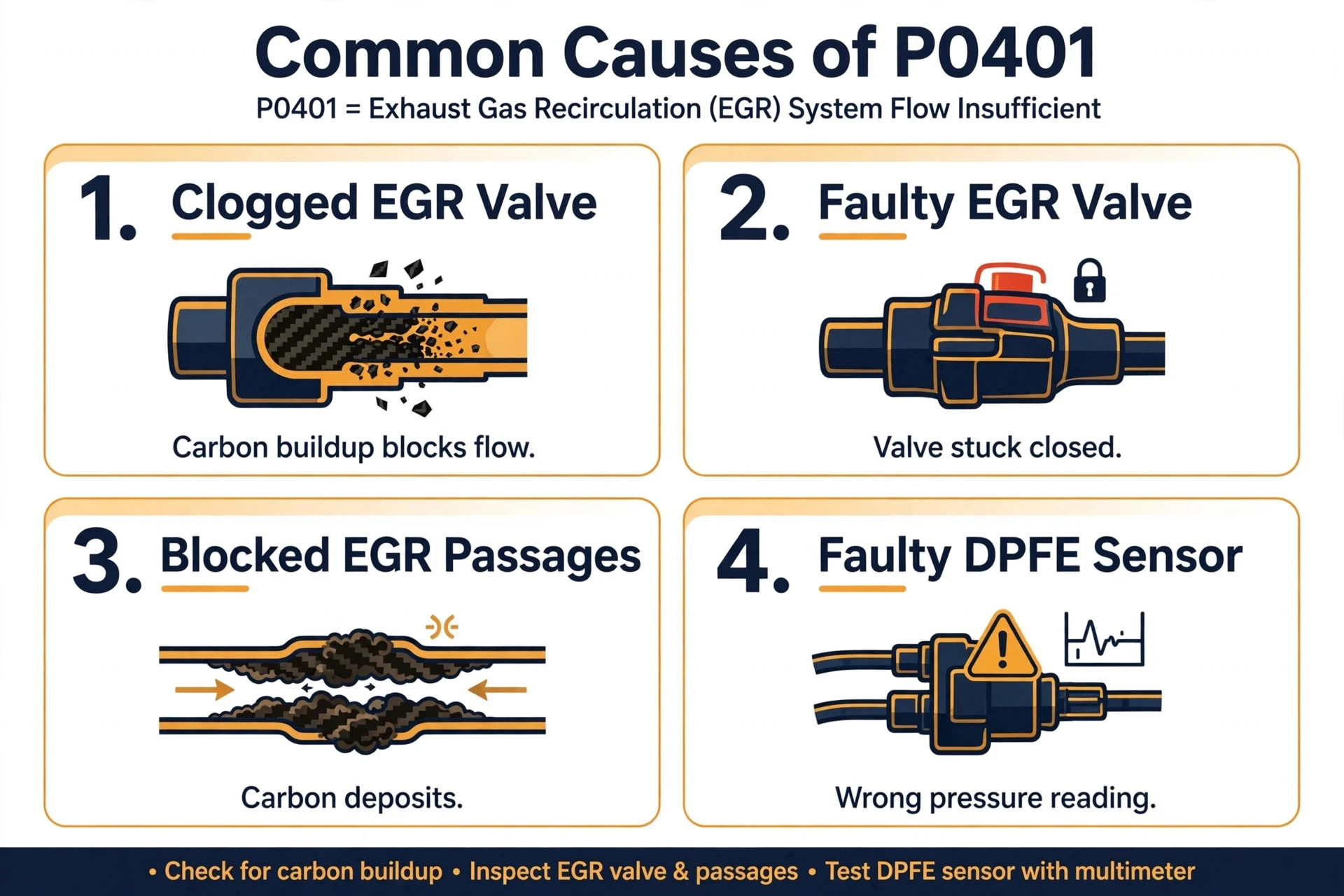
The most common cause of a P0401 code is carbon buildup choking the EGR passages. Soot accumulates over thousands of miles and slowly strangles the flow path. But a clogged passage is far from the only cause, and replacing the EGR valve without testing is the most expensive mistake drivers make with this code. Here are the causes, roughly in order of likelihood:
- Carbon-clogged EGR passages: soot packs the EGR valve, the metal EGR tube, and the intake manifold ports. Short trips and stop-and-go driving make it worse, because the system never gets hot enough for long enough to stay clean.
- Stuck or faulty EGR valve: the valve sticks closed, or fails to open fully, when the computer commands it, mechanically blocking the flow.
- Faulty DPFE sensor: on Fords especially, the differential pressure feedback sensor is a known weak point. It sends false readings, so the computer thinks flow is low even when the valve is working fine.
- Vacuum supply problems: on vacuum-operated EGR systems, cracked or brittle vacuum hoses, loose fittings, or a failed EGR vacuum solenoid keep the valve from opening.
- EGR temperature sensor fouling: carbon coating on the sensor skews its readings and confuses the computer.
- Wiring and electrical faults: damaged wiring or corroded connectors in the EGR circuit interrupt the signals between the sensor, the valve, and the computer.
- Clogged EGR cooler (diesels): on diesel trucks, the EGR cooler itself packs with soot and restricts flow.
- Engine computer or software issues: rare, but an outdated calibration can misjudge EGR flow.
How to Diagnose P0401 (Do This Before Buying Parts)
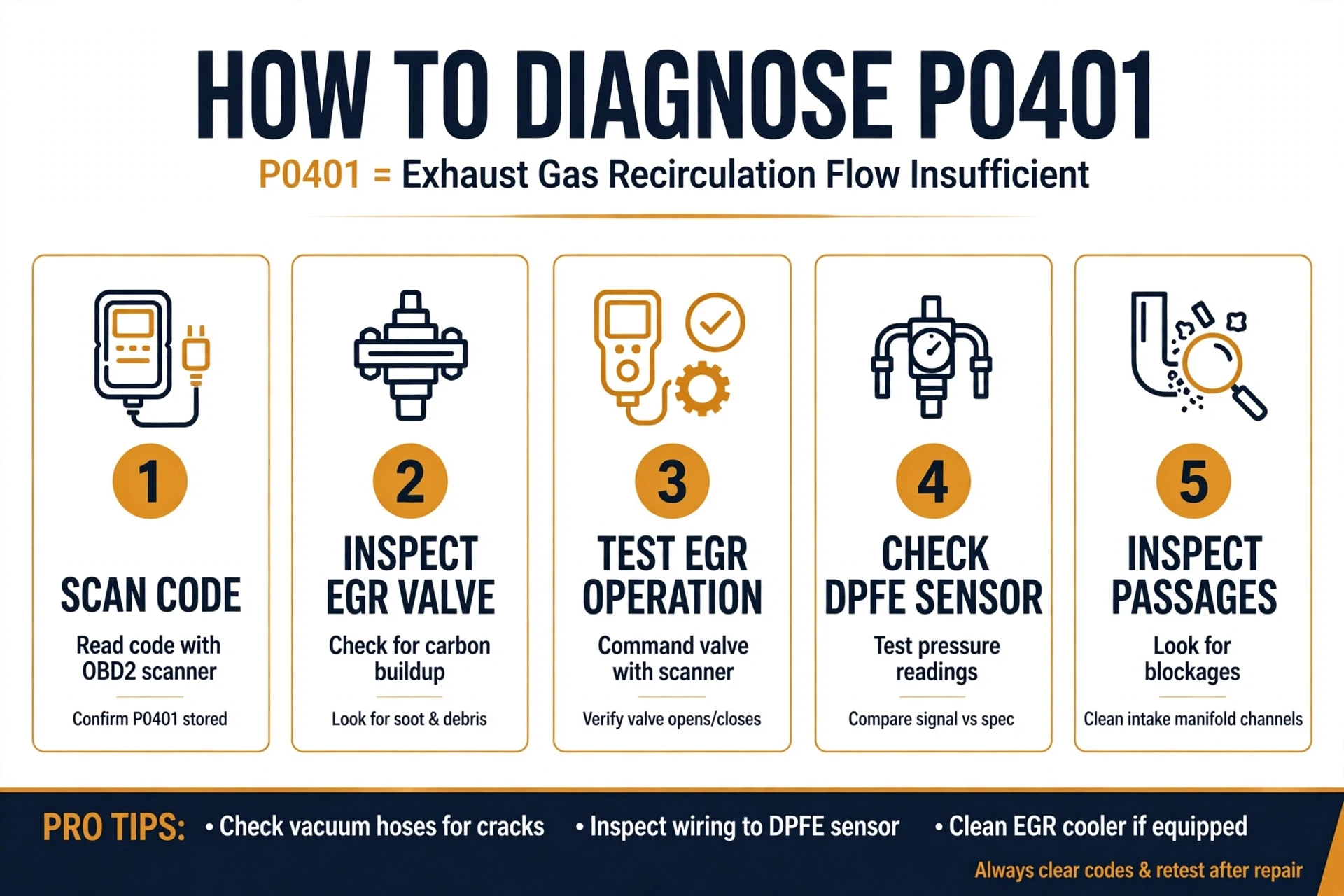
Mechanics see the P0401 code misdiagnosed constantly. The code points at flow, but the real fault can be the valve, the passages, the sensor, or the vacuum supply. Follow this order:
- Scan for other codes first. Companion codes like P0400, P0402, P0403, P0404, P0405, P0406, or DPFE circuit codes narrow the search fast. Fix circuit codes before condemning the valve.
- Command the EGR valve with a scan tool. With the engine idling, command the EGR valve open and watch for the RPM to drop and the engine to stumble. If nothing changes, the valve is not opening or the passages are fully blocked.
- Inspect the EGR valve and tube for carbon. Remove the valve and the metal bypass tube and look inside. A heavy black crust is the answer in most P0401 cases.
- Test the DPFE sensor. Backprobe the sensor and compare its voltage to the specification in your manual. On many Fords, expect roughly 0.5 to 1.0 volt at idle, rising when EGR is commanded. A sensor stuck at one value is lying to the computer.
- Check the vacuum supply. If your system is vacuum-operated, verify the solenoid is getting power and that the hoses hold vacuum without leaking.
- Check wiring and connectors. Look for chafed wires, green corrosion, and loose pins at the EGR valve and DPFE connectors.
- Clear the code and test drive. After cleaning or repair, clear the code with your scanner and drive through several warm-up cycles, including steady cruising where the EGR system is active, to confirm the fix.
How to Fix the P0401 Code
The right fix depends on what your diagnosis found:
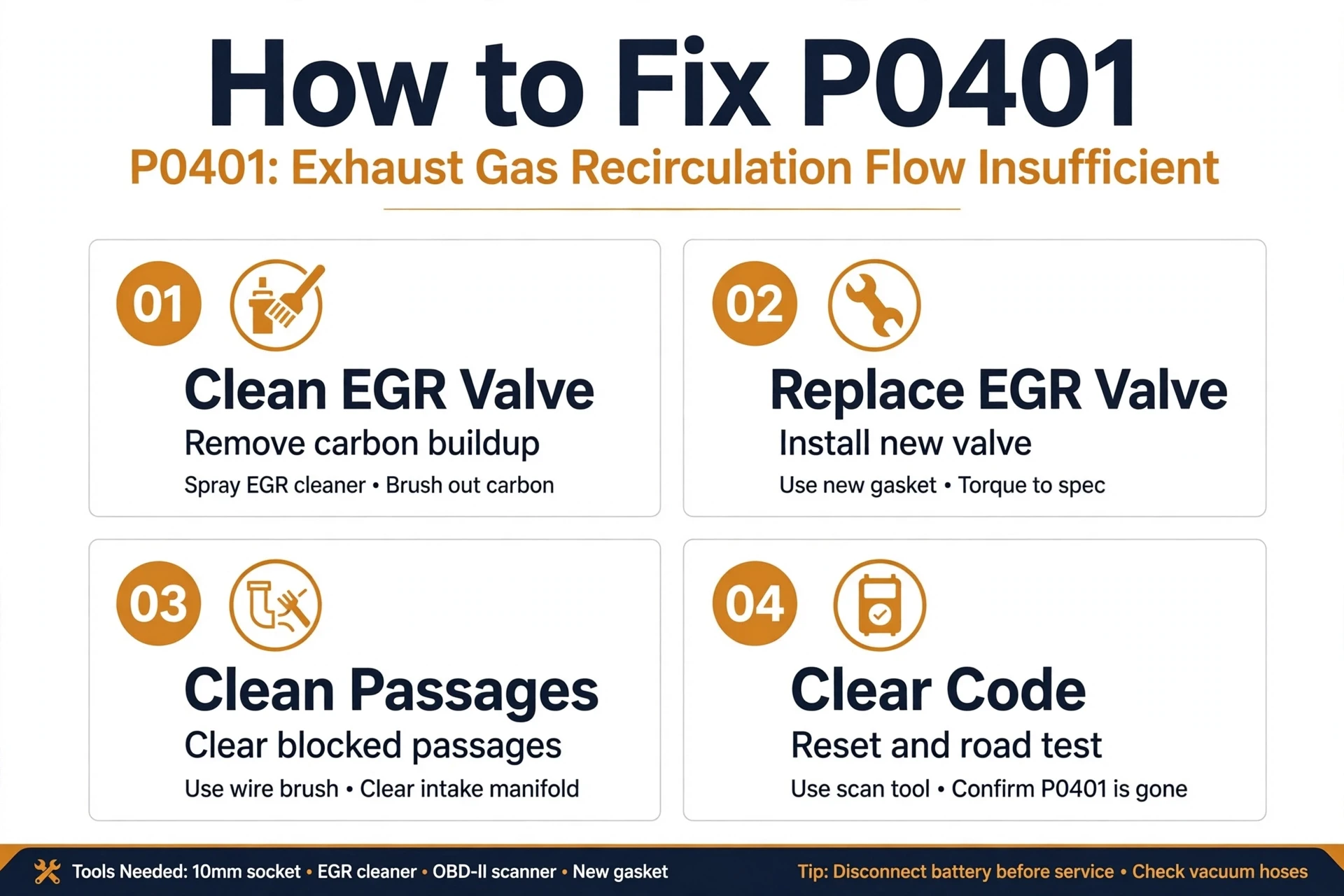
- Clean the EGR valve and passages: remove the valve and scrub the carbon off with a wire brush and dedicated EGR or throttle body cleaner. Rod out the intake manifold ports and the metal EGR tube. This fixes most P0401 cases and costs almost nothing.
- Replace a faulty EGR valve: if the valve is stuck shut, its diaphragm is torn, or its electric motor is dead, cleaning will not save it. Use a quality or OEM replacement and always fit a new gasket.
- Replace the DPFE sensor: a very common fix on Fords. Prefer OEM or high-quality sensors, since cheap ones can read badly right out of the box.
- Repair vacuum lines and the solenoid: replace cracked hoses and a failed EGR vacuum solenoid so the valve actually gets the command to open.
- Fix wiring faults: repair damaged wiring and clean corroded connectors in the EGR circuit.
- Service the EGR cooler (diesels): clean or replace a soot-packed cooler on diesel trucks.
- Clear the code and verify: erase the code with an OBD-II scanner and test drive. Clearing it without fixing the cause only guarantees the light comes back.
P0401 Repair Costs
Drivers always ask how much it costs to fix P0401, and the answer depends entirely on the cause. Here are realistic ranges:
| Repair | Cost Range |
|---|---|
| EGR valve and passage cleaning (DIY) | $0 to $50 |
| EGR valve replacement | $200 to $500 |
| DPFE sensor replacement | $80 to $200 |
| Professional carbon cleaning service | $150 to $400 |
| EGR cooler replacement (diesel) | $500 to $1,500+ |
This is why diagnosis matters. A $20 can of cleaner and an afternoon can fix the same code that a $500 valve replacement would. Drivers looking for a p0401 code fix that is permanent, easy, and cheap should always start with the carbon inspection, not the parts catalog.
DIY vs Mechanic Verdict
You can do this at home: scanning codes with an OBD2 reader, removing and cleaning the EGR valve and tube, checking vacuum hoses for cracks, and testing the DPFE sensor with a multimeter. Carbon cleaning is the classic DIY win for this code.
See a mechanic for: EGR cooler service on diesels, wiring diagnosis when the fault is intermittent, and any repair where the diagnosis is unclear after the basic checks. A shop can command the EGR valve with a professional scan tool and confirm flow in minutes.
Bottom line: clean it yourself first, test the sensor yourself, but let a pro handle the cooler and the tricky electrical faults.
Can You Drive With a P0401 Code?
Generally yes, for a short time. Many cars drive normally with this code. But driving long term with P0401 is not advisable: combustion temperatures stay higher than designed, which can cause persistent knocking that stresses pistons and head gaskets over time, fuel economy drops, NOx emissions rise, and you will fail any emissions or smog test. Get it diagnosed soon, even if the car feels fine.
P0401 on Popular Vehicles
P0401 shows up across all brands, but some patterns are worth knowing:
- Ford (F-150, Escape, Explorer): The p0401 ford code (ford p0401, p0401 code ford) is famous for DPFE sensor failures. Test the DPFE sensor before replacing the valve.
- Honda (Accord, Civic, CR-V, Odyssey, Pilot): The p0401 honda code (honda p0401, p0401 code honda) is usually carbon-packed EGR passages in the intake manifold on V6 models. Cleaning the ports fixes most of them.
- Toyota (Camry, Corolla, Tacoma): For p0401 toyota (toyota p0401, p0401 code toyota), check the EGR tube for carbon blockage and test the vacuum modulator.
- Chevy (Silverado, Equinox, Malibu): The p0401 chevy code (p0401 code chevy, code p0401 chevy) often traces to a stuck EGR valve or vacuum leaks.
- Nissan (Altima, Sentra, Frontier): For p0401 nissan (nissan p0401, p0401 code nissan), check EGR valve operation and the EGR temperature sensor.
- Diesel trucks (Powerstroke, Cummins, Duramax): a soot-packed EGR cooler is the signature cause of the p0401 code on diesels.
EOBD P0401 and OBD P0401 are the same code under different naming (European vs generic OBD-II). DTC P0401 and OBD-II P0401 also refer to the identical fault.
P0401 vs P0402
P0401 means the computer sees too little EGR flow. P0402 is the mirror image: “Exhaust Gas Recirculation Flow Excessive Detected,” meaning the computer sees too much flow, often from an EGR valve stuck open. The symptoms point in opposite directions: a stuck-open valve causes rough idle and stalling, while the stuck-closed or blocked flow behind P0401 causes knocking under load. Diagnose them with the same tests, but expect opposite failures.
Related Codes
- P0400: Exhaust Gas Recirculation Flow Malfunction (the general EGR flow fault)
- P0402: Exhaust Gas Recirculation Flow Excessive Detected (too much flow, the opposite of P0401)
- P0403: Exhaust Gas Recirculation Control Circuit Malfunction
- P0404: Exhaust Gas Recirculation Control Circuit Range/Performance
- P0405 / P0406: EGR Sensor A Circuit Low / High
- P1404: EGR Closed Position Performance (a GM-specific companion code)
Video Walkthrough
Watch the video above for a visual walkthrough of P0401 causes and diagnosis before you read on.
Frequently Asked Questions
What is the most common cause of a P0401 code?
Carbon buildup clogging the EGR valve, the EGR tube, or the intake manifold passages. Soot accumulates over time and slowly strangles exhaust flow, which is why removing the valve and cleaning the passages fixes most P0401 cases without any new parts.
Can I still drive my car with a P0401 code?
For a short time, yes. Many cars drive normally with this code. But do not put it off: combustion runs hotter than designed, which can cause persistent knocking, hurt fuel economy, raise NOx emissions, and fail an emissions test. Get it diagnosed soon.
How do you fix the code P0401?
Diagnose first, then fix what you find. In most cases that means removing the EGR valve and cleaning carbon from the valve, tube, and intake ports. If cleaning does not do it, test the DPFE sensor and vacuum supply, then replace the faulty part. Clear the code with a scanner and test drive to verify.
How much does it cost to fix P0401?
From nearly free to over $1,500. DIY carbon cleaning costs $0 to $50 in cleaner. An EGR valve replacement runs $200 to $500, a DPFE sensor $80 to $200, professional carbon cleaning $150 to $400, and a diesel EGR cooler $500 to $1,500 or more.
Will P0401 clear itself?
Rarely. The computer retests EGR flow on every drive cycle, so if the restriction is still there, the light comes back. After a genuine fix, the code may clear on its own after several drive cycles, but clearing it with a scanner and confirming it stays off is the reliable way.
Can a bad DPFE sensor cause P0401?
Yes, and on Fords it is one of the top causes. The DPFE sensor tells the computer how much exhaust gas is flowing. When it fails, it reports incorrect readings that look exactly like insufficient flow, so the computer stores P0401 even though the valve itself is fine.
Can I clean the EGR valve instead of replacing it?
Yes, cleaning is the correct first step and it resolves most P0401 cases. Remove the valve, scrub off the carbon with a wire brush and EGR cleaner, and clear the passages. Replace the valve only if it is mechanically stuck, torn, or electrically dead after cleaning.
Conclusion
The P0401 code looks technical, but it is really your car reporting a breathing problem in the emissions system: exhaust gas that should be recirculated is not getting through. Start with carbon, test the sensor and the vacuum supply, and fix what you find. Do that, and you will either solve it for the price of a can of cleaner or know exactly which part has failed. Either way, you stop guessing and start fixing.
About the author: Written by the OBD2 Code Hub editorial team. Our diagnostic guides are built from real OBD-II data, manufacturer service procedures, and hands-on troubleshooting experience, then reviewed for technical accuracy before publishing. We drive the same cars you do.