
P2419 Trouble Code: Meaning, Causes, Symptoms & Fixes
In This Guide
One-line meaning: Your engine computer detected low voltage in the control circuit for the EVAP system switching valve, so the leak detection pump cannot run its self-test for fuel vapor leaks.
What the P2419 Code Means
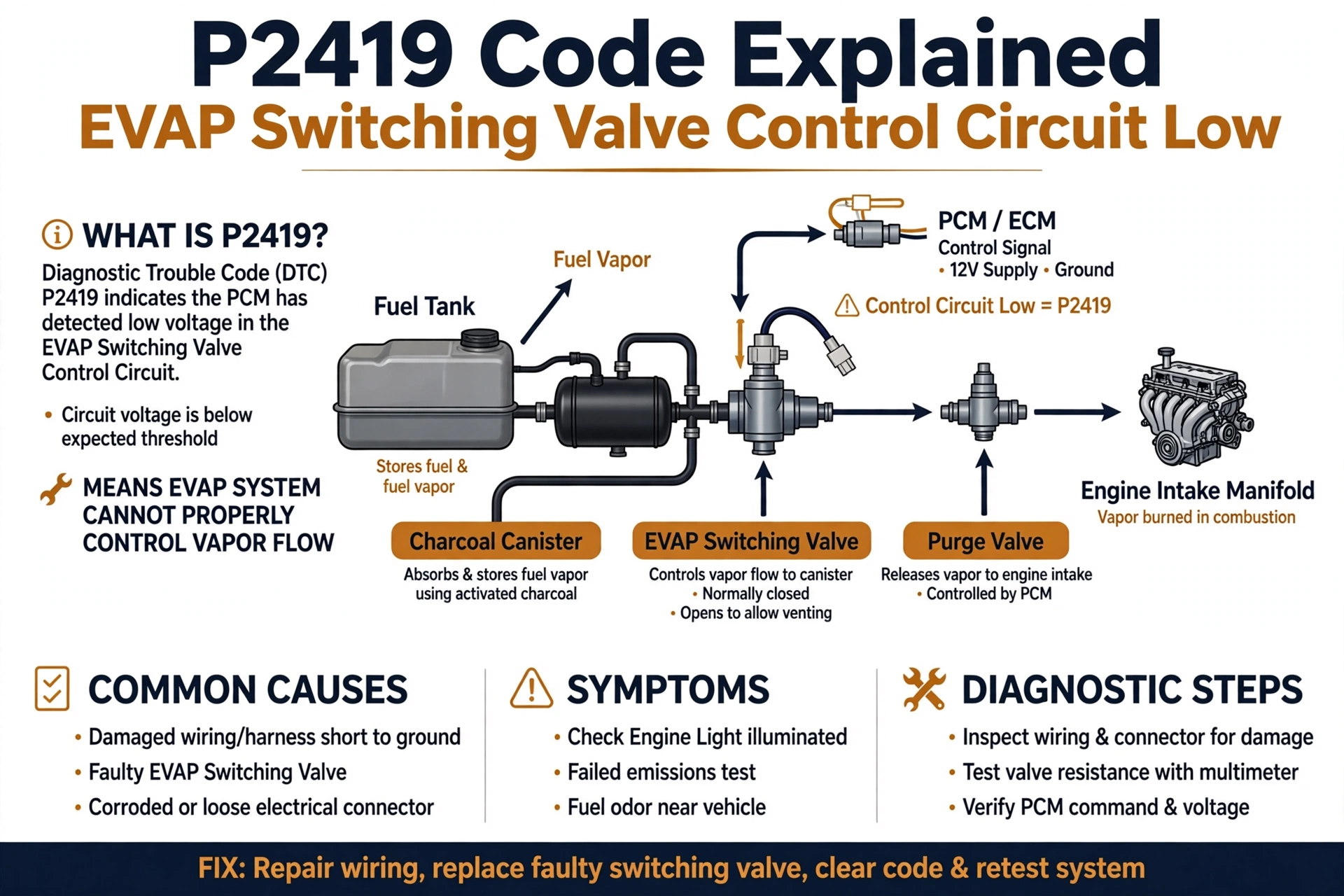
The P2419 code is an emissions trouble code that stands for “Evaporative Emission System Switching Valve Control Circuit Low.” It sets when the powertrain control module (PCM) or engine control module (ECM) sees lower-than-expected voltage in the circuit that drives the EVAP switching valve, which is usually built into the leak detection pump or charcoal canister assembly.
Here is what that valve does. The EVAP system traps fuel vapors from the gas tank in a charcoal canister instead of letting them escape into the air. After the vehicle sits for a while, the computer runs a self-test: it commands the switching valve to pull a small vacuum on the system and checks for leaks. When the control circuit voltage reads low, the computer knows the valve cannot do its job, so it stores P2419 and turns on the check engine light.
P2419 (p2419 obd2, p2419 code) is a generic powertrain code, so it means the same thing on every make. It is an electrical circuit code, not a report of an actual vapor leak, which is why the fix is usually wiring, a connector, or the pump module itself. Exact definitions can vary slightly by manufacturer, so always check model-specific service information when you diagnose it.
Symptoms of the P2419 Code
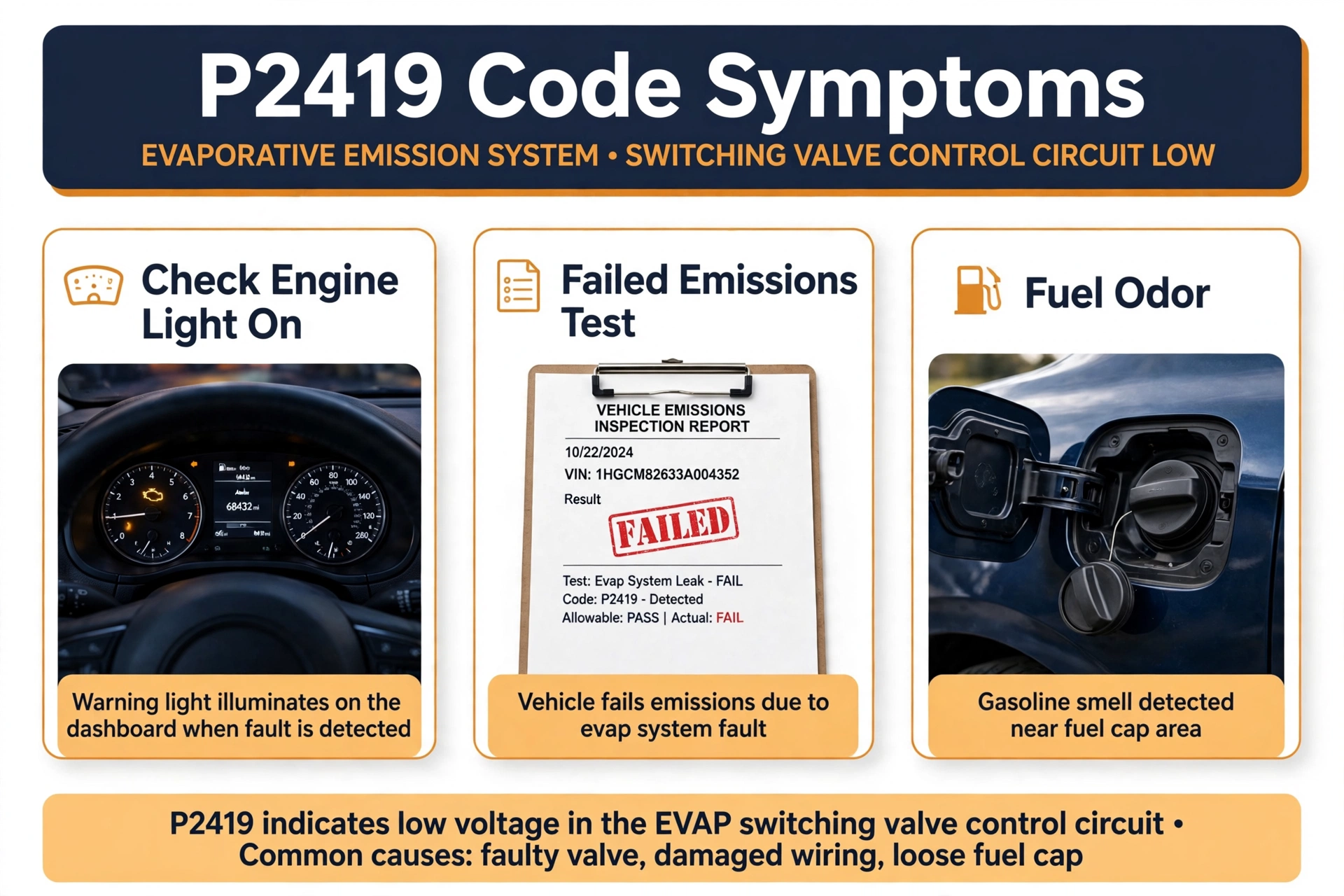
The p2419 code is a quiet one. Unlike a misfire code, it rarely changes how the car feels. Here is what drivers usually notice:
- Check engine light on, often the only symptom
- Fuel vapor odor or a faint smell of gas around the vehicle
- Failed emissions or smog test, since the EVAP monitor cannot complete
- On some models, a slightly rough idle or brief hesitation
What is the p2419 code trying to tell you? In short: the EVAP self-test cannot run, so the computer is warning you about an electrical fault, not a drivability emergency.
Common Causes of P2419
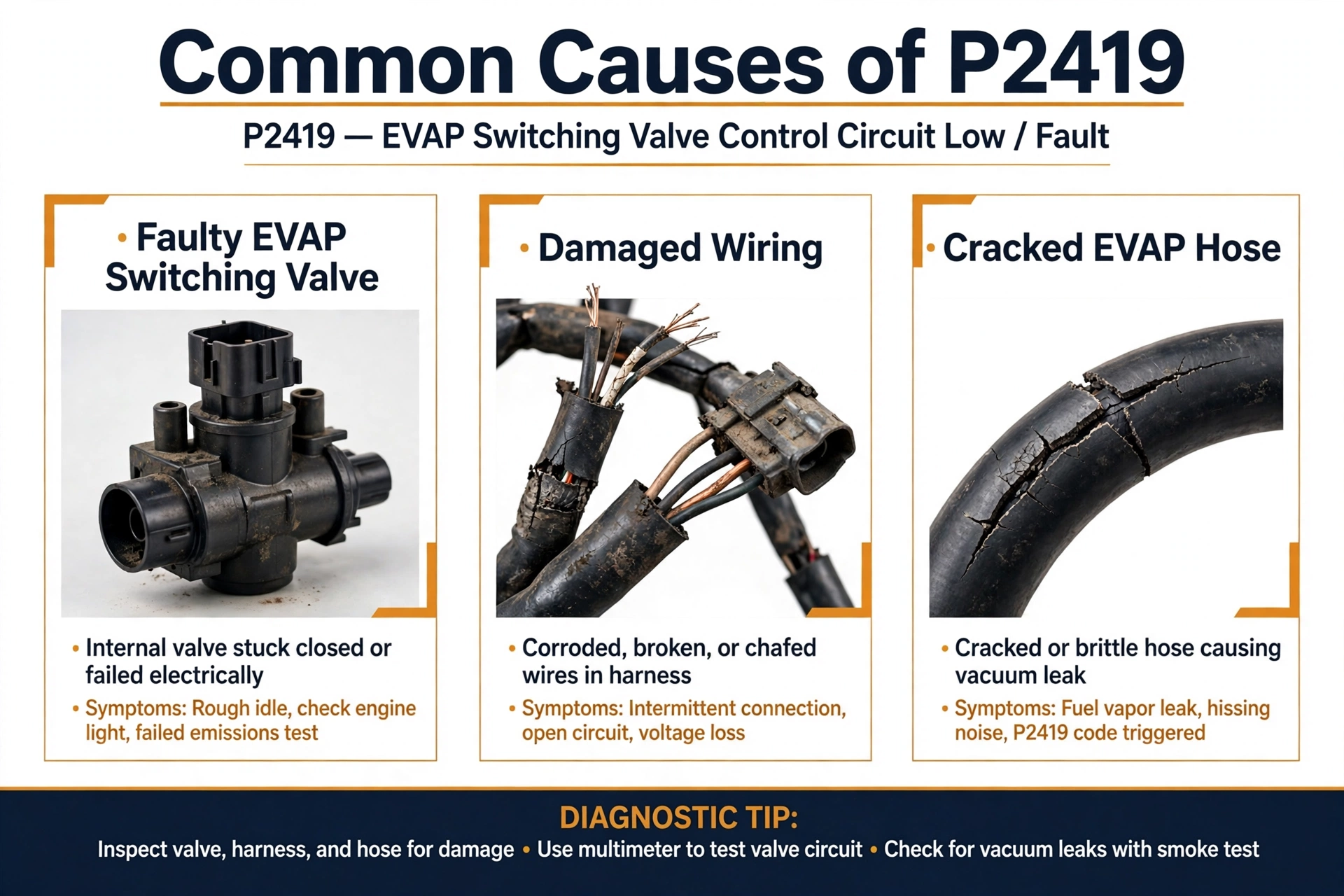
These are the causes, roughly in order of likelihood. Notice that the switching valve itself is only one suspect:
- Faulty leak detection pump or canister pump module: the switching valve is often built into this unit, and when its motor or internal circuit fails, the control voltage drops.
- Damaged, pinched, or cracked EVAP and vacuum hoses: air leaks change the pressure the pump sees and can confuse the self-test.
- Wiring or connector problems: shorted, open, corroded, or loose wires in the EVAP harness cut the voltage the computer expects.
- Water intrusion or moisture damage in the charcoal canister assembly: very common on Toyotas, where water gets into the canister area and damages the pump circuit.
- Failed control module or purge solenoid: rare, but a fault in the PCM or a related solenoid can set a false switching valve circuit code.
How to Diagnose P2419 (Do This Before Buying Parts)
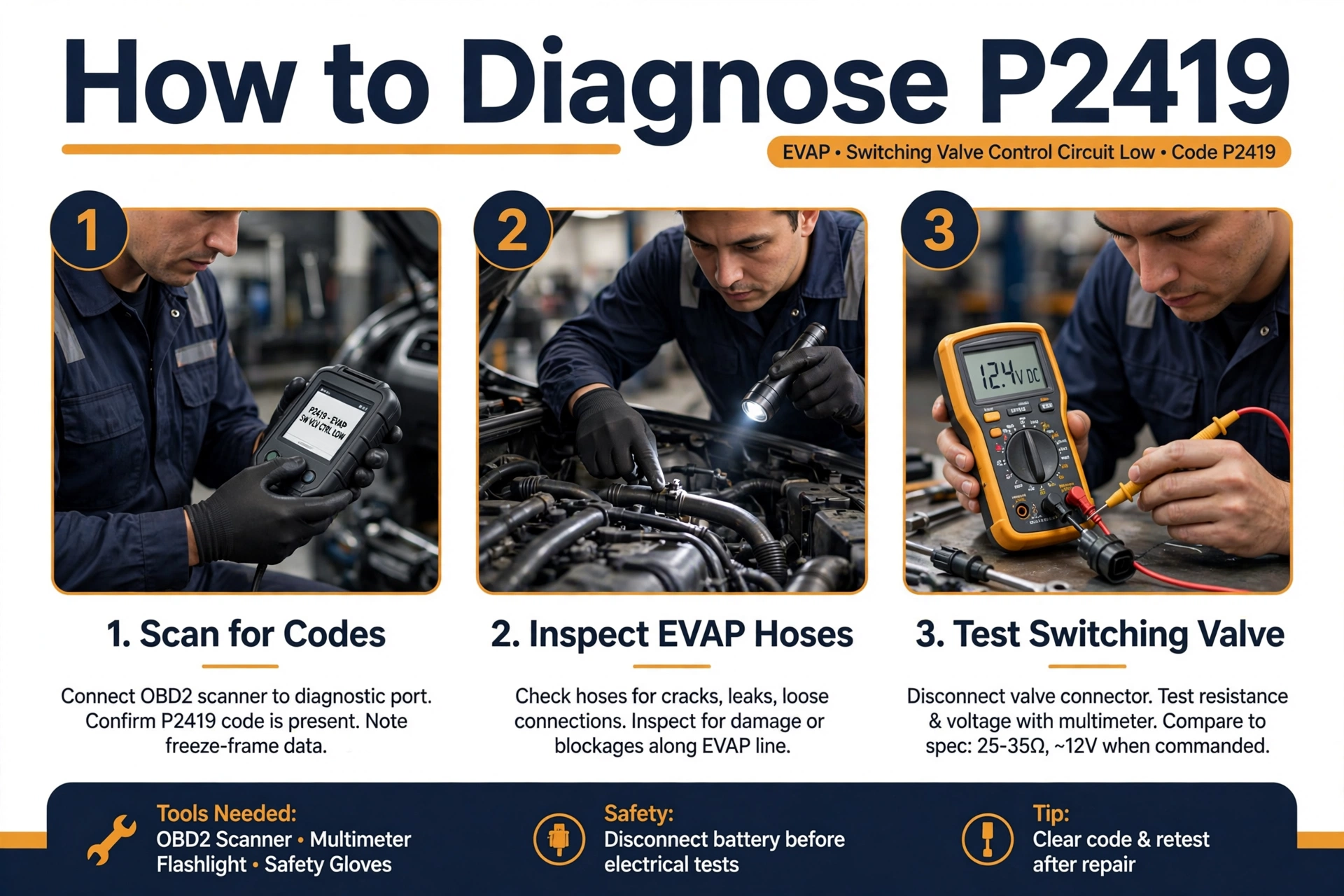
The p2419 code is misdiagnosed often, usually as a guaranteed bad pump. Work in this order and you will find the real fault:
- Confirm the code and scan for companions. A basic reader shows P2419. Note related codes such as P2418, P2420, P0441, or P0446, which point to different parts of the EVAP system.
- Inspect the wiring and connectors. Check the EVAP harness around the canister and leak detection pump for corrosion, bent pins, chafed insulation, and loose plugs.
- Check the hoses. Look for cracked, pinched, or disconnected EVAP and vacuum hoses, and make sure the gas cap seals.
- Command the switching valve with a scan tool. A bi-directional scanner can activate the leak detection pump. You should hear or feel it run. Silence means the circuit or pump is dead.
- Test the circuit with a multimeter. With the key on, check for proper voltage and ground at the pump connector, and check continuity through the control wire back to the computer.
- Look for water intrusion. On Toyotas especially, check the canister assembly for standing water or corrosion, which is a classic P2419 trigger.
- Smoke test the EVAP system if needed. A smoke machine finds the small leaks that visual checks miss.
How to Fix the P2419 Code
The right fix follows the diagnosis:
- Repair the wiring and connectors: clean corrosion, solder and heat-shrink broken wires, and reseat the pump connector with dielectric grease.
- Replace damaged EVAP hoses: swap cracked or pinched hoses and secure them with proper clamps so they cannot kink.
- Replace the leak detection pump (canister pump module): if the pump does not run when commanded and the circuit tests good, the module itself is bad.
- Replace the charcoal canister assembly: needed when water intrusion has soaked or corroded the canister and pump area.
- Address the control module: reflash or replace the PCM only after everything else tests good, since module failure is the least likely cause.
- Clear the code and verify: erase P2419, then run a drive cycle so the EVAP monitor can complete and confirm the repair.

Repair Costs for the P2419 Code
Drivers always ask how much it costs to fix P2419, and the range is wide because the causes are so different:
| Repair | Cost Range |
|---|---|
| Diagnostic inspection | $100 \u2013 $200 |
| Wiring or connector repair | $100 \u2013 $300 |
| EVAP hose replacement | $80 \u2013 $250 |
| Leak detection pump (canister pump module) replacement | $200 \u2013 $500 |
| Charcoal canister assembly replacement | $250 \u2013 $650 |
| PCM reflash or replacement (rare) | $500 \u2013 $1,500 |
This is why the diagnostic order matters. A $150 wiring repair and a $600 canister share the same p2419 code. Guessing the expensive part first is the classic mistake with this code.
DIY vs Mechanic Verdict
You can do this at home: reading and clearing codes with an OBD2 scanner, inspecting EVAP hoses and wiring for visible damage, and checking the canister area for water. Simple hose and connector repairs are fair DIY work too.
See a mechanic for: circuit testing that needs wiring diagrams and specs, leak detection pump replacement (often tucked near the fuel tank), smoke testing, and any PCM work. A shop with a bi-directional scan tool can command the pump and pinpoint the fault in minutes.
Bottom line: handle the visual checks and simple repairs yourself, but let a shop prove the pump guilty before you buy parts.
Can You Drive With a P2419 Code?
Yes, for normal driving. The p2419 code does not cause drivability symptoms on most vehicles, and it is not considered an immediately serious fault. The real cost of ignoring it is a failed emissions test, since the EVAP monitor cannot complete with this code stored. Fix it before your inspection date, and remember that fuel vapors are escaping into the air in the meantime.
Vehicles Commonly Affected by the P2419 Code
This code shows up across all brands, but some patterns are worth knowing:
- Toyota / Lexus (Camry, Corolla, RAV4, Tundra): for these vehicles, the p2419 toyota code (toyota p2419, p2419 code toyota) is common, and water intrusion in the charcoal canister area is the classic trigger.
- Honda (Accord, Civic, CR-V): the p2419 honda code (honda p2419, p2419 code honda) usually leads to the canister pump module or its wiring.
- Nissan (Altima, Rogue, Sentra): with the p2419 nissan code (nissan p2419, p2419 code nissan), inspect the EVAP harness near the rear canister for chafing.
- Ford (F-150, Escape, Fusion): the p2419 ford code (ford p2419, p2419 code ford) often traces to a tired leak detection pump or damaged vacuum lines.
- Chevrolet / GMC (Silverado, Equinox, Sierra): for the p2419 chevy code (chevy p2419, p2419 code chevy), check connectors for corrosion before replacing parts.
- Dodge / Jeep (Ram, Grand Cherokee): on these, the p2419 dodge code (dodge p2419, p2419 code dodge) follows the usual order: wiring, hoses, then the pump module.
Comparing P2419 With P2420, P0441 & P0446
EVAP codes come in a family, and the last digits tell you which part of the system reported the fault. P2419 means the switching valve control circuit voltage is low. P2420 is its mirror image: the same circuit reading high. P0441 means the purge flow is incorrect, which is a flow problem rather than a circuit problem. P0446 points to the vent control circuit instead of the switching valve circuit. They share symptoms, but each one sends you to a different wire and a different part.
Related Codes
- P2418: Evaporative Emission System Switching Valve Control Circuit/Open
- P2420: Evaporative Emission System Switching Valve Control Circuit High
- P0441: Evaporative Emission System Incorrect Purge Flow
- P0446: Evaporative Emission System Vent Control Circuit
- P0455: Evaporative Emission System Leak Detected (Large Leak)
Video Walkthrough
Watch the video above for a visual walkthrough of P2419 causes and diagnosis before you read on.
Frequently Asked Questions
What does the P2419 code mean?
It means the engine computer detected low voltage in the control circuit for the EVAP system switching valve, which is usually part of the leak detection pump. The valve cannot run the fuel vapor leak self-test, so the computer stores P2419 and turns on the check engine light.
What are the symptoms of a P2419 code?
Usually just the check engine light. Some drivers notice a fuel vapor smell near the vehicle or fail an emissions test because the EVAP monitor cannot complete. A rough idle or hesitation happens only on some models.
What causes a P2419 code?
The most common causes are a faulty leak detection pump (canister pump module), damaged or pinched EVAP hoses, wiring or connector problems, and water intrusion in the charcoal canister assembly, which is very common on Toyotas. A failed PCM is rare.
How do I fix a P2419 code?
Inspect the EVAP wiring, connectors, and hoses first. Command the switching valve with a scan tool and test the circuit with a multimeter. Repair wiring, replace bad hoses, or replace the leak detection pump if it does not run. Then clear the code and run a drive cycle to verify.
How much does it cost to fix P2419?
A wiring or hose repair runs $100 to $300. Replacing the leak detection pump costs $200 to $500, and a charcoal canister assembly runs $250 to $650. A diagnostic inspection is usually $100 to $200.
Can I drive with a P2419 code?
Yes, it does not cause drivability problems on most vehicles. But you will fail an emissions test with the code stored, so fix it before your inspection date.
Is the P2419 code common on Toyotas?
Yes. Toyotas and Lexuses are the most reported vehicles for P2419, and water intrusion in the charcoal canister area is the classic cause. Check the canister assembly for moisture before replacing parts.
Conclusion
The P2419 code looks technical because it names a circuit instead of a part, but the story is simple: the EVAP switching valve cannot run its leak self-test because the control circuit voltage is low. Check the wiring, hoses, and canister area first, test the leak detection pump before replacing it, and most drivers are back on the road for a few hundred dollars.
About the author: Written by the OBD2 Code Hub editorial team. Our diagnostic guides are built from real OBD-II data, manufacturer service procedures, and hands-on troubleshooting experience, then reviewed for technical accuracy before publishing. We drive the same cars you do.