
P0155 Trouble Code: Meaning, Causes, Symptoms & Fixes
In This Guide
One-line meaning: P0155: O2 Sensor Heater Circuit Malfunction (Bank 2, Sensor 1).
What the P0155 Code Means
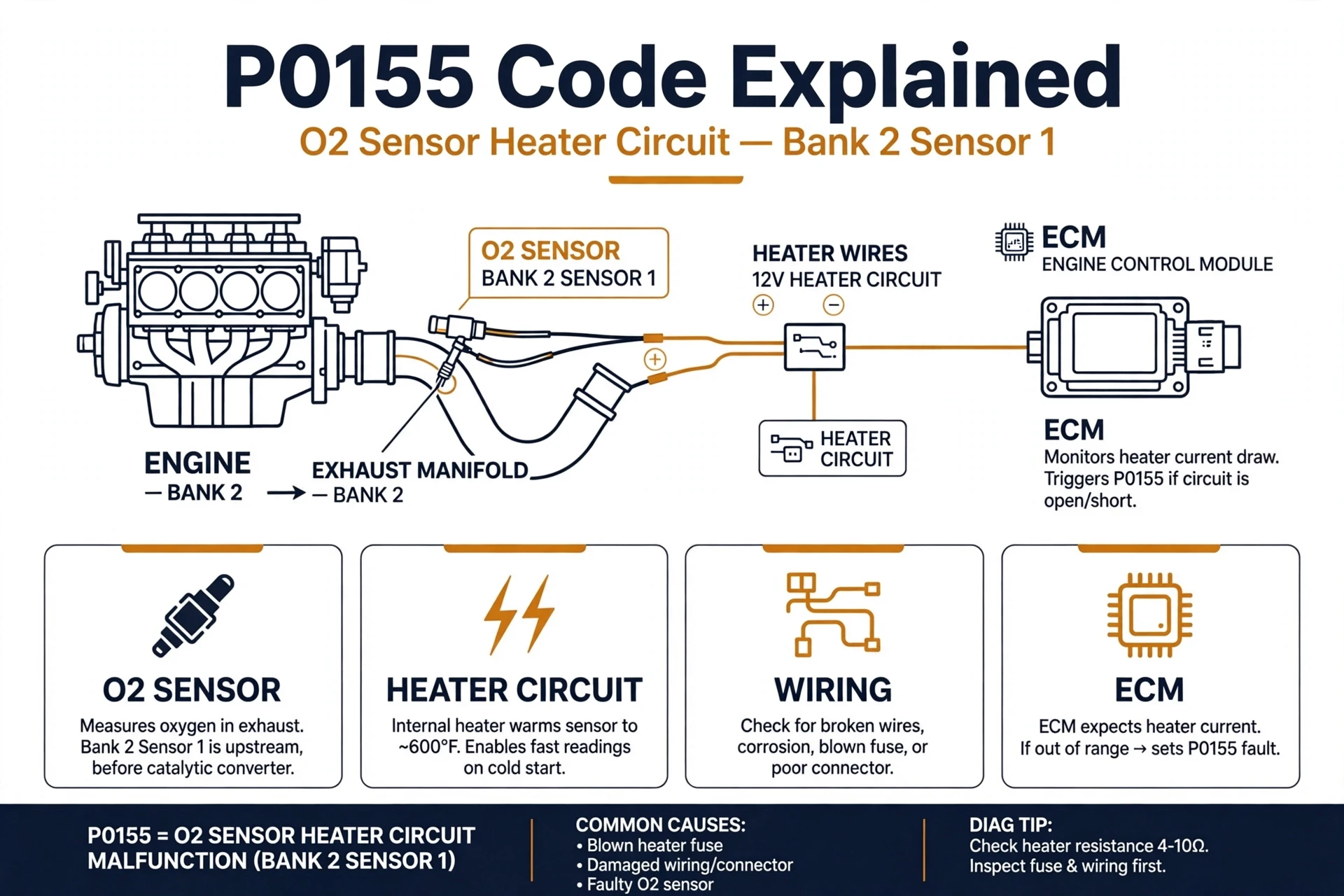
The P0155 code is a diagnostic trouble code that points to the heater circuit of the upstream oxygen sensor on bank 2. Its full definition is “O2 Sensor Heater Circuit Malfunction (Bank 2, Sensor 1).” In plain English, your car’s computer has spotted an electrical fault in the built-in heater that warms up the bank 2 upstream O2 sensor.
Here is a quick decoder for the code. Bank 2 is the side of the engine opposite cylinder number 1, so only V6, V8 and other multi-bank engines can set this code. Sensor 1 is the upstream sensor, mounted in the exhaust before the catalytic converter. The heater circuit is a small internal heating element that brings the sensor up to operating temperature, roughly 600 to 800 degrees Fahrenheit, within seconds of a cold start so it can feed accurate readings to the computer right away.
The PCM tests this heater circuit on a regular basis. When it sees an open circuit, a short, or current draw that is far too high or too low, it stores the P0155 code and switches on the check engine light. P0155 (p0155 code, p0155 obd2) is a generic powertrain code, which means it has the same meaning on every make and model, from a Toyota Tundra to a Ford F-150 to a Jeep Grand Cherokee. Its closest sibling is P0135, the exact same heater fault on bank 1.
Symptoms of the P0155 Code
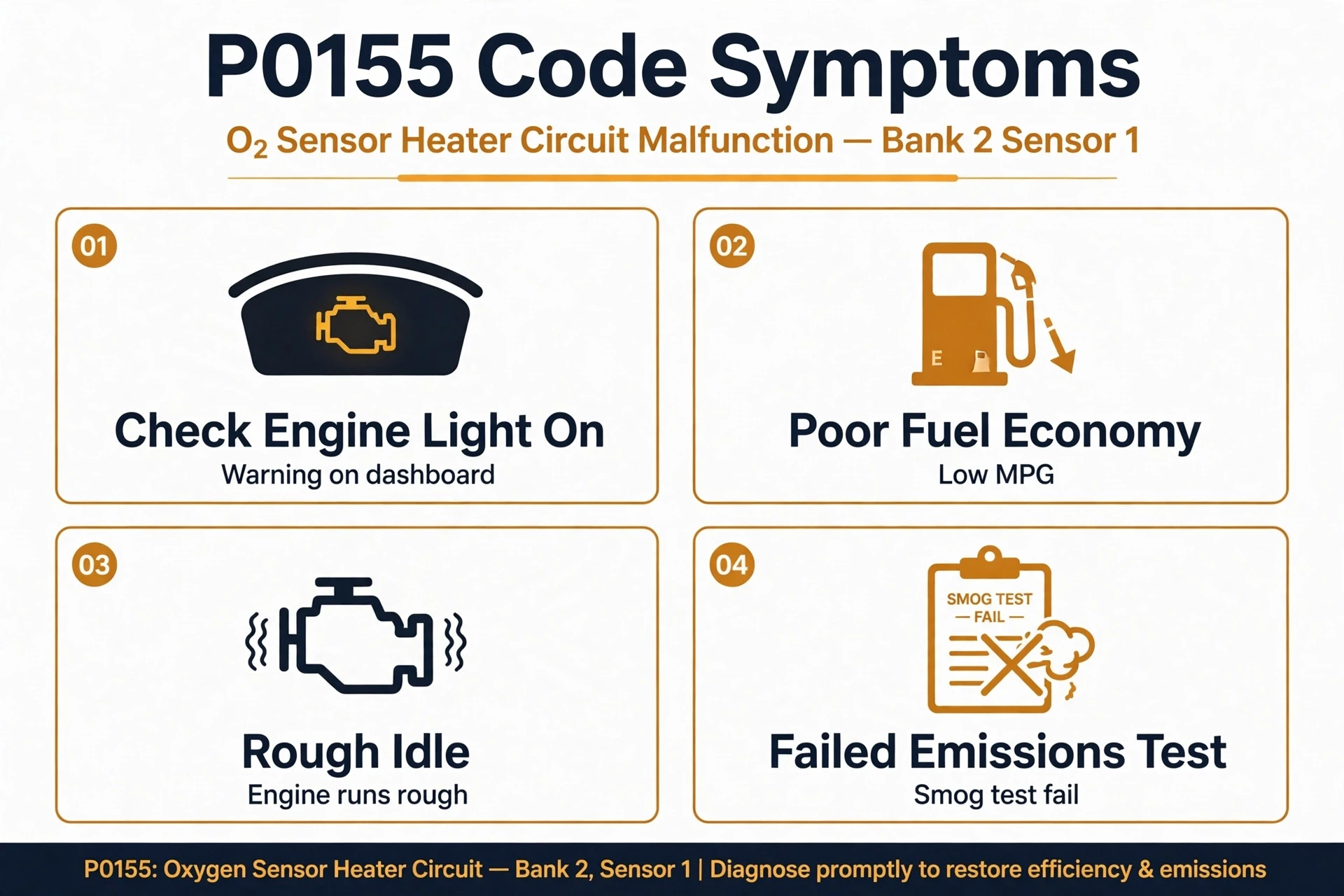
In many cases, the check engine light is the only symptom you will notice. It often appears a few drive cycles after a cold start, and the car may drive exactly the same as before. However, depending on what is causing it, you might also notice:
- Check engine light that stays on
- Reduced fuel economy, you are filling up more often than usual
- Rough idle or slight hesitation, especially noticeable during cold starts
- Failed emissions test, since a cold sensor raises hydrocarbon output
What is code P0155? What is car code P0155 trying to tell you? In short: the upstream O2 sensor on bank 2 is not heating up properly, so the computer cannot trust its readings during warm-up. Do not ignore it just because the car still drives.
Common Causes of P0155
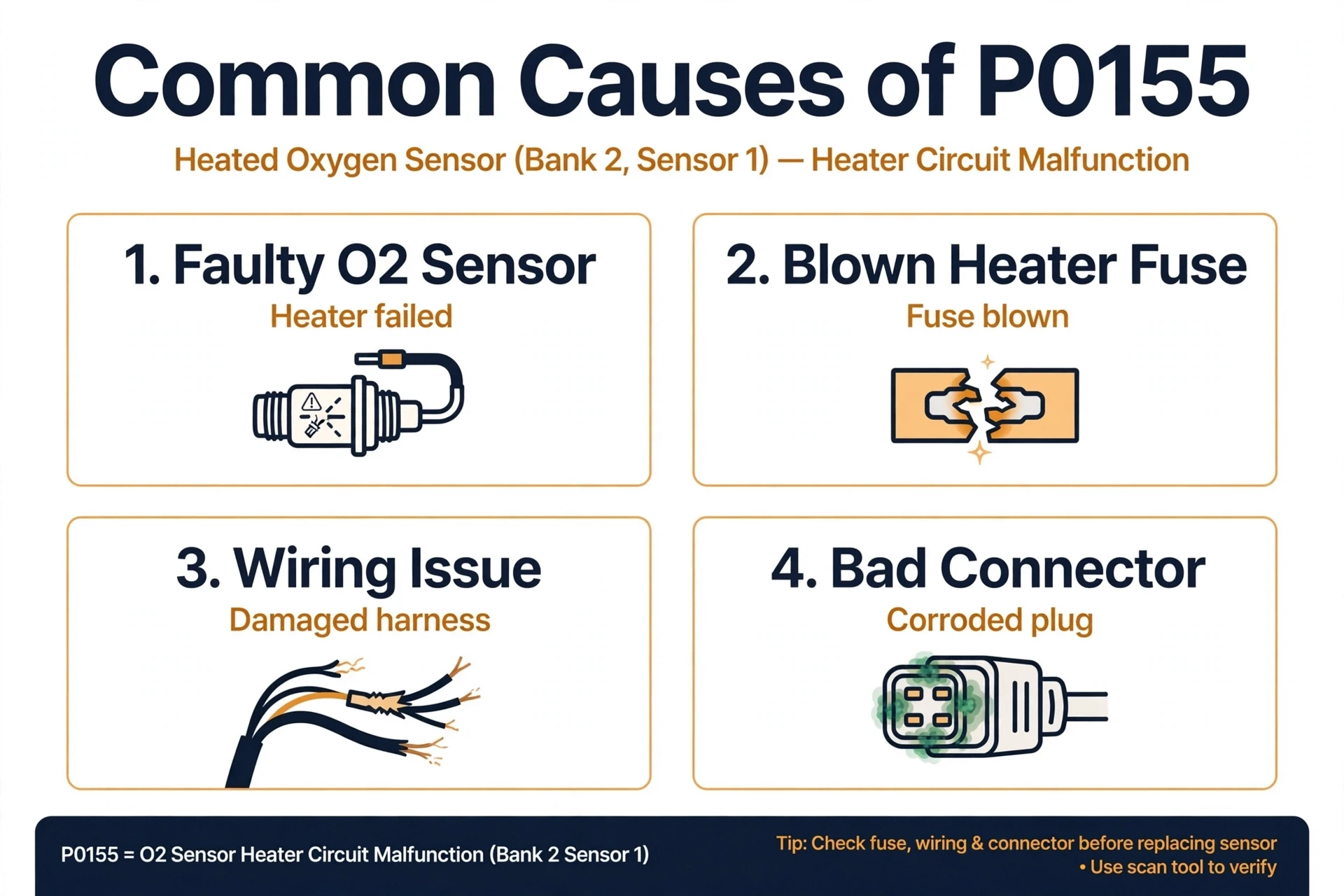
The most common cause of a P0155 code is a failed heater element inside the bank 2 sensor 1 oxygen sensor itself. The internal coil burns out or breaks with age and heat cycling. But the sensor is far from the only suspect. Here are the causes, roughly in order of likelihood:
- Failed O2 sensor heater element: the internal heating coil has burned out or broken. This is the most frequent cause.
- Damaged wiring or connector: frayed, melted or corroded wires in the sensor harness, often where it touches the hot exhaust manifold.
- Blown fuse or bad relay: the heater circuit usually has its own dedicated fuse (often 15A). A blown fuse kills the heater.
- Open or shorted heater circuits: the 12V power feed, the ground, or the PCM control wire can be open, shorted to power, or shorted to ground.
- Exhaust leaks near bank 2: a leak ahead of the sensor can throw off the readings and confuse the monitor.
- Low battery voltage: weak system voltage can keep the heater from drawing proper current.
- Faulty PCM: rare, but the computer’s heater driver circuit can fail.
How to Diagnose P0155 (Do This Before Buying Parts)
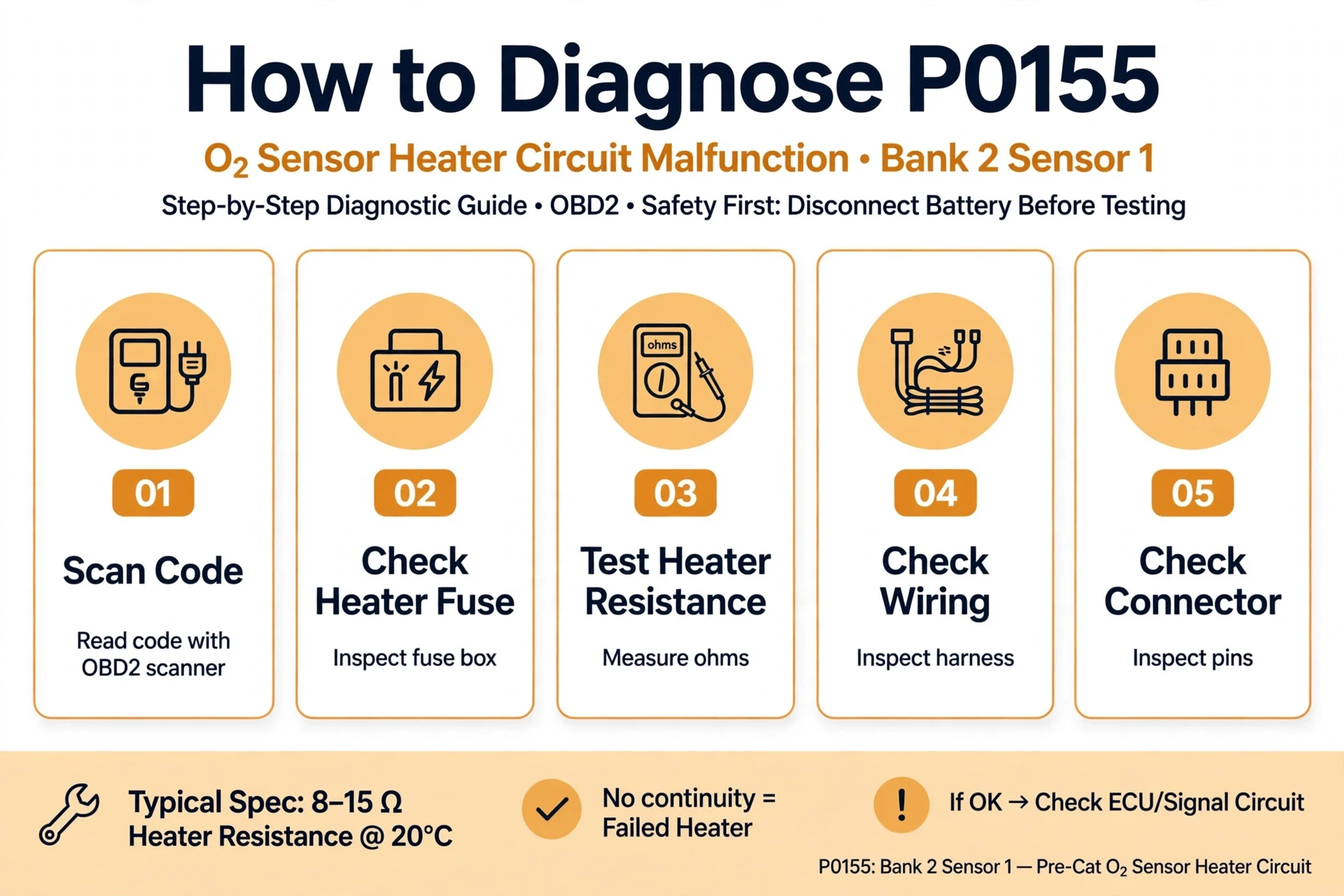
Mechanics see the P0155 code misdiagnosed constantly. The code points at the heater circuit, but the real fault is often a cheap fuse or a chafed wire, not the sensor. Follow this order:
- Scan for other codes first. If you also see heater-circuit siblings like P0135, P0141 or P0161, suspect a shared fuse or power feed rather than one bad sensor.
- Check the fuse. Find the dedicated O2 sensor heater fuse in the fuse box (often 15A) and replace it if blown. If the new fuse blows again, there is a short to find.
- Visually inspect the wiring and connector at bank 2 sensor 1. Look for melted insulation, chafing against the exhaust, corrosion, or bent pins. Clean the connector and make sure it seats fully.
- Test heater resistance. Unplug the sensor and measure resistance across the two heater wires with a multimeter. A healthy heater usually reads a few ohms (roughly 2 to 10 ohms depending on the vehicle). An open circuit or a dead short means the sensor’s heater has failed.
- Check for heater power and ground. With the key on, verify that battery voltage reaches the heater power wire and that the ground path is intact.
- Clear the code and cold-start the engine. The heater monitor runs during warm-up, so a proper retest needs a cold start, not just idling a warm engine.
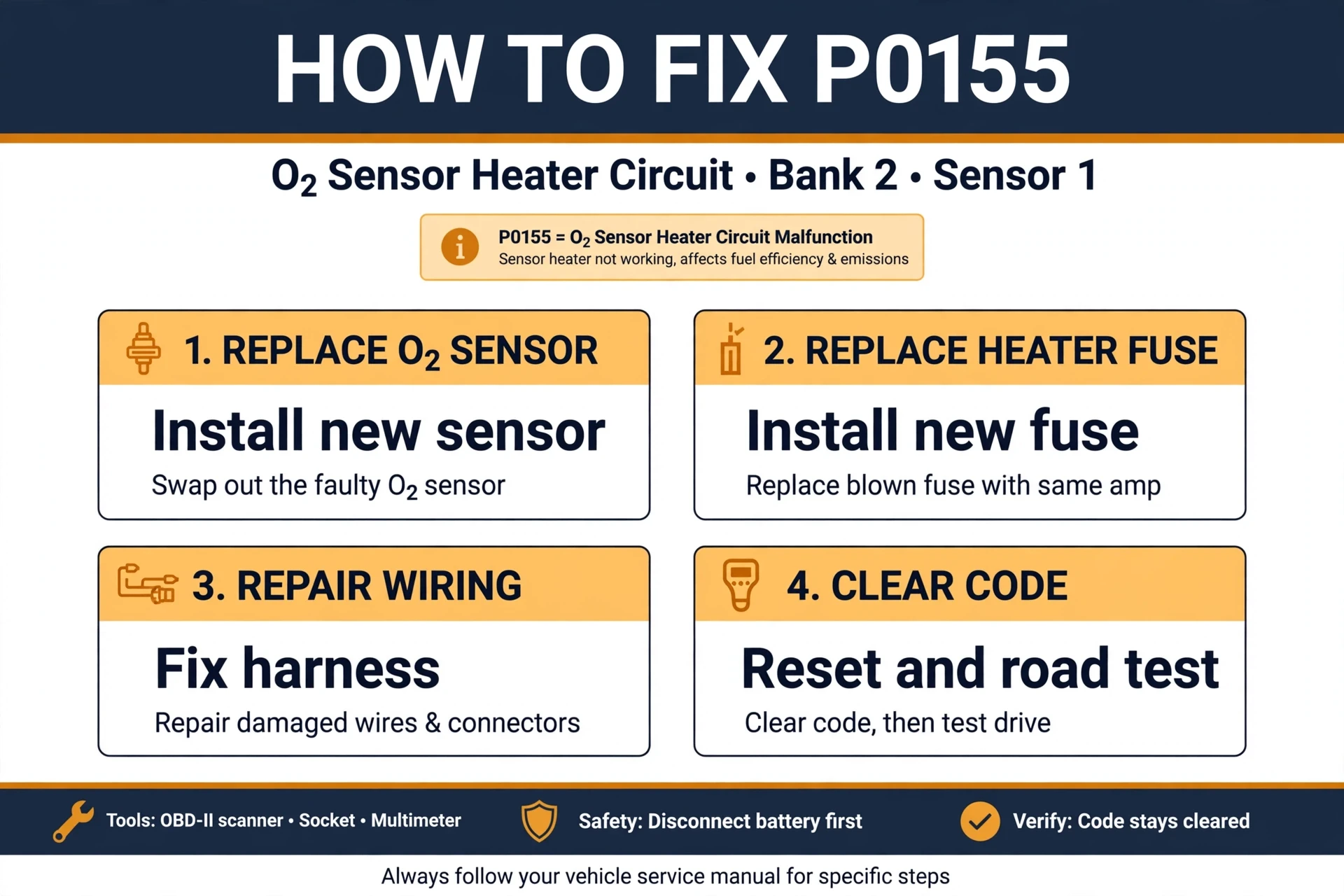
How to Fix the P0155 Code
The right fix depends on what your diagnosis found:
- Replace a blown heater fuse: the cheapest fix. If the new fuse blows again, trace the short before going further.
- Repair damaged wiring or connectors: splice, solder and seal chafed wires, replace corroded terminals, and reroute the harness away from the exhaust.
- Replace the bank 2 sensor 1 oxygen sensor: when the heater element itself has failed. Make sure you are replacing the correct sensor: bank 2 sits opposite cylinder 1, and sensor 1 is upstream of the converter.
- Seal exhaust leaks near bank 2: leaks ahead of the sensor can skew the monitor and set the code.
- Fix low system voltage: charge or replace a weak battery and check the charging system.
- Reprogram or replace the PCM: a rare last resort when the computer’s heater driver has failed and everything else tests good.
P0155 Repair Costs
Drivers always ask how much it costs to fix P0155, and the answer depends entirely on the cause. Here are realistic ranges:
| Repair | Cost Range |
|---|---|
| O2 sensor heater fuse replacement | $10 – $30 |
| Wiring or connector repair | $100 – $250 |
| O2 sensor replacement (Bank 2, Sensor 1) | $150 – $400 |
| Exhaust leak repair | $100 – $300 |
| PCM replacement (rare) | $600 – $1,200 |
This is why diagnosis matters. A $15 fuse and a $400 sensor job share the same code. Drivers looking for a p0155 code fix that lasts should always start with the fuse and wiring checks before buying parts.
DIY vs Mechanic Verdict
You can do this at home: checking and replacing the heater fuse, visual wiring inspection, reading and clearing codes with an OBD2 scanner, and replacing the O2 sensor itself with an O2 sensor socket and basic hand tools.
See a mechanic for: intermittent wiring shorts that need professional tracing, exhaust repairs, and any suspected PCM failure.
Bottom line: diagnose it yourself, fix the simple stuff yourself, but let a pro chase the tricky electrical faults.
Can You Drive With a P0155 Code?
Generally yes, for a short time. The car will usually run normally once warmed up, because exhaust heat eventually brings the sensor up to temperature on its own. But driving long term with P0155 means worse fuel economy, higher emissions, and a guaranteed failed emissions test. Fix it soon rather than later.
P0155 on Popular Vehicles
P0155 shows up across all brands with V6 and V8 engines. Four-cylinder engines have no bank 2, so they never set this code. Some patterns are worth knowing:
- Toyota (Tundra, Sequoia, 4Runner): The p0155 toyota code (toyota p0155, p0155 code toyota) is well documented, and a technical service bulletin covers O2 sensor codes on early-2000s models. Diagnosis plus sensor replacement is the usual path.
- Ford (F-150, Explorer): The p0155 ford code (ford p0155, p0155 code ford) often traces to the sensor heater itself, but check the heater fuse first.
- Chevy (Silverado, Trailblazer): The p0155 chevy code (chevy p0155, p0155 code chevy) can involve O2 sensor wiring chafing along the exhaust.
- Jeep (Grand Cherokee, Wrangler): The p0155 jeep code (jeep p0155, p0155 code jeep) frequently ends with a straightforward upstream sensor replacement on bank 2.
- Nissan (Pathfinder, Frontier): For p0155 nissan (nissan p0155, p0155 code nissan), inspect the harness where it routes near hot exhaust parts.
- Honda (Pilot, Odyssey, Accord V6): The p0155 honda code (honda p0155, p0155 code honda) is usually the heater element inside the sensor itself.
EOBD P0155 and OBD P0155 are the same code under different naming (European vs generic OBD-II). DTC P0155 follows the same definition everywhere.
P0155 vs P0135
P0155 is bank 2, sensor 1. P0135 is the mirror image for bank 1: “O2 Sensor Heater Circuit Malfunction (Bank 1, Sensor 1).” Same fault, same diagnosis steps, different side of the engine. If you have both codes at once, suspect a shared cause like a blown heater fuse or a common power feed rather than two dead sensors.
Related Codes
- P0135: O2 Sensor Heater Circuit Malfunction (Bank 1, Sensor 1)
- P0141: O2 Sensor Heater Circuit Malfunction (Bank 1, Sensor 2)
- P0161: O2 Sensor Heater Circuit Malfunction (Bank 2, Sensor 2)
- P0051: HO2S Heater Control Circuit Low (Bank 2, Sensor 1)
Video Walkthrough
Watch the video above for a visual walkthrough of P0155 causes and diagnosis, including the sensor removal and replacement process, before you read on.
Frequently Asked Questions
What is the most common cause of a P0155 code?
A burned-out heater element inside the bank 2 sensor 1 oxygen sensor is the most common cause. The internal coil fails with age and heat cycling, which is why sensor replacement fixes most P0155 cases. Still, check the fuse and wiring first, because those fixes are cheaper.
Can I still drive my car with a P0155 code?
Yes, for a short time. The car usually runs fine once the engine is warm. But fuel economy drops, emissions rise, and you will fail an emissions test, so get it fixed soon.
How do you fix the code P0155?
Diagnose first: check the heater fuse, inspect the wiring and connector, and test heater resistance with a multimeter. Then replace the bank 2 sensor 1 O2 sensor if the heater element has failed.
How much does it cost to fix P0155?
From about $10 for a fuse to $150-$400 for a professional O2 sensor replacement. Wiring repairs run $100-$250. A rare PCM replacement can reach $600-$1,200.
Will P0155 clear itself?
Rarely. If the underlying fault is fixed, the code may clear after several successful warm-up cycles, but a failed heater will keep setting it. Clear it with a scanner after the repair and confirm it stays off after a cold start.
Where is bank 2 sensor 1 located?
Bank 2 is the side of the engine opposite cylinder number 1. Sensor 1 is the upstream oxygen sensor, screwed into the exhaust manifold or pipe before the catalytic converter on that side.
What is the difference between P0155 and P0135?
Both mean an O2 sensor heater circuit malfunction on the upstream sensor. P0155 is bank 2, P0135 is bank 1. The diagnosis steps are identical; only the sensor location differs.
Conclusion
The P0155 code looks simple, and it usually is: a tired heater inside the bank 2 upstream O2 sensor. Check the fuse, inspect the wiring, test the heater, and replace what you find. Do that, and you will either solve it cheaply or know for certain the sensor is done. Either way, you stop guessing and start fixing.
About the author: Written by the OBD2 Code Hub editorial team. Our diagnostic guides are built from real OBD-II data, manufacturer service procedures, and hands-on troubleshooting experience, then reviewed for technical accuracy before publishing. We drive the same cars you do.