
P0136 Trouble Code: Meaning, Causes, Symptoms & Fixes
In This Guide
One-line meaning: P0136: O2 Sensor Circuit Malfunction (Bank 1, Sensor 2).
What the P0136 Code Means
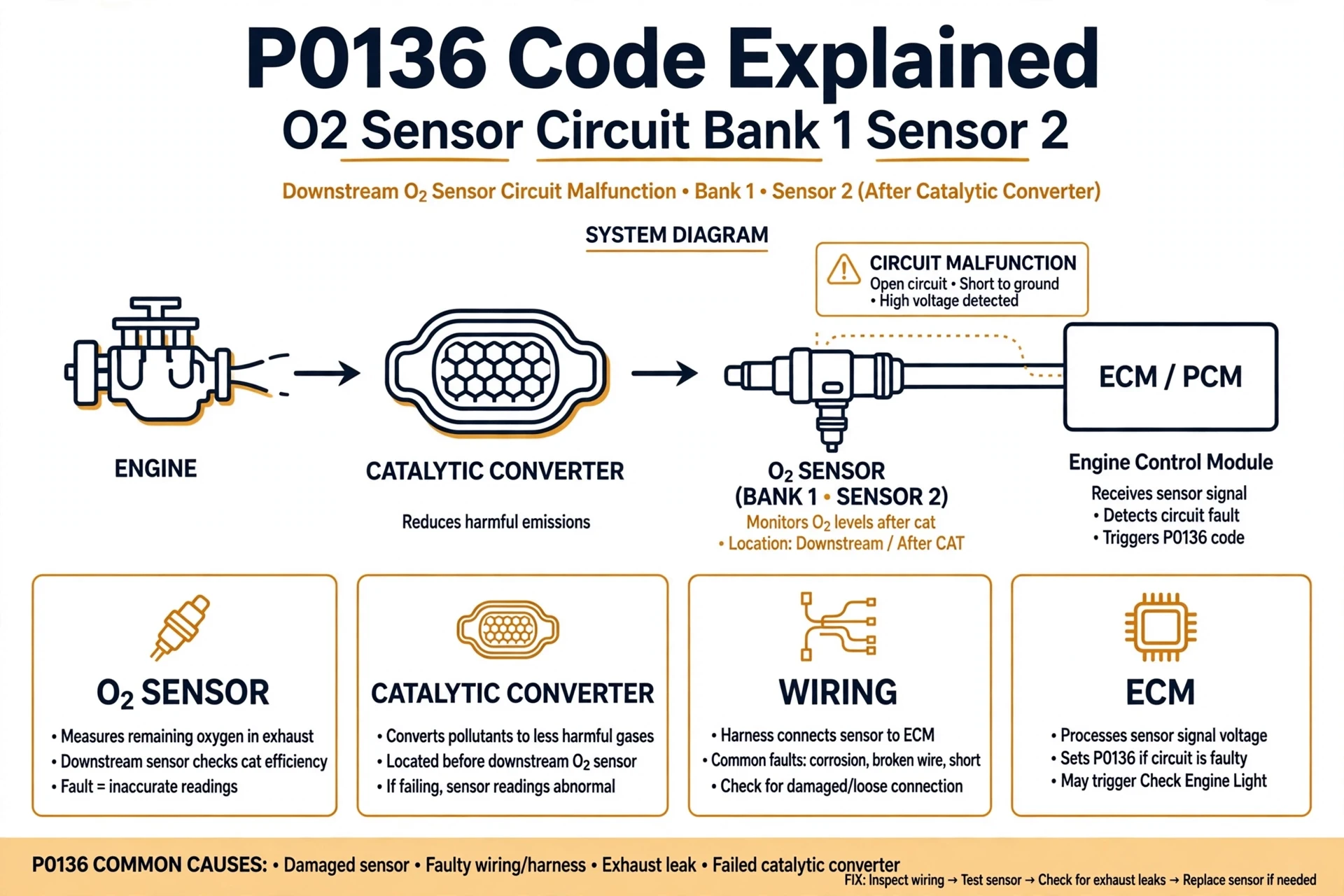
The P0136 code is one of the more common oxygen sensor codes drivers run into. Its full definition is “O2 Sensor Circuit Malfunction (Bank 1, Sensor 2).” In plain English, your car’s engine computer (ECM/PCM) has detected that the signal coming from the downstream oxygen sensor is abnormal, and it no longer trusts that reading.
Here is the key detail. Bank 1 is the side of the engine that contains cylinder number one (on a four cylinder engine there is only one bank). Sensor 2 is the downstream oxygen sensor, the one mounted in the exhaust after the catalytic converter. While the upstream sensor (Sensor 1) constantly fine tunes the air fuel mixture, the downstream sensor has a different job: it watches the catalytic converter and reports how well it is cleaning the exhaust gases.
The computer sets the p0136 engine code when the downstream sensor signal stays abnormal, flat, or outside its expected range for an extended period, often longer than two minutes of driving. P0136 is a generic OBD-II powertrain code, which means it carries the same meaning on every make and model, from a Toyota Camry to a Ford F-150 to a Nissan Altima.
Symptoms of the P0136 Code
In many cases, the check engine light is the only obvious symptom. Because the downstream sensor monitors the catalytic converter instead of controlling fuel delivery, the engine often runs just as it did before the light came on. Depending on the root cause, though, you might also notice:
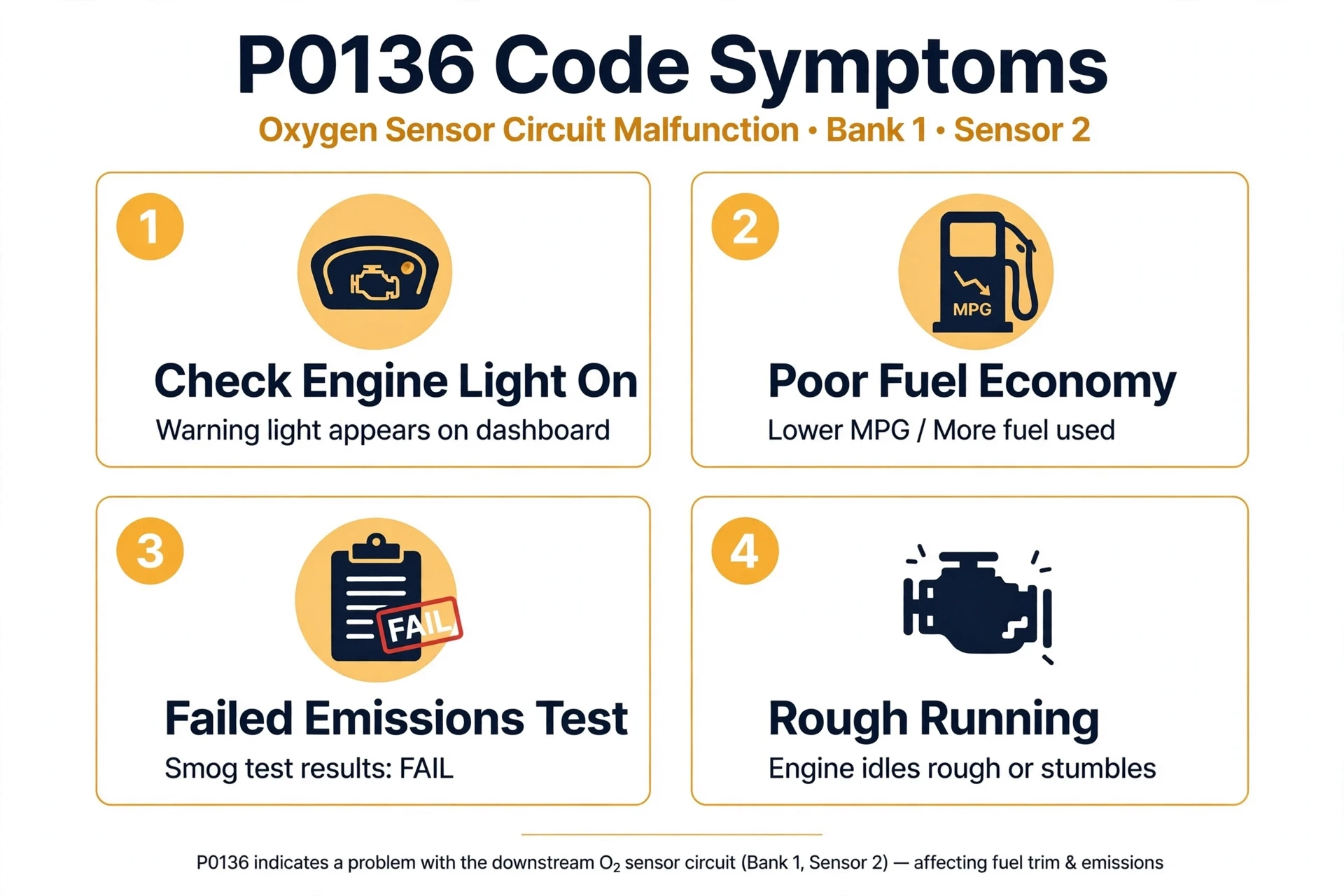
- Check engine light on, the symptom almost every driver reports first
- Poor fuel economy, you find yourself filling up more often than usual
- Rough idle or brief engine hesitation under load
- Higher tailpipe emissions than normal
- Failed emissions or inspection test
- In some cases, no driveability symptoms at all
What does the p0136 code mean for how your car feels day to day? Usually very little. That is exactly why many drivers ignore the p0136 engine code for weeks, which is a mistake, because the underlying fault can still damage the catalytic converter or cost you an emissions test failure.
Common Causes of P0136
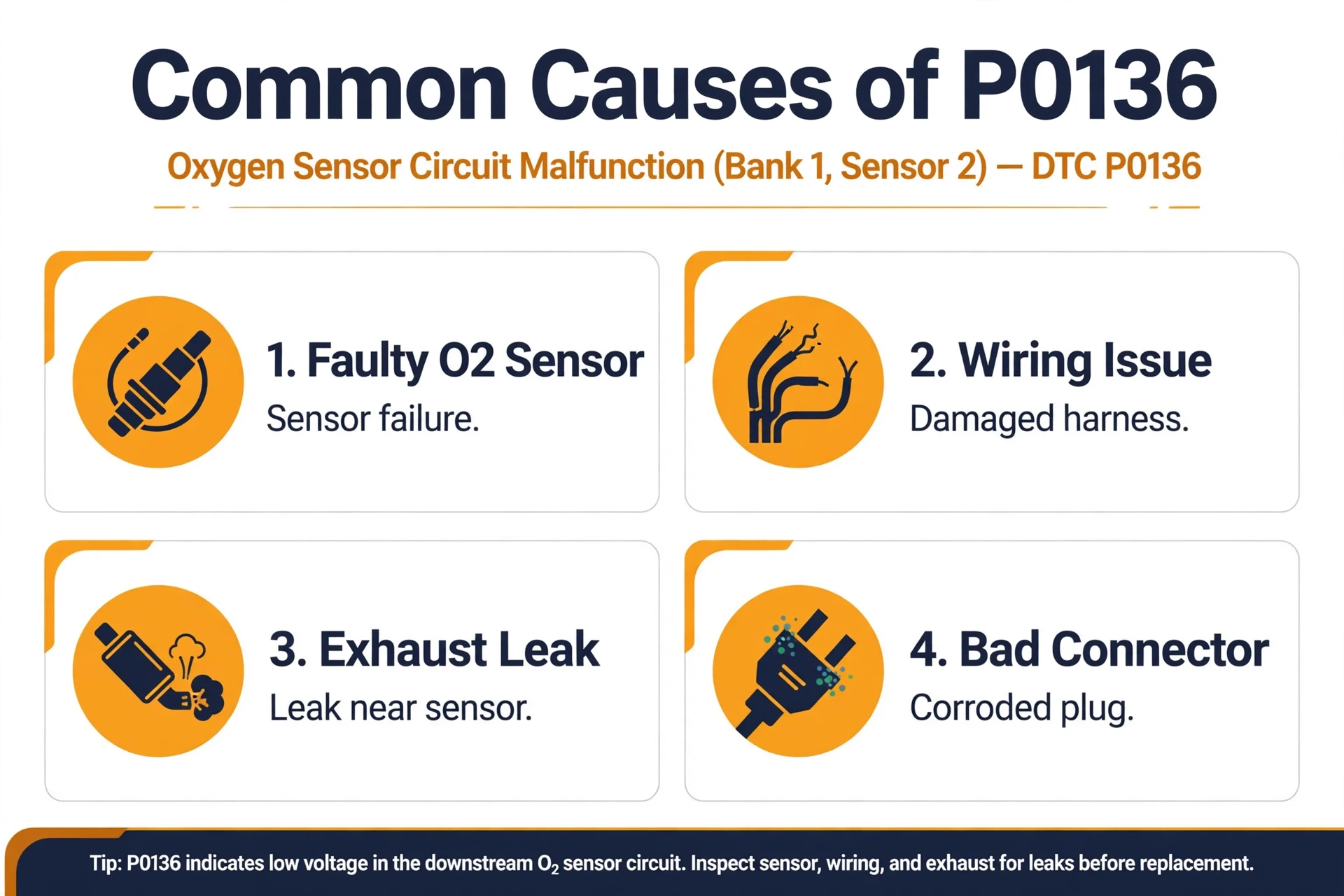
The most common cause of a P0136 code is a worn out downstream oxygen sensor. These sensors live in a brutal environment of heat, vibration, and exhaust gases, and they simply wear out with age and mileage. When the sensor element degrades, its signal goes flat or erratic and the computer flags the circuit.
- Faulty downstream O2 sensor: the sensor element wears out, its internal heater fails, or it becomes coated with carbon, oil, or coolant residue
- Damaged wiring harness: wires running to bank 1 sensor 2 that are melted by exhaust heat, frayed, pinched, or broken
- Corroded or loose connector: a corroded plug at the sensor, bent pins, or a connector that is not fully seated
- Exhaust leaks: a leak in the exhaust manifold, pipe, or converter flange near sensor 2 lets outside air in and skews the reading
- Failing catalytic converter: a converter that no longer stores oxygen properly changes the downstream sensor signal
- Blown O2 sensor heater fuse: the sensor heater circuit has its own fuse, and a blown fuse triggers a circuit fault
- Intake air leak: less common, but unmetered air entering upstream can disturb the sensor readings enough to set the code
How to Diagnose P0136 (Do This Before Buying Parts)
P0136 gets misdiagnosed when people assume it always means a dead sensor. The code points at the whole circuit, meaning the sensor, the wiring, the connector, and the exhaust around it all need a look before you spend money on parts. Work through these steps in order:
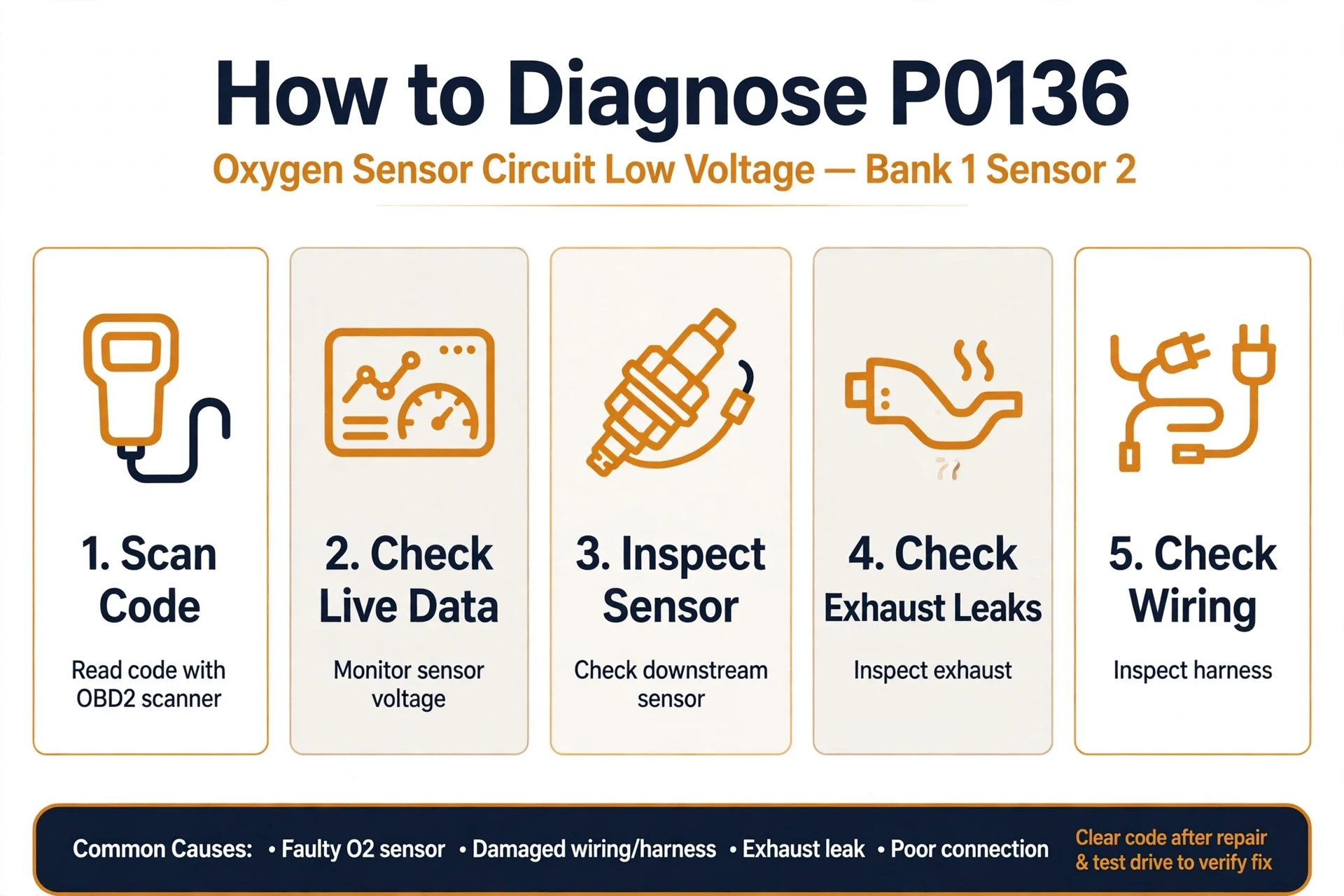
- Scan for other codes first. If you also see P0137, P0138, P0139, or misfire codes, diagnose them together, since they share the same circuit and often share the same root cause.
- Visually inspect the wiring and connector. Follow the harness from the bank 1 sensor 2 plug back along its routing and look for burns, melted spots, frayed insulation, corrosion, and loose or bent pins.
- Check for exhaust leaks. Listen and look for leaks at the exhaust manifold, pipes, and converter flanges near sensor 2. Even a small leak lets outside air into the exhaust and corrupts the sensor reading.
- Check live sensor data. With any OBD2 scanner that shows live data, watch the downstream sensor voltage. A healthy sensor 2 signal normally moves between about 0.1V and 0.9V. A flat line or a signal stuck at one extreme points to the sensor or its circuit.
- Test the heater circuit and fuse. Check the O2 sensor heater fuse, then measure the heater circuit resistance and compare it with the specification in your service manual.
- Only then replace the sensor. If the wiring, connector, exhaust, and fuse all check out and the sensor fails the live data test, replacement is the right call.
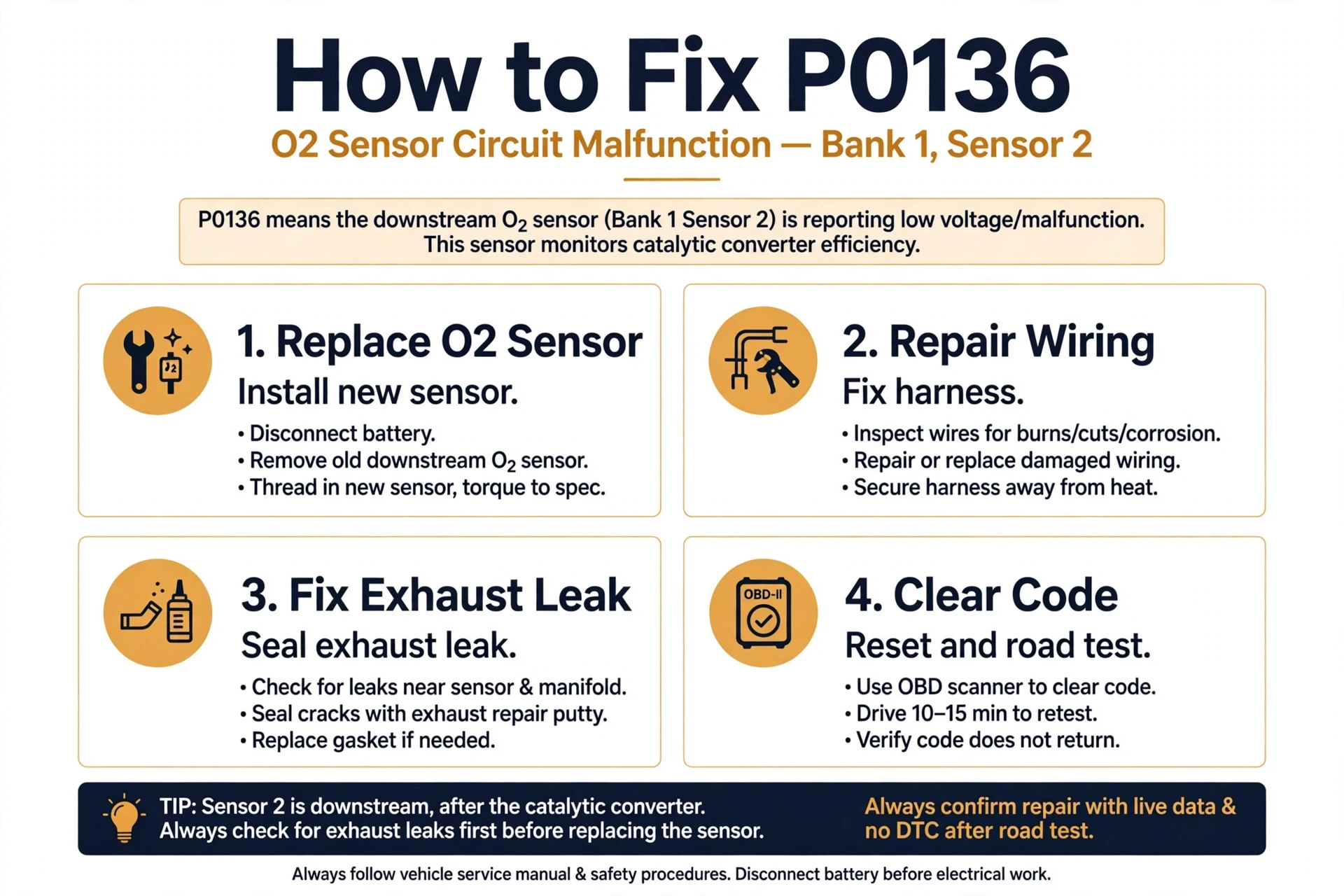
How to Fix the P0136 Code
The right fix depends on what your diagnosis found:
- Repair damaged wiring: splice, solder, and heat shrink damaged sections, then reroute the harness away from hot exhaust parts so it does not happen again
- Clean or replace the connector: clean corrosion from the pins, or install a new pigtail connector if the plug itself is damaged
- Seal exhaust leaks: weld or replace the leaking section, or replace failed gaskets at the manifold and converter flanges
- Replace the blown fuse: install the correct amperage fuse for the O2 heater circuit, and track down what blew it if the new one blows too
- Replace the downstream O2 sensor: when testing shows the sensor itself has failed, install a new bank 1 sensor 2, clear the code, and road test
- Replace the catalytic converter: only when the converter is confirmed dead, since this is by far the most expensive outcome
P0136 Repair Costs
Drivers always ask how much it costs to fix P0136, and the answer depends entirely on the cause. The good news is that the most common fix costs far less than a converter replacement.
| Repair | Cost Range |
|---|---|
| Downstream O2 sensor replacement | $150 – $350 |
| Wiring or connector repair | $100 – $250 |
| Exhaust leak repair | $100 – $300 |
| O2 heater circuit fuse | $10 – $30 |
| Catalytic converter replacement | $800 – $2,500+ |
This is why diagnosis matters. A $200 sensor job and a $2,000 converter job can start with the same check engine light, and guessing wrong gets expensive fast.
DIY vs Mechanic Verdict
You can do this at home: scanning the code, visually inspecting the wiring and connector, checking the heater fuse, and replacing the downstream O2 sensor with basic hand tools. The sensor usually unscrews with an O2 sensor socket and some penetrating oil.
See a mechanic for: wiring faults buried deep in the harness, welding exhaust leaks, and catalytic converter replacement, which needs a lift, cutting tools, and sometimes welding.
Bottom line: P0136 is one of the most DIY friendly trouble codes. Most owners can diagnose it in an afternoon and fix it in their driveway for the price of a sensor.
Can You Drive With a P0136 Code?
Generally yes, for a short time. Because the downstream sensor does not control fueling, the car usually drives normally with P0136. But do not treat that as permission to ignore it. You will burn more fuel, you will fail an emissions test with the light on, and if the root cause is an exhaust leak or a dying converter, driving on it lets a cheap problem grow into an expensive one. Get it checked within a week or two.
P0136 on Popular Vehicles
P0136 shows up across all brands, but some patterns are worth knowing:
- Toyota (Camry, Corolla, RAV4): the p0136 code appears often on higher mileage Toyotas as the original downstream sensor ages out. Aftermarket sensors work, but many Toyota techs prefer OEM parts for stable readings.
- Nissan (Altima, Sentra): the p0136 nissan code is a frequent Altima complaint, and corroded sensor connectors show up a lot on cars from the rust belt.
- Ford (F-150, Focus, Escape): on Fords, check the harness routing first, since heat damage to the sensor 2 wiring is a known pattern.
- Chevy (Silverado, Malibu): the p0136 chevy code often traces back to exhaust manifold leaks near the downstream sensor on trucks.
- Jeep (Wrangler): off road use shakes connectors loose, so Wranglers see more P0136 faults from unplugged or damaged sensor plugs than from dead sensors.
EOBD P0136 and OBD P0136 are the same code under different naming (European vs generic OBD-II). DTC P0136, engine code P0136, and p0136 engine code all refer to this same fault.
P0136 vs P0137
P0136 and P0137 both point at the bank 1 sensor 2 circuit, but they describe different faults. P0136 is a general circuit malfunction, meaning the signal is erratic, stuck, or outside its expected behavior. P0137 is specifically a low voltage fault, meaning the signal is pinned low. The two codes share most of the same causes, including a bad sensor, damaged wiring, and exhaust leaks, so the diagnosis steps overlap heavily. If you see both codes together, start with the wiring and connector before condemning the sensor.
Related Codes
- P0137: O2 Sensor Circuit Low Voltage (Bank 1, Sensor 2)
- P0138: O2 Sensor Circuit High Voltage (Bank 1, Sensor 2)
- P0139: O2 Sensor Circuit Slow Response (Bank 1, Sensor 2)
- P0140: O2 Sensor Circuit No Activity Detected (Bank 1, Sensor 2)
- P0135: O2 Sensor Heater Circuit Malfunction (Bank 1, Sensor 1)
- P0156: O2 Sensor Circuit Malfunction (Bank 2, Sensor 2)
Video Walkthrough
Watch the video above for a visual walkthrough of P0136 causes and fixes before you read on.
Frequently Asked Questions
What is the most common cause of a P0136 code?
A worn out downstream oxygen sensor is the number one cause. The bank 1 sensor 2 unit lives in hot exhaust gases and simply wears out with age and mileage. Damaged wiring, a corroded connector, and exhaust leaks near the sensor are the next most common culprits.
Can I still drive my car with a P0136 code?
For short trips, yes. The downstream sensor does not control fuel delivery, so the car usually drives normally. Still, get it diagnosed within a week or two, because you will use more fuel, you will fail an emissions test with the light on, and the underlying fault can damage the catalytic converter.
How do you fix the code P0136?
Diagnose first, then fix what you find. Most P0136 faults are fixed by replacing the downstream O2 sensor, repairing damaged wiring or the connector, sealing an exhaust leak, or replacing a blown heater fuse. Clear the code with a scanner and road test the car to confirm it stays off.
How much does it cost to fix P0136?
Most repairs land between $150 and $350 for a downstream O2 sensor replacement. Wiring or connector repairs run $100 to $250, exhaust leak repairs $100 to $300, and a new heater fuse costs under $30. A catalytic converter replacement, needed only in rare cases, runs $800 to $2,500 or more.
Will P0136 clear itself?
Rarely. The code stays until the underlying fault is fixed and the code is cleared with a scanner. Even after a repair, the computer needs several drive cycles to run its self tests before it considers the problem solved.
Which O2 sensor is bank 1 sensor 2?
Bank 1 is the side of the engine that contains cylinder number one. On a four cylinder engine there is only one bank. Sensor 2 is the downstream sensor, the one mounted after the catalytic converter. It monitors converter efficiency rather than controlling the fuel mixture.
Will P0136 cause me to fail an emissions test?
Yes. Any stored trouble code that turns on the check engine light is an automatic failure in most inspection programs. Fix the fault, clear the code, and complete a full drive cycle so the monitors read ready before your test.
Conclusion
The P0136 code looks technical, but it is really your car asking for a simple circuit check, not an automatic sensor replacement. Inspect the wiring, rule out exhaust leaks, test the sensor with live data, and most of the time you will be back on the road for the price of a sensor. Handle it promptly and it stays a small, cheap repair.
About the author: Written by the OBD2 Code Hub editorial team. Our diagnostic guides are built from real OBD-II data, manufacturer service procedures, and hands-on troubleshooting experience, then reviewed for technical accuracy before publishing. We drive the same cars you do.