
Check Engine Light Causes: Every Reason Your Light Turns On
In This Guide
The Check Engine Light Is a Symptom, Not a Diagnosis
When the check engine light comes on, drivers ask one question: what are the check engine light reasons behind that glow? Here is the honest answer. The light itself is not a diagnosis. It is a symptom. Your car’s onboard computer turns the light on because a sensor reading drifted out of range, an emissions value crossed a legal limit, or a system failed a self-test. Behind every illuminated light sits a stored trouble code plus a failed part or an abnormal condition, and that combination is the real answer.
That is why lists of check engine light causes matter, and also why they can mislead. Two drivers can see the same glowing icon for completely different check engine light reasons. One has a gas cap that never clicked shut. The other has a catalytic converter that is breaking apart inside. The light looks identical. The cause, the urgency, and the repair bill are not.
Most of the common check engine light causes fall into four groups: sensors that report bad data, ignition and fuel parts that weaken combustion, emissions and EVAP parts that let vapors escape, and mechanical problems that change how the engine breathes, cools, or holds oil. Work through them in this guide, and you will understand the reasons why check engine light comes on in your car long before a shop hands you an estimate.

Sensor-Related Check Engine Light Causes
Sensors are the computer’s eyes and ears. When one lies, the computer lights the lamp. Among the common causes of check engine light trouble, sensor faults rank near the top, because a single skewed reading can push fuel trim, timing, or emissions out of range.
- Faulty oxygen sensor: the oxygen sensor measures how much unburned oxygen remains in the exhaust, and the computer uses that signal to fine-tune fuel delivery. A lazy or dead sensor reports a false lean condition, the computer adds extra fuel, and fuel economy drops while emissions climb. It is one of the most common reasons for check engine light warnings on high-mileage cars.
- Dirty or failed mass air flow sensor: the mass air flow sensor weighs the air entering the engine. Oil mist, dust, and debris coat its sensing element, so it under-reports airflow and the engine runs lean. Expect hesitation, stalling, or jerky acceleration, which are classic reasons check engine light comes on after an oiled aftermarket air filter is installed.
- Coolant temperature sensor: this sensor tells the computer whether the engine is cold, warming up, or fully hot. A faulty reading can keep the engine in cold-start enrichment too long, wasting fuel and loading the catalytic converter, another quiet entry among check engine light causes.

Ignition and Fuel Check Engine Light Causes
A healthy engine needs spark at the right moment and fuel in the right amount. When either side weakens, combustion degrades and the computer notices. These are some of the most expensive causes for a check engine light if they are ignored, because raw fuel from misfires can overheat and destroy the catalytic converter.
- Worn spark plugs: spark plug electrodes erode with every mile. Once the gap grows too wide or carbon fouls the tip, the spark weakens and the cylinder misfires. Misfires are among the most common reasons check engine light drivers report as a flashing light, and a flashing light means you should pull over.
- Bad ignition coil: each coil turns battery voltage into the high-voltage jolt that fires a plug. A cracked coil or a failed winding delivers a weak or missing spark, which causes check engine light codes for cylinder misfires and a rough, shaking idle.
- Faulty fuel injector: injectors spray a fine fuel mist. A clogged nozzle dribbles instead of atomizing, creating a lean misfire, poor acceleration, and higher fuel consumption. These are frequent reasons for check engine light to come on in direct-injection engines with carbon buildup.
- Weak fuel pump: low fuel pressure starves every cylinder at once. The engine may hesitate under load, struggle on hills, or stall, and the computer sets lean codes. A dying pump is one of the causes of check engine light trouble that gets worse fast, so do not ignore it.

Emissions and EVAP Check Engine Light Causes
The check engine light is, at its core, an emissions watchdog. It exists to warn you when the engine is polluting beyond its allowed limit. That makes the emissions and evaporative systems prime suspects, and the causes of check engine light warnings here are often the cheapest to fix.
- Failing catalytic converter: the converter scrubs pollutants from the exhaust. Years of heat, ignored misfires, and oil contamination melt or clog its internal honeycomb, so exhaust flow drops and emissions spike. A sulfur or rotten egg smell and sluggish acceleration are telltale check engine light on reasons pointing at the converter.
- Loose or damaged gas cap: the fuel system is sealed, and the computer pressure-tests it. A cap that was never tightened, has a cracked seal, or is simply missing lets fuel vapor escape and sets an EVAP code. It is the single most common of all check engine light reasons, and the fix is tightening the cap until it clicks.
- EVAP system leak: beyond the cap, cracked hoses, a split filler neck, or a leaking charcoal canister let vapors escape. The computer detects the pressure loss during its self-test and stores codes like P0442 or P0455, which are classic causes check engine light scanners reveal on older cars.
- Purge or vent valve fault: the purge valve meters stored fuel vapor into the engine, and the vent valve seals the system during testing. A valve stuck open or closed fails the self-test and turns the light on, rounding out the usual reasons a check engine light would come on from the EVAP side.

Mechanical Check Engine Light Causes
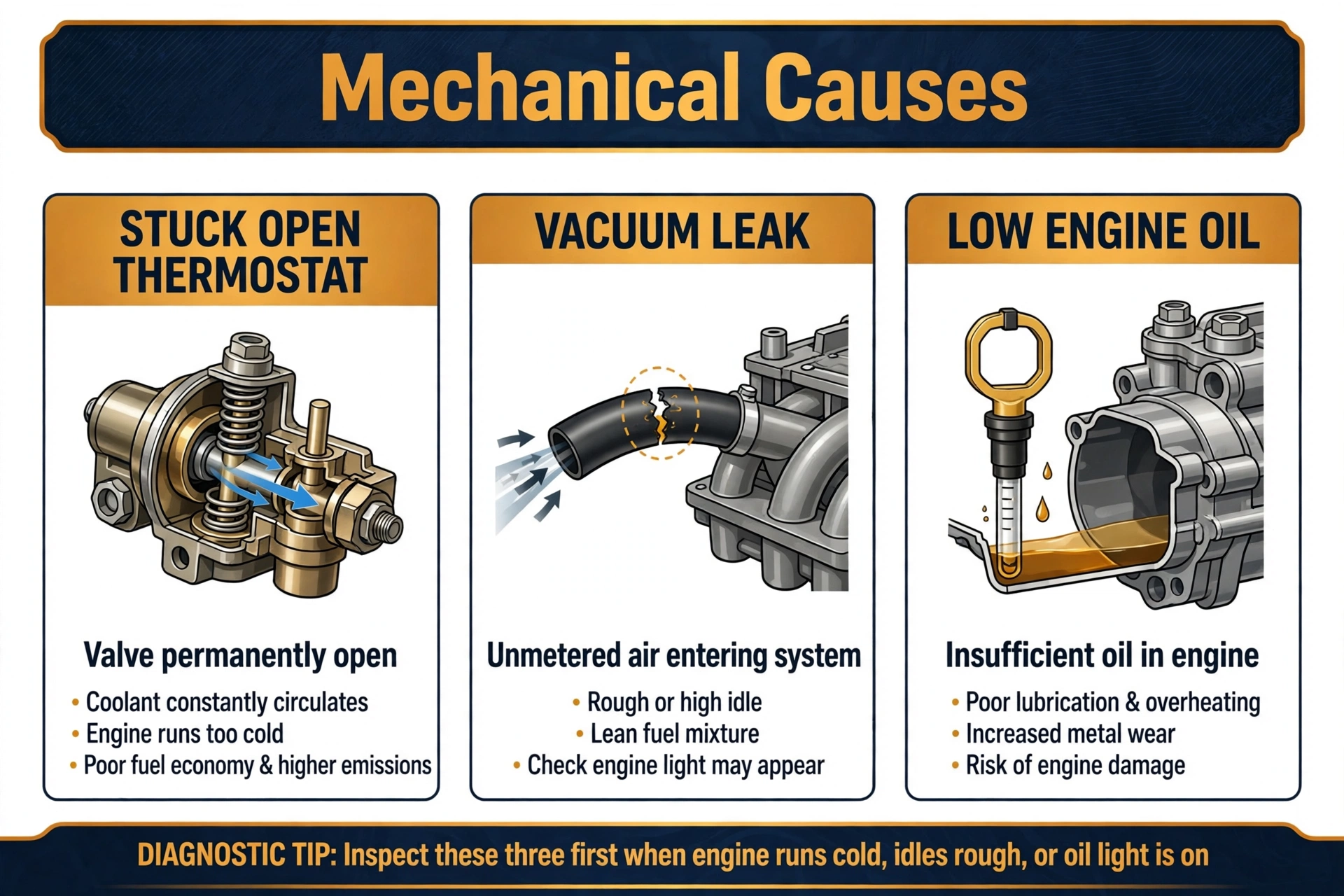
Not every trigger is electrical. Worn or stuck mechanical parts change airflow, temperature, or lubrication, and the sensors report the fallout. These common reasons for check engine light illumination reward a quick visual inspection before you buy parts.
- Stuck-open thermostat: a thermostat stuck open lets coolant circulate constantly, so the engine never reaches full operating temperature. Fuel economy suffers, emissions rise, and the heater blows lukewarm, all for a part that costs less than a tank of gas.
- Vacuum leak: cracked hoses, a leaking intake gasket, or a failed PCV valve let unmetered air into the engine. The extra air leans the mixture, the idle turns rough or high, and the computer flags the imbalance. Vacuum leaks are sneaky reasons why check engine light comes on with no other obvious symptom.
- Low engine oil: low oil starves variable valve timing systems and increases friction and heat. Some engines set camshaft timing codes when oil pressure drops, so checking the dipstick belongs in every what causes check engine light to come on investigation.
- Timing issues: a stretched timing chain or a jumped belt shifts valve timing away from specification. Expect poor performance, rattling on startup, and codes for camshaft or crankshaft correlation, which are serious causes for a check engine light that deserve prompt attention.
Match the Symptom to the Cause
Your senses narrow the search. Use the symptom you can feel, hear, or smell to aim the diagnosis before you scan. These pairings cover what causes a check engine light to come on most often in real driveways.
- Rough idle or shaking points to a misfire: a steady shake at idle usually means one cylinder is not pulling its weight. Suspect worn spark plugs, a failing coil, or a vacuum leak first.
- Poor fuel economy points to a sensor fault: when mileage drops with no drivability drama, a lazy oxygen sensor or a dirty mass air flow sensor is misreporting data, and the computer is over-fueling to compensate.
- Rotten egg smell points to the catalytic converter: that sulfur odor means the converter is overloaded or breaking down. Do not ignore it, because an ignored misfire upstream is often what killed the converter.
- Hard starting or stalling points to ignition or fuel delivery: long cranks, no-starts, or dying at stoplights suggest weak spark, low fuel pressure, or a failing sensor that the computer needs for startup.

How to Find Your Cause in Three Steps
Guessing is expensive. Follow this order and you will land on the true cause without throwing parts at the car.
- Scan for the code: plug an OBD-II scanner into the diagnostic port under the dashboard and read the stored trouble code. The code does not name the bad part, but it names the failing system, which cuts the list of possible check engine light reasons down to a handful.
- Note the symptoms: write down when the light came on, whether it is solid or flashing, and what you feel, hear, and smell. A flashing light means a severe misfire, so reduce speed and get help right away instead of continuing to drive.
- Inspect the indicated system: start with the free checks the code suggests. Tighten the gas cap until it clicks and inspect its seal, look for cracked vacuum hoses and damaged wiring, check the oil level, and only then test or replace the sensor or part the evidence points to.
Check Engine Light Repair Costs
What you pay depends entirely on which cause your diagnosis found. Typical repair cost ranges in the United States:
| Cause | Typical Repair Cost Range |
| Gas cap replacement | $15–$40 |
| EVAP purge or vent valve | $120–$300 |
| Oxygen sensor replacement | $150–$400 |
| Mass air flow sensor replacement | $200–$450 |
| Spark plugs, full set | $120–$350 |
| Ignition coil, each | $150–$350 |
| Fuel injector replacement, each | $250–$600 |
| Fuel pump replacement | $400–$900 |
| Catalytic converter replacement | $1,000–$2,500 |
| Thermostat replacement | $150–$400 |
| Vacuum leak repair | $100–$350 |
| OBD-II diagnostic fee | $100–$160 |
Video Walkthrough: Top 5 Check Engine Light Causes
Watch DeBoer’s Auto, a USA-based repair shop in Hamburg, New Jersey, walk through the top five reasons your check engine light is on, covering oxygen sensors, ignition system parts, and the mass airflow sensor.
Video: the top five check engine light causes explained step by step by DeBoer’s Auto, a USA-based creator.
Check Engine Light Causes FAQs
Quick answers to the questions drivers ask most about check engine light causes.
What are the most common check engine light reasons?
The most common check engine light reasons are a loose or damaged gas cap, a faulty oxygen sensor, worn spark plugs or a bad ignition coil, a dirty mass air flow sensor, an EVAP system leak, and a failing catalytic converter. These six account for the large majority of lights, and the gas cap alone is the single most frequent trigger.
What causes check engine light to come on suddenly?
A sudden light usually follows a part failure or a threshold crossing: an ignition coil dies, a sensor goes out of range, a vacuum hose splits, or the EVAP self-test fails after a fill-up. If the light starts flashing, the cause is a severe misfire, so slow down and have the car checked immediately.
Can a loose gas cap really cause the check engine light?
Yes. The fuel system is sealed, and the computer pressure-tests it for vapor leaks. A cap that never clicked shut, has a cracked seal, or is missing lets vapor escape and sets an EVAP code. Tighten it until it clicks, drive a few trips, and the light often clears on its own.
Is it safe to drive with the check engine light on?
A solid light with no drivability symptoms is usually safe for short, gentle trips to a repair shop, but get it diagnosed soon. A flashing light is different: it signals a severe misfire that can overheat and destroy the catalytic converter, so pull over safely and arrange a tow.
Why is my check engine light flashing instead of staying solid?
A flashing check engine light means the engine is misfiring badly enough to send raw fuel into the exhaust, where it can melt the catalytic converter. Common triggers are failed ignition coils, badly worn spark plugs, or a major vacuum leak. Reduce speed, avoid hard acceleration, and get immediate service.
How do I find out why my check engine light came on?
Scan for the stored trouble code with an OBD-II scanner, note whether the light is solid or flashing and any symptoms, then inspect the system the code points to. Start with the free checks: gas cap, vacuum hoses, wiring, and oil level, before replacing any part.
How much does it cost to fix the cause of a check engine light?
It ranges from about $15 for a gas cap to $2,500 for a catalytic converter. Common fixes land in the middle: oxygen sensors $150 to $400, ignition coils $150 to $350 each, and EVAP valves $120 to $300. A diagnostic fee of $100 to $160 identifies the true cause before you spend on parts.
Conclusion: Every Light Has a Cause, and Every Cause Has a Fix
The check engine light never comes on for no reason. Behind it sits a stored code and a failed part or condition, from a five-minute gas cap fix to a catalytic converter replacement. The drivers who spend the least are the ones who scan first, match the symptom to the system, and fix what the evidence proves.
Start with the simple checks, respect a flashing light, and work the systems in order. Do that, and the most common check engine light causes become routine maintenance instead of scary surprises.
About the author: Written by the OBD2 Code Hub editorial team. Our diagnostic guides are built from real OBD-II data, manufacturer service procedures, and hands-on troubleshooting experience, then reviewed for technical accuracy before publishing. We drive the same cars you do.