
Check Engine Light: What It Means, Causes & What to Do
In This Guide
- What Does the Check Engine Light Mean?
- Steady vs Flashing Check Engine Light
- Common Causes of a Check Engine Light
- Symptoms to Watch For
- How to Diagnose a Check Engine Light With an OBD2 Scanner
- How to Fix a Check Engine Light
- Check Engine Light Repair Costs
- Can You Drive With the Check Engine Light On?
- When to See a Mechanic
- Video: Check Engine Light Walkthrough
- Frequently Asked Questions
- Conclusion
Seeing the check engine light glow on your dashboard can be unsettling, especially when it appears in the middle of a normal drive. This small amber warning is your car’s way of telling you its onboard computer has found a problem that needs attention. Understanding the check engine light meaning early can save you from expensive repairs and keep you safe on the road.
The check engine light is also called the malfunction indicator lamp. It is an amber, engine-shaped symbol on your instrument cluster, and the engine computer switches it on whenever a sensor reports a reading outside its normal range. In this guide, we explain what the check engine light means, the difference between a steady and a flashing light, the most common causes, and exactly what to do when the check engine light comes on.
What Does the Check Engine Light Mean?
So, what does the check engine light mean in plain language? It means your car’s OBD2 system has detected a fault in the engine, the emissions system, or the transmission, and it wants you to have it checked. The moment the fault is confirmed, the computer stores a diagnostic trouble code and turns the light on so you know something needs attention.
The check engine light symbol looks like a side-view outline of an engine, and it usually glows yellow or amber. Some vehicles instead show the words “Service Engine Soon” or “Check Powertrain.” All of these are the same basic warning: a monitored system is not working the way it should.
A check engine light on its own does not tell you which part failed. It is a general alert, not a diagnosis. The stored trouble code is what identifies the problem, which is why scanning the code is always the first real step. Once you know what does check engine light mean for your specific vehicle, you can decide whether it is a simple fix or a job for a shop.

Steady vs Flashing Check Engine Light
How the light behaves tells you how serious the problem is. A solid check engine light means the computer found a fault that is not an immediate emergency. The car will often drive normally, but you should have it checked soon. A yellow check engine light that stays on steadily is the most common version of this warning.
A flashing check engine light is a different story. It almost always means an active engine misfire that is dumping unburned fuel into the exhaust. That can overheat and destroy the catalytic converter in a short time, turning a small repair into a very expensive one. If the light is flashing, slow down, pull over somewhere safe, and switch the engine off. Do not keep driving far with a flashing light. Call for roadside help or a tow instead.
Some vehicles use a red check engine light for severe faults instead of flashing. Treat a red check engine light the same way you would a flashing one: stop safely and get help right away.

Common Causes of a Check Engine Light
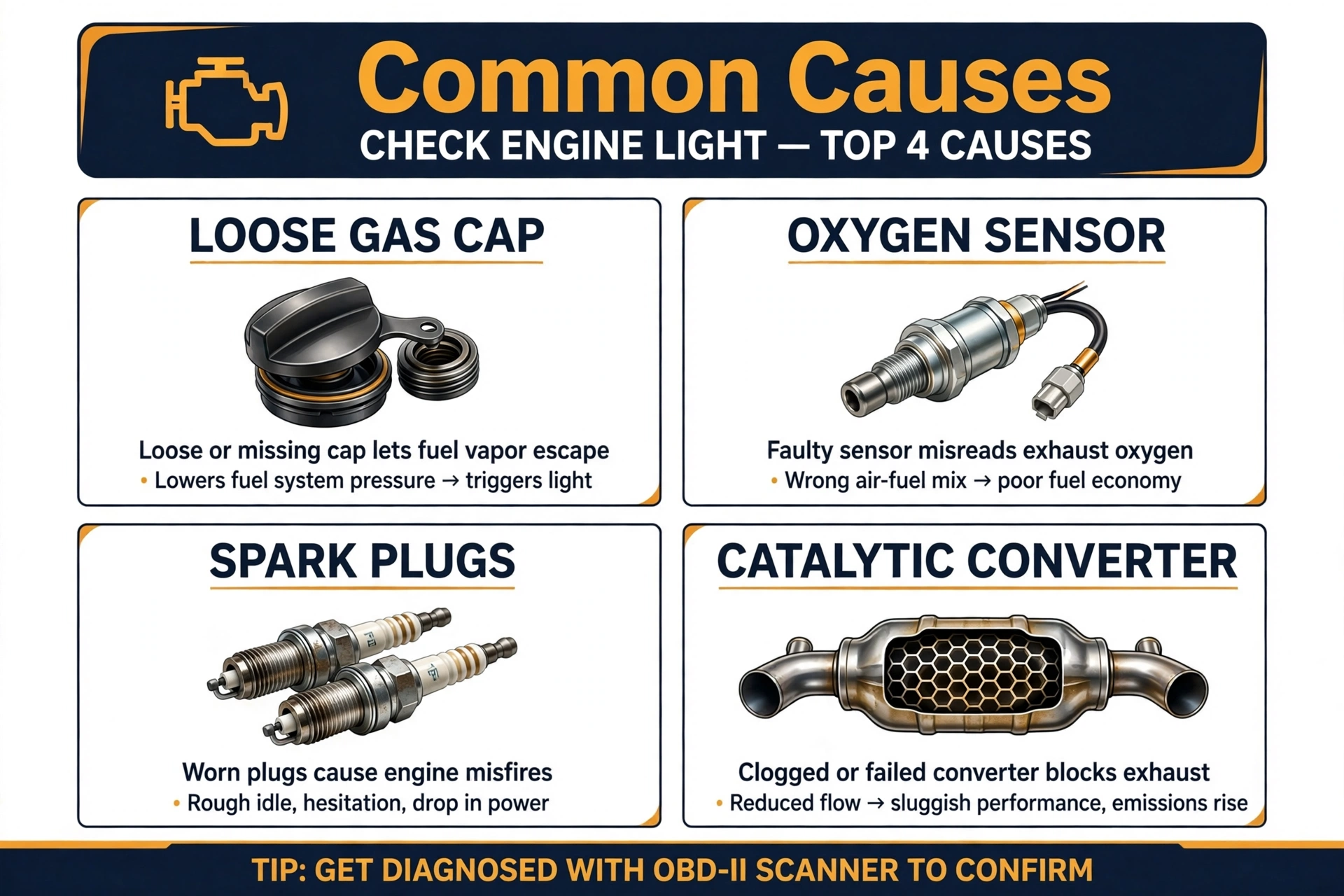
Hundreds of different faults can trigger the light, but a handful of causes account for most cases:
- Loose or damaged gas cap: a cap that is not sealing lets fuel vapor escape and drops fuel system pressure, which the EVAP monitor quickly notices.
- Faulty oxygen sensor: a failing O2 sensor misreads exhaust oxygen, which throws off the air-fuel mixture and hurts fuel economy.
- Worn spark plugs: old plugs cause misfires, rough idle, and hesitation under acceleration.
- Failing catalytic converter: a clogged or worn converter cannot clean exhaust gases properly, which raises emissions and hurts performance.
- Mass air flow sensor problems: a dirty or failing MAF sensor reports the wrong amount of incoming air, confusing the fuel calculations.
- EVAP system issues: cracked hoses, stuck purge valves, or leaks in the evaporative emissions system are frequent triggers.
Symptoms to Watch For
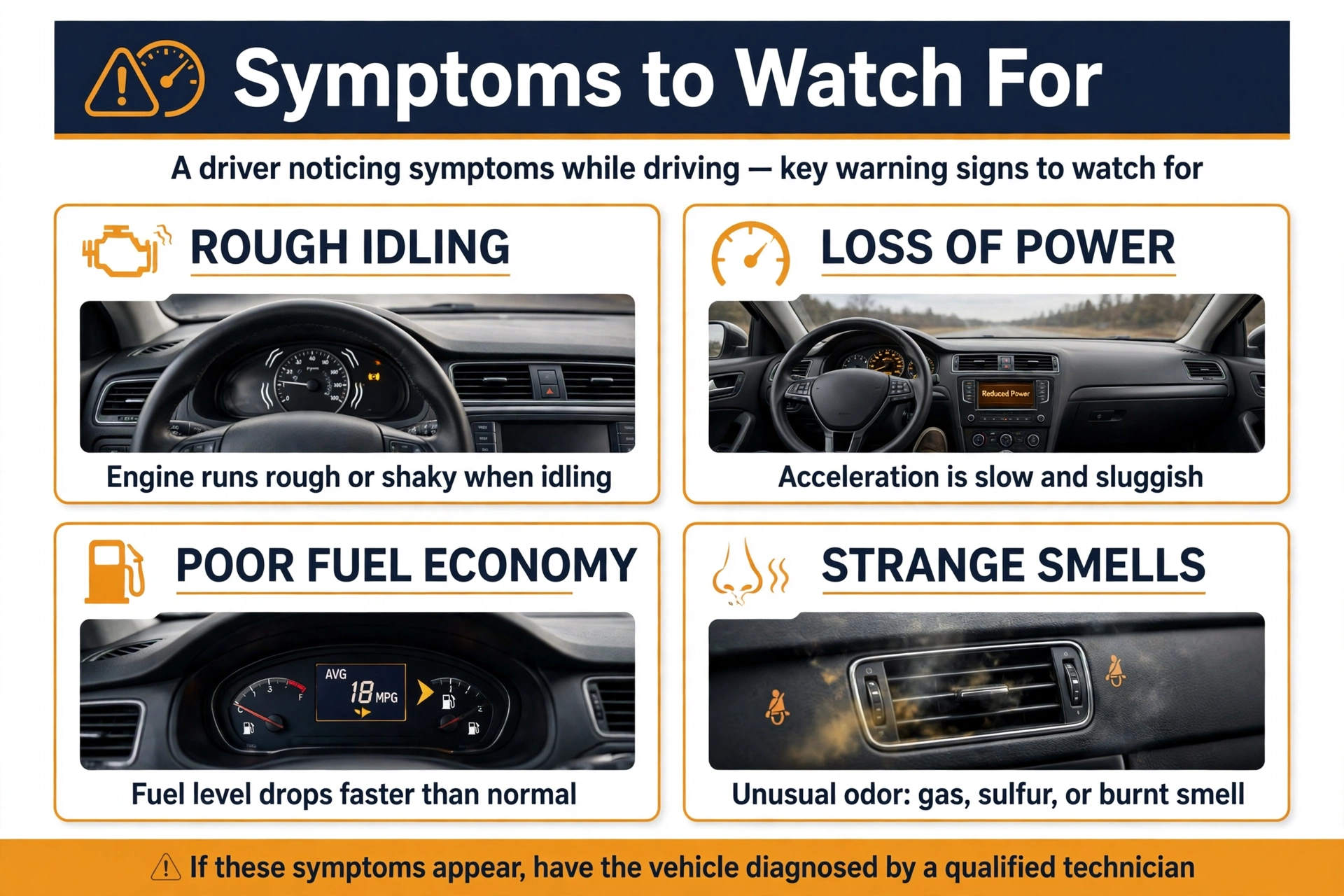
Sometimes the only symptom is the light itself. In other cases, the car gives you clear hints that something is wrong. Watch for rough idling or shaking at stoplights, a noticeable loss of power when you accelerate, fuel economy that drops faster than normal, and strange smells such as gasoline, sulfur, or a burnt odor from the engine bay.
You may also notice that the check engine light comes on and off by itself. An intermittent light usually points to a borderline fault, such as a sensor reading that drifts in and out of range. The computer still stores a code when this happens, so have it scanned even if the light goes out on its own.
How to Diagnose a Check Engine Light With an OBD2 Scanner
A quick check engine light check with a basic OBD2 scanner takes less than five minutes, and many auto parts stores will read your codes for free. Here is how to do it yourself:
- Locate the OBD2 port. It is usually under the dashboard on the driver’s side, near the steering column.
- Plug in the scanner. Push the connector in firmly until it seats.
- Turn the key to ON with the engine OFF. This powers the computer without starting the car.
- Read the codes. Follow the scanner’s menu to pull stored trouble codes such as P0420 or P0171.
- Record the code BEFORE clearing it. Write down the exact code and any freeze-frame data first. Clearing a code erases the evidence a mechanic needs, so always record it before you clear anything.
Once you have the code, you can look up what it means and decide whether it is a simple fix or a job for a shop.

How to Fix a Check Engine Light
The right way to fix check engine light warnings is to repair the root cause the code points to, not just clear the light and hope. Common fixes include:
- Tighten or replace the gas cap. Turn it until it clicks, and replace it if the seal is cracked or worn.
- Replace worn spark plugs. Fresh plugs restore clean ignition and smooth out misfires.
- Replace a faulty oxygen sensor. A new sensor corrects the air-fuel mixture and lowers emissions.
- Clean or replace the mass air flow sensor. Use MAF-safe cleaner first; replace the sensor if readings stay wrong.
- Repair EVAP leaks. Replace cracked hoses or a stuck purge valve, then retest the system.
- Replace a failed catalytic converter. Only after testing confirms it has actually failed, since this is the most expensive fix.
If you see a check engine light after oil change service, the oil itself is rarely the cause. It is usually a sensor connector or vacuum hose that was bumped during the service. Check that everything under the hood is seated properly, then scan for codes.
After the repair, clear the code and drive normally for a few trips. If the light stays off, the fix worked. If it returns, the diagnosis needs another look.

Check Engine Light Repair Costs
Repair costs vary widely because the light can point to a five-minute fix or a major component. Typical price ranges in the US are:
| Repair | Cost Range |
| Gas cap replacement | $20–$60 |
| Diagnostic scan at a shop | $50–$150 |
| Spark plug replacement | $100–$200 |
| Oxygen sensor replacement | $200–$300 |
| Mass air flow sensor replacement | $300–$400 |
| EVAP system repair | $200–$600 |
| Catalytic converter replacement | $1,000–$2,500 |
Labor rates differ by region, so treat these as ballpark figures. Getting the code read first is the cheapest way to avoid paying for parts you do not need.
Can You Drive With the Check Engine Light On?
With a steady light and no other symptoms, you can usually keep driving short distances, but get the car checked soon. Drive gently, avoid towing heavy loads, and skip hard acceleration until the fault is fixed.
With a flashing light, the answer is no. A flashing light means a severe misfire is happening right now, and continuing to drive can destroy the catalytic converter. Pull over safely, switch the engine off, and arrange a tow. The same applies to a red check engine light.
When to See a Mechanic
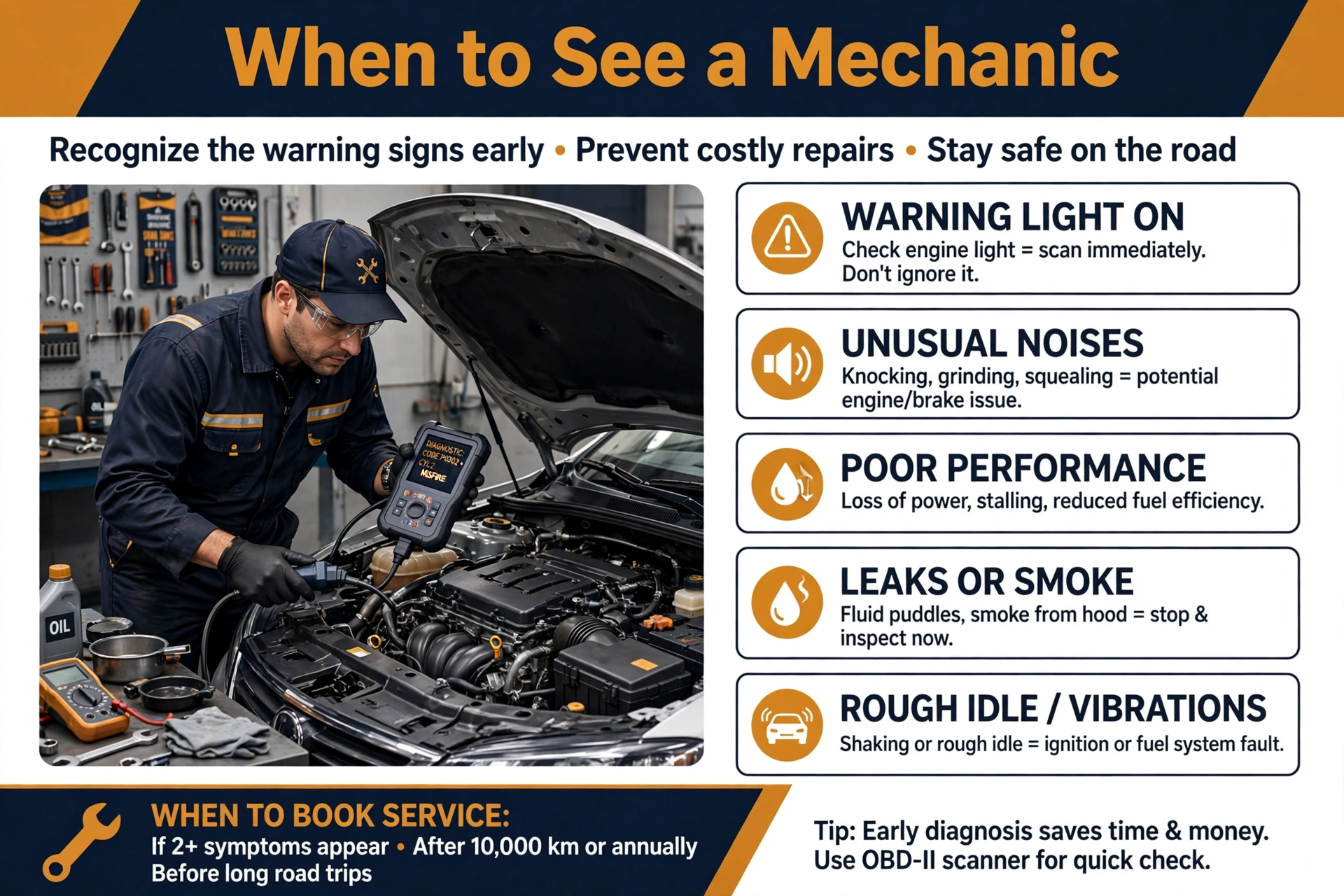
Book a visit with a qualified technician if any of these apply:
- The light is flashing, or the car runs roughly, loses power, or stalls.
- You notice smoke, fluid leaks, or strong unusual smells.
- The light comes back after you repaired the suspected cause.
- The car failed an emissions test because of the warning light.
- You do not own a scanner or the code points to a complex system.
A professional diagnosis usually costs far less than replacing the wrong part, so do not guess your way through an expensive repair.
Video: Check Engine Light Walkthrough
Watch this short walkthrough covering what the check engine light means, the most common causes, and how a simple OBD2 scan reveals the exact fault behind the warning.
Video: Check Engine Light On in Your Car? The Truth About What it Means (Scotty Kilmer)
Frequently Asked Questions
What does the check engine light mean?
It means your car’s OBD2 system detected a fault in the engine, emissions system, or transmission and stored a diagnostic trouble code. The light is a general alert, so scanning the code is the only way to know the exact cause.
What to do when check engine light comes on?
First, check whether the light is steady or flashing. If it is flashing, pull over safely and switch the engine off. If it is steady, tighten the gas cap until it clicks, note any symptoms such as rough running or power loss, and have the codes read with an OBD2 scanner as soon as you can.
Can I drive with a solid check engine light on?
Usually yes, for short trips, as long as the car runs normally. A solid check engine light is not an emergency, but you should get it diagnosed soon and avoid towing or hard acceleration until the fault is fixed.
Why does my check engine light come on and off?
An intermittent light usually points to a borderline fault, such as a sensor reading that drifts in and out of range or a loose connection. The computer still stores a code, so have it scanned even if the light is off when you arrive at the shop.
What does it mean if the check engine light is red or yellow?
A yellow check engine light is the standard steady warning and means you should have the car checked soon. A red check engine light signals a severe fault and should be treated like a flashing light: stop safely and get help right away.
How urgent is check engine light diagnosis?
It depends on how the light behaves. A steady light means the problem is not urgent, but you should still diagnose it within days to avoid extra damage or a failed emissions test. A flashing or red light is urgent: stop driving and get help immediately.
How much does it cost to fix a check engine light?
It ranges from about $20 for a new gas cap to $1,000–$2,500 for a catalytic converter. Common repairs such as spark plugs ($100–$200) or an oxygen sensor ($200–$300) fall in between. Reading the code first is the cheapest way to find out which repair you actually need.
Conclusion
The check engine light is your car’s early warning system, not a reason to panic. Learn the difference between a steady and a flashing light, read the stored code with an OBD2 scanner, and fix the root cause instead of just clearing the warning. A few minutes of diagnosis now can save you from a much bigger repair bill later.
About the author: The OBD2 Code Hub team creates practical, beginner-friendly guides to car diagnostics, trouble codes, and repairs. Every guide is researched against real-world repair data so you can diagnose with confidence.