
Check Engine Light On But Car Runs Fine: Should You Worry?
Your check engine light is on but the car runs fine, and now you are caught between worry and doubt. The engine sounds normal, the car pulls like it always has, and nothing smells, smokes, or shakes. So should you actually worry? The short answer is that a steady check engine light with the car driving normally usually means a non-urgent fault. It is safe to drive short distances while you diagnose it, but it is not safe to ignore it forever.
In this guide, you will learn what a check engine light on with no symptoms really means, the minor causes behind it, the hidden problems that feel fine at first, why your check engine light is on but no codes show up, and the exact order of checks to run before you spend a single dollar.

What It Really Means When the Check Engine Light Is On but the Car Feels Fine
Your car watches itself constantly. The engine computer runs self tests on the emissions system, the fuel mixture, and dozens of sensors while you drive. When one of those tests fails, it turns on the check engine light and stores a trouble code. Many of those tests watch things that have nothing to do with how the car feels from the driver seat, which is why the light can glow while everything seems perfectly normal.
When the check engine light is on but the car runs fine, the underlying situation is usually one of these:
- An emissions fault. The computer monitors the emissions system more strictly than anything else. A small vapor leak or a lazy sensor can set the light long before you feel any change in performance.
- A drifting sensor. An oxygen sensor or mass airflow sensor can drift out of its expected range or get dirty with age. The computer quietly compensates by adjusting the fuel mixture, so the car still drives fine while the light stays on.
- An intermittent glitch. A one-time hiccup in ignition or fuel delivery can log a fault. The light then stays lit for several drive cycles even though the problem already passed.
One critical detail: everything above describes a steady light. A flashing check engine light is a different story, and you will find it in the When to Stop Driving section below.
Common Minor Causes
Most of the time, a check engine light but car runs fine comes down to a short list of minor and inexpensive problems:
- Loose or faulty gas cap. This is the classic cause. The fuel system is sealed, and a cap that was never clicked shut lets fuel vapors escape, which the EVAP monitor reads as a leak. Tightening it is free, and it fixes the problem more often than any other single step.
- Dirty sensor. A mass airflow sensor coated with dust or oil residue, or an oxygen sensor that has grown sluggish with age, can push readings just far enough out of range to set the light while the car still drives smoothly.
- Small EVAP leak. Beyond the gas cap, the EVAP system includes hoses, a purge valve, and a charcoal canister. A tiny crack in a hose or a sticky purge valve lets vapors escape. The car runs fine because only vapors are leaking, not power.
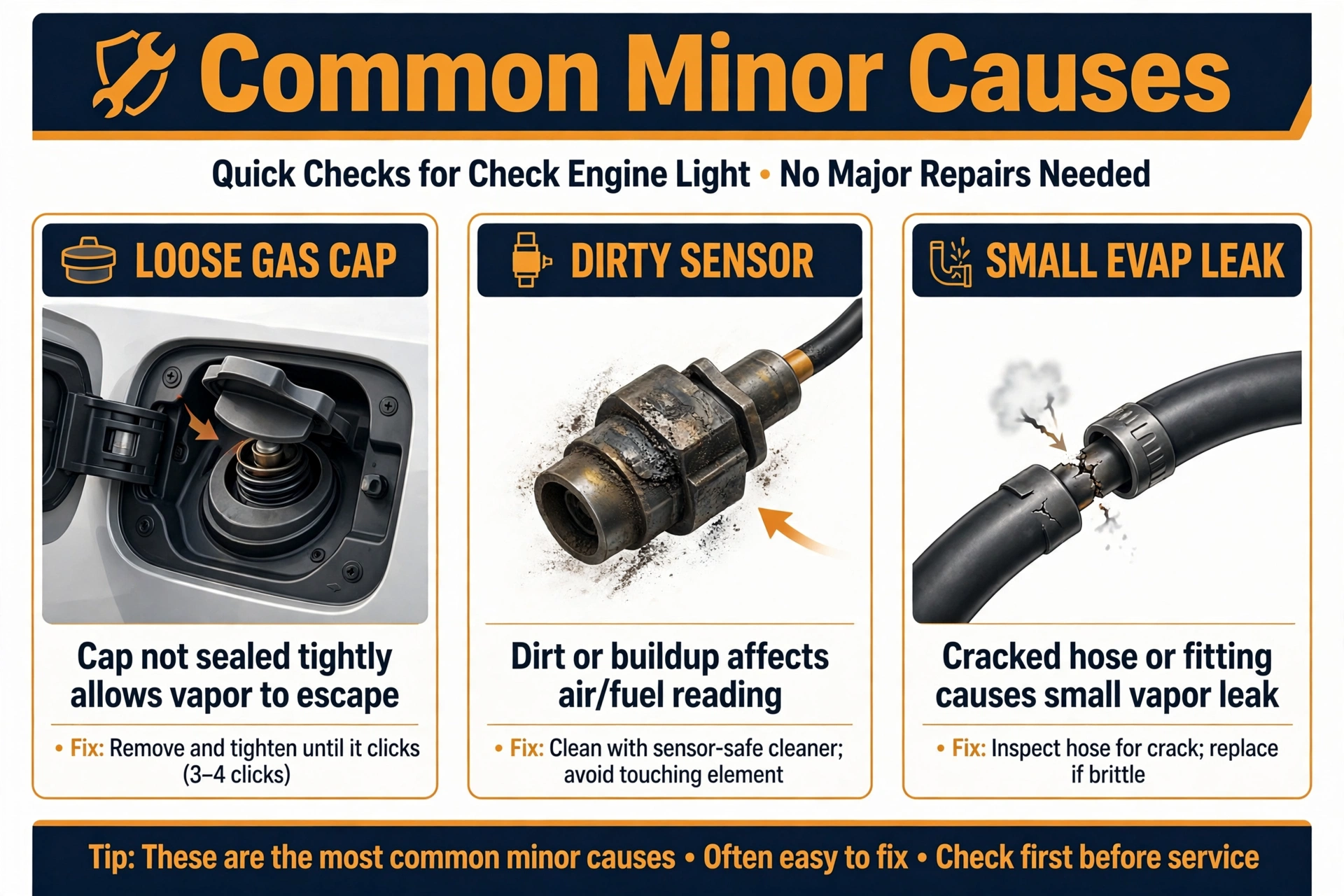
These are cheap and quick to rule out, which is exactly where your diagnosis should start. The risk is assuming the light is always one of these. That brings us to the causes you cannot feel yet.
Hidden Serious Causes That Feel Fine at First
A check engine light car runs fine situation can also hide problems that are quietly getting worse. These deserve your attention even when the car feels perfect:
- Failing catalytic converter. A converter that is starting to clog or lose efficiency sets efficiency codes well before you notice any power loss. Left alone, it can overheat, choke the exhaust, and turn into one of the most expensive repairs on the car.
- Developing misfire. A spark plug or ignition coil that is starting to weaken may misfire only under load or only once in a while. The car feels fine in normal driving, but raw fuel from misfires can destroy the catalytic converter if it gets worse.
- Emissions faults that feel fine at first. A lazy oxygen sensor or a thermostat stuck open keeps the engine running in a slightly wrong state. Fuel economy drops, emissions rise, and the engine wears faster, all while the car feels normal to you.
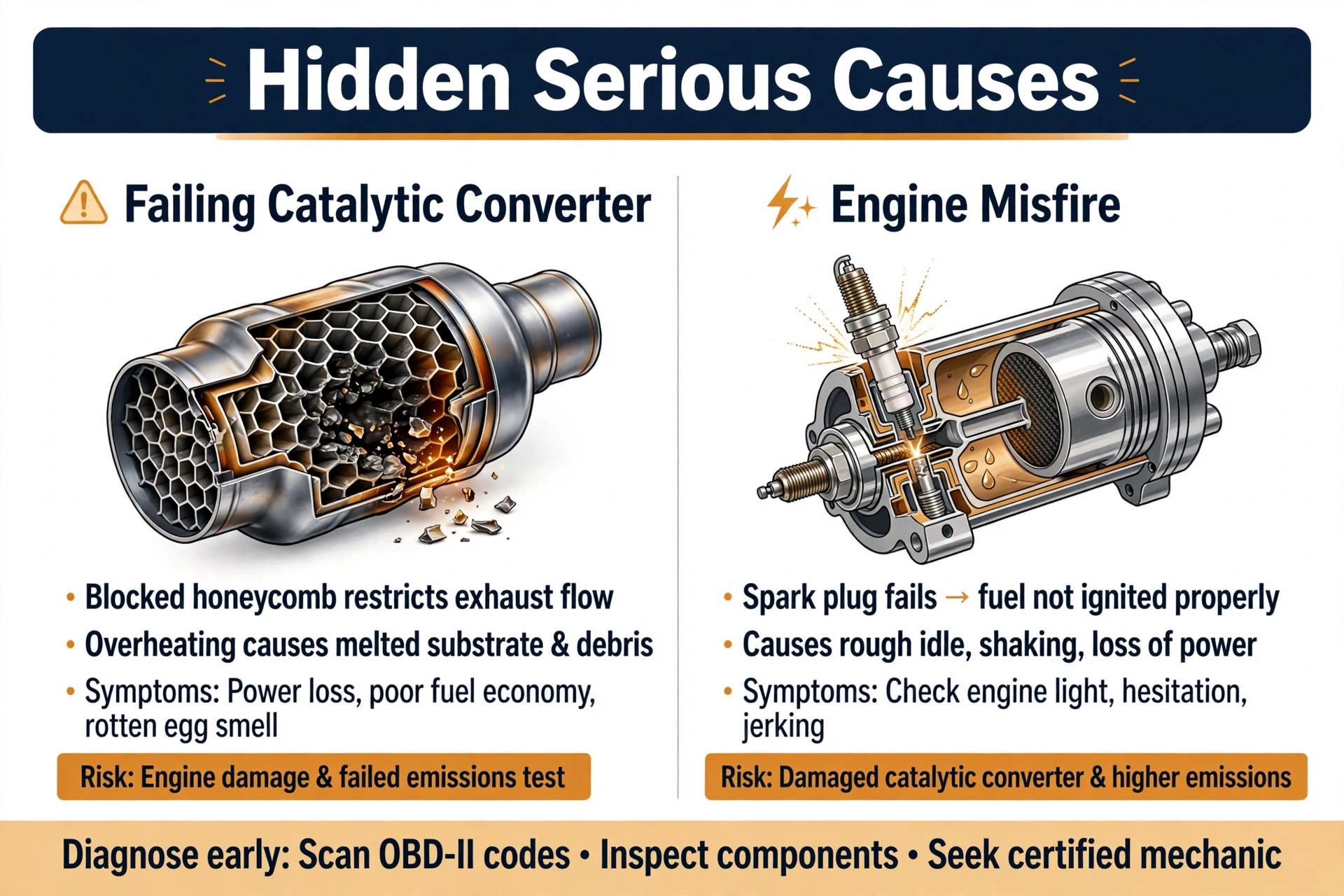
This is exactly why a steady light is safe for short trips but not safe to ignore indefinitely. A hidden fault that feels like nothing today can grow into a repair bill that hurts tomorrow.
Check Engine Light On but No Codes: Why It Happens
One of the most confusing situations is a check engine light on but no codes found on your scanner. The light is clearly on, yet the scan comes back empty. Drivers searching for check engine light is on car runs fine often land here next. There are real explanations for a check engine light on with no codes, and none of them mean your car is playing tricks on you:
- Pending codes. The computer saw the fault once but has not seen it repeat enough times to confirm it. A check engine light but no codes result on a basic scan often means the fault is still in the pending stage.
- Intermittent fault. The problem comes and goes. The code was stored while the fault was active, but by the time you scan, the condition has cleared and some scanners show nothing current.
- Basic scanner limits. Inexpensive scanners only read generic powertrain codes. A check engine light no codes result on a basic tool often means the real code is a manufacturer-specific code that only a more capable scanner can see.
- Recently cleared codes. If the codes were cleared recently, by a scan tool or a disconnected battery, the light can return before the monitors finish retesting, leaving you with a check engine light with no codes stored yet.

If your check engine light is on but no codes appear on a basic scanner, do not assume the car is fine. Move to a more capable scanner and check the pending codes before you write the light off as a glitch.
What to Check First (in This Exact Order)
When the check engine light is on but the car runs fine, work through these checks in order. Each step costs less than the next, and most drivers find the answer in the first two.
- Tighten the gas cap until it clicks, then drive a few drive cycles. Remove the cap, inspect the seal for cracks, and reinstall it until it clicks several times. The light will not go out instantly. The EVAP monitor needs a few normal drive cycles to retest the system, so give it a few days of regular driving before you conclude anything.
- Scan for codes. Plug an OBD2 scanner into the port under the dashboard and read the stored codes. Write down every code before you clear anything. The code points you at the system to inspect, which beats guessing at parts.
- Check pending codes with a better scanner if the first scan shows nothing. If the first scan is empty, borrow or buy a scanner that reads pending codes and manufacturer-specific codes. A check engine light but no codes result on a basic tool is exactly the situation where a better scanner earns its price.
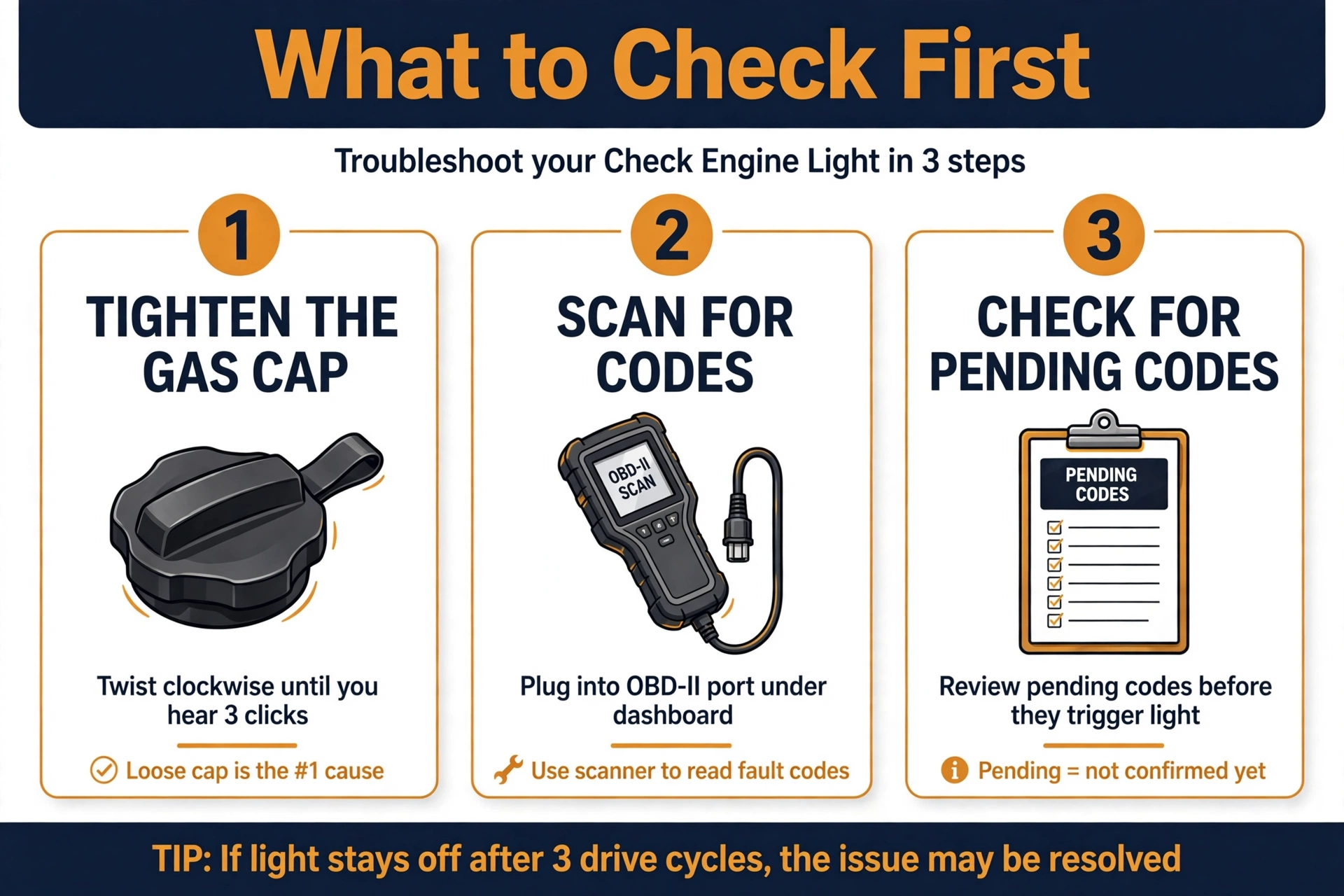
If the light stays off after a few drive cycles, the issue may be resolved. If it returns, the stored code tells you exactly where to look next.
When to Stop Driving Immediately
A check engine light on but runs fine is one thing. The signs below mean the situation has changed and the car needs to stop. Pull over safely and shut the engine off if you notice any of them:
- Flashing check engine light. A flashing light means a severe misfire is happening right now. Raw fuel is pouring into the exhaust, and it can destroy the catalytic converter in minutes. Stop driving as soon as it is safe.
- Loss of power. If the car suddenly will not accelerate or struggles to hold speed, the engine is protecting itself or failing. Do not push it.
- Overheating. A temperature gauge climbing into the red or steam from under the hood means stop now. Driving an overheating engine can warp the cylinder head.
- Smoke. Smoke from the exhaust or from under the hood is never a wait-and-see situation.
- Strange knocking or grinding noises. New mechanical noises mean something is coming apart or running without lubrication. Shut the engine down.
- Stalling. If the engine dies at idle or while driving, the fault is no longer minor. Get the car somewhere safe and have it towed.

When in doubt, err on the side of stopping. A tow bill is always cheaper than an engine.
Video Walkthrough
In this video walkthrough, Brian from Honest Mechanic Colorado, a USA-based repair shop channel, walks through 7 possible causes when the check engine light is on but the car runs fine, showing what to check first and how to tell a minor fault from a serious one.
VIDEO: Check Engine Light On But Car Runs Fine: 7 Possible Causes
Frequently Asked Questions
Is it safe to drive with the check engine light on but the car runs fine?
Yes, for short distances, as long as the light is steady and the car shows no other symptoms. A steady light usually means a non-urgent fault such as a loose gas cap or a minor EVAP leak. Still, get it diagnosed soon, because hidden problems like a failing catalytic converter or a developing misfire can turn expensive if you ignore the light for weeks.
What does a check engine light on no codes mean?
It usually means one of four things: the fault is still a pending code that has not been confirmed yet, the fault is intermittent and cleared before you scanned, your basic scanner cannot read manufacturer-specific codes, or the codes were cleared recently and the monitors have not finished retesting. Rescan with a more capable scanner and check the pending codes.
Can a loose gas cap really turn on the check engine light?
Yes. It is the most common minor cause. The fuel system is sealed, and a cap that was never clicked shut lets vapors escape, which the EVAP monitor reads as a leak. Remove the cap, check the seal, tighten it until it clicks several times, then drive normally for a few days so the monitor can retest.
What is the difference between a steady and a flashing check engine light?
A steady light means a non-urgent fault that you should diagnose soon. A flashing light means a severe misfire is happening right now, and raw fuel can destroy the catalytic converter in minutes. If the light flashes, stop driving as soon as it is safe and get the car checked immediately.
How long can I drive with the check engine light with no codes showing?
Short local trips are usually fine if the light is steady and the car behaves normally, but get a better scan first so you know what you are dealing with. Avoid long highway trips, towing, and hard acceleration until the cause is diagnosed, because extra load can turn a small fault into a big one.
Will the check engine light turn off by itself?
Sometimes. If the fault was intermittent and the computer runs its self tests without seeing the problem again over several drive cycles, it will turn the light off on its own. The history usually stays stored, so it is still worth scanning to see what happened.
Can I pass an emissions test with the check engine light on?
In most cases, no. A lit check engine light is an automatic failure in states with emissions testing. Clearing the codes does not help either, because the monitors will show “not ready” until the system completes its self tests. Fix the underlying cause, drive until the monitors are ready, then test.
Conclusion
A check engine light on car runs fine is one of the most common reasons drivers reach for a scanner, and most of the time the cause is minor: a loose gas cap, a dirty sensor, or a small EVAP leak. A steady light means you can keep driving short distances while you work the checklist, starting with the gas cap, then a code scan, then pending codes on a better scanner if the first scan is empty.
What you must not do is ignore it. Hidden faults like a failing catalytic converter or a developing misfire feel like nothing at first and get expensive fast. And if the light ever flashes, or you notice power loss, overheating, smoke, strange noises, or stalling, stop driving right away. Diagnose the steady light soon, respect the flashing one immediately, and your car will thank you with years of reliable service.
About the author: Adam Smith is the founder of OBD2 Code Hub and a long-time OBD2 diagnostics writer. He has spent years helping drivers read check engine light codes, understand what their cars are reporting, and fix small problems before they turn into expensive repairs.