
OBD1 vs OBD2: Key Differences, Ports & Which System Your Car Has
In This Guide
If you have ever plugged a scanner into your car, or wondered why your neighbor’s code reader will not fit your older truck, you have run into the split between the two generations of on-board diagnostics. When drivers look up obd i and ii, what they really want to know is the difference between obd1 and obd2, and which one their own car uses.
The short version: OBD1 was the first, manufacturer-specific era of engine diagnostics, and OBD2 is the standardized system every car has used since 1996. Knowing which system you have decides what port to look for, what the codes mean, and which scanner will actually talk to your car. This guide explains both generations of on-board diagnostics, compares obd and obd2 side by side, and shows you how to identify your car’s system in minutes.

What Is OBD1?
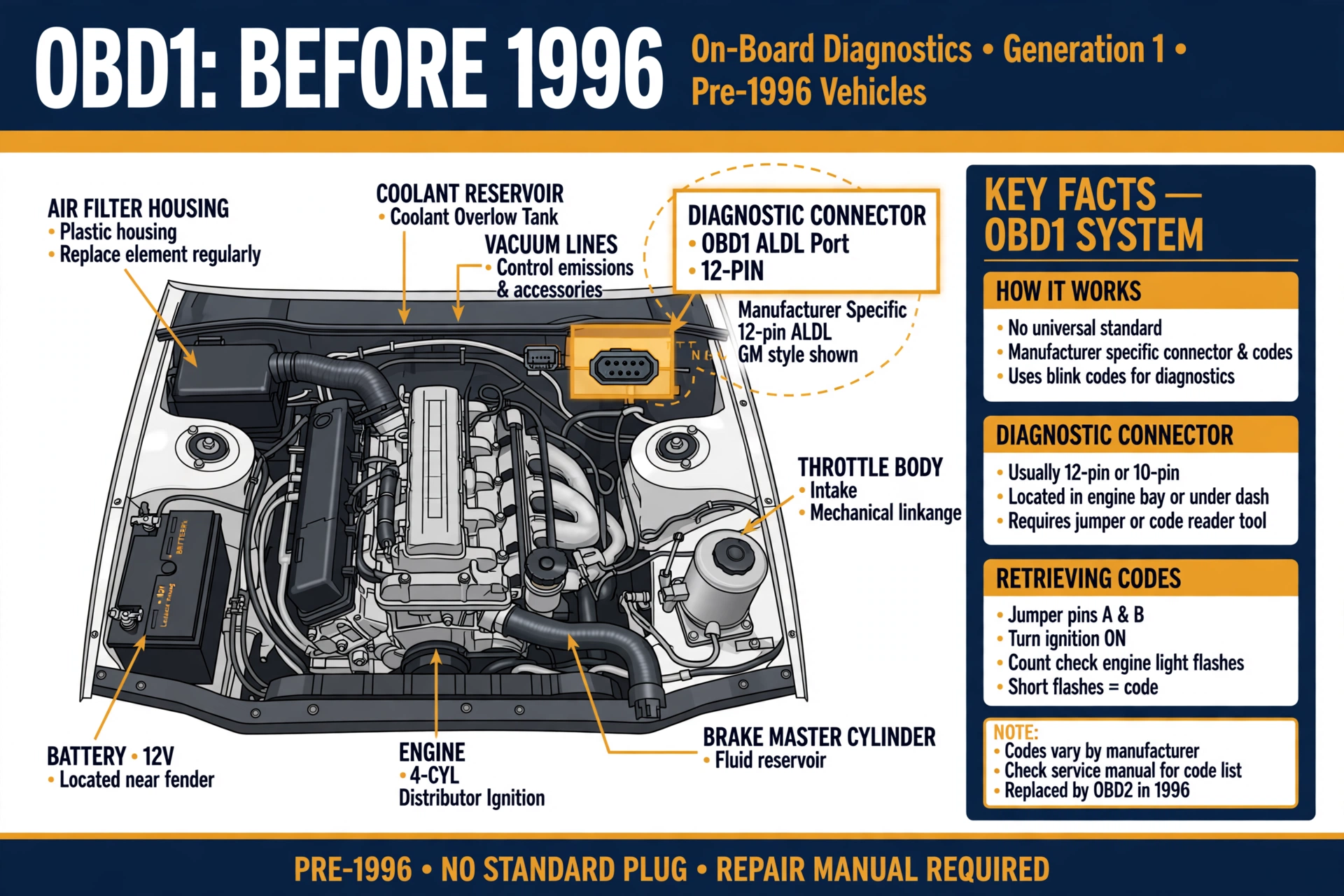
OBD1 (On-Board Diagnostics, generation one) was the first generation of on-board diagnostics, used roughly from the 1980s to 1995. There was no universal standard: each manufacturer built its own system, with its own connectors and its own code definitions.
- Years: roughly the 1980s to 1995, before the federal OBD2 mandate.
- Connectors: manufacturer-specific, often 10- or 12-pin. The best-known example is GM’s ALDL connector, but every brand had its own shape and location.
- Codes: manufacturer-specific definitions, often read as 2-3 digit blink codes flashed through the dashboard check-engine light.
- Monitoring: limited to basic engine functions, with no standardized live data stream.
Because every brand did things differently, a code reader built for one make often could not read another, and the generic scanners we know today did not exist yet.
What Is OBD2?
OBD2 is the second, standardized generation of on-board diagnostics. It became mandatory in the USA for all cars and light trucks from model year 1996, which is why 1996 is the dividing line you will see in every obd vs obd2 discussion.
- Mandate: required on all 1996 and newer cars and light trucks sold in the USA.
- Connector: one standard 16-pin connector, always located under the dash on the driver side.
- Codes: standardized 5-character codes. A generic obd ii fault code starts with P0 (for example, P0300), so the same code means the same thing on any brand.
- Live data: real-time sensor readings (RPM, coolant temperature, oxygen sensors, fuel trim) that any compatible scanner can display.
- Emissions monitors: continuous self-tests of the catalytic converter, EVAP system, oxygen sensors, and other emissions components.
Standardization is the whole point of OBD2: one port, one code format, and one set of rules, so a single scanner works on virtually any car built in the last 30 years.

OBD1 vs OBD2: Side-by-Side Comparison
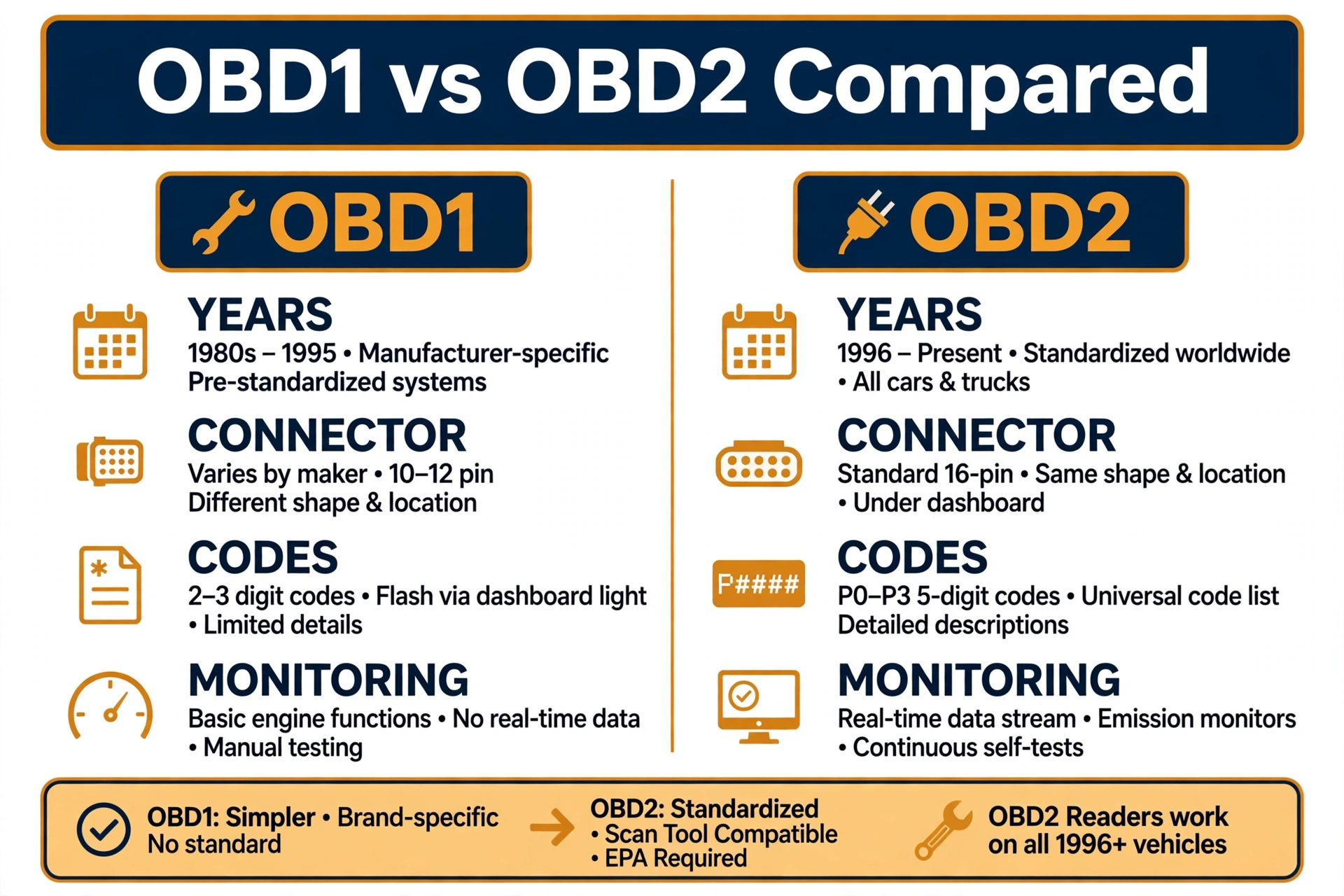
Here is the difference between obd1 and obd2 at a glance, covering the points every top guide highlights: years, ports, codes, and capabilities.
| Feature | OBD1 | OBD2 |
| Years in use | 1980s–1995 | 1996–present |
| Standardization | Manufacturer-specific, no universal standard | Federally mandated universal standard (USA) |
| Diagnostic connector | Varies by maker; often 10- or 12-pin (e.g. GM ALDL) | One standard 16-pin connector |
| Port location | Varies by brand (engine bay, under dash) | Under the dash, driver side |
| Trouble codes | Manufacturer-specific definitions | Standardized 5-character codes (P0xxx generic) |
| Reading codes | Often 2–3 digit blink codes via the dashboard light, or a brand-specific tool | Any OBD2 scanner through the 16-pin port |
| Live sensor data | Very limited or none | Yes, real-time data stream |
| Emissions monitoring | Basic, not standardized | Continuous monitors (catalyst, EVAP, O2 sensors) |
Which System Does Your Car Have?
The obd2 vs obd1 question is easy to settle with three quick checks. You do not need any tools for this.
- Check the model year. Find it on the driver-side door jamb sticker or your registration. Model year 1996 or newer sold in the USA means OBD2. Older than that usually means OBD1, although some 1994–1995 transition models used early or partial implementations.
- Look for the 16-pin port. Kneel by the driver-side footwell and look under the dash. The OBD2 port is a trapezoid-shaped 16-pin connector, usually within reach of the steering column. If you find it, you have OBD2.
- Read the emissions label. Open the hood and find the emissions sticker (on the underside of the hood or a strut tower). It lists the vehicle’s emissions certification and often names the OBD system outright.

OBD1 to OBD2 Adapters
If you own a pre-1996 car, you have probably seen an obd1 to obd2 adapter for sale and wondered whether it lets you use a modern scanner. Here is the honest answer.
An obd1 to obd2 adapter (also sold as an obd1 adapter obd2 cable, or an obd1 adapter to obd2 lead) is a vehicle-specific cable: one end fits your car’s manufacturer-specific OBD1 connector (for example, GM’s 12-pin ALDL), and the other end presents a 16-pin OBD2-style plug so a compatible scanner can physically connect and read that car’s codes.
These adapters are vehicle-specific, so you must match the adapter to your car’s manufacturer and connector type. An adapter lets a compatible scanner read that car’s OBD1 codes, but it does NOT turn an OBD1 car into a full OBD2 car: you still get the manufacturer’s limited OBD1 code set and data, not OBD2 live data and monitors. And no adapter works universally across all makes, so do not expect plug-and-play conversion on just any older car.
The bottom line on going from obd1 to obd2 with an adapter: buy the cable made for your exact make and connector, pair it with a scanner that supports OBD1 protocols for that brand, and expect basic code reading, not the full OBD2 experience.

Which Scanner Do You Need for Each System?
For OBD2 cars (1996 and newer), any standard OBD2 scanner works: a basic code reader, a Bluetooth dongle with a phone app, or a professional scan tool. The 16-pin port and the standard protocol mean one tool covers nearly every car.
For OBD1 cars, you need a scanner that speaks your manufacturer’s OBD1 protocol, often plus the correct adapter cable for your car’s connector. Some older cars can also flash their 2–3 digit blink codes with a simple jumper wire, but a proper OBD1-capable tool is faster and less error-prone.
If you work on both generations, look for a scan tool that explicitly lists OBD1 coverage for the makes you service, plus the matching adapter cables. The story of obd i obd ii compatibility is really the story of matching the tool to the car’s era.
Video Walkthrough: OBD1 vs OBD2 Explained
Prefer to watch? In the video below, USA-based diagnostic technician Brian (briansmobile1) explains what OBD1 and OBD2 mean in auto repair, drawing on decades of experience with both generations of on-board diagnostics.
Video: What OBDI & OBDII Mean In Auto Diagnostics by briansmobile1 on YouTube.
FAQs: OBD1 vs OBD2
Quick answers to the most common questions about obd and obd2.
What is the difference between obd1 and obd2?
The difference between obd1 and obd2 comes down to standardization. OBD1 (1980s–1995) was manufacturer-specific: each brand used its own connectors (often 10- or 12-pin) and its own code definitions, frequently read as 2–3 digit blink codes through the dashboard light. OBD2 (mandatory from model year 1996 in the USA) uses one standard 16-pin port under the driver-side dash, standardized 5-character codes, live sensor data, and emissions monitors. In short, OBD1 is brand-specific and limited, while OBD2 is universal and far more capable.
Can I use an OBD2 scanner on an OBD1 car?
Not directly. An OBD2 scanner expects the standard 16-pin port and OBD2 protocols, which an OBD1 car does not have. You need either a scanner built for your car’s OBD1 system, or a vehicle-specific obd1 to obd2 adapter cable plus a scanner that supports OBD1 protocols for your make. Even then, you only get OBD1-level codes and data, not full OBD2 functionality.
Do obd1 to obd2 adapters really work?
A quality adapter made for your exact vehicle can work, within honest limits. It converts your car’s manufacturer-specific OBD1 connector to a 16-pin plug so a compatible scanner can read the car’s OBD1 codes. But adapters are vehicle-specific (match your make and connector type), they do not give you OBD2 live data or monitors, and no single adapter works on every car. Treat an adapter as a bridge for code reading, not a conversion to OBD2.
How do I know if my car is OBD1 or OBD2?
Use the three checks in this guide: (1) model year, 1996 or newer in the USA means OBD2; (2) look under the driver-side dash for the trapezoid-shaped 16-pin port; (3) read the emissions label under the hood, which often names the OBD system. If all three point the same way, you have your answer.
Do OBD1 and OBD2 use the same trouble codes?
No. OBD1 codes are manufacturer-specific and often just 2 or 3 digits. OBD2 codes are standardized 5-character codes, so a generic obd ii fault code such as P0300 (random/multiple cylinder misfire) means the same thing on any make. That standardization is one of the biggest practical gains of the obd i obd ii transition.
Is OBD2 better than OBD1?
For diagnosis, yes. In the obd2 vs obd1 comparison, OBD2 wins on every practical point: a universal connector, standardized codes, real-time live data, and continuous emissions monitors. OBD1 was a big step forward in its day, but its brand-specific connectors and limited blink-code output make diagnosis slower and harder.
What does “obd i and ii” mean?
“obd i and ii” is just another way of writing OBD1 and OBD2: the first and second generations of on-board diagnostics. Guides that cover obd and obd2 together explain how the industry moved from manufacturer-specific systems (OBD I) to the standardized 16-pin system (OBD II) that has been mandatory in the USA since model year 1996.
Conclusion
OBD1 and OBD2 are simply the before and after of car diagnostics: a manufacturer-specific era that ran from the 1980s to 1995, and the standardized system that has covered every car and light truck since model year 1996. The port tells the story at a glance. A brand-specific 10- or 12-pin connector means OBD1, while the universal 16-pin port under the driver-side dash means OBD2.
Once you know which system your car has, everything else follows: the right scanner, the right code definitions, and realistic expectations for adapters. Use the three checks above, and you will never again wonder which generation of on-board diagnostics you are working with.
About the author: Written by the OBD2 Code Hub editorial team. Our diagnostic guides are built from real OBD-II data, manufacturer service procedures, and hands-on troubleshooting experience, then reviewed for technical accuracy before publishing. We drive the same cars you do.