
P0306 Trouble Code: Meaning, Causes, Symptoms & Fixes
In This Guide
One-line meaning: P0306: Cylinder 6 Misfire Detected.
What the P0306 Code Means
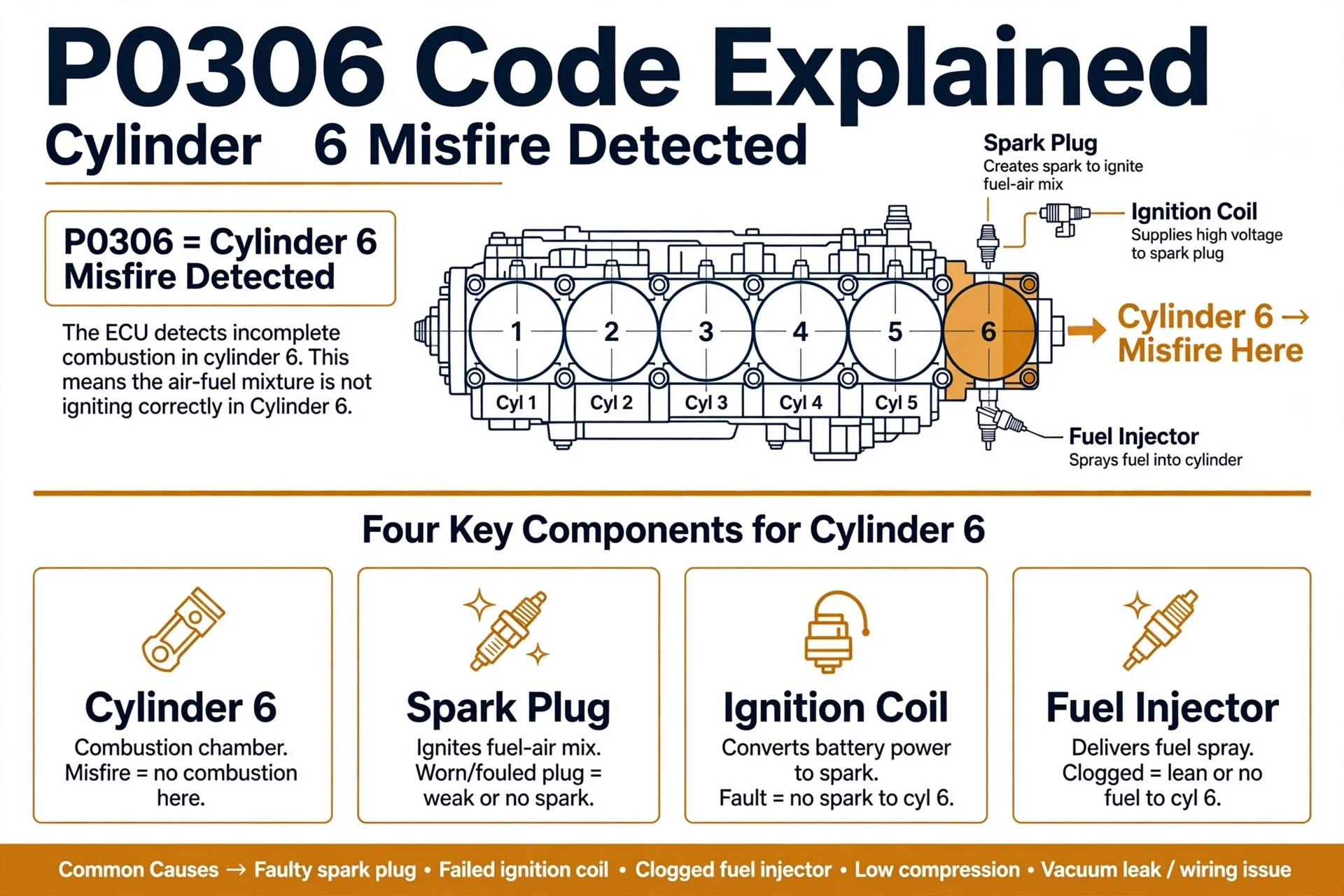
The P0306 code is one of the most searched misfire codes, and for good reason: it points at one exact cylinder. Its full definition is “Cylinder 6 Misfire Detected.”
Your engine computer constantly watches how smoothly the crankshaft spins. Each cylinder is supposed to push its share on every power stroke. When the air and fuel charge inside cylinder 6 fails to light, or burns so weakly that the crankshaft stumbles at that moment, the computer counts a misfire. Count enough of them and it stores the p0306 code and switches on the check engine light.
A quick note on numbering: which physical cylinder counts as “number 6” changes with the engine design, so check a cylinder diagram for your exact make, model, and engine before you start pulling parts.
A misfire always comes down to three ingredients. A cylinder needs a strong spark at the right moment, the right amount of fuel, and good compression to squeeze the mixture. Take away any one of the three and cylinder 6 goes quiet while the rest keep firing.
P0306 (p0306 obd2, p0306 code cylinder 6) is a generic powertrain code, so it means the same thing on every OBD-II vehicle, whether you drive a Ford F-150, a Honda Pilot, or a Chevy Silverado.
Symptoms of the P0306 Code
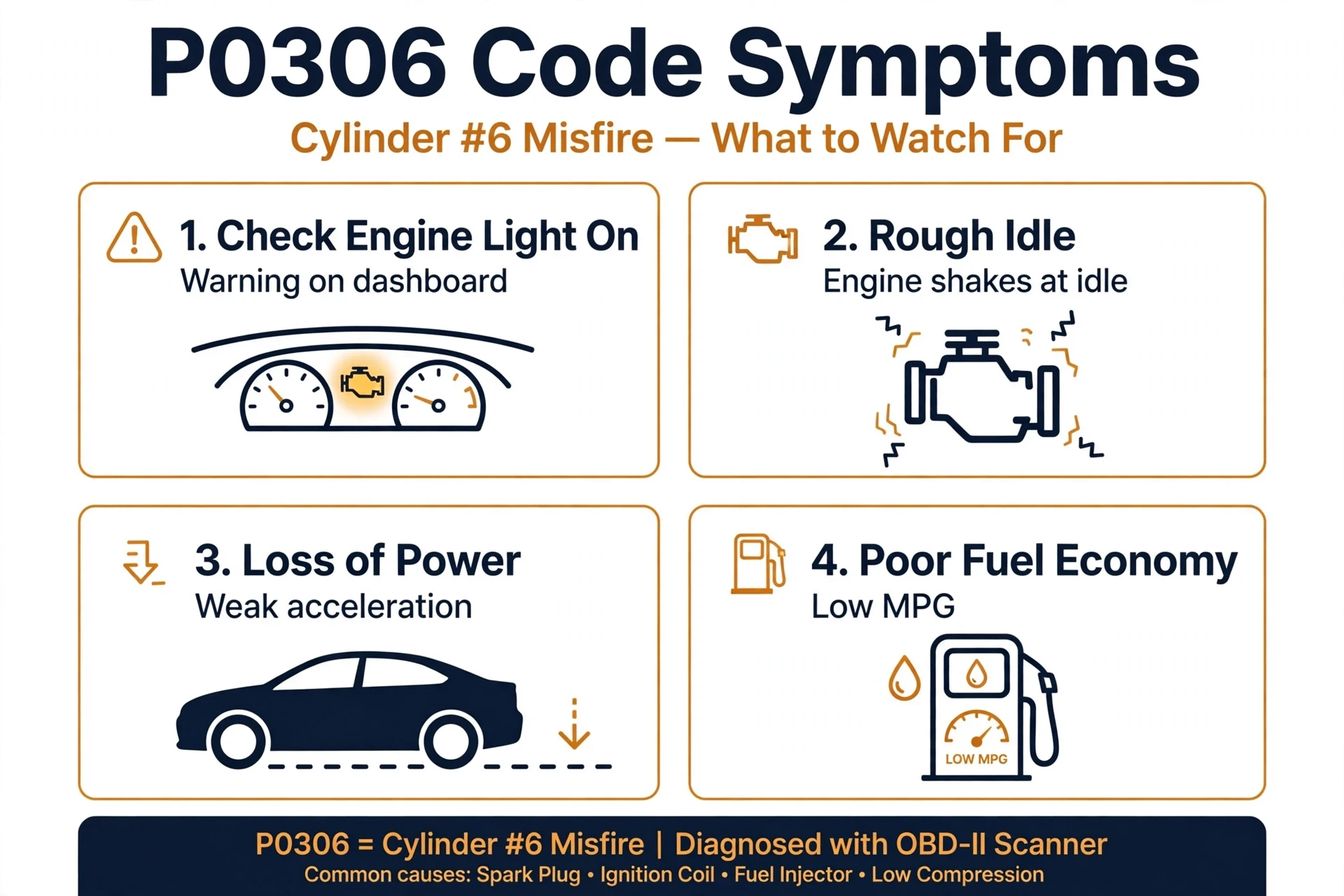
When cylinder 6 stops contributing, you will usually feel it. Watch for these signs:
- Check engine light, steady for a mild misfire and flashing when the misfire is severe
- Rough or shaky idle, with vibration you can feel through the seat or steering wheel
- Noticeable power loss and hesitation when you press the accelerator
- Stumbling, bucking, or jerking under load, such as climbing a hill
- Reduced fuel economy, since the engine burns extra fuel to make up for the dead cylinder
- A raw fuel smell from the exhaust, from unburned gasoline leaving cylinder 6
- Popping or backfiring sounds from the engine or tailpipe
- In mild cases the car can feel almost normal apart from the warning light
What is the p0306 code trying to tell you? In short: cylinder 6 is not pulling its weight, and the computer wants you to find out why before the problem spreads.
Common Causes of P0306
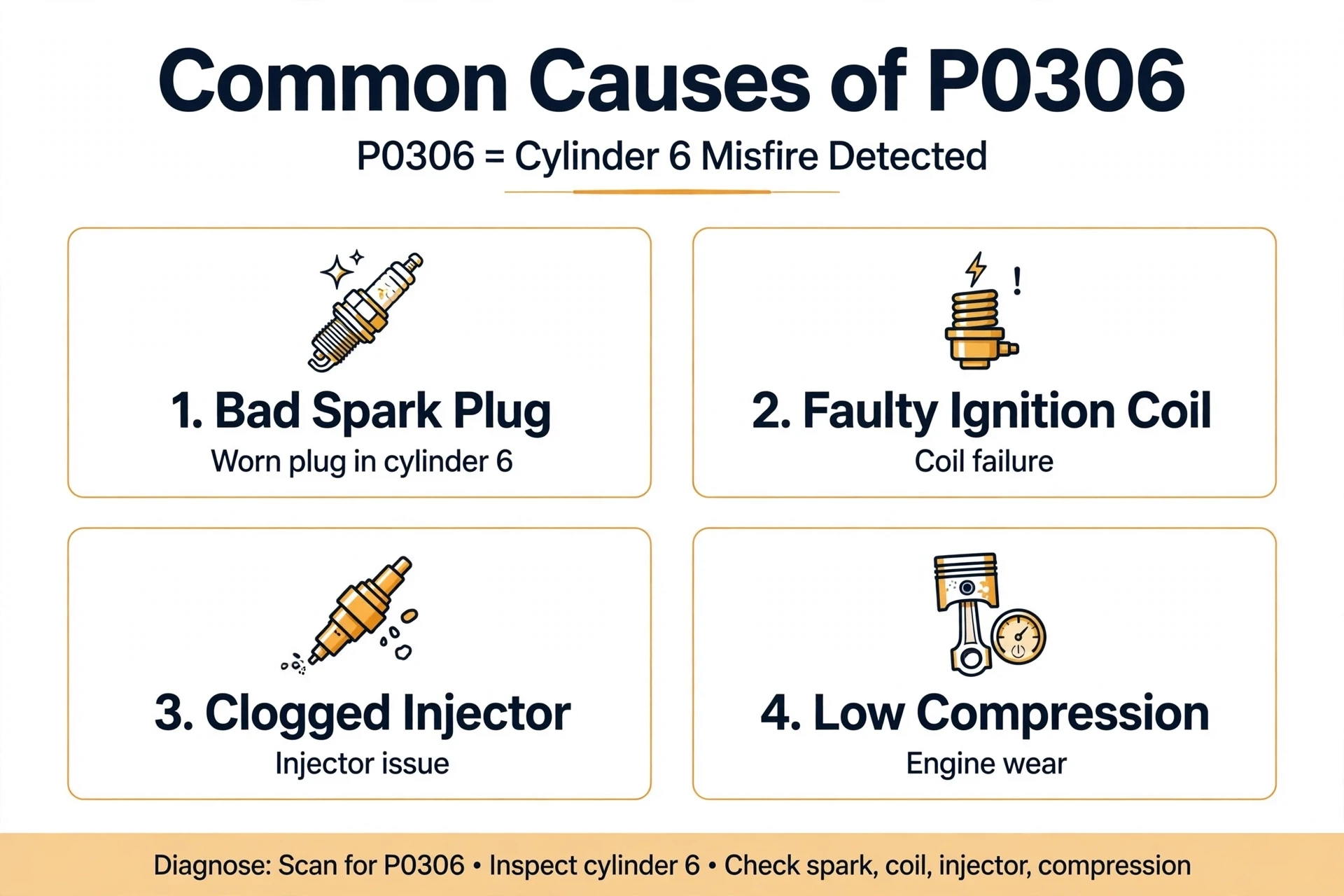
The most common cause of a P0306 code is an ignition fault on cylinder 6, usually a worn spark plug or a dying coil. Misfires are spark problems far more often than anything else.
- Worn or fouled spark plugs: the top cause. A plug with a worn electrode, heavy carbon, oil fouling, or the wrong gap cannot reliably light the mixture in cylinder 6.
- Failing ignition coil: on coil-on-plug engines, the individual coil for cylinder 6 breaks down, often only under load. This is one of the most frequent confirmed fixes for the p0306 code.
- Bad spark plug wires or boots: where fitted, cracked insulation or carbon tracking lets the spark escape before it reaches the plug.
- Clogged or dead fuel injector: if cylinder 6’s injector is dirty, stuck open, stuck shut, or has a broken electrical connection, that cylinder gets the wrong amount of fuel or none at all.
- Low fuel pressure: a weak pump or restricted filter can starve one cylinder before the others show symptoms.
- Low compression: worn piston rings, burnt or sticking valves, or a head gasket leak near cylinder 6 mean the mixture never gets squeezed hard enough to burn properly.
- Vacuum leaks: a cracked hose, leaking gasket, or cracked intake manifold lets unmetered air in and leans out cylinder 6, especially at idle.
- Wiring and connector damage: chafed, melted, or corroded wiring to the coil or injector interrupts the signal.
- Failing PCM: rare, but a faulty engine computer or a bad coil driver circuit inside it can shut down one cylinder.
How to Diagnose P0306 (Do This Before Buying Parts)
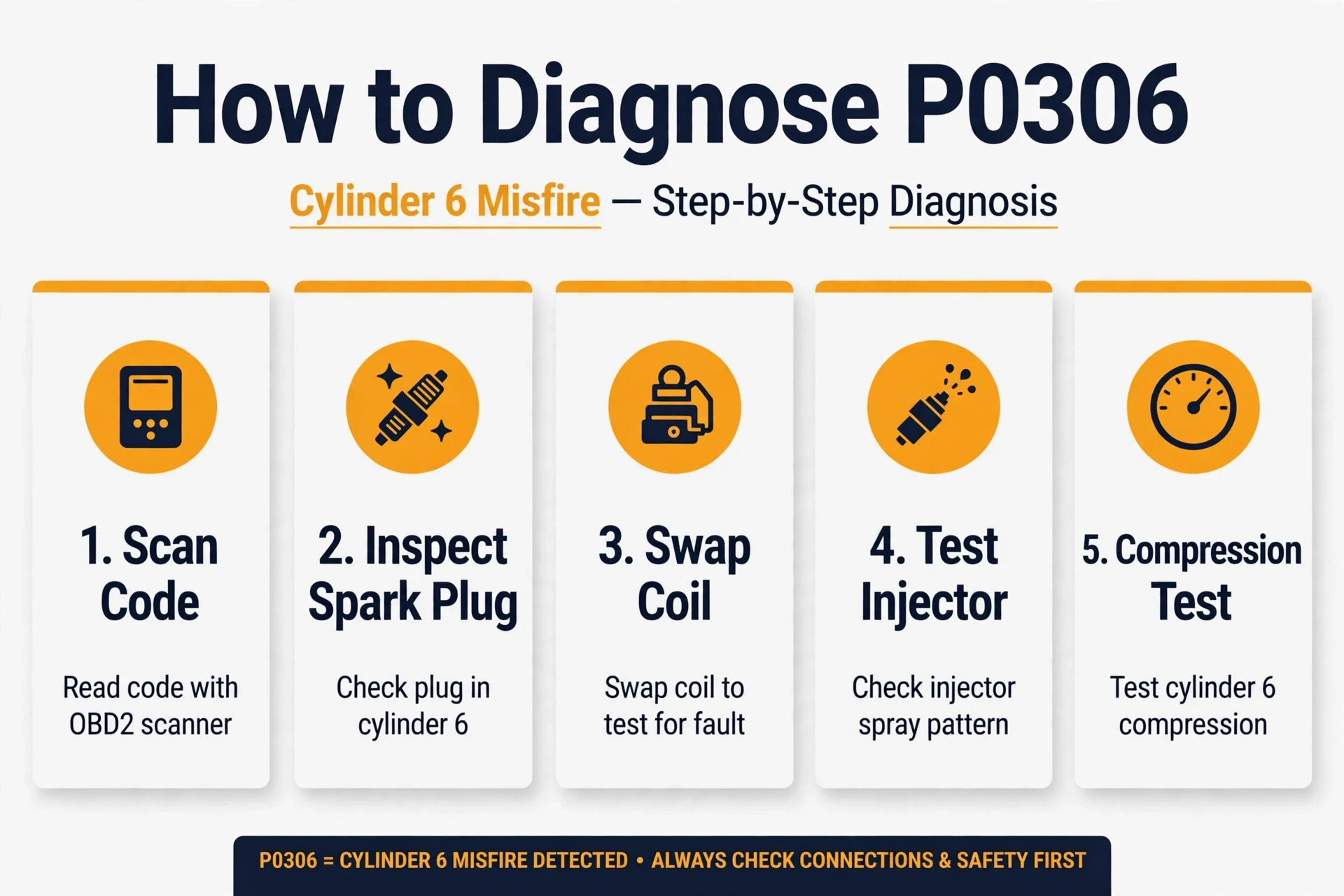
Mechanics see the P0306 code misdiagnosed all the time. The code tells you WHERE the misfire is, not WHY it is happening. Work through these steps before you buy parts:
- Scan for all codes first. If P0300 (random misfire) or lean codes came along with P0306, chase those too. Note the freeze frame data showing when the misfire happened.
- Do the swap test. This is the classic shop trick: move the spark plug and ignition coil from cylinder 6 to a different cylinder, such as cylinder 4. Clear the codes, drive the car, and scan again. If the misfire follows the parts and you now see P0304, the moved plug or coil is bad. If P0306 stays put on cylinder 6, the ignition parts are innocent.
- Read the spark plug. Pull the cylinder 6 plug and inspect it: oil fouling points at rings or valve seals, heavy carbon points at a rich mixture, and a cracked insulator or eroded electrode means the plug itself is done.
- Check the injector. Listen for its steady click, measure its resistance with a multimeter, and compare the reading with a neighboring cylinder.
- Test compression. A compression or leak-down test on cylinder 6 exposes worn rings, leaky valves, or head gasket trouble.
- Hunt for vacuum leaks. A smoke test, or a careful listen for hissing around the intake near cylinder 6, finds air sneaking in.
- Watch live misfire counters. A scanner with live data shows misfires per cylinder in real time, confirming the problem is really on cylinder 6 and revealing whether it happens at idle, under load, or both.
How to Fix the P0306 Code
The right fix depends on what your diagnosis found:
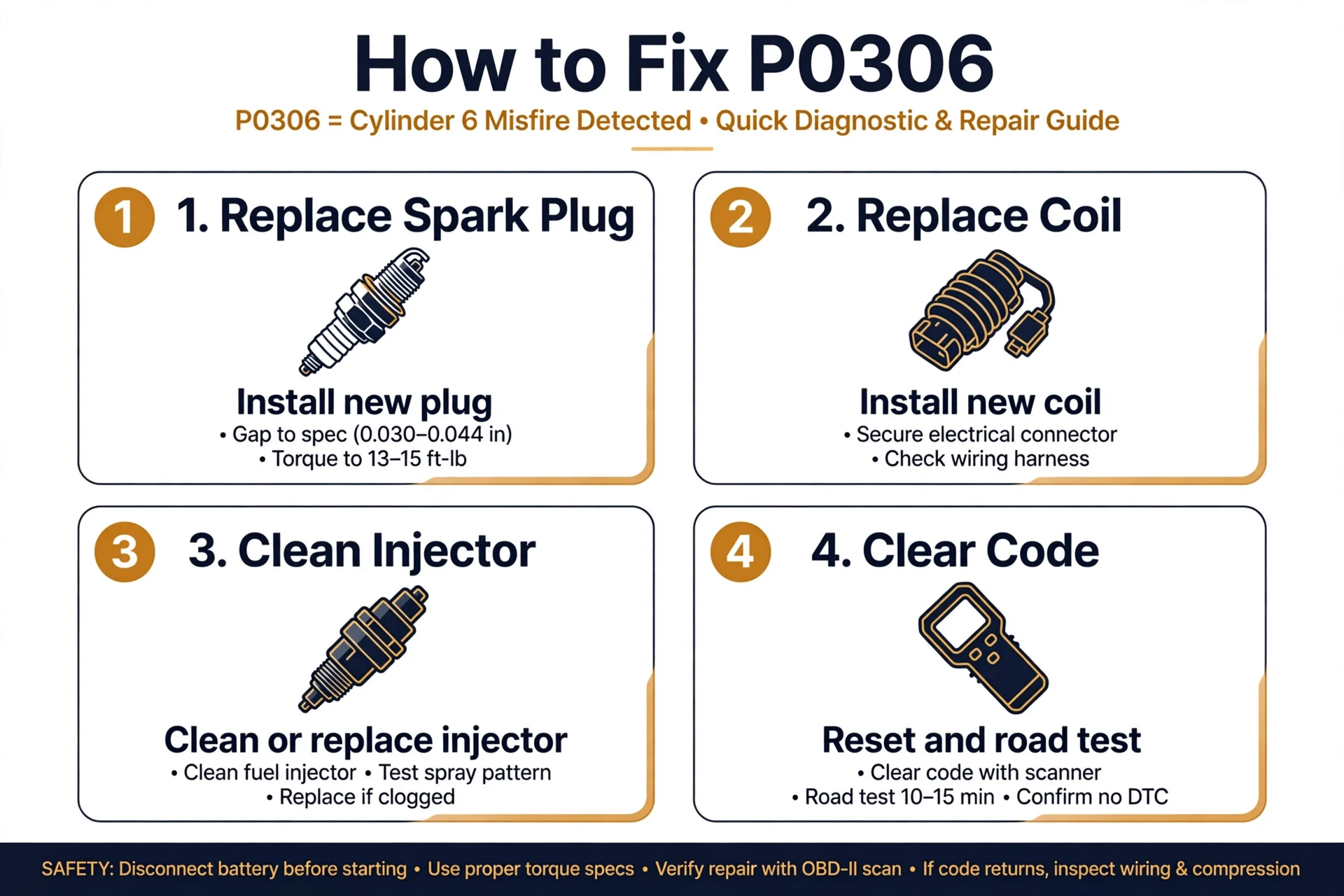
- Replace the spark plugs: if they are worn, change the whole set, not just cylinder 6, because the rest are the same age. Fresh plugs fix a large share of P0306 cases.
- Replace the bad ignition coil: fit a quality coil on cylinder 6. A failing coil is one of the most common confirmed fixes for the p0306 code.
- Replace wires or coil boots: if they are cracked, brittle, or show tracking marks, replace the set.
- Service the fuel injector: have cylinder 6’s injector professionally cleaned, or replace it if it is electrically dead or leaking.
- Repair wiring: mend chafed wires and clean or replace corroded connectors in the coil and injector circuits.
- Seal vacuum leaks: replace split hoses, failed gaskets, or a cracked intake section.
- Fix low compression: valve work, piston rings, or a head gasket repair when the mechanical test points inside the engine.
- Clear and retest: erase the code, then drive through several warm-up cycles and confirm the misfire counter for cylinder 6 stays at zero.
P0306 Repair Costs
Drivers always ask how much it costs to fix the p0306 code, and the answer depends entirely on the cause. Here are typical shop ranges:
| Repair | Cost Range |
|---|---|
| OBD2 diagnostic scan | $75 – $150 |
| Spark plug replacement (full set) | $100 – $300 |
| Ignition coil replacement (cylinder 6) | $150 – $350 |
| Fuel injector cleaning or replacement | $200 – $600 |
| Vacuum leak repair | $150 – $400 |
| Internal engine repair (valves, rings, head gasket) | $1,000 – $3,000+ |
This is why the swap test matters. A $15 spark plug and a $2,000 engine rebuild share the same code.
DIY vs Mechanic Verdict
You can do this at home: reading codes with an OBD2 scanner, the coil and plug swap test, replacing spark plugs and a coil-on-plug coil, and visual checks for vacuum leaks and damaged wiring.
See a mechanic for: compression and leak-down testing, fuel injector diagnosis and flow testing, any internal engine work, and suspected PCM faults.
Bottom line: run the diagnosis yourself, handle the simple ignition parts yourself, and let a professional open up the engine.
Can You Drive With a P0306 Code?
Get it fixed soon, and keep the trip short. Every mile on a misfiring cylinder sends unburned fuel into the exhaust, where it can overheat and melt the catalytic converter. That turns a $200 ignition repair into a $2,000 exhaust repair, and it can also wash fuel past the rings and dilute your engine oil.
If the check engine light is flashing, the misfire is severe: ease off the road safely and stop driving, because converter and engine damage are happening right now. A steady light with mild symptoms means a careful drive to the shop is reasonable, but do not commute on it for weeks.
P0306 on Popular Vehicles
P0306 can appear on any engine with six or more cylinders, but some patterns are worth knowing:
- Chevy Silverado and GMC Sierra: the p0306 chevy code often comes down to coil packs or plug wires on higher mileage trucks, and the swap test is the standard first move.
- Ford F-150 (including EcoBoost V6): the p0306 ford code frequently involves ignition coils; carbon buildup can play a role on direct injection versions.
- Dodge Ram 1500: plugs and coils are the usual suspects for the p0306 dodge code.
- Jeep Gladiator and Wrangler (3.6L Pentastar): check the coil and plug on cylinder 6 first, since the rear cylinders run hot.
- Honda Accord, Pilot, and Odyssey (V6): the p0306 honda code often ends at a failing coil or a tired injector.
- Toyota 4Runner and Tacoma (V6): the p0306 toyota code is usually ignition related, and these engines reward fresh, correctly gapped plugs.
- Nissan Maxima and Pathfinder (VQ V6): coil packs are a known weak point worth testing early.
- Chrysler 300 and Dodge Charger (3.6L): rear bank coils fail often enough to check them first.
P0306 vs Related Codes
Misfire codes are one family, and the last two digits name the cylinder. P0300 means the misfire is random or hitting multiple cylinders, while P0301 through P0312 point at a single cylinder: P0301 is cylinder 1, P0302 is cylinder 2, and so on. P0306 is simply the cylinder 6 member of that family.
If P0306 arrives with P0300, the misfire may be spreading from cylinder 6, or several cylinders share one root cause such as low fuel pressure or a big vacuum leak. And if a P0420 converter code shows up after a P0306, treat it as a warning: the misfire has been feeding raw fuel to the converter and the converter is now suffering.
Related Codes
- P0300: Random/Multiple Cylinder Misfire Detected
- P0301: Cylinder 1 Misfire Detected
- P0302: Cylinder 2 Misfire Detected
- P0305: Cylinder 5 Misfire Detected
- P0307: Cylinder 7 Misfire Detected
- P0420: Catalyst System Efficiency Below Threshold (a long misfire can cause this)
Video Walkthrough
Watch the video above for a visual walkthrough of P0306 diagnosis and repair before you read on.
Frequently Asked Questions
What is the most common cause of a P0306 code?
Worn spark plugs and failing ignition coils cause the large majority of P0306 cases. Ignition parts wear out and break down far more often than injectors or internal engine parts, which is why the coil and plug swap test is the first diagnostic step.
How do I fix the P0306 code?
Diagnose before you buy parts. Scan all codes, then swap the coil and spark plug from cylinder 6 with another cylinder, clear the code, and drive. Replace whichever part the misfire follows. If P0306 stays on cylinder 6, test the fuel injector, check compression, and look for vacuum leaks.
Can I drive with a P0306 code?
Only a short distance to a repair shop. A misfiring cylinder sends unburned fuel into the exhaust, which can overheat and destroy the catalytic converter. If the check engine light is flashing, stop driving and have the car towed, because damage is happening right now.
How much does it cost to fix a P0306 code?
Most cases land at the cheaper end: about $100 to $300 for spark plugs, $150 to $350 for an ignition coil, and $200 to $600 for a fuel injector. Internal engine repairs for low compression run $1,000 and up, but those are the exception.
Will P0306 clear itself?
The light sometimes goes off on its own if the misfire stops happening, but the code stays in memory and the underlying fault is usually still there. In practice the code almost always comes back until the worn plug, bad coil, or faulty injector is replaced.
What does a flashing check engine light mean with P0306?
A flashing light means a severe misfire is happening at that moment and raw fuel is reaching the catalytic converter. Keep driving and you risk melting the converter and damaging the engine. Ease off the road safely and stop.
Can a bad fuel injector cause P0306?
Yes. A clogged, leaking, or electrically dead injector on cylinder 6 is one of the top causes after ignition parts. Suspect the injector especially when the swap test proves the spark plug and coil are healthy and the misfire stays on cylinder 6.
Conclusion
The P0306 code looks alarming, but it is one of the most straightforward codes to chase down. It names the exact cylinder, and the swap test usually fingers the bad part within the hour. Act on it quickly, because every mile of misfiring puts your catalytic converter at risk. Handle the simple ignition parts in your driveway, and leave internal engine work to a professional.
About the author: Written by the OBD2 Code Hub editorial team. Our diagnostic guides are built from real OBD-II data, manufacturer service information, and hands-on shop experience, so you can fix your check engine light with confidence.