
P0451 Trouble Code: Meaning, Causes, Symptoms & Fixes
In This Guide
- What the P0451 Code Means
- Symptoms of the P0451 Code
- Common Causes of the P0451 Code
- How to Diagnose the P0451 Code
- How to Fix the P0451 Code
- Repair Cost for P0451
- DIY vs. Mechanic Verdict
- Can You Still Drive with the P0451 Code?
- P0451 in Common Vehicles
- P0451 vs. P0452, P0453, P0455, and P0456
- Related Codes
- Video Walkthrough
- FAQs
- Conclusion
One-line meaning: The P0451 code means the EVAP system pressure sensor signal is out of its expected range or is behaving erratically.
What the P0451 Code Means: EVAP Pressure Sensor Range/Performance
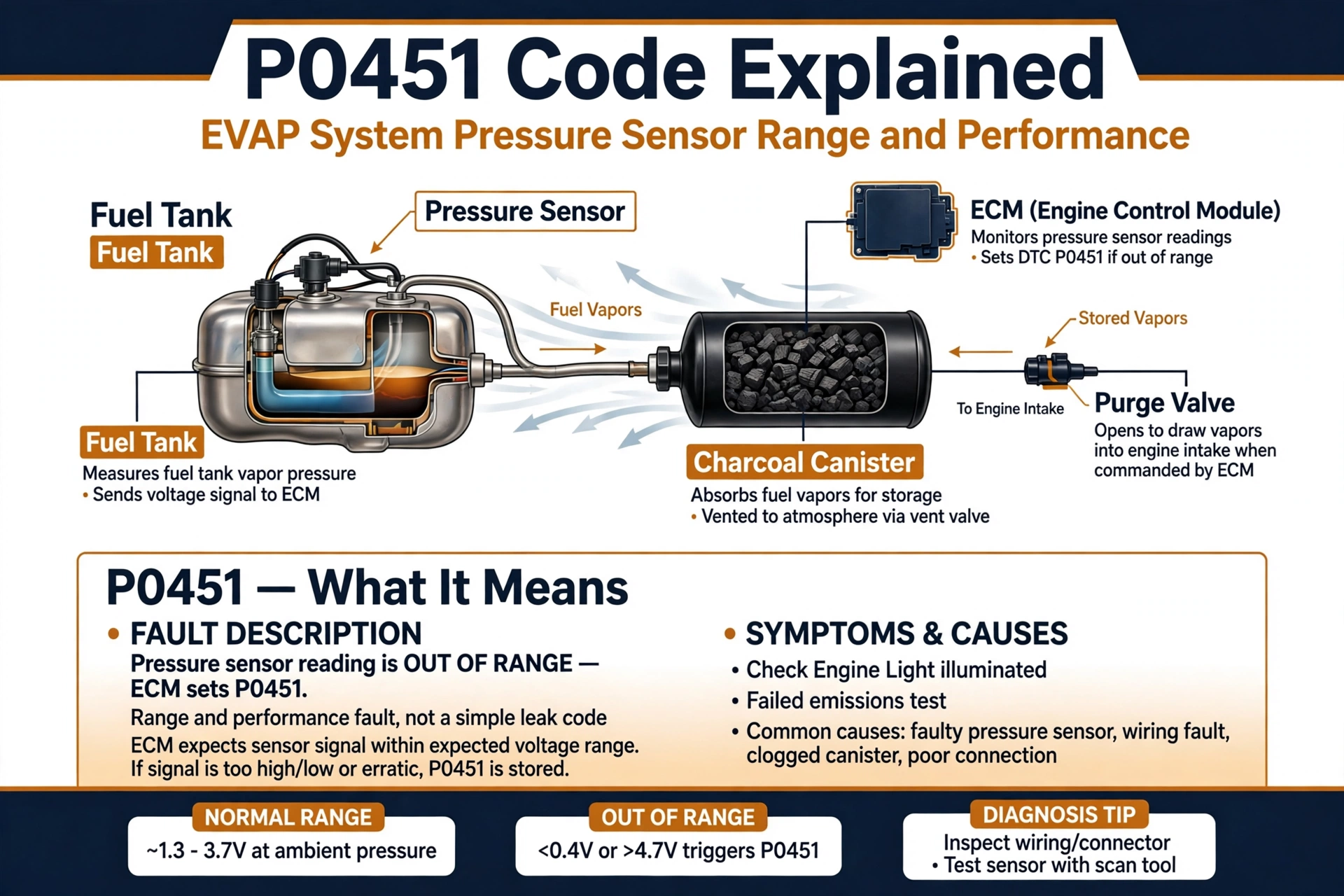
P0451 is the OBD-II code for “Evaporative Emission System Pressure Sensor/Switch Range/Performance.” If you looked up the engine code p0451 after your check engine light came on, here is what your car is trying to tell you.
Your EVAP system traps fuel vapors from the gas tank so they do not escape into the air. A small pressure sensor, usually called the fuel tank pressure (FTP) sensor and mounted on or near the fuel tank, constantly reports tank pressure and vacuum to the powertrain control module (PCM). During self-tests, the PCM seals the EVAP system and watches how that sensor signal behaves.
P0451 sets when the sensor voltage, pressure, or vacuum reading is erratic, falls outside the expected range, or fails to respond the way the PCM predicts during those self-tests. In plain English: the computer no longer trusts the pressure readings it is getting.
The angle that makes this guide different: P0451 is a sensor range and performance fault, not a leak code. P0455 means a large EVAP leak, P0456 means a very small EVAP leak, P0452 means the sensor circuit reads too low, and P0453 means it reads too high. P0451 sits in the middle: the circuit works, but the signal itself is implausible. That distinction decides which parts you test first, and it is the reason this code gets misdiagnosed so often.
Symptoms of the P0451 Code
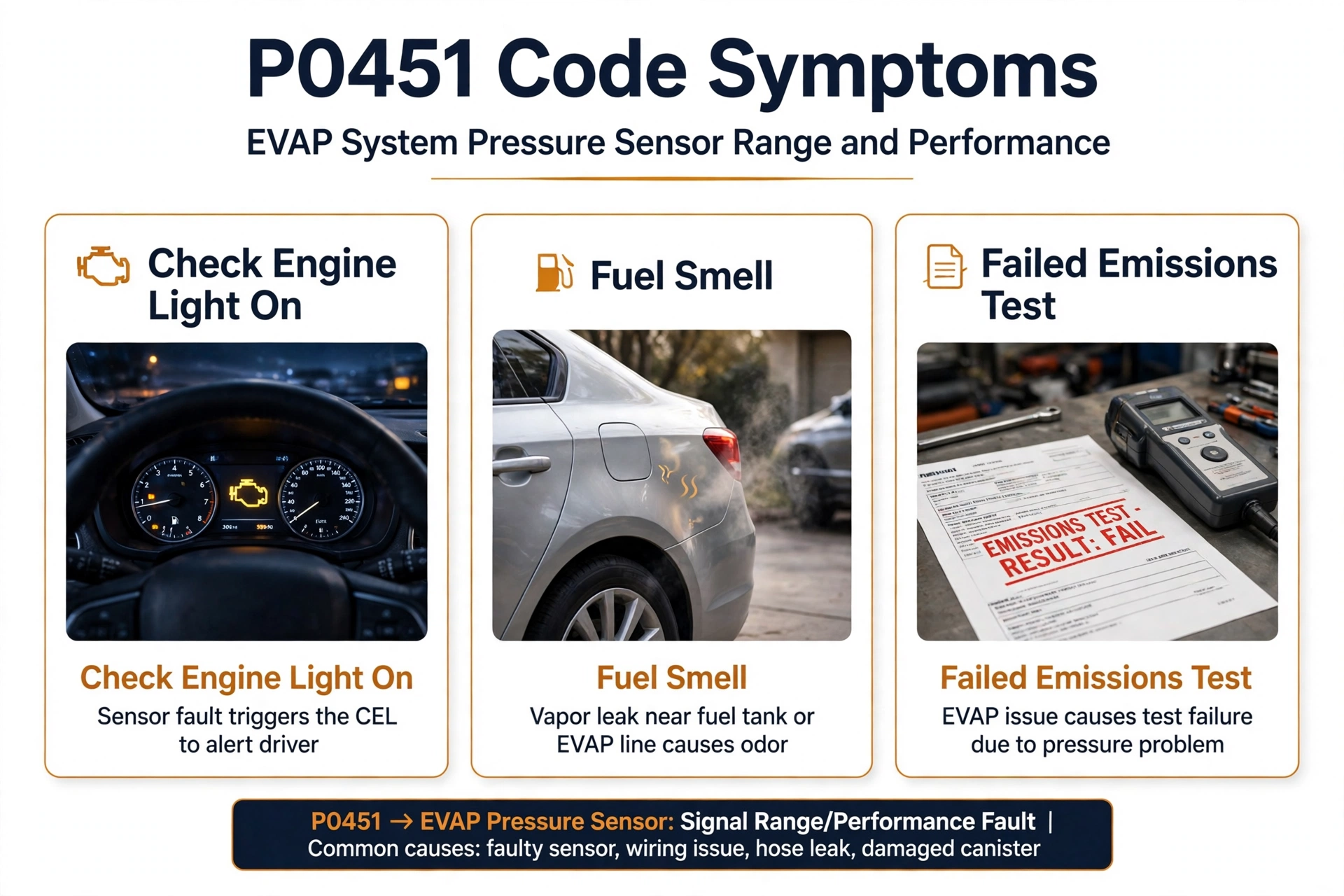
P0451 is a quiet code. In most cars the check engine light is the only clue, which is why many drivers keep driving for weeks before looking it up.
- Check engine light on, often with no other symptoms at all
- Faint fuel smell around the vehicle in some cases
- Fuel pump nozzle clicking off early, or trouble filling the tank, when a vent problem is present too
- Failed state emissions or inspection test because the light is on
- No change in how the engine runs, idles, or accelerates in most cases
Common Causes of the P0451 Code
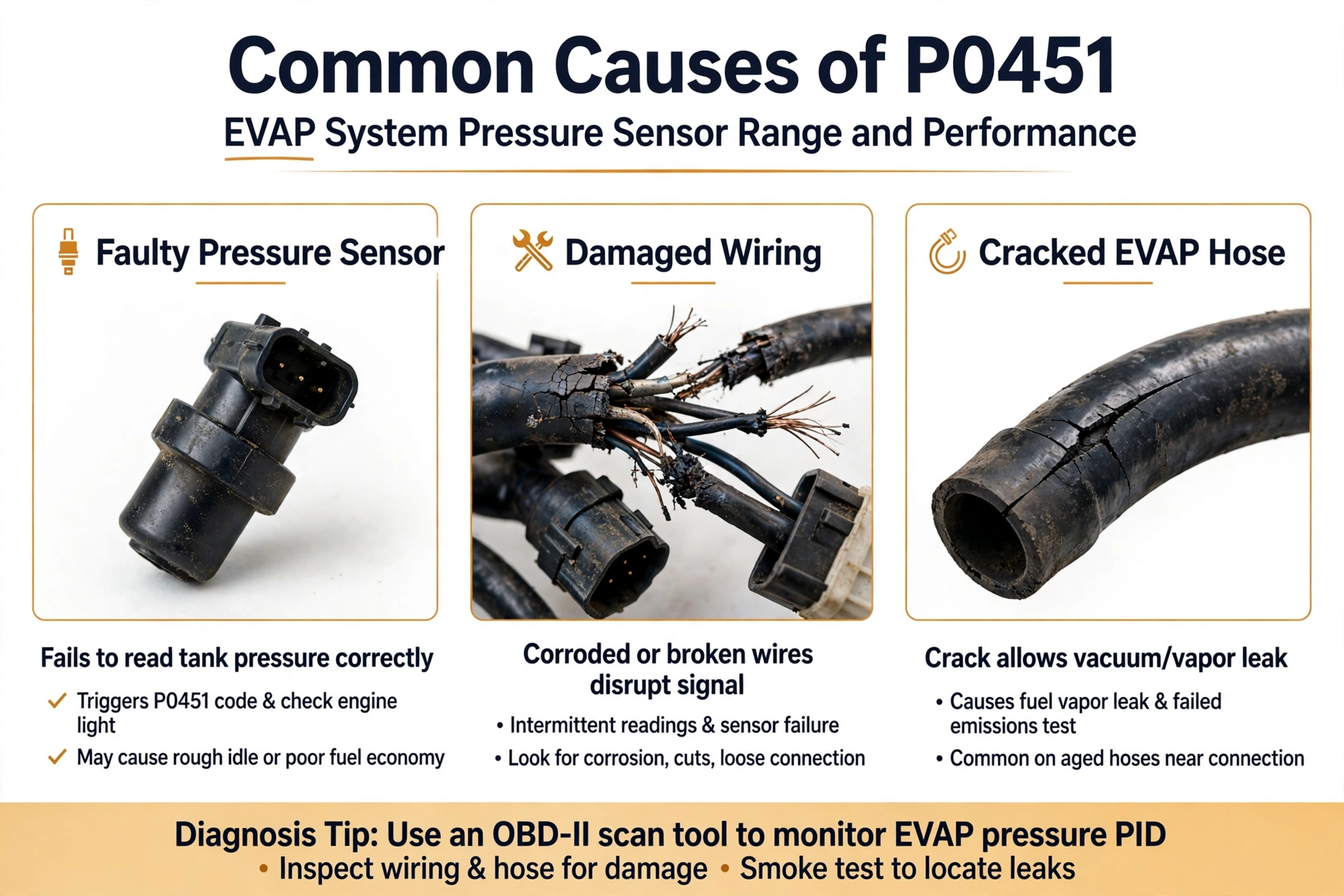
The PCM sets P0451 when it cannot trust the EVAP pressure signal. These are the causes, ordered from most to least common.
- Faulty fuel tank pressure (FTP) or EVAP pressure sensor that reads erratically or sticks, the most common cause by far
- Damaged, chafed, or corroded wiring to the pressure sensor, or a loose or oil-fouled connector
- Open or short in the sensor signal circuit or the 5-volt reference circuit
- EVAP vent valve stuck closed, trapping abnormal pressure in the system
- EVAP purge valve stuck open, pulling unexpected vacuum on the tank
- Cracked, kinked, collapsed, or disconnected EVAP vapor hoses
- Damaged fuel tank or faulty fuel pump and sending unit assembly (rare)
- Failed powertrain control module (PCM) (rare)
How to Diagnose the P0451 Code
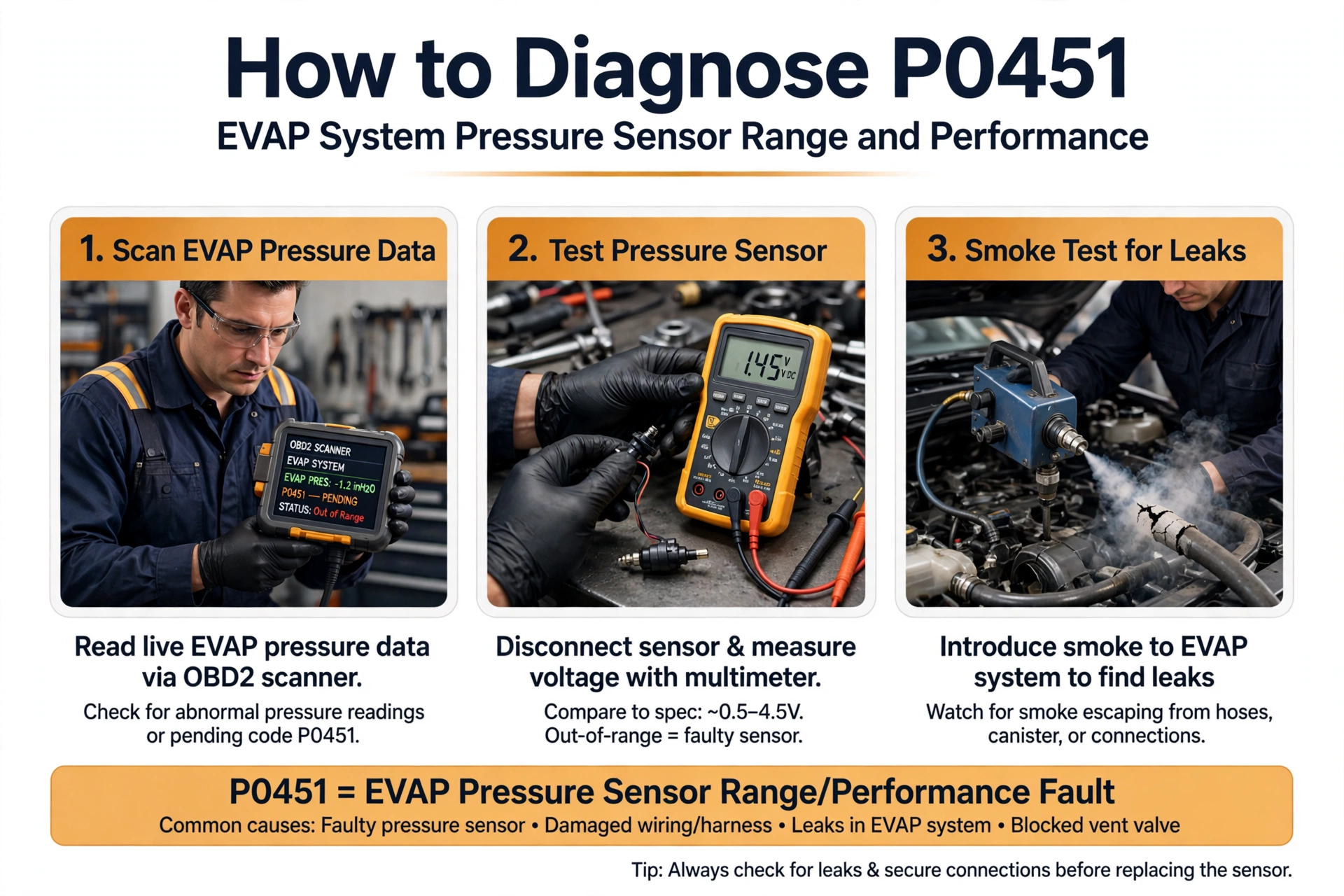
Work from cheap and simple toward expensive and involved. Do not replace the pressure sensor until testing proves it is bad.
- Scan and document: connect an OBD-II scanner, confirm P0451, and record freeze frame data plus any companion codes such as P0452 or P0453.
- Visual inspection: examine the fuel tank pressure sensor, its connector, and the wiring harness near the fuel tank for corrosion, chafing, or loose pins. Check EVAP hoses for cracks, kinks, or disconnections.
- Check reference voltage and ground: with the key on and the engine off, verify the sensor receives its 5-volt reference and has a clean ground. Missing voltage points to a circuit fault, not a bad sensor.
- Watch live data: use the scanner to monitor fuel tank pressure with the key on, engine off, and then running. A healthy sensor shows near-atmospheric pressure at rest and smooth, believable changes. A frozen, jumping, or implausible reading condemns the sensor or its circuit.
- Test sensor response: where the service procedure allows, gently apply a small amount of pressure or vacuum to the sensor and watch the signal. No change means the sensor is dead.
- Test the vent and purge valves: command them with the scanner and listen for clicks. A vent valve stuck closed or a purge valve stuck open will skew pressure readings and can set P0451.
- Smoke test if needed: if the sensor and valves test good, a smoke machine can reveal hidden hose cracks that disturb system pressure.
- Run the pinpoint test: follow the manufacturer pinpoint test for the P0451 circuit before condemning the PCM, which is always the last suspect.
How to Fix the P0451 Code
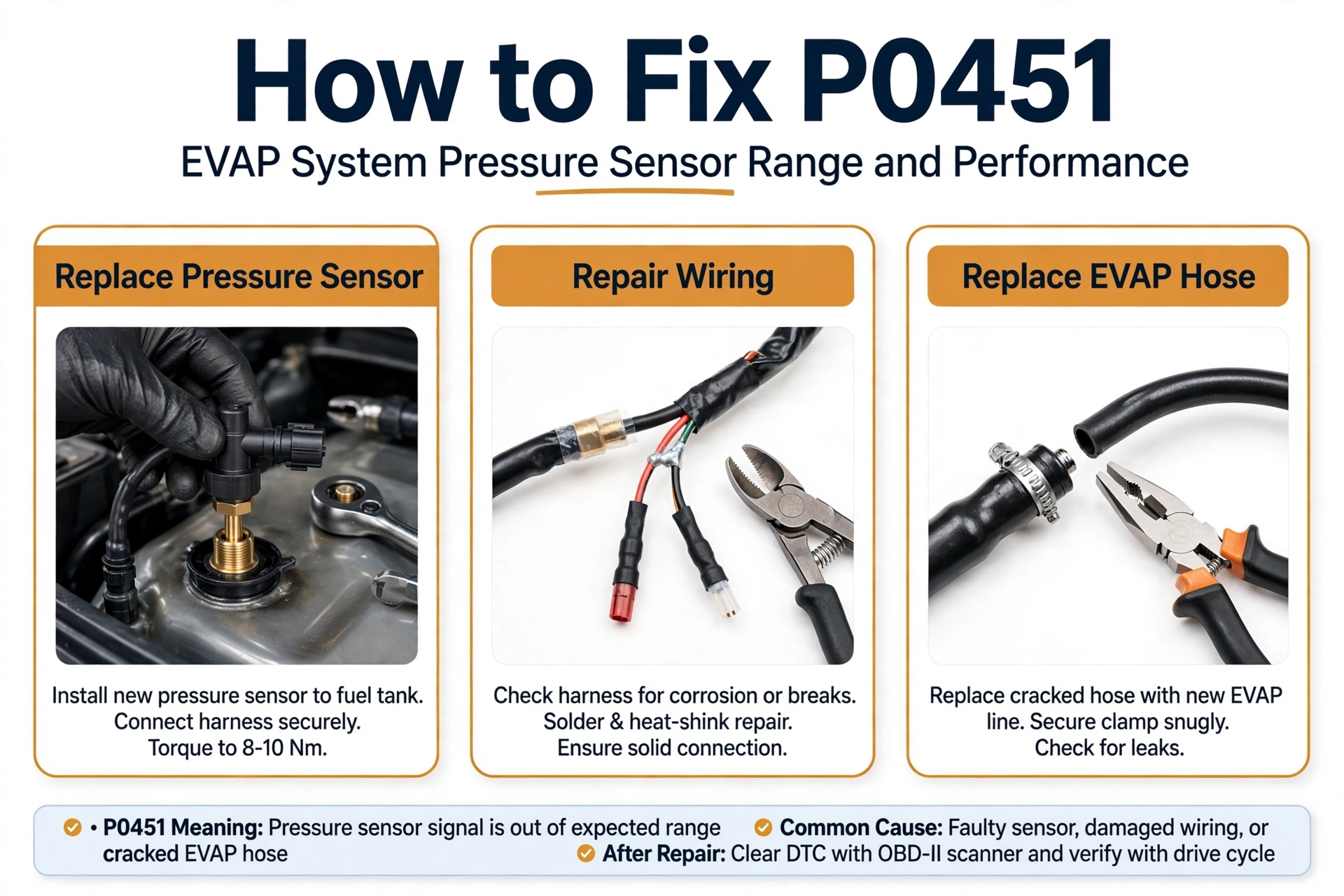
Fix what the diagnosis proved, not what the code guessed. Most P0451 repairs end at the sensor or its wiring.
- Replace the faulty fuel tank pressure or EVAP pressure sensor, the fix in most cases
- Repair damaged wiring or replace a corroded or loose sensor connector
- Replace a stuck EVAP vent valve or purge valve if testing showed it not operating
- Replace cracked, kinked, or collapsed EVAP vapor hoses
- Reseat or replace the fuel pump module seal if the sending unit assembly is the source (rare)
- Update PCM software or replace the PCM only after every other cause is ruled out (rare)
- Clear the code with a scanner and drive through a full EVAP monitor cycle to confirm the repair held
Repair Cost for P0451
What you pay depends on which part failed and how hard it is to reach. These are typical US repair ranges including parts and labor.
| Repair | Cost Range |
| OBD-II diagnostic fee | $100–$160 |
| EVAP / fuel tank pressure sensor replacement | $150–$400 |
| Wiring or connector repair | $100–$250 |
| EVAP vent valve replacement | $120–$300 |
| EVAP purge valve replacement | $100–$250 |
| EVAP vapor hose replacement | $80–$200 |
| PCM replacement (rare) | $500–$1,200 |
Because the sensor itself is the culprit in most cases, many drivers land in the $150 to $400 range including diagnosis. Always get a written estimate before authorizing tank-drop labor, which is where the bill climbs.
DIY vs. Mechanic Verdict
P0451 is a beginner-friendly diagnosis but a sometimes-awkward repair, because the sensor often lives on top of the fuel tank.
You can do this at home:
- Scan and document the code with an OBD-II scanner
- Inspect the sensor connector and EVAP hoses for visible damage
- Test the 5-volt reference and ground with a basic multimeter
- Replace an accessible vent or purge valve
- Clear the code and run a drive cycle to retest
See a mechanic for:
- Smoke testing the EVAP system for hidden faults
- Manufacturer pinpoint electrical tests on the sensor circuit
- Any repair that requires lowering the fuel tank to reach the pressure sensor
- PCM software updates or PCM replacement
Bottom line: Diagnose it yourself with a scanner and a multimeter, but hand over the wrench if the sensor is buried above the tank. Paying an hour of labor beats dropping a fuel tank in your driveway.
Can You Still Drive with the P0451 Code?
Yes, for short trips. P0451 is widely ranked among the least severe check engine codes because it does not affect how the engine runs. You will not damage the engine by driving with it, and there is no safety risk for you or your passengers.
Still, get it fixed within a week or two. You will fail an emissions inspection with the light on, fuel vapors may keep escaping, and a new, unrelated problem can develop while the light is already on and hiding fresh codes.
P0451 in Common Vehicles
P0451 is a generic code that applies to every OBD-II vehicle, but some brands report it more often than others.
- p0451 code ford: The F-150 and other Ford trucks report P0451 when the fuel tank pressure sensor on the pump module starts reading erratically. Check the connector on top of the tank for corrosion before replacing parts.
- p0451 code chevy: Silverado, Tahoe, and Equinox models see P0451 from a failing FTP sensor or a vent valve stuck closed. Both are common on higher-mileage GM trucks and SUVs.
- p0451 code toyota: Camry and Corolla rarely set P0451 for the sensor itself. Inspect the wiring harness near the tank and the charcoal canister hoses first.
- p0451 code honda: Accord and Civic models can set P0451 with an aging FTP sensor. A scan tool reading of tank pressure at key-on will usually expose a frozen or jumping signal.
- p0451 code nissan: Altima and Rogue report P0451 when the EVAP pressure sensor signal goes implausible. Check the sensor and the vent control valve together, since either can skew the reading.
- p0451 code jeep: Grand Cherokee and Wrangler models see P0451 from the fuel tank pressure sensor or from cracked EVAP hoses near the canister. A smoke test finds the hose faults fast.
- how to fix p0451 code: The universal answer is test first. Verify the 5-volt reference, watch live tank pressure data for an erratic or frozen signal, and replace the FTP sensor only when its readings prove bad. That sequence works on every brand above.
P0451 vs. P0452, P0453, P0455, and P0456
These EVAP codes look alike but point at different faults. Mixing them up buys the wrong parts.
- P0451 vs. P0452: P0452 means the pressure sensor circuit voltage is stuck too low, usually a short to ground or a failed sensor. P0451 means the circuit works but the signal is out of range or erratic.
- P0451 vs. P0453: P0453 is the mirror image: sensor circuit voltage stuck too high, usually a short to power or an open ground. P0451 is about implausible performance, not a pegged voltage.
- P0451 vs. P0455: P0455 means the EVAP system has a large leak, such as a loose gas cap or a disconnected hose. P0451 is not a leak code at all. It is a sensor trust issue.
- P0451 vs. P0456: P0456 means a very small EVAP leak was detected. Like P0455, it is about sealing, while P0451 is about the pressure sensor signal quality.
Related Codes
If P0451 showed up with companion codes, or you typed a neighboring code by mistake, start here.
- P0440: Evaporative Emission Control System Malfunction
- P0441: Evaporative Emission Control System Incorrect Purge Flow
- P0446: Evaporative Emission Control System Vent Control Circuit Malfunction
- P0452: Evaporative Emission System Pressure Sensor/Switch Low Input
- P0453: Evaporative Emission System Pressure Sensor/Switch High Input
- P0455: Evaporative Emission Control System Leak Detected (Large Leak)
- P0456: Evaporative Emission Control System Leak Detected (Very Small Leak)
Video Walkthrough: P0451 Code Causes and Solutions
Watch Car Mechanic USA, a USA-based English-language channel, explain the P0451 code, walk through the most common causes, and show the solutions step by step.
Video: P0451 Code Explained – Most Common Causes & Solutions! by Car Mechanic USA
P0451 Code FAQs
Quick answers to the questions drivers ask most about the P0451 code.
What does the P0451 code mean?
The P0451 code means the EVAP system pressure sensor signal is out of its expected range or is performing erratically. The PCM watches the fuel tank pressure sensor during EVAP self-tests, and when its voltage, pressure, or vacuum reading looks implausible or fails to respond as predicted, it stores P0451 and turns on the check engine light. It is a sensor performance fault, not a leak code.
What are the symptoms of the P0451 code?
The most common symptom is the check engine light with no other noticeable changes. Some drivers report a faint fuel smell, a fuel nozzle that clicks off early, or a failed emissions test. The engine usually runs normally, which is why this code often goes unnoticed for a while.
What causes the P0451 code?
The most common cause is a faulty fuel tank pressure (EVAP pressure) sensor. Other causes include damaged or corroded sensor wiring, an open or short in the 5-volt reference circuit, a stuck EVAP vent or purge valve, and cracked EVAP hoses. A failed PCM is possible but rare.
More P0451 Code Questions
How do I fix the P0451 code?
Start by scanning for codes and inspecting the sensor wiring and EVAP hoses. Verify the 5-volt reference and ground at the sensor, then watch live fuel tank pressure data for erratic or frozen readings. Replace the pressure sensor if its signal proves bad, repair any wiring damage, and replace a stuck vent or purge valve if testing condemns it. Clear the code and complete a drive cycle to confirm the repair.
How much does it cost to fix a P0451 code?
A diagnostic fee usually runs $100 to $160. Replacing the EVAP pressure sensor, the most common fix, typically costs $150 to $400 including labor. Wiring repairs run $100 to $250, and valve or hose replacements fall in a similar range. Costs climb if the fuel tank must be lowered to reach the sensor.
Is it safe to drive with a P0451 code?
Yes, for short trips. P0451 does not affect engine performance and will not damage the engine. Still, fix it within a week or two, because you will fail an emissions inspection with the check engine light on, and the light can mask new codes from other problems.
What is the difference between P0451 and P0455?
P0455 means the EVAP system has a large leak, while P0451 means the EVAP pressure sensor signal is out of range or erratic. P0451 is a sensor performance fault, not a leak code. A related pair is P0452 and P0453, which mean the sensor circuit voltage is stuck low or high.
Conclusion: Trust the Sensor, Then Verify It
P0451 looks like an emissions maze, but the path through it is short: the computer stopped trusting its EVAP pressure readings, and your job is to find out why. In most cases the answer is the fuel tank pressure sensor itself or the wiring feeding it. Test the 5-volt reference, watch the live pressure signal, and replace only what testing condemns. Do that, clear the code, and the light will stay off. Remember the one fact that keeps this code straight: P0451 is a sensor range and performance fault, never a leak code, and treating it as one is how drivers buy parts they do not need.
About the author: Written by the OBD2 Code Hub editorial team. Our diagnostic guides are built from real OBD-II data, manufacturer service procedures, and hands-on troubleshooting experience, then reviewed for technical accuracy before publishing. We drive the same cars you do.