
P2096 Trouble Code: Meaning, Causes, Symptoms & Fixes
In This Guide
One-line meaning: P2096: Post Catalyst Fuel Trim System Too Lean (Bank 1).
What the P2096 Code Means
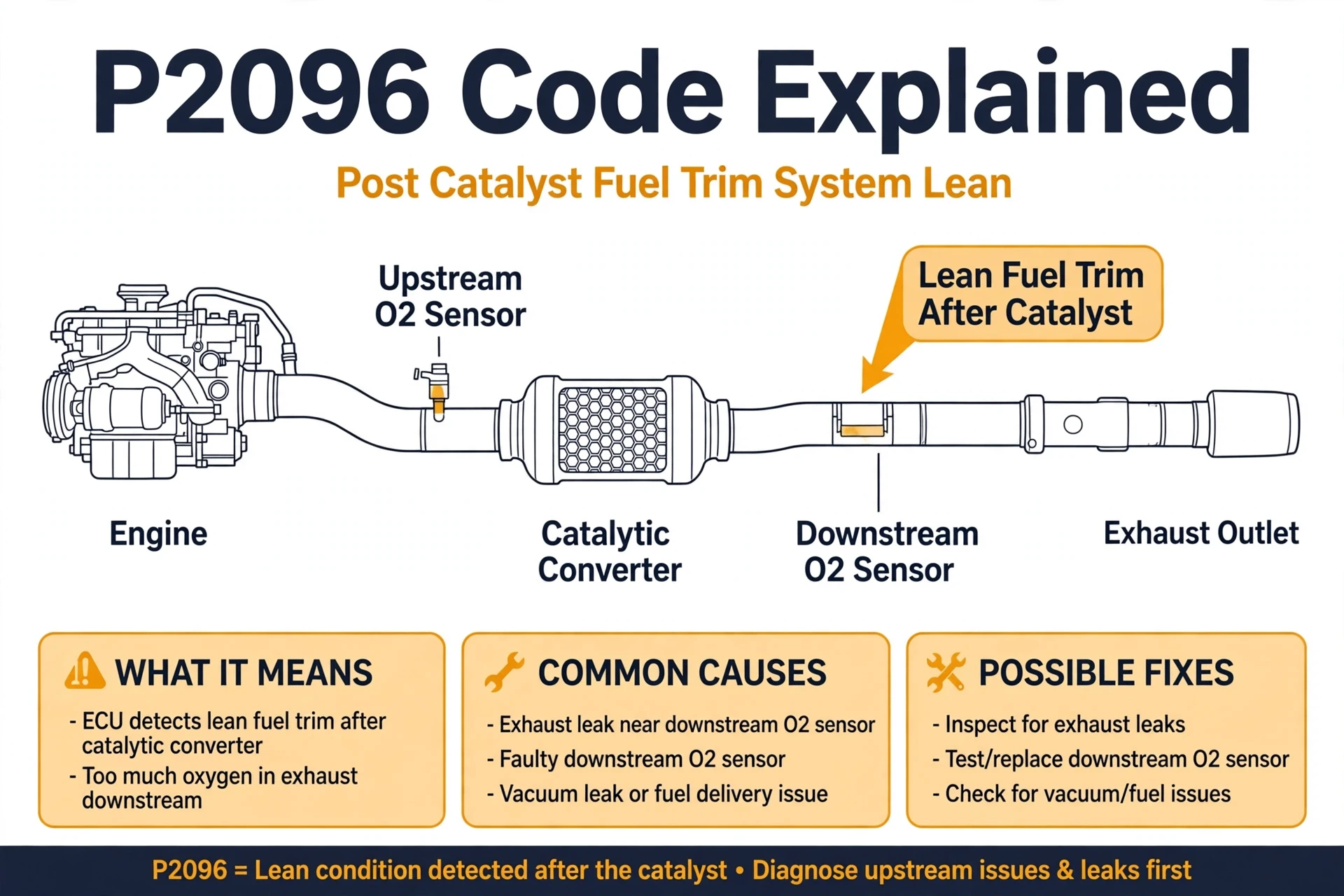
The p2096 engine code stands for “Post Catalyst Fuel Trim System Too Lean (Bank 1).” In plain English, your car’s computer has decided that the exhaust leaving the catalytic converter on bank 1 contains too much oxygen and not enough fuel. The mixture the sensor sees after the converter is leaner than it should be.
Here is how your car reaches that conclusion. The downstream oxygen sensor, the one mounted after the catalytic converter, watches the oxygen left in the exhaust. Under normal conditions it reports a fairly steady signal. When that sensor keeps reporting a lean mixture, the computer adjusts fuel trim to compensate, and when the correction passes its limit, the engine code p2096 is stored and the check engine light comes on.
P2096 is a generic powertrain code, so it means the same thing on every make and model. Bank 1 is the side of the engine that holds cylinder number one; on a four-cylinder or straight-six engine, the whole engine is bank 1. Its mirror image is P2098, the identical fault for bank 2 on V6 and V8 engines. Two close relatives, P2097 and P2099, describe the same post-catalyst fuel trim test failing in the rich direction instead of lean.
Symptoms of the P2096 Code
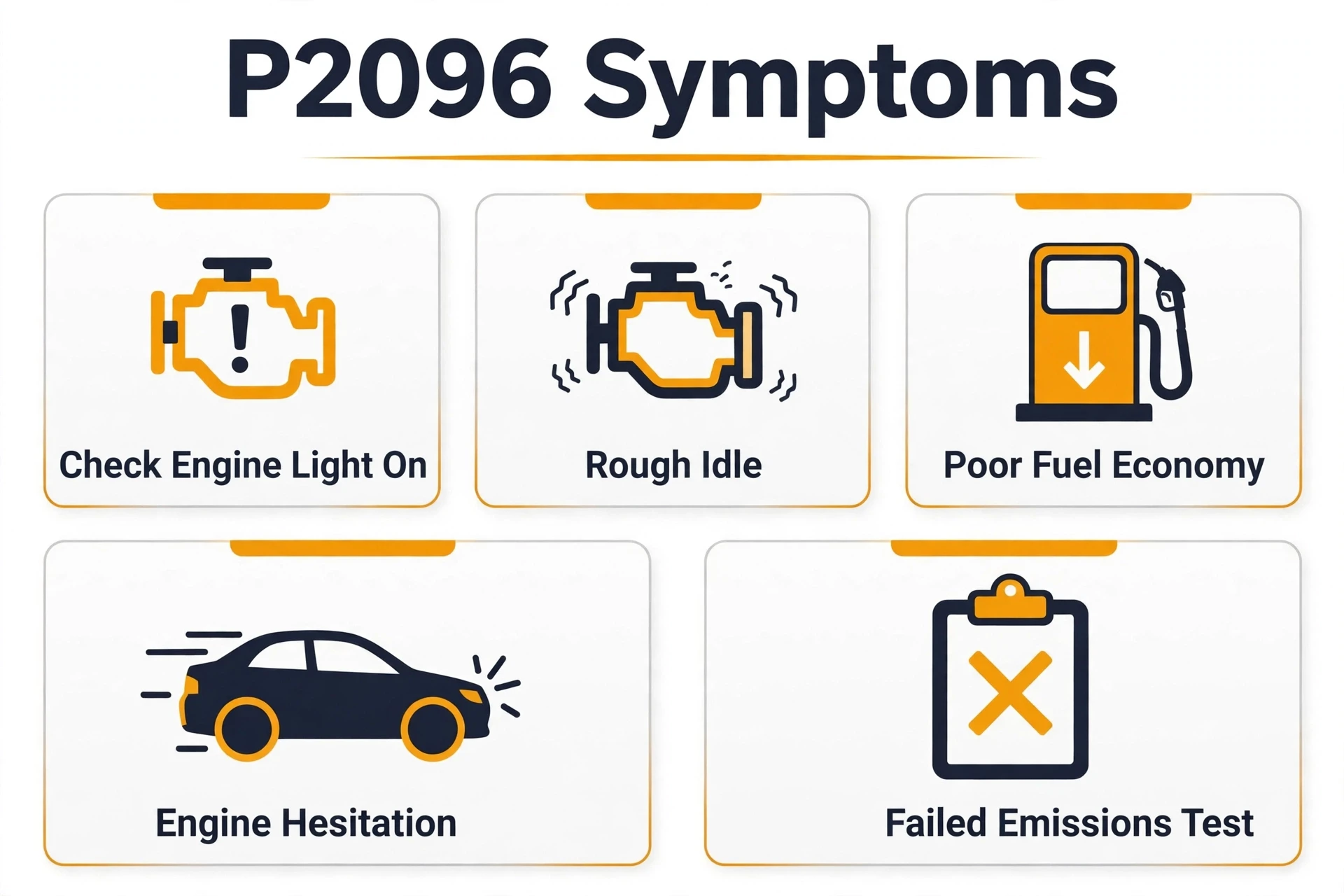
In many cases, the check engine light is the only symptom you will notice. The car may drive exactly the same as before. But depending on what is causing the lean reading, you might also notice:
- Check engine light illuminated, the one symptom nearly every driver gets
- Rough idle, especially when stopped at lights
- Poor acceleration or a sluggish, hesitant feel when you press the gas
- Reduced fuel economy, roughly a 5 to 15 percent drop, so more frequent fill-ups
- Loss of engine power on hills or under load
- Engine misfires in severe cases
- Unusual exhaust noise if an exhaust leak is the culprit
What is the p2096 code trying to tell you? In short: the computer sees too much oxygen after the converter on bank 1. Do not ignore it just because the car still drives. A lean condition left alone burns hotter and can damage engine parts and the catalytic converter.
Common Causes of P2096
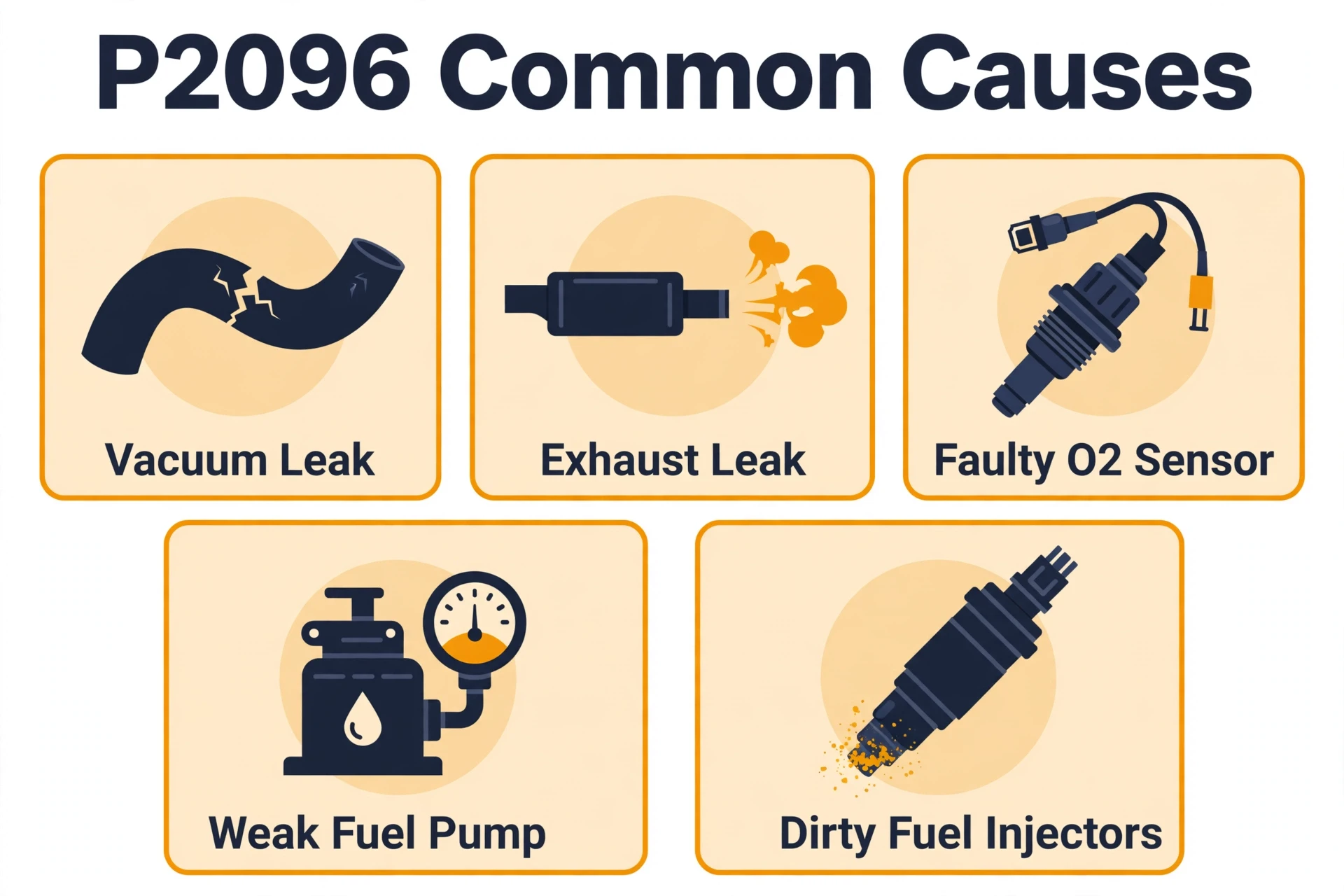
An exhaust leak is the most frequent and cheapest cause to check first, but several other faults can set a p2096 code. Here are the causes, roughly in order of likelihood:
- Exhaust leaks: cracks, rust holes, loose clamps, or bad gaskets between the engine and the downstream oxygen sensor. A leak upstream of the sensor pulls outside air into the exhaust pipe and tricks the sensor into reporting a false lean condition.
- Faulty downstream oxygen sensor: the post-catalyst O2 sensor itself may be aging, contaminated, or slow to respond, sending inaccurate readings to the computer.
- Vacuum or intake leaks: unmetered air sneaking in past the mass airflow sensor through cracked hoses, a leaking intake manifold gasket, or a bad PCV valve leans out the real mixture.
- Fuel delivery issues: a weak fuel pump, clogged fuel filter, dirty or clogged fuel injectors, or a failing fuel pressure regulator starves the engine of fuel.
- Dirty or faulty MAF sensor: if the mass airflow sensor misreads incoming air, the computer calculates the wrong fuel amount and the mixture runs lean.
- Failing catalytic converter: a degraded converter that can no longer process exhaust gases properly. Check this last, since it is the priciest part and rarely the true root cause of a lean code.
- Wiring and connector problems: damaged O2 sensor wiring or corroded connectors corrupt the signal. This is a known issue on some Jeep and Chrysler models.
- ECM/PCM software issues: rare, but some manufacturers have released software updates that correct false P2096 readings, so check for service bulletins for your model.
How to Diagnose P2096 (Do This Before Buying Parts)
P2096 is misdiagnosed constantly, often with a new O2 sensor that was never bad. Work through this order before buying parts:
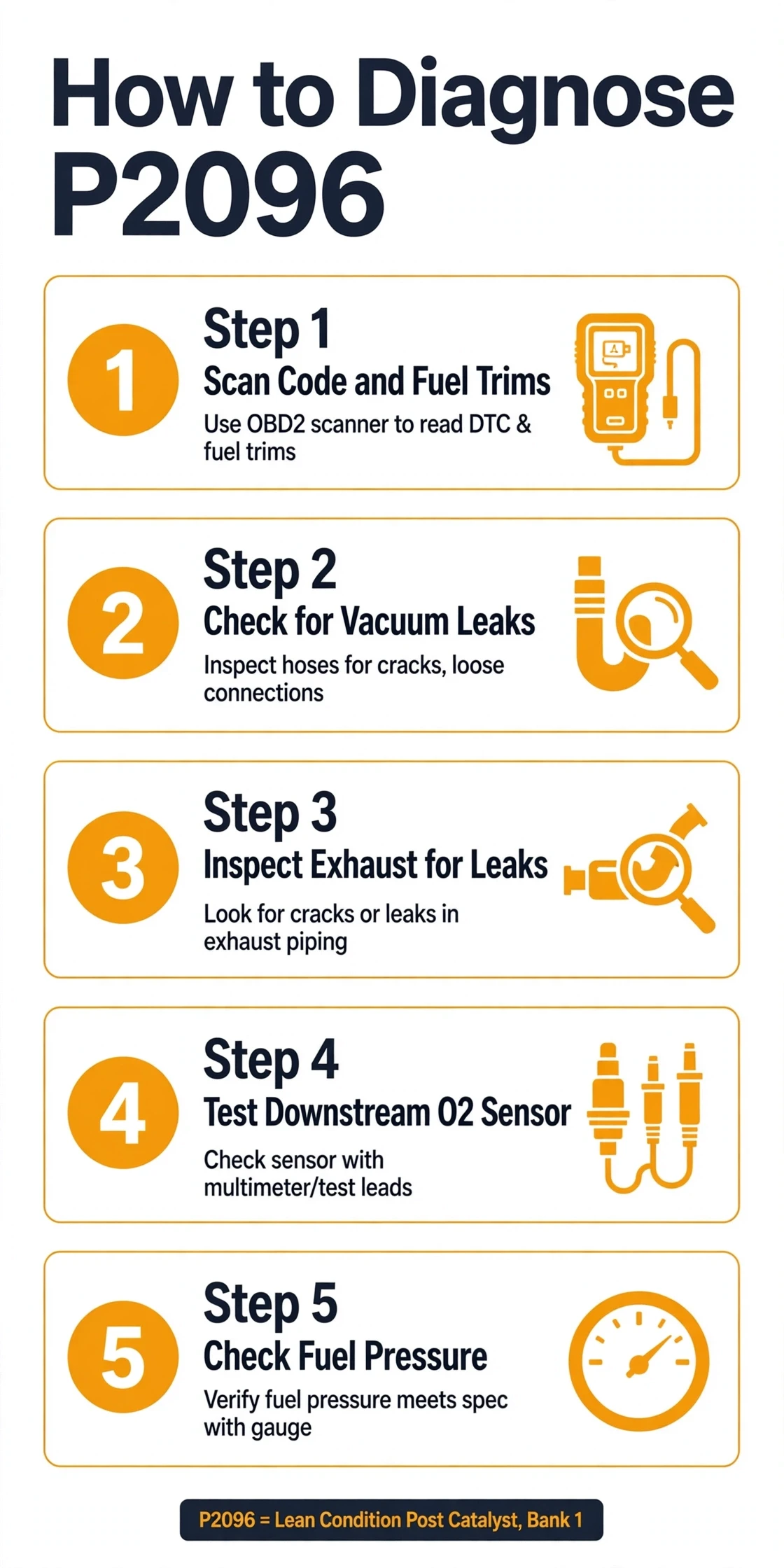
- Scan for other codes first. P0171 or P0174 (system too lean), misfire codes, or a companion P2098 change the whole diagnosis. Fix those first; the P2096 may clear on its own.
- Check fuel trim live data. With a scan tool that shows live data, look at short-term and long-term fuel trims. If trims sit near zero, the engine is fueling correctly and you are likely chasing a false lean reading from an exhaust leak. If trims read high positive, the lean condition is real.
- Hunt for exhaust leaks. Start the cold engine and listen along the manifold and pipes for ticking or puffing. Look for black soot marks at flanges and gaskets. A smoke machine finds the tiny leaks near the post-catalyst O2 sensor that ears miss.
- Test the downstream O2 sensor. Watch its live waveform; a healthy post-cat sensor holds fairly steady. If it is stuck lean or responds slowly, suspect the sensor or its wiring before condemning anything else.
- Inspect the intake side. Clean the MAF sensor with dedicated cleaner, check vacuum hoses for cracks, and verify the air filter box and intake tube are sealed.
- Verify fuel delivery. Test fuel pressure against the specification for your vehicle, and consider injector and filter condition if pressure reads low.
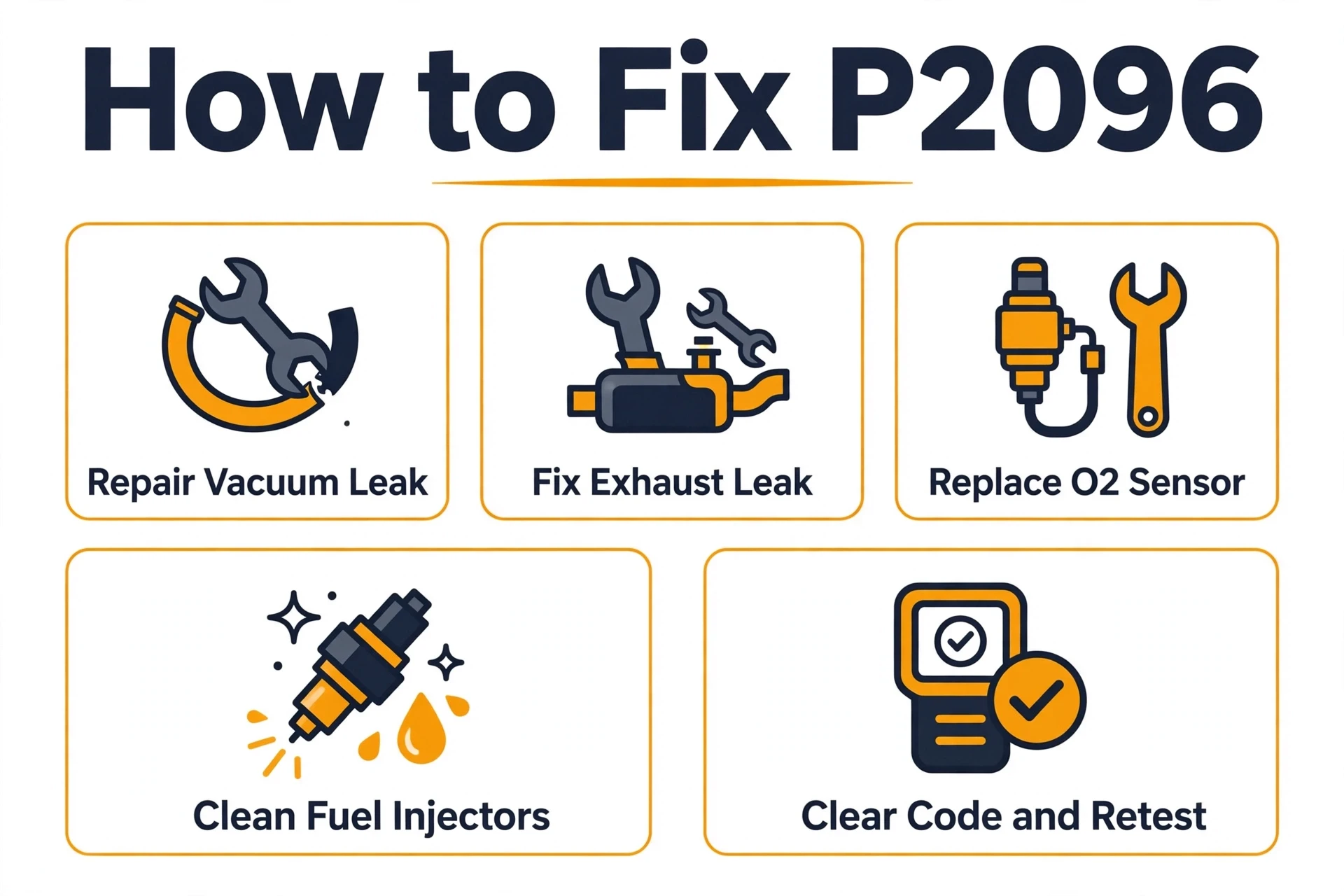
How to Fix the P2096 Code
The right fix depends on what your diagnosis found:
- Repair exhaust leaks: weld or replace the leaking section and replace failed gaskets. This is often the cheapest fix and resolves many P2096 cases.
- Replace a faulty downstream O2 sensor: only after testing proves it is bad. Do not throw a sensor at the code blindly; that is the most common wasted repair for this code.
- Fix vacuum and intake leaks: replace cracked hoses, reseat the intake tube, and repair manifold gasket leaks so no unmetered air gets in.
- Clean or replace the MAF sensor: a can of MAF cleaner fixes many misreading sensors for a few dollars; replace the sensor if cleaning does not help.
- Repair fuel delivery problems: replace a clogged fuel filter, service or replace dirty injectors, or replace a weak fuel pump or faulty pressure regulator.
- Replace the catalytic converter: only after every other cause is ruled out. A converter does not cause a lean mixture on its own; it is usually the victim, not the culprit.
- Update ECM/PCM software: rare, but check for technical service bulletins for your model. Some vehicles need a dealer reflash to stop false P2096 readings.
P2096 Repair Costs
Drivers always ask how much it costs to fix the p2096 engine code, and the answer depends entirely on the cause. Here are realistic ranges:
| Repair | Cost Range |
|---|---|
| Exhaust leak repair | $100 – $300 |
| Downstream O2 sensor replacement | $100 – $300 |
| MAF sensor cleaning / replacement | $15 – $400 |
| Fuel filter replacement | $50 – $150 |
| Fuel pump replacement | $400 – $1,000 |
| Catalytic converter replacement | $800 – $2,500+ |
This is why diagnosis matters. A $15 can of MAF cleaner and a $2,000 converter job can share the same code. Drivers looking for a cheap p2096 fix should always start with the exhaust leak check and fuel trim readings, not the parts catalog.
DIY vs Mechanic Verdict
You can do this at home: reading codes and fuel trim data with an OBD2 scanner, visual exhaust inspection for leaks and damage, listening for leaks on a cold start, cleaning the MAF sensor, and replacing a downstream O2 sensor with basic tools. If you find an obvious exhaust leak or a dead sensor, those are reasonable DIY repairs.
See a mechanic for: smoke testing for tiny leaks, fuel pressure testing and injector service, catalytic converter replacement, and wiring diagnosis when the cause stays hidden after the basic checks. A shop can confirm a lean condition versus a false reading in under an hour, which is cheaper than guessing with parts.
Bottom line: diagnose it yourself, fix the simple stuff yourself, but let a pro handle fuel system and converter work.
Can You Drive With a P2096 Code?
Generally yes, for a short time, and many drivers feel no difference at all. But P2096 deserves prompt attention: a genuinely lean mixture burns hotter, which can overheat and damage pistons, valves, and the catalytic converter, and you will fail any emissions test with the light on. If the engine misfires, stumbles badly, or the check engine light flashes, stop driving and get it checked. Otherwise, book the diagnosis soon even if the car feels fine.
P2096 on Popular Vehicles
P2096 shows up across all brands, but some patterns are worth knowing:
- Jeep (Wrangler, Grand Cherokee) and Chrysler: the p2096 jeep code is common enough that owner forums are full of it. Check the O2 sensor electrical connectors and the exhaust manifold for cracks before replacing any sensors.
- Subaru (Forester, Outback): the p2096 subaru code is a known issue; technicians test for tiny exhaust leaks near the post-catalyst O2 sensor with a smoke machine.
- Nissan (Versa, Altima, Sentra): for p2096 nissan, O2 sensor and exhaust leak checks come first, then fuel delivery.
- Mazda (CX-5, Mazda3): the p2096 mazda code sometimes traces to ECM software calibration, so check for service bulletins before buying parts.
- Chevy (Cruze) and Ford: the p2096 chevy and p2096 ford codes usually follow the standard pattern: exhaust leak or O2 sensor first, fuel delivery second.
The p2096 code means the same thing on every brand; only the most likely culprit changes. When the engine code p2096 appears with no other codes, the exhaust leak check is the best first move on any vehicle.
P2096 vs P2098
P2096 is bank 1. P2098 is the mirror image for bank 2: “Post Catalyst Fuel Trim System Too Lean (Bank 2).” On a four-cylinder engine there is only bank 1, so you will only ever see P2096. On V6 and V8 engines, the two banks have separate exhaust paths and separate downstream sensors, so each side can set its own code. Diagnose them the same way. Do not confuse these with P2097 and P2099, which are the same post-catalyst fuel trim test failing rich instead of lean.
Related Codes
- P2098: Post Catalyst Fuel Trim System Too Lean (Bank 2)
- P2097: Post Catalyst Fuel Trim System Too Rich (Bank 1)
- P2099: Post Catalyst Fuel Trim System Too Rich (Bank 2)
- P0171 / P0174: System Too Lean (upstream fuel mixture faults that often appear with P2096)
- P0137: O2 Sensor Circuit Low Voltage (Bank 1, Sensor 2), a downstream sensor circuit fault
Video Walkthrough
Watch the video above for a visual walkthrough of P2096 causes and diagnosis before you read on.
Frequently Asked Questions
What is the most common cause of a P2096 code?
An exhaust leak upstream of the downstream O2 sensor is the most frequent and cheapest cause to check first. The leak pulls outside air into the exhaust pipe and tricks the sensor into reporting a false lean condition. Fuel delivery problems and a faulty downstream O2 sensor are the next most common causes.
How do I fix code P2096?
Diagnose first: check for companion codes, read fuel trim live data, hunt for exhaust leaks, and test the downstream O2 sensor. Then fix what you find: seal the leaks, replace a proven-bad sensor, clean the MAF sensor, or repair fuel delivery. Do not replace the O2 sensor blindly.
Can I still drive with a P2096 code?
Usually yes, short term, if the car runs normally. Get it diagnosed soon, because a real lean condition burns hotter and can damage pistons, valves, and the catalytic converter, and you will fail an emissions test with the light on.
How much does it cost to fix P2096?
From about $100 to $300 for an exhaust leak repair or a downstream O2 sensor, $15 to $400 for MAF sensor cleaning or replacement, $400 to $1,000 for fuel pump work, and up to $800 to $2,500+ for a catalytic converter if it has truly failed.
Will P2096 clear itself?
Sometimes, if the fault was intermittent, like a one-time lean spike. Usually the code returns until the real problem is fixed. Clearing the code without a repair just resets the countdown.
Can a bad O2 sensor cause P2096?
Yes. An aging, contaminated, or slow downstream O2 sensor can report a false lean mixture even when fueling is correct. Always test the sensor’s live data before replacing it.
Can a dirty air filter or MAF sensor cause P2096?
A dirty MAF sensor can, because it misreads incoming air and the computer fuels the engine wrong. A dirty air filter alone rarely sets P2096, but a cracked intake tube or loose airbox letting in unmetered air can.
Conclusion
The P2096 code looks technical, but it is really your car reporting too much oxygen after the converter on bank 1. Check for exhaust leaks first, read your fuel trims, test the downstream O2 sensor, and fix what you find. Do that, and you will either solve it cheaply or know for certain a bigger repair is needed. Either way, you stop guessing and start fixing.
About the author: Written by the OBD2 Code Hub editorial team. Our diagnostic guides are built from real OBD-II data, manufacturer service procedures, and hands-on troubleshooting experience, then reviewed for technical accuracy before publishing. We drive the same cars you do.