
P0299 Trouble Code: Meaning, Causes, Symptoms & Fixes
In This Guide
One-line meaning: Your car’s computer has detected that the turbocharger or supercharger is producing less boost pressure than expected.
What the P0299 Code Means
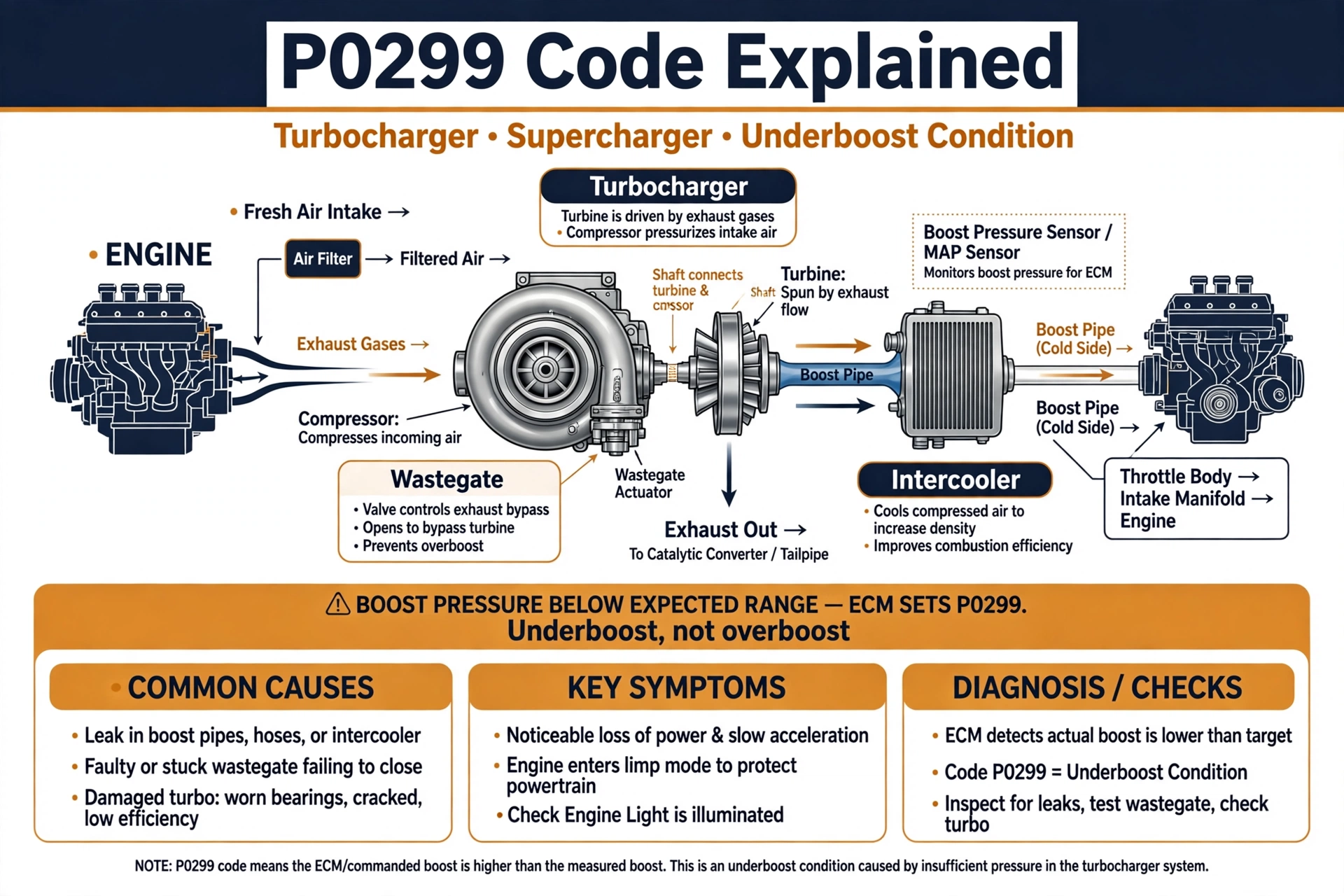
The P0299 code is the check engine light code drivers see when their turbocharged or supercharged engine stops pulling the way it should. Its full definition is “Turbocharger/Supercharger ‘A’ Underboost Condition,” which means the actual boost pressure reaching the engine is below the expected range the computer commanded.
Here is how your car figures this out. The engine computer (ECM or PCM) knows how much boost the turbo should be making at any given RPM and throttle position. A boost pressure sensor (often combined with the MAP sensor) reports the real pressure in the intake. When the measured pressure stays lower than the commanded target for a set amount of time, the computer stores P0299 and turns on the check engine light.
The letter “A” refers to the first (or only) bank of forced induction. On an inline engine there is only bank A; on a V engine it usually points to bank 1. P0299 (p0299 obd ii, engine code p0299) is a generic powertrain code, so it means the same thing on every make: the turbo or supercharger is underboosting.
The critical distinction: P0299 is UNDERBOOST (too little boost). It is not overboost. Overboost (too much boost) is a different code entirely: P0234. Mixing these two up is one of the most common mistakes drivers make when researching this code.
Symptoms of the P0299 Code
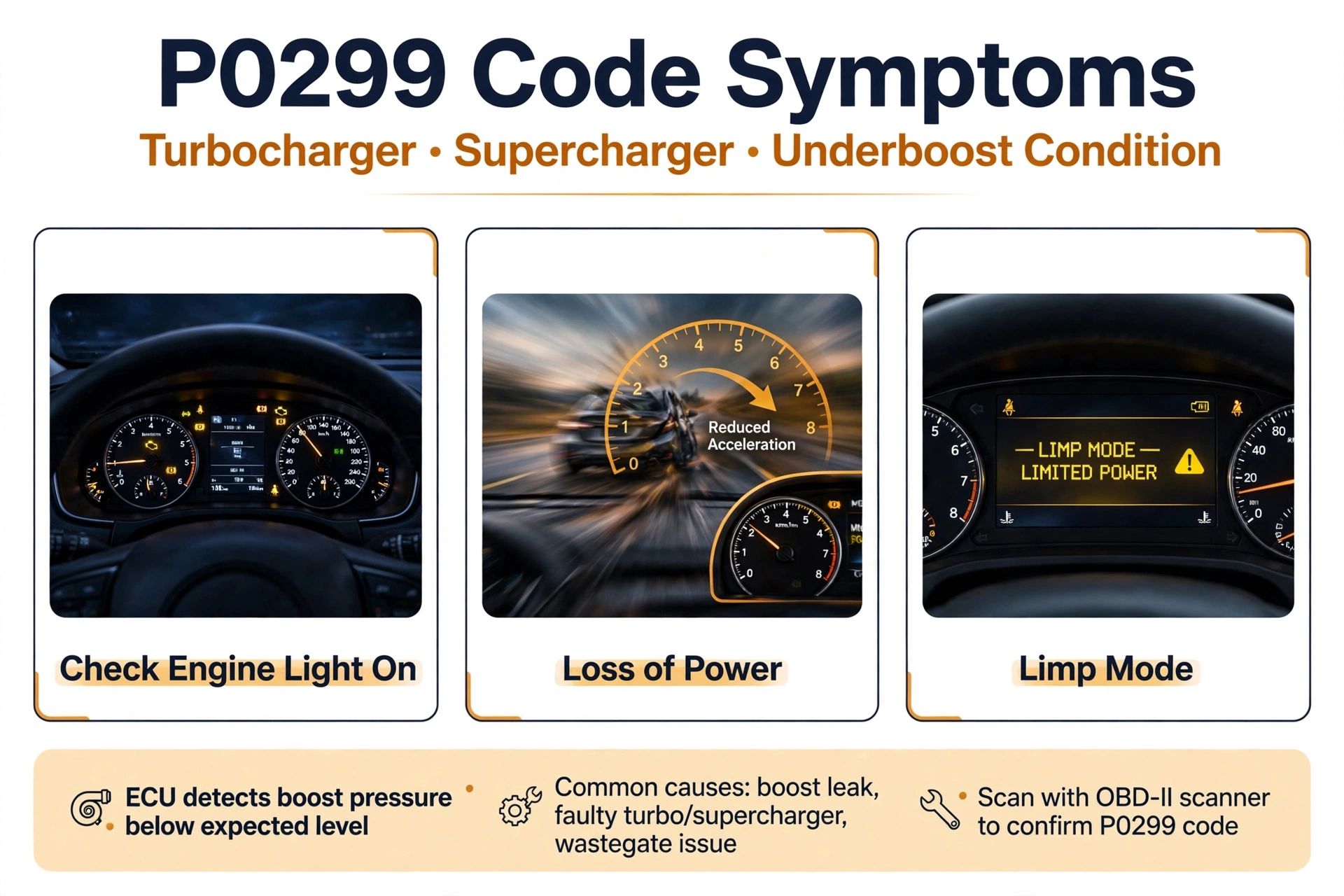
Because the engine is getting less air than it expects, the most obvious symptom is a noticeable loss of power. Many drivers also notice new noises from the engine bay, since escaping boost pressure often whistles or hisses under acceleration.
- Check engine light on, sometimes with reduced engine power or limp mode
- Noticeable loss of power and slow acceleration, especially uphill or when passing
- Sluggish turbo response: the turbo feels like it never “kicks in”
- Hissing or whistling noises from the engine bay under acceleration (a classic sign of a boost leak)
- Rattling or fluttering sounds from the turbo area
- Reduced fuel economy, since the engine works harder to do the same job
- Black smoke from the exhaust on diesel engines
What is code P0299? What is the engine code p0299 trying to tell you? In short: your turbo is spinning, but the boost it makes is not reaching the engine, or the turbo cannot make enough boost in the first place.
Common Causes of P0299
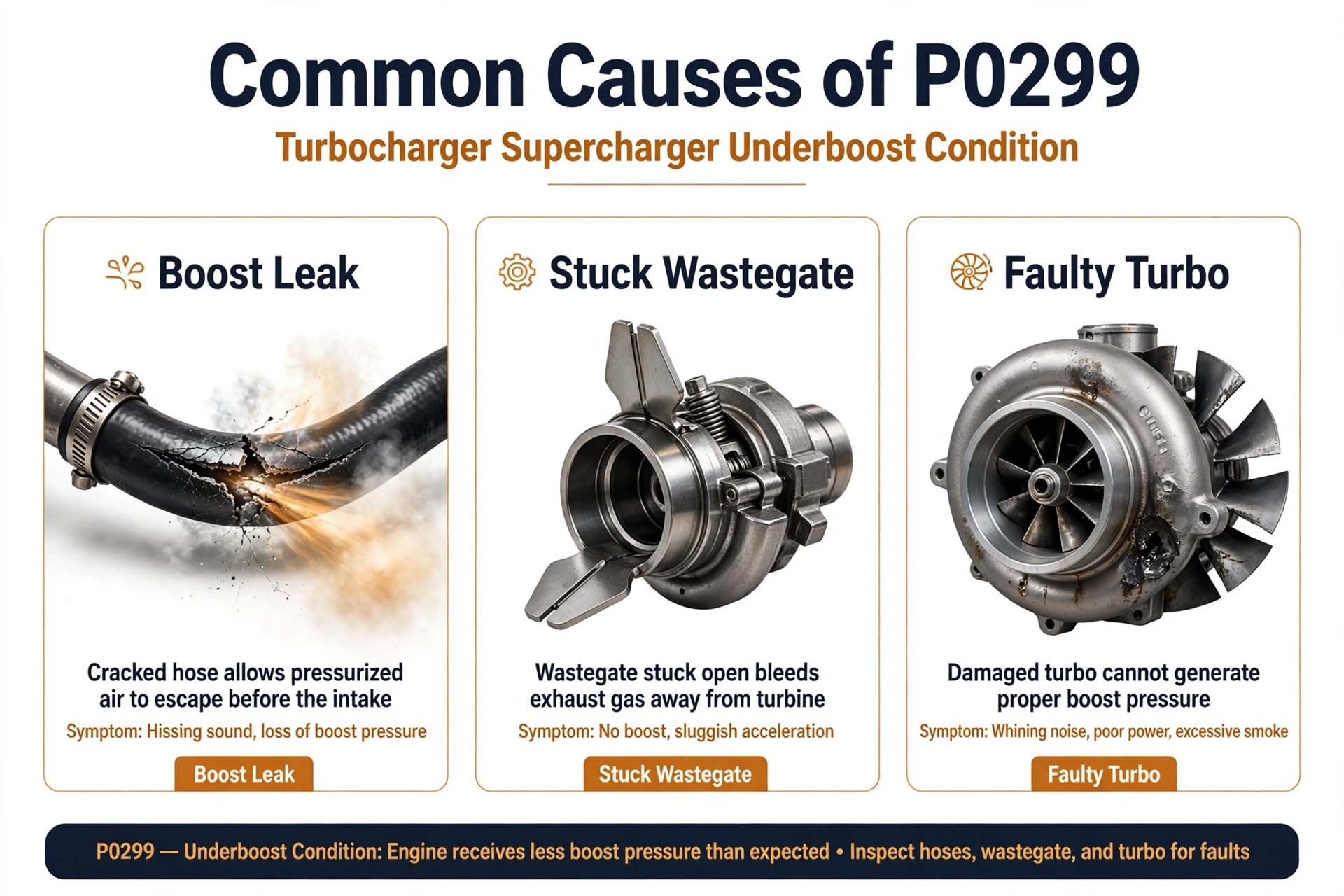
The most important thing to know: most of the time, P0299 is NOT a dead turbo. In the majority of real-world cases the turbo itself is fine, but a leak or a control problem is keeping boost from reaching the engine. That is why technicians always check for leaks before condemning the turbo.
- Boost leaks: the single most common cause. Cracked or split charge hoses, a leaking intercooler, loose or broken clamps, or a damaged charge pipe let pressurized air escape before it reaches the intake manifold.
- Wastegate stuck open: the wastegate bleeds exhaust gas away from the turbine. If it sticks open (or its linkage seizes), the turbo cannot build pressure.
- Faulty wastegate actuator: a weak diaphragm, corroded rod, or vacuum line leak keeps the wastegate from closing fully.
- Boost control solenoid problems: a failing boost control solenoid (the N75 valve on many VW and Audi models) cannot regulate the wastegate correctly.
- Torn diverter valve: on VW and Audi 2.0T engines, a torn diverter valve diaphragm vents boost back instead of holding it.
- Faulty boost pressure sensor: a bad sensor (or its wiring) reports the wrong pressure, so the computer thinks boost is low.
- Failing turbocharger: worn bearings, excess shaft play, or damaged compressor blades on a high-mileage turbo reduce actual boost output.
- Intake restrictions: a severely clogged air filter or a blocked intake path starves the turbo of air.
- Blocked exhaust: a clogged catalytic converter or restricted exhaust raises backpressure and slows the turbine.
- PCV system failure: on the Chevy Cruze 1.4T, a failed PCV check valve in the valve cover is a well-known P0299 trigger.
- Low engine oil pressure: the turbo’s bearings are oil-fed; low oil pressure starves them and can damage the turbo.
- Ford-specific issues: on Ford EcoBoost and diesel models, sticking VGT (variable geometry turbo) vanes, a faulty turbo actuator, or EGR problems can set P0299.
How to Diagnose P0299 (Do This Before Buying Parts)
Mechanics see the P0299 code misdiagnosed constantly. The code points at low boost, but the fix is rarely a new turbo. Follow these steps in order:
- Scan for other codes first. If you also have boost sensor codes (P0236/P0237), MAF codes (P0101), or misfire codes, fix those first. They can cause or accompany P0299.
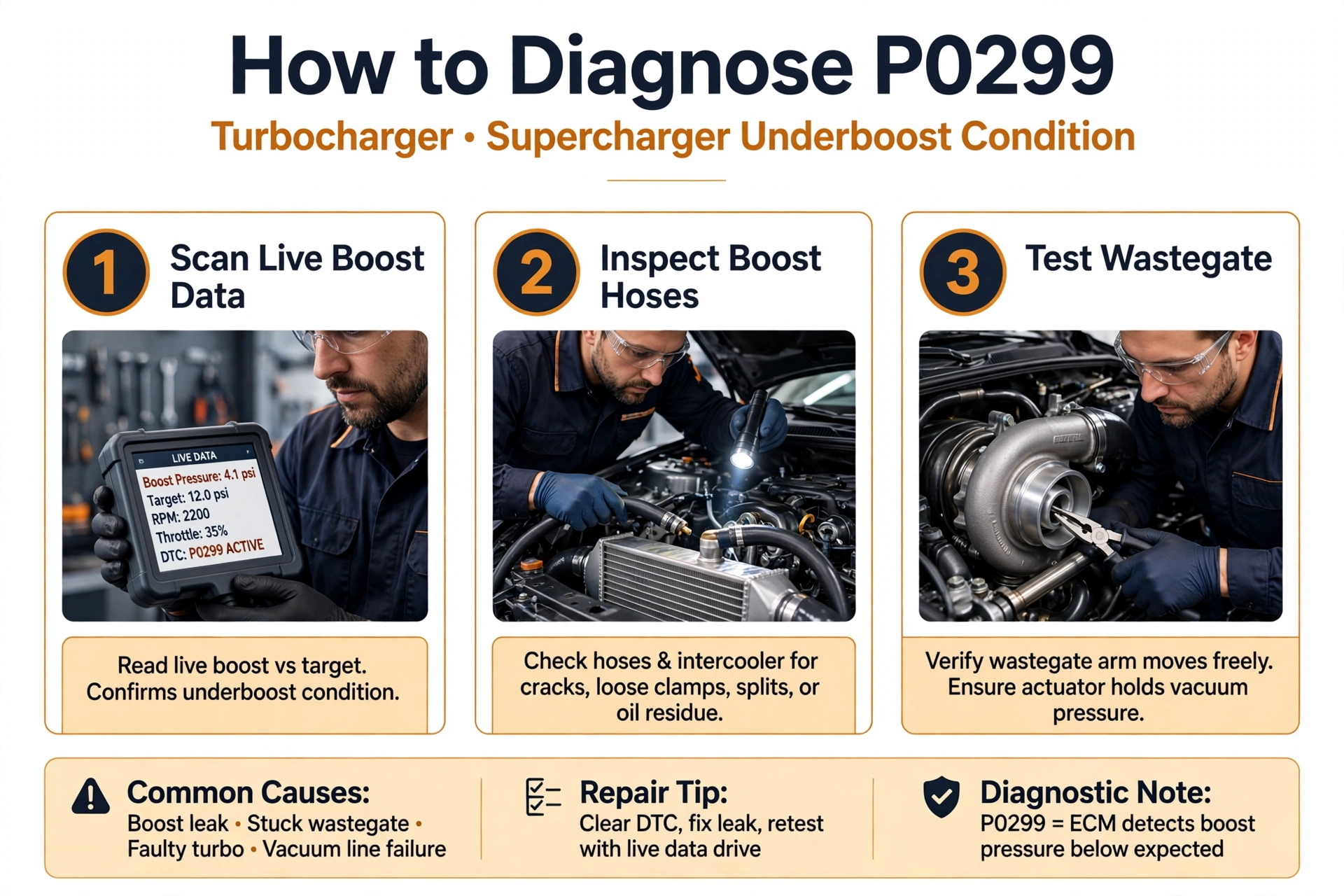
- Visually inspect the entire intake tract. With the engine off, check every boost hose, charge pipe, intercooler end tank, and clamp from the turbo outlet to the throttle body. Look for cracks, splits, oil residue (a sign of a leak), and loose clamps.
- Run a boost leak (smoke or pressure) test. Pressurizing the intake system is the fastest way to find hidden leaks you cannot see. This one test solves most P0299 cases.
- Check live boost data. With any OBD2 scanner that shows live data, compare actual boost pressure against the commanded target under load. A large, steady gap confirms a real underboost condition.
- Inspect the wastegate and actuator. With the engine cool, check that the wastegate arm moves freely and the actuator holds vacuum. A stuck-open wastegate bleeds away the exhaust energy the turbo needs.
- Test the boost control solenoid and diverter valve. Apply vacuum by hand (or with a scan tool’s bidirectional controls) and confirm they hold and release correctly.
- Check the air filter and intake for restrictions, and look for a blocked catalytic converter if exhaust flow seems restricted.
- Inspect the turbo itself last. Check for excessive shaft play, damaged compressor blades, and oil in the intake tract. Only condemn the turbo after the checks above pass.
- Check for technical service bulletins (TSBs). Some models have known P0299 fixes, such as software updates or revised PCV components.
How to Fix the P0299 Code
The right fix depends on what your diagnosis found:
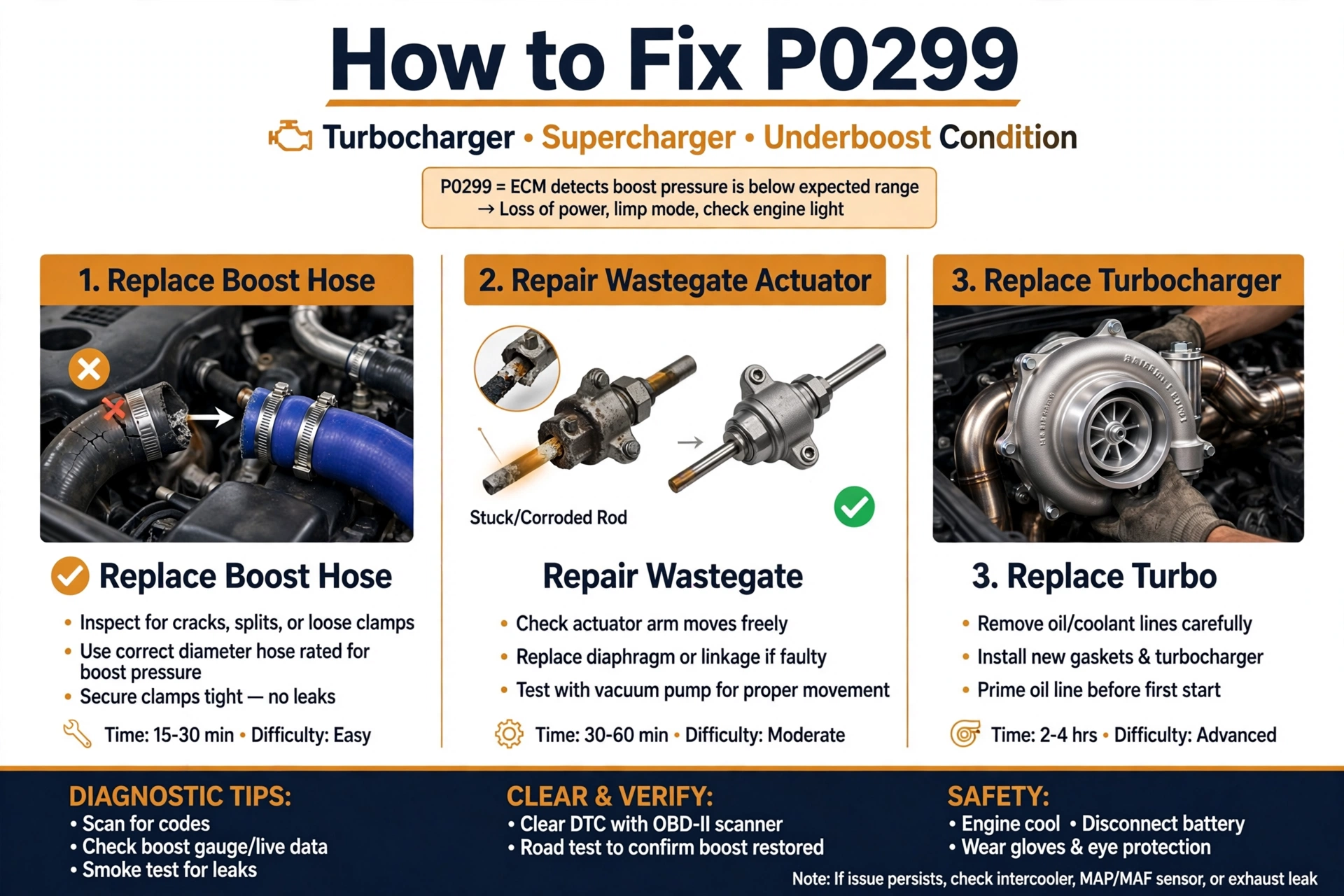
- Repair boost leaks: replace cracked hoses, tighten or replace clamps, and repair or replace a leaking intercooler. This is the most common fix and often the cheapest.
- Free or replace the wastegate: free up a seized linkage, or replace a faulty wastegate actuator that will not hold vacuum.
- Replace the boost control solenoid or diverter valve: a new N75 valve (VW/Audi) or diverter valve restores proper boost control.
- Replace a faulty boost pressure sensor: if the sensor reads wrong, a new sensor (and repaired wiring, if damaged) fixes the false reading.
- Replace a clogged air filter: a simple maintenance item that can restore intake flow.
- Fix the PCV system: on affected models like the Chevy Cruze 1.4T, replace the failed PCV check valve or valve cover.
- Clear a blocked exhaust: replace a clogged catalytic converter or repair exhaust restrictions.
- Replace the turbocharger: only after confirming it has actually failed. Many ask how to fix the p0299 code without replacing the turbo, and the answer is that most cases never need a new turbo at all.
P0299 Repair Costs
Drivers always ask how much it costs to fix P0299, and the answer depends entirely on the cause. Here are typical ranges:
| Repair | Cost Range |
|---|---|
| Boost leak repair (hoses, clamps) | $100 – $350 |
| Intercooler replacement | $300 – $800 |
| Wastegate actuator replacement | $200 – $600 |
| Boost control solenoid / diverter valve | $80 – $250 |
| Boost pressure sensor replacement | $100 – $250 |
| Air filter replacement | $20 – $60 |
| Turbocharger replacement | $1,200 – $2,800 |
This is why diagnosis matters. A $150 hose job and a $2,500 turbo job share the same code.
DIY vs Mechanic Verdict
You can do this at home: visual inspection of hoses, clamps, and the intercooler for leaks and damage; reading codes and live boost data with an OBD2 scanner; replacing an air filter, clamps, or a boost hose; testing the wastegate arm for free movement.
See a mechanic for: smoke or pressure testing the intake system (needs special equipment); turbocharger replacement (requires oil line priming and precise installation); diagnosing internal wastegate or VGT vane faults; exhaust and catalytic converter work.
Bottom line: diagnose it yourself, fix the simple leaks yourself, but let a pro handle the turbo swap.
Can You Drive With a P0299 Code?
For a short time, usually yes. The car will run, just with noticeably less power. But driving long term with P0299 is not advisable: the engine works harder, fuel economy drops, and a small boost leak forces the turbo to overspin to compensate, which can turn a cheap hose repair into a failed turbo. On some vehicles the computer will also limit power (limp mode) to protect the engine. Get it diagnosed soon, even if the car still feels drivable.
P0299 on Popular Vehicles
P0299 shows up across all brands, but some patterns are worth knowing:
- Ford (F-150 EcoBoost, Escape, Explorer): The p0299 ford code (ford p0299, p0299 code ford) often traces to sticking VGT vanes, a faulty variable geometry turbo actuator, EGR issues, or low oil pressure starving the turbo.
- Chevy Cruze (1.4T): The p0299 chevy cruze code (chevy cruze p0299, p0299 code chevy) is famously caused by the PCV check valve failing inside the valve cover. Check this before touching the turbo.
- Chevy (Malibu, Equinox): For p0299 chevy malibu and other Chevy turbo models, boost hose leaks and wastegate actuator faults are the usual suspects.
- VW / Audi (Golf, Jetta, Passat, A4 2.0T): The diverter valve’s torn diaphragm and the N75 boost control solenoid are the classic causes; also inspect the wastegate bypass regulator valve.
- Nissan (Rogue, Altima): For p0299 nissan (nissan p0299, p0299 code nissan), check the charge pipes and intercooler for leaks first, then the boost pressure sensor.
- Ram / Dodge EcoDiesel: Turbo actuator and boost leak issues dominate; soot buildup on VGT vanes is common at higher mileage.
EOBD P0299 and OBD P0299 are the same code under different naming (European vs generic OBD-II). DTC P0299 is simply the diagnostic trouble code format of the same fault.
P0299 vs P0234, P0236, P0237, P2262
These boost codes are easy to confuse, so here is how they differ:
- P0299 vs P0234: P0299 is underboost (too little boost). P0234 is the opposite: overboost (too much boost). They have different causes and different fixes, so do not mix them up.
- P0299 vs P0236: P0236 means the boost pressure sensor’s signal is out of range or performing poorly. P0299 means the actual boost is low. A bad sensor (P0236) can cause a false P0299.
- P0299 vs P0237: P0237 means the boost pressure sensor circuit is reading low voltage. It is an electrical fault, while P0299 is a performance fault (boost really is low, or the computer thinks it is).
- P0299 vs P2262: P2262 means boost pressure was not detected at all (a mechanical no-boost condition). P0299 means boost is present but below the expected range. P2262 is the more severe of the two.
Related Codes
- P0234: Turbocharger/Supercharger Overboost Condition
- P0236: Turbocharger/Supercharger Boost Sensor “A” Circuit Range/Performance
- P0237: Turbocharger/Supercharger Boost Sensor “A” Circuit Low
- P2262: Turbocharger/Supercharger Boost Pressure Not Detected – Mechanical
- P0101: Mass Air Flow (MAF) Sensor Circuit Range/Performance (a common companion)
Video Walkthrough
Watch the video above for a visual walkthrough of P0299 causes and diagnosis before you read on.
Frequently Asked Questions
What does the P0299 code mean?
P0299 means “Turbocharger/Supercharger ‘A’ Underboost Condition.” Your car’s computer has detected that the actual boost pressure is below the expected range, so the turbo or supercharger is underboosting. It is not an overboost code; overboost is P0234.
Can I drive with a P0299 code?
For short trips, usually yes, but expect reduced power and worse fuel economy. Do not ignore it long term: a boost leak forces the turbo to overspin, which can destroy it, and some cars will enter limp mode. Get it diagnosed soon.
What is the most common cause of P0299?
A boost leak. Cracked or split charge hoses, a leaking intercooler, or loose clamps let pressurized air escape before it reaches the engine. In most real-world cases the turbo itself is fine, so always check for leaks before replacing parts.
How do I fix the P0299 code?
Start with a visual inspection of all boost hoses, clamps, and the intercooler, then run a boost leak (smoke or pressure) test. Fix any leaks, then check the wastegate, actuator, boost control solenoid, and boost pressure sensor. Replace the turbo only if it is confirmed faulty.
How much does it cost to fix P0299?
It depends on the cause. A boost leak repair typically runs $100 to $350, a wastegate actuator $200 to $600, and a full turbocharger replacement $1,200 to $2,800. Most P0299 cases are fixed on the cheaper end.
Will P0299 clear itself?
It can clear temporarily if the underboost condition stops happening, but it will return as soon as the computer sees low boost again. The code will not stay away until the underlying leak or fault is fixed.
Is P0299 the same as P0234?
No. P0299 is underboost (too little boost pressure), while P0234 is overboost (too much boost pressure). They are opposites with different causes, so make sure you are diagnosing the right one.
Conclusion
The P0299 code looks scary, but it is really your car asking for a proper boost leak check, not an automatic turbo replacement. In most cases the turbo itself is healthy; a cracked hose, a loose clamp, or a stuck wastegate is bleeding away the boost. Work through the diagnosis steps in order, fix what you find, and you will usually have full power back for far less than the cost of a new turbo.
About the author: Written by the OBD2 Code Hub editorial team. Our diagnostic guides are built from real OBD-II data, manufacturer service information, and hands-on repair experience to help you fix the code right the first time.