
P2015 Trouble Code: Meaning, Causes, Symptoms & Fixes
In This Guide
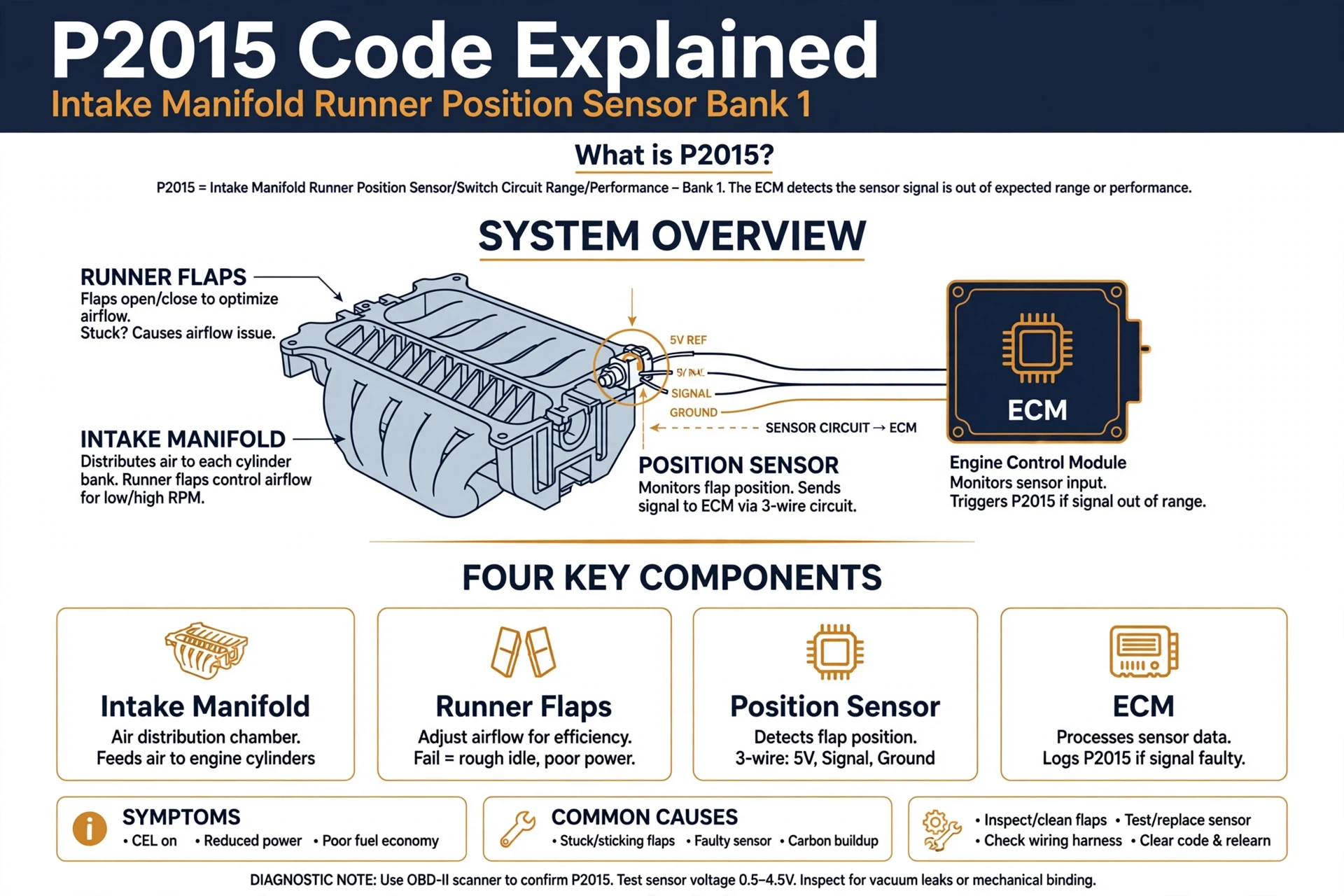
One-line meaning: P2015: Intake Manifold Runner Position Sensor/Switch Circuit Range/Performance (Bank 1).
What the P2015 Code Means
The P2015 code is a diagnostic trouble code many Volkswagen and Audi owners run into. Its full definition is “Intake Manifold Runner Position Sensor/Switch Circuit Range/Performance (Bank 1)” (p2015 intake manifold runner position sensor/switch circuit range/performance bank 1). In plain English, your car’s engine computer (ECM/PCM) has decided that the sensor tracking the intake manifold runner flaps is reporting a position that does not make sense.
Here is what is happening inside your engine. The intake manifold has a set of flaps, called runner flaps or swirl flaps, that open and close to shape the airflow into the cylinders. At low RPM they take a longer path for better torque; at high RPM they open for maximum airflow. A small motor drives the flaps, and a position sensor (the intake manifold runner position sensor) tells the computer exactly where the flaps are. The computer commands a target position, then compares it with what the sensor reports.
The powertrain control module watches this sensor closely. Over time, a small plastic stop or linkage lever on the manifold can wear down, letting the actuator arm travel past its intended end point, a condition owners call “over-centering.” When that happens, the sensor reports a position the computer never commanded, or a signal outside the expected voltage range. The computer flags the mismatch as implausible and stores the p2015 code.
P2015 is a generic powertrain code, so it has the same meaning on every make and model. Bank 1 is the side of the engine that holds cylinder number one; on an inline engine there is only one bank, so this code always points at that single manifold. Its close relatives are P2016 (circuit low) and P2017 (circuit high), which point at electrical faults rather than a range or performance problem.
Symptoms of the P2015 Code
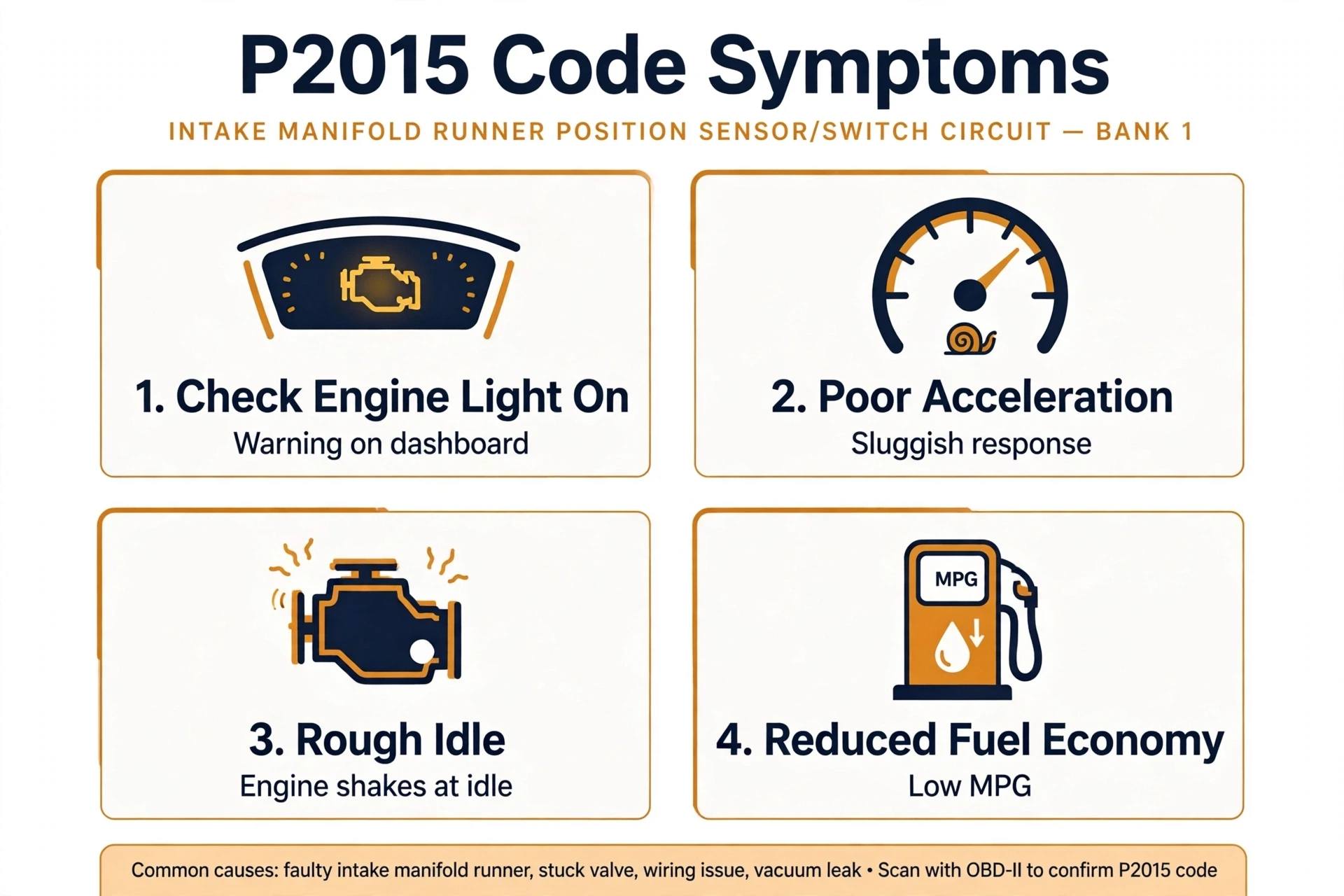
In many cases the check engine light is the only symptom you will notice. The car may drive almost normally, which is why the p2015 code catches so many drivers by surprise. Depending on how far the runner system has drifted, you might also notice:
- Check engine light on, sometimes with a flashing glow plug light on TDIs
- Rough or unstable idle, the engine shakes more than usual at a stop
- Hesitation or sluggish acceleration, the car feels lazy when you press the gas
- RPMs hanging or failing to drop quickly after you let off the gas pedal
- Reduced fuel economy, you are filling up more often than usual
- Failed emissions test, the code alone is enough to fail in many states
What is code P2015 trying to tell you? In short: the computer no longer trusts what the runner flap sensor is saying about airflow into the engine. Do not ignore it just because the car still drives.
Common Causes of P2015
The most common cause of a P2015 code is a worn plastic stop or linkage lever on the intake manifold runner actuator. This is the famous over-centering fault: the stop wears down, the actuator arm travels too far, and the position sensor reads a value the computer considers impossible. It is so common on VW and Audi 2.0T engines that entire repair kits exist just for it. But it is not the only cause. Here are the causes, roughly in order of likelihood:
- Worn actuator stop or lever: the plastic end stop on the manifold wears down or breaks, letting the flap linkage over-center past its intended position.
- Faulty runner position sensor: the sensor itself (VW part G336 on many models) fails, sticks, or sends an erratic signal.
- Faulty runner control motor: the actuator motor that drives the flaps weakens or seizes, so the flaps never reach the commanded position.
- Carbon buildup: soot and carbon inside the intake manifold, especially on direct-injection engines, gum up the flaps and restrict their movement.
- Clogged or restricted vacuum hoses: on vacuum-operated systems, kinked, cracked, or clogged hoses keep the actuator from moving the flaps fully. This is a common find after a manifold has been removed and reinstalled.
- Wiring and connector problems: loose, corroded, or chafed wires in the sensor harness, or a poor connector at the sensor, corrupt the signal.
- Damaged intake manifold: cracked linkage arms or broken internal flaps inside the manifold itself.
- ECM software: rare, but some manufacturers have released software calibrations that change how runner position is monitored.

How to Diagnose P2015 (Do This Before Buying Parts)
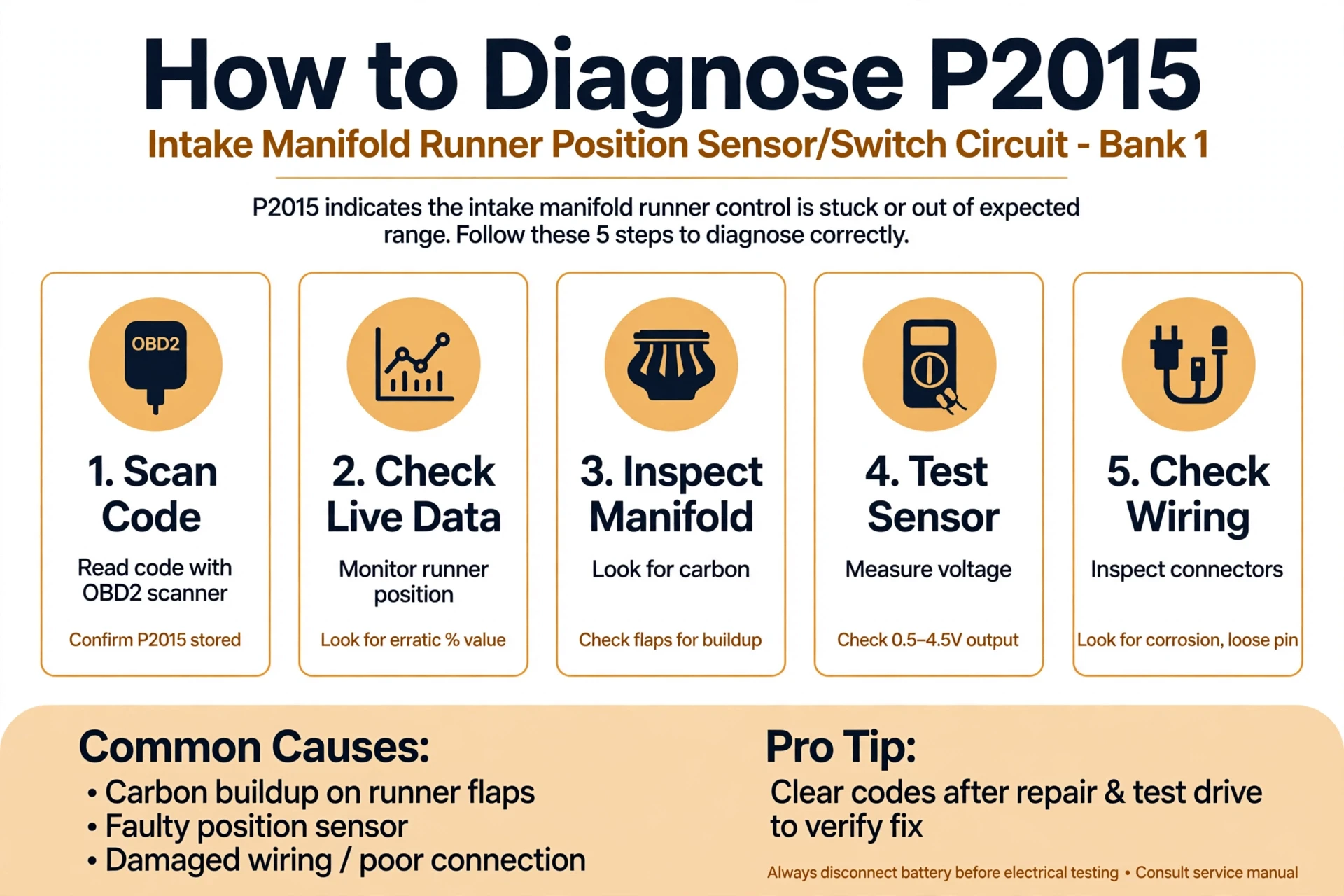
The p2015 code is misdiagnosed constantly, usually as a bad manifold that did not need replacing. Follow this order before you buy anything:
- Scan for all codes first. Note any companions like P2004, P2005, P2006, or P2007 (runner stuck open or closed). Companion codes narrow down whether the flaps are mechanically stuck or the sensor signal is wrong.
- Watch live data. With a scan tool that shows live data (VCDS/VAG-COM on VW and Audi), compare the specified runner position against the actual position. A large or wandering gap between the two points at the worn stop or a binding flap.
- Inspect the actuator linkage. With the engine off, look at the runner actuator arm and its plastic stop on the side of the manifold. A worn, rounded, or broken stop is the classic p2015 vw failure and is visible to the naked eye.
- Check flap movement. Move the linkage by hand (engine off and cool) and feel for binding, sticking, or excessive free play that suggests carbon buildup or a broken internal flap.
- Inspect vacuum hoses. Trace every vacuum line to the manifold actuator. Look for kinks, cracks, clogs, or hoses left disconnected after previous work.
- Test the sensor and wiring. Check the sensor connector for corrosion and pin fit. Back-probe the sensor and watch its voltage sweep smoothly (typically about 0.5 to 4.5 volts) as the flaps move. A dead spot or jump means a bad sensor.
- Clear and retest. Clear the code, run the engine through a drive cycle with varied RPM, and see if P2015 returns before condemning any part.
How to Fix the P2015 Code
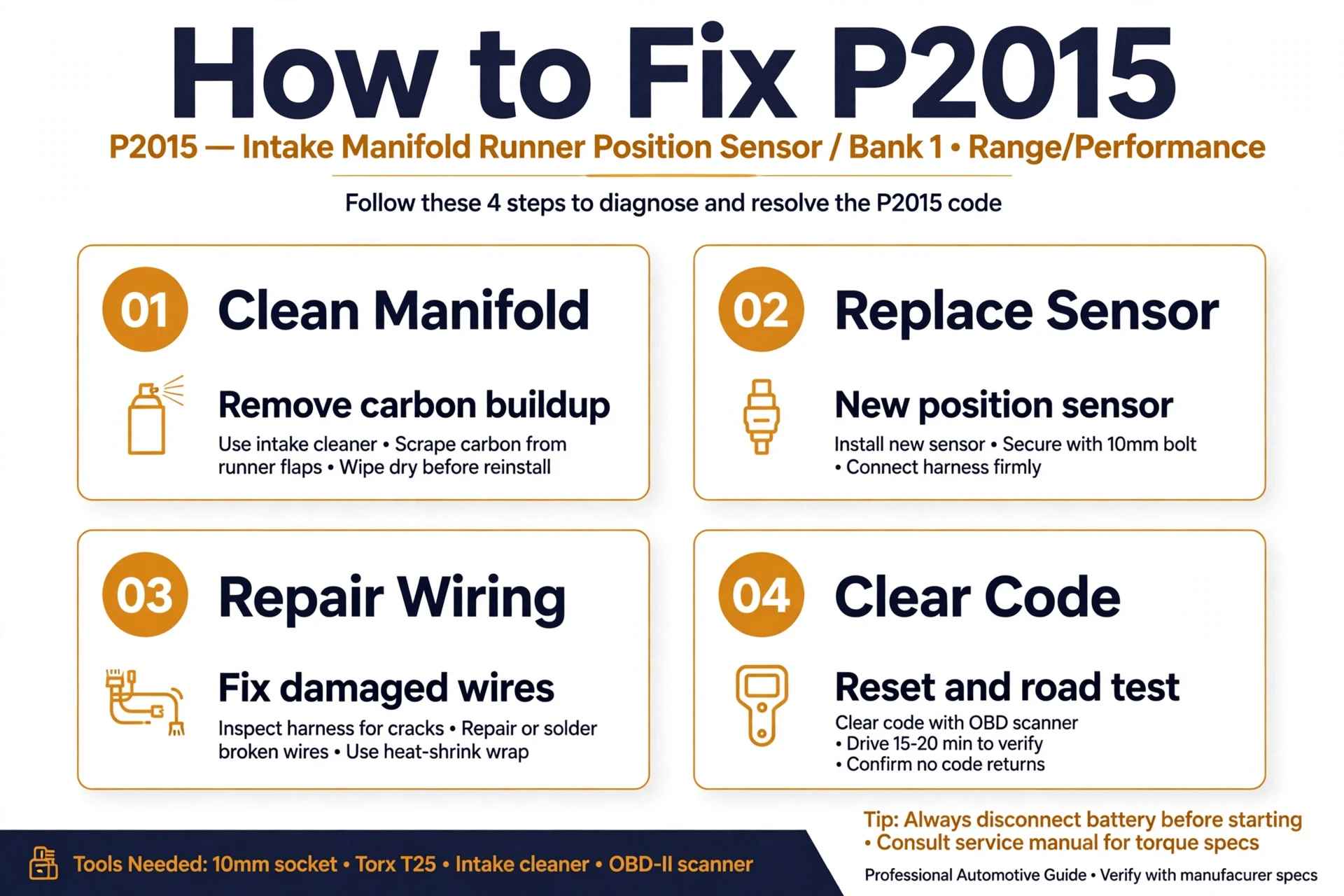
The right fix depends on what your diagnosis found:
- Install a repair bracket: for the worn-stop failure, an aftermarket billet bracket restores the correct end stop without replacing the manifold. Many ask how to fix p2015 code cheaply; this $60 to $100 bracket is the answer, and it installs in about 15 to 20 minutes.
- Clean carbon buildup: remove the manifold or use intake cleaner to free flaps that are gummed up with carbon, a common issue on direct-injection engines.
- Repair vacuum hoses: replace kinked, cracked, or clogged hoses and make sure every line is routed and connected correctly.
- Repair wiring and connectors: clean corroded pins, tighten loose connectors, and repair chafed sections of the sensor harness.
- Replace the position sensor: if the sensor voltage sweep is erratic or dead, replace the runner position sensor itself.
- Replace the intake manifold: if the internal flaps are broken, the linkage is cracked, or the manifold body is damaged, the whole assembly has to go. Use an OEM or OEM-equivalent unit.
- Software update: rare, but check with the dealer whether an ECM calibration update applies to your vehicle.
- Clear and relearn: after the repair, clear the code and perform the runner adaptation or relearn procedure so the computer re-learns the flap end positions.
P2015 Repair Costs
Drivers always ask how much it costs to fix P2015, and the range is wide because a $70 bracket and a full manifold job share the same code. Here are realistic ranges:
| Repair | Cost Range |
|---|---|
| Intake runner repair bracket (DIY) | $60 – $150 |
| Carbon buildup cleaning | $150 – $400 |
| Vacuum hose repair/replacement | $50 – $200 |
| Runner position sensor replacement | $150 – $400 |
| Intake manifold replacement (with labor) | $600 – $1,500+ |
This is why diagnosis matters. A p2015 code cost question has no single answer: the worn-stop fix costs less than a tank of gas in parts, while a dealer manifold replacement can top $1,500. Always inspect the actuator stop before authorizing the big job.
DIY vs Mechanic Verdict
You can do this at home: reading the code with an OBD2 scanner, visually inspecting the actuator linkage and stop lever, installing the repair bracket (a famous 15-minute DIY), replacing vacuum hoses, cleaning electrical connectors, and clearing the code with a basic scan tool.
See a mechanic for: intake manifold replacement (involves fuel and intake disassembly), advanced live-data diagnosis with factory-level tools, runner adaptation procedures on some models, and any case where the flaps are broken inside the manifold. A shop can confirm the diagnosis in under an hour, which beats guessing on a $1,000 manifold.
Bottom line: the p2015 code has one of the best DIY fixes in the OBD-II world. Check the stop lever first; if it is worn, the bracket kit fixes it cheaply at home. Save the shop visit for manifold replacement.
Can You Drive With a P2015 Code?
Generally yes, for a short time. The car will usually run with only minor drivability quirks. But driving long term with P2015 is not advisable: fuel economy and performance suffer, you will fail an emissions or smog test, and in rare cases broken flap pieces inside the manifold can damage the engine. Get it diagnosed soon, even if the car feels mostly fine.
P2015 on Popular Vehicles
P2015 is overwhelmingly a Volkswagen and Audi code, but it can appear on other makes too:
- VW Golf/GTI and Jetta (2.0T TSI, 2.0 TDI): the p2015 vw classic. The TSI engines are famous for the worn actuator stop; the TDI engines see it on the swirl flap motor. VW extended coverage on some 2.0T TSI manifolds (dealers replaced them free up to about 120K miles), so check with a dealer using your VIN before paying out of pocket.
- VW Passat and Tiguan: the same 2.0T/2.0 TDI runner systems with the same worn-stop failure. The p2015 tiguan search is common because the code often appears after manifold work where a vacuum hose got kinked.
- Audi A3, A4, and TT (2.0T TFSI): the audi p2015 fault mirrors the VW TSI problem exactly, since they share the engine family.
- Jeep Patriot and others: the p2015 code jeep patriot query shows this code is not exclusive to VW. On other makes, suspect the runner control motor, the sensor, or carbon buildup first.
DTC P2015 and OBD-II P2015 refer to the identical fault. For “p2015 intake manifold runner position sensor location” searches, the short answer is: on the side of the intake manifold, where the runner actuator linkage and sensor sit.
P2015 vs Related Codes
P2015 means the runner position signal is out of range or performs implausibly. Its relatives slice the same system differently: P2004 and P2005 mean the runner is stuck open (bank 1 and bank 2), P2006 and P2007 mean it is stuck closed, while P2016 and P2017 flag an electrical circuit low or high fault on the position sensor. If you have P2015 plus a stuck open or closed code, the mechanical fault (worn stop, carbon, broken flap) is the prime suspect. If you have P2015 plus a circuit low or high code, chase the wiring and the sensor first.
Related Codes
- P2004: Intake Manifold Runner Control Stuck Open (Bank 1)
- P2005: Intake Manifold Runner Control Stuck Open (Bank 2)
- P2006: Intake Manifold Runner Control Stuck Closed (Bank 1)
- P2007: Intake Manifold Runner Control Stuck Closed (Bank 2)
- P2016: Intake Manifold Runner Position Sensor/Switch Circuit Low (Bank 1)
- P2017: Intake Manifold Runner Position Sensor/Switch Circuit High (Bank 1)
Video Walkthrough
Watch the video above for a visual walkthrough of the P2015 intake manifold failure, what breaks on the actuator, and how the position sensor reads out of range.
Frequently Asked Questions
What is the most common cause of a P2015 code?
A worn plastic stop or linkage lever on the intake manifold runner actuator. The stop wears down over time, the actuator arm travels past its intended end position, and the position sensor reports a value the computer considers impossible. This over-centering failure is the classic cause on VW and Audi 2.0T engines.
Can I still drive with a P2015 code?
Yes, for a short time. Most cars drive with only minor quirks like a rough idle or sluggish acceleration. Long term, you risk failed emissions tests, worse fuel economy, and in rare cases engine damage from broken flap pieces, so get it diagnosed soon.
How do you fix the code P2015?
Diagnose first: inspect the actuator stop lever, check live runner position data, and look for carbon buildup or vacuum hose problems. The common fixes are a $60 to $100 repair bracket for the worn stop, carbon cleaning, hose or wiring repairs, a new position sensor, or a full intake manifold replacement if the flaps are broken.
How much does it cost to fix P2015?
The budget bracket fix costs about $60 to $150 in parts and takes minutes. Carbon cleaning or sensor replacement runs $150 to $400. A full intake manifold replacement with labor costs $600 to $1,500 or more at a dealer.
Will P2015 clear itself?
Rarely. The code may clear temporarily, but it almost always returns until the underlying fault, usually the worn actuator stop or a binding flap, is repaired.
What does the intake manifold runner do?
Runner flaps inside the intake manifold change the airflow path into the cylinders. A longer path at low RPM improves torque, and the flaps open at high RPM for maximum airflow. The position sensor tells the computer where the flaps are at all times.
Is P2015 covered under warranty on VW?
VW and Audi covered intake manifold replacement up to about 120K miles on affected 2.0T TSI engines under an extended warranty program. Check with a dealer using your VIN, since coverage depends on model year and engine.
Conclusion
The P2015 code looks scary, but it usually comes down to one small worn part: the plastic stop on the intake manifold runner actuator. Check the actuator linkage first, watch the live position data, and fix what you find. Do that, and you will either solve it with a $70 bracket or know for certain the manifold needs replacing. Either way, you stop guessing and start fixing.
About the author: Written by the OBD2 Code Hub editorial team. Our diagnostic guides are built from real OBD-II data, manufacturer service procedures, and hands-on troubleshooting experience, then reviewed for technical accuracy before publishing. We drive the same cars you do.