
P2006 Trouble Code: Meaning, Causes, Symptoms & Fixes
In This Guide
One-line meaning: P2006: Intake Manifold Runner Control Stuck Closed (Bank 1).
What the P2006 Code Means
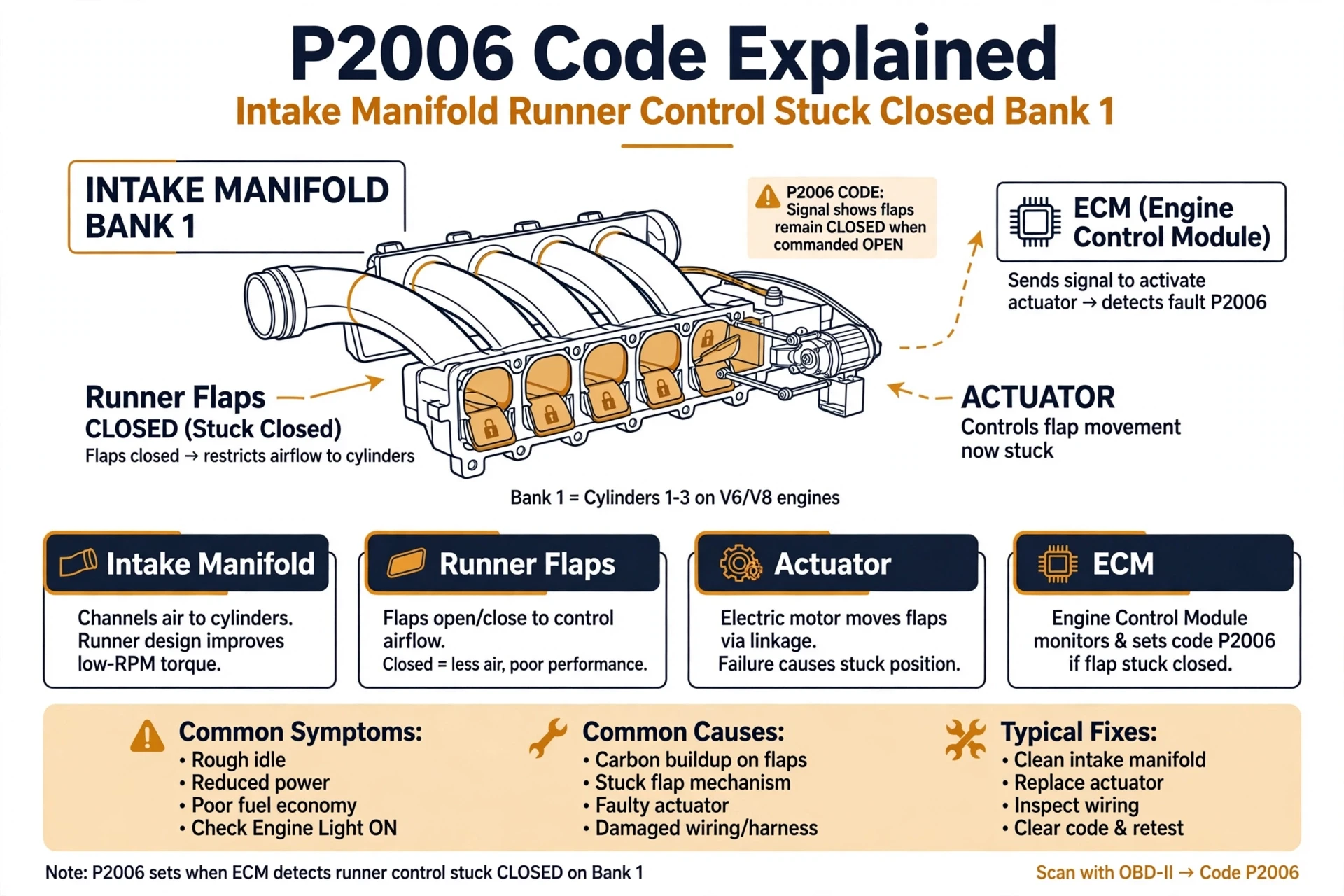
The P2006 code is one of the most common check engine light codes tied to the air intake side of the engine. Its full definition is “Intake Manifold Runner Control Stuck Closed (Bank 1).” In plain English, your car’s computer (ECM/PCM) has decided that the small flaps inside the intake manifold on bank 1 are stuck shut when they should be open.
Here is how your car figures this out. Inside the intake manifold, a set of runner flaps (also called tumble or swirl flaps) changes the shape of the air path. At low RPM they stay closed, which keeps air velocity high for strong low-end torque and clean combustion. At higher RPM, the computer commands them open so the engine can breathe freely and make full power. An actuator, either an electric motor or a vacuum unit, moves the flaps, and a position sensor reports back where they actually are. When the computer commands the bank 1 runners open and the sensor reports that they are still closed, it stores the P2006 code.
P2006 (p2006 obd ii, p2006 code bank 1) is a generic powertrain code, which means it has the same meaning on every make and model, from a Hyundai Sonata to a Ford F-150. Bank 1 is the side of the engine that contains cylinder number one. On an inline four-cylinder there is only one bank, so bank 1 is simply the whole engine.
Symptoms of P2006
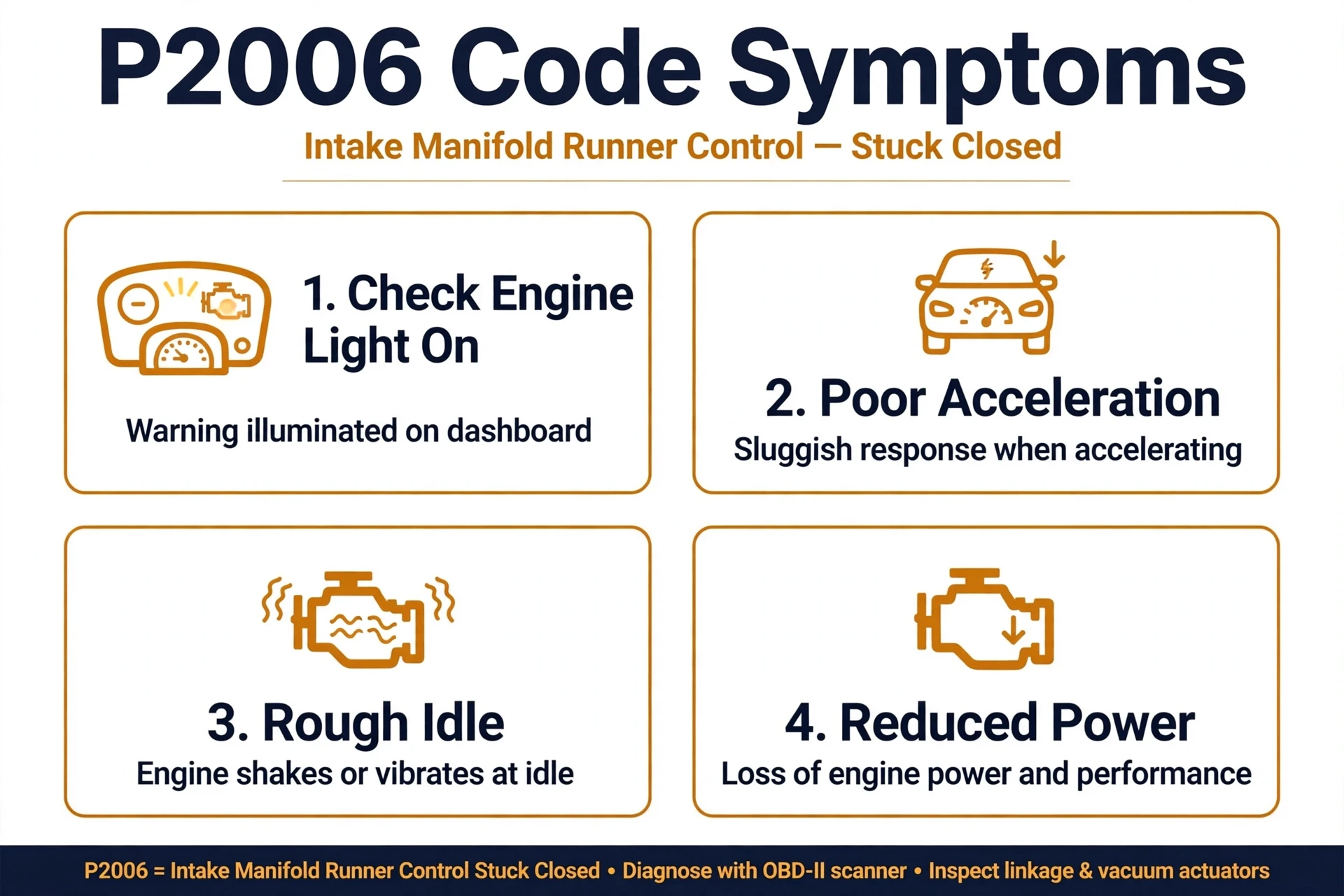
In many cases, the check engine light is the only symptom you will notice, and the car may drive exactly the same as before. That is one reason the P2006 code surprises so many drivers. However, depending on what is causing it, you might also notice:
- Sluggish acceleration or hesitation when you press the gas
- A noticeable loss of power, especially at higher RPMs or under heavy load
- Rough idle or occasional engine surging
- Reduced fuel economy, since the engine cannot manage its airflow properly
- A rich exhaust smell from unburned fuel
- In some cases, difficulty starting or rough running
What is car code P2006 trying to tell you? In short, the engine is stuck breathing through its low-RPM air path even when it needs the high-RPM path. Because the flaps are jammed in the closed position, top-end power suffers most. If you searched for the p2006 definition after your scanner showed this code, the key takeaway is that the runner flaps on bank 1 are not opening on command.
Common Causes of P2006
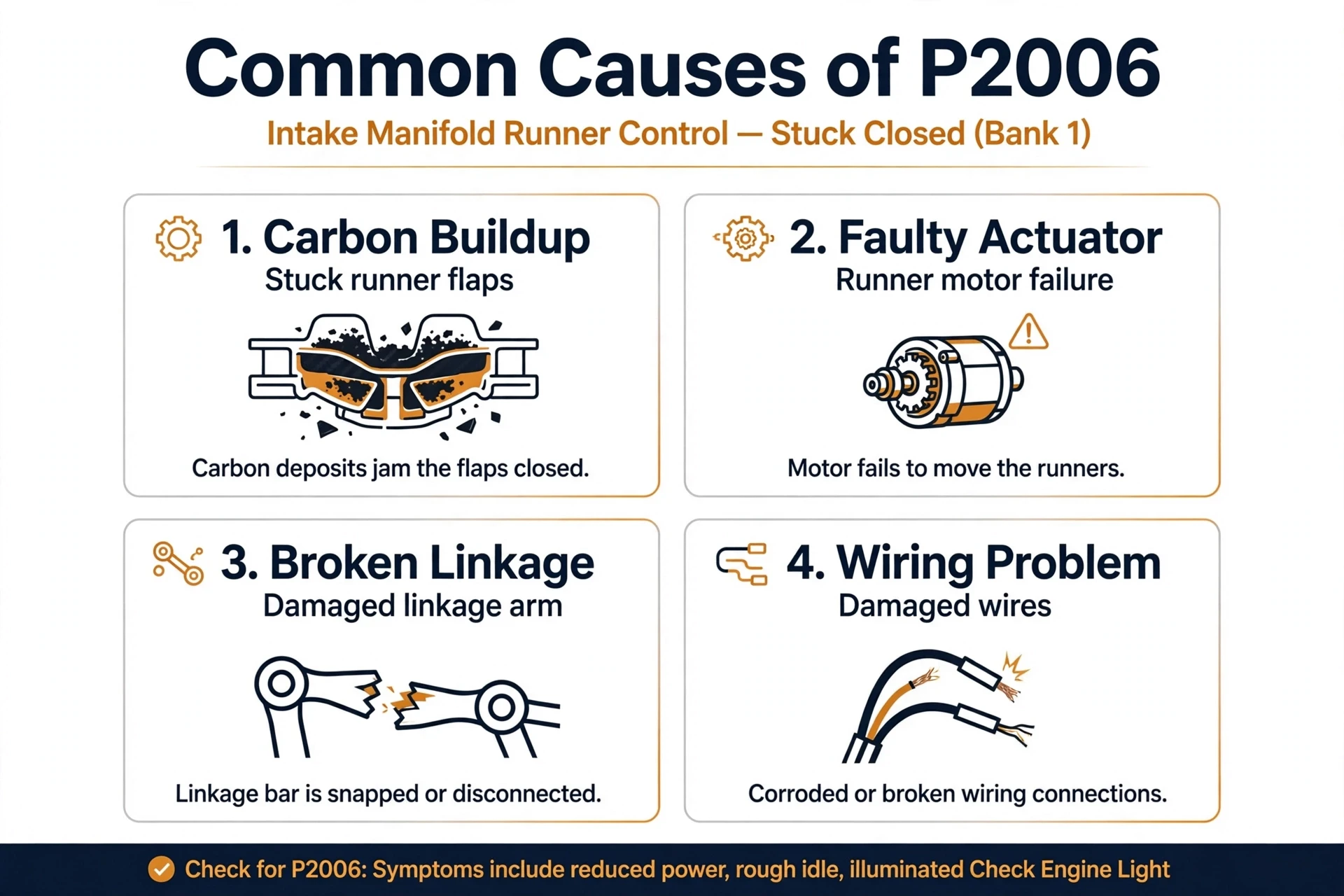
The most common cause of a P2006 code is a failed intake manifold runner control actuator or a broken piece of linkage. But a bad actuator is far from the only cause, and replacing parts without testing is the most expensive mistake drivers make with this code. Here are the causes, roughly in order of likelihood:
- Faulty IMRC actuator: the electric motor or vacuum unit that moves the runner flaps wears out or fails, so the flaps never open on command.
- Broken or disconnected linkage: the small plastic rod, retaining clips, or connecting pins between the actuator and the flaps snap or pop off, which is a very common and cheap fix.
- Carbon buildup: soot and carbon coat the flaps and ports, especially on direct-injection engines, and physically jam the runners shut.
- Vacuum leaks: cracked, split, or disconnected vacuum hoses (or a torn actuator diaphragm) starve a vacuum-type actuator of the suction it needs to pull the flaps open.
- Wiring or connector problems: shorted or open wires and corrosion in the IMRC solenoid or position sensor connector interrupt the command or the feedback signal.
- Faulty runner position sensor: the sensor itself misreports flap position, so the computer thinks the runners are stuck when they are not.
- Faulty MAP sensor: less common, but bad manifold pressure readings can confuse the computer’s airflow strategy.
- Failed PCM: rare, but the engine computer itself can be the root cause when everything else tests good.
How to Diagnose P2006 (Do This Before Buying Parts)
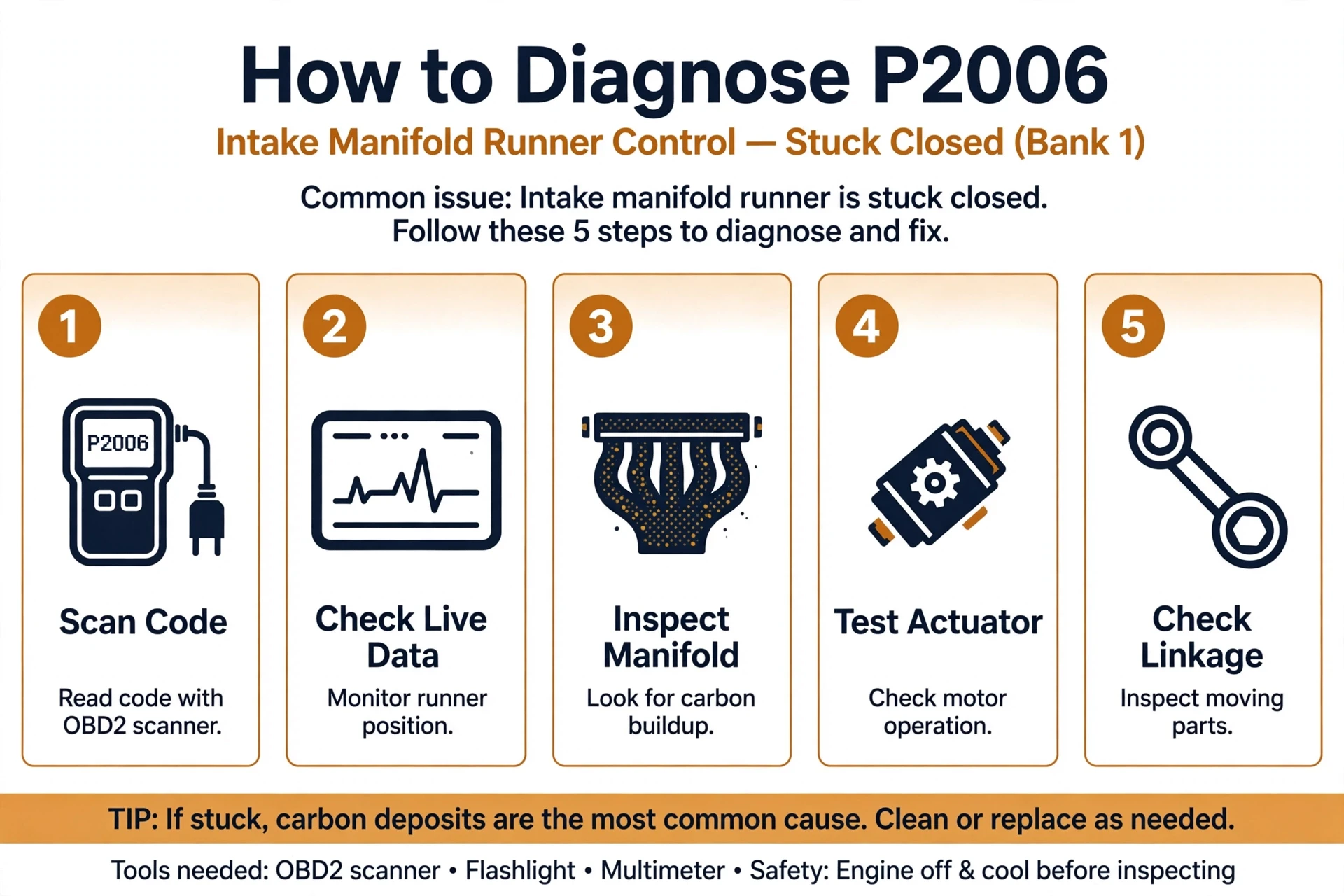
Mechanics see the P2006 code misdiagnosed constantly. The code points at restricted airflow, but the real fault is often a ten-dollar clip or a cracked hose. Follow this order:
- Scan for other codes first. Write down any companion codes and freeze frame data. If you also have circuit codes (P2008 through P2010) or a P2015, those narrow the search toward wiring or the position sensor.
- Visually inspect the linkage and actuator. Find the IMRC actuator arm on bank 1 and check whether the linkage rod and clips are intact, connected, and free to move. Broken plastic rods and popped-off clips are easy to spot.
- Check vacuum lines and electrical connections. Look for cracked, split, or disconnected vacuum hoses, plus green corrosion or loose pins in the IMRC solenoid and sensor connectors.
- Command the actuator with a scan tool. This is the deciding test: use a scan tool with bidirectional controls to command the IMRC open and closed while watching the linkage move and the position sensor reading change. If the arm does not move, the actuator, vacuum supply, or linkage is at fault.
- Test vacuum supply on vacuum-type systems. Apply vacuum with a hand pump to the actuator and see if it holds and moves the linkage. A diaphragm that will not hold vacuum needs a new actuator.
- Try moving the flaps by hand. With the linkage disconnected, the flap shaft should turn freely. If the flaps will not move by hand, carbon or a seized shaft is jamming them.
- Rule out electrical issues. Check the actuator and sensor circuits for opens, shorts, and proper voltage before condemning the computer.
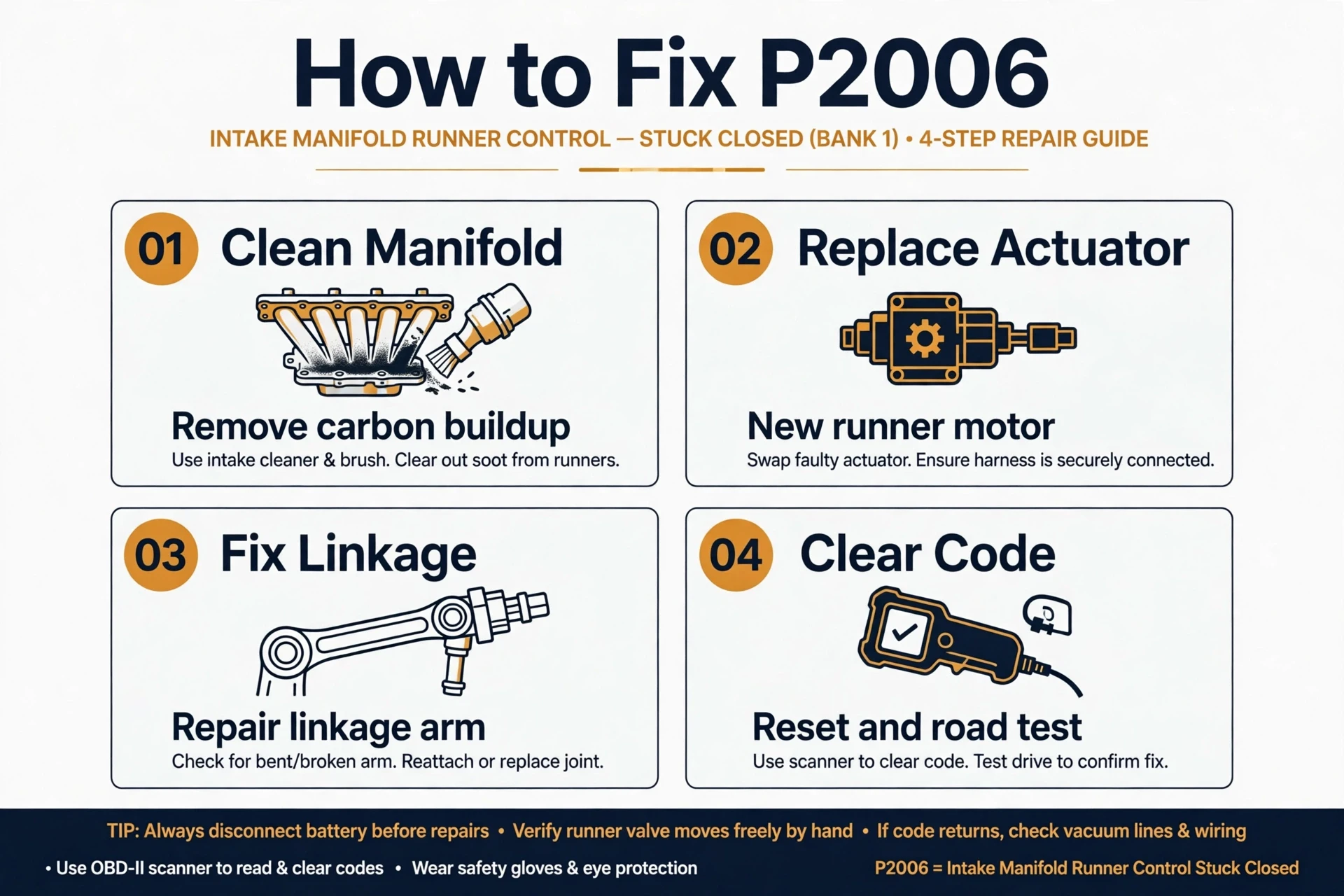
How to Fix the P2006 Code
The right fix depends on what your diagnosis found:
- Clean carbon buildup: spray intake cleaner on the flaps and ports and work them free. This solves many P2006 cases on direct-injection engines without any new parts.
- Repair or replace the linkage: snap a new rod, retaining clip, or pin into place when the old one broke. This is often the cheapest fix for a p2006 code and takes minutes.
- Replace the IMRC actuator: install a new electric actuator or vacuum controller when it fails the command or vacuum test. On some models the vacuum controller alone is serviceable.
- Fix vacuum leaks: replace cracked or disconnected vacuum hoses so the actuator gets full vacuum again.
- Repair wiring and connectors: fix shorted or open wires and clean or replace corroded connectors at the IMRC solenoid and position sensor.
- Replace the position sensor: when the sensor misreports flap position but the flaps move freely, a new sensor restores correct feedback.
- Replace the intake manifold: only needed when the flaps are seized in the manifold and will not move by hand after cleaning. Many actuators and linkages are serviceable separately, so a full manifold is the last resort.
- Replace the PCM: only in the rare case where every other component tests good.
After the repair, clear the code with your scanner and take the car for a test drive that includes both low-speed cruising and a few higher-RPM pulls, then rescan to confirm the P2006 code does not return.
P2006 Repair Costs
Drivers always ask how much it costs to fix P2006, and the answer depends entirely on the cause. Here are realistic ranges:
| Repair | Cost Range |
|---|---|
| Diagnostic scan and inspection | $122 – $233 |
| Carbon cleaning of flaps and ports | $100 – $200 |
| Linkage rod, clips, or pin repair | $20 – $120 |
| Vacuum hose repair | $50 – $150 |
| IMRC actuator or vacuum controller replacement | $150 – $400 |
| Wiring or connector repair | $80 – $250 |
| Runner position sensor replacement | $100 – $280 |
| Intake manifold replacement (manifold-off job) | $682 – $832 |
This is why diagnosis matters. A $20 linkage clip and an $800 manifold job share the same code. Drivers looking for a cheap p2006 fix should always start with the visual linkage check and a carbon cleaning before agreeing to a manifold replacement.
DIY vs Mechanic Verdict
You can do this at home: visual inspection of the linkage and vacuum lines, snapping on a new retaining clip or rod, cleaning carbon from the flaps with intake cleaner spray, and checking connectors for corrosion. If you find an obvious broken rod or a cracked vacuum hose, those are reasonable DIY repairs for anyone comfortable with basic tools.
See a mechanic for: manifold removal when the flaps are seized, electrical diagnosis of the actuator and sensor circuits, and any repair where the diagnosis is unclear after the basic checks. A shop with a bidirectional scan tool can command the IMRC and confirm actuator failure in minutes, which is cheaper than guessing with parts.
Bottom line: inspect and clean it yourself, fix the simple stuff yourself, but let a pro handle the manifold swap or the wiring hunt.
Can You Drive With a P2006 Code?
Generally yes, for a short time. The P2006 code is usually rated low to medium severity, and the car remains drivable. The stuck runner itself does not risk engine or converter damage the way some codes do. Expect reduced power, especially at higher RPMs, and worse fuel economy while the code is active. Still, prolonged restricted airflow can worsen carbon problems over time, so get it diagnosed soon rather than ignoring it for months.
P2006 on Popular Vehicles
The P2006 code shows up across many makes, but a few patterns stand out:
- Hyundai and Kia (Sonata, Optima, Santa Fe, Sorento): the variable charge motion (VCM) system on 2.0L and 2.4L engines is a common P2006 source, and it is often the cheapest fix, since linkage and actuator parts are serviceable separately.
- Ford and Mazda (Escape, Fusion, Focus, Mazda3): broken linkage clips and retaining pins are the classic failure. Check the little plastic connecting pieces first.
- Volkswagen and Audi (TFSI/FSI engines): carbon buildup dominates here. Direct injection coats the runner flaps, and cleaning often clears the code.
- Mercedes-Benz: seized runner shafts are common, and these more often end in a full intake manifold replacement.
- Stellantis 3.6L Pentastar (Dodge, Jeep, Chrysler): actuator and linkage faults appear regularly across the V6 lineup.
- Subaru: the tumble generator valves (TGV) are Subaru’s version of runner flaps and can stick closed the same way.
- Toyota and Lexus: less frequent, but actuator and carbon issues still occur on higher-mileage models.
No matter the badge, the diagnostic order is the same: linkage and vacuum first, actuator second, carbon third, and the manifold itself last.
P2006 vs P2004
P2006 and P2004 are mirror images. P2006 means the bank 1 runner flaps are stuck closed, so the engine keeps its low-RPM manners but loses top-end power because it cannot open the high-flow air path. P2004 means the bank 1 runner flaps are stuck open, which hurts low-end torque and idle quality instead. P2007 is the same fault as P2006 but on bank 2, the opposite cylinder bank. P2015 is different again: it points to the runner position sensor or switch signal being out of range, rather than the flap position itself. Note that a stuck runner is not the same thing as a stuck throttle, and seeing P2006 together with P2007 usually points to a shared cause affecting both banks.
Related Codes
- P2004: Intake Manifold Runner Control Stuck Open (Bank 1)
- P2005: Intake Manifold Runner Control Stuck Open (Bank 2)
- P2007: Intake Manifold Runner Control Stuck Closed (Bank 2)
- P2008: Intake Manifold Runner Control Circuit/Open (Bank 1)
- P2009: Intake Manifold Runner Control Circuit Low (Bank 1)
- P2010: Intake Manifold Runner Control Circuit High (Bank 1)
- P2015: Intake Manifold Runner Position Sensor/Switch Range/Performance (Bank 1)
Video Walkthrough
Watch the video above for a visual walkthrough of P2006 causes and diagnosis before you read on.
P2006 FAQs
What does the P2006 code mean?
P2006 means “Intake Manifold Runner Control Stuck Closed (Bank 1).” The engine computer commanded the intake runner flaps on bank 1 to open for better high-RPM airflow, but the position sensor reported that they stayed shut.
What is bank 1 on a P2006 code?
Bank 1 is the side of the engine that contains cylinder number one. On a V6 or V8 it is one cylinder bank; on an inline four-cylinder there is only one bank, so bank 1 is the whole engine.
Can I drive with a P2006 code?
Usually yes, for a short time. P2006 is rated low to medium severity and the car stays drivable. Expect reduced power at higher RPMs and worse fuel economy, and get it diagnosed soon rather than ignoring it for months.
What is the most common cause of P2006?
The most common cause is a failed IMRC actuator or a broken linkage rod, clip, or pin between the actuator and the flaps. On direct-injection engines, carbon buildup jamming the flaps shut is also very common.
What is the difference between P2006 and P2004?
P2006 means the bank 1 runner flaps are stuck closed, while P2004 means they are stuck open. Stuck closed hurts top-end power; stuck open hurts low-end torque and idle quality.
Can carbon buildup cause a P2006 code?
Yes. Soot and carbon coat the runner flaps and ports, especially on direct-injection engines, and can physically jam the flaps in the closed position. Cleaning the flaps with intake cleaner often clears the code without any new parts.
Does a P2006 code always require replacing the intake manifold?
No. A full manifold replacement is only needed when the flaps are seized in the manifold and will not move by hand after cleaning. Most P2006 fixes are smaller: a linkage clip, an actuator, a vacuum hose, or a carbon cleaning.
Conclusion
The P2006 code looks intimidating, but it usually comes down to a stuck flap, a tired actuator, or a broken ten-dollar clip. Work through the diagnosis in order, fix what you find, and confirm the repair with a proper test drive. Your engine will breathe freely again, and the check engine light will stay off.
About the author: Written by the OBD2 Code Hub editorial team. Our diagnostic guides are built from real OBD-II data, manufacturer service procedures, and hands-on troubleshooting experience, then reviewed for technical accuracy before publishing. We drive the same cars you do.