
P2195 Trouble Code: Meaning, Causes, Symptoms & Fixes
In This Guide
One-line meaning: P2195: O2 Sensor Signal Stuck Lean (Bank 1, Sensor 1).
What the P2195 Code Means
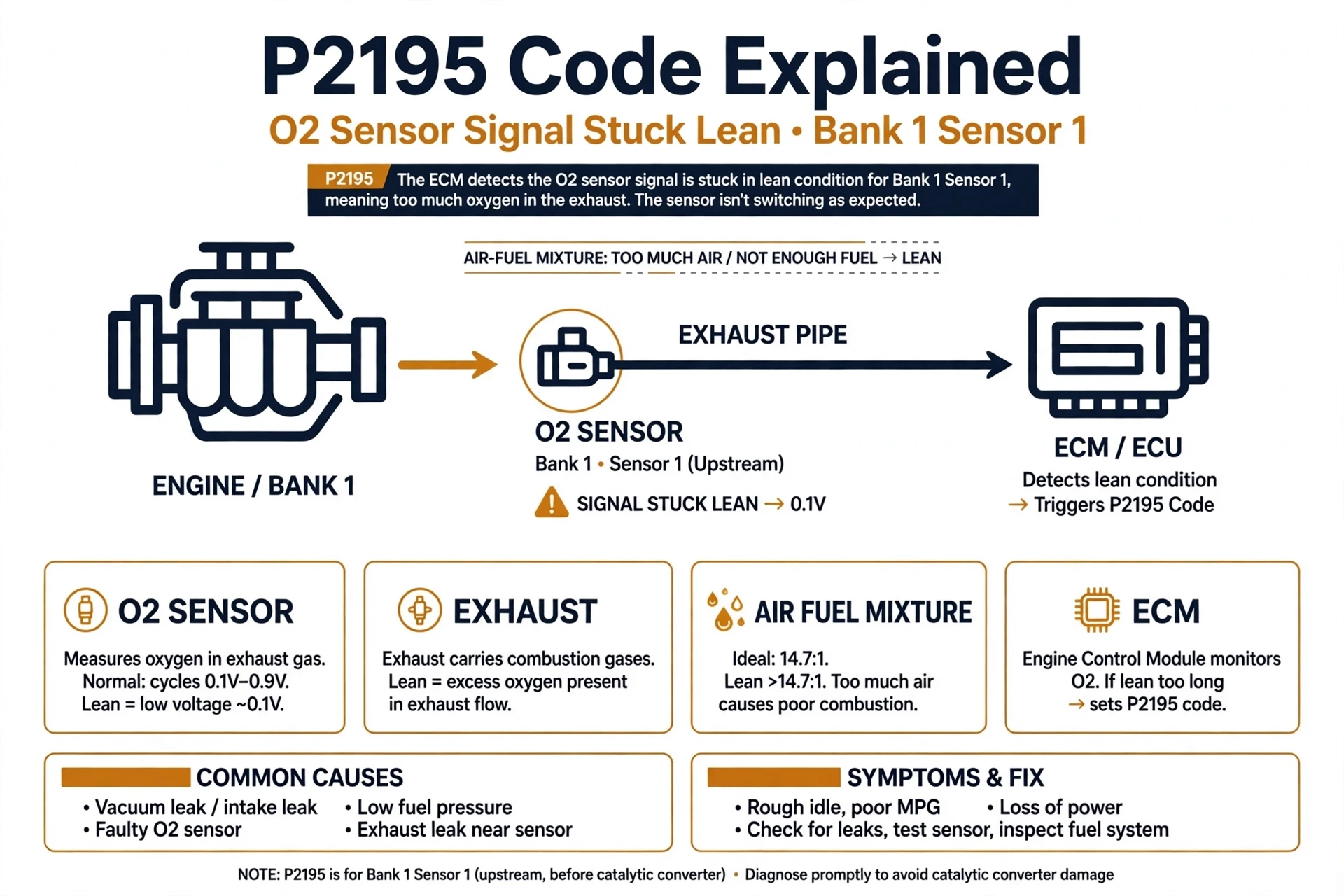
The P2195 code is a fuel and air metering code that points straight at the upstream oxygen sensor on bank 1. Its full definition is “O2 Sensor Signal Biased/Stuck Lean (Bank 1, Sensor 1).” In plain English, the sensor watching the exhaust leaving bank 1 keeps telling the computer the mixture is lean, and its signal is not moving the way a healthy sensor should.
Here is how your car figures this out. Bank 1 is the side of the engine that holds cylinder number one. Sensor 1 is the upstream sensor, the one threaded into the exhaust before the catalytic converter. On most modern cars this is an air/fuel ratio sensor rather than a conventional oxygen sensor, but the job is the same: report the exhaust mixture moment by moment. A healthy sensor signal swings constantly as the computer trims fuel delivery. When that signal parks itself at the lean end and stays there, the computer decides the sensor is biased or stuck lean and stores the P2195 code.
P2195 (p2195 obd2, p2195 code bank 1 sensor 1) is a generic powertrain code, which means it has the same meaning on every make, from a Ford Fusion to a Lincoln MKS to a Hyundai Sonata. The trap with this code is that it does not tell you whether the engine is actually running lean or the sensor is simply lying, which is why diagnosis matters far more than guessing at parts.
Symptoms of the P2195 Code
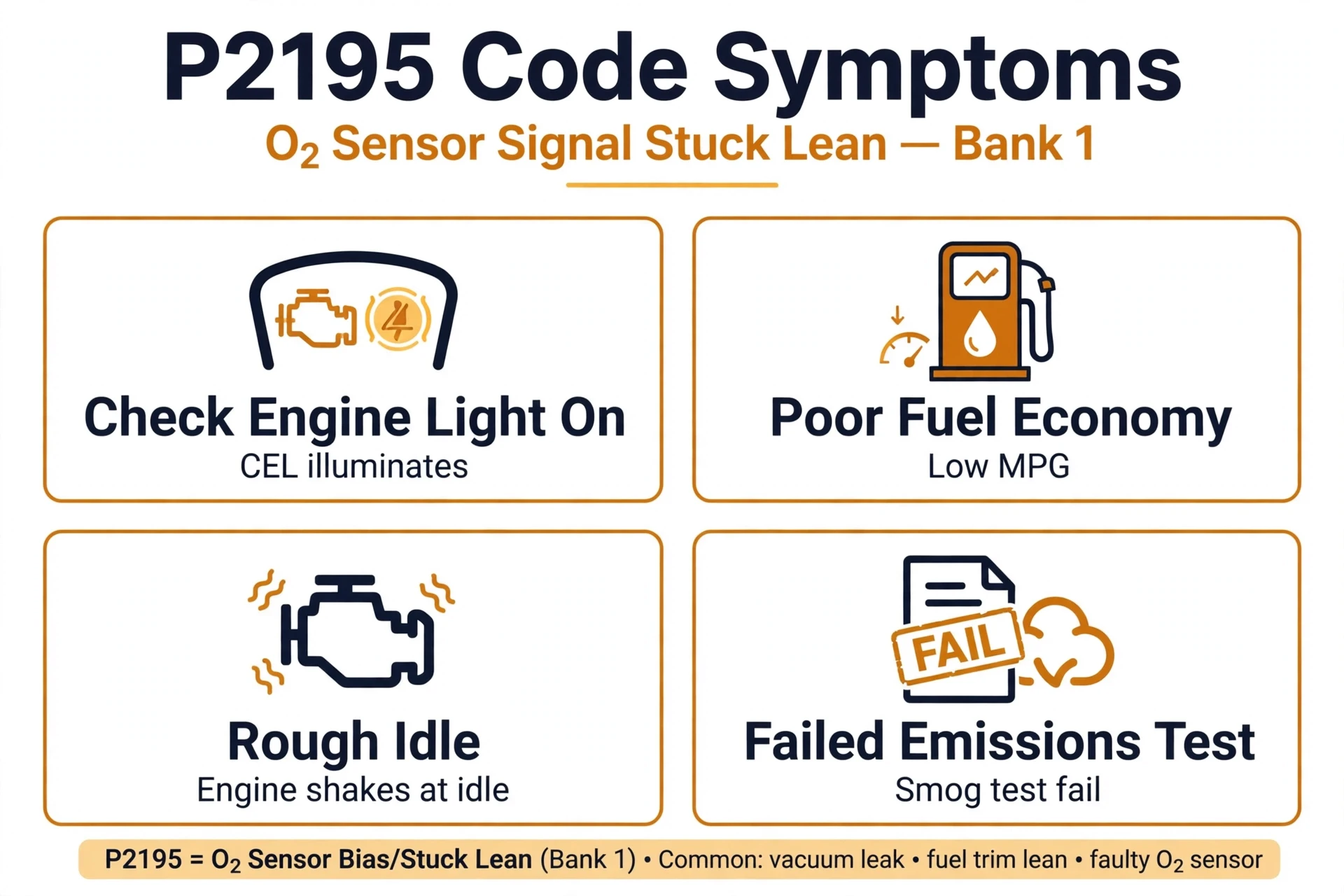
The check engine light is often the only clue, and many cars drive normally with the P2195 code stored. But when the engine truly is running lean, you will usually notice one or more of these:
- Check engine light that stays on, sometimes with P0171 or P0174 stored alongside it
- Rough idle, hesitation, or stumbling on acceleration
- Engine misfires, especially under load
- Reduced fuel economy, often 2 to 4 MPG worse than usual
- Occasional stalling at stops
- Failed emissions or smog test
What is the P2195 code really telling you? Bank 1 is either breathing in too much air, getting too little fuel, or the sensor reporting it is stuck. A steady light means diagnose soon, not panic.
Common Causes of P2195
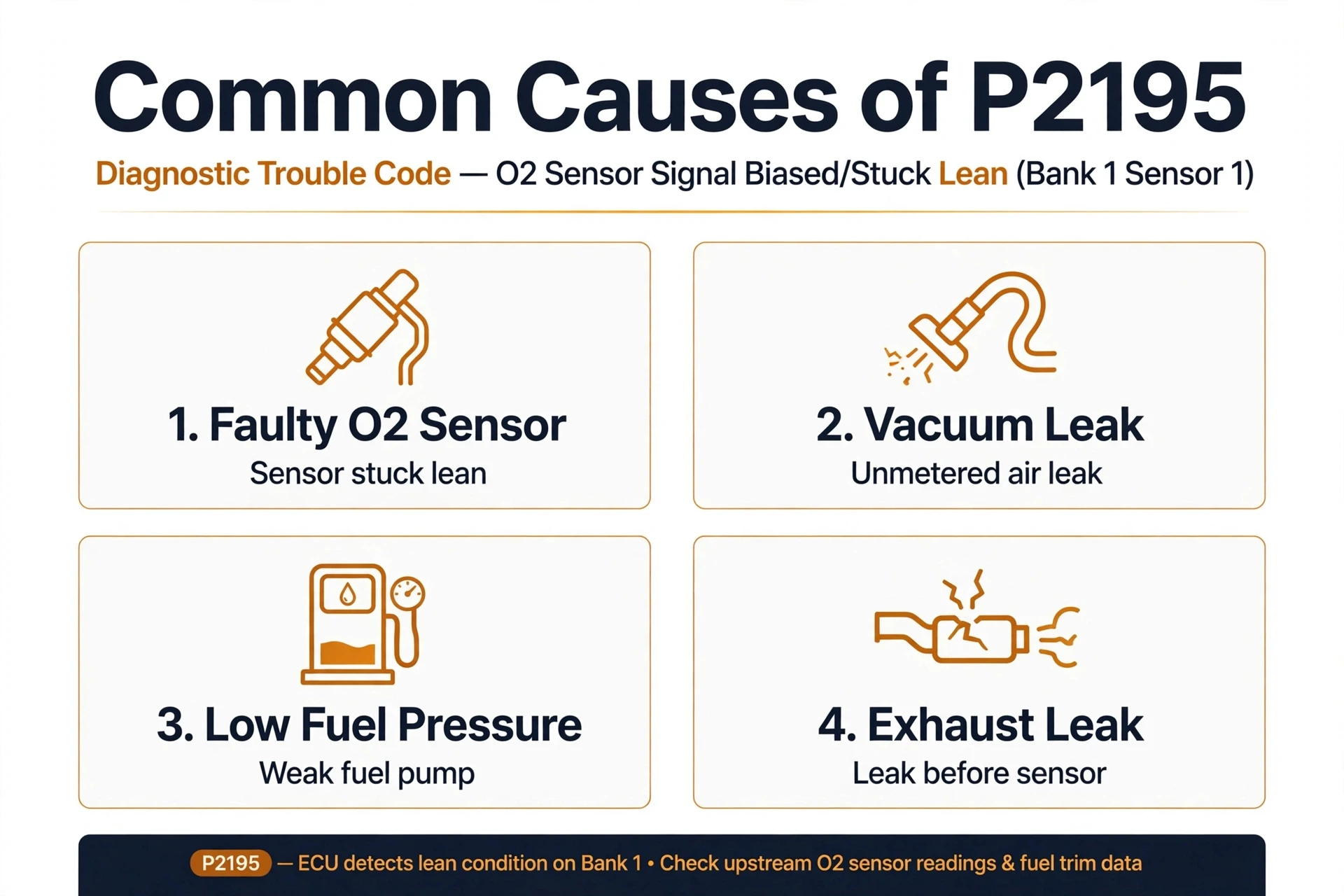
The most common genuine cause of a P2195 code is unmetered air sneaking into the engine, which the sensor correctly reports as lean. The sensor itself is the second most common culprit, so test before you replace.
- Vacuum leaks: cracked or disconnected intake hoses, leaking intake manifold gaskets, or a faulty PCV valve or crankcase separator let in air the MAF sensor never measured.
- Exhaust leaks before or near Sensor 1: a cracked manifold or leaking gasket pulls outside air into the exhaust stream, and the sensor reads that extra oxygen as a false lean condition.
- Faulty upstream O2 or air/fuel sensor (Bank 1, Sensor 1): a degraded sensing element, a failed heater circuit, or stuck internal circuitry can pin the signal lean even when the mixture is fine.
- Weak fuel delivery: a tired fuel pump, low fuel pressure, or clogged fuel injectors starve bank 1 of the fuel it needs.
- Dirty or faulty MAF sensor: if the sensor under-reports incoming air, the computer delivers too little fuel for the real airflow and the mixture goes lean.
- Restricted air filter or intake: less common, but a severely clogged filter changes what the sensors see.
- O2 sensor wiring and connector problems: corroded pins, heat-damaged or melted insulation, and loose connectors on the Bank 1 Sensor 1 harness.
- PCM software or calibration glitches: rare, but a computer fault can misread a perfectly good sensor.
How to Diagnose P2195 (Do This Before Buying Parts)
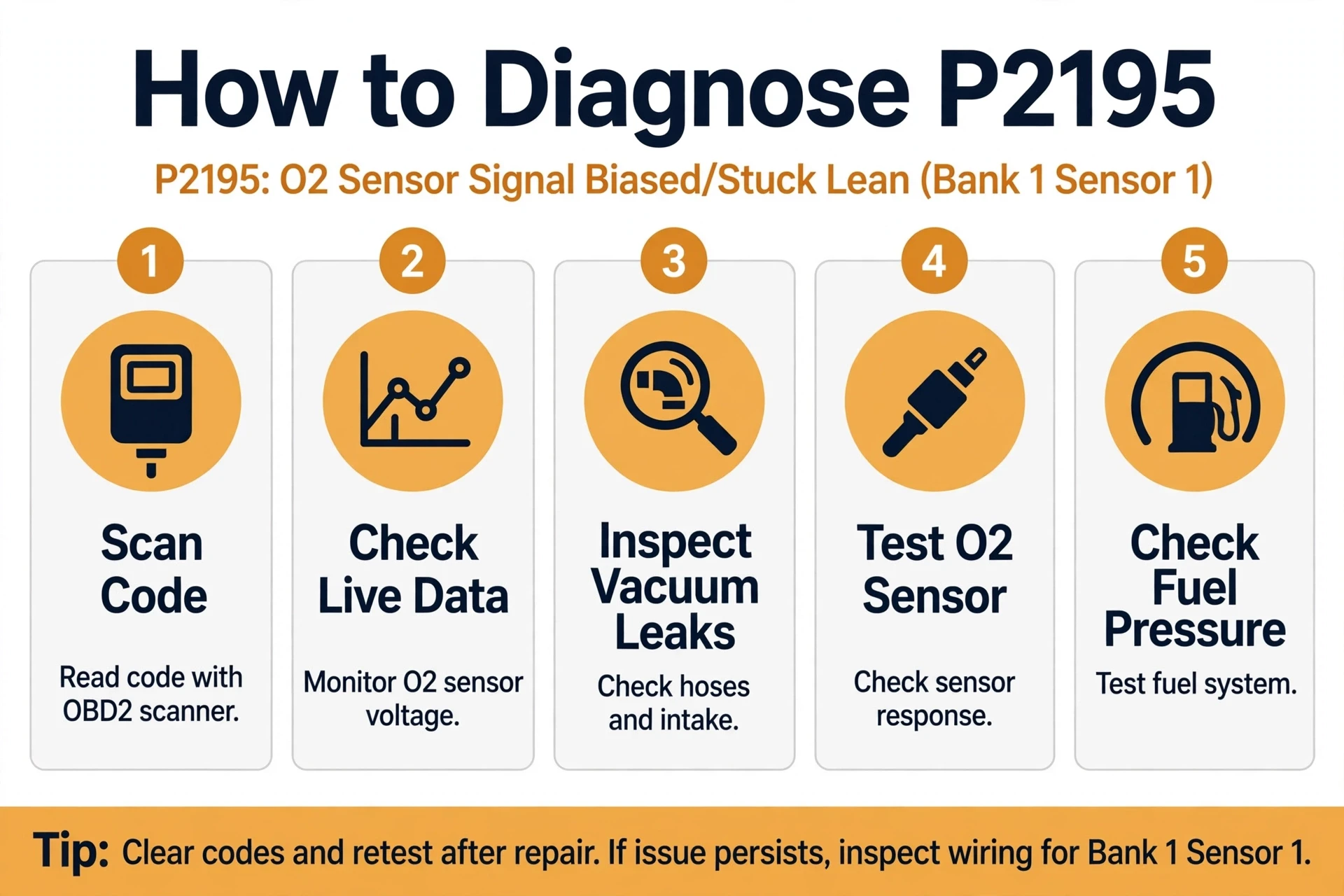
The P2195 code gets misdiagnosed constantly because drivers replace the oxygen sensor first and the code comes right back. The sensor is often just the messenger. Work through this order instead:
- Scan for other codes first. Misfire codes (P0300 series) or lean codes (P0171/P0174) change the whole picture, so address the underlying fault they point to before anything else.
- Check O2 sensor live data. With any OBD2 scanner that shows live data, watch Bank 1 Sensor 1. A healthy conventional sensor swings rapidly between roughly 0.1 and 0.9 volts, while a signal parked low and flat backs up the stuck lean report.
- Read the fuel trims. High positive short-term and long-term fuel trims, around +15% or more, mean the computer is adding fuel to compensate for a genuinely lean mixture. That points away from the sensor and toward a leak or a fuel delivery problem.
- Hunt for vacuum leaks. Listen for hissing around the intake, inspect every hose and the intake manifold gasket, and check the PCV valve. A smoke test finds the leaks your eyes miss.
- Check for exhaust leaks near the upstream sensor. Look for black soot marks, listen for ticking on a cold start, and inspect the manifold and gaskets before Sensor 1.
- Inspect wiring, then test fuel pressure. Look for damaged wires, melted insulation, and corroded connectors at the sensor, then verify fuel pressure matches spec before condemning the pump or the injectors.
Replace the sensor only after the data says it is bad. On trucks like the Ford F-150, owners have replaced the oxygen sensor and watched the code return because an undiagnosed vacuum leak was the real problem all along.
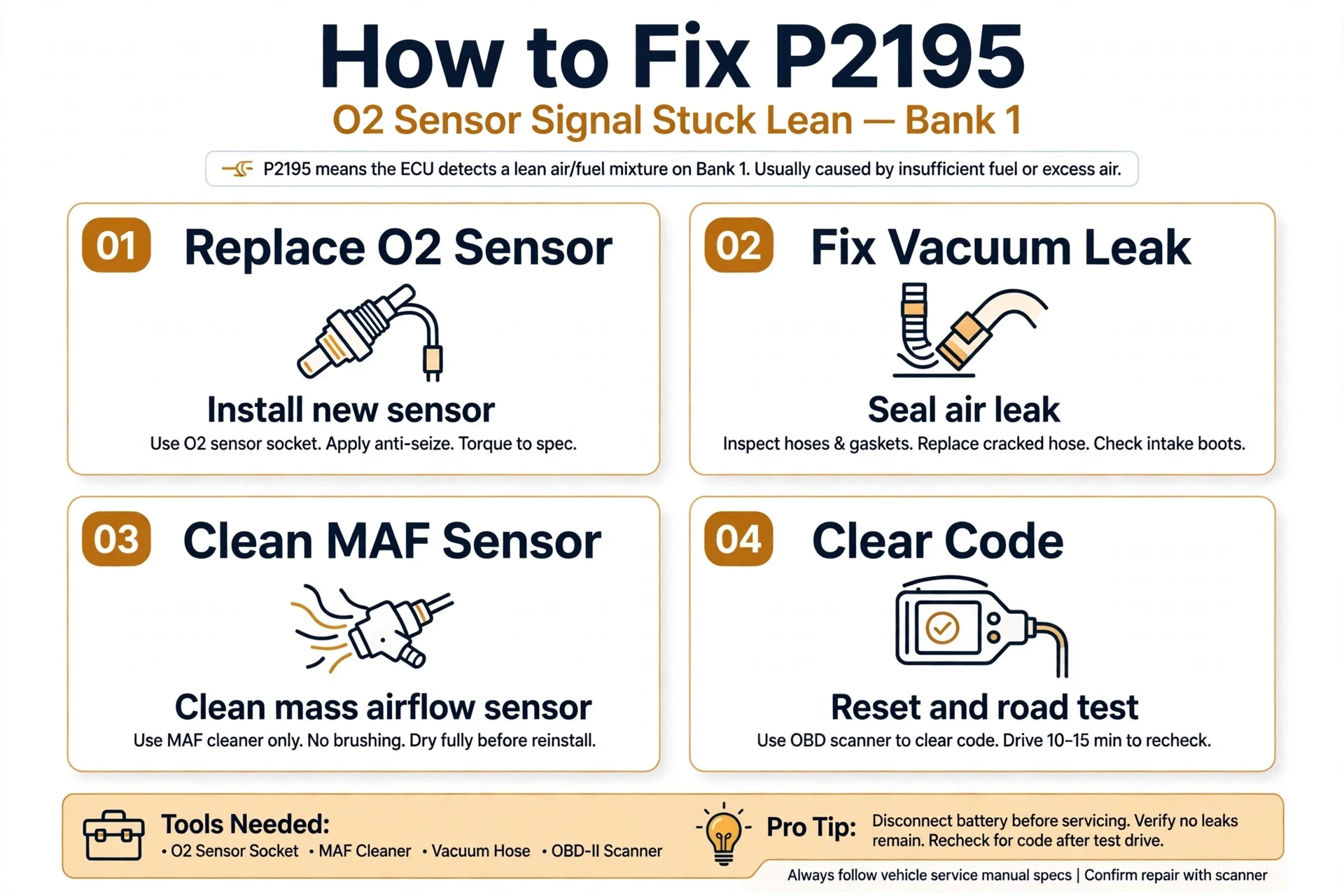
How to Fix the P2195 Code
The right fix depends on what your diagnosis found:
- Repair vacuum leaks: replace cracked hoses, reseal or replace the intake manifold gasket, and replace a faulty PCV valve. This fixes a large share of genuine lean cases.
- Repair exhaust leaks: weld or replace the cracked manifold or leaking gasket before Sensor 1 so outside air stops fooling the sensor.
- Replace the faulty O2 or air/fuel sensor: only Bank 1 Sensor 1 needs replacement, and only after live data proves it is stuck or lazy.
- Clean or replace the MAF sensor: a can of MAF cleaner fixes many dirty sensors, and replace a badly clogged air filter at the same time.
- Fix fuel delivery problems: replace a weak fuel pump, service or replace clogged injectors, and repair a faulty fuel pressure regulator.
- Repair damaged wiring: fix frayed wires, corroded pins, and loose connectors on the sensor harness.
- Update or reprogram the PCM: a last resort for calibration-related faults, handled at the dealer or a qualified shop.
P2195 Repair Costs
Drivers always ask how much it costs to fix P2195, and the answer depends entirely on the cause. Here are typical ranges:
| Repair | Cost Range |
|---|---|
| Vacuum leak repair (hoses, gaskets, PCV) | $150 – $400 |
| Exhaust leak repair (manifold, gaskets) | $100 – $300 |
| O2 / air-fuel sensor replacement (Bank 1, Sensor 1) | $150 – $400 |
| MAF sensor replacement | $150 – $400 |
| Fuel pump replacement | $400 – $900 |
| Professional diagnosis | $80 – $150 |
This is why diagnosis matters. A $150 vacuum hose job and a $900 fuel pump job share the same code.
DIY vs Mechanic Verdict
You can do this at home: reading codes and live data with an OBD2 scanner, checking fuel trims, visually inspecting intake hoses and the air filter, cleaning the MAF sensor, and listening for exhaust leaks.
See a mechanic for: smoke testing for hidden vacuum leaks, fuel pressure testing, fuel pump or injector replacement, wiring faults buried in the harness, and PCM reprogramming.
Bottom line: diagnose it yourself with a scanner, fix the simple air and sensor jobs yourself, but let a pro handle fuel system surgery.
Can You Drive With a P2195 Code?
Generally yes, for a short time, if the car runs normally. But a truly lean mixture burns hotter, which can overheat and damage the catalytic converter over time, and your fuel economy will suffer while the computer adds extra fuel to compensate.
If the check engine light is flashing, or the engine is misfiring badly or stalling, stop driving and get it checked right away. Otherwise, book a diagnosis soon rather than ignoring the p2195 code for weeks.
P2195 on Popular Vehicles
P2195 shows up across all brands, but some patterns are worth knowing:
- Ford (Fusion, Escape, Focus, F-150): The p2195 ford code is very common. Check for vacuum leaks and the upstream sensor first, and on 2015-2018 Transit vans check whether water has been leaking onto the air filter housing.
- Lincoln (MKS): the p2195 code often traces to the upstream oxygen sensor itself, a straightforward replacement once live data confirms it.
- Hyundai/Kia (Sonata, Elantra, Santa Fe, Tucson): vacuum and PCV system leaks are frequent causes on these models.
- Toyota (Camry, Corolla, RAV4): The p2195 toyota code often comes down to an aging upstream air/fuel ratio sensor.
- Honda (Accord, Civic, CR-V): intake leaks and MAF sensor issues deserve a close look here.
- Nissan (Altima, Sentra, Rogue): the p2195 nissan code often involves sensor wiring and connectors.
P2195 is a generic OBD-II code, so the same definition applies on every brand. DTC P2195 and OBD P2195 are just different names for the same code.
P2195 vs Related Codes
P2195 is bank 1, sensor 1, stuck lean. Its closest relatives: P2197 is the mirror image for bank 2 (stuck lean), while P2196 and P2198 are the stuck rich versions for bank 1 and bank 2. You will also see P2195 stored next to P0171 or P0174, the generic system too lean codes, which point at the same underlying lean condition from a different angle.
Related Codes
- P2197: O2 Sensor Signal Biased/Stuck Lean (Bank 2, Sensor 1)
- P2196: O2 Sensor Signal Biased/Stuck Rich (Bank 1, Sensor 1)
- P2198: O2 Sensor Signal Biased/Stuck Rich (Bank 2, Sensor 1)
- P0171: System Too Lean (Bank 1)
- P0174: System Too Lean (Bank 2)
- P0131: O2 Sensor Circuit Low Voltage (Bank 1, Sensor 1)
- P0300: Random/Multiple Cylinder Misfire Detected (a common companion)
Video Walkthrough
Watch the video above for a visual walkthrough of P2195 causes, oxygen sensor testing and replacement, and diagnosis before you read on.
Frequently Asked Questions
What is the most common cause of a P2195 code?
Unmetered air from a vacuum leak is the most common genuine cause: cracked intake hoses, a leaking manifold gasket, or a bad PCV valve. A worn upstream O2 or air/fuel sensor is the next most common, which is why testing before replacing matters so much.
Can I still drive my car with a P2195 code?
Short trips are usually fine if the engine runs normally, but do not ignore it for long. A lean mixture burns hotter and can damage the catalytic converter, and your fuel economy will drop while the computer compensates with extra fuel.
How do you fix the code P2195?
Diagnose first: scan all codes, watch Bank 1 Sensor 1 live data, and check fuel trims to see whether the engine is truly lean. Then fix what you find, whether that is a vacuum or exhaust leak, a bad sensor, MAF issues, or a fuel delivery problem.
How much does it cost to fix P2195?
Most repairs land between $150 and $400, covering vacuum leak repairs, exhaust leak repairs, and sensor replacement. Fuel pump replacement can reach $400 to $900, and a professional diagnosis typically costs $80 to $150.
Will P2195 clear itself?
Rarely. The code returns after a few drive cycles unless the underlying fault is fixed. Clearing it with a scanner without repairing anything just buys a short quiet period before the light comes back.
Can a bad O2 sensor cause P2195?
Yes. A degraded sensing element, a failed heater circuit, or stuck internal circuitry can pin the signal lean. But the sensor is often just reporting a real lean condition, so verify with live data and fuel trims before buying one.
What does “stuck lean” mean on an O2 sensor?
It means the sensor signal stays parked at the lean end instead of swinging as the mixture changes. On a conventional sensor that looks like voltage stuck low, and on a wideband air/fuel sensor it looks like a flat lean reading the computer stops trusting.
Conclusion
The P2195 code looks intimidating, but it really narrows the hunt: bank 1, upstream sensor, lean signal. Remember that the sensor is usually the messenger, not the criminal. Check your fuel trims, hunt down the extra air or the missing fuel, and fix the real cause instead of throwing a sensor at it. Do that, and the p2195 code stays gone.
About the author: Written by the OBD2 Code Hub editorial team. Our diagnostic guides are built from real OBD-II data, manufacturer service procedures, and hands-on troubleshooting experience, then reviewed for technical accuracy before publishing. We drive the same cars you do.