
P2004 Trouble Code: Meaning, Causes, Symptoms & Fixes
In This Guide
One-line meaning: P2004: Intake Manifold Runner Control Stuck Open (Bank 1).
What the P2004 Code Means
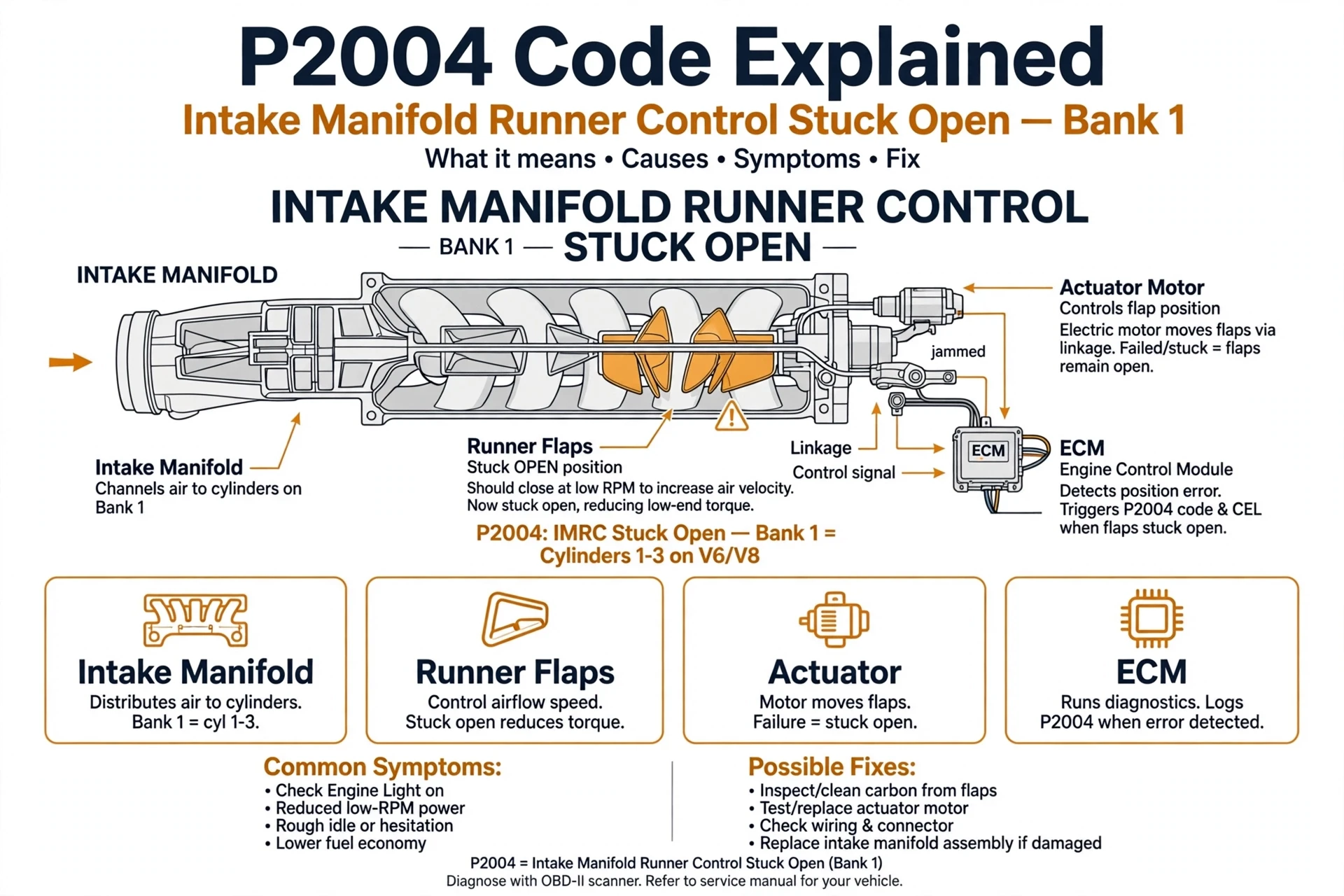
The p2004 code is a diagnostic trouble code that means the intake manifold runner control (IMRC) on bank 1 is stuck in the open position. Your engine computer (PCM) ordered the runner flaps to close, but the position sensor reported back that they stayed open, so the computer stored the code and turned on the check engine light.
Here is what the system does. Inside the intake manifold, flap valves sit in the runner passages that feed air to the cylinders. These flaps change the effective length of the runners. At low RPM the flaps close to create long runners, which boosts low-end torque for pulling away from a stop. At higher RPM they open for maximum airflow and power. When the flaps jam open, the engine loses that low-RPM tuning and feels lazy right where you need torque most.
P2004 (p2004 obd ii, p2004 code bank 1) is a generic powertrain code, which means it has the same meaning on every 1996 and newer vehicle, from a Ford F-150 to a Chevy Cruze to a Mazda. Bank 1 is the side of the engine that contains cylinder number one. On an inline four-cylinder engine there is only one bank, so bank 1 is the whole engine. Its mirror image is the P2005 code, the exact same fault but on bank 2.
Symptoms of the P2004 Code
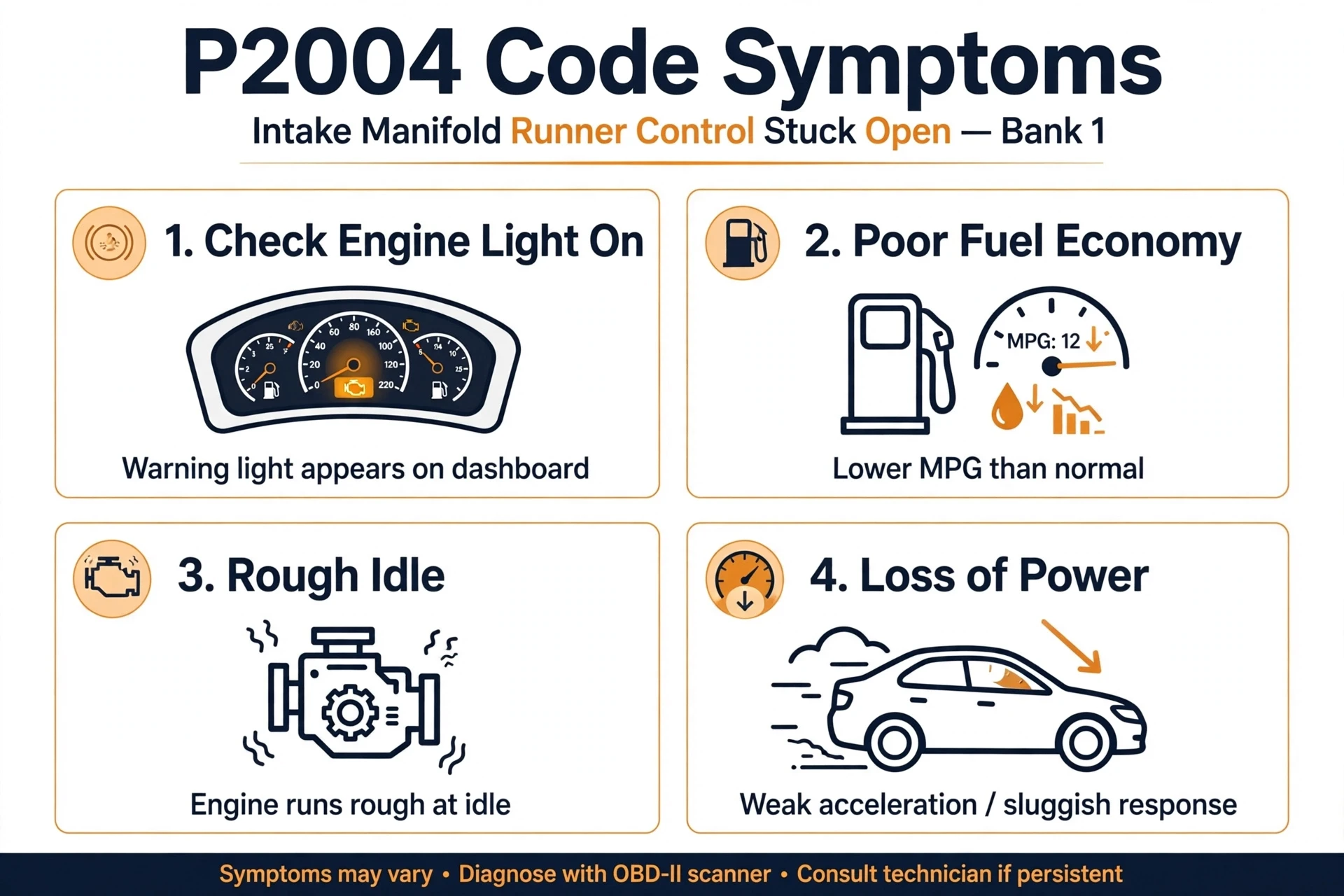
Many drivers first learn about the p2004 code from the check engine light. The car may still feel fine at highway speed, because the flaps are supposed to be open up there anyway. Where you will feel it is down low. Depending on the vehicle, you might notice:
- Check engine light on (it can flash if the engine runs very rough)
- Sluggish acceleration from a stop and weak low-end torque
- Rough idle or hesitation when pulling away
- Engine surging or sputtering under light throttle
- Decreased fuel economy, you are filling up more often than usual
What is code P2004? What is car code P2004 trying to tell you? In short: the intake tuning system is stuck in its high-RPM position while you are driving at low RPM, so the engine feels lazy pulling away from lights even though it cruises fine. Do not ignore it just because the car still moves.
Common Causes of P2004
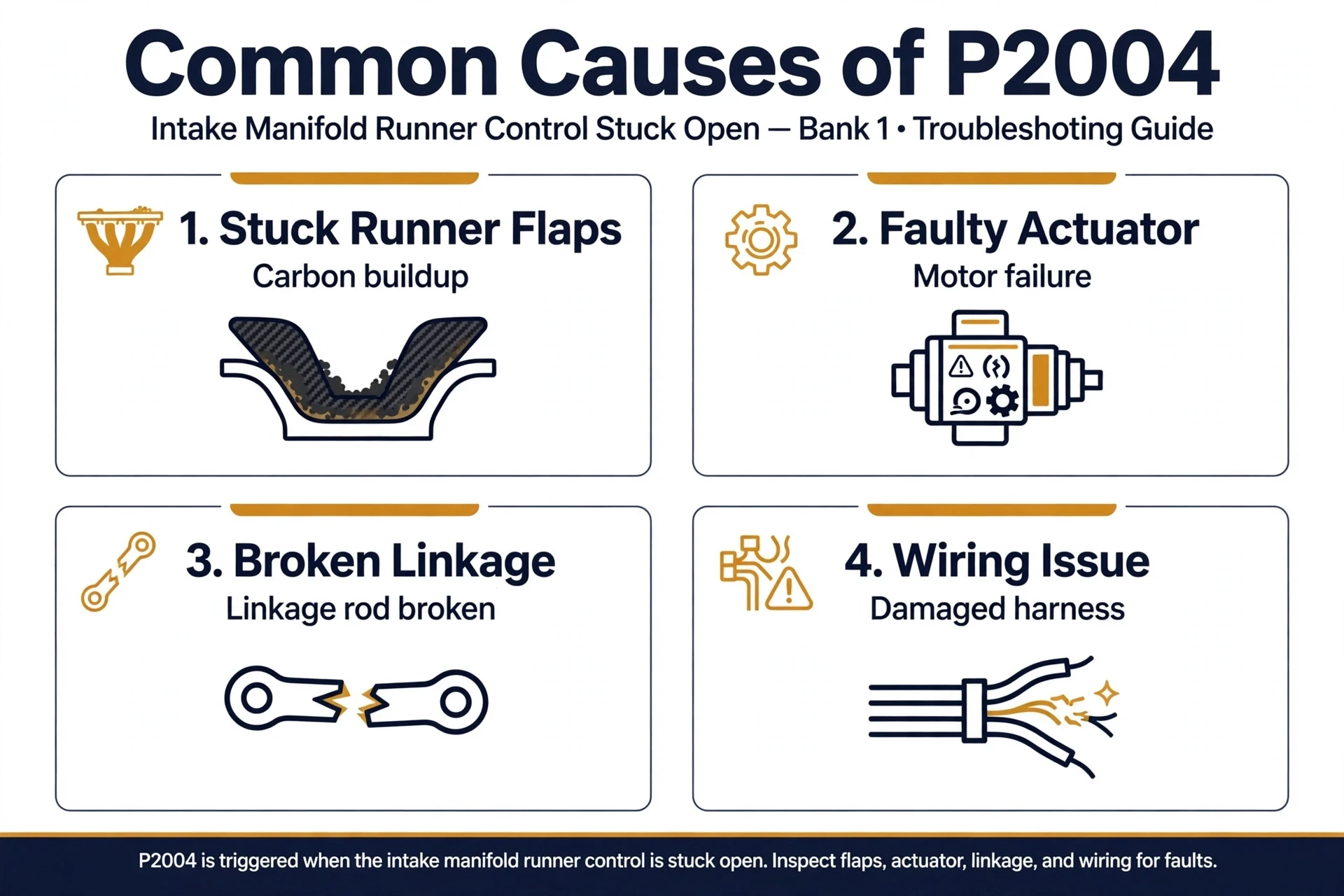
The most common cause of a p2004 code is a cracked, split, or disconnected vacuum hose feeding the IMRC actuator. It is a cheap part that is easy to overlook, and it fails far more often than the expensive components. But several other faults set the same code. Here are the causes, roughly in order of likelihood:
- Damaged or cracked vacuum lines or hoses: the number one cause. A split hose means the actuator never gets vacuum, so the flaps stay open. Inspect every line before buying parts.
- Faulty IMRC solenoid: the electric solenoid that routes vacuum to the actuator can stick, burn out, or fail to click when powered.
- Faulty IMRC actuator: the vacuum diaphragm or motor that physically moves the linkage rods can leak, seize, or wear out.
- Electrical issues: loose connectors, corroded pins, or shorted, frayed, or broken wiring in the IMRC solenoid circuit.
- Carbon buildup or mechanical binding: soot and carbon gum up the runner flaps and linkage rods so they cannot move freely, especially on higher-mileage engines.
- Loose or broken butterfly valve hardware: loose plate screws, or plates that have disconnected from the actuator linkage.
- Faulty runner position sensor: gives the PCM incorrect feedback, so the computer thinks the flaps are open when they are not, or misses that they are stuck.
- Clogged vacuum filter or debris in the vacuum control solenoid: blocks the vacuum signal even when the hoses look fine.
- Companion sensor codes: stored EGR valve, MAF sensor, or BARO sensor faults can confuse the IMRC strategy. Fix those first.
How to Diagnose P2004 (Do This Before Buying Parts)
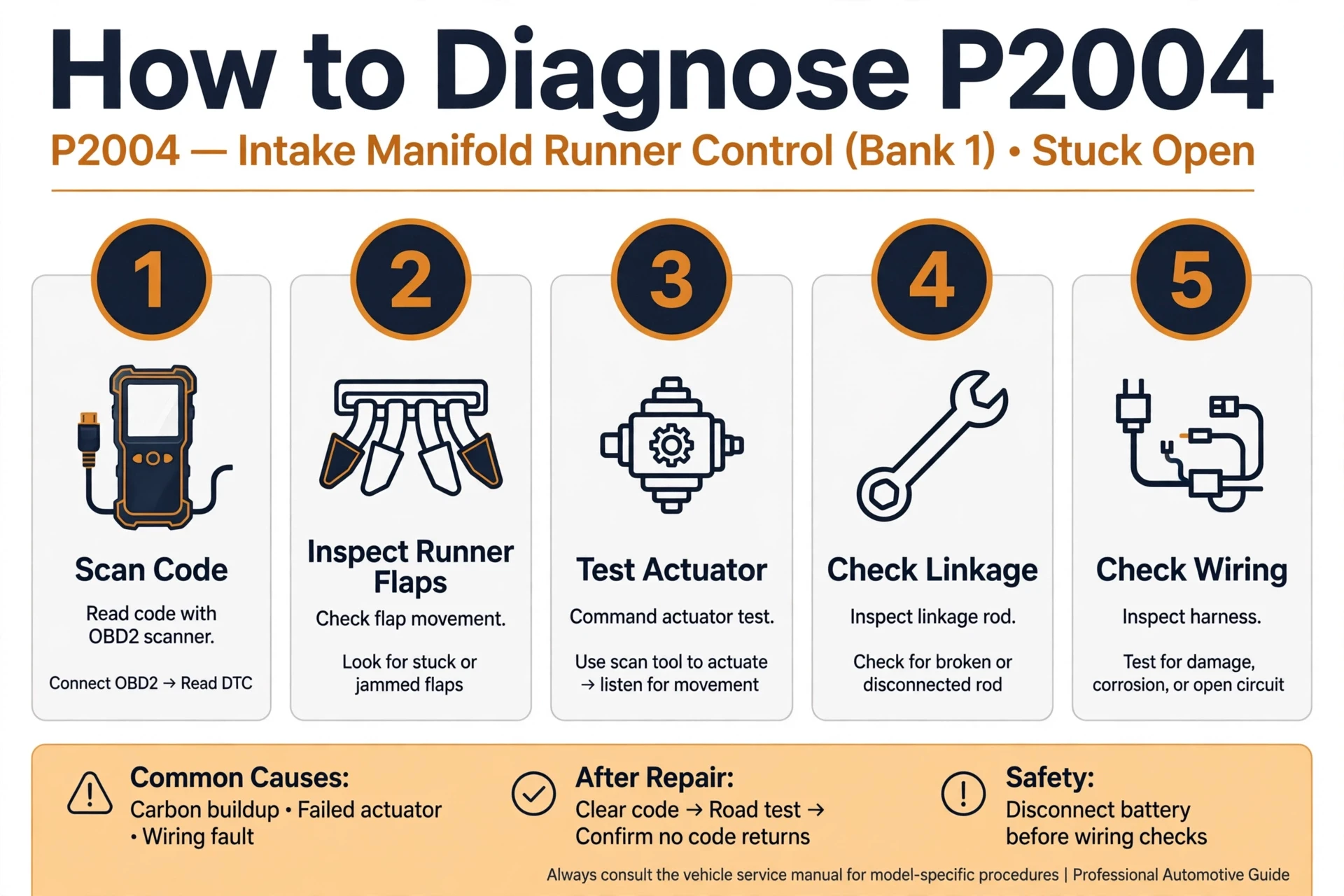
The p2004 code is misdiagnosed constantly because people replace the solenoid without checking a five-dollar hose first. Follow this order:
- Scan for other codes first. If you have EGR, MAF, or BARO sensor codes stored, diagnose those first. They can trigger or mask IMRC faults, and the P2004 may clear once they are fixed.
- Inspect hoses and wiring. Trace every vacuum line to the IMRC solenoid and actuator. Look for cracks, splits, kinks, and disconnected ends. Wiggle the electrical connector at the solenoid and check for corrosion, loose pins, and frayed wiring.
- Test the solenoid and actuator. With the engine off, apply 9V or 12V from a battery to the solenoid terminals with jumper wires. You should hear a firm click as it opens and closes, and you should see the actuator linkage move.
- Check for binding. Move the linkage rods and butterfly valves by hand with the engine off. They should move smoothly. Carbon deposits or physical obstructions mean the flaps need cleaning before you condemn any part.
- Check the position sensor. With a scan tool that shows live data, watch the IMRC position reading while commanding the solenoid open and closed. If the reading never changes, suspect the sensor or its wiring.
- Clear the codes and retest. After each repair, clear the code and drive through a few warm-up cycles to see if the p2004 code returns.
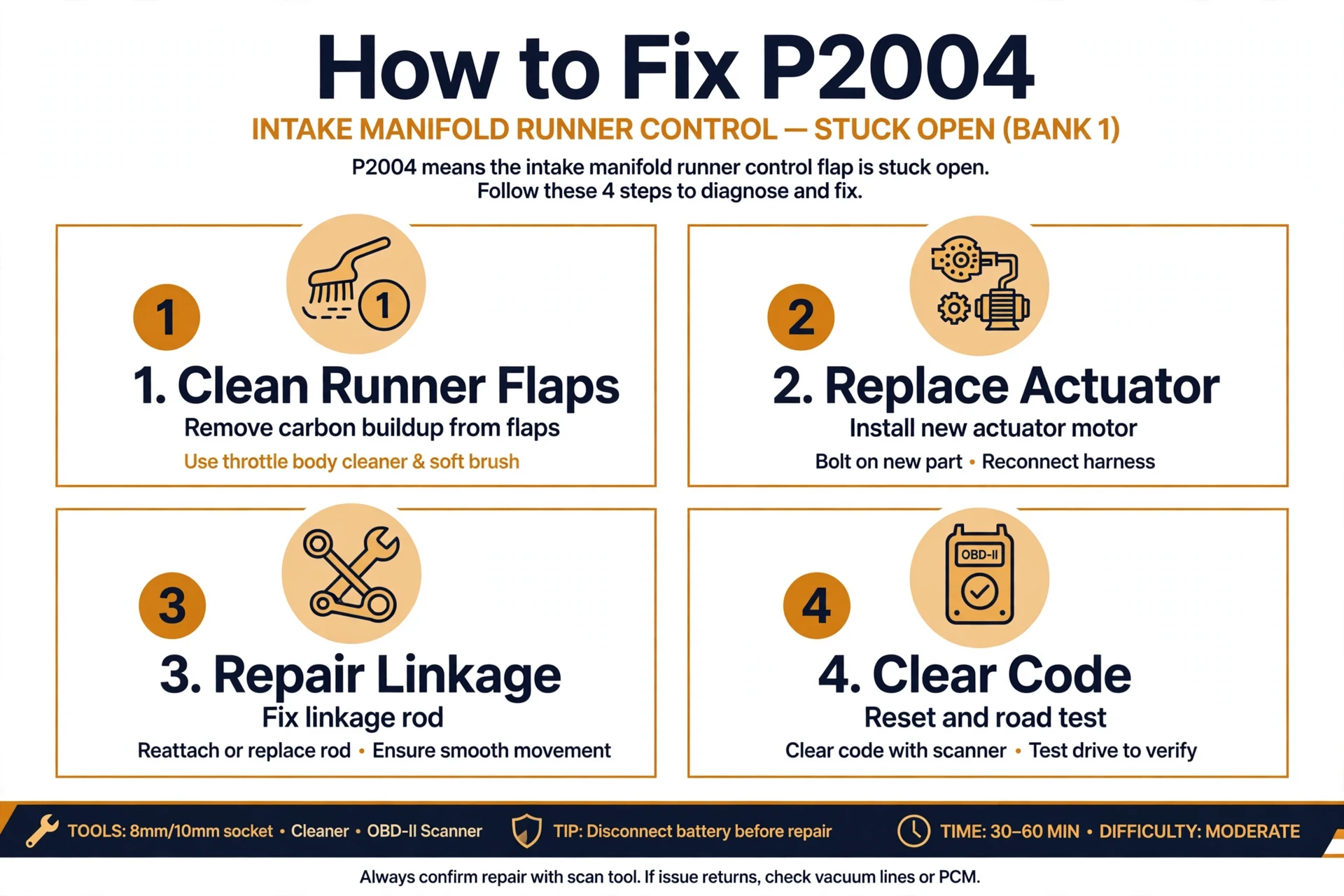
How to Fix the P2004 Code
The right fix depends on what your diagnosis found:
- Replace damaged vacuum hoses: the cheapest and most common fix. Replace any cracked line and retest before buying anything else. Many ask how to fix p2004 code cheaply, and this is the answer most of the time.
- Clean carbon from the runner flaps: remove the accessible buildup from the butterfly valves and linkage rods so they move freely again.
- Repair wiring and connectors: fix shorts, breaks, and corroded pins in the IMRC solenoid circuit, and reseat any loose connectors.
- Replace the IMRC solenoid: if it fails the click test or shows an open or shorted circuit.
- Replace the IMRC actuator: if the vacuum diaphragm leaks or the motor does not move the linkage. Only replace it after the hoses, solenoid, and flaps check out.
- Reattach or replace butterfly valve hardware: tighten or replace loose plate screws, and reconnect plates that came off the actuator linkage.
- Fix companion codes first: repair EGR, MAF, or BARO faults, since the PCM needs good sensor inputs to run the IMRC strategy correctly.
P2004 Repair Costs
Drivers always ask how much it costs to fix the p2004 code, and the answer depends entirely on the cause. Here are realistic ranges:
| Repair | Cost Range |
|---|---|
| Vacuum hose/line replacement | $4 – $50 |
| IMRC solenoid replacement | $150 – $300 |
| IMRC actuator replacement | $200 – $550 |
| Intake carbon cleaning (runner flaps) | $150 – $300 |
| Professional diagnosis | $100 – $175 |
This is why diagnosis matters. A $10 vacuum hose and a $550 actuator job share the same code. Always start with the hoses and the solenoid click test, not the parts catalog.
DIY vs Mechanic Verdict
You can do this at home: visual vacuum hose and wiring inspection, reading codes with an OBD2 scanner, the 9V or 12V solenoid click test with jumper wires, and cleaning accessible carbon from the runner flaps and linkage. If you find a cracked hose or a silent solenoid, those are reasonable DIY repairs for anyone comfortable with basic tools.
See a mechanic for: actuator replacement that requires intake manifold removal, electrical diagnosis of the solenoid circuit, and any case where the flaps are buried deep in the manifold or the position sensor needs scope testing.
Bottom line: inspect the cheap stuff yourself first. Most p2004 code cases end at a vacuum hose or a cleaning, not a new actuator.
Can You Drive With a P2004 Code?
Generally yes, for a short time. The car will usually run, but with weak low-end pull and worse fuel economy. Driving long term with the p2004 code is not advisable: performance stays degraded, you may fail an emissions test, and a binding flap can eventually damage the actuator or manifold hardware. If the check engine light is flashing or the engine surges badly, get it checked promptly instead of continuing to drive it.
P2004 on Popular Vehicles
The p2004 code shows up across all brands, but some patterns are worth knowing:
- Ford (F-150, Mustang): The p2004 ford code (ford p2004, p2004 code ford) is common on trucks and Mustangs with vacuum-operated IMRC systems. Cracked vacuum lines are the usual suspect, so check those before anything else.
- Chevy (Cruze): The p2004 chevy code (p2004 code chevy, code p2004 chevy) often traces to the IMRC solenoid itself or carbon-fouled runner flaps.
- Nissan: For p2004 nissan (nissan p2004, p2004 code nissan), check the solenoid wiring and connectors first. Chafed harnesses are a known issue.
- Mazda (RX-8): the rotary engine uses auxiliary port valves that can stick open and set P2004. Carbon buildup is the classic cause here.
- Dodge (Caliber): P2004 often appears together with P2017 on these cars. The manifold flow control valve actuator is the common failure point.
- Subaru: the p2004 subaru code often pairs with P2007, which covers the tumble generator valves on the other bank. Check for stuck TGVs and damaged wiring.
- Hyundai (Sonata): actuator and solenoid faults are the most commonly reported causes on these models.
OBD P2004 and DTC P2004 refer to the identical fault under different naming. P2004 is a generic code, so the definition never changes between brands, only the most likely cause does.
P2004 vs Related Codes
P2004 means the intake manifold runner control is stuck open on bank 1. Its closest relatives describe the same system failing in a different way. P2005 is the exact same stuck-open fault on bank 2. P2006 and P2007 mean the runners are stuck closed on bank 1 and bank 2. P2008 through P2010 are IMRC circuit faults (open, low, high) on bank 1, while P2014 through P2018 cover the runner position sensor circuit on bank 1. P2015, the position sensor range and performance code, often appears alongside P2004 when carbon buildup confuses the sensor. Diagnose the circuit and sensor codes with the same hose, wiring, and binding checks used for P2004.
Related Codes
- P2005: Intake Manifold Runner Control Stuck Open (Bank 2)
- P2006: Intake Manifold Runner Control Stuck Closed (Bank 1)
- P2007: Intake Manifold Runner Control Stuck Closed (Bank 2)
- P2015: Intake Manifold Runner Position Sensor/Switch Circuit Range/Performance (Bank 1)
Video Walkthrough
Watch the video above for a visual walkthrough of P2004 causes and diagnosis before you read on.
Frequently Asked Questions
What is the most common cause of a P2004 code?
A cracked, split, or disconnected vacuum hose feeding the IMRC actuator. It is cheap to fix and easy to miss, which is why it tops the list. A faulty IMRC solenoid is the next most common cause.
Can I still drive my car with a P2004 code?
Yes, for a short time. Expect sluggish acceleration from a stop and worse fuel economy. Get it diagnosed soon, and sooner if the check engine light flashes or the engine surges badly.
How do you fix the code P2004?
Diagnose first: inspect the vacuum hoses and wiring, click-test the solenoid with a 9V or 12V battery, and check the runner flaps for carbon binding. Then repair what you find: replace hoses, clean the flaps, fix wiring, or replace the solenoid or actuator.
How much does it cost to fix P2004?
From about $4 to $50 for a vacuum hose, $150 to $300 for an IMRC solenoid, and $200 to $550 for an actuator replacement, plus $100 to $175 for professional diagnosis if you hand it to a shop.
Will P2004 clear itself?
Rarely. If the fault was a one-time glitch it might, but a stuck flap, bad hose, or failed solenoid will keep setting the code until it is repaired.
What does intake manifold runner control stuck open mean?
It means the flap valves inside the intake manifold runners are jammed in their open, high-RPM position when the engine computer commanded them closed for low-RPM driving, which hurts low-end torque.
Can carbon buildup cause a P2004 code?
Yes. Carbon and soot can gum up the runner flaps and linkage rods so they cannot move, especially on higher-mileage engines. Cleaning the flaps often resolves it without new parts.
Conclusion
The P2004 code looks technical, but it is really your car telling you its intake tuning flaps are stuck. Check the vacuum hoses first, test the solenoid, clean what is dirty, and replace only what has actually failed. Do that, and you will either solve it for the price of a hose or know exactly which part to replace. Either way, you stop guessing and start fixing.
About the author: Written by the OBD2 Code Hub editorial team. Our diagnostic guides are built from real OBD-II data, manufacturer service procedures, and hands-on troubleshooting experience, then reviewed for technical accuracy before publishing. We drive the same cars you do.