
P0140 Trouble Code: Meaning, Causes, Symptoms & Fixes
In this P0140 code guide:
One-line meaning: The P0140 code means your car’s computer detects no activity from the downstream oxygen sensor (Bank 1, Sensor 2), the O2 sensor located after the catalytic converter.
What the P0140 Code Means
DTC P0140 stands for “O2 Sensor Circuit No Activity Detected (Bank 1, Sensor 2).” When your scanner shows engine code p0140, it means the engine control module is watching the downstream oxygen sensor and seeing a flat signal with no switching. A healthy O2 sensor constantly swings its voltage between roughly 0.1 and 0.9 volts as the oxygen level in the exhaust changes. With P0140, that signal stays stuck, often hovering near 0.45 volts or showing no voltage at all, for long enough that the computer stores the code.
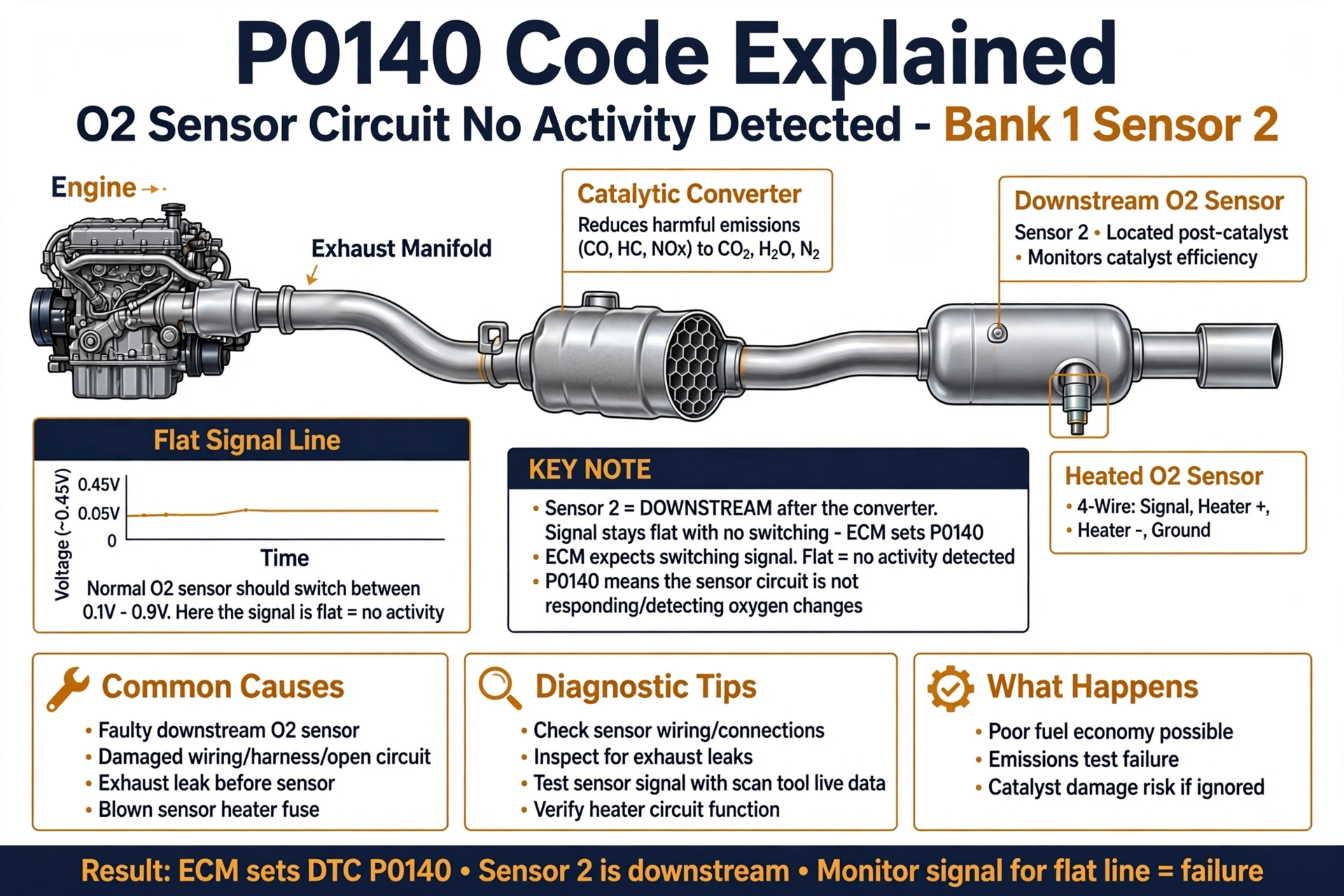
Sensor 2 is the DOWNSTREAM sensor. It screws into the exhaust pipe after the catalytic converter, and its job is to monitor how well the converter stores oxygen. It does not steer fuel trim the way the upstream sensor (Sensor 1) does. Bank 1 is simply the side of the engine that contains cylinder number 1. So the p0140 code is the computer saying the post-cat O2 sensor on the cylinder-1 bank has gone quiet.
The critical distinction: “no activity” means a flat, unchanging signal. That is different from a signal stuck high, which sets P0138, or a signal stuck low on the other bank, which sets P0157. Each behavior points to a different fault, so getting this distinction right keeps you from replacing the wrong part.
Symptoms of a P0140 Code
The tricky part of the p0140 code is that your car will usually feel completely normal. Because the downstream sensor does not control fuel delivery, most drivers notice nothing except the warning light. Watch for these symptoms:
- Check engine light on. This is the most common, and often the only, symptom, and the light will not clear itself until the underlying problem is fixed.
- Slightly lower fuel economy in some vehicles.
- Higher tailpipe emissions.
- A failed emissions or smog inspection.
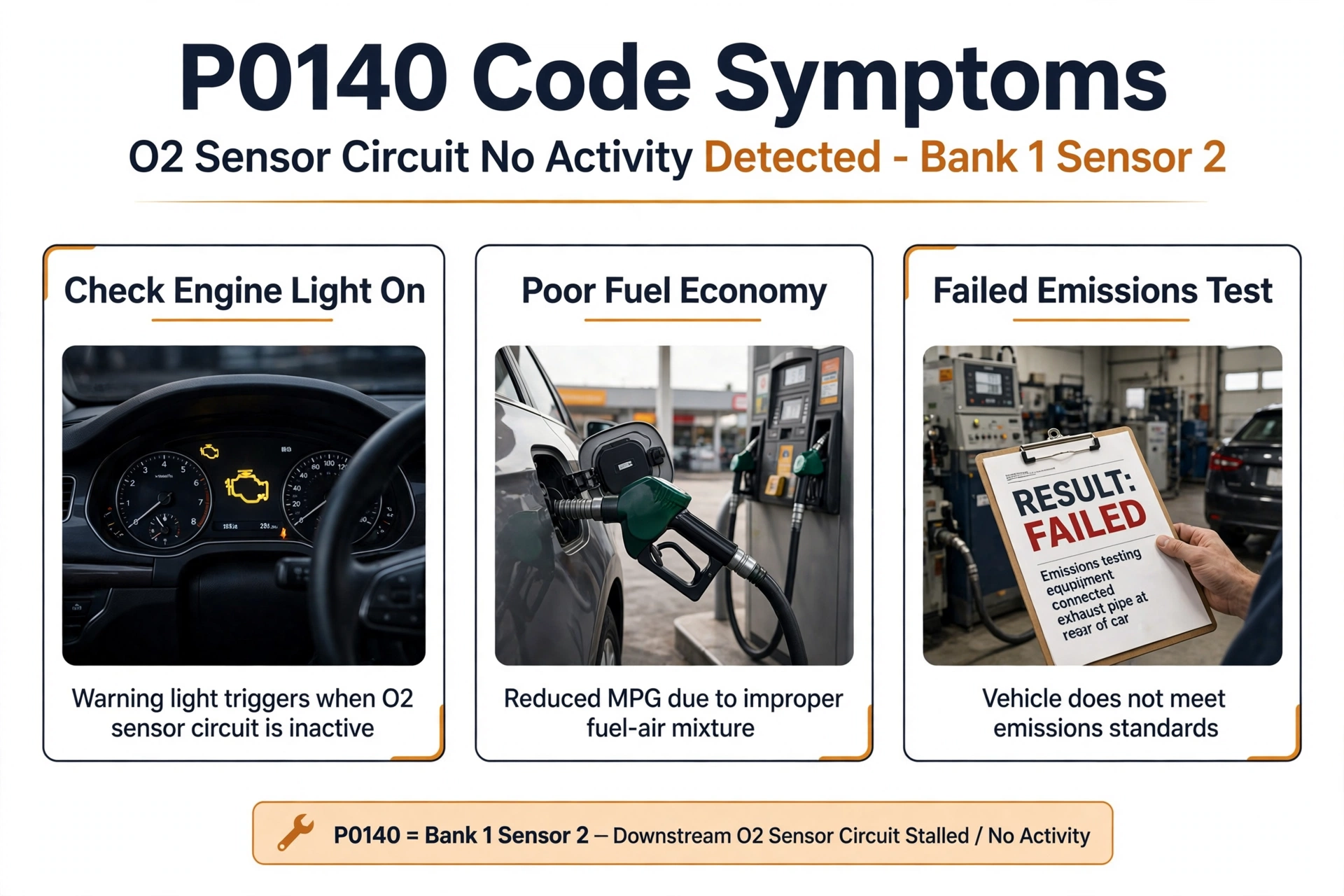
What you usually will NOT feel: rough idle, stalling, hesitation, or a loss of power. The downstream sensor only watches the catalytic converter, so drivability is rarely affected, which is why many people keep driving for weeks with a P0140 code stored.
Common Causes of P0140
A P0140 code has a short list of usual suspects. Work through them in this order:
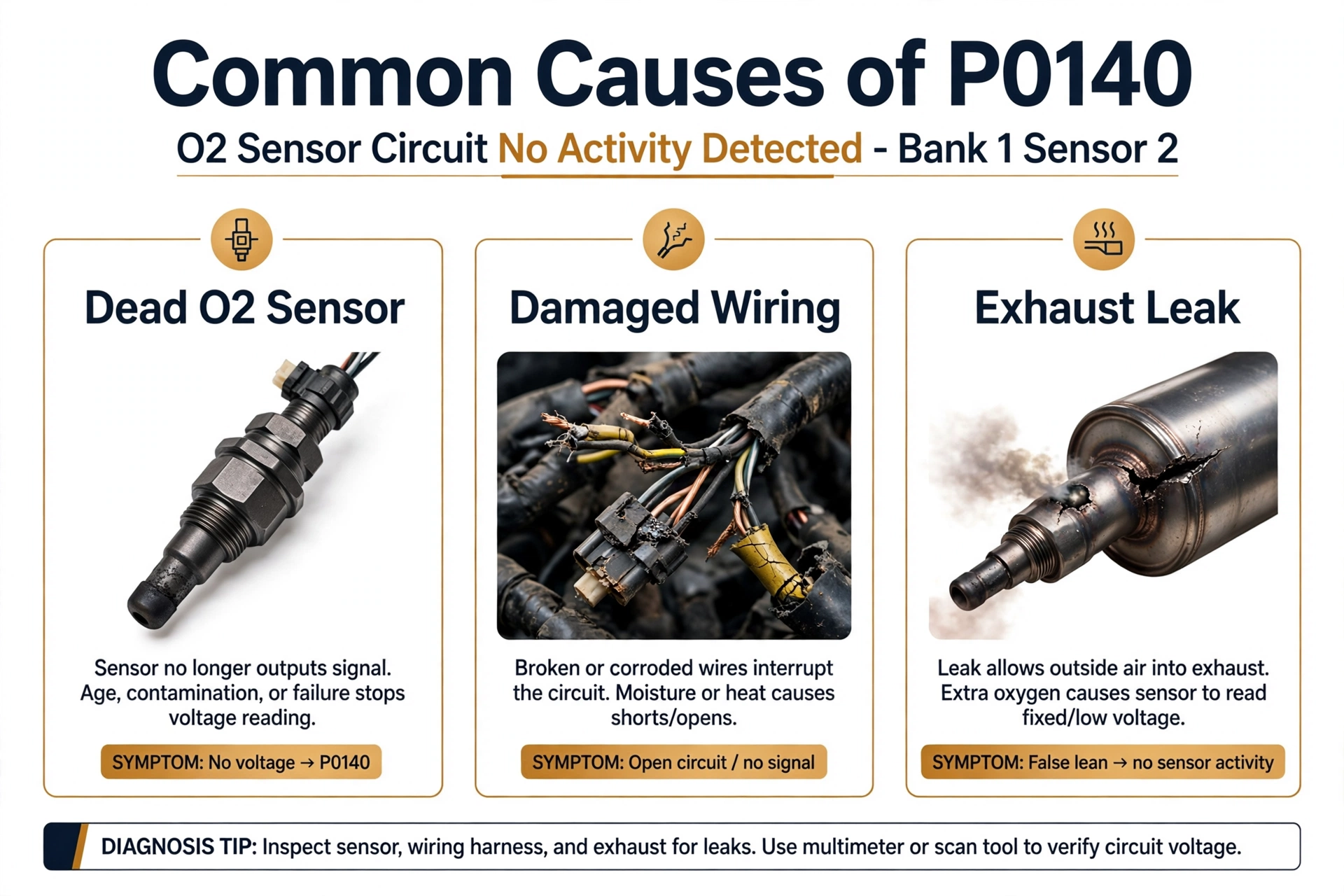
- A dead or dying downstream O2 sensor (Bank 1, Sensor 2). This is the most common cause: the sensor’s sensing element wears out with age, heat, or contamination and stops producing a signal.
- Damaged, frayed, melted, or corroded wiring between the sensor and the computer, or a loose, unplugged, or corroded electrical connector.
- A blown fuse in the O2 sensor heater circuit. The heater brings the sensor up to operating temperature quickly; if it never warms up, the sensor may never start switching.
- An exhaust leak near or ahead of the sensor. Outside air sneaking into the exhaust dilutes the sample and can pin the sensor’s reading flat.
- A failing catalytic converter, which is less common but possible.
- Rarely, an internal ECM fault or software issue that misreads a good sensor.
How to Diagnose P0140
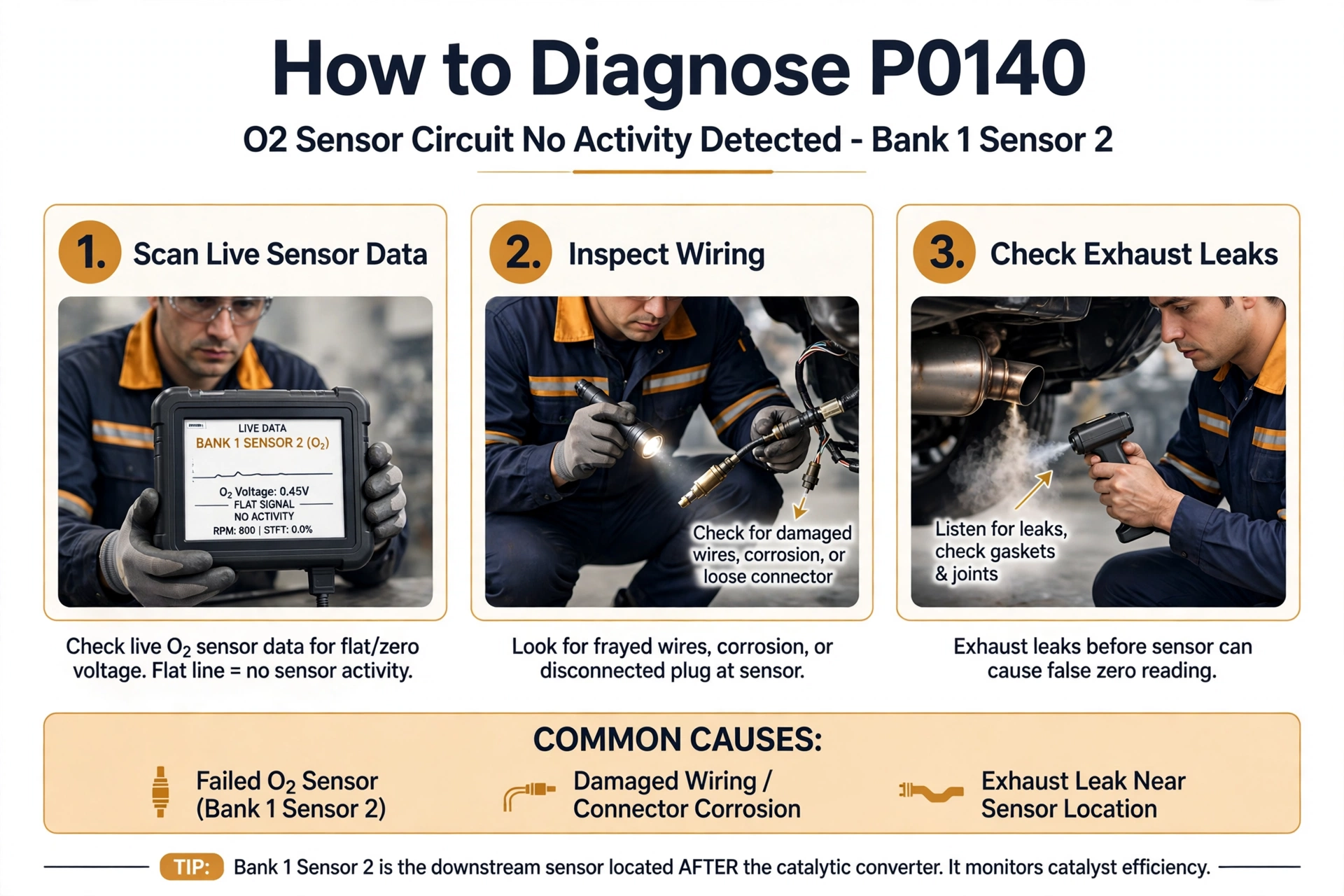
Diagnosing the p0140 code is mostly about proving which part of the circuit has gone quiet. Follow these steps in order:
- Confirm the code with an OBD-II scan tool and note any companion codes. Related codes such as P0136, P0138, P0141, or heater-circuit codes change the diagnosis.
- With the engine off and cool, visually inspect the Bank 1 Sensor 2 sensor, its wiring, and its connector. Look for melted insulation, chafed wires touching the exhaust, green corrosion inside the plug, or a connector that has worked loose.
- Check the exhaust pipe and joints near and ahead of the sensor for leaks, cracks, or loose flanges. A leak that lets outside air in is a classic cause of a flat downstream reading.
- Start the engine and watch live data for Bank 1 Sensor 2 on your scan tool. A faulty circuit shows a flat line, often stuck near 0.45 volts or at zero, while Bank 1 Sensor 1 keeps switching normally.
- Test the sensor’s heater circuit and signal wiring with a multimeter, and check the heater fuse. No power to the heater means the sensor may never wake up.
- If the sensor is confirmed dead and the wiring tests good, replace the Bank 1 Sensor 2 downstream O2 sensor, clear the code, and complete a drive cycle to verify the fix.
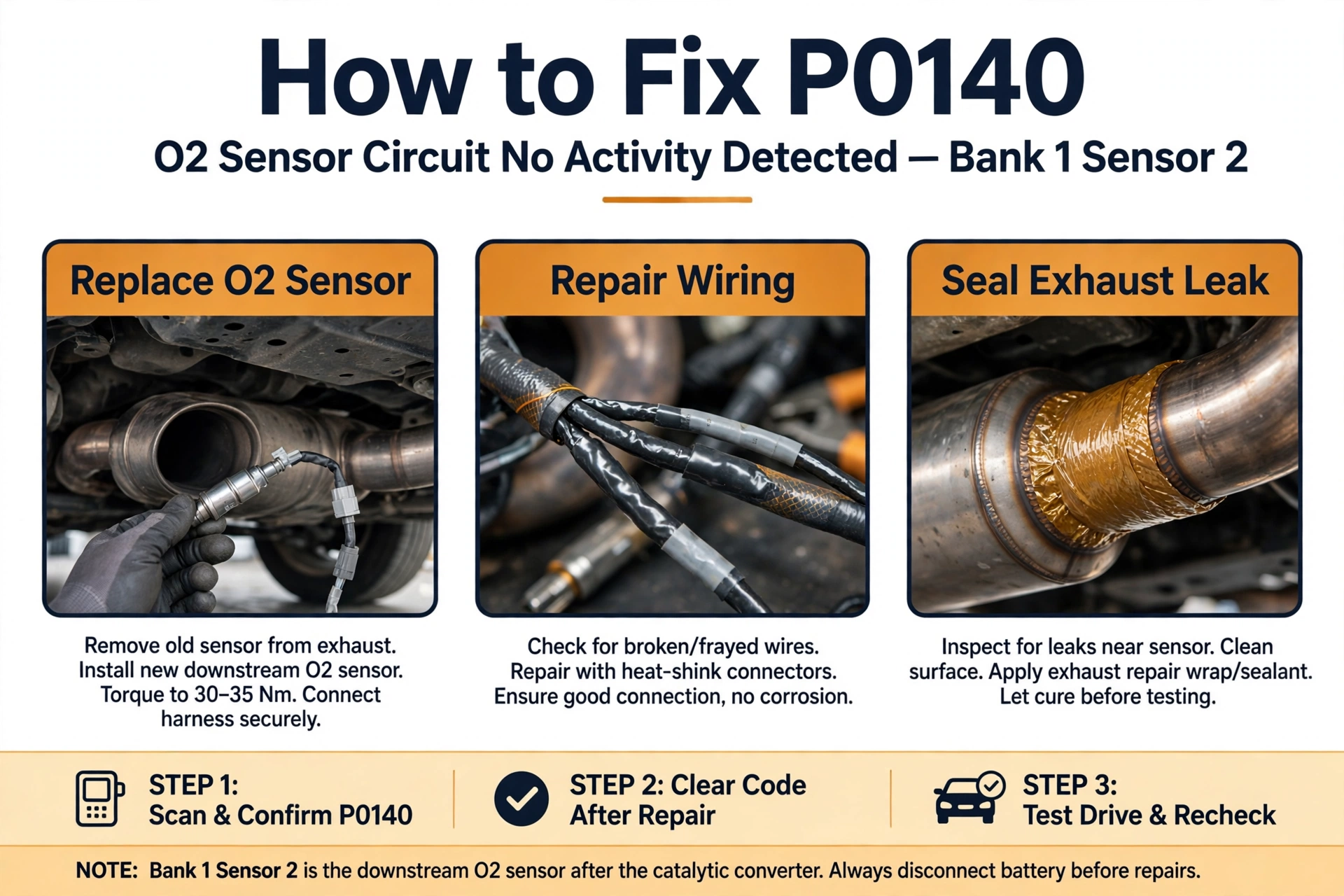
How to Fix a P0140 Code
There is no single fix for every P0140, because the repair depends on what your diagnosis found. The most effective fixes are:
- Replace the downstream oxygen sensor (Bank 1, Sensor 2) with a direct-fit sensor. Apply anti-seize to the threads if the new sensor is not pre-coated, torque it to spec, and route the harness away from hot exhaust parts.
- Repair or replace damaged wiring and clean or replace corroded connectors. Make sure the plug clicks fully home and the harness cannot rest on the exhaust.
- Replace a blown O2 sensor heater fuse, and find out why it blew before fitting a new one.
- Repair exhaust leaks near the sensor by tightening or replacing gaskets, clamps, or cracked sections of pipe.
- Clear the code with your scan tool and run a normal drive cycle. The monitor needs to see the sensor switching again before the code stays away for good.
P0140 Repair Costs
Typical repair costs for a P0140 code are modest compared with converter codes, because the fix is usually one sensor:
| Repair | Cost Range |
|---|---|
| Downstream O2 sensor replacement, shop (parts and labor) | $150 – $300 |
| Downstream O2 sensor, part only (DIY) | $40 – $120 |
| Wiring or connector repair | $50 – $150 |
| Exhaust leak repair near the sensor | $100 – $400 |
| Professional diagnostic fee | $75 – $150 |
DIY vs Mechanic Verdict
You can do this at home: inspecting the sensor’s wiring and connector, checking the heater fuse, reading live O2 sensor data with an affordable scan tool, and replacing the downstream O2 sensor itself. It is usually one sensor, one plug, and an O2 sensor socket. Disconnect the battery first and let the exhaust cool completely before you start.
See a mechanic for: wiring faults buried deep in the harness, exhaust leaks that need welding, a code that returns right after a new sensor (which can point to the catalytic converter or the computer), or any repair where you cannot safely lift the car.
Bottom line: P0140 is one of the more DIY-friendly trouble codes when the sensor itself has failed, which is the most common outcome. But diagnose first: a blown fuse or a loose connector costs far less than a sensor you did not need.
Can You Drive With a P0140 Code?
Yes, in most cases you can keep driving with a P0140 code. Because the downstream sensor does not control fuel trim, the engine usually runs exactly as before, and there are no driving restrictions. Treat it as a fix-within-1-to-2-weeks job, though: you will fail an emissions or smog inspection while the light is on, and ignoring the code lets any underlying exhaust or converter problem develop unchecked. Stop driving and get the car checked right away if the check engine light starts flashing (a sign of a severe misfire), you hear loud new exhaust noises, or you smell strong rotten eggs from the exhaust.
P0140 in Popular Vehicles
P0140 is a generic OBD-II code, so its meaning is the same on every make: no activity from the Bank 1 Sensor 2 downstream oxygen sensor. On V6 and V8 engines, remember that Bank 1 is the bank containing cylinder 1, so check your service manual before ordering parts. Drivers search for this code in many ways:
- p0140 honda, honda p0140, p0140 code honda
- p0140 toyota, toyota p0140, p0140 code toyota
- p0140 nissan, nissan p0140, p0140 code nissan
- p0140 chevy, chevrolet p0140, p0140 code chevrolet
- p0140 ford, ford p0140, p0140 code ford
- p0140 subaru, subaru p0140, p0140 code subaru
P0140 IN YOUR REGION: In markets outside North America you may see this code written as EOBD P0140. It is the same fault whether your tool displays it as EOBD P0140, DTC P0140, or OBD-II P0140: the downstream O2 sensor on Bank 1 is not switching.
P0140 vs P0138, P0157, P0139 and P0141
These four codes all involve the downstream oxygen sensor, but each describes a different electrical behavior, and mixing them up leads to buying the wrong part:
- P0140 vs P0138: P0140 means no activity, a flat signal, on Bank 1 Sensor 2. P0138 means the same sensor’s signal is stuck HIGH (rich), usually above about 0.9 volts.
- P0140 vs P0157: P0140 is Bank 1 Sensor 2 with no activity. P0157 is the Bank 2 Sensor 2 signal stuck LOW (lean). Different bank, different failure.
- P0140 vs P0139: P0139 means Bank 1 Sensor 2 is responding too SLOWLY, switching lazily. P0140 means it is not switching at all.
- P0140 vs P0141: P0141 is a heater circuit malfunction on Bank 1 Sensor 2, the electric heater that warms the sensor up. P0140 is the signal circuit showing no activity. A dead heater can keep a sensor cold enough to look inactive, so check the heater circuit before condemning the sensor.
Related Codes
P0136, P0137, P0138, P0139, P0141, P0157, P0160, P0161, P0420
Video Walkthrough: Fixing the P0140 Code
Video: “Causes and Fixes P0140 Code: Oxygen Sensor Circuit No Activity Detected (Bank 1, Sensor 2)” by HVAC Mechanic on YouTube.
P0140 FAQs
What does the P0140 code mean?
Can I drive with a P0140 code?
What causes a P0140 code?
How do I fix a P0140 code?
Will a P0140 code clear itself?
What is the difference between P0140 and P0138?
How much does it cost to fix a P0140 code?
Conclusion
P0140 is one of the more straightforward check engine codes you can get. The downstream oxygen sensor on Bank 1 has gone quiet, and the fix is usually a visual inspection followed by a sensor replacement. Do not ignore it just because the car drives fine: the light guarantees a failed emissions test, and the underlying fault can mask converter problems over time. Diagnose first, replace second, and you will have the p0140 code resolved without overspending.
About the author: I write plain-English OBD-II code guides so you can understand what your car is telling you, what to check first, and when to call a professional. I focus on practical, step-by-step diagnostics: symptoms, causes, real costs, and safe DIY checks.