
P0449 Trouble Code: Meaning, Causes, Symptoms & Fixes
In This Guide
One-line meaning: P0449: Evaporative Emission System Vent Valve/Solenoid Circuit Malfunction.
What the P0449 Code Means
The P0449 code is a generic OBD-II powertrain code, which means it carries the same definition on every make and model. Its full definition is “Evaporative Emission System Vent Valve/Solenoid Circuit Malfunction.” In plain English, your car’s computer has detected an electrical problem in the circuit that operates the EVAP vent valve, also called the vent solenoid.
Here is the background. The evaporative emission (EVAP) system traps fuel vapors from the gas tank in a charcoal canister so they do not escape into the atmosphere. The vent valve is normally open and sits on or near the canister, usually at the rear of the vehicle close to the fuel tank. While you drive, it lets fresh air flow into the canister. When the computer runs its EVAP self-test, it commands the vent valve closed to seal the system, then watches for leaks. Every time it sends that command, it also monitors the circuit’s voltage and current.
When your scanner displays engine code p0449, the computer has seen an open circuit, a short circuit, or resistance outside the expected range in the vent solenoid circuit, so it turns on the check engine light. The key thing to understand is that P0449 is an electrical code, not a leak code. Leak codes such as P0455 or P0442 mean the EVAP system cannot hold pressure. P0449 means the vent valve’s wiring or the solenoid itself is not responding the way the computer expects.

Symptoms of the P0449 Code
P0449 rarely causes drivability problems, which is why many drivers only learn about it from a scan or a failed inspection. The engine will usually run exactly as it always has.
- Check engine light (MIL) on, often the only symptom you will notice
- A faint fuel or vapor smell near the rear of the vehicle or inside the cabin
- Rough idle or stalling right after refueling, if the vent valve is stuck
- A failed emissions test, because the EVAP readiness monitor cannot complete
- A slight drop in fuel economy in some cases
- Difficulty refueling, or the pump nozzle clicking off early (rare, happens when the valve sticks closed)
What is code P0449 trying to tell you? In short: the vent valve circuit has an electrical fault. The p0449 code does not by itself tell you which part failed, only that the circuit is not behaving, so some testing is needed before replacing anything.

Common Causes of P0449
The most common cause of a P0449 code is a failed vent valve solenoid, but damaged wiring runs a close second. Real-world reports from truck owners show that a broken wire in the pigtail at the valve can set this code even after the valve itself has been replaced.
- Faulty EVAP vent valve/solenoid: the internal coil burns open, the plunger sticks from dirt or corrosion, or the valve simply stops responding to commands. This is the number one cause, and it is extremely common on GM trucks and SUVs.
- Damaged wiring or connectors: the valve lives underneath the vehicle, exposed to road salt, water spray, and debris. Chafed, corroded, or broken wires, especially in the pigtail connector right at the valve, are a classic cause.
- Blown EVAP fuse: the solenoid shares a fused feed with other EVAP components on many vehicles. An electrical short can pop the fuse and set the code.
- Clogged vent filter or saturated charcoal canister: dirt, mud, or debris can block the vent path so the valve cannot do its job.
- Failed PCM driver: rare, but the computer’s internal driver transistor for the vent solenoid can fail. Only consider this after the wiring and solenoid test good.
- Loose or damaged gas cap: a bad cap will not directly set P0449 (it usually sets leak codes instead), but it costs nothing to check, so rule it out.

How to Diagnose P0449 (Do This Before Buying Parts)
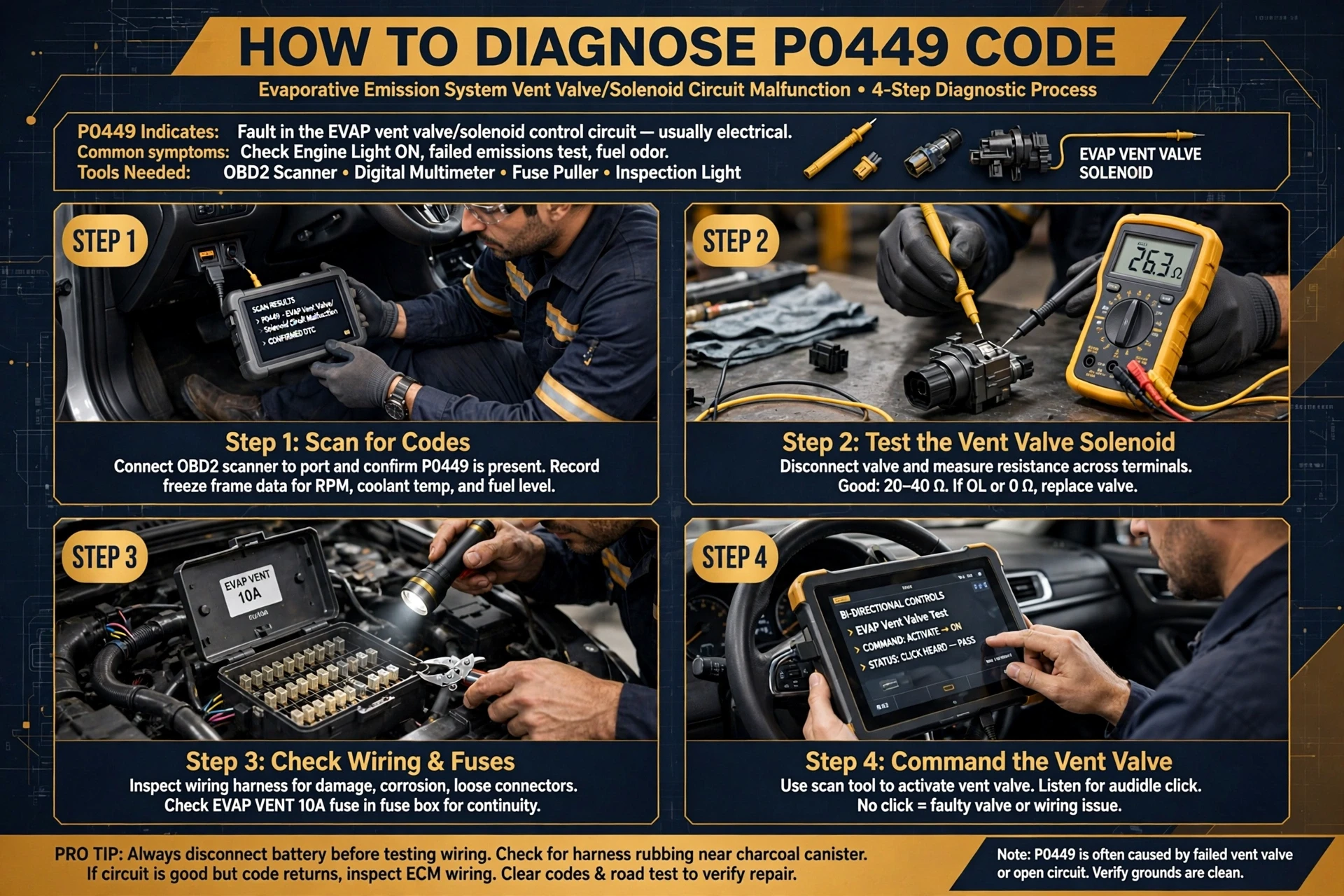
P0449 gets misdiagnosed constantly because the code names the vent valve, so people replace the valve first. Test the circuit first instead. Work through these steps in order:
- Confirm the code and check freeze-frame data. Note any companion codes: P0449 plus P0455 or P0442 suggests a stuck-open valve, while P0449 plus P0446 points at vent performance or a clogged canister.
- Check the EVAP fuse. Find it in the underhood fuse box using the diagram on the lid. A blown fuse is the cheapest fix there is.
- Inspect the wiring and connectors. Follow the harness from the frame rail back to the canister and vent valve. Look for chafing, corrosion, green crust on pins, and broken wires in the pigtail right at the valve connector.
- Test for power at the valve. Unplug the vent valve connector, turn the key on, and check for battery voltage (about 12V) on the feed wire.
- Measure solenoid resistance. With the valve unplugged, measure across the two solenoid terminals and compare to spec. Many solenoids read roughly 20 to 40 ohms at room temperature (some GM units read near 18.5 ohms). An open (infinite) or shorted (near zero) reading confirms a bad solenoid.
- Command the valve with a scan tool. A bidirectional tool can command the vent valve open and closed. A healthy valve makes a clear click.
- Clear the code and verify. After the repair, clear the codes and complete a drive cycle so the EVAP monitor runs and the light stays off.
How to Fix the P0449 Code
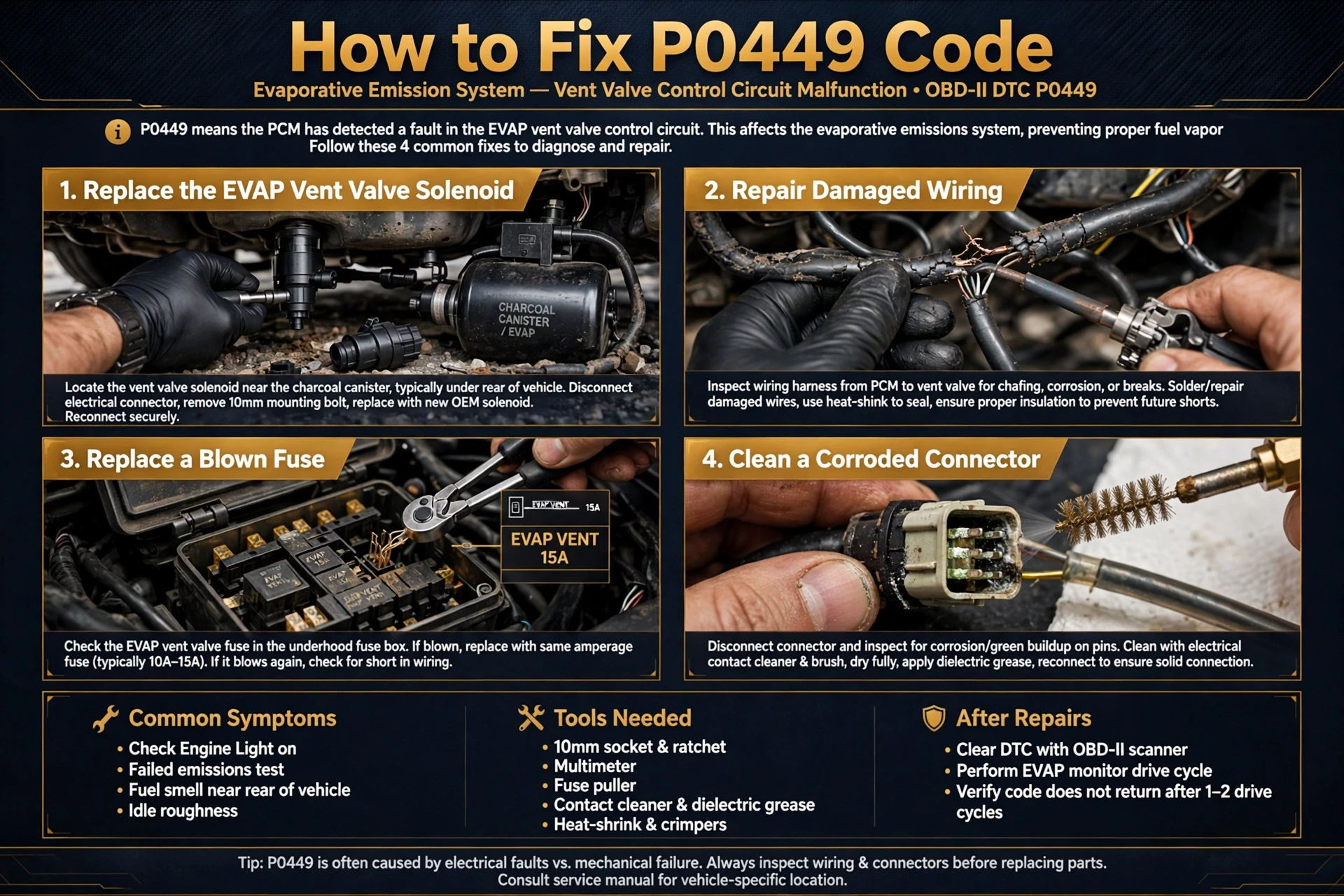
The right fix depends on what your diagnosis found:
- Replace the vent valve/solenoid: the most common fix. It is usually held on by a couple of bolts plus an electrical connector and a hose. Use an OEM or quality part, since cheap aftermarket valves are known to retrigger the code on some trucks.
- Repair the wiring: clean corroded terminals with electrical contact cleaner, replace a damaged pigtail or connector, and repair any chafed section of the harness.
- Replace a blown fuse: use the same amperage. If the new fuse blows immediately, there is a short to find.
- Clean or replace the vent filter/canister: if the solenoid tests good but the vent path is blocked, clear the blockage or replace the canister.
- Address the PCM last: a reflash or replacement is the last resort, only after every hardware cause has been ruled out.
P0449 Repair Costs
Drivers always ask how much it costs to fix the p0449 code, and the answer depends entirely on the cause. Here are typical ranges:
| Repair | Cost Range |
|---|---|
| Vent valve/solenoid replacement | $30 – $100 (DIY) / $80 – $300 (shop) |
| Wiring/connector repair | $10 – $30 (DIY) / $80 – $250 (shop) |
| Fuse replacement | $2 – $10 (DIY) / $50 – $150 (shop) |
| Charcoal canister replacement | $50 – $200 (DIY) / $300 – $700 (shop) |
This is why diagnosis matters. A $5 fuse and a $300 valve job share the same code, so test before you spend.
DIY vs Mechanic Verdict
You can do this at home: checking the EVAP fuse, inspecting the wiring and connectors for damage, testing solenoid resistance with a multimeter, checking for 12V power at the connector, and replacing the vent valve itself.
See a mechanic for: bidirectional scan-tool testing of the valve, smoke testing the EVAP system, tracing deep wiring faults along the chassis, and any suspected PCM problem.
Bottom line: this is one of the most DIY-friendly check engine codes. Diagnose it yourself with basic tools, fix the simple stuff yourself, and let a pro handle the tricky electrical tracing.
Can You Drive With a P0449 Code?
Generally yes, for short trips. P0449 is an emissions code, not an engine protection code, so the engine will keep running normally and the code will not damage anything under the hood. The downsides are a failed emissions inspection, since the check engine light is an automatic failure, and possibly a fuel smell. Get it fixed before your next test, and sooner if the light starts flashing or new symptoms appear.
P0449 on Popular Vehicles
P0449 is a generic code that can appear on any OBD-II vehicle, but some patterns are worth knowing:
- Chevy/GMC (Silverado, Tahoe, Suburban, Yukon): the p0449 chevy and GMC code is extremely common. Check the harness routed along the frame rail to the canister, and prefer an OEM Delphi vent valve, since some aftermarket units retrigger the code.
- Buick/Cadillac (Enclave, Escalade, SRX): often shows up paired with P0455 (large leak). Inspect the EVAP harness near the rear subframe.
- Ford (F-150, Escape, Explorer, Fusion): the canister vent solenoid is the typical failure point. Motorcraft or Standard Motor Products parts are the safe bet.
- Honda (Accord, Civic, CR-V, Pilot): connector corrosion is the number one cause on Hondas, so check the pins and terminals before replacing parts.
- Toyota/Lexus (Camry, RAV4, Tundra): less frequent than on GM, but increasingly common past 120k miles. Verify the part number, since Toyota revised the vent valve across model years.
- Nissan, Hyundai/Kia, Jeep, Subaru: documented as vent solenoids age past 100k miles.
EOBD P0449 and OBD P0449 are the same code under different naming (European vs generic OBD-II). DTC P0449 always refers to the vent valve/solenoid circuit.
P0449 vs P0446
P0449 and P0446 are the two vent valve codes drivers mix up most. P0449 is a circuit malfunction: an electrical fault such as an open, a short, or out-of-range resistance in the vent solenoid circuit. P0446 is a vent control performance code: the valve’s circuit looks okay electrically, but the valve does not seal or perform as commanded. The two often appear together, and that combination points strongly at the vent valve, its wiring, or a clogged canister vent.
Related Codes
- P0446: Evaporative Emission System Vent Control Malfunction
- P0442: Evaporative Emission System Leak Detected (Small Leak)
- P0455: Evaporative Emission System Leak Detected (Large Leak)
- P0441: Evaporative Emission Control System Incorrect Purge Flow
- P0496: EVAP System High Purge Flow
Video Walkthrough
Watch the video above for a visual walkthrough of EVAP vent valve solenoid symptoms, how the valve works, and how to diagnose it without a scanner, including the P0449 code, before you read on.
Frequently Asked Questions
What is the most common cause of a P0449 code?
A failed EVAP vent valve solenoid is the single most common cause. The internal coil burns out or the valve sticks and stops responding to the computer’s commands. Damaged wiring and corroded connectors are the second most common cause, so inspect the harness before buying parts.
Can I still drive my car with a P0449 code?
Yes, for short trips. P0449 is an emissions code, not an engine protection code, so the car will run normally. Get it fixed before your next emissions inspection, because the check engine light is an automatic failure.
How do you fix the code P0449?
Diagnose first: check the EVAP fuse, inspect the wiring and connectors at the vent valve, test for 12V power at the connector, and measure solenoid resistance. Then replace the vent valve solenoid if it tests bad, or repair the wiring or fuse if that is the problem. Clear the code and run a drive cycle to verify.
How much does it cost to fix P0449?
A vent valve replacement costs about $30 to $100 DIY or $80 to $300 at a shop. Wiring repairs run $80 to $250 professionally, a fuse costs a few dollars, and a charcoal canister runs $300 to $700 installed. Diagnosis first keeps the bill low.
Will P0449 clear itself?
Usually not. The electrical fault that sets engine code p0449 stays until it is repaired. An intermittent loose connector can make the light come and go, but the code will keep returning until the underlying problem is fixed.
Can a bad purge valve cause P0449?
No. P0449 is specific to the vent valve/solenoid circuit. A bad purge valve sets different codes, such as P0441 (incorrect purge flow) or P0496 (high purge flow). If you have both vent and purge codes, diagnose each circuit separately.
Where is the EVAP vent valve located?
On most vehicles it is bolted to or near the charcoal canister, which sits underneath the vehicle at the rear, close to the fuel tank. Follow the EVAP lines from the tank and you will find it.
Conclusion
The P0449 code looks intimidating, but it is really your car asking for a simple electrical check, not an automatic parts cannon. Test the fuse, the wiring, and the solenoid before spending money, and in most cases the fix is a straightforward vent valve replacement you can do in your driveway. Fix it before your next emissions test and the light will stay off.
About the author: Written by the OBD2 Code Hub editorial team. Our diagnostic guides are built from real OBD-II data, manufacturer service information, and hands-on shop experience to help you fix check engine lights with confidence.