
P0325 Trouble Code: Meaning, Causes, Symptoms & Fixes
In This Guide
One-line meaning: P0325: Knock Sensor 1 Circuit Malfunction (Bank 1).
What the P0325 Code Means
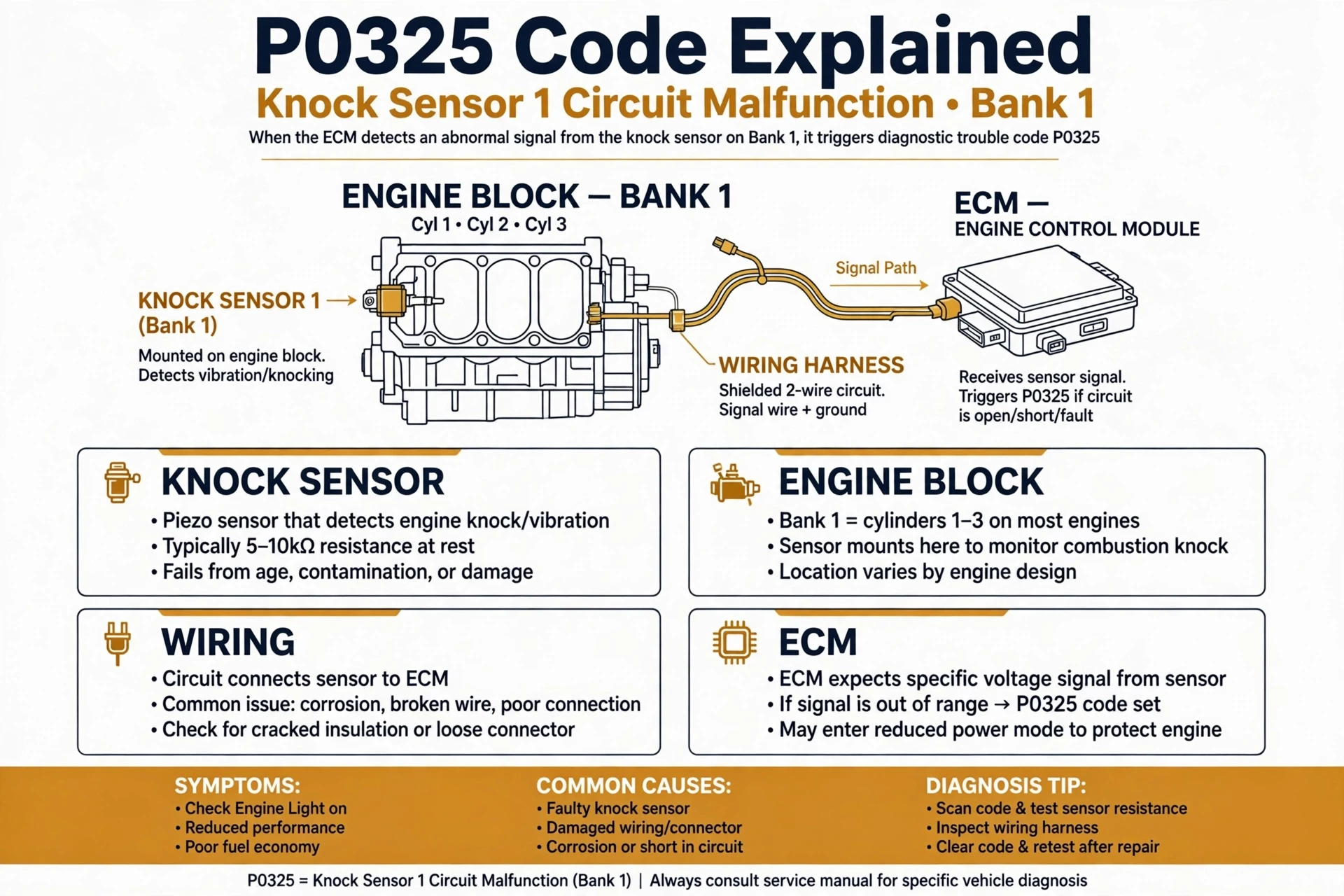
The P0325 code is one of the most searched check engine light codes from drivers dealing with drivability complaints. Its full definition is “Knock Sensor 1 Circuit Malfunction (Bank 1)” (p0325 knock sensor 1 circuit malfunction bank 1). In plain English, your car’s engine computer (ECM/PCM) is not receiving a proper signal from the knock sensor on bank 1, the side of the engine that contains cylinder number one.
Here is what that sensor does. A knock sensor is a small piezoelectric microphone bolted to the engine block. It listens for abnormal combustion, the uncontrolled mini explosions engineers call detonation, spark knock, or pinging. When it hears knock, it converts those vibrations into a voltage signal and sends it to the computer, which instantly retards the ignition timing to protect the pistons and bearings. The computer expects that signal to stay inside a set voltage window. When the signal drops out, sticks too high, or falls too low, the computer knows the circuit has a problem and stores the P0325 code.
P0325 (p0325 obd ii, p0325 code bank 1) is a generic powertrain code, which means it carries the same meaning on every make and model, from a Honda Civic to a Ford F-150 to a Toyota Camry. Note the wording carefully: this is a circuit malfunction code, not a “knock detected” code. It means the computer cannot trust the sensor signal, which is a different problem from the engine actually knocking.
Symptoms of the P0325 Code
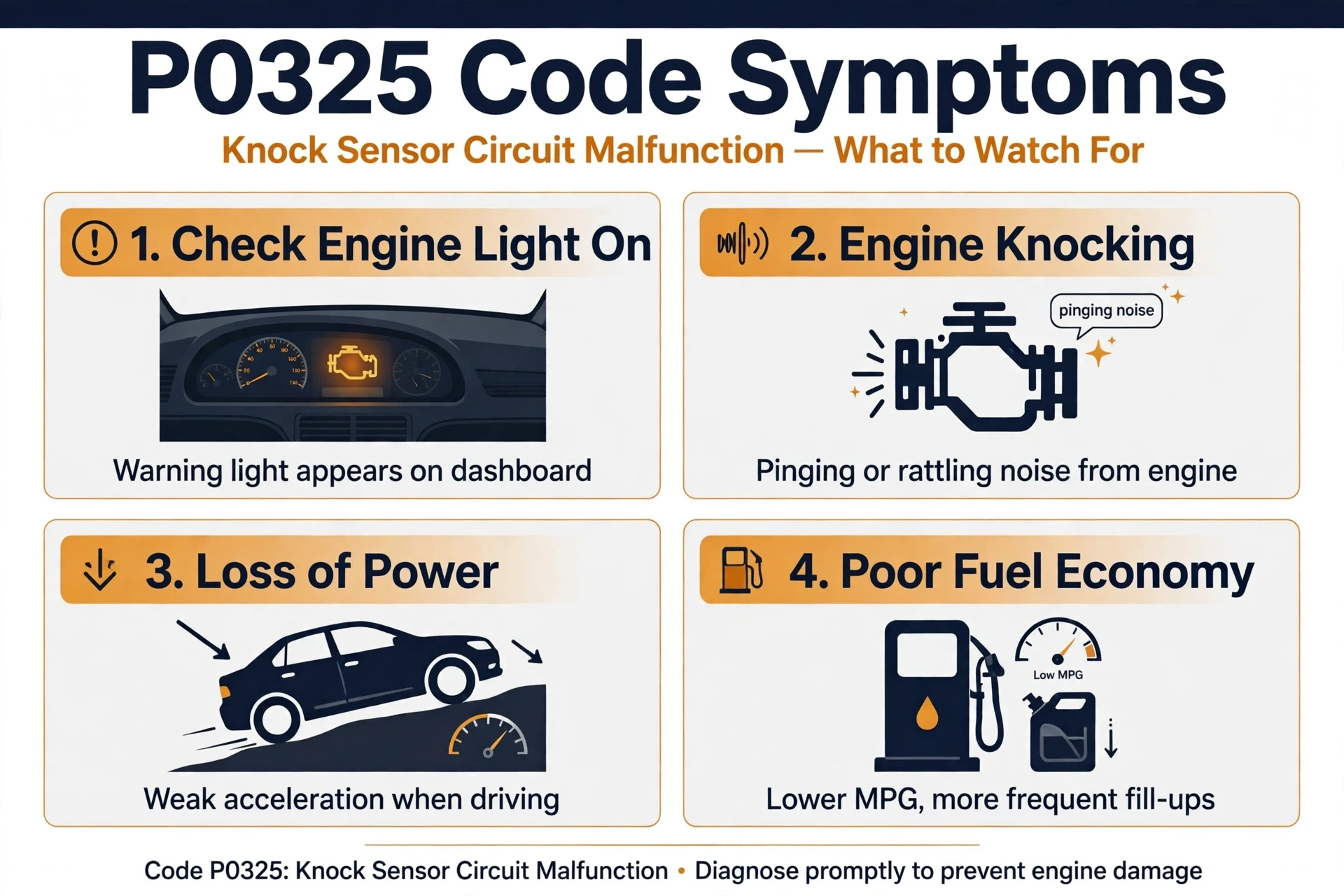
In many cases, the check engine light is the only symptom you will notice. The car may drive exactly the same as before, which is why the P0325 code surprises so many drivers. However, because the computer loses its knock feedback, it switches to a conservative backup strategy, and depending on the underlying cause, you might also notice:
- Check engine light, often with no other obvious symptoms
- Reduced fuel economy or excessive fuel consumption, since the computer runs cautious timing and a richer mixture to stay safe
- Sluggish acceleration, lack of power, or engine hesitation under load
- Audible pinging or knocking noise under acceleration, if real detonation is happening and the computer cannot hear it
What is code P0325? What is car code P0325 trying to tell you? In short: the computer has lost its ears. It can no longer hear whether the engine is knocking, so it plays it safe, and your performance and fuel economy pay the price.
Common Causes of P0325
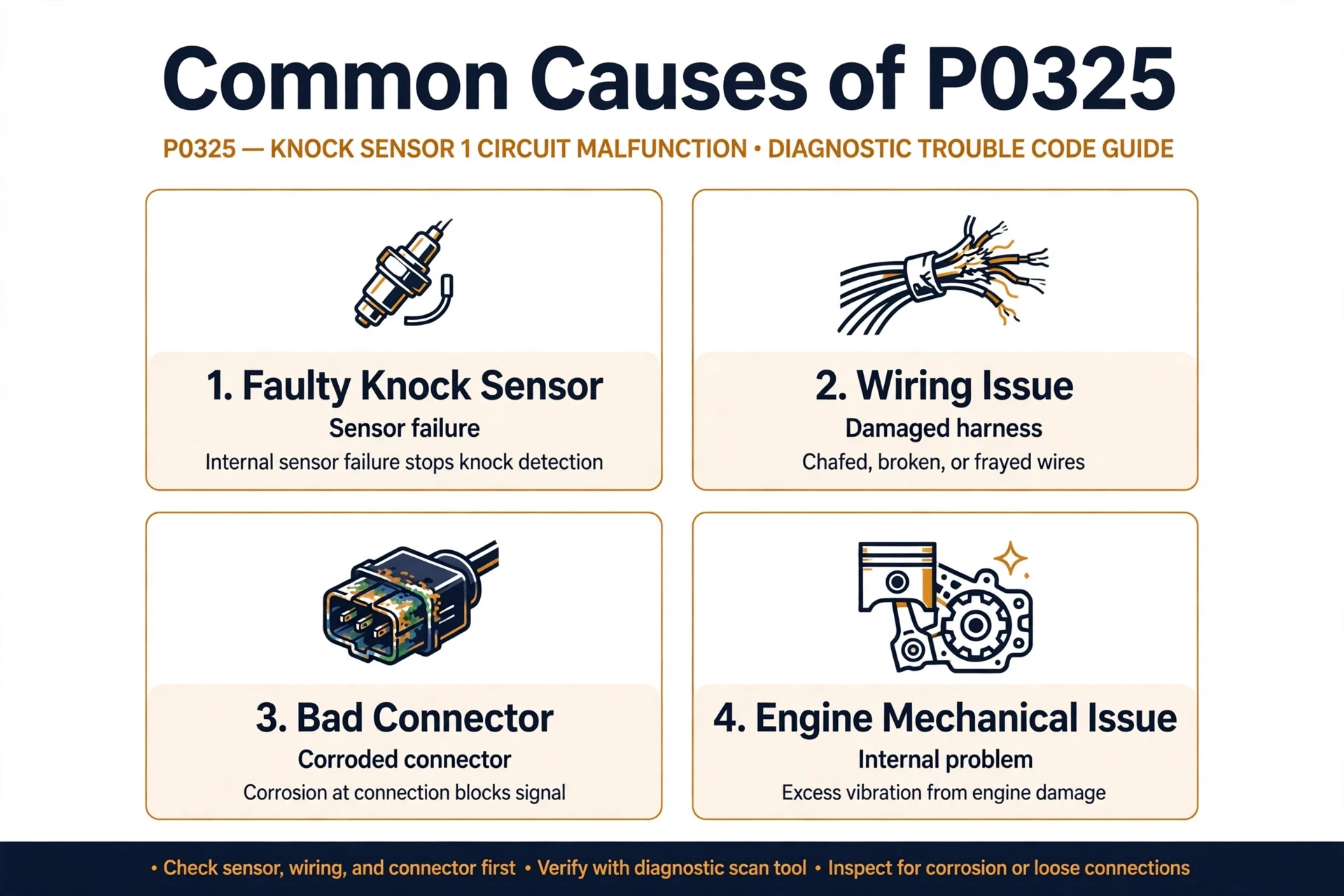
The most common cause of a P0325 code is a faulty knock sensor itself, usually one that has cracked, corroded, or degraded after years of engine heat. But damaged wiring is a very close second, and on some vehicles it is actually the number one cause. Here are the causes, roughly in order of likelihood:
- Faulty knock sensor: the sensor element has failed, cracked, or degraded due to heat and age. Corrosion at the sensor body is common.
- Wiring or connector damage: broken, frayed, or corroded wires, loose pins, or oil-soaked connectors in the knock sensor harness interrupt the signal.
- Pest damage: rodents love to chew through knock sensor wiring harnesses, especially on vehicles parked outdoors. This is a famously common cause on some Toyota V6 models.
- Actual engine knock: real detonation caused by low-octane fuel, carbon buildup, worn spark plugs, a lean running condition, or cooling system overheating. The sensor circuit gets blamed when the underlying problem is mechanical.
- Faulty ECM/PCM: rare, but the computer itself can misread a good signal. Only suspect this after the sensor and wiring test good.
How to Diagnose P0325 (Do This Before Buying Parts)
Mechanics see the P0325 code misdiagnosed constantly. The code points at the knock sensor circuit, but the real fault is often upstream in the wiring, or even in the engine itself. Follow this order:
- Scan for other codes first. If you also have misfire codes (P0300 series), cooling system codes, or lean codes, fix those first. They may be causing real knock that the sensor circuit is reporting.
- Visually inspect the wiring and connector. Trace the knock sensor harness and look for oil contamination, corrosion, snapped wires, loose pins, and signs of rodent chewing.
- Test the sensor with a multimeter. Measure resistance at the sensor terminal and compare it against your vehicle’s manufacturer specification (many common applications read around 500 to 600 kOhms). A dead short or an open circuit means the sensor is bad.
- Check for real engine knock. Ask when the code sets: cheap low-octane fuel, overheating, and worn spark plugs can all cause genuine detonation.
- Verify the repair. Clear the code, road test under load (a hill or hard acceleration), and rescan. Knock sensor codes often need a full drive cycle to return.

How to Fix the P0325 Code
The right fix depends on what your diagnosis found:
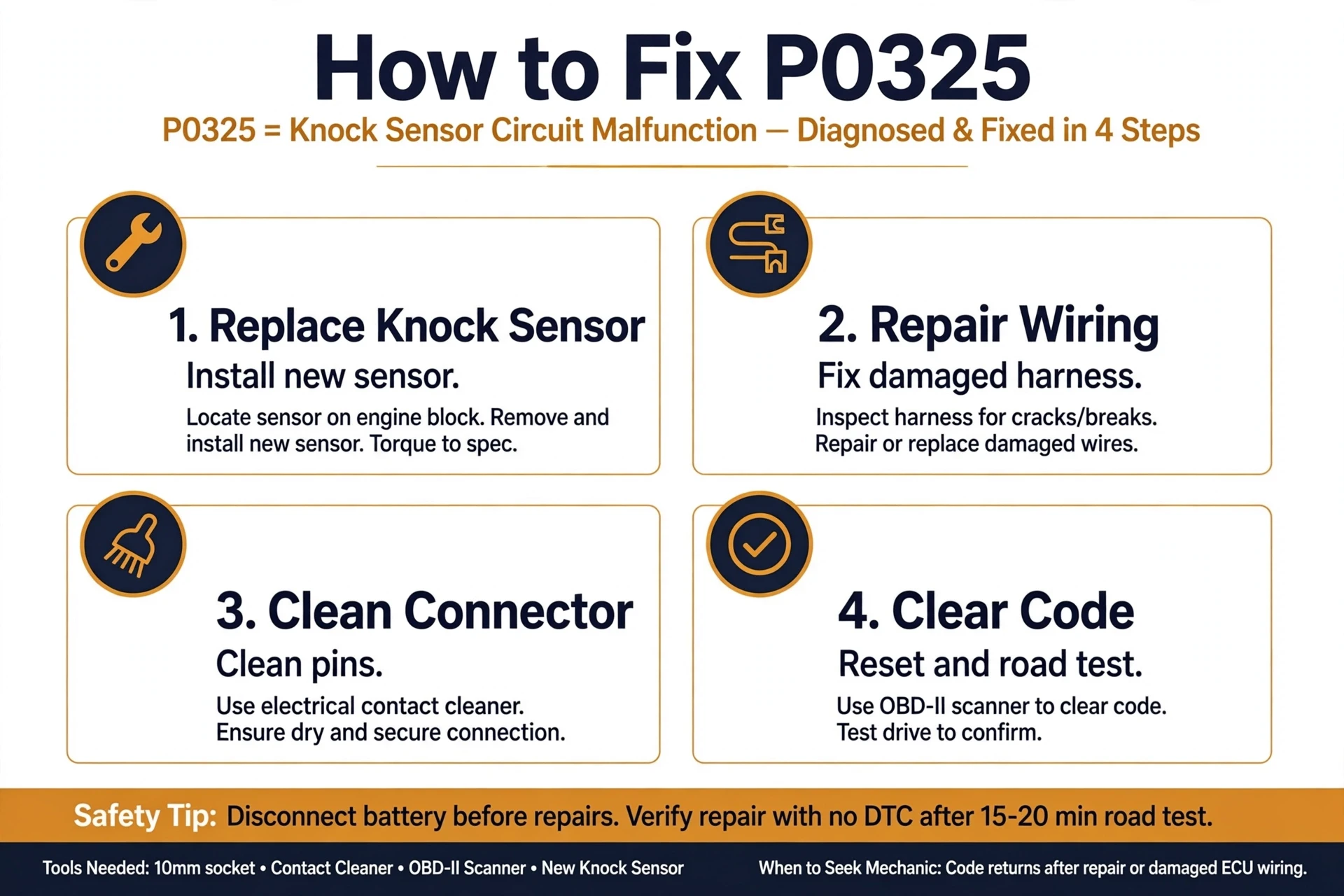
- Repair damaged wiring: splice in new wire, replace corroded connectors, and re-route the harness away from heat. This is often the cheapest fix and solves many P0325 cases.
- Replace the faulty knock sensor: if the sensor fails the resistance test, replace it. The sensor often sits beneath the intake manifold on V6 and V8 engines, so budget extra labor there, and always tighten the new sensor to the exact torque spec.
- Fix the underlying engine problem: new spark plugs, cooling system repairs, or switching back to the correct octane fuel, whatever is causing the real knock.
- Clear and retest: erase the code with your scanner and drive normally. If the p0325 code stays away through several drive cycles, the fix worked.
P0325 Repair Costs
Drivers always ask how much it costs to fix P0325, and the answer depends entirely on the cause. Here are realistic ranges:
| Repair | Cost Range |
|---|---|
| Knock sensor replacement (parts and labor) | $150 – $450 |
| Wiring or connector repair | $100 – $250 |
| Spark plugs (knock-related fix) | $150 – $400 |
| ECM/PCM replacement (rare) | $500 – $1,500+ |
This is why diagnosis matters. The sensor itself is often a $20 to $60 part, but on engines where it hides under the intake manifold, labor makes up most of the bill. A $150 wiring repair and a $450 sensor job share the same p0325 code.
DIY vs Mechanic Verdict
You can do this at home: reading codes with an OBD2 scanner, visually inspecting the knock sensor harness for damage or rodent chewing, checking connectors for oil and corrosion, and testing sensor resistance with a multimeter.
See a mechanic for: knock sensor replacement when it sits under the intake manifold, intermittent electrical faults that need a lab scope, and any suspected ECM problem.
Bottom line: diagnose it yourself, fix the wiring yourself, but let a pro handle the buried sensor swap unless you are comfortable removing an intake manifold.
Can You Drive With a P0325 Code?
Technically yes, for a short time, if you absolutely have to. The computer falls back to conservative ignition timing to protect the engine. But driving long term with P0325 is not advisable: fuel economy drops, performance suffers, and if real detonation is occurring, the computer cannot hear it or correct it, which can damage pistons over time. Get it diagnosed soon, and avoid hard acceleration and towing until you do.
P0325 on Popular Vehicles
P0325 shows up across all brands, but some patterns are worth knowing:
- Honda (Accord, Civic, CR-V, Element): The p0325 honda code (honda p0325, p0325 code honda) is extremely common, especially on K-series engines. A failed sensor is the usual culprit, and replacement is a well-documented DIY job.
- Toyota (Camry, Corolla, RAV4, Lexus): The p0325 toyota code (toyota p0325, p0325 code toyota) on V6 models like the 1MZ-FE is famous for rodent-chewed knock sensor harnesses. Check the wiring before buying a sensor.
- Nissan (Altima, Sentra, Rogue): For p0325 nissan (nissan p0325, p0325 code nissan), check both the sensor and the sub-harness connector, which can oil-foul over time.
- Chevy / GM (Silverado, Malibu, Equinox): The p0325 chevy code (p0325 code chevy, code p0325 chevy) often traces to wiring chafing where the harness crosses the engine.
- Ford (F-150, Escape, Explorer): The p0325 ford code (ford code p0325) can accompany lean running conditions, so pull the full code list before condemning the sensor.
EOBD P0325 and OBD P0325 are the same code under different naming (European vs generic OBD-II). DTC P0325 and OBD P0325 also refer to the identical fault.
P0325 vs P0330
P0325 is bank 1, sensor 1. P0330 is the mirror image for bank 2: “Knock Sensor 2 Circuit (Bank 2).” On a four-cylinder engine there is only bank 1, so you will never see P0330. On V6 and V8 engines, the two banks each get their own sensor, and a wiring or rodent problem can easily set both codes at once. Diagnose them the same way.
Related Codes
- P0326: Knock Sensor 1 Circuit Range/Performance (Bank 1)
- P0327: Knock Sensor 1 Circuit Low Input (Bank 1)
- P0328: Knock Sensor 1 Circuit High Input (Bank 1)
- P0330: Knock Sensor 2 Circuit (Bank 2)
Video Walkthrough
Watch the video above for a visual walkthrough of P0325 causes and diagnosis before you read on.
Frequently Asked Questions
What is the most common cause of a P0325 code?
A faulty knock sensor or damaged wiring to it. The sensor element cracks or degrades from years of engine heat, and the harness suffers from corrosion, oil contamination, or rodent damage. Actual engine problems like worn spark plugs or overheating are less common but worth ruling out, which is why testing before replacing parts saves so much money.
Can I still drive my car with a P0325 code?
Yes, for short trips if you must. The computer switches to conservative ignition timing to protect the engine. But you should not ignore it long term: fuel economy and performance suffer, and if genuine detonation is happening, the computer cannot detect or correct it, which risks piston damage over time.
How do you fix the code P0325?
Diagnose first: scan for companion codes, inspect the knock sensor wiring and connector for damage or corrosion, and test the sensor with a multimeter against factory specs. Then repair what you find: fix the wiring, replace a failed sensor (torqued to spec), or address the engine issue causing real knock. Clear the code and road test to confirm.
How much does it cost to fix P0325?
From about $100 to $250 for a wiring repair, $150 to $450 for a knock sensor replacement depending on labor access, and up to $400 if worn spark plugs are the root cause. The sensor itself is usually a $20 to $60 part; labor dominates when it sits under the intake manifold.
Will P0325 clear itself?
Rarely. If the underlying fault was temporary, it might. Usually the code returns within a few drive cycles until the real problem is fixed, because the computer re-tests the knock sensor circuit every time you drive.
Can bad spark plugs cause P0325?
Yes. Worn spark plugs can cause real engine knock (detonation), and the resulting abnormal signal can trigger knock sensor circuit codes. If your plugs are overdue, replace them as part of the diagnosis before condemning the sensor.
Where is the knock sensor located?
Bolted to the engine block, cylinder head, or intake manifold area, positioned to pick up combustion vibrations. On many V6 and V8 engines it sits beneath the intake manifold, which is why replacement labor can be high. Bank 1 is the side of the engine containing cylinder number one.
Conclusion
The P0325 code looks scary, but it is really your car telling you it has lost its knock feedback, not that the engine is doomed. Work through the diagnosis in order, check the wiring before buying parts, and you will either solve it cheaply or know for certain the sensor needs replacing. Either way, you stop guessing and start fixing.
About the author: Written by the OBD2 Code Hub editorial team. Our diagnostic guides are built from real OBD-II data, manufacturer service procedures, and hands-on troubleshooting experience, then reviewed for technical accuracy before publishing. We drive the same cars you do.