
P0120 Trouble Code: Meaning, Causes, Symptoms & Fixes
In This Guide
One-line meaning: P0120: Throttle/Pedal Position Sensor/Switch A Circuit Malfunction.
What the P0120 Code Means
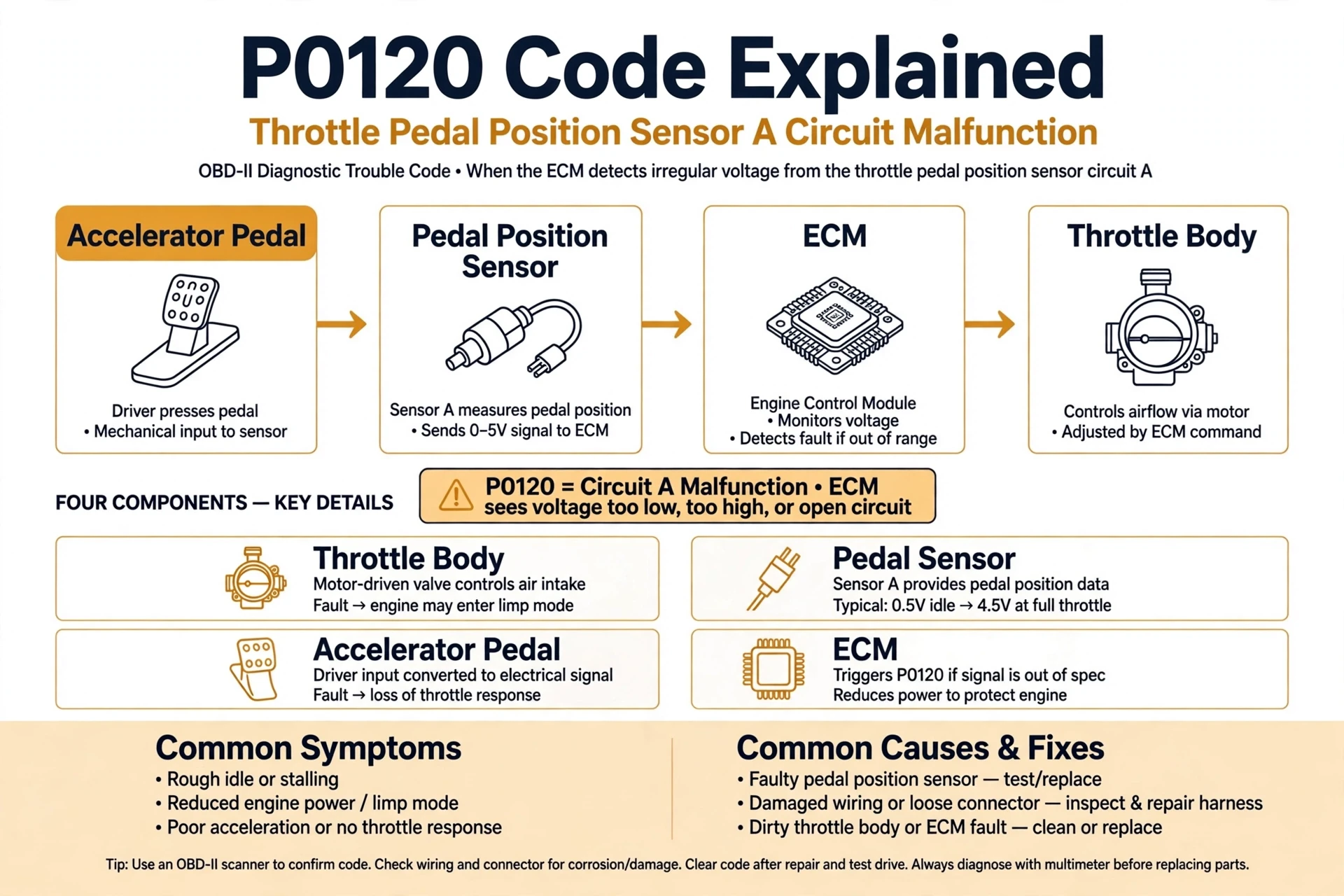
The P0120 code is a diagnostic trouble code that stands for “Throttle/Pedal Position Sensor/Switch A Circuit Malfunction.” In plain English, your car’s engine computer (ECM/PCM) has detected that the voltage signal coming from the throttle position sensor (TPS) or the accelerator pedal position (APP) sensor on circuit “A” is missing, out of range, or erratic.
Here is how your car figures this out. On modern drive-by-wire vehicles, there is no physical cable between your gas pedal and the throttle body. Instead, the accelerator pedal position sensor tells the computer how far you are pressing the pedal, and the throttle position sensor reports how far the throttle plate has actually opened. The computer constantly compares these signals. When the “A” circuit signal drops out, spikes, or disagrees with what the computer expects (sometimes cross-checked against the mass airflow sensor and crankshaft position sensor), it stores the P0120 code and turns on the check engine light.
P0120 (p0120 obd ii, p0120 code) is a generic powertrain code, which means it has the same meaning on every make and model, from a Toyota Corolla to a Ford F-150 to a Nissan Altima. The “A” in the definition matters: many vehicles use two redundant sensor circuits (A and B), so the p0120 code points specifically at circuit A. Related codes like P0121, P0122, and P0123 describe range, low voltage, and high voltage faults on that same circuit.
Symptoms of the P0120 Code
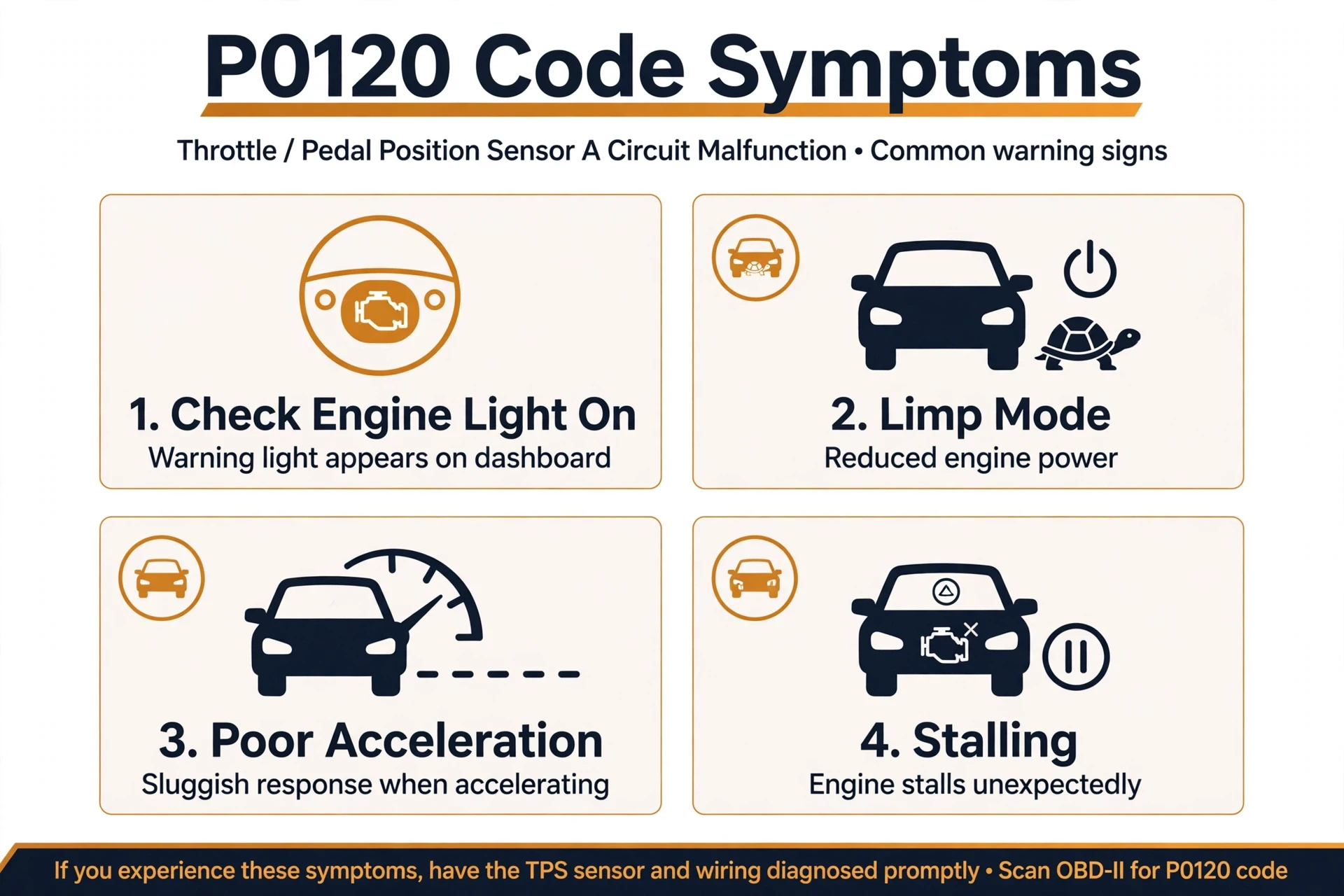
The check engine light is the one symptom every driver with a P0120 code will see, either steady or flashing. Beyond that, the symptoms depend on how badly the signal is corrupted. Because the computer no longer trusts the throttle data, it often takes protective action:
- Check engine light on, steady or flashing
- Limp mode or reduced engine power, the car deliberately limits acceleration to protect the engine
- Rough or erratic idle, with RPMs that bounce or surge up and down
- Hesitation or stumbling when you press the gas pedal, the car delays or jerks instead of accelerating smoothly
- Engine idles higher than normal or revs unexpectedly
- Hard starting, rare, but the engine may struggle to fire up
- Transmission shifts incorrectly or harshly on some vehicles, since shift timing uses throttle data
What is code P0120 trying to tell you? In short: the computer has lost confidence in the throttle signal, so it is guessing. Do not ignore it just because the car still moves, limp mode and throttle faults can get worse without warning.
Common Causes of P0120
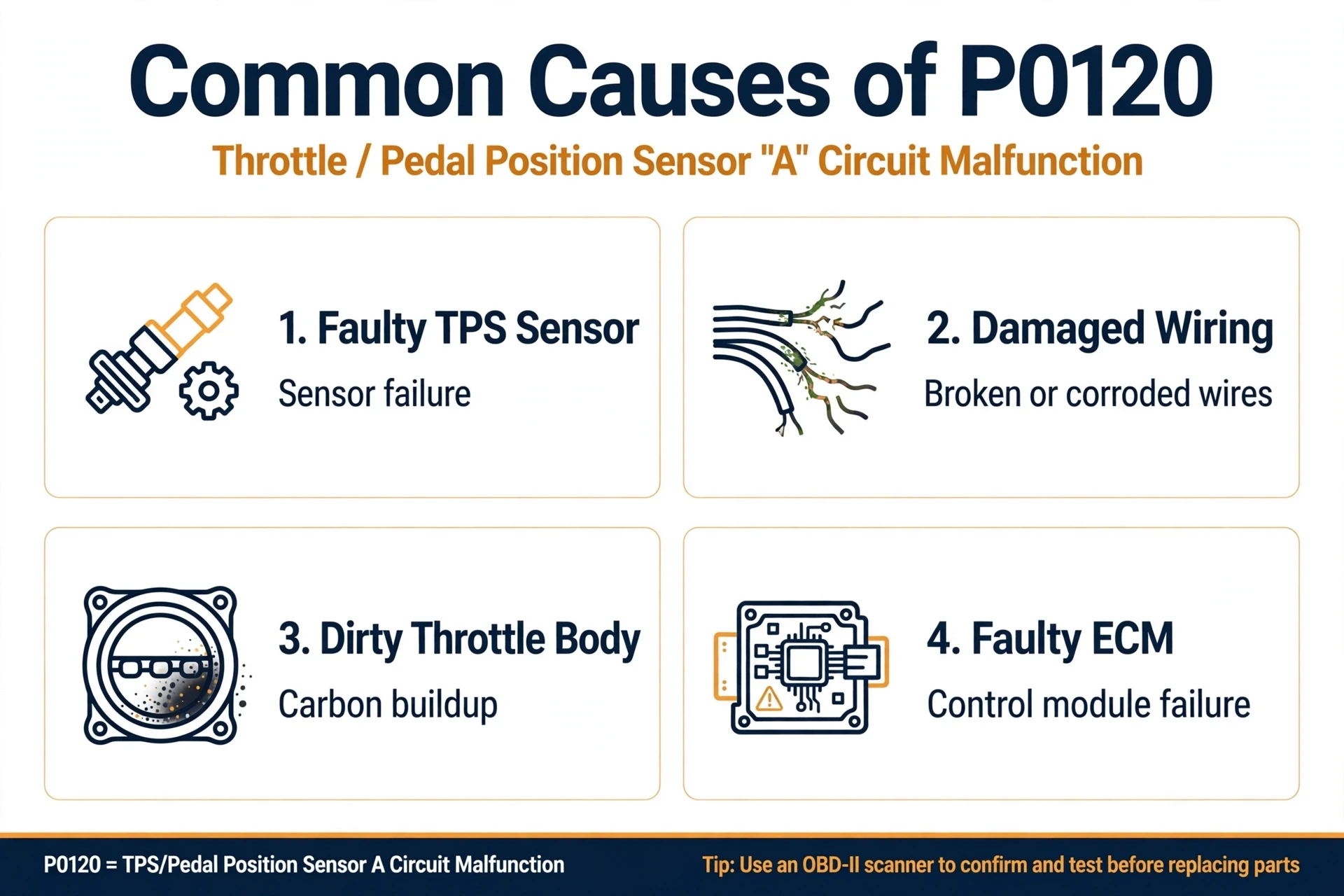
The most common cause of a P0120 code is a faulty throttle position sensor or accelerator pedal position sensor, usually one whose internal contacts or potentiometer have worn out. But the word “circuit” in the definition is a hint: the problem is often in the wiring, not the sensor itself. Here are the causes, roughly in order of likelihood:
- Faulty TPS or APP sensor: the internal potentiometer or sensor element has worn out or failed, sending a dead, jumpy, or stuck signal.
- Wiring or connector issues: frayed wires, loose plugs, bent pins, moisture, or corrosion in the harness between the sensor and the computer, especially near the throttle body or pedal assembly.
- Dirty or sticking throttle body: heavy carbon buildup or a gummed-up throttle plate can bind the mechanism and confuse the sensor readings.
- Corroded sensor or ECM connectors: corrosion on the pins breaks the signal even when the sensor itself is fine.
- Stuck throttle or pedal mechanism: a binding throttle return spring, a jammed floor mat holding the pedal, or a sticking accelerator can all skew the signal.
- PCM/ECM problems: a failing input circuit inside the computer, or a software or calibration mismatch after a repair, much less common but possible.
How to Diagnose P0120 (Do This Before Buying Parts)
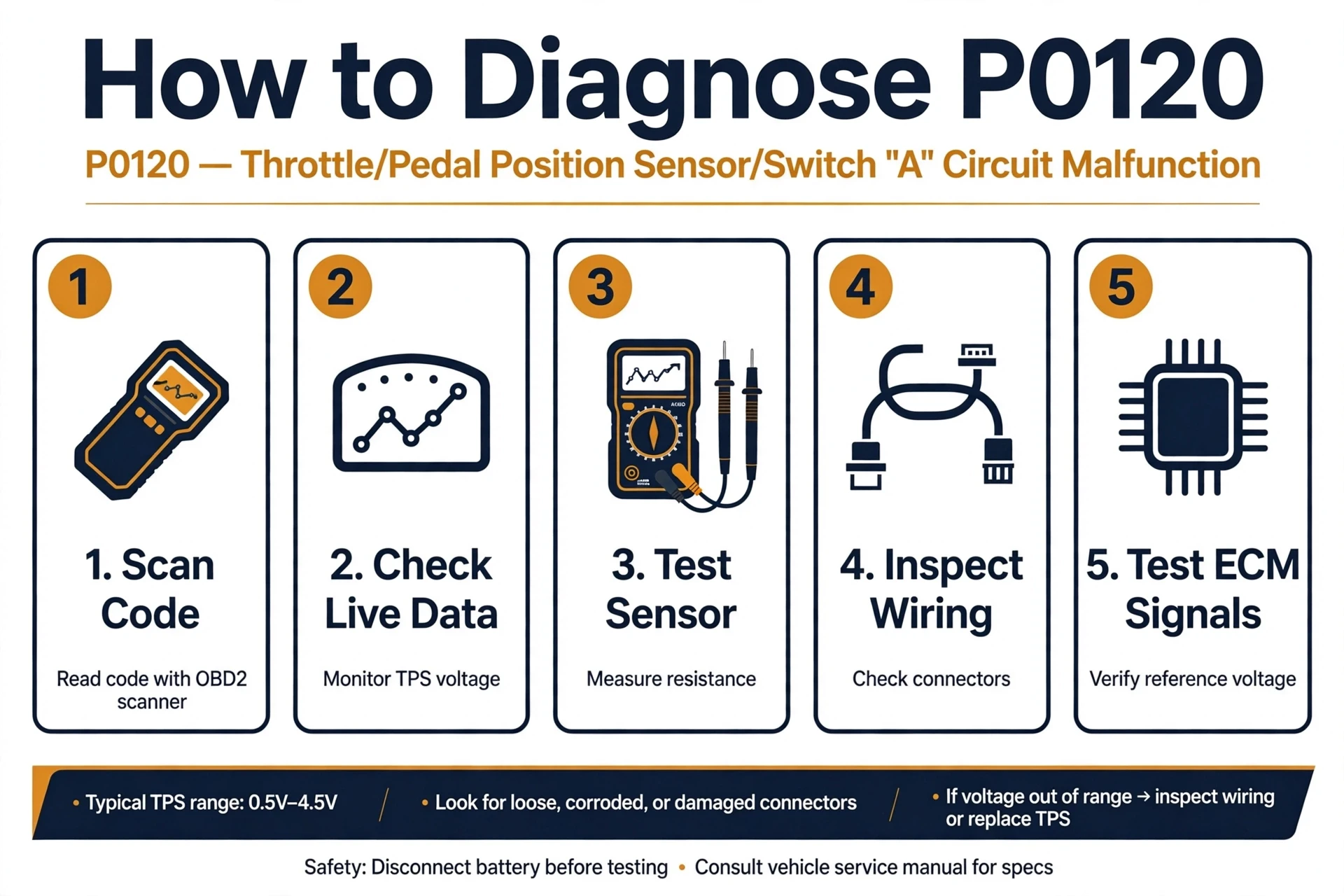
P0120 is misdiagnosed constantly because drivers replace the sensor first and skip the circuit checks. The code says “circuit malfunction,” so test the whole circuit. Follow this order:
- Scan for other codes first. Confirm P0120 with an OBD2 scanner and look for related codes such as P0121, P0122, P0123, or P0220. Companion codes narrow down whether the fault is the sensor, the circuit, or the pedal assembly.
- Inspect the wiring and connectors. Unplug the TPS and APP connectors and look for bent pins, moisture, corrosion, or cracked insulation. Clean the contacts with electrical contact cleaner and apply dielectric grease on reassembly.
- Check the throttle body. Remove the intake duct and look for carbon buildup or a sticky throttle plate. Clean it with dedicated throttle body cleaner if it is gummed up.
- Test live sensor data. With a scan tool that shows live data, watch the TPS voltage while slowly pressing the pedal. It should sweep smoothly from about 0.5 volts at closed throttle to about 4.5 volts at wide open throttle. Dropouts, spikes, or a flat line point at the sensor or its wiring.
- Back-probe the sensor with a multimeter. With the ignition on and engine off, check the signal wire voltage and confirm the 5 volt reference and ground are present. Then check continuity from the sensor connector to the computer pin to rule out broken wires.
- Perform a relearn after repairs. Many vehicles need a throttle body or idle relearn procedure after sensor replacement or throttle cleaning, or the code and rough idle will return.
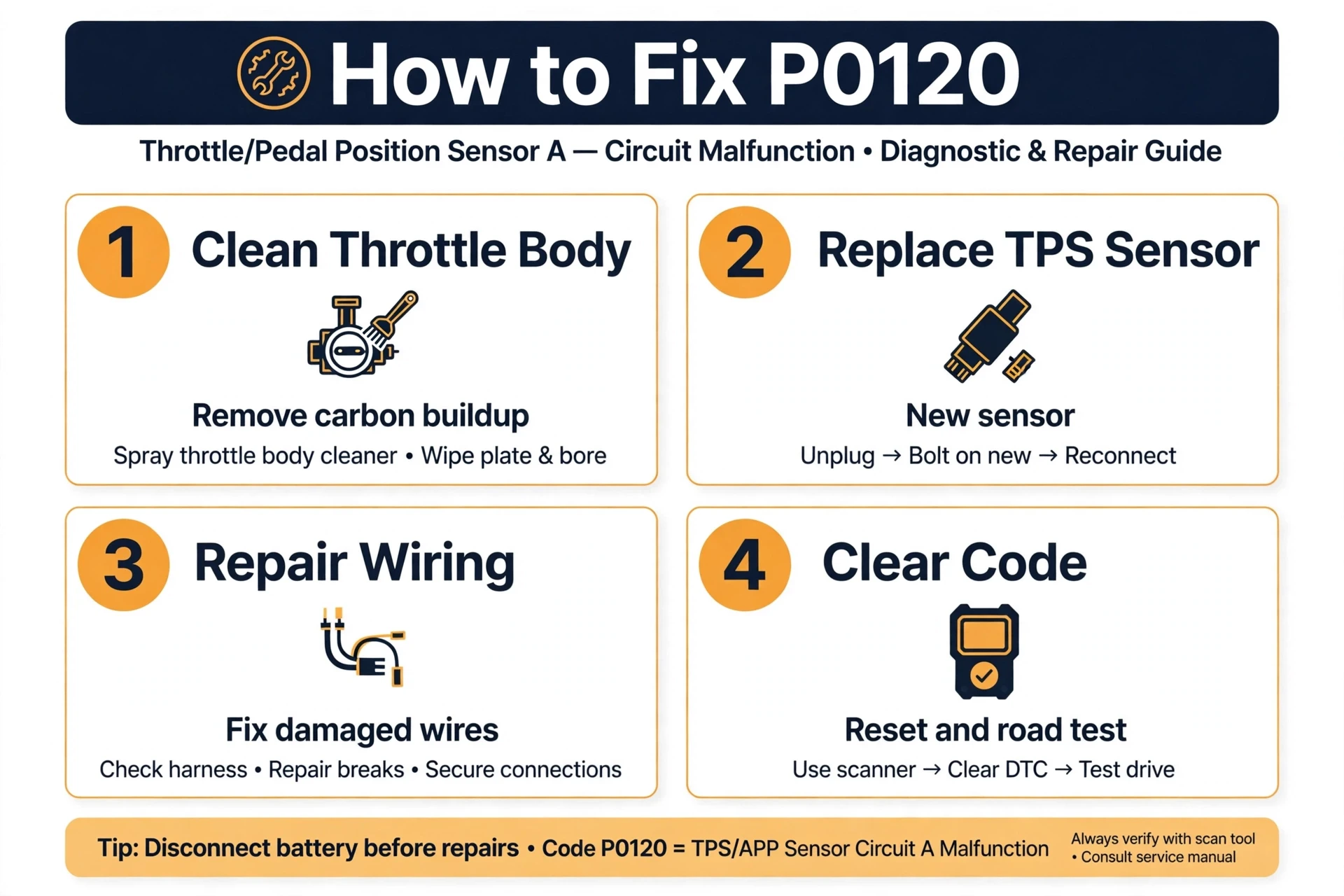
How to Fix the P0120 Code
The right fix depends on what your diagnosis found:
- Clean the connector and wiring: the cheapest fix. Clean corrosion, repair frayed wires, and reseat loose plugs. This alone resolves many P0120 cases.
- Clean the throttle body: remove carbon buildup from the throttle plate and bore with throttle body cleaner, then perform the idle relearn.
- Replace the faulty sensor: if the TPS or APP sensor fails the voltage sweep test, replace it. On many vehicles the TPS is part of the throttle body assembly.
- Repair the wiring harness: solder and seal any broken or chafed wires between the sensor and the computer rather than patching them with tape.
- Replace the throttle body: if the body itself is worn or the integrated sensor is not serviceable separately.
- Update or replace the PCM: rare, but a software update or a replacement computer is the answer when the sensor and wiring test perfectly and the code persists.
P0120 Repair Costs
Drivers always ask how much it costs to fix P0120, and the answer depends entirely on the cause. Here are realistic ranges:
| Repair | Cost Range |
|---|---|
| Sensor voltage test and connector cleaning | $80 – $120 |
| Throttle position sensor replacement | $115 – $500 |
| Accelerator pedal position sensor replacement | $200 – $400 |
| Wiring harness repair | $150 – $300 plus labor |
| PCM/ECM replacement with programming | $600 – $900 plus $200 – $300 labor |
This is why diagnosis matters. A $100 connector cleaning and a $900 computer replacement share the same code. Always test the circuit before buying parts.
DIY vs Mechanic Verdict
You can do this at home: reading codes with an OBD2 scanner, inspecting and cleaning the sensor connectors, cleaning the throttle body, and testing TPS voltage with a multimeter. Replacing a bolt-on TPS or pedal assembly is also reasonable for anyone comfortable with basic tools.
See a mechanic for: wiring harness diagnosis deep in the loom, PCM input circuit testing, computer replacement and programming, and any case where the sensor tests good but the code keeps returning.
Bottom line: inspect and test it yourself, fix the simple stuff yourself, but let a pro handle computer-level faults.
Can You Drive With a P0120 Code?
Short distances, cautiously, yes, but it is not advisable. The car may enter limp mode without warning, leaving you with severely reduced power in traffic. Hesitation and stalling can also appear suddenly. Because the computer is guessing at throttle position, the car can behave unpredictably. Get it diagnosed soon, even if it feels drivable right now.
P0120 on Popular Vehicles
P0120 shows up across all brands, but some patterns are worth knowing:
- Toyota (Corolla, Camry, Tacoma): The p0120 toyota code (toyota p0120, p0120 code toyota) is common on higher mileage models. The p0120 toyota corolla and Tacoma cases often trace to a worn TPS or a tired throttle body, so check the sensor sweep before replacing anything.
- Nissan (Altima, Maxima, Sentra): For p0120 nissan (nissan p0120, p0120 code nissan), the throttle body and its integrated sensor are frequent culprits, and a throttle relearn after repair is essential.
- Honda (Accord, Civic, CR-V): The p0120 honda code (honda p0120, p0120 code honda) often comes from APP sensor or throttle body issues on drive-by-wire models.
- Chevy (Silverado, Malibu, Equinox): The p0120 chevy code (p0120 code chevy, code p0120 chevy) can follow throttle body carbon buildup, so clean the body and do the relearn before condemning parts.
- Ford (F-150, Escape, Explorer): The p0120 ford code (ford code p0120) sometimes appears with electronic throttle body faults, check for related throttle actuator codes too.
DTC P0120 and OBD-II P0120 refer to the identical fault. The p0120 code is generic, so the diagnostic approach is the same on every brand.
P0120 vs P0122
P0120 is the general “circuit malfunction” code for the throttle/pedal position sensor A circuit. P0122 is the specific “circuit low input” version: it means the computer is seeing abnormally low voltage on that same circuit. Think of P0120 as the broad fault and P0122 as one specific flavor of it. Diagnose them the same way, starting with the wiring and the sensor voltage sweep.
Related Codes
- P0121: Throttle/Pedal Position Sensor/Switch A Circuit Range/Performance Problem
- P0122: Throttle/Pedal Position Sensor/Switch A Circuit Low Input
- P0123: Throttle/Pedal Position Sensor/Switch A Circuit High Input
- P0220: Throttle/Pedal Position Sensor/Switch B Circuit Malfunction (the companion circuit)
- P2135: Throttle/Pedal Position Sensor/Switch A/B Voltage Correlation (the two circuits disagree)
Video Walkthrough
Watch the video above for a visual walkthrough of P0120 throttle position sensor testing and replacement before you read on.
Frequently Asked Questions
What is the most common cause of a P0120 code?
A faulty throttle position sensor or accelerator pedal position sensor is the single most common cause. But wiring problems, corroded connectors, and a dirty throttle body are close behind, which is why testing the whole circuit before replacing parts saves so much money.
Can I still drive my car with a P0120 code?
Short distances, cautiously. The car may enter limp mode without warning and lose most of its power, so longer trips are not advisable. Get it diagnosed soon.
How do you fix the code P0120?
Diagnose first: scan for companion codes, inspect and clean the sensor connectors and wiring, check the throttle body for carbon buildup, and test the TPS voltage sweep. Then repair what you find: clean or repair the wiring, clean the throttle body, replace the faulty sensor, or in rare cases address the computer.
How much does it cost to fix P0120?
From about $80-$120 for a sensor test and connector cleaning, $115-$500 for a throttle position sensor replacement, up to $600-$900 plus labor for a computer replacement in rare cases.
Will P0120 clear itself?
Rarely. If the fault was a one-time glitch, it might. Usually the code returns until the real problem in the sensor circuit is fixed.
What is the difference between P0120 and P0122?
P0120 is the general circuit malfunction code for throttle/pedal position sensor circuit A. P0122 is the specific low-voltage version of that same circuit fault. They are diagnosed the same way.
Do I need a throttle relearn after fixing P0120?
Often yes. Many vehicles require a throttle body or idle relearn procedure after sensor replacement or throttle cleaning. Skipping it can leave you with a rough idle or a returning code, so check your service manual for the procedure.
Conclusion
The P0120 code looks scary, but it is really your car asking you to check a circuit, not just a part. Scan for companion codes, inspect the wiring and connectors, test the sensor voltage, and fix what you find. Do that, and you will either solve it cheaply or know for certain the sensor or computer is done. Either way, you stop guessing and start fixing.
About the author: Written by the OBD2 Code Hub editorial team. Our diagnostic guides are built from real OBD-II data, manufacturer service procedures, and hands-on troubleshooting experience, then reviewed for technical accuracy before publishing. We drive the same cars you do.