
P2172 Trouble Code: Meaning, Causes, Symptoms & Fixes
In This Guide
One-line meaning: P2172: Throttle Actuator Control System – Sudden High Airflow Detected.
What the P2172 Code Means
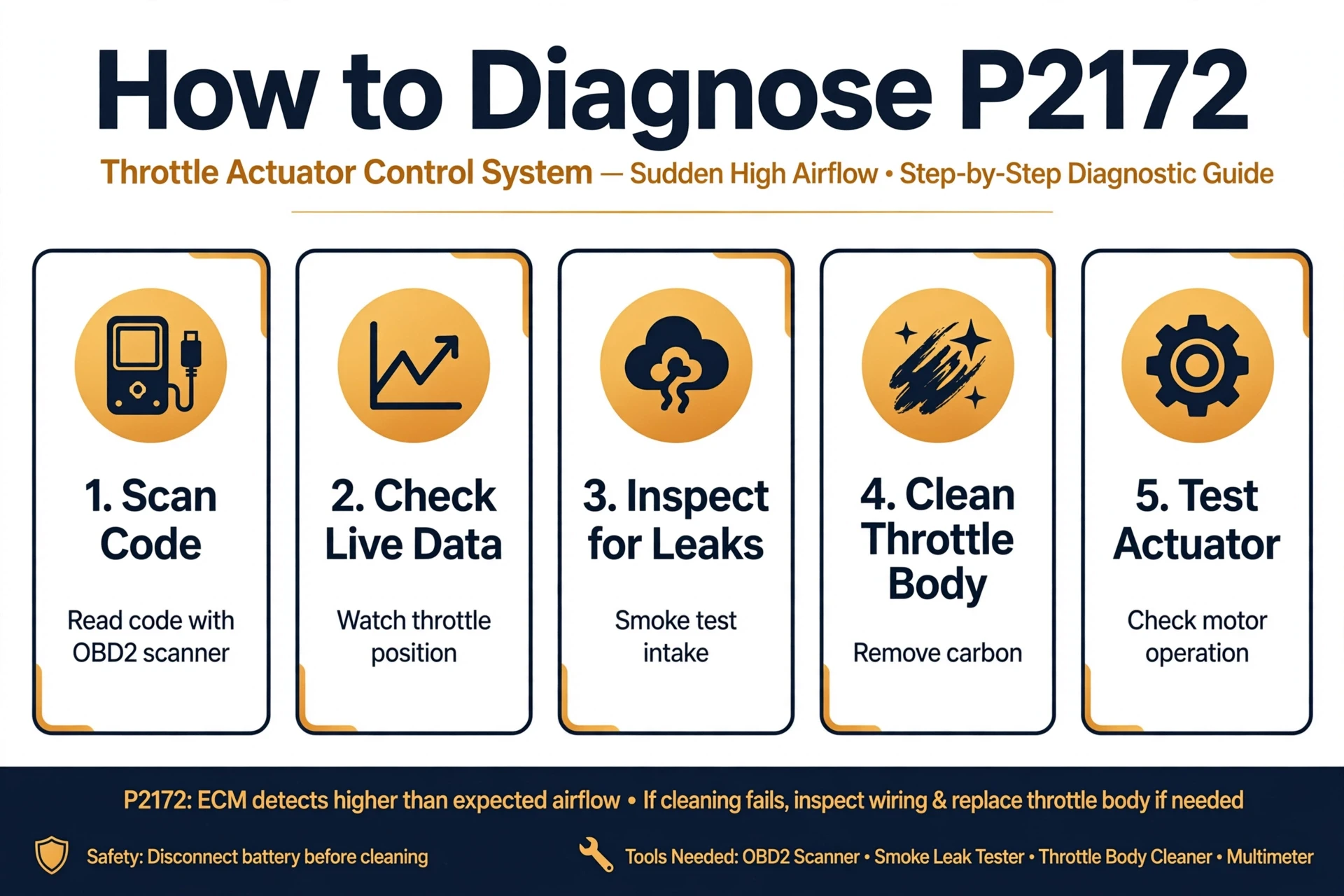
The P2172 code is a generic powertrain code that only shows up on vehicles with a drive-by-wire electronic throttle control system. Its full definition is “Throttle Actuator Control System – Sudden High Airflow Detected.” In plain English, your car’s computer (ECM/PCM) has detected a sudden rush of air entering the engine that does not match what the throttle body should be letting through.
Here is how your car figures this out. The throttle actuator control system is part of the electronic throttle control system (ETCS), which is how your car turns gas pedal input into engine power. When you press the accelerator, the accelerator pedal position sensor (APP sensor) tells the PCM how much power you want, and the PCM opens the throttle plate to match. The manifold absolute pressure (MAP) sensor and the throttle position sensor (TPS) then confirm how much air is actually flowing.
The P2172 code sets when the PCM sees airflow suddenly spike far beyond what the throttle position allows. That extra air is getting in around the throttle body instead of through it: unmetered and uncontrolled. P2172 (p2172 obd2, code p2172) is a generic code, which means it has the same meaning on every make, from a Dodge Challenger to a Jeep Cherokee.
This is a safety-critical fault, not a minor emissions code. An uncontrolled surge of air can cause sudden unintended acceleration or make the engine stall without warning. Because of that, the computer usually protects you by cutting power and dropping the car into limp mode, and in severe cases it may refuse to start at all.
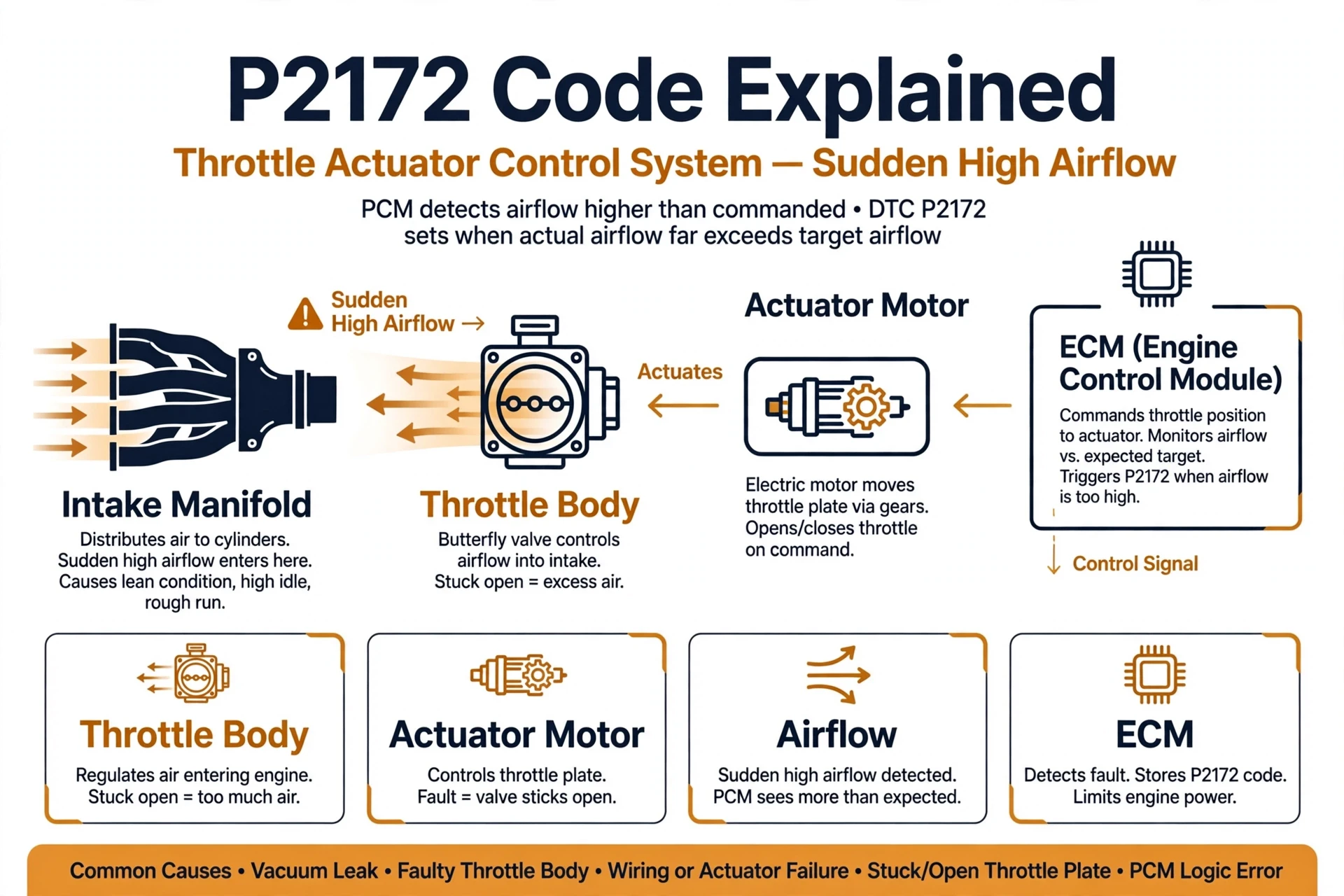
Symptoms of the P2172 Code
In many cases the check engine light is the first thing you notice, sometimes joined by a flashing Electronic Throttle Control (ETC) warning light. But P2172 often hits harder than that, because the computer may deliberately limit the engine to protect you. Depending on the underlying problem, you might notice:
- Check engine light on, sometimes with a flashing ETC light
- Sudden loss of engine power, or little to no throttle response
- Engine stalling, sometimes while driving, or a no-start condition
- Rough, unstable, or unusually high idle
- Limp mode, and the automatic transmission may not shift properly
What is code P2172 trying to tell you? In short: air is getting into the engine that the computer did not ask for, and it no longer trusts the throttle to control the engine safely.
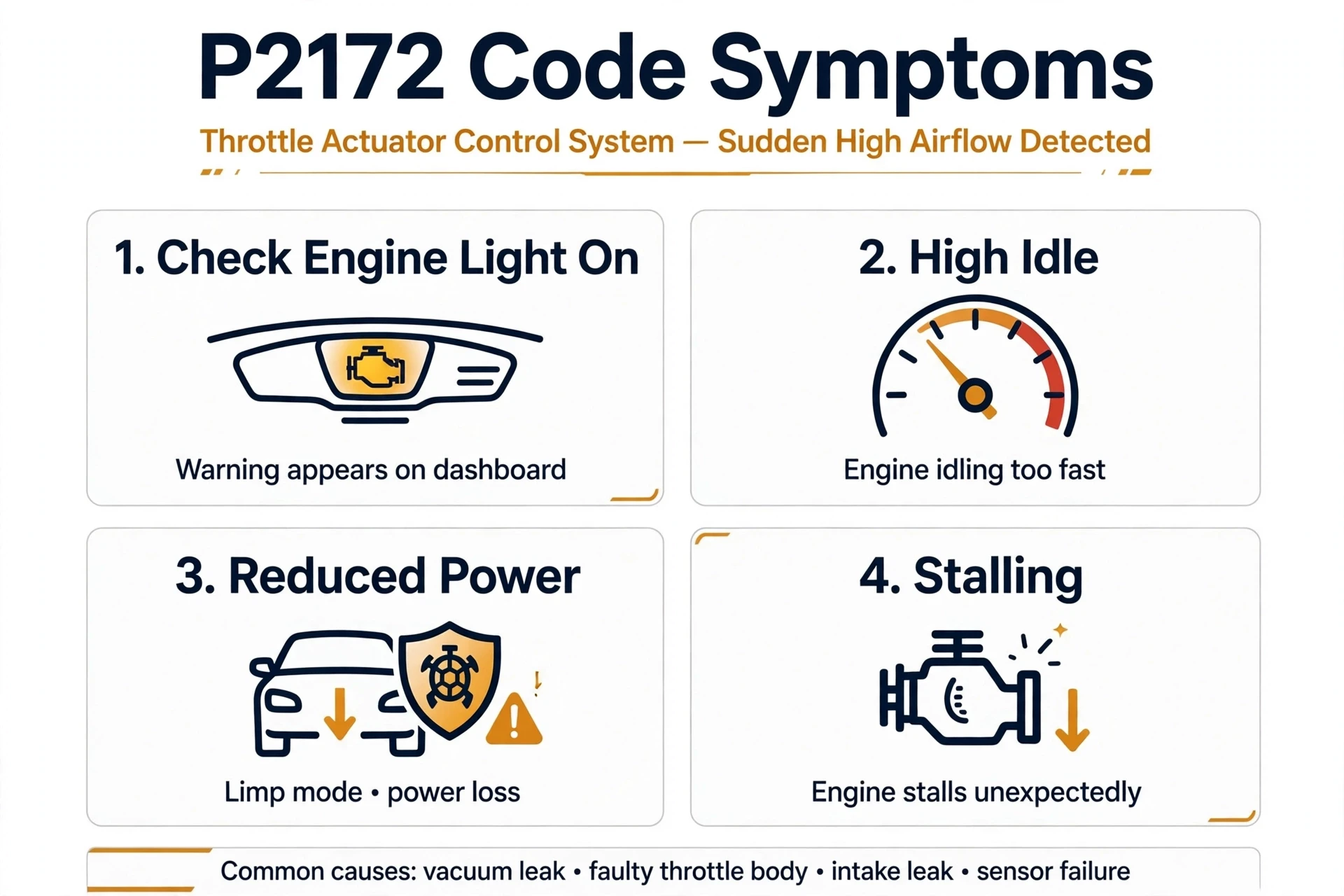
Common Causes of P2172
Vacuum leaks are the number one cause of the P2172 code, by a wide margin. Chrysler and Dodge even describe this code as “High Airflow/Vacuum Leak Detected” because a leak is the reason you see it in the vast majority of cases. Here are the causes, roughly in order of likelihood:
- Vacuum leaks: disconnected or cracked vacuum hoses, split intake boots, cracked intake manifold gaskets, or loose hose clamps letting unmetered air in after the throttle body.
- PCV valve issues: a PCV (positive crankcase ventilation) valve stuck open or a cracked PCV hose.
- MAP sensor failure: a faulty manifold absolute pressure sensor, or a loose or unplugged MAP sensor connector. If you recently worked near the intake, check this first.
- Throttle body problems: carbon buildup, a sticking throttle plate, or an open vacuum nipple left unplugged during a service.
- Faulty TPS or APP sensor: erratic throttle position or accelerator pedal position signals that do not match actual airflow.
- Wiring problems: corroded connectors, opens, or shorts in the sensor circuits.
- PCM software: outdated calibration or a module communication glitch. Check for technical service bulletins for your vehicle.
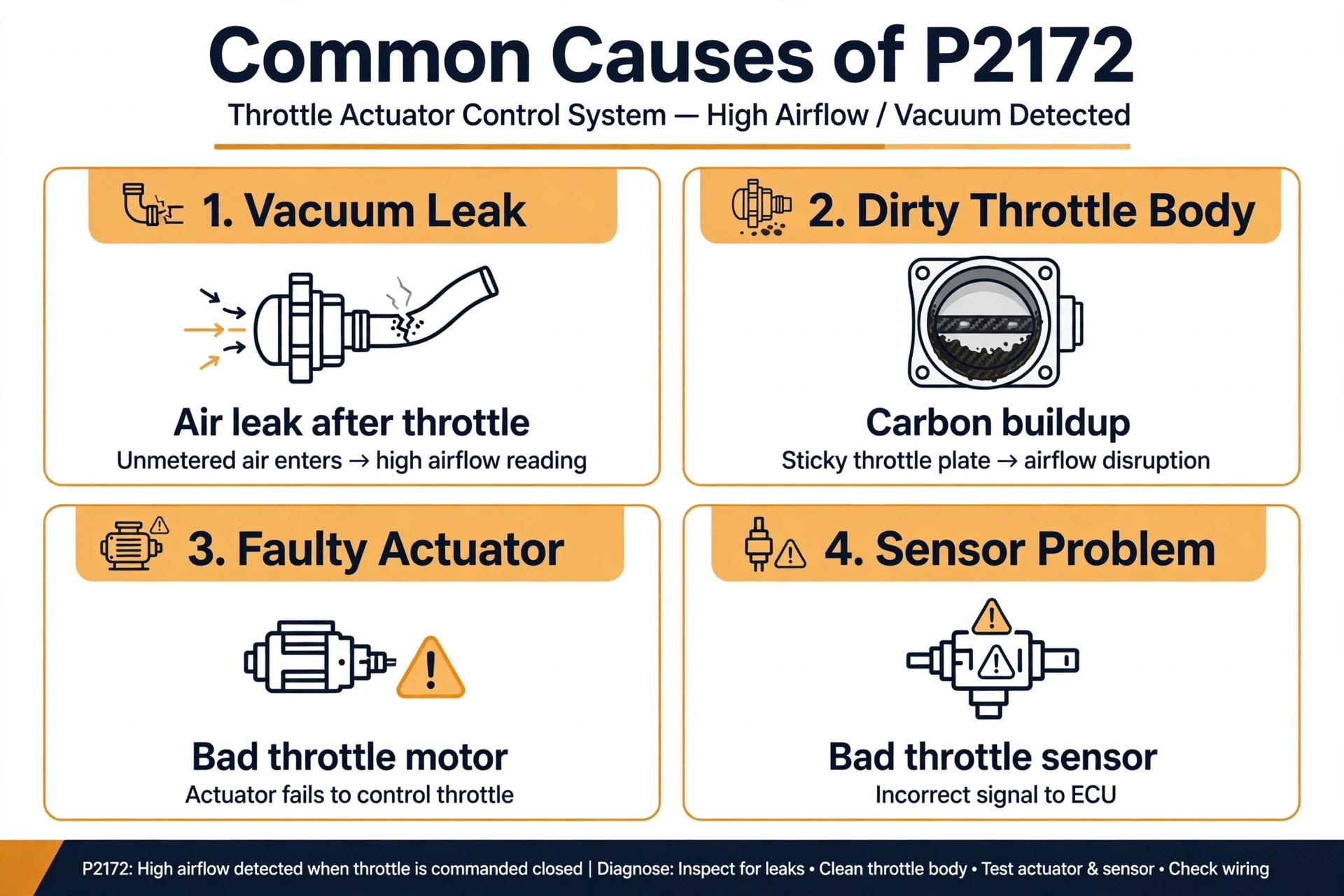
How to Diagnose P2172 (Do This Before Buying Parts)
Mechanics see the P2172 code misdiagnosed constantly, usually by people who replace the throttle body first. The code points at an airflow surge, but the real fault is most often a simple air leak. Follow this order:
- Scan for other codes first. Record every code plus freeze-frame data. P2172 is often a secondary code, so fix companion codes first.
- Try the quick cycle test. Pull over somewhere safe, shut the engine off, wait a minute, and restart. If the code clears temporarily, you are likely dealing with an intermittent leak or sensor glitch, but keep diagnosing.
- Visually inspect the intake. Check every vacuum hose, the PCV valve and tube, the intake boot, and the manifold connections for cracks, splits, or loose clamps. Look for hoses left disconnected after recent work and open vacuum nipples on the throttle body.
- Check the MAP sensor connection. Make sure the MAP sensor is fully plugged in and its wiring is intact.
- Check live data. With any scan tool that shows live data, compare APP %, TPS %, MAP kPa, RPM, and fuel trims (STFT/LTFT). A MAP reading that does not track throttle position points at a leak or a bad sensor.
- Smoke test the intake. A smoke machine finds hidden leaks that a visual check misses.
- Test the throttle actuator and wiring. Run throttle actuator command tests if your scan tool supports them, and back-probe sensor circuits for dropouts if the data looks erratic.
- Do the relearn. If you cleaned or replaced the throttle body, perform the electronic throttle control relearn procedure, then clear the codes and road test.
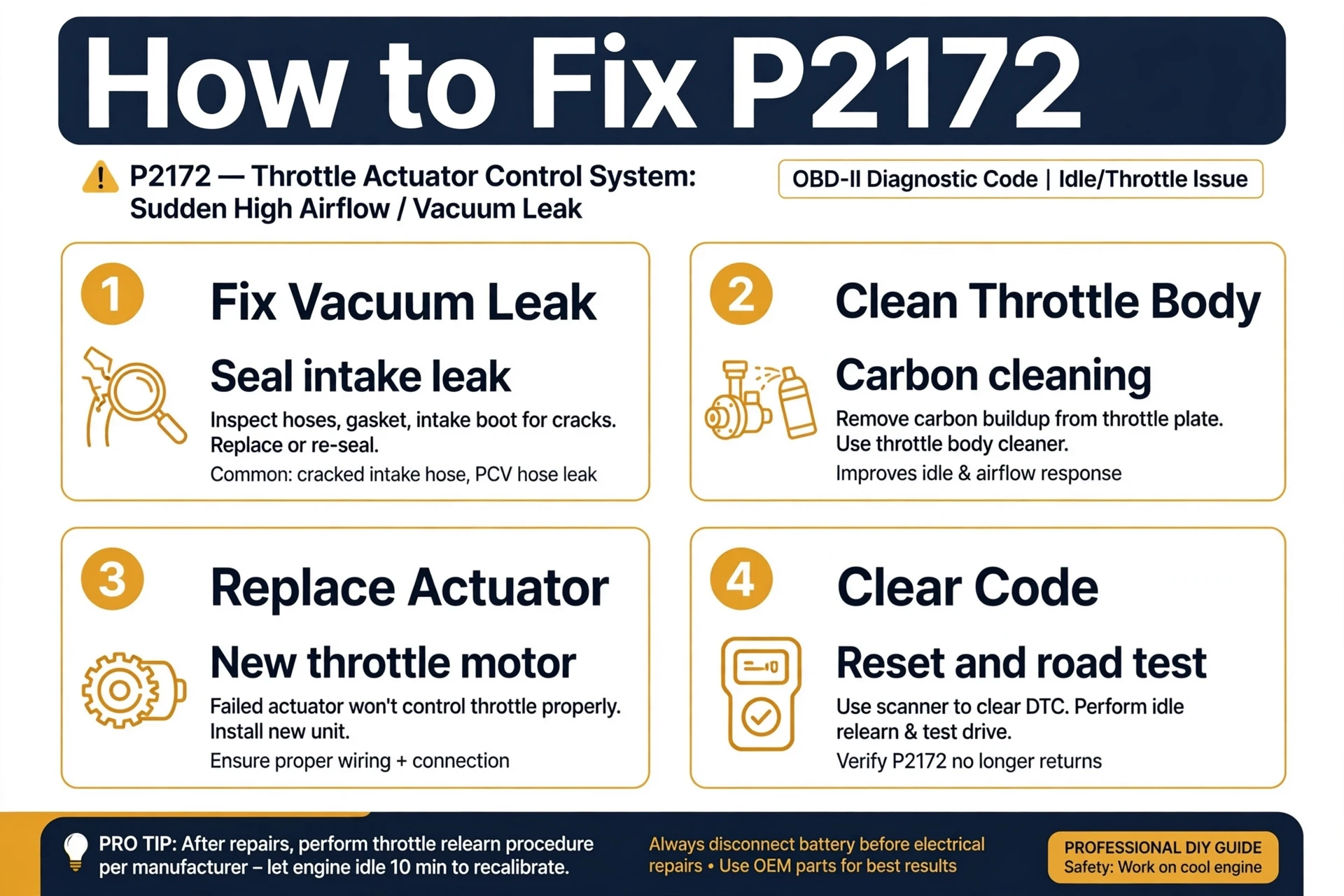
How to Fix the P2172 Code
The right fix depends on what your diagnosis found:
- Repair vacuum leaks: reseat or replace split hoses, replace cracked intake boots and manifold gaskets, and tighten every clamp. This is the cheapest fix and solves most P2172 cases.
- Fix the PCV system: replace a stuck-open PCV valve or a cracked PCV hose.
- Clean or replace the throttle body: remove carbon buildup or replace a sticking unit, then perform the ETC relearn so the PCM learns the new closed position.
- Replace the faulty sensor: install a new MAP, TPS, or APP sensor, but only the one your live data proved bad.
- Repair wiring: fix corroded connectors, opens, or shorts, then clear the code and road test.
- Update the PCM: if a technical service bulletin points at software, a dealer calibration update is the fix.
P2172 Repair Costs
Drivers always ask how much it costs to fix P2172, and the answer depends entirely on the cause. Here are realistic ranges:
| Repair | Cost Range |
|---|---|
| Vacuum hose replacement | $50 – $150 |
| Intake boot or manifold gasket | $150 – $450 |
| PCV valve replacement | $75 – $200 |
| Throttle body cleaning | $100 – $250 |
| Throttle body replacement | $300 – $800 |
| MAP sensor replacement | $100 – $300 |
| TPS or APP sensor replacement | $120 – $350 |
| PCM software update | $100 – $250 |
| Professional diagnosis | $100 – $175 |
The good news is that most P2172 repairs are cheap air-leak fixes, not expensive parts. Cost estimates are US averages and vary by vehicle and region.
DIY vs Mechanic Verdict
You can do this at home: a visual inspection of every vacuum hose and intake connection, reseating the MAP sensor connector, cleaning the throttle body, reading codes and live data with an OBD2 scanner, and replacing a PCV valve or a simple vacuum hose. These are reasonable DIY repairs for anyone comfortable with basic tools.
See a mechanic for: smoke testing the intake, wiring and connector diagnosis, throttle body replacement with the relearn procedure, and PCM software updates, which need dealer equipment.
Bottom line: diagnose it yourself first, because the most common P2172 fixes are cheap and simple. But hand it to a pro if the leak hunt or the relearn is beyond your tools.
Can You Drive With a P2172 Code?
Kelley Blue Book calls the P2172 code exceptionally serious, and that matches what owners report. Can you drive with it? Only to get somewhere safe. The engine can stall or lose power without warning, and the computer may cut throttle response entirely or refuse to start the car. This is not a code to commute on. Get it diagnosed as soon as possible, and do not take it on a highway trip.
P2172 on Popular Vehicles
P2172 shows up most often on Chrysler, Dodge, Jeep, and Ram vehicles with drive-by-wire throttles, but some patterns are worth knowing:
- Dodge Challenger and Charger (including Scat Pack and Hellcat): owners report the car dying suddenly with P2172. Check the MAP sensor connection and the PCV hoses first, especially after recent engine work.
- Jeep Cherokee, Compass, and Renegade: the p2172 jeep code usually traces to vacuum leaks or MAP sensor faults. Inspect the intake plumbing and the throttle body for open vacuum nipples.
- Jeep Wrangler: check the intake boots and vacuum lines, which take a beating from heat and vibration.
- Ram 1500: the p2172 ram code usually traces to an intake leak or a tired MAP sensor. A smoke test finds it fast.
- Chrysler 200 and Dart: the p2172 chrysler code has been tied to PCM calibration issues on some model years, so check for technical service bulletins along with the usual leak hunt.
EOBD P2172 and OBD P2172 are the same code under different naming (European vs generic OBD-II). The p2172 dodge code and p2172 chrysler code are described by the manufacturer as “High Airflow/Vacuum Leak Detected,” which tells you exactly where to look first.
P2172 vs Related Codes
These codes all live in the throttle actuator control system, but they describe different faults. P2172 means the system detected a sudden HIGH airflow event: more air than the throttle position allows. P2173 is the mirror image: sudden LOW airflow detected, meaning the engine is getting less air than expected. P2118, P2111, and P2101 are other throttle actuator codes. They deal with the actuator motor itself, its current draw, its range, or a stuck throttle plate, rather than a sudden airflow surge. Diagnose those by the actuator and its circuits, not by hunting for an air leak.
Related Codes
- P2173: Throttle Actuator Control System – Sudden Low Airflow Detected
- P2118: Throttle Actuator Control Motor Current Range/Performance
- P2111: Throttle Actuator Control System – Stuck Open
- P2101: Throttle Actuator Control Motor Circuit Range/Performance
Video Walkthrough
Watch the video above for a visual walkthrough of P2172 causes, fixes, and diagnosis before you read on.
Frequently Asked Questions
What is the most common cause of a P2172 code?
Vacuum leaks are the single most common cause, by a wide margin: disconnected or cracked vacuum hoses, split intake boots, cracked intake manifold gaskets, or loose clamps. Chrysler and Dodge even describe this code as “High Airflow/Vacuum Leak Detected,” because a leak is what you find in most cases.
Can I still drive my car with a P2172 code?
Only to get somewhere safe. The engine can stall or lose power without warning, and the computer may cut throttle response or refuse to start the car. Get it diagnosed as soon as possible.
How do you fix the code P2172?
Find where the extra air is coming from: inspect every vacuum hose, the PCV valve and tube, and the intake connections, check that the MAP sensor is fully plugged in, and smoke test the intake if the leak hides. Then repair the leak, clean or replace the throttle body if it is sticking, replace only the sensor your live data proved bad, perform the throttle relearn, and clear the code.
Will P2172 clear itself?
Rarely for long. Shutting the engine off and restarting can clear it temporarily, which is the quick cycle test many owners use, but the code returns until the leak or sensor fault is actually fixed.
Can a bad MAP sensor cause P2172?
Yes. A faulty MAP sensor, or one with a loose or unplugged connector, feeds the PCM wrong manifold pressure data, which looks exactly like a sudden airflow surge. Reseat the connector first, especially if you recently worked near the intake.
What is the difference between P2172 and P2173?
P2172 means the throttle actuator control system detected sudden high airflow: more air than the throttle position allows. P2173 is the mirror image: sudden low airflow detected. Same system, opposite readings.
How much does it cost to fix P2172?
Most P2172 repairs are cheap air-leak fixes: $50 to $300 for vacuum hoses, a PCV valve, or a MAP sensor. Throttle body replacement runs $300 to $800, a PCM software update $100 to $250, and a professional diagnosis $100 to $175. Cost estimates are US averages and vary by vehicle and region.
Conclusion
The P2172 code looks scary, but it is really your car protecting you from air it did not ask for. Start with the simple stuff: inspect every vacuum hose and intake connection, check the PCV system, and make sure the MAP sensor is fully plugged in. Most P2172 cases end with a cheap leak repair, not an expensive part. Fix what you find, do the throttle relearn if you touched the throttle body, and clear the code. And if the leak hides from you, a smoke test at a good shop will find it fast.
About the author: Written by the OBD2 Code Hub editorial team. Our diagnostic guides are built from real OBD-II data, manufacturer service procedures, and hands-on troubleshooting experience, and we drive the same cars you do.