
P0118 Trouble Code: Meaning, Causes, Symptoms & Fixes
In This Guide
One-line meaning: P0118: Engine Coolant Temperature Circuit High Input.
What the P0118 Code Means
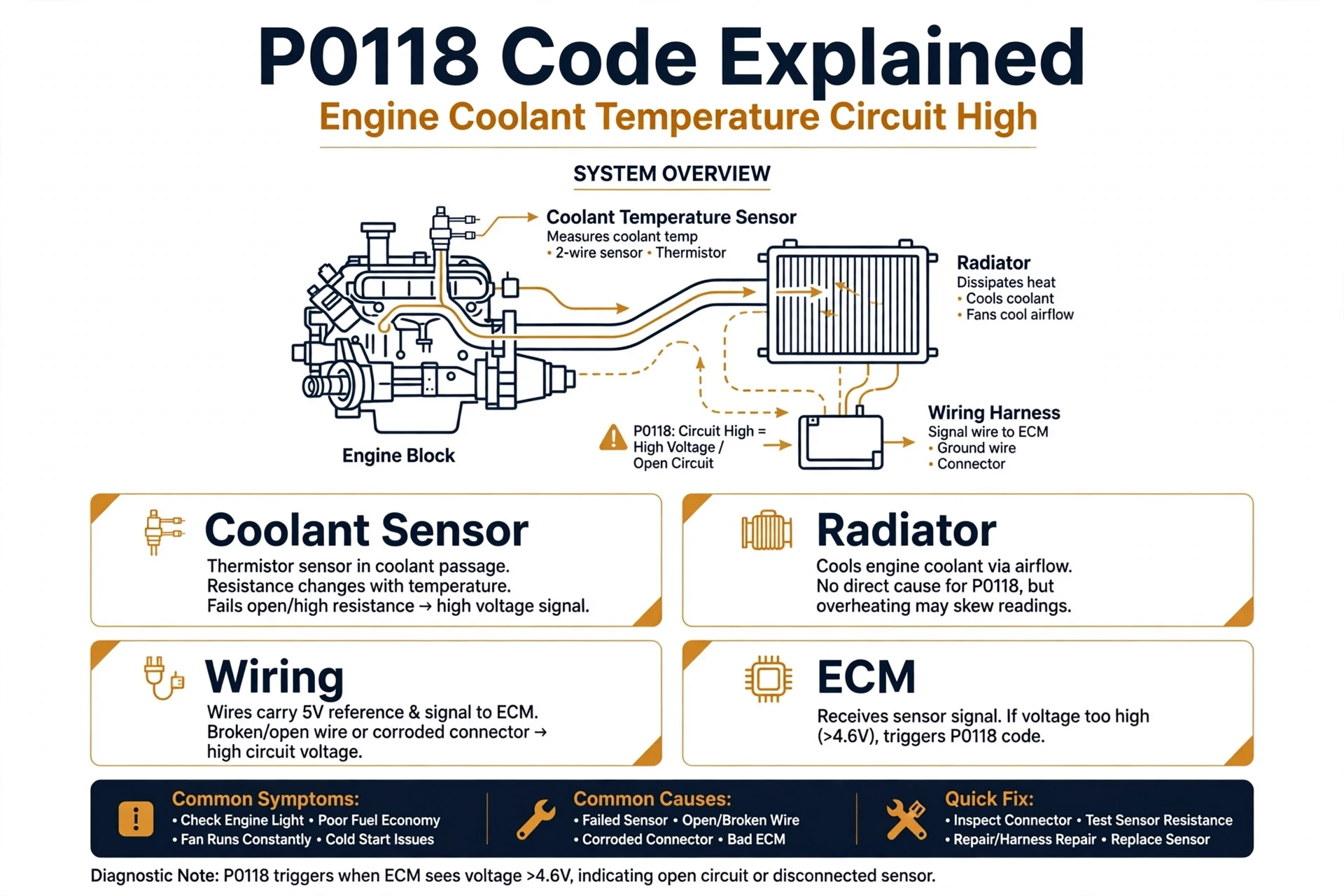
The P0118 code is a check engine light code that points at the engine’s temperature sensing circuit. Its full definition is “Engine Coolant Temperature (ECT) Sensor Circuit High Input”. In plain English, your car’s engine computer (ECM/PCM) is receiving an abnormally high voltage signal, usually above 4.9 volts, from the engine coolant temperature sensor.
Here is how that circuit works. The ECT sensor is a thermistor screwed into a coolant passage in the cylinder head or near the thermostat housing. A thermistor simply changes its electrical resistance as temperature changes: resistance is high when the engine is cold and drops as the engine warms up. The computer sends the sensor a 5-volt reference signal and reads what comes back. A high return voltage tells the computer the resistance is very high, which it interprets as extreme cold. That is why scan data on a P0118 car often shows an impossible -40°F (-40°C) coolant temperature, even on an engine that has been running for half an hour.
What creates that high reading? Almost always an open in the circuit: a disconnected plug, a broken or chafed wire, corroded connector pins, or a sensor that has failed internally. With the circuit open, the full reference voltage comes back to the computer, and the P0118 code sets. Drivers searching for the engine code p0118 usually want to know whether it is the sensor or the wiring at fault, and this guide walks through both, because the fix is very different in cost.
P0118 (p0118 obd ii) is a generic powertrain code, which means it has the same meaning on every make and model, from a Honda Civic to a Ford F-150 to a Toyota Camry. Its mirror image is the P0117 code, which is the exact same circuit reading too low instead of too high.
Symptoms of the P0118 Code
Because the computer thinks the engine is freezing cold, it fuels and manages the engine for arctic conditions. That makes P0118 one of the more noticeable codes to drive with. Watch for:
- Check engine light is on, sometimes with a coolant temperature warning light as well
- Hard or difficult starting, especially in cold weather, with long cranking before the engine catches
- Rough idle, stalling, or hesitation while the engine warms up
- Cooling fans running constantly at high speed, the computer’s failsafe when it cannot trust the temperature reading
- Reduced fuel economy, because the computer enriches the fuel mixture for an engine it believes is ice cold
- Black smoke from the exhaust or a strong fuel smell from running rich
- Temperature gauge reading stone cold, or behaving erratically, on a fully warmed up engine
What is code P0118? What is the p0118 code trying to tell you? In short: the temperature signal your computer is steering the engine with cannot be trusted, so fuel delivery, fan control, and the dashboard gauge are all working from bad data. Do not ignore it just because the car still starts.

Common Causes of P0118
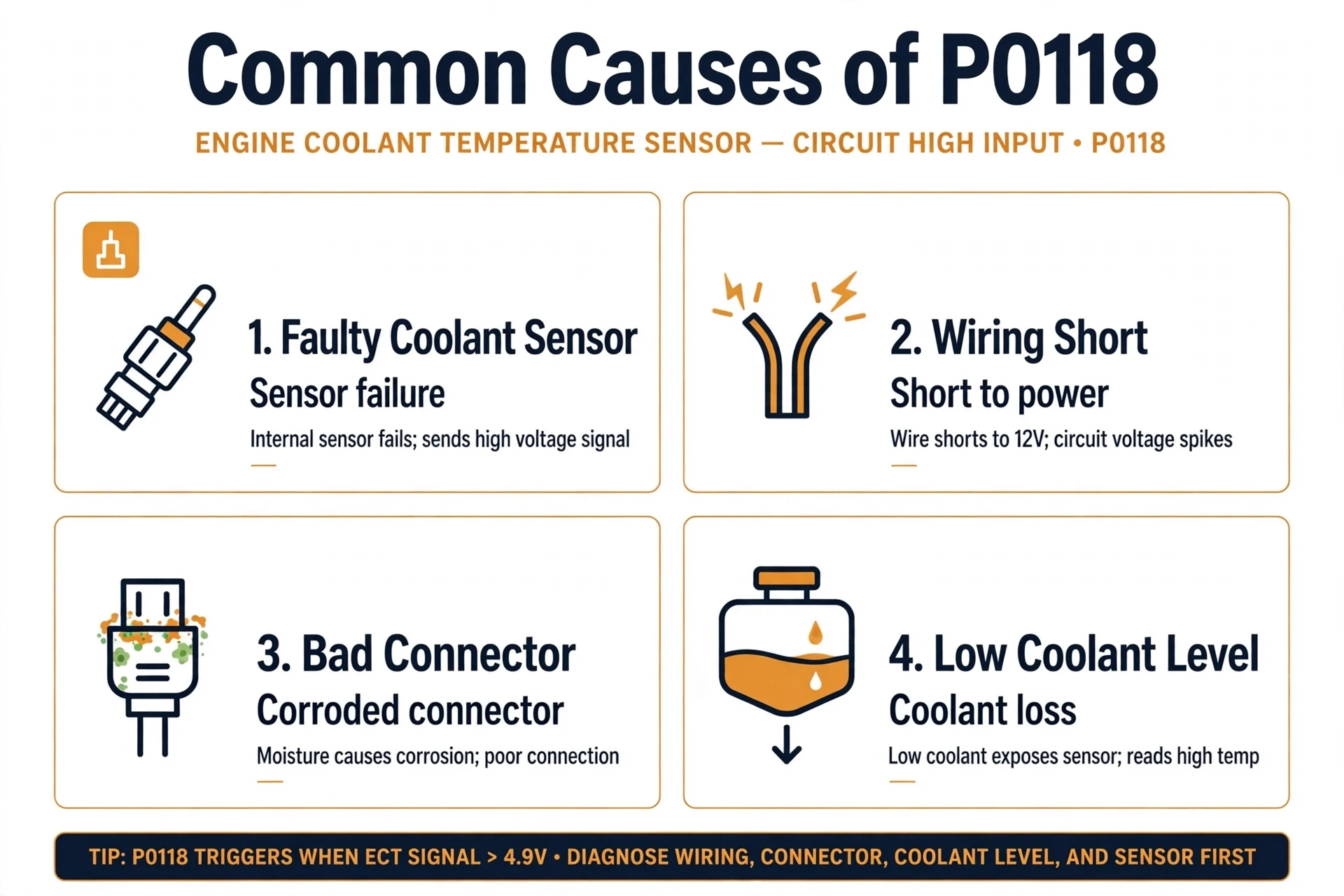
The most common cause of a P0118 code is a disconnected or loose ECT sensor connector, not a dead sensor. That is good news, because it is a free fix. But several other faults create the same high-input reading. Here are the causes, roughly in order of likelihood:
- Disconnected or loose ECT connector: the plug works its way off from vibration, or was never latched after cooling system work. The most common cause by far.
- Damaged wiring: broken, chafed, or oil-soaked wires between the sensor and the computer create an open circuit. Check where the harness rubs against brackets or the fan shroud.
- Corroded connector pins: moisture in the connector corrodes the pins and breaks the signal path. Green or white crust on the terminals is the giveaway.
- Faulty ECT sensor: the thermistor fails internally and goes open circuit. The sensor is cheap, but test it before replacing it.
- Low coolant level: if coolant drops below the sensor, it reads air temperature instead of coolant temperature, which confuses the computer’s temperature logic.
- Failed PCM/ECM: rare, but the computer’s 5-volt reference supply or its input circuit can fail. Only suspect this after the sensor and wiring test good.
How to Diagnose P0118 (Do This Before Buying Parts)
P0118 is one of the easier codes to pin down, because the failure is electrical and the scan data gives you a dead giveaway. Follow this order:
- Scan live data first. With any OBD2 scanner that shows live data, look at the ECT temperature parameter. If it reads an impossible -40°F (-40°C) on a warm engine, you have confirmed the high-input fault and can skip straight to the connector.
- Inspect the connector. Find the ECT sensor, usually on or near the thermostat housing or threaded into the cylinder head. Push the plug firmly on and confirm the latch clicks. Look for cracked housings, bent pins, and corrosion.
- Check the wiring. Follow the harness from the sensor toward the computer, looking for chafing, cuts, melted spots, and oil contamination. With live data on screen, wiggle the harness; if the temperature reading jumps, you have found the break.
- Test the 5-volt reference. Ignition on, engine off, back-probe the harness side of the connector with a multimeter. You should see about 5 volts on the reference wire. No voltage, or full battery voltage, points at a wiring or computer issue.
- Test sensor resistance. Unplug the sensor and measure resistance across its two terminals with a multimeter. Compare the reading to the spec for the current temperature; resistance should fall as the sensor warms. Infinite resistance means the sensor is open and dead.
- Check the coolant level. Make sure the sensor is actually submerged in coolant. If the level is low, top it up, pressure test for leaks, and recheck.

How to Fix the P0118 Code
The right fix depends on what your diagnosis found:
- Reseat the ECT connector: push the plug on firmly until the latch clicks. Clean any corrosion with electrical contact cleaner and add a dab of dielectric grease. This free fix resolves a large share of P0118 cases.
- Repair damaged wiring: solder and heat-shrink broken wires, or replace the pigtail connector if the pins are corroded. Do not use twist-and-tape splices under the hood.
- Replace the faulty ECT sensor: with the engine cold, drain a little coolant, unscrew the old sensor, and install the new one with thread sealant. Refill and bleed the cooling system afterward.
- Top up or flush the coolant: if the level was low or the coolant is contaminated, refill with the correct type and bleed out air pockets.
- Replace a stuck thermostat: if the engine never reaches proper operating temperature, a thermostat stuck open can keep setting temperature-related codes alongside P0118.
- Repair or replace the PCM: only in the rare case where the sensor, wiring, and reference voltage all test good but the code persists. PCM replacement requires programming to the vehicle.

P0118 Repair Costs
Drivers always ask how much it costs to fix P0118, and the answer is refreshingly cheap compared to most check engine codes. Here are realistic ranges:
| Repair | Cost Range |
|---|---|
| Reseat ECT connector (DIY) | $0 |
| ECT sensor replacement | $30 – $200 |
| Wiring / connector repair | $80 – $350 |
| Coolant top-up or flush | $100 – $200 |
| Thermostat replacement | $150 – $400 |
| PCM / ECM replacement (rare) | $400 – $1,500 |
This is why diagnosis matters. A free connector reseat and a $1,000 computer job share the same code. Always start with the plug before spending money on parts.
DIY vs Mechanic Verdict
You can do this at home: reading the code and live ECT data with an OBD2 scanner, inspecting and reseating the ECT connector, checking the harness for visible damage, testing the sensor with a multimeter, replacing the ECT sensor (usually one plug and one threaded fitting), and topping up coolant. If you find a loose plug or a dead sensor, those are easy DIY repairs for anyone comfortable with basic tools.
See a mechanic for: wiring faults buried deep in the main harness, PCM diagnosis and replacement (the new computer must be programmed to the vehicle), and any case where the code returns after the sensor, connector, and wiring all test good. A shop can also pressure test the cooling system if you suspect a hidden leak.
Bottom line: check the connector yourself first, replace the sensor yourself second, and only pay a shop if the fault is in the wiring harness or the computer.
Can You Drive With a P0118 Code?
For a short trip, usually yes, but keep it brief and get it fixed soon. This code is more urgent than many others for one reason: the computer cannot trust the coolant temperature, so the dashboard gauge may not warn you if the engine actually overheats. The computer often runs the cooling fans nonstop as a failsafe, and it fuels the engine rich, which wastes fuel and can overheat and damage the catalytic converter over time. If the temperature gauge sits on cold after twenty minutes of driving, or the fans scream constantly, treat it as a fix-it-this-week problem, not a fix-it-someday one.
P0118 on Popular Vehicles
P0118 shows up across all brands, but some patterns are worth knowing:
- Honda (Civic, Accord, CR-V): The p0118 honda code (honda p0118, p0118 code honda) is often a tired ECT sensor, or a connector left unlatched after timing belt or coolant service.
- Toyota (Camry, Corolla, RAV4): The p0118 toyota code (toyota p0118, p0118 code toyota) frequently traces to the sensor itself; still, check the connector first because it costs nothing.
- Chevy (Silverado, Malibu, Equinox): For the p0118 chevy code (p0118 code chevy), inspect the harness near the thermostat housing, where chafing is a known issue.
- Ford (F-150, Escape, Explorer): The p0118 ford code can follow overheating episodes, so verify the coolant level and look for leaks before condemning the sensor.
- Nissan (Altima, Sentra, Rogue): The p0118 nissan code (nissan p0118) is split between sensor failures and harness damage; the wiggle test on live data usually tells you which.
- Jeep (Wrangler): The p0118 code jeep wrangler owners see often appears right after cooling system work, which points straight at the connector.
EOBD P0118 and OBD P0118 are the same code under different naming (European vs generic OBD-II). DTC P0118 and OBD-II P0118 also refer to the identical fault.
P0118 vs Related Codes
P0118 means the ECT circuit is reading high: an open circuit that the computer interprets as -40°F (-40°C). P0117 is the exact mirror image: circuit low input, usually a short to ground that the computer reads as an impossibly hot engine. Same sensor, same wires, opposite electrical faults, and the live data reading tells you which one you have. P0119 sits between them: an intermittent ECT signal that drops in and out. P0116 is a range or performance fault, where the sensor reads but does not follow the expected warm-up curve, and P0125 means the coolant never got hot enough for closed loop fuel control.
Related Codes
- P0117: Engine Coolant Temperature Sensor Circuit Low Input (the mirror image of P0118)
- P0119: Engine Coolant Temperature Sensor Circuit Intermittent
- P0116: Engine Coolant Temperature Sensor Circuit Range/Performance
- P0125: Insufficient Coolant Temperature for Closed Loop Fuel Control
Video Walkthrough
Watch the video above for a visual walkthrough of P0118 testing and sensor replacement before you read on.
Frequently Asked Questions
What is the most common cause of a P0118 code?
A disconnected or loose ECT sensor connector. Before buying any parts, push the plug firmly onto the sensor until the latch clicks. That free check fixes more P0118 cases than any part replacement.
Can I still drive my car with a P0118 code?
For short trips, usually yes. But the computer cannot trust the coolant temperature, so the gauge may not warn you of real overheating, and the engine runs rich. Get it diagnosed within days, not weeks.
How do you fix the code P0118?
Check live data for the -40°F giveaway, inspect and reseat the connector, check the wiring for damage, test the 5-volt reference and the sensor’s resistance, then replace the sensor or repair the wiring as needed. Clear the code and confirm the temperature reads normally on a test drive.
How much does it cost to fix P0118?
Often nothing: reseating the connector is free. A new ECT sensor costs $30 to $200 installed. Wiring or connector repairs run $80 to $350. The rare worst case, a failed PCM, costs $400 to $1,500.
Will P0118 clear itself?
Rarely while the fault is still present. If a loose connection reseated itself on its own, the code might not return. In most cases it comes back until the circuit is actually repaired.
Can low coolant cause P0118?
Indirectly, yes. If the coolant level drops below the sensor, the ECT reads air temperature instead of coolant temperature, which can trigger temperature circuit codes. Always verify the coolant level as part of P0118 diagnosis.
What is the difference between P0118 and P0117?
P0118 is circuit high input: an open circuit the computer reads as -40°F (-40°C). P0117 is circuit low input: a short to ground the computer reads as extremely hot. Same sensor, opposite electrical faults.
Conclusion
The P0118 code sounds technical, but it is usually a simple electrical fault: a loose plug, a tired sensor, or a damaged wire. Check the connector first and test the sensor second, and you will fix most cases for little or no money. Do not ignore it, though. An engine running blind on coolant temperature can overheat without warning or run rich enough to damage the catalytic converter.
About the author: Written by the OBD2 Code Hub editorial team. Our diagnostic guides are built from real OBD-II data, manufacturer service procedures, and hands-on troubleshooting experience, then reviewed for technical accuracy before publishing. We drive the same cars you do.