
P0116 Trouble Code: Meaning, Causes, Symptoms & Fixes
In This Guide
One-line meaning: P0116 means the engine coolant temperature sensor reading does not match the temperature curve the computer expects after a cold start, so the computer flags a range or performance problem in the ECT sensor circuit.
What the P0116 Code Means
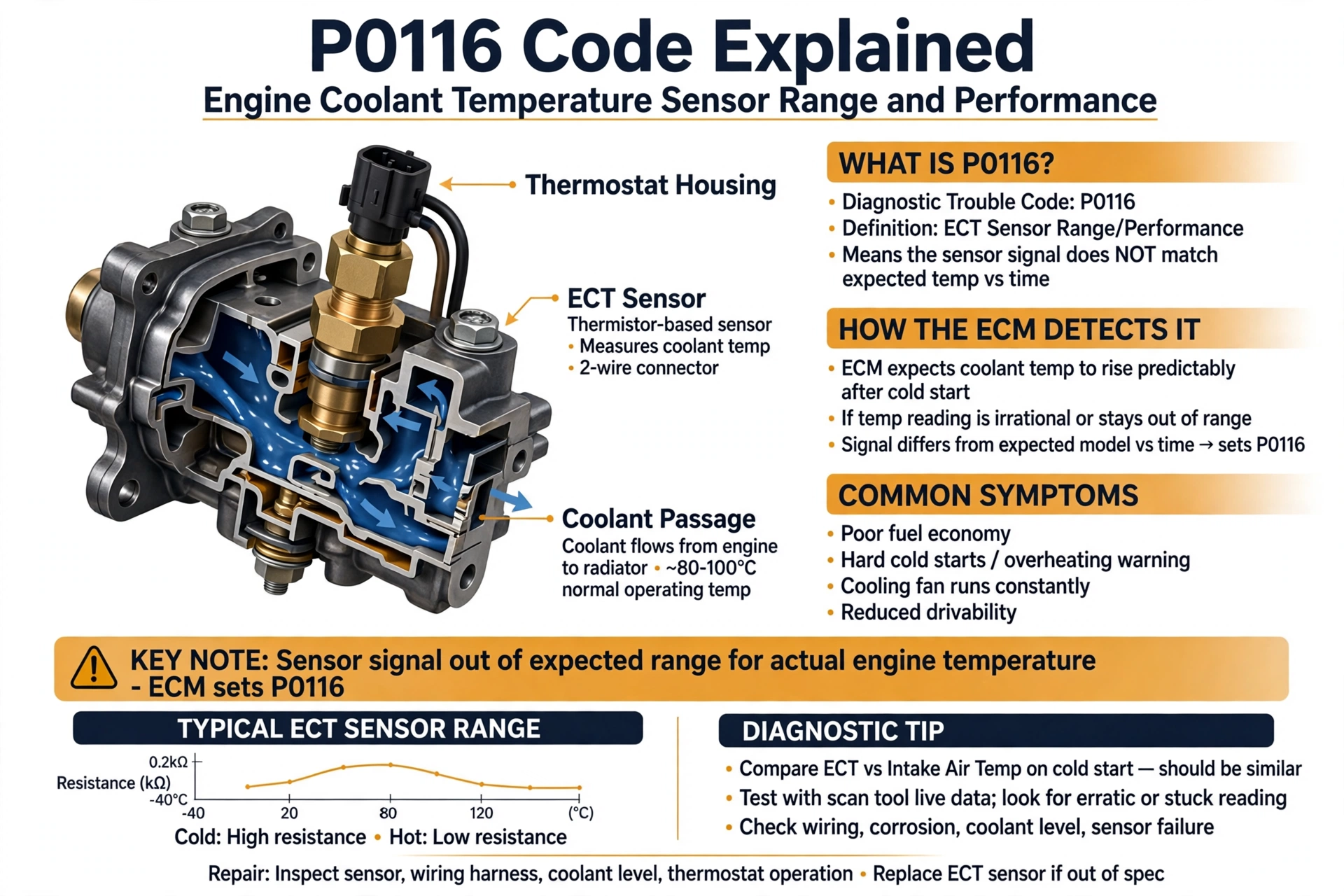
The P0116 code is one of the most searched check engine light codes, and one of the most misunderstood. Its full definition is “Engine Coolant Temperature (ECT) Sensor Circuit Range/Performance.” In plain English, your car’s computer (ECM/PCM) watched the coolant temperature sensor reading during warm-up and found it did not behave the way physics says it should: the temperature failed to rise predictably after a cold start, stayed flat, jumped around, or reported a value that makes no sense for the driving conditions.
Here is the critical distinction that trips people up. P0116 is a RANGE/PERFORMANCE code. It is not an electrical low-voltage fault and not an electrical high-voltage fault. Those are separate codes: “Circuit Low” is P0117 and “Circuit High” is P0118. With P0116, the circuit may be electrically fine; the problem is that the reading does not match the expected temperature-vs-time model programmed into the computer.
How does the computer know what to expect? The ECT sensor is a thermistor, a resistor whose resistance falls as coolant temperature rises, and it sits in the coolant stream at the thermostat housing or cylinder head. After a cold start, the computer expects the reading to climb along a predictable curve toward normal operating temperature. If you scan engine code p0116 and your temperature gauge is stuck low or barely moves while the engine is clearly warming up, that mismatch between the expected curve and the actual reading is exactly what this code describes.
A very common real-world trigger is a thermostat stuck open. With the thermostat unable to close, coolant circulates through the radiator from the start, the engine takes far too long to warm up, and the computer’s warm-up timer runs out before the target temperature is reached. That is a performance problem with the cooling system, reported through the sensor circuit, and it sets P0116.
Why does one temperature reading matter so much? The computer bases fuel delivery, ignition timing, cooling fan operation, emissions controls, and the dashboard temperature gauge on this single value. When the reading is wrong or cannot be trusted, fueling stays in cold-start enrichment too long, the engine runs rich, fuel economy drops, and the catalytic converter works overtime. That is why a small, inexpensive sensor (or a lazy thermostat) can cause such noticeable symptoms.
Symptoms of a P0116 Code
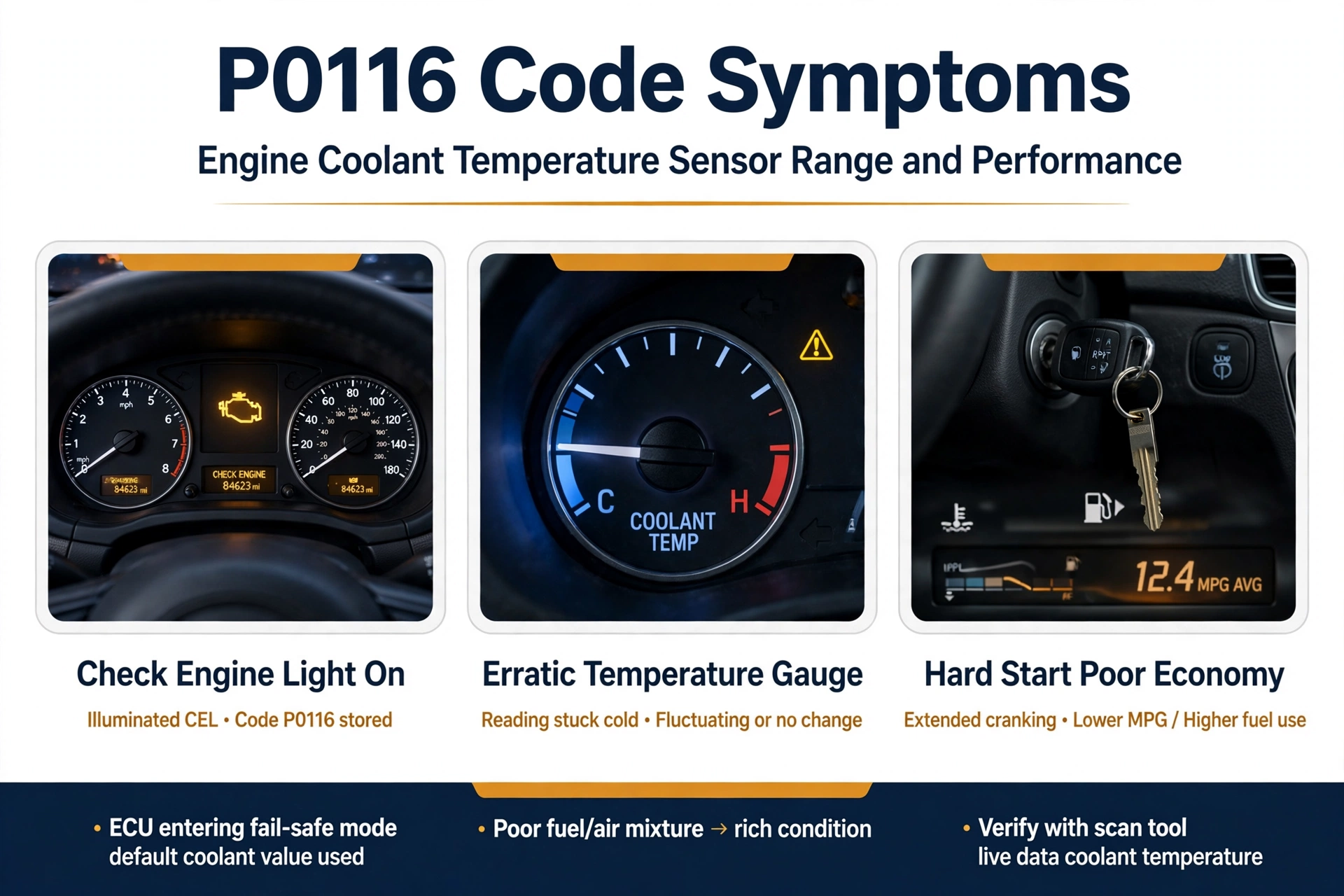
In many cases, the check engine light is the first and only obvious symptom. But because the computer cannot trust the temperature reading, you may notice several of these:
- Check engine light on with P0116 stored
- Temperature gauge reading low, stuck at cold, or moving erratically
- Cabin heater blowing lukewarm air because the engine never fully warms up
- Poor fuel economy from the engine running rich on extended cold-start fueling
- Rough idle, hesitation, or hard starting, especially on cold starts
- In some cases, the computer enters a fail-safe mode and uses a default coolant temperature value, which hurts drivability
- Failed emissions test from rich running
The hallmark symptom is the mismatch: a gauge that barely climbs while the engine has been running for ten minutes or more. If your engine takes forever to produce cabin heat and the needle never reaches its normal spot, the temperature signal is not tracking reality.
Common Causes of a P0116 Code
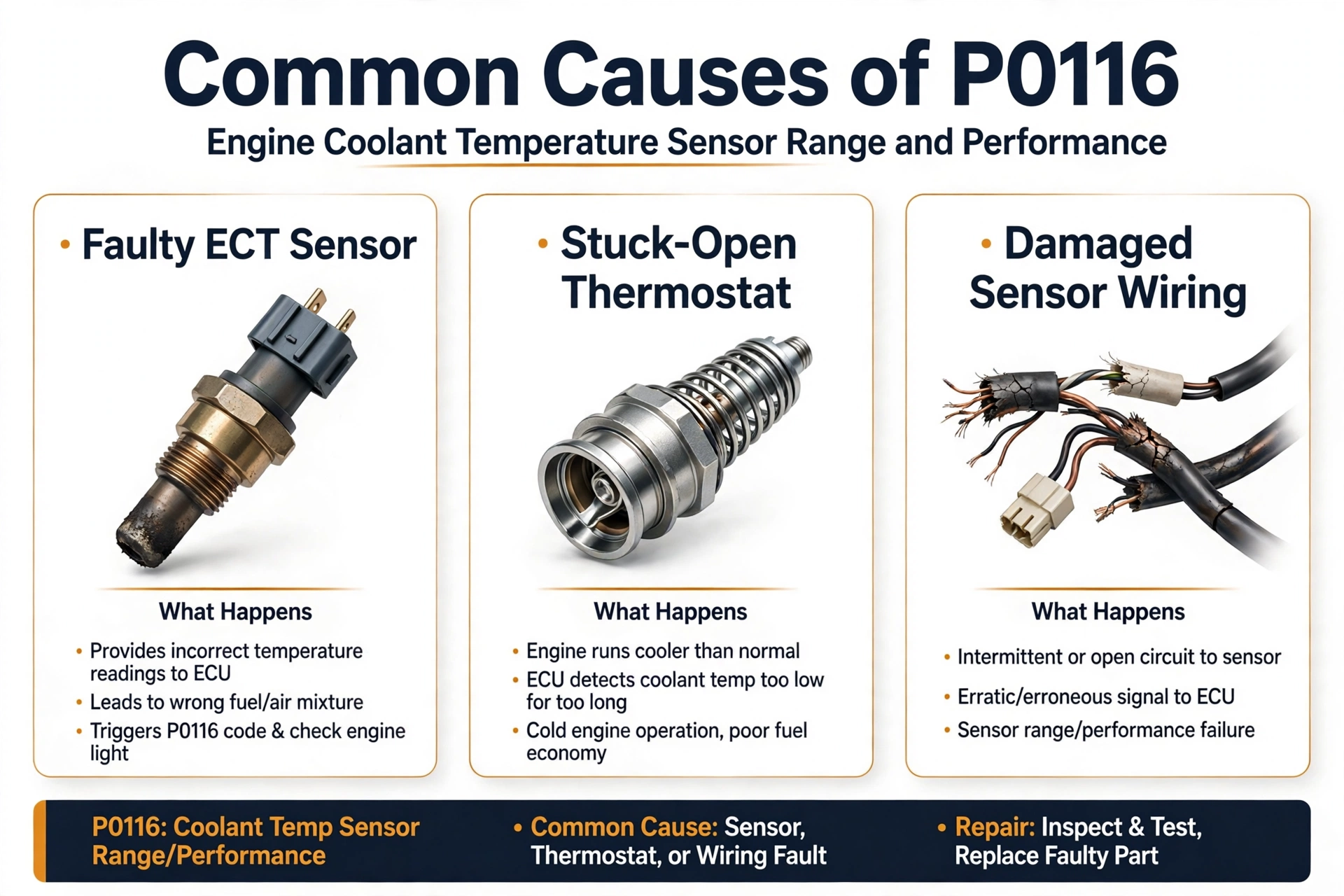
P0116 is a performance fault first and an electrical fault second. Here are the causes, roughly in order of likelihood:
- Stuck-open thermostat: the classic P0116 cause. A thermostat that never closes keeps coolant flowing to the radiator from the start, so the engine cannot warm up within the computer’s expected time.
- Faulty ECT sensor: the thermistor degrades and responds too slowly, sticks at one value, or reports erratic readings that do not follow actual temperature.
- Low coolant level or trapped air: if the sensor tip is not fully submerged in coolant, or air pockets pass over it, the reading turns erratic and untrustworthy.
- Damaged wiring or corroded connector: chafed insulation, corroded terminals, or oil and coolant contamination in the sensor plug corrupt the signal intermittently.
- Dirty or degraded coolant: old, contaminated coolant can insulate the sensor tip and slow its response to temperature changes.
- Faulty engine computer: rare, but possible after every other cause has been ruled out; some cases are resolved with a PCM software update.
How to Diagnose a P0116 Code (Do This Before Buying Parts)
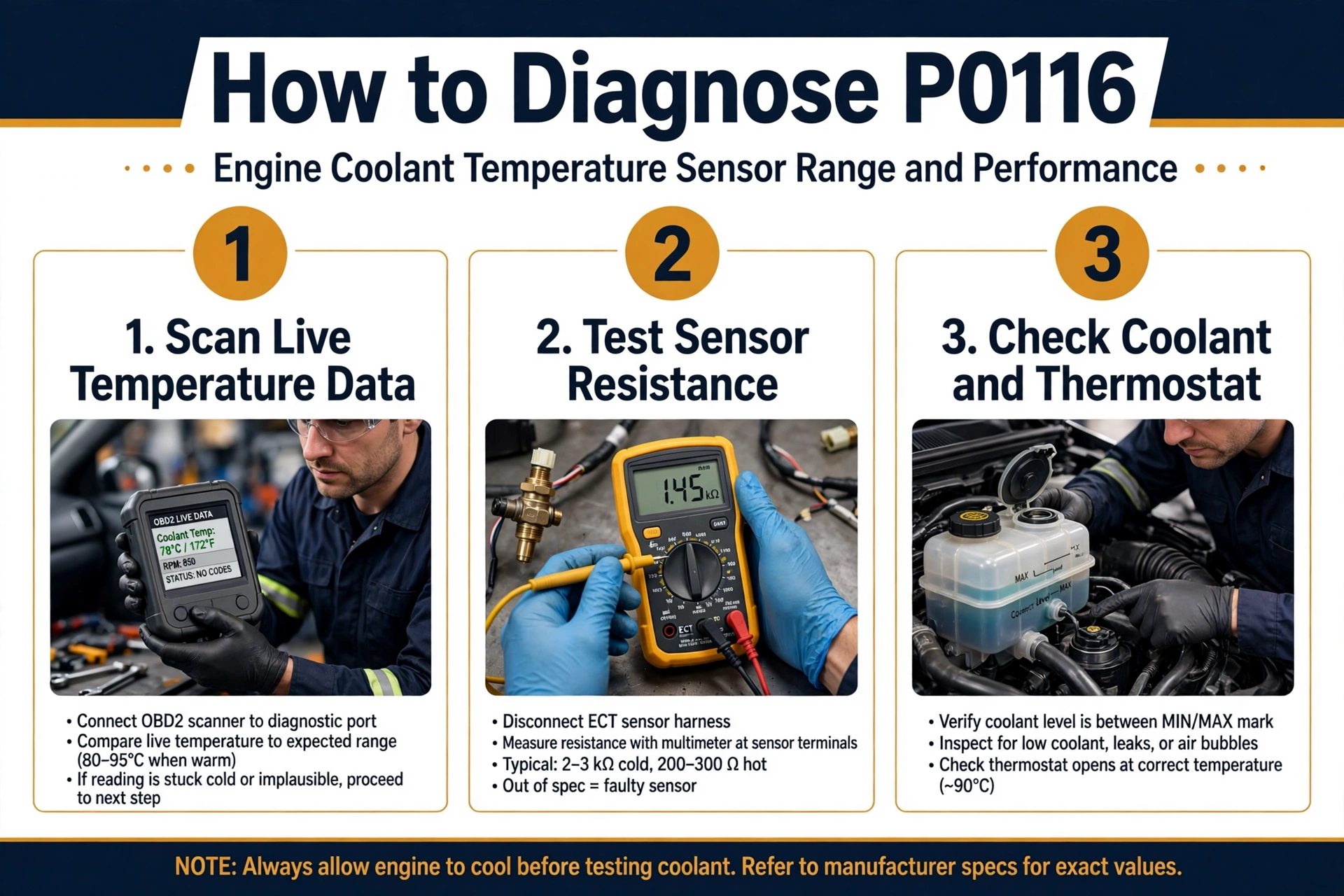
P0116 is often misdiagnosed as a bad sensor when the real problem is a lazy thermostat. Work through this order before spending money:
- Scan and document. Connect an OBD-II scanner, confirm P0116, and check the freeze-frame data. On a fully cold engine, the ECT reading and the intake air temperature reading should be nearly the same; a big difference right at startup points at the sensor.
- Watch the warm-up curve. Start the cold engine with live data running and watch the coolant temperature climb. It should rise steadily toward 195 to 220°F (90 to 105°C). If it climbs far too slowly, never reaches normal, or jumps erratically, you have found the performance problem.
- Check the coolant level. With the engine fully cold, verify the reservoir sits between MIN and MAX and the radiator is full. Top up with the correct coolant if it is low, bleed out trapped air, and look for leaks.
- Test the thermostat. Feel the upper radiator hose as the engine warms: it should stay cool until the thermostat opens, then heat up quickly. If it warms from the start, the thermostat is stuck open and is the likely culprit.
- Inspect the wiring and connector. Unplug the ECT sensor and look for corrosion, bent pins, oil or coolant contamination, and any wiring with cracked, melted, or chafed insulation.
- Test the sensor. With the sensor disconnected, measure resistance across its terminals with a multimeter. Expect roughly 2 to 3 kΩ cold and 200 to 300 Ω fully hot. A reading that does not change with temperature means the sensor is faulty.
- Clear and verify. After the repair, clear the code, drive through a full warm-up cycle from a cold start, and confirm P0116 does not return.
How to Fix a P0116 Code
The right fix depends on what your diagnosis found:
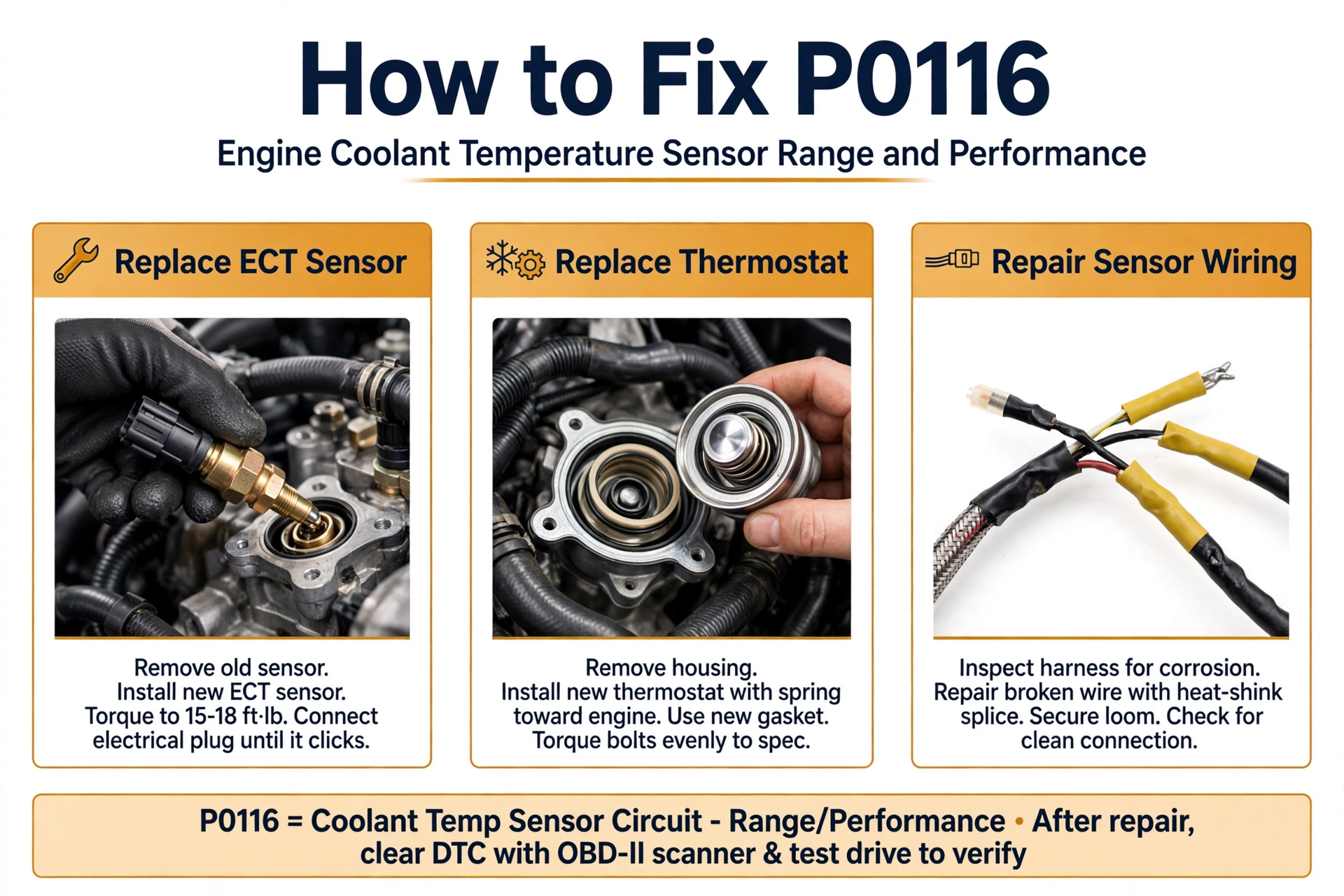
- Replace the ECT sensor: drain a little coolant, unscrew the old sensor, thread in the new one to the specified torque (commonly 15 to 18 ft-lb), and reconnect the plug until it clicks.
- Replace a stuck-open thermostat: remove the thermostat housing, install the new thermostat with the spring toward the engine, use a new gasket, and torque the housing bolts evenly to spec.
- Top up and bleed the cooling system: refill with the correct 50/50 coolant mix to the MAX line and bleed any trapped air so the sensor stays submerged.
- Repair damaged wiring: cut out the damaged section, splice and crimp, seal with heat shrink, and secure the harness away from hot or moving parts.
- Clean or replace the connector: remove corrosion, make sure the pins grip tightly, and fit a pigtail replacement if the plug itself is damaged.
- Clear the code and test drive: erase the code with your scanner and verify the temperature reading follows a normal warm-up curve through a full drive cycle.
P0116 Repair Costs
Drivers always ask how much it costs to fix the p0116 code. The sensor itself is cheap; the thermostat job costs more in labor. Here are realistic ranges:
| Repair | Cost Range |
|---|---|
| Coolant temperature sensor replacement | $150–$300 |
| Thermostat replacement | $200–$350 |
| Wiring or connector repair | $100–$250 |
| Coolant top-up and system bleed | $80–$160 |
| Professional diagnostic fee | $100–$150 |
The sensor is a $15 to $50 part on most vehicles, and a thermostat is similarly inexpensive, so a DIY repair of either is one of the cheaper check engine light fixes. Costs climb only when damaged wiring is buried deep in the harness or the thermostat housing is hard to reach.
DIY vs Mechanic Verdict
You can do this at home: checking the coolant level, watching live temperature data on a scanner, testing the sensor with a multimeter, replacing the coolant temperature sensor with basic hand tools, and topping up and bleeding the coolant.
See a mechanic for: thermostat replacement on engines where the housing is buried, intermittent wiring faults that need an oscilloscope, any signs of real overheating or coolant loss you cannot explain, or if you are not comfortable opening the cooling system.
Bottom line: P0116 is a very DIY-friendly code when the cause is the sensor or low coolant, and a moderate DIY job when it is the thermostat. The parts are inexpensive and the diagnosis is straightforward with a basic scanner and multimeter.
Can You Drive With a P0116 Code?
For short trips, usually yes, but do not ignore it for long. The computer does not trust the temperature reading, so it may keep the engine in cold-start fueling, which wastes fuel and can foul spark plugs and overload the catalytic converter over time.
The bigger risk is blindness in the other direction: with the temperature signal unreliable, you have no trustworthy warning if the engine starts genuinely overheating. If you see steam, smell hot coolant, or the engine feels abnormally hot, stop driving immediately. Otherwise, get it diagnosed within a few days, and keep an eye on the coolant level meanwhile.
P0116 on Popular Vehicles
P0116 is a generic code with the same meaning on every brand, but thermostat designs, sensor locations, and common failure points vary:
- p0116 honda: on Honda Civic and Accord models, a thermostat stuck open is a frequent cause, and the ECT sensor sits at the thermostat housing where its connector can corrode.
- p0116 toyota: on Toyota Corolla and Camry models, check the thermostat first if warm-up takes too long, and inspect the sensor wiring where it routes near hot exhaust parts.
- p0116 ford: on Ford F-150 and Focus models, slow warm-up from a lazy thermostat is common, and chafed wiring near the engine can corrupt the sensor signal.
- p0116 nissan: on Nissan Altima and Sentra models, air pockets after a coolant service can trigger false readings, and the sensor is accessible at the coolant outlet.
- p0116 chevy: on Chevrolet Silverado, Malibu, and Impala models, stuck-open thermostats are a well-known source of range and performance codes, so verify warm-up time before replacing the sensor.
- p0116 jeep: on Jeep Wrangler models, check for low coolant and trapped air first, since cooling system work can introduce air pockets that confuse the sensor.
On European cars that also follow EOBD, the same P0116 definition applies, since P0xxx codes are standardized across all markets.
P0116 vs P0115, P0117, P0118, and P0128
These codes are constantly confused because they all involve the coolant temperature sensor, so here is the difference. P0116 means the sensor reading does not track the expected temperature-vs-time curve: a range or performance problem, often caused by a stuck-open thermostat or a sluggish sensor. P0115 means the sensor circuit has a general malfunction. P0117 and P0118 are the electrical pair: P0117 means the circuit voltage is too low, which the computer reads as extreme heat, while P0118 means the circuit voltage is too high, which the computer reads as minus 40 degrees.
P0128 is the closest cousin to P0116: it means the coolant temperature stayed below the thermostat regulating temperature, which almost always points at a stuck-open thermostat. In practice, a lazy thermostat can set P0116, P0128, or both, so check for P0128 stored alongside P0116 before you decide which part to replace.
Related Codes
Related codes include P0115, P0117, P0118, P0119, P0125, P0128, P0480, and P2181.
Video Walkthrough
Watch this walkthrough from Car Mechanic USA explaining exactly what the P0116 engine code means, how to test the ECT sensor and wiring with a multimeter, and the step-by-step repair.
P0116 FAQs
What does the P0116 code mean?
What is the most common cause of a P0116 code?
Can I drive with a P0116 code?
How do I fix a P0116 code?
How much does it cost to fix P0116?
Where is the engine coolant temperature sensor located?
Will P0116 clear itself?
Conclusion
If engine code p0116 shows up on your scanner, the story is usually simple: the engine did not warm up the way the computer expected, and the usual reason is a thermostat stuck open or a tired coolant temperature sensor. Work through the diagnosis in order, fix what you find, and verify with a full warm-up cycle. Your fuel economy and your heater will thank you.
About the author: Written by the OBD2 Code Hub editorial team. Our diagnostic guides are built from real OBD-II data, manufacturer service procedures, and hands-on troubleshooting experience, then reviewed for technical accuracy before publishing. We drive the same cars you do.