
P0480 Trouble Code: Meaning, Causes, Symptoms & Fixes
In This Guide
One-line meaning: P0480: Cooling Fan 1 Control Circuit Malfunction.
What the P0480 Code Means
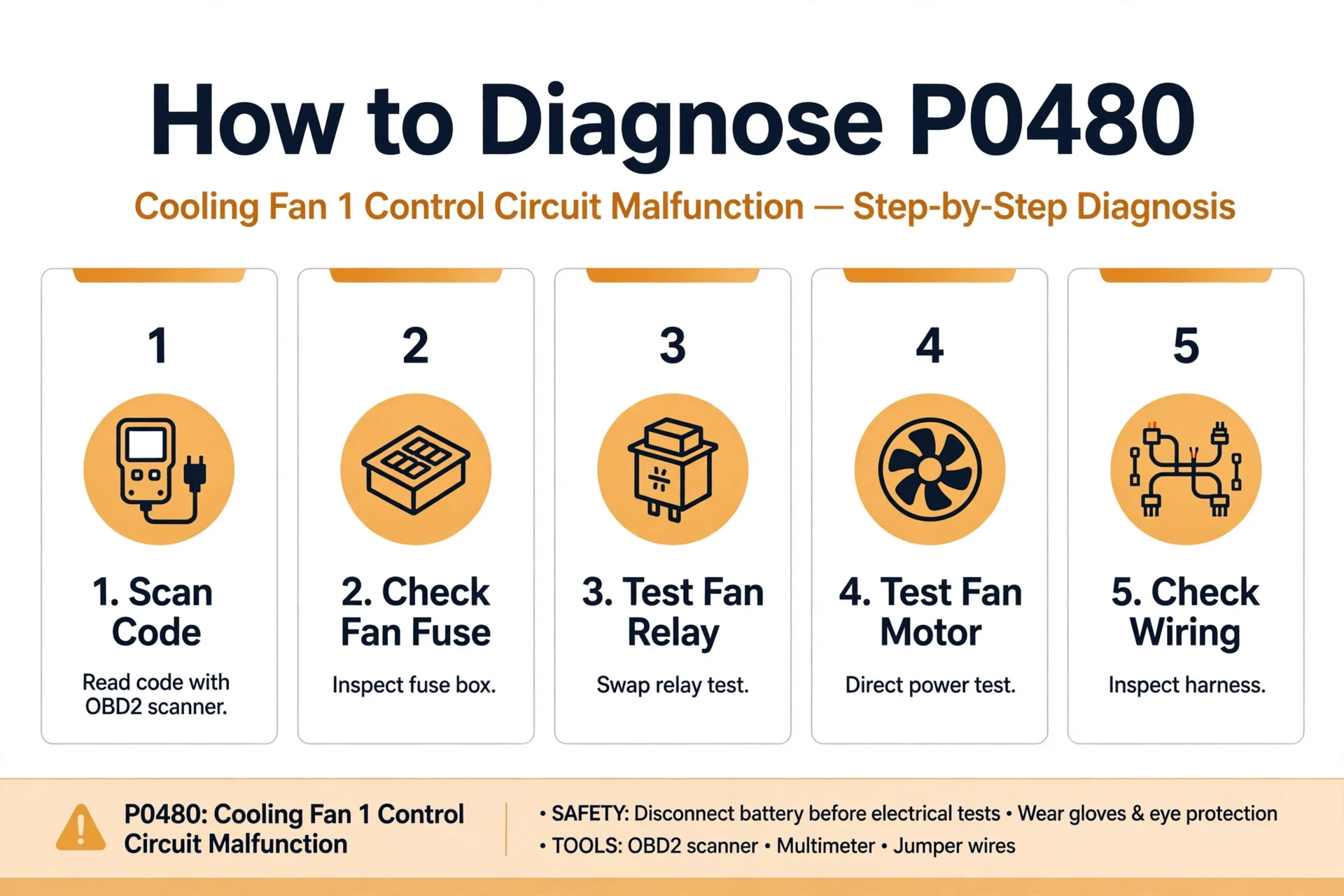
The P0480 code is the trouble code your car sets when the primary electric cooling fan stops answering commands. Its full definition is “Cooling Fan 1 Control Circuit Malfunction” (p0480 cooling fan 1 control circuit malfunction). In plain English, your car’s engine computer (PCM/ECM) has detected an electrical fault in the control circuit for cooling fan 1, the main electric fan that keeps the engine from overheating.
Here is how your car figures this out. The computer constantly monitors engine coolant temperature through the coolant temperature sensor. When the coolant gets hot enough, usually around 223 degrees F, the computer sends a signal through a relay to switch the electric cooling fan on. It then checks the feedback on the fan 1 control circuit. If the circuit is supposed to be active and the feedback voltage does not match the command, or the voltage reads wrong while the computer tests the circuit, it stores the p0480 code and turns on the check engine light.
P0480 (p0480 obd ii, dtc p0480, obd p0480) is a generic powertrain code, which means it carries the same basic meaning on every make and model, from a Jeep Wrangler to a Chevy Silverado to a VW Golf. Its close relatives are the P0481 code for fan 2 and the P0483 code for the cooling fan rationality check. Note that the exact definition of code p0480 can vary slightly between manufacturers, so always check the service information for your specific vehicle.
Symptoms of the P0480 Code
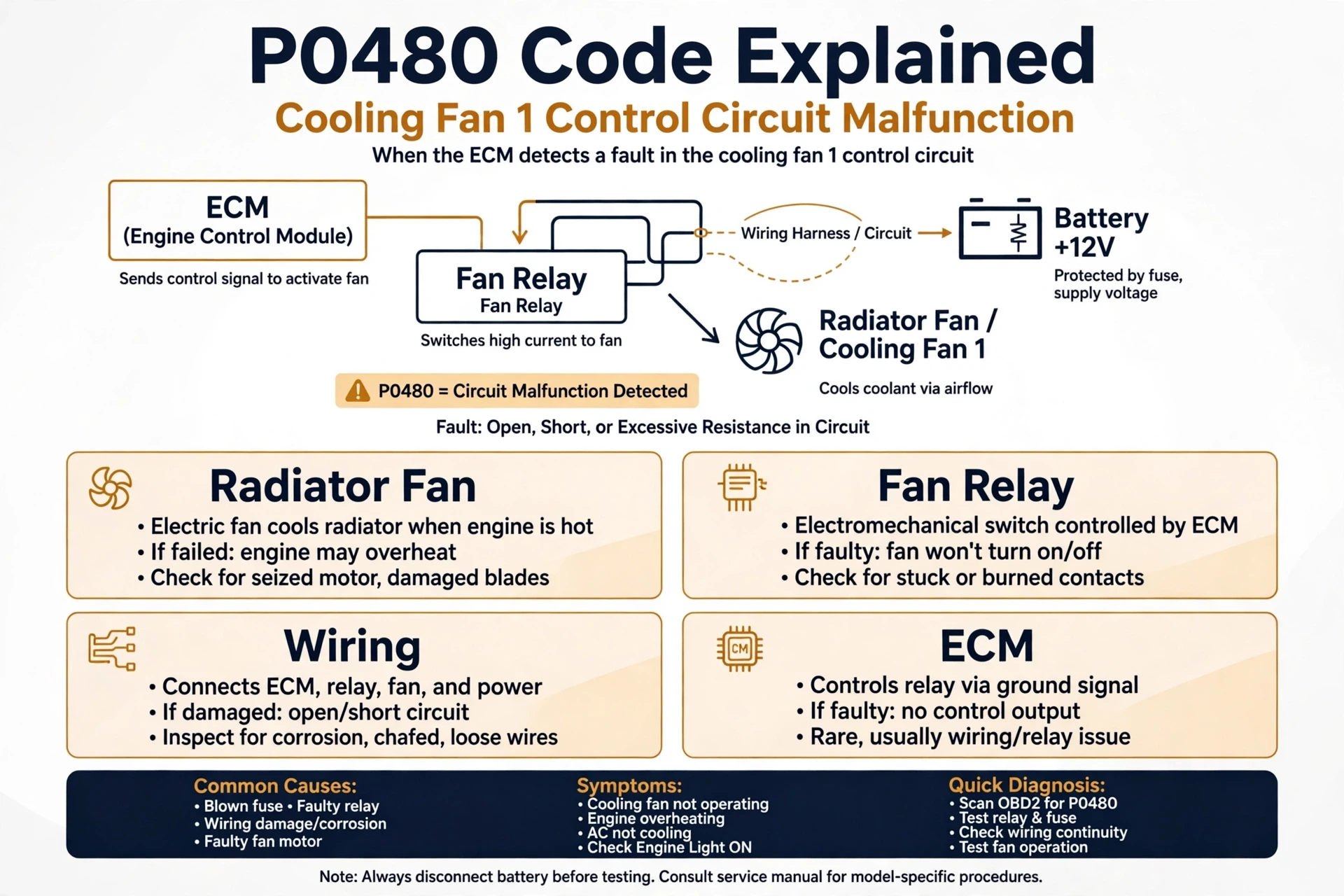
The check engine light is the one symptom every driver with this code will see. Beyond that, what you notice depends on whether the fan is dead, stuck on, or working only sometimes. Because the fan’s job is to cool the engine at low speeds, the classic pattern is trouble in traffic and at idle:
- Check engine light is on (the constant symptom of the p0480 code)
- Engine overheating, especially while idling or stuck in slow traffic
- Temperature gauge reading very high or climbing into the red
- Air conditioning loses cooling capacity because the primary fan is not spinning
- Cooling fan refuses to turn on, or the opposite: it stays stuck on and drains the battery
- Pinging or detonation on acceleration as the engine runs hotter than it should
- Failed emissions test, since an overheating engine runs dirty
- Fuel economy decreases and the engine may stall when coming to a stop
- In some cases, no symptoms the driver can feel at all, just the light
What is code P0480? What is the p0480 code trying to tell you? In short: the computer asked the main cooling fan to run and the circuit did not respond correctly. Do not ignore it just because the car still drives, because the next traffic jam could be the one that overheats the engine.
Common Causes of P0480
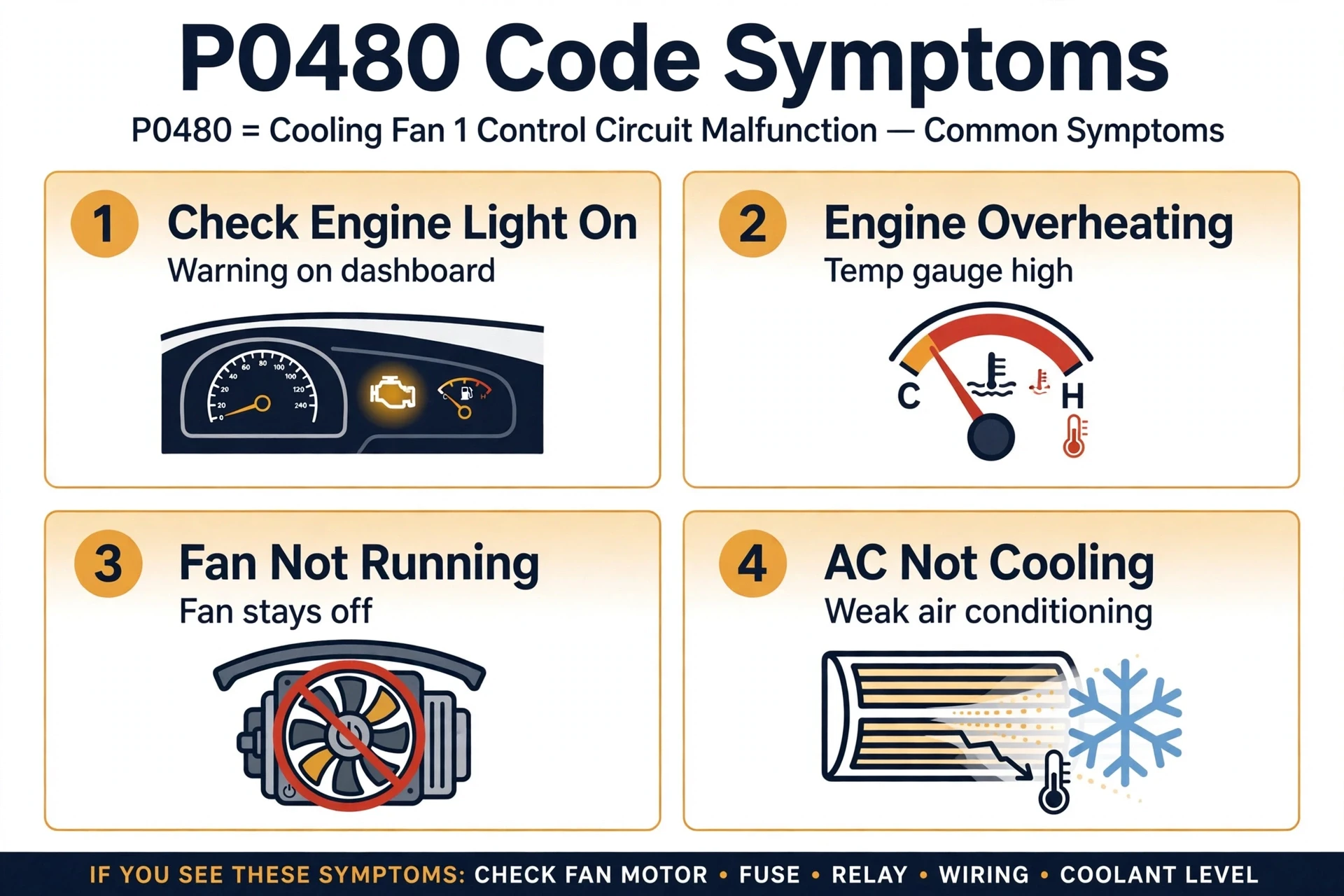
The most common cause of a P0480 code is a bad cooling fan relay. Relay 1 lives a hard life, switching high current every time the fan cycles, and a stuck, burned-out, or corroded relay keeps power from reaching the fan. But the relay is far from the only suspect, and throwing parts at the code without testing is the most expensive mistake drivers make here. These are the causes, roughly in order of likelihood:
- Faulty cooling fan relay: a stuck, burned-out, or corroded relay 1 prevents power from reaching the fan. This is the number one cause.
- Failing cooling fan motor: the electric fan motor can seize, wear out, or burn out over time. A dying motor can also draw excess current and blow the fuse.
- Blown fuse: an electrical short or a fan motor pulling too much current blows the fuse protecting the fan 1 circuit.
- Damaged wiring and connections: corroded terminals, frayed wires, loose pins, melted connectors, or bad grounds anywhere in the fan harness. Corvette C6 owners know this one well from heat-damaged fan connectors.
- Faulty engine coolant temperature (ECT) sensor: if the sensor feeds the computer wrong temperature data, the fan control logic goes wrong too. Less common, but real.
- Cooling fan control module failure: on many Volkswagens and other makes, the fan control module is built into the fan assembly itself. When the module dies, the whole assembly usually needs replacement.
- Totally integrated power module (TIPM) problems: on Chrysler, Dodge, and Jeep products, fan control runs through the TIPM, and internal TIPM faults can set this code.
- Weak battery or bad terminals and grounds: low system voltage and poor grounds make the whole fan circuit behave badly.
- Defective PCM or PCM software: rare, but a failed fan driver inside the computer or software needing an update can be the root cause.
How to Diagnose P0480 (Do This Before Buying Parts)
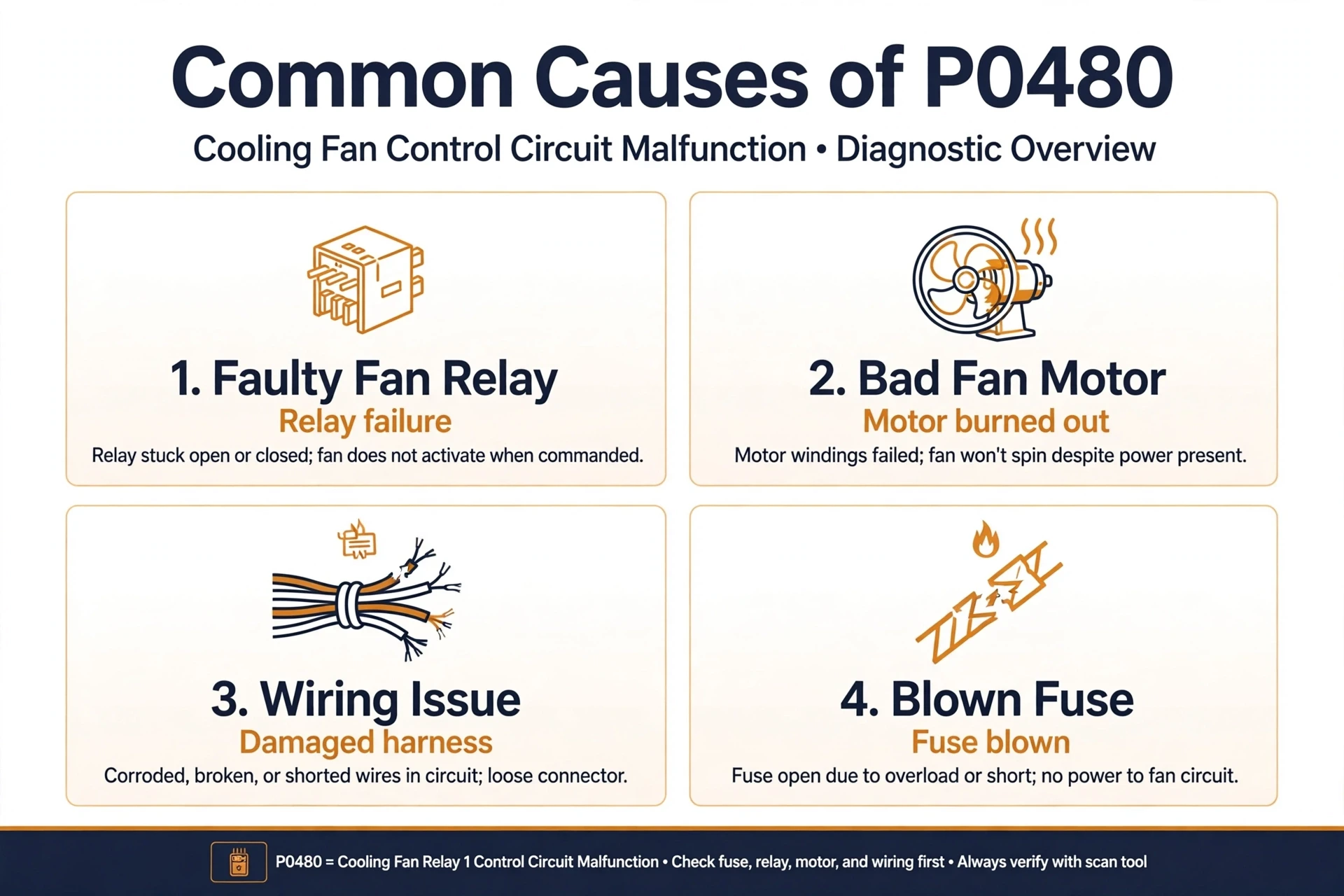
The P0480 code is a circuit code, not a parts code. It tells you the circuit misbehaved, not which part failed. Work through the circuit in this order and you will find the fault without guessing:
- Scan for companion codes first. P0481, P0483, P0691, P0692, P0693, P0526, P0528, or coolant temperature sensor codes (P0117/P0118) narrow the search fast. Fix what those point to first.
- Check the fuse and relay. Open the underhood fuse and relay box, pull the fan 1 fuse and look for a break, then swap the cooling fan relay with an identical relay from a non-critical circuit (like the horn). If the fan starts working, you found it.
- Test the fan motor with direct 12V power. Unplug the fan connector and apply battery power and ground straight to the motor. If the fan spins strongly, the motor is good and the fault is in the control side. If it does nothing, the motor is dead.
- Inspect the wiring and connectors. Look for burnt, melted, or corroded wires and terminals at the relay socket, the fan connector, and the grounds. Wiggle-test the harness while watching for the fan to cut in and out.
- Command the fan with a scan tool. A scan tool with bi-directional control can switch fan 1 on and off. If the computer commands it on and nothing happens, the break is between the relay output and the fan. If the command itself will not go through, suspect the control side or the PCM.
- Check the coolant temperature sensor data. Compare the live ECT reading on the scan tool with actual coolant temperature. A sensor reading far off reality will confuse the fan logic and can set the p0480 code on its own.
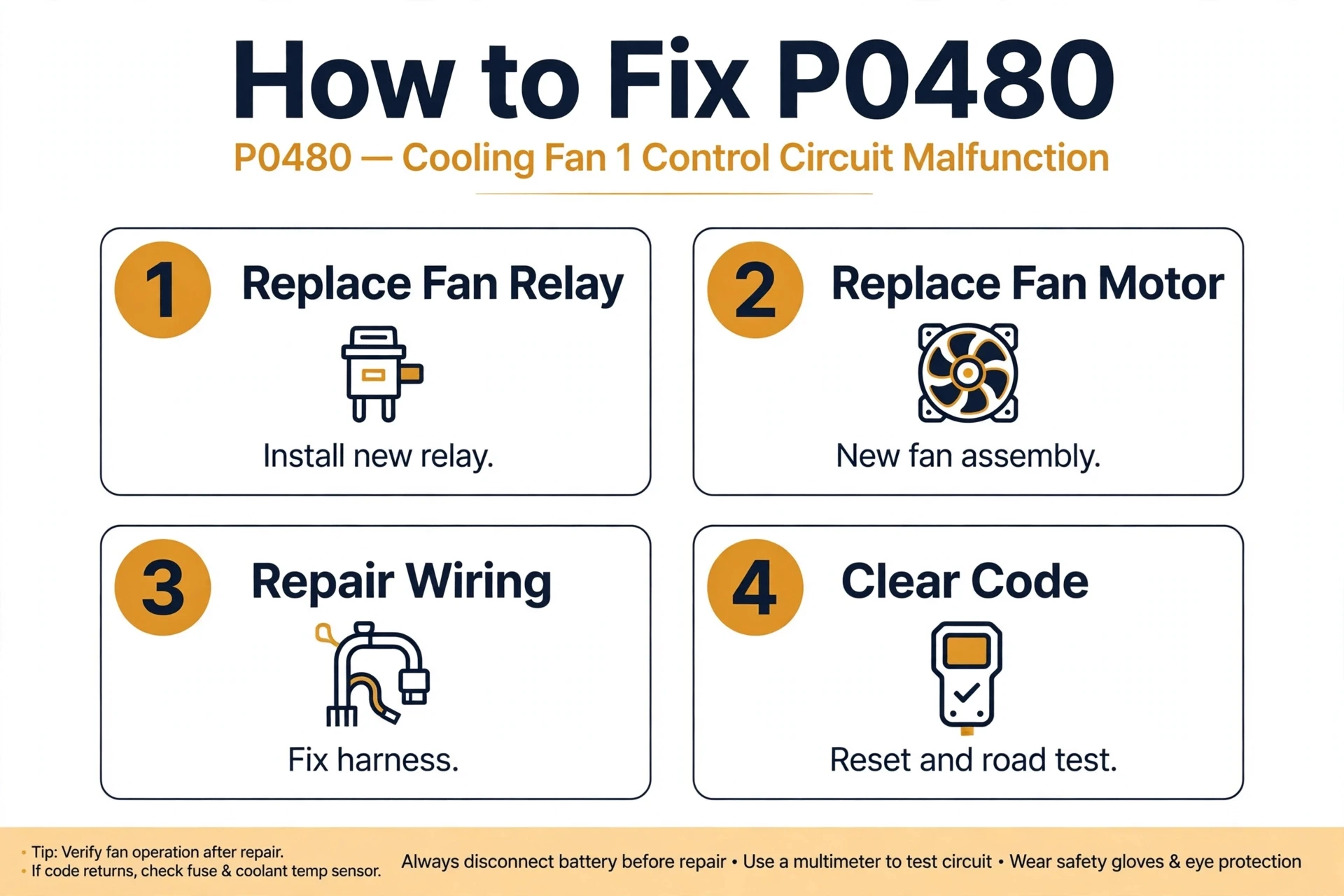
How to Fix the P0480 Code
There is no one-size-fits-all fix for the p0480 code because the fault can sit anywhere in the circuit. The right fix is whatever your diagnosis found:
- Replace the faulty cooling fan relay: the cheapest and most common fix. Match the part number and pin layout exactly.
- Replace a blown fuse, then find why it blew: a fuse rarely dies alone. A fan motor drawing too much current is the usual killer, so test the motor before calling it done.
- Repair damaged wiring: clean corroded terminals, replace melted connectors, repair frayed wires, and restore solid grounds. Dielectric grease on the new connections keeps corrosion away.
- Replace the cooling fan motor or full fan assembly: if the direct 12V test shows a dead motor, or the control module is built into the assembly (common on VW), replace the unit.
- Replace a faulty coolant temperature sensor: when live data shows the sensor lying about coolant temperature, a new sensor restores correct fan control.
- Address TIPM or PCM issues: on Chrysler products with TIPM faults, or in the rare case of a failed PCM fan driver, this is professional territory. A software update fixes it in a few edge cases.
P0480 Repair Costs
Drivers always ask how much it costs to fix P0480, and the good news is that the most common fix is also the cheapest. Here are realistic ranges:
| Repair | Cost Range |
|---|---|
| Fuse replacement | $5 – $20 |
| Cooling fan relay (DIY part) | $15 – $60 |
| Relay replacement at a shop | $80 – $180 |
| Cooling fan motor / assembly | $150 – $500+ |
| Fan control module | $200 – $600 |
| Coolant temperature sensor | $100 – $250 |
| Wiring / connector repair | $100 – $400 |
| Professional diagnosis | $100 – $175 |
This is why diagnosis matters. A $20 relay and a $500 fan assembly share the same p0480 code. Drivers looking for how to fix p0480 code cheap should always start with the fuse and relay check, not the parts catalog.
DIY vs Mechanic Verdict
You can do this at home: checking fuses, swapping relays, visual wiring inspection, the direct 12V fan motor test, and reading codes with an OBD2 scanner. Replacing a relay or fuse is a ten-minute job on most cars. If you find a blown fuse or a dead relay, those are easy DIY wins.
See a mechanic for: fan assembly replacement in cramped engine bays, control module diagnosis and programming, TIPM faults on Chrysler products, intermittent electrical gremlins that only show up hot, and any case where the fan still will not run after the fuse, relay, and motor all test good. A shop with a bi-directional scan tool can command the fan and trace the circuit in under an hour.
Bottom line: test it yourself, fix the simple stuff yourself, but let a pro chase the electrical ghosts.
Can You Drive With a P0480 Code?
It is best avoided. Short trips can be manageable if you watch the temperature gauge constantly and stay out of stop-and-go traffic, but a dead cooling fan lets the engine overheat fast the moment airflow stops. Overheating can warp the cylinder head or blow the head gasket, turning a $30 relay into a $2,000-plus engine repair. If the gauge starts climbing, pull over somewhere safe and shut the engine off. Get it diagnosed soon, even if the car feels fine on the highway.
P0480 on Popular Vehicles
P0480 shows up across all brands, but some patterns are worth knowing:
- Jeep (Cherokee, Compass, Wrangler): The p0480 code jeep (jeep p0480, p0480 code jeep wrangler) often traces to the fan relay and fuse. Owner forums consistently say the same thing: check fuses and relays before anything else.
- VW Golf / Jetta: On these cars the fan control module is built into the main fan assembly. A faulty module sets the code and the light, and the fix is usually the complete fan assembly rather than a separate part.
- Chevy (Silverado, Colorado, Malibu): The p0480 code chevy silverado (p0480 code chevy, p0480 code chevy malibu) usually comes down to the relay or the fan motor itself. The underhood fuse box is the first place to look.
- Ford (F-150, F-350): The p0480 code ford (ford p0480) deserves a full wiring check before parts get replaced, especially on trucks where the harness runs through harsh environments.
- Dodge Grand Caravan / Chrysler Town & Country: TIPM-related fan control issues are a known pattern here, sometimes with companion codes like U0100. TIPM diagnosis is shop territory.
- Corvette C6: Heat-damaged fan connectors are a documented weak spot. Owners have fixed recurring P0480 codes by replacing both sides of the melted fan connector.
- Nissan: The p0480 code nissan (nissan p0480) usually points at the relay or a skewed coolant temperature sensor reading, so check live ECT data early.
- Honda: The p0480 honda code is less common, but when it appears the same fuse, relay, and fan motor tests apply.
EOBD P0480 and OBD P0480 are the same code under different naming (European vs generic OBD-II). DTC P0480 and OBD-II P0480 also refer to the identical fault.
P0480 vs P0481
P0480 is fan 1, the primary cooling fan. P0481 is the mirror image for fan 2: “Cooling Fan 2 Control Circuit Malfunction.” On cars with two electric fans, the two codes point at the two separate control circuits, and you diagnose them exactly the same way. Related neighbors include P0483 (the fan rationality check, set when the computer thinks fan behavior does not match conditions) and P0691/P0692 (fan 1 control circuit low/high). If you see P0480 and P0481 together, suspect a shared fuse, ground, or power feed before suspecting two dead fans.
Related Codes
- P0481: Cooling Fan 2 Control Circuit Malfunction
- P0483: Cooling Fan Rationality Check Malfunction
- P0691 / P0692: Fan 1 Control Circuit Low / Fan 1 Control Circuit High
- P0526 / P0528: Cooling Fan Speed Sensor Circuit Range / No Signal
- P0117 / P0118: Engine Coolant Temperature Sensor Circuit Low / High Input
Video Walkthrough
Watch the video above for a quick visual guide to the P0480 code, what it means, and how risky it is to keep driving with it before you read on.
Frequently Asked Questions
What is the most common cause of a P0480 code?
A faulty cooling fan relay is the single most common cause. A stuck, burned-out, or corroded relay 1 keeps power from reaching the fan. A failing fan motor and a blown fuse are close behind, which is why testing the relay, fuse, and motor before buying parts saves so much money.
Can I still drive my car with a P0480 code?
It is best avoided. Short trips can be manageable if you watch the temperature gauge constantly, but a dead cooling fan lets the engine overheat fast in traffic, and overheating can warp the cylinder head or blow the head gasket.
How do you fix the code P0480?
Diagnose first: check the fan 1 fuse and relay in the underhood box, test the fan motor with direct 12V power, and inspect the wiring and connectors. Then replace what failed: usually the relay, sometimes the fuse, fan motor, wiring, or coolant temperature sensor.
How much does it cost to fix P0480?
From about $5-$20 for a fuse and $15-$60 for a relay you replace yourself, to $150-$500+ for a cooling fan assembly or $200-$600 for a fan control module. A professional diagnosis typically runs $100-$175.
Will P0480 clear itself?
Rarely. If the fault was a one-time glitch, it might. Usually the code returns until the real problem is fixed. After the repair, clear the code with a scan tool and confirm it stays off through a full drive cycle.
Where is the cooling fan relay located?
In the underhood fuse and relay box on most vehicles. The exact slot varies by year, make, and model, so check the diagram on the box lid or your owner’s manual to find the fan 1 relay.
Can a bad coolant temperature sensor cause P0480?
Yes, though it is less common. If the sensor sends the computer wrong temperature readings, the fan control logic goes wrong and the computer can set P0480. Always check live coolant temperature data during diagnosis.
Conclusion
The P0480 code looks alarming, but it is really your car telling you the primary cooling fan circuit is not responding. Check the fuse and relay first, test the fan motor with direct 12V power, inspect the wiring, and replace only what failed. Do that, and you will either fix it for the price of a relay or know exactly which part to replace. Either way, you stop guessing and start fixing. And do not put it off: an engine that cannot cool itself at idle is an engine headed for expensive damage.
About the author: Written by the OBD2 Code Hub editorial team. Our diagnostic guides are built from real OBD-II data, manufacturer service procedures, and hands-on troubleshooting experience, then reviewed for technical accuracy before publishing. We drive the same cars you do.