
P0121 Trouble Code: Meaning, Causes, Symptoms & Fixes
In This Guide
One-line meaning: P0121: Throttle/Pedal Position Sensor/Switch A Circuit Range/Performance Problem.
What the P0121 Code Means
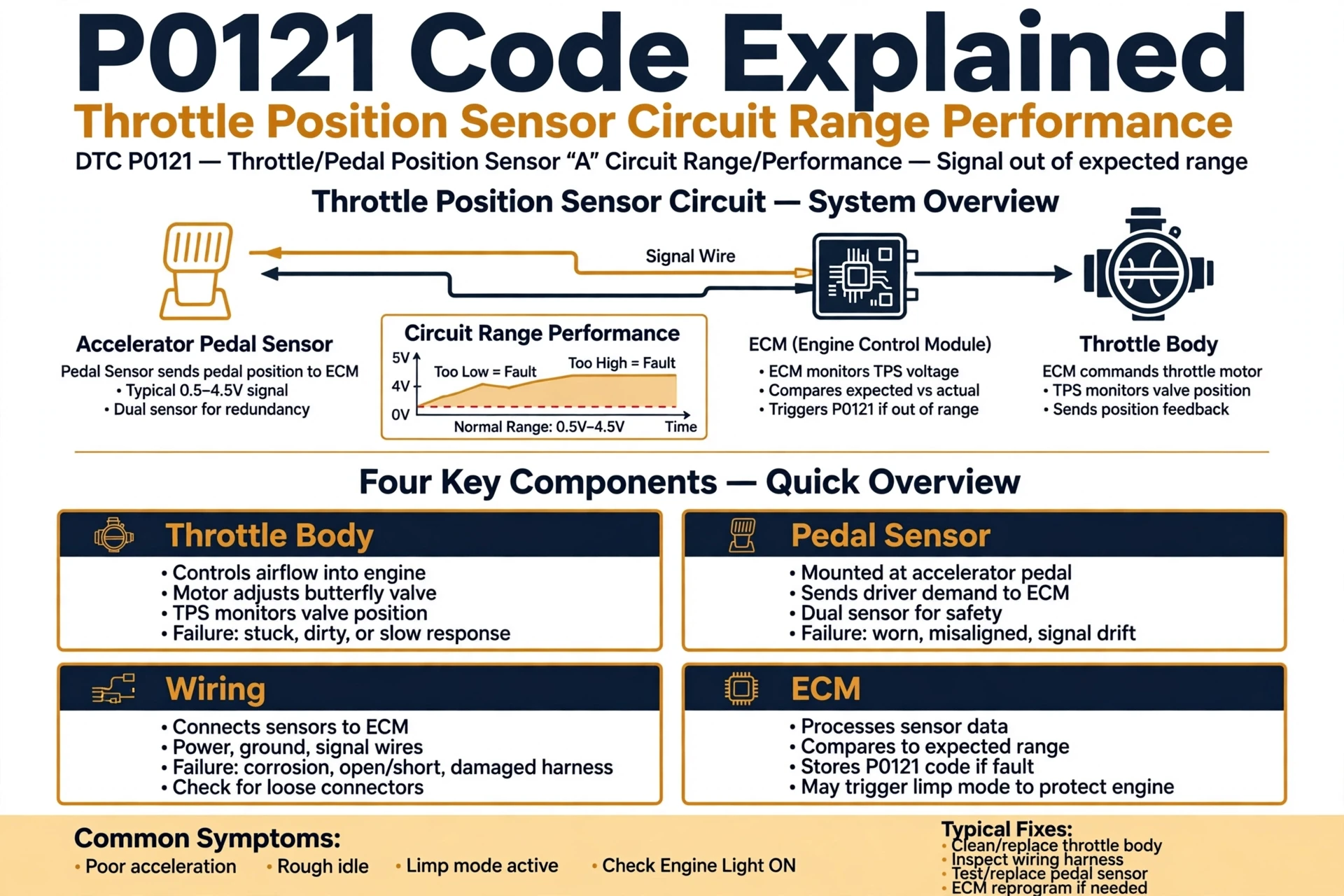
The P0121 code is a generic powertrain trouble code that points at the throttle or accelerator pedal position sensor “A” circuit. When your car sets the p0121 code, the engine control module (ECM) is seeing a signal from the throttle position sensor that is alive but does not make sense: the voltage sits outside the expected range for the driving conditions, or it disagrees with what the airflow sensors and the pedal input say should be happening.
Here is how your car figures this out. Most modern cars use drive-by-wire, so there is no physical cable between the gas pedal and the throttle plate. The pedal carries its own position sensor, the throttle body carries a throttle position sensor (TPS), and the ECM constantly cross-checks the two against engine airflow. P0121 (p0121 obd ii, p0121 code) is a generic code, which means it carries the same core meaning on every make, although the exact test conditions that set it can vary a little by manufacturer.
The key word in the definition is range/performance. Unlike P0122 (circuit low) or P0123 (circuit high), which flag a sensor signal stuck at one extreme, P0121 flags a signal that is present but implausible. That distinction matters, because it usually points away from a completely dead sensor and toward things like carbon buildup on the throttle plate, a worn spot inside the sensor, a corroded connector, or wiring that only misbehaves when the engine is hot or vibrating.
Symptoms of the P0121 Code
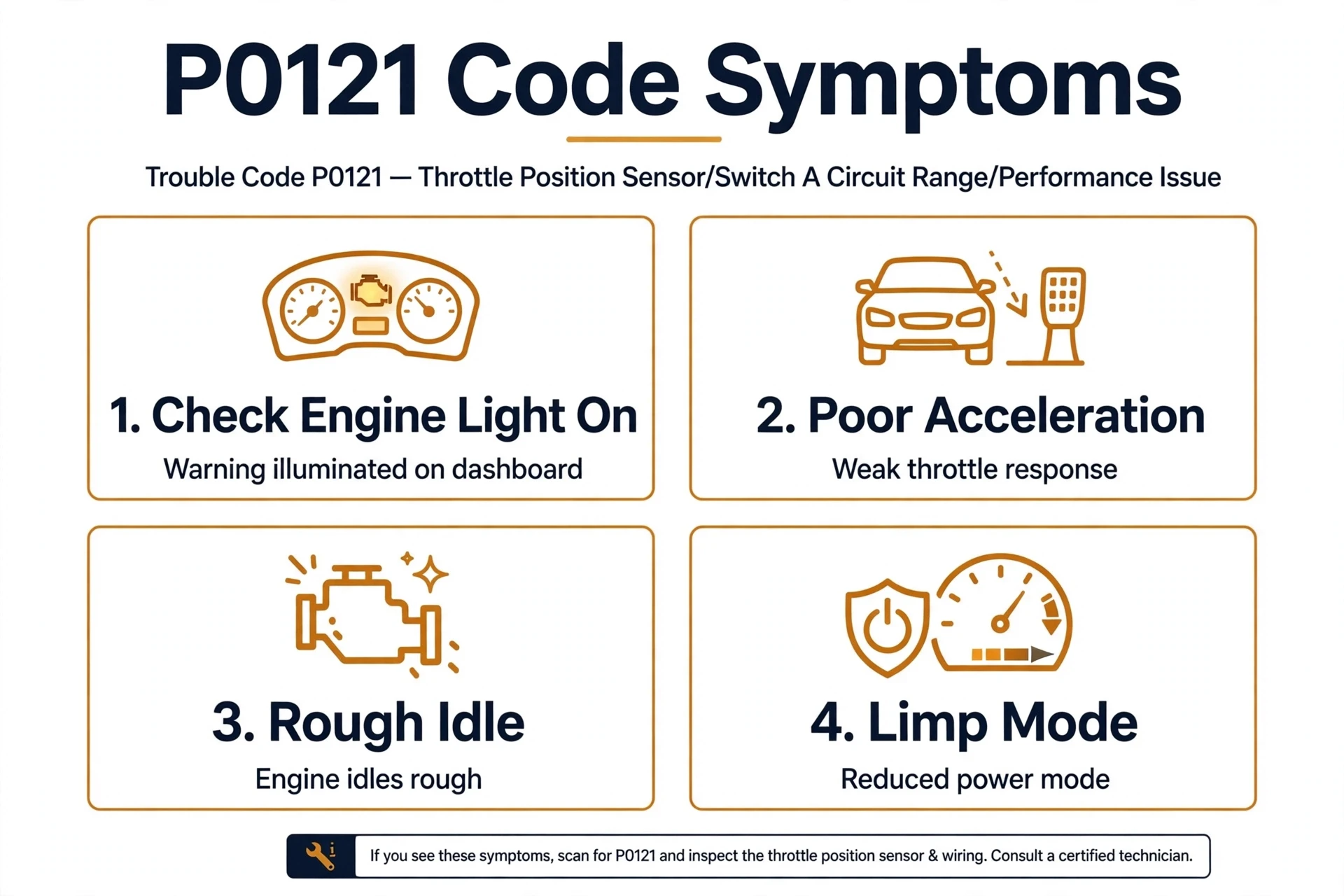
The p0121 code rarely hides quietly. Because the ECM cannot fully trust the throttle signal, it often protects the engine, and you feel that protection immediately.
- Check engine light illuminated on the dashboard, sometimes with a “reduced engine power” warning
- Engine stumbles, hesitates, or surges when you accelerate
- Rough idling, or RPM that climbs and falls on its own
- Stalling when you press the pedal from a stop
- Throttle feels unresponsive at light pedal pressure, then suddenly surges
- Hard starting, or black smoke from the exhaust during acceleration
- Limp mode: the car limits speed and throttle response until the fault is resolved
If other codes are stored alongside P0121, the symptom picture can change, because companion codes point at the part of the circuit that is actually failing.
Common Causes of P0121
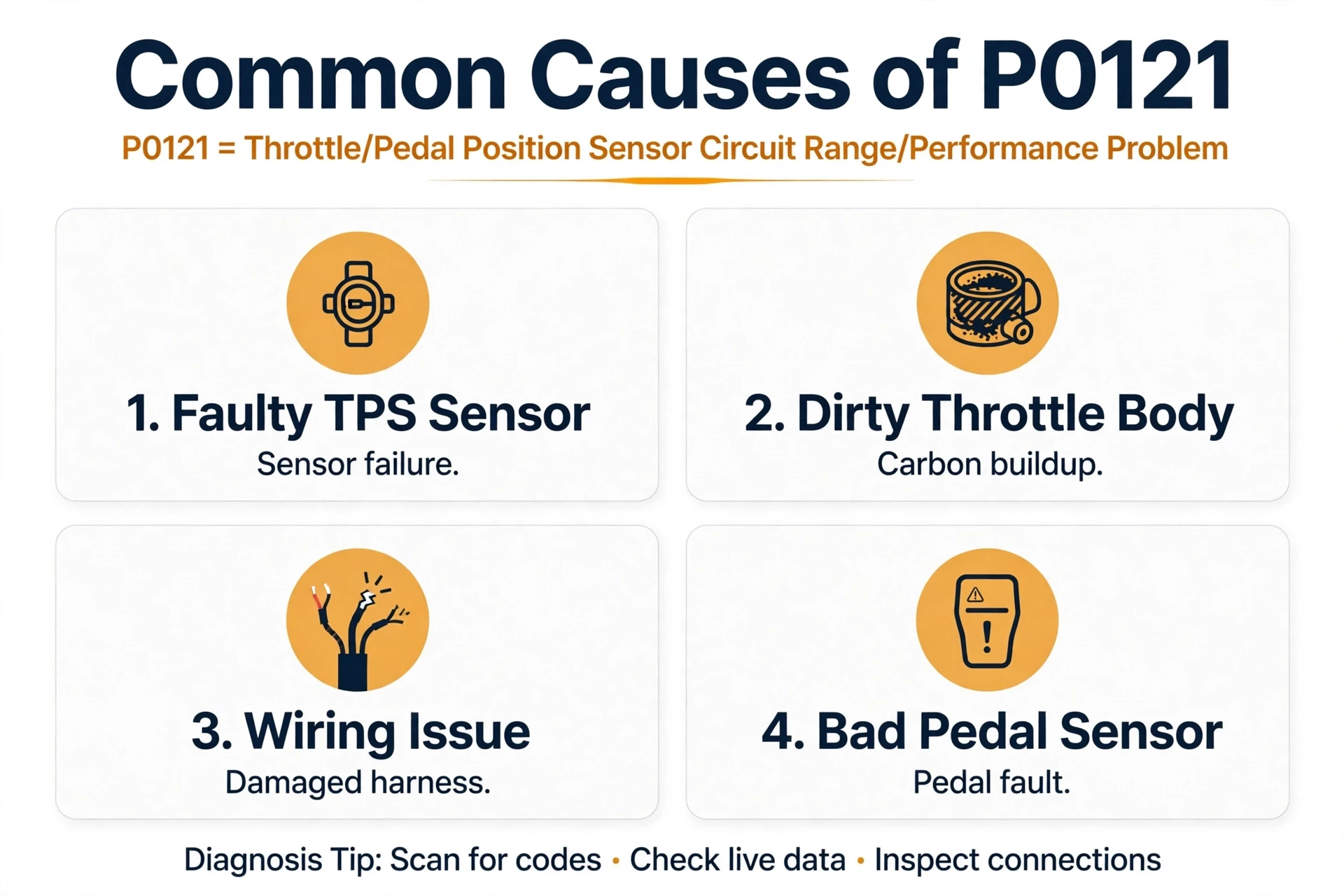
In most cases, P0121 comes down to the throttle body, its wiring, or the sensor itself. These are the causes in the order a good technician would suspect them.
- Dirty throttle body: carbon deposits and sticky residue around the throttle plate keep it from moving smoothly, so the sensor reports a position the ECM does not expect.
- Wiring or connector problems: corroded pins, loose terminals, frayed wires, or a harness damaged by heat and moisture can push the signal voltage in and out of range. This is one of the most common root causes of the p0121 code.
- Worn throttle position sensor: the internal contacts wear with mileage and develop dead spots that the ECM reads as an implausible signal.
- Faulty accelerator pedal position sensor: on drive-by-wire cars the pedal assembly has its own sensor, and its signal feeds the same plausibility checks.
- Conflicting sensor data: if the MAP or MAF sensor readings disagree with the throttle position, the ECM may set P0121 even when the throttle sensor itself is healthy.
- ECM or software issues: outdated calibration or an internal control module fault can misjudge a good signal. This is uncommon, but it happens, especially after a throttle body replacement that was never calibrated.
How to Diagnose P0121 (Do This Before Buying Parts)
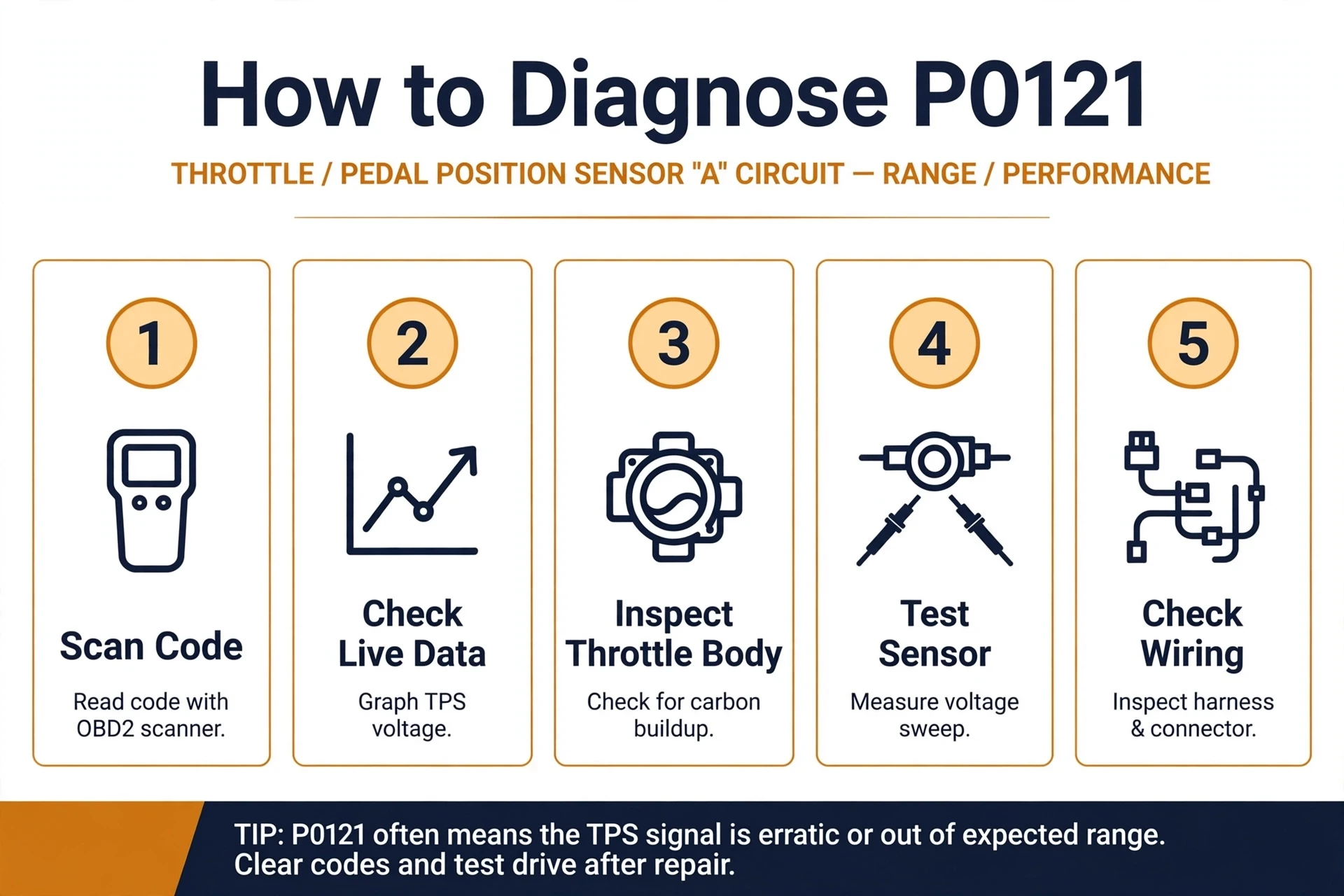
Do not buy parts first. P0121 rewards a logical diagnosis, and most of it needs nothing more than a scan tool and a multimeter.
- Scan and record everything. Read all stored codes with an OBD-II scanner and save the freeze-frame data. Companion codes like P0120, P0122, P0123, or P0124 narrow the search immediately.
- Inspect the throttle body. Remove the intake duct and look for carbon buildup around the throttle plate. A black, gummy ring is a classic P0121 trigger.
- Check the wiring and connectors. Unplug the throttle body and pedal sensor connectors and look for green corrosion, pushed-out pins, and cracked insulation. Wiggle the harness with the engine running and watch the live data for dropouts.
- Watch live sensor data. Graph the TPS signal on a scan tool while slowly opening the throttle. It should sweep smoothly from about 0.5 volts at idle to about 4.5 volts at wide open throttle, with no flat spots or sudden jumps.
- Test with a multimeter. Back-probe the sensor connector and confirm the 5-volt reference, a solid ground, and a smooth signal sweep as the throttle moves.
- Check for software updates. Ask a dealer or a well-equipped shop whether your vehicle has a calibration update covering throttle position plausibility faults.
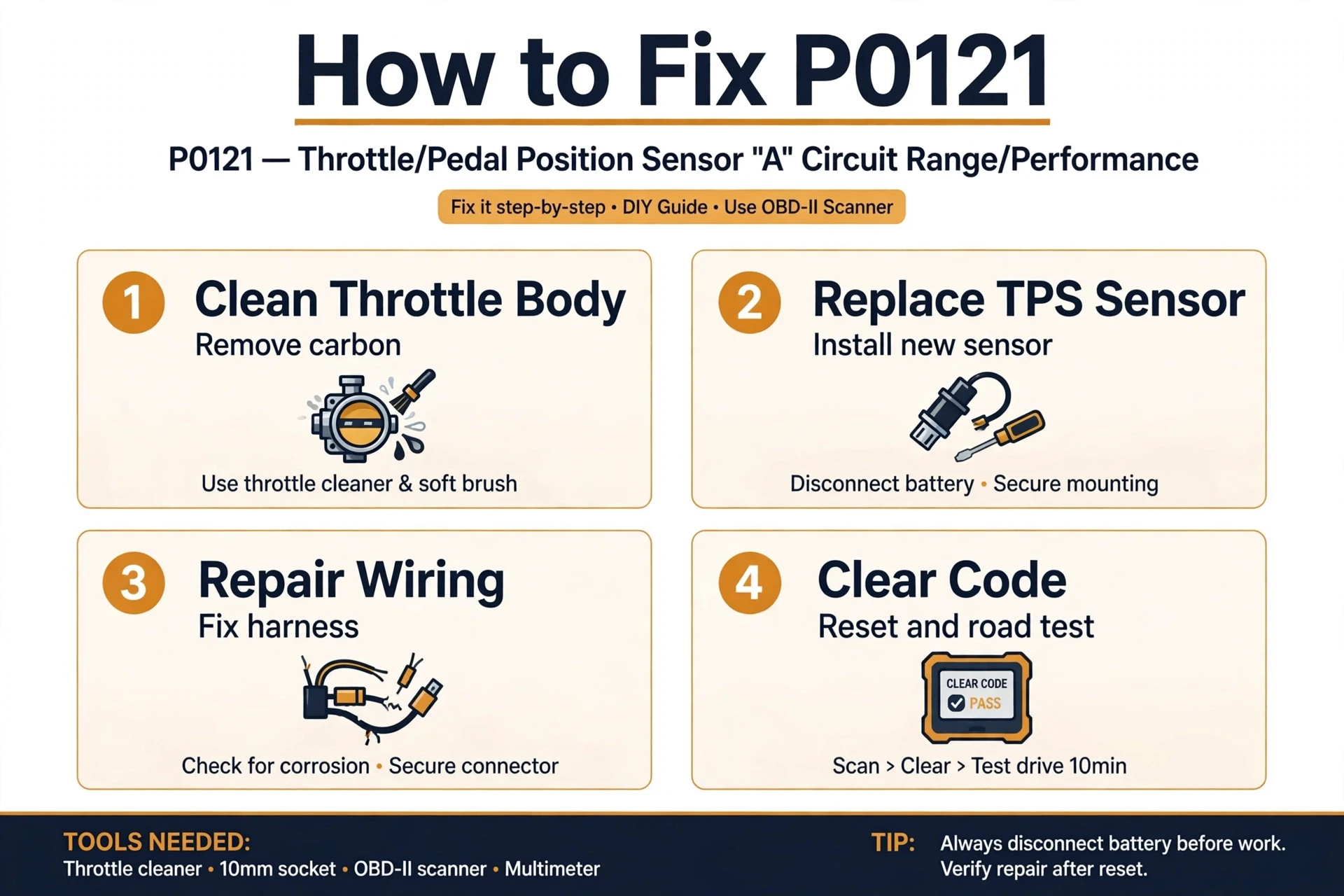
How to Fix the P0121 Code
The right fix follows the diagnosis. Match the repair to what you found:
- Clean the throttle body and perform a relearn: remove carbon with a dedicated throttle body cleaner and a lint-free cloth, then run the idle relearn or throttle reset with a scan tool. Disconnecting the battery alone is usually not enough.
- Repair the wiring: clean corroded pins, replace damaged pigtails, and secure the harness away from heat and moving parts.
- Replace the throttle position sensor: on many cars the sensor is part of the throttle body assembly, so the whole unit gets replaced.
- Replace the accelerator pedal position sensor: when testing shows the pedal assembly is the source of the bad signal.
- Update the ECM software: when a manufacturer calibration addresses the fault.
- Clear the code and road test: erase the code, then drive for at least 10 minutes, including a few full-throttle accelerations, to confirm the fix holds.
P0121 Repair Costs
Drivers always ask how much it costs to fix P0121, and the answer depends entirely on which part of the circuit failed.
| Repair | Cost Range |
|---|---|
| Throttle body cleaning + relearn (shop) | $80 – $200 |
| Throttle position sensor replacement | $120 – $300 |
| Throttle body assembly replacement | $250 – $700 |
| Accelerator pedal position sensor replacement | $150 – $400 |
| Wiring / connector repair | $100 – $300 |
| ECM software update | $120 – $300 |
Cleaning is the cheapest possible outcome, which is another reason to diagnose before buying parts.
DIY vs Mechanic Verdict
You can do this at home: scanning codes with an OBD2 scanner, removing the intake duct, inspecting and cleaning the throttle body, checking connectors for corrosion, and clearing the code after a repair.
See a mechanic for: pinpoint voltage testing with a multimeter or scope, wiring repairs buried inside looms, ECM software updates, and throttle body replacement on cars that require a scan-tool relearn.
Bottom line: most P0121 fixes are within reach of a careful DIYer, but the relearn step is not optional. If you cannot perform it, let a shop finish the job.
Can You Drive With a P0121 Code?
Short trips at low speed are usually possible, but driving with P0121 is not recommended. The engine can stall when you pull away from a stop, hesitate when you need power to merge, or drop into limp mode without warning. Get it diagnosed soon, and avoid highway driving until the throttle signal is trustworthy again.
P0121 on Popular Vehicles
P0121 is a generic code, so it appears on every brand, but owners of certain models report it most often:
- Chevy (Silverado, Tahoe): the p0121 code on high-mileage trucks usually traces to carbon buildup or a worn throttle position sensor.
- Toyota (Tundra, 4Runner): a dirty throttle body is the classic trigger; cleaning plus a relearn cures many cases.
- Ford (F-150): check the accelerator pedal position sensor and its connector, not just the throttle body.
- Ram (1500): wiring chafing near the throttle body harness shows up repeatedly.
- Nissan and Honda: on some models the code sets when the TP and MAP signals disagree, so test both sensors before replacing anything.
- VW and Audi: throttle body adaptation after cleaning is critical; skipping the relearn brings the code right back.
- Pontiac (GTO): aging TPS units with worn spots are a known trigger.
DTC P0121 and OBD-II P0121 are the same fault under different naming. The code means the identical thing on every brand.
P0121 vs P0122 and P0123
These three codes live in the same circuit but describe different failures. P0122 means the Sensor A signal is stuck low, from a short to ground or a dead sensor, and P0123 means it is stuck high, from a short to voltage. P0121 is the in-between case: the signal is alive but out of range or implausible for the conditions. That is why P0121 so often ends with a cleaning or a wiring repair, while P0122 and P0123 more often end with a part replacement. P2135 is a different kind of check: it compares Sensor A against Sensor B and flags a correlation mismatch.
Related Codes
- P0120: Throttle/Pedal Position Sensor “A” Circuit
- P0122: Throttle/Pedal Position Sensor/Switch “A” Circuit Low
- P0123: Throttle/Pedal Position Sensor/Switch “A” Circuit High
- P0124: Throttle/Pedal Position Sensor/Switch “A” Circuit Intermittent
- P0222: Throttle/Pedal Position Sensor/Switch “B” Circuit Low
- P2135: Throttle/Pedal Position Sensor/Switch “A”/“B” Voltage Correlation
Video Walkthrough
Watch the video above for a visual walkthrough of P0121 causes and diagnosis before you read on.
Frequently Asked Questions
What does the P0121 code mean?
It means the engine computer has detected a range or performance problem in the throttle or pedal position sensor “A” circuit. In plain English, the sensor signal is present but does not match what the computer expects for the current throttle position, pedal input, and airflow.
What are the symptoms of a P0121 code?
The most common symptoms are a check engine light, hesitation or surging during acceleration, rough or wandering idle, stalling when pulling away from a stop, and limp mode with reduced power. Some drivers also notice hard starting or black smoke from the exhaust under acceleration.
What is the most common cause of a P0121 code?
A dirty throttle body and wiring or connector problems top the list. Carbon buildup around the throttle plate confuses the position reading, while corroded pins or damaged wires make the signal drop in and out of range. A worn throttle position sensor is the next most likely cause.
Can I drive with a P0121 code?
Short, low-speed trips are usually possible, but it is not recommended. The engine can stall at intersections, hesitate when you need to merge, or enter limp mode unexpectedly. Diagnose it soon and avoid highway driving until it is fixed.
How do I fix a P0121 code?
Start by scanning for codes, inspecting the throttle body for carbon, and checking the wiring and connectors. Clean the throttle body, repair any wiring damage, replace the sensor only if testing proves it has failed, then perform a throttle relearn and clear the code before a road test.
Will a P0121 code clear itself?
It can clear on its own if the fault stops occurring for enough drive cycles, but the underlying problem usually returns. The reliable approach is to fix the cause, perform the relearn, and clear the code with a scan tool.
Do I need a throttle relearn after fixing P0121?
Yes, in most cases. After cleaning or replacing the throttle body, the ECM must relearn the closed-throttle position, or the code can return immediately. Use a scan tool for the relearn procedure; simply disconnecting the battery is usually not enough.
Conclusion
The P0121 code looks intimidating because it names a circuit fault, but it is usually your car asking for a cleaning, a connector repair, or a calibration rather than an expensive part. Work through the diagnosis in order, do not skip the relearn, and the throttle response you remember will come back.
About the author: Written by the OBD2 Code Hub editorial team. Our diagnostic guides are built from real OBD-II data, manufacturer service procedures, and hands-on troubleshooting experience, then reviewed for technical accuracy before publishing. We drive the same cars you do.