
P2135 Trouble Code: Meaning, Causes, Symptoms & Fixes
In This Guide
One-line meaning: P2135: Throttle/Pedal Position Sensor/Switch “A”/”B” Voltage Correlation.
What the P2135 Code Means
The P2135 code is a generic powertrain code drivers usually meet together with a sudden loss of power or a “Reduced Engine Power” warning on the dash. Its full definition is “Throttle/Pedal Position Sensor/Switch ‘A’/‘B’ Voltage Correlation” (p2135 throttle/pedal position sensor/switch a/b voltage correlation). In plain English, your car’s engine computer (ECM/PCM) has decided that the two redundant position sensors in the electronic throttle system no longer agree with each other, so it can no longer trust what your right foot is asking for.
Here is how your car figures this out. Modern cars use drive-by-wire: there is no physical cable between the gas pedal and the throttle. Instead, the accelerator pedal carries position sensors and the electronic throttle body carries its own throttle position sensors, always in pairs called Sensor A and Sensor B for redundancy. The computer constantly compares the voltage signals from both sensors, and they should track each other inside a tight, predictable range. When one sensor reads half throttle while the other reads full throttle, or the two signals fall out of sync for a set period, the computer stores the P2135 code as a safety measure against unintended acceleration.
P2135 (p2135 obd ii, p2135 code) is a generic code, which means it has the same meaning on every make and model, from a Chevy Silverado to a Nissan Sentra to a Ford Fusion. Its close relative is the P2138 code, the same kind of correlation fault for the second sensor pair (sensors D and E). When P2135 sets, the computer usually answers by cutting engine power to a fail-safe level, which is why the car suddenly feels gutless.
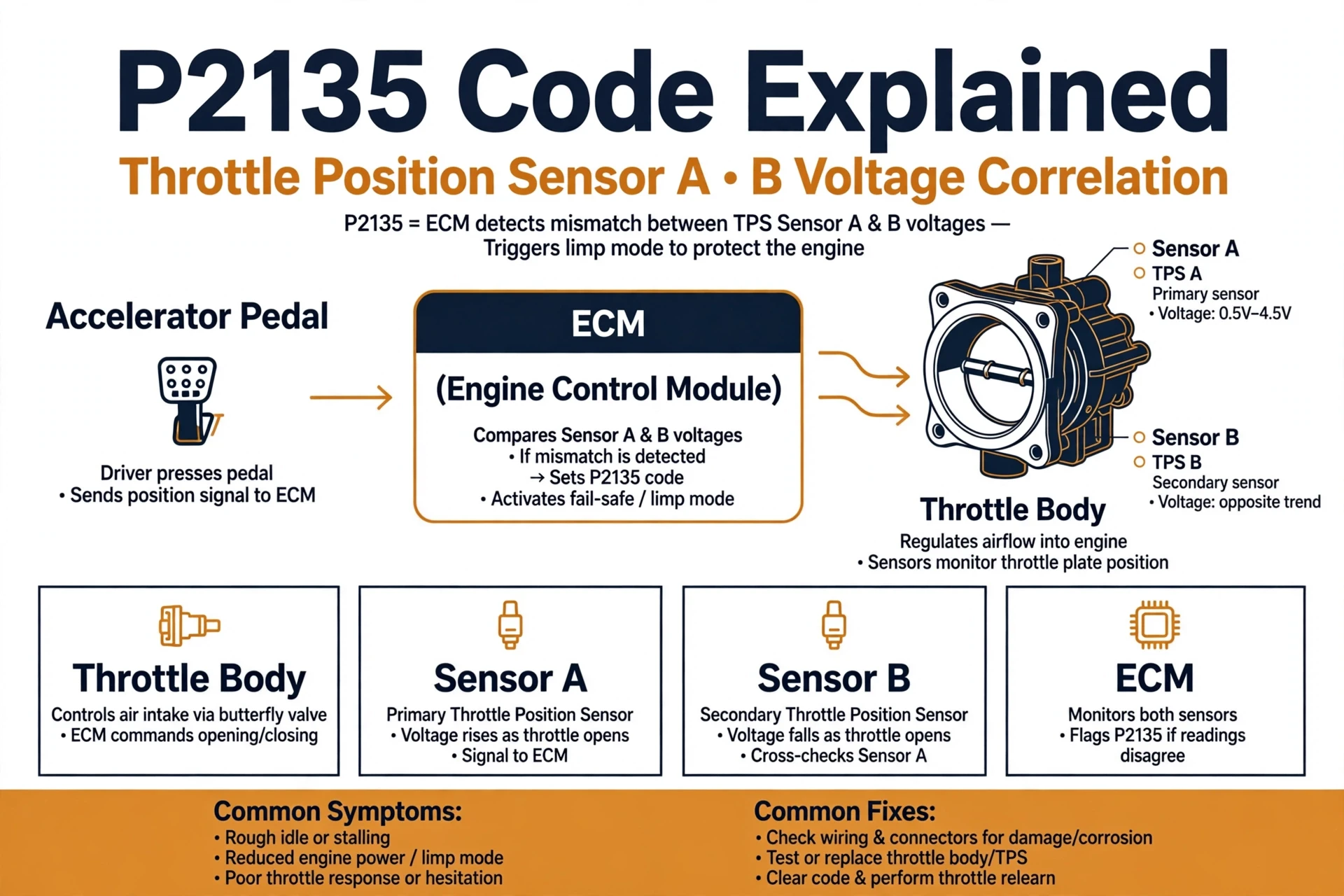
Symptoms of the P2135 Code
Unlike some codes that hide quietly, the p2135 code usually announces itself. The most dramatic symptom is the car dropping into limp mode, often with a “Reduced Engine Power” message on the dash. Depending on what failed, you might also notice:
- Limp mode / reduced engine power: the vehicle severely limits acceleration and top speed
- Check engine light illuminated on the dashboard
- Unresponsive gas pedal: pressing the accelerator gives little or no response
- Erratic idling: the engine may surge, hesitate, or stall at a stop
- Weak acceleration from a stop or up hills, even with the pedal pressed down hard
- Engine revving on its own or hanging at high RPM when you lift off the pedal
What is code P2135 trying to tell you? In short: the computer no longer trusts the throttle system, so it is protecting you by limiting power. The car may feel fine one moment and fall flat the next, which is exactly why drivers find this code so unsettling.

Common Causes of P2135
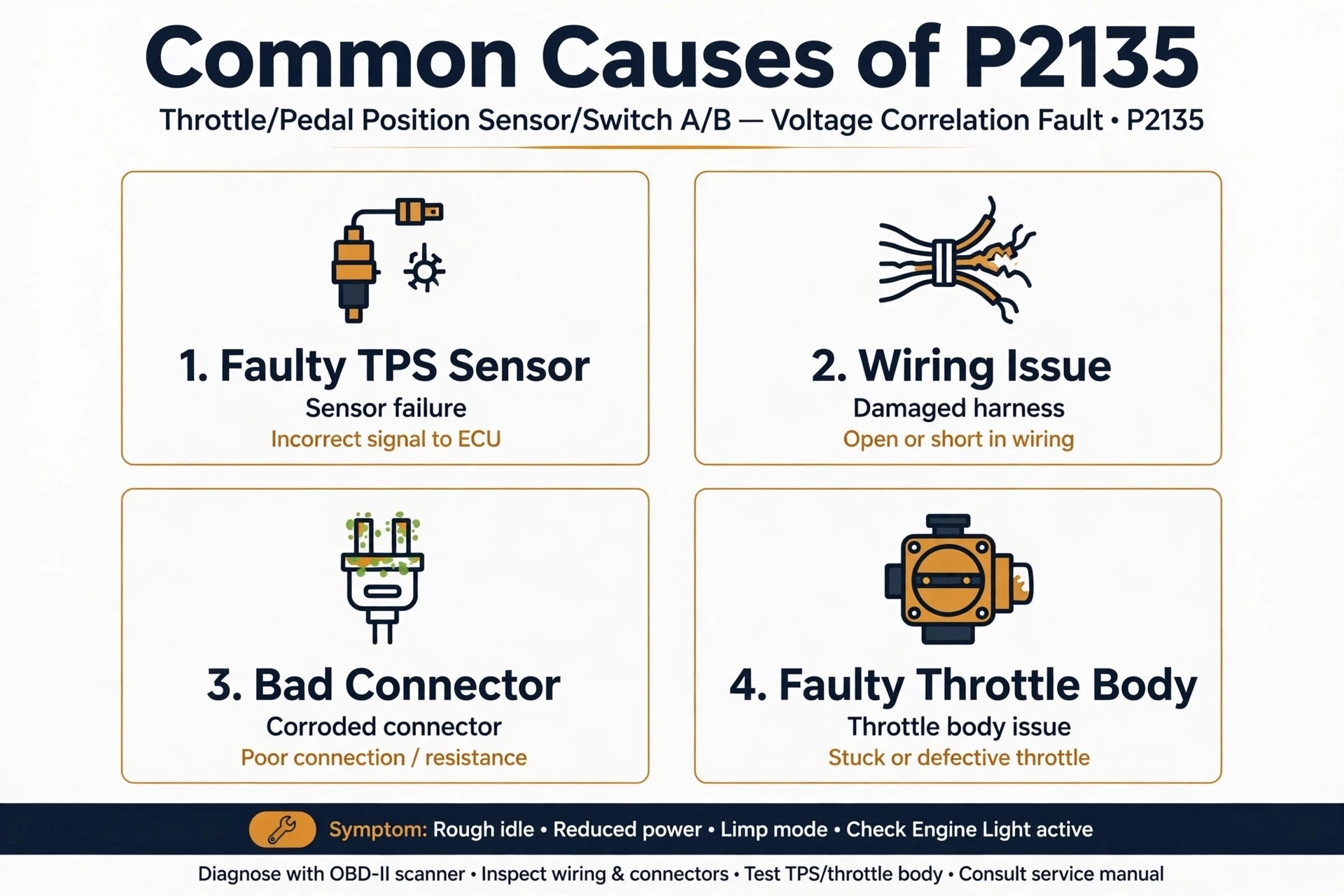
The most common cause of a P2135 code is a failing electronic throttle body, specifically the throttle position sensors built into it. But the code is really about the whole signal chain from pedal to throttle, so several faults can set it. Here are the causes, roughly in order of likelihood:
- Failing throttle body / TPS: internal wear or failure of the throttle position sensor assembly on the electronic throttle body. On most drive-by-wire cars the sensors are not sold separately, so the whole unit gets replaced.
- Dirty throttle body: carbon and grime baked onto the throttle plate and bore throw the sensor readings off, especially at idle and small throttle openings.
- Wiring and connector problems: corroded or green pins, pushed-out terminals, frayed wires, or a loose pigtail harness at the throttle body connector interrupt the 5-volt reference or signal circuits.
- Accelerator pedal position (APP) sensor failure: the sensor assembly on the gas pedal wears out and sends a signal that no longer matches the throttle body.
- Torn intake boot: a cracked or split rubber air duct between the air filter and throttle body lets in unmetered air, and this simple fault has resolved many real-world P2135 cases.
- PCM/ECM issues: outdated computer software or, rarely, a failing control module. A dealer software update can resolve some cases.
How to Diagnose P2135 (Do This Before Buying Parts)
Mechanics see the P2135 code misdiagnosed constantly, usually as an automatic throttle body replacement. The code points at a correlation problem, not a specific part. Follow this order:
- Scan for companion codes first. Throttle system codes like P0120, P0121, P0222, P2101, or P2138 narrow down which sensor or circuit is unhappy. Fix circuit codes before correlation codes.
- Inspect the wiring and connectors. Unplug the throttle body connector and look for green corrosion, bent or pushed-out pins, and chafed wires. Do the same at the accelerator pedal sensor connector.
- Check the intake duct. Pull the rubber boot between the airbox and throttle body and flex it; hidden cracks and tears open up under movement and cause all kinds of throttle complaints.
- Look at live sensor data. With a scan tool, graph TPS Sensor A and Sensor B (and the APP sensors) while slowly pressing the pedal. The two signals should move smoothly and stay in sync; a glitchy, flat, or jumping trace points at the bad sensor.
- Test with a multimeter. Check the 5-volt reference, ground, and signal voltages at the sensor connectors, and measure resistance across the sensor where the service data gives a specification.
- Clean carefully, then relearn. If the throttle plate is caked with carbon, clean it with throttle body cleaner and a soft brush, never your fingers, and never force the plate open by hand on an electronic unit. After any cleaning or part replacement, run the idle/throttle relearn procedure with a capable scan tool, or the code may come straight back.

How to Fix the P2135 Code
The right fix depends on what your diagnosis found:
- Clean the throttle body and perform a relearn: the cheapest fix, and it resolves many P2135 cases caused by carbon buildup alone.
- Repair the wiring: clean corrosion from the connector pins, repair the pigtail harness, and make sure every terminal seats fully.
- Replace the torn intake boot: a simple part that cures the cases where unmetered air was confusing the system.
- Replace the electronic throttle body: when the internal TPS has failed. Budget for a relearn procedure after installation.
- Replace the accelerator pedal position sensor: when the pedal assembly, not the throttle body, is the one sending the bad signal.
- Update the PCM software: rare, but some manufacturers have released calibrations that change how strictly the correlation is judged.

P2135 Repair Costs
Drivers always ask how much it costs to fix P2135, and the answer depends entirely on which part of the system failed. Here are realistic ranges:
| Repair | Cost Range |
|---|---|
| Throttle body cleaning + relearn (shop) | $80 – $200 |
| Throttle body replacement | $250 – $700 |
| Accelerator pedal position sensor replacement | $150 – $400 |
| Wiring / pigtail harness repair | $100 – $300 |
| Intake boot replacement | $50 – $200 |
| PCM software update | $120 – $300 |
This is why diagnosis matters. A $20 can of throttle body cleaner and a $600 throttle body share the same code. Drivers looking for a p2135 code fix that is cheap and permanent should always start with the inspection, cleaning, and relearn before buying parts.
DIY vs Mechanic Verdict
You can do this at home: reading codes with an OBD2 scanner, visual inspection of connectors and the intake boot, cleaning the throttle body properly, and running a throttle relearn if your scan tool supports it. These steps solve a large share of P2135 cases.
See a mechanic for: pinpoint voltage and resistance testing with a multimeter or scope, wiring harness repairs buried in the loom, PCM software updates, and throttle body replacement on vehicles where coolant lines or tricky relearn procedures are involved.
Bottom line: inspect and clean it yourself, replace the simple stuff yourself, but let a pro handle the electrical diagnosis if the basics do not fix it.
Can You Drive With a P2135 Code?
Only as far as you must. The car will usually still run, but limp mode can cap your speed and gut your acceleration without warning, which makes merging and hill climbs genuinely unsafe. The engine may also stall at stops. Get it diagnosed promptly; this is not a code to commute on for weeks.
P2135 on Popular Vehicles
P2135 shows up across all brands, but some patterns are worth knowing:
- Chevy (Silverado, Malibu, Cruze, Equinox): The p2135 chevy code (chevy p2135, p2135 code chevy) is one of the most reported. Trucks from the 2000s and 2010s are famous for the “Reduced Engine Power” message; cleaning the throttle body and checking the connector pigtail fixes many, and throttle body replacement fixes most of the rest.
- GMC (Sierra, Yukon, Acadia): same hardware as the Chevy trucks, same story: start with the throttle body and its wiring.
- Nissan (Sentra, Altima, Rogue): the p2135 nissan code often appears right after a throttle body replacement that skipped the idle relearn. Always perform the relearn on Nissans.
- Ford (Fusion, Focus, Escape): for the p2135 ford code, do not overlook the accelerator pedal sensor; manufacturer bulletins have pointed at the pedal assembly on some models.
- Toyota (RAV4, Corolla, Camry): carbon buildup on the electronic throttle body is the usual suspect; cleaning plus a relearn cures most cases.
- Honda (Accord, Civic, CR-V): less common, but the same diagnostic order applies: connectors, cleaning, relearn, then parts.
- Jeep (Wrangler, Grand Cherokee): the p2135 jeep code usually traces to the throttle body or its connector, especially after water or mud exposure.
DTC P2135 and OBD-II P2135 are the same fault under different naming. The code means the identical thing on every brand.
P2135 vs P2138
P2135 watches Sensor A and Sensor B. P2138 is the mirror image: “Throttle/Pedal Position Sensor/Switch ‘D’/‘E’ Voltage Correlation,” watching the second redundant sensor pair. On many vehicles the throttle body carries one pair and the pedal assembly carries the other. Diagnose them the same way: inspect, clean, test the voltages, and relearn. Seeing both codes together usually means a shared wiring or reference voltage problem rather than two bad sensors.
Related Codes
- P2138: Throttle/Pedal Position Sensor/Switch “D”/“E” Voltage Correlation
- P0120: Throttle/Pedal Position Sensor “A” Circuit
- P0121: Throttle/Pedal Position Sensor “A” Circuit Range/Performance
- P0222: Throttle/Pedal Position Sensor/Switch “B” Circuit Low
- P2101: Throttle Actuator Control Motor Circuit Range/Performance
Video Walkthrough
Watch the video above for a visual walkthrough of P2135 causes and diagnosis before you read on.
Frequently Asked Questions
What is the most common cause of a P2135 code?
A failing electronic throttle body (the throttle position sensors inside it) is the single most common cause. A carbon-fouled throttle plate and corroded connector pins are close behind, which is why inspection and cleaning come before buying parts.
Can I still drive my car with a P2135 code?
Only short distances. Limp mode can slash your power without warning and the engine may stall, so highway driving and merging become unsafe. Get it fixed soon.
How do you fix the code P2135?
Diagnose first: scan for companion codes, inspect the wiring and connectors, check the intake boot, and graph the sensor signals. Then clean the throttle body, repair what you find, replace the failed sensor assembly, and finish with a throttle relearn.
How much does it cost to fix P2135?
From about $80-$200 for a professional throttle body cleaning and relearn, $150-$400 for a pedal sensor, up to $250-$700 for a throttle body replacement, depending on the vehicle.
Will P2135 clear itself?
Rarely. The computer rechecks the sensor correlation constantly, so the code comes back until the underlying fault is fixed. Clearing it without a repair just restarts the countdown.
Can a dirty throttle body cause P2135?
Yes. Carbon buildup changes the airflow and the sensor readings at small throttle openings. A proper cleaning plus a throttle relearn resolves many P2135 cases without any new parts.
Do I need a throttle relearn after fixing P2135?
Yes, after cleaning or replacing the throttle body or pedal sensor. Without the relearn, the computer works with the old learned values and the code often returns immediately.
Conclusion
The P2135 code looks alarming, especially when the car drops into limp mode, but it is really your car protecting you from a throttle it cannot trust. Work the system in order: scan for companion codes, inspect the connectors and intake boot, clean the throttle body, test the sensor signals, and finish with a relearn. Do that, and you will either fix it cheaply or know exactly which part failed. Either way, you stop guessing and start fixing.
About the author: Written by the OBD2 Code Hub editorial team. Our diagnostic guides are built from real OBD-II data, manufacturer service procedures, and hands-on troubleshooting experience, then reviewed for technical accuracy before publishing. We drive the same cars you do.