
P0013 Trouble Code: Meaning, Causes, Symptoms & Fixes
In This Guide
- What the P0013 Code Means
- Symptoms of the P0013 Code
- Common Causes of the P0013 Code
- How to Diagnose the P0013 Code
- How to Fix the P0013 Code
- Repair Cost for P0013
- DIY vs. Mechanic Verdict
- Can You Still Drive with the P0013 Code?
- P0013 in Common Vehicles
- P0013 vs. P0011, P0012, and P0014
- Related Codes
- Video Walkthrough
- FAQs
- Conclusion
One-line meaning: The P0013 code means the Bank 1 exhaust camshaft is timed over-retarded. In other words, it lags behind the position the engine computer commanded.
What the P0013 Code Means: Bank 1 Exhaust Camshaft Timing Over-Retarded
P0013 is the OBD-II code for “B” Camshaft Position – Timing Over-Retarded (Bank 1). In short, that sentence tells you three facts. The “B” camshaft is the exhaust camshaft (never the intake camshaft). “Bank 1” is the bank of cylinders that contains cylinder 1. And “over-retarded” (never over-advanced) means the exhaust camshaft is running behind schedule. When the engine code p0013 is stored, the computer has measured the Bank 1 exhaust camshaft sitting further retarded than its target allows, and as a result, it turns on the check engine light.
Most modern engines adjust exhaust valve timing on the fly with variable valve timing (VVT). A VVT solenoid, also called the oil control valve, meters engine oil pressure to a cam phaser mounted on the nose of the exhaust camshaft. The phaser twists the camshaft slightly ahead or behind as speed and load change. Meanwhile, a camshaft position sensor watches the result and reports the actual angle back to the computer, which compares it against the angle it commanded.
When P0013 sets, however, that comparison has failed. The Bank 1 exhaust camshaft stays over-retarded past the limit the computer permits, so the exhaust valves open too late in the cycle. Combustion efficiency drops, idle turns rough, fuel economy suffers, and the computer logs the code because it can no longer correct the timing on its own. P0013 is the exact mirror image of P0014, which is the same “B” camshaft timed over-advanced on the same bank.
The angle that makes this guide different: because VVT runs on oil pressure, P0013 is one of the few major trouble codes where the smartest first move is checking the dipstick instead of the parts catalog. Oil level, oil condition, and oil viscosity decide whether the phaser can move at all, so every diagnosis here starts with oil before it touches a single sensor.

Symptoms of the P0013 Exhaust Camshaft Over-Retarded Code
A P0013 code does not always announce itself loudly. In fact, the check engine light is sometimes the only sign. When the over-retarded Bank 1 exhaust camshaft starts affecting combustion, expect these symptoms:

- Check engine light on, sometimes the only symptom at first
- Rough idle, shaking, or a lopey idle that was not there before
- Hesitation or stumbling on acceleration and noticeably reduced engine power
- Poor fuel economy that keeps getting worse
- Hard starting or stalling, especially when the timing error is large
- Rattling noise from the timing cover area on cold start (points to a stretched chain)
Common Causes of the P0013 Code
The computer sets P0013 when the exhaust camshaft cannot reach its commanded position. The causes below are ordered from most common to least common, so work them in this order:
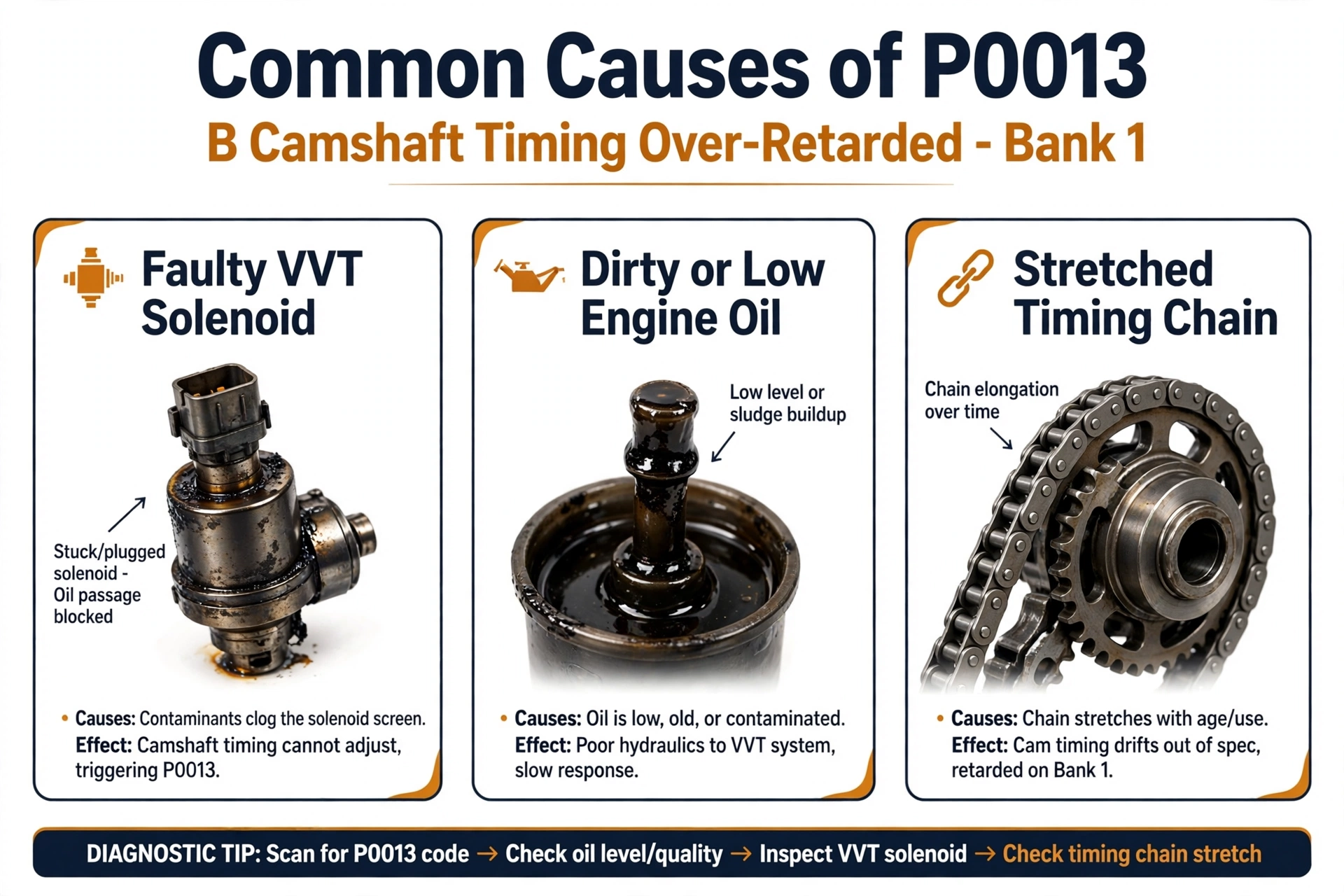
- Low, dirty, or wrong-viscosity engine oil starving the VVT system of clean oil pressure
- Faulty VVT solenoid (oil control valve) for the Bank 1 exhaust camshaft: stuck valve, clogged screen, or failed coil winding
- Open or short in the VVT solenoid control circuit, including damaged wiring and corroded or oil-fouled connectors
- Stretched timing chain or worn guides and sprockets letting the exhaust camshaft drift retarded
- Failed camshaft phaser (actuator) that no longer responds to oil pressure commands
- Engine sludge blocking the small oil passages that feed the phaser
- Faulty engine computer (ECM or PCM) or outdated control software (rare)
How to Diagnose the P0013 Code Step by Step
Work from cheap and simple toward expensive and involved. Do not replace any part until testing points at it:

- Scan and document: connect an OBD-II scanner, confirm the P0013 code, and record freeze frame data plus any companion codes such as P0011, P0012, or P0014. Clear the code, road test, and see whether it returns before spending a dollar.
- Check the oil: pull the dipstick with the engine off. The level should sit between MIN and MAX, the oil should look clean and amber (not black and gritty), and it must match the viscosity on the oil cap. If it is low, dirty, or overdue, change the oil and filter with the factory-spec viscosity, clear the code, and road test before doing anything else.
- Inspect the VVT solenoid and connector: find the Bank 1 exhaust VVT solenoid (usually on the valve cover or timing cover), and check its two-pin connector for corrosion, bent pins, oil inside the plug, and chafed or broken wiring. Clean and firmly reseat the connector.
- Test the solenoid: unplug it and measure the coil resistance with a multimeter. Most specs fall between 6 and 12 ohms, with many reading 6.9 to 7.9 ohms. Compare your reading against the service manual, then briefly apply battery voltage to hear and feel the valve click. No click means a stuck valve.
- Check oil pressure and passages: if the solenoid tests good, verify that engine oil pressure meets specification and that the solenoid screen and the small oil passages feeding the phaser are not clogged with sludge.
- Evaluate the timing components: with a scan tool, compare the desired versus actual exhaust camshaft angle. A stretched chain shows up as a constant retard offset, and a rattle on cold start points at worn guides or a weak tensioner.
- Run the pinpoint test: follow the manufacturer pinpoint test for the P0013 control circuit, checking for shorts or opens between the computer and the solenoid, before ever condemning the ECM or PCM.
How to Fix the P0013 Code
Fix what the diagnosis proved, not what the code guessed. Most P0013 repairs turn out to be one of the following:

- Change the engine oil and filter with the correct factory-spec viscosity (this alone fixes a large share of P0013 cases)
- Clean the VVT solenoid screen and connector, and replace the Bank 1 exhaust VVT solenoid (oil control valve) if it failed the resistance or click test
- Repair damaged wiring or replace a corroded or oil-fouled connector at the solenoid
- Flush sludge from the VVT oil passages wherever the service procedure allows it
- Replace a stretched timing chain along with its guides and tensioner if the chain has elongated
- Replace the exhaust camshaft phaser if it no longer responds to oil pressure commands
- Update the engine computer software, or replace the ECM or PCM, only after every other cause has been ruled out
- Clear the code with a scanner and road test through a full drive cycle to confirm the repair held
P0013 Repair Cost
What you pay for a P0013 repair depends entirely on which cause your diagnosis found. Typical price ranges:
| Repair | Cost Range |
| OBD-II diagnostic fee | $100–$160 |
| Engine oil and filter change | $45–$90 |
| VVT solenoid (oil control valve), Bank 1 exhaust | $120–$350 |
| Wiring or connector repair | $100–$250 |
| Camshaft phaser replacement | $400–$900 |
| Timing chain set (chain, guides, tensioner) | $800–$1,800 |
| ECM or PCM replacement (rare) | $500–$1,200 |
Because the cheapest fixes (oil change, solenoid) solve most cases, always diagnose before authorizing the expensive ones.
DIY vs. Mechanic Verdict
P0013 sits in the middle of the difficulty scale: the first half of the diagnosis is easy driveway work, while the second half gets serious fast.
You can do this at home:
- Check the oil level and condition, and perform an oil and filter change with the correct viscosity
- Scan for codes, record freeze frame data, clear the code, and retest with an affordable OBD-II scanner
- Inspect and clean the VVT solenoid connector and its wiring
- Remove, test (resistance and click test), clean, or replace the Bank 1 exhaust VVT solenoid, which is usually one bolt and one electrical connector
See a mechanic for:
- Engine oil pressure testing and internal sludge diagnosis
- Timing chain, guide, tensioner, or phaser replacement, which requires timing cover removal and precise timing alignment
- Manufacturer pinpoint electrical tests and engine computer software updates
- Any repair where the camshaft timing must be locked at top dead center
Bottom line: Start with the oil change and the solenoid check yourself. You will fix a large share of P0013 cases for under $100 in parts. Hand the car to a professional the moment a timing chain or phaser becomes suspect.
Can You Drive with the P0013 Code?
Short, gentle trips are usually possible with the P0013 code, but it should not be ignored. An over-retarded exhaust camshaft hurts combustion efficiency, so fuel economy drops and the engine may run rough, hesitate, or stall in traffic. That answers the common question of how long can I drive with a P0013 code: drive gently to a repair, avoid hard acceleration and long highway runs, and fix it within days rather than months. A stretched timing chain can jump further and cause valve damage on interference engines, and a shorted solenoid circuit can, in rare prolonged cases, stress the computer driver. Treat the check engine light as a deadline, not a suggestion.
P0013 in Common Vehicles
P0013 is a generic code, but certain vehicles report it more often than others. If your search looked like one of these phrases, this guide covers your exact situation:
- p0013 code chevy: GM 2.4L Ecotec engines (Equinox, Malibu, Terrain) are among the most common P0013 reporters. The Bank 1 exhaust VVT solenoid and oil consumption are the usual suspects.
- p0013 code chevy cruze: On the Cruze 1.4L and 1.8L, check the oil level first, since these engines are known oil users, then test the Bank 1 exhaust solenoid.
- p0013 code chevy malibu: The 2.4L Malibu sets P0013 when the exhaust actuator solenoid sticks or its screen clogs. A solenoid swap is a common driveway fix.
- p0013 code toyota camry: On the 2.4L and 2.5L Camry, the oil control valve and its fine mesh screen clog with sludge when oil change intervals stretch too long.
- p0013 code nissan: Nissan V6 engines report P0013 for the Bank 1 exhaust intake valve timing solenoid. Low or dirty oil is the first check.
- p0013 code jeep wrangler: The 3.6L Pentastar can set P0013 with a failing Bank 1 exhaust VVT solenoid. Wiring chafing near the valve cover is worth a close look.
- how to fix p0013 code: The universal answer is oil first, then the Bank 1 exhaust VVT solenoid, then wiring, and finally the timing components.
P0013 vs. P0011, P0012, and P0014
These four codes are siblings. The letter tells you which camshaft is involved, and the word tells you which direction the timing drifted:
- P0013 vs. P0014: Both involve the “B” (exhaust) camshaft on Bank 1. P0013 means the timing is over-retarded (lagging behind the commanded position), while P0014 means it is over-advanced (running ahead of the commanded position). They are mirror images with overlapping causes.
- P0013 vs. P0011: P0011 is the “A” (intake) camshaft over-advanced on Bank 1. It is a different camshaft and the opposite timing direction.
- P0013 vs. P0012: P0012 is the “A” (intake) camshaft over-retarded on Bank 1. Same direction (retarded), different camshaft (intake instead of exhaust).
Related Exhaust Camshaft Timing Codes
If P0013 showed up with companion codes, or you typed a neighboring code by mistake, these plain-text definitions will point you in the right direction:
- P0011: “A” Camshaft Position – Timing Over-Advanced (Bank 1)
- P0012: “A” Camshaft Position – Timing Over-Retarded (Bank 1)
- P0014: “B” Camshaft Position – Timing Over-Advanced (Bank 1)
- P0015: “B” Camshaft Position – Timing Over-Retarded (Bank 2)
Video Walkthrough: P0013 Code Diagnosis and Repair
Watch ScannerDanner, a USA-based diagnostic technician, walk through testing the camshaft actuator solenoids behind codes P0010 and P0013 on a GM 2.4L engine, including 5V reference and signal circuit quick tests.
Video: P0013 camshaft actuator solenoid testing and diagnosis demonstrated step by step by ScannerDanner, a USA-based creator.
P0013 Code FAQs
Quick answers to the questions drivers ask most about the P0013 code.
What does the P0013 code mean?
The P0013 code means the Bank 1 exhaust camshaft (the “B” camshaft) is timed over-retarded. The engine computer commanded a specific camshaft angle, but the sensor reported the exhaust camshaft lagging behind that target past the allowed limit, so the computer stored the code and turned on the check engine light.
What are the symptoms of the P0013 code?
The most common symptoms are an illuminated check engine light, rough idle or stalling, hesitation and reduced power on acceleration, and worse fuel economy. Some drivers also report hard starting or a rattling noise from the timing area when a stretched chain is the cause. Sometimes the check engine light is the only symptom.
What causes the P0013 code?
The most common causes are low, dirty, or wrong-viscosity engine oil; a faulty Bank 1 exhaust VVT solenoid (oil control valve) with a stuck valve, clogged screen, or failed coil; damaged wiring or a corroded connector at the solenoid; a stretched timing chain or worn guides; and, rarely, a failed camshaft phaser or engine computer.
More P0013 Code Questions
How do I fix the P0013 code?
Start with an oil and filter change using the factory-spec viscosity, then inspect and test the Bank 1 exhaust VVT solenoid (resistance and click test) and its wiring. Replace the solenoid if it fails testing, repair any wiring damage, and clear the code for a road test. If the code returns, check for a stretched timing chain or a failed phaser.
How much does it cost to fix a P0013 code?
An oil and filter change runs $45 to $90 and resolves many cases. A replacement VVT solenoid typically costs $120 to $350 installed. Wiring repairs run $100 to $250, while a timing chain set replacement costs $800 to $1,800. A diagnostic fee is usually $100 to $160.
Is it safe to drive with a P0013 code?
Short, gentle trips are usually fine, but you should not ignore it or drive hard. The engine may stall, hesitate, or lose power, and a stretched timing chain can cause serious valve damage if it jumps further. Get it diagnosed within days and avoid long highway drives until it is fixed.
What is the difference between P0013 and P0014?
Both codes concern the Bank 1 exhaust (“B”) camshaft. P0013 means the camshaft timing is over-retarded (lagging behind the commanded position), while P0014 means it is over-advanced (running ahead of the commanded position). They are mirror images with overlapping causes, mostly centered on oil condition and the VVT solenoid.
Conclusion: Start With Oil, End With the Light Off
The P0013 code looks intimidating, but its fix is often refreshingly simple. Because the variable valve timing system runs on engine oil, the majority of cases trace back to oil that is low, dirty, or the wrong viscosity, or to a Bank 1 exhaust VVT solenoid that is stuck or clogged. Work the diagnosis in order (oil, connector, solenoid, wiring, timing chain) and you will find the fault without guessing.
Remember the one fact that keeps this code straight: P0013 is the over-retarded mirror of P0014. “B” means exhaust, Bank 1 means the cylinder-1 bank, and retarded means lagging behind. Keep that definition in mind, fix the oil first, and the check engine light will stay off.
About the author: Written by the OBD2 Code Hub editorial team. Our diagnostic guides are built from real OBD-II data, manufacturer service procedures, and hands-on troubleshooting experience, then reviewed for technical accuracy before publishing. We drive the same cars you do.