
P0014 Trouble Code: Meaning, Causes, Symptoms & Fixes
In This Guide
- What the P0014 Code Means
- Symptoms of the P0014 Code
- Common Causes of the P0014 Code
- How to Diagnose the P0014 Code
- How to Fix the P0014 Code
- Repair Cost for P0014
- DIY vs. Mechanic Verdict
- Can You Still Drive with the P0014 Code?
- P0014 in Common Vehicles
- P0014 vs. P0011, P0013, and P0015
- Related Codes
- Video Walkthrough
- FAQs
- Conclusion
One-line meaning: The P0014 code means the Bank 1 exhaust camshaft is timed over-advanced. In other words, it sits too far ahead of the position the engine computer commanded.
What the P0014 Code Means: Bank 1 Exhaust Camshaft Timing Over-Advanced
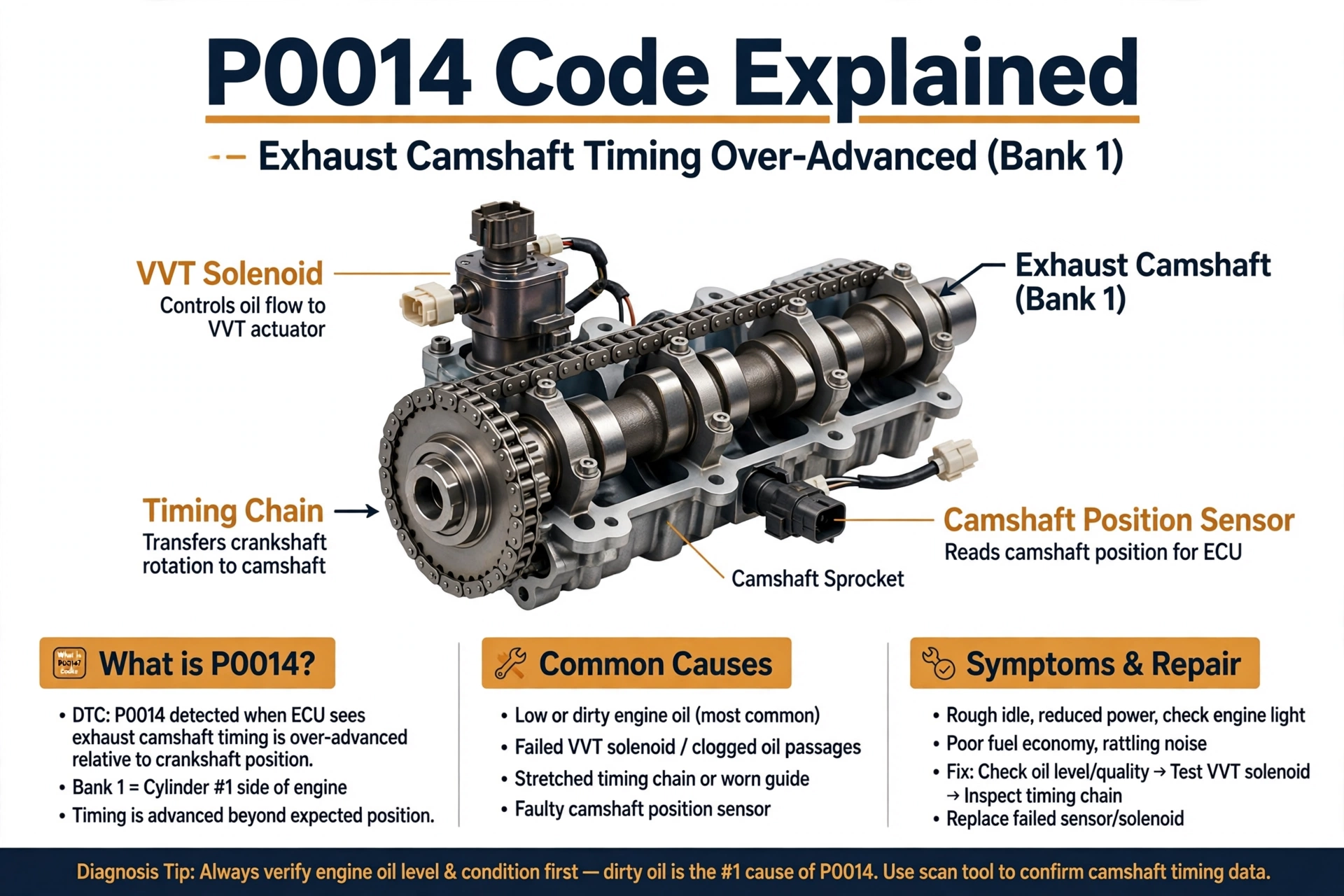
P0014 is the OBD-II code for “Camshaft Position ‘B’ – Timing Over-Advanced or System Performance (Bank 1).” In short, that sentence tells you three facts. The “B” camshaft is the exhaust camshaft (never the intake camshaft). “Bank 1” is the bank of cylinders that contains cylinder 1. And “over-advanced” (never over-retarded) means the exhaust camshaft is running ahead of schedule. When the engine code p0014 is stored, the computer has measured the Bank 1 exhaust camshaft sitting further advanced than its target allows, and as a result, it turns on the check engine light.
Most modern engines adjust exhaust valve timing on the fly with variable valve timing (VVT). A VVT solenoid, also called the oil control valve, meters engine oil pressure to a cam phaser mounted on the nose of the exhaust camshaft. The phaser twists the camshaft slightly ahead or behind as speed and load change. Meanwhile, a camshaft position sensor watches the result and reports the actual angle back to the computer, which compares it against the angle it commanded.
When P0014 sets, however, that comparison has failed. The Bank 1 exhaust camshaft stays over-advanced past the limit the computer permits, so the exhaust valves open too early in the cycle. The engine wastes energy it should be using for power, idle turns rough, and the computer logs the code because it can no longer correct the timing on its own.
The angle that makes this guide different: because VVT runs on oil pressure, P0014 is one of the few major trouble codes where the smartest first move is checking the dipstick instead of the parts catalog. Oil level, oil condition, and oil viscosity decide whether the phaser can move at all, so every diagnosis here starts with oil before it touches a single sensor.
Symptoms of the P0014 Exhaust Camshaft Over-Advanced Code
A P0014 code does not always announce itself loudly. In fact, the check engine light is sometimes the only sign. When the over-advanced Bank 1 exhaust camshaft starts affecting combustion, expect these symptoms:
- Check engine light on, sometimes flashing under load
- Rough idle or a shaky, uneven idle
- Hard starting or extended cranking before the engine catches
- Engine stalling, especially at low speeds or when coming to a stop
- Noticeable loss of power and sluggish acceleration
- Worse fuel economy than usual
- Rattling or ticking noise from the front of the engine, often worst on cold starts

Common Causes of the P0014 Exhaust Camshaft Over-Advanced Code
P0014 has a short list of usual suspects. First, check the oil, because it sits at the top of the list. Work through these from cheapest to most expensive:
- Low engine oil level: the single most common and cheapest cause of P0014
- Dirty, degraded, or wrong-viscosity oil, or sludge blocking the VVT oil passages
- Faulty Bank 1 exhaust VVT solenoid (oil control valve) that sticks, clogs with sludge, or fails electrically
- Worn or sticking Bank 1 exhaust cam phaser that cannot return to its commanded position
- Failing Bank 1 camshaft position sensor sending a wrong position reading
- Stretched timing chain, worn chain tensioner, or damaged chain guides
- Damaged wiring or loose, corroded connectors in the VVT solenoid or camshaft position sensor circuit
- Rare: a failing engine control module (ECM/PCM)

How to Diagnose the P0014 Exhaust Camshaft Over-Advanced Code
First, diagnose P0014 in order, cheapest checks first. Do not replace the solenoid until the oil is proven good:
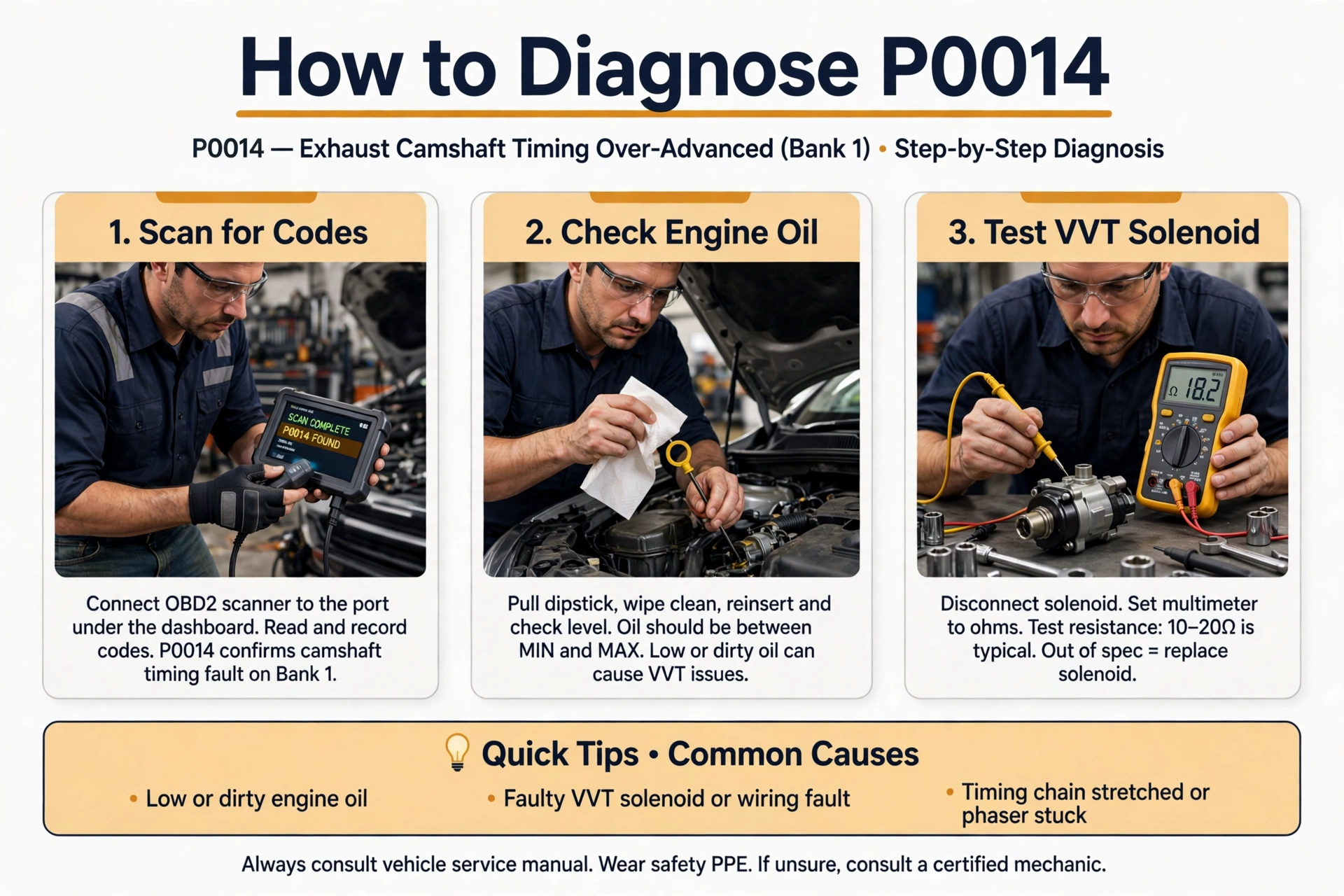
- First, scan and confirm the code. Connect an OBD-II scanner, confirm P0014 is stored, record the freeze-frame data, and note any companion codes such as P0011, P0012, or P0015.
- Next, check the engine oil. Pull the dipstick, wipe it, reinsert it fully, and read again. The level should sit between the marks and the oil should look amber and clean, not black, gritty, or smelling of fuel. Top up or change it if it is low, overdue, or the wrong viscosity.
- Clear and retest. Erase the code and take a 10 to 15 minute test drive through varied speeds. If P0014 returns, then the fault is confirmed and repeatable.
- Then, inspect wiring and connectors. Examine the Bank 1 exhaust VVT solenoid and camshaft position sensor connectors for oil contamination, green corrosion, or broken and chafed wires.
- Test the Bank 1 exhaust VVT solenoid. Remove it, inspect its screen for sludge buildup, clean it with an approved valve cleaner, and check its resistance against the factory specification. Replace it if it tests out of specification or the screen clogs again quickly.
- Watch live camshaft timing data. With a capable scanner, compare the commanded exhaust camshaft angle to the actual angle on Bank 1. A large, steady gap points to the phaser or the timing drive.
- Finally, inspect the timing components. If oil, wiring, and the solenoid all check out, inspect the timing chain, tensioner, guides, and Bank 1 exhaust cam phaser for wear, slack, or damage.
How to Fix the P0014 Exhaust Camshaft Over-Advanced Code
Next, match the fix to the cause you found during diagnosis. Most P0014 repairs are refreshingly simple:
- Change the engine oil and filter using the manufacturer recommended viscosity, because this alone clears many P0014 codes.
- Clean or replace the Bank 1 exhaust VVT solenoid if it sticks, clogs, or tests out of specification.
- Repair damaged wiring or corroded connectors in the solenoid and sensor circuits.
- Replace a failing Bank 1 camshaft position sensor.
- Replace a worn or sticking Bank 1 exhaust cam phaser.
- Replace the timing chain, guides, and tensioner if the chain has stretched or the tensioner has failed.
- Clear the code with a scanner and road test the vehicle to verify the Bank 1 exhaust camshaft now tracks its commanded timing.

After any repair, clear the code and drive the vehicle through several warm-up cycles. If the P0014 code stays away and the Bank 1 exhaust camshaft timing matches the commanded angle on live data, the repair is verified.
Repair Cost for the P0014 Exhaust Camshaft Over-Advanced Code
P0014 repair costs swing wide because the fix can be a bottle of oil or a timing chain job. Typical shop prices:
| Repair | Cost Range |
|---|---|
| Engine oil and filter change | $50 – $200 |
| VVT solenoid cleaning and oil passage flush | $100 – $250 |
| Bank 1 exhaust VVT solenoid replacement | $150 – $400 |
| Bank 1 camshaft position sensor replacement | $120 – $250 |
| Bank 1 exhaust cam phaser replacement | $600 – $1,200 |
| Timing chain, guides, and tensioner replacement | $1,000 – $1,800 |
| Professional diagnostic labor | $100 – $200 |
Overall, most drivers land between $100 and $400 for a solenoid or oil-related fix. Bills climb past $1,000 only when the timing drive itself is worn.
DIY vs. Mechanic Verdict for the P0014 Exhaust Camshaft Over-Advanced Code
You can do this at home: for instance, checking and topping up the engine oil, performing an oil and filter change with the correct viscosity, clearing the code with an OBD-II scanner, removing and cleaning the Bank 1 exhaust VVT solenoid, testing the solenoid with a multimeter, and inspecting connectors and wiring for damage.
See a mechanic for: for example, cam phaser replacement, timing chain and tensioner replacement, any diagnosis that needs live camshaft timing data on a professional scanner, and any P0014 code that returns after an oil change and solenoid service.
Bottom line: in short, P0014 rewards the DIY oil-first approach. Handle the simple, cheap checks in your driveway, and hand the job to a professional the moment the timing drive becomes suspect.
Can You Still Drive with the P0014 Exhaust Camshaft Over-Advanced Code?
Technically the car will still run, so short trips are possible, but driving far with P0014 is not recommended. An over-advanced Bank 1 exhaust camshaft can cause stalling in traffic, rough running, higher fuel consumption, and a failed emissions test. More importantly, the underlying cause is sometimes a worn phaser or a stretched timing chain, and on interference engines that kind of wear can turn into valve damage. Therefore, get it diagnosed promptly, avoid hard acceleration, and skip long highway trips until it is fixed.
P0014 Exhaust Camshaft Over-Advanced Code in Common Vehicles
P0014 is a generic OBD-II code, so it appears on any vehicle with variable valve timing. However, some models see it far more often because their VVT systems are sensitive to oil condition.
- P0014 Chevrolet / GMC: the 2.4L Ecotec (Equinox, Malibu, Terrain) clogs VVT solenoids easily, and the 5.3L V8 (Silverado, Sierra) reports it often. Most “P0014 Chevy Silverado” and “P0014 Chevy Equinox” cases trace to oil or the exhaust VVT solenoid.
- P0014 Toyota: the Camry, Corolla, and RAV4 run oil-sensitive VVT systems where a delayed oil change is the usual trigger. Most “P0014 Toyota Camry” cases clear with fresh oil of the correct viscosity.
- P0014 Honda: the Accord and CR-V with K-series VTEC engines set this code when oil runs low. On a “P0014 Honda Accord”, check the dipstick before condemning the solenoid.
- P0014 Ford: the F-150 5.4L 3V is famous for cam phaser rattle, and the Escape and Fusion follow the same pattern. A “P0014 Ford F-150” with a cold-start rattle points at the phaser.
- P0014 Nissan: the Altima and Rogue with QR25 engines set exhaust cam timing codes when oil level drops. Start every “P0014 Nissan Altima” diagnosis at the dipstick.
- P0014 Hyundai / Kia: the Sonata, Elantra, and Optima with Theta engines build sludge on extended oil intervals. A “P0014 Hyundai Sonata” often needs an oil change plus solenoid cleaning.
European and Asian vehicles using EOBD/OBD-II standards report the same P0014 definition: Bank 1 exhaust camshaft timing over-advanced. In addition, the diagnostic steps do not change with the badge on the grille.
P0014 vs. P0011, P0013, and P0015: Exhaust Camshaft Code Comparison
These four codes sound alike. However, they point at different failures. P0014 and P0011 are both “timing over-advanced” codes on Bank 1, with one key split: P0011 is the intake (“A”) camshaft, while P0014 is the exhaust (“B”) camshaft. P0013 is also about the Bank 1 exhaust camshaft, but it is an actuator circuit code, meaning the computer sees an electrical fault in the solenoid circuit rather than timing that is actually over-advanced. P0015 is the mirror image of P0014: “B” camshaft timing over-retarded on Bank 1. Remember the golden rule of this code: P0014 is always over-advanced and never over-retarded, so if your scanner shows P0015 instead, the exhaust camshaft is lagging behind, not running ahead.
Related Exhaust Camshaft Timing Codes
- P0011: Camshaft Position “A” – Timing Over-Advanced or System Performance (Bank 1)
- P0012: Camshaft Position “A” – Timing Over-Retarded (Bank 1)
- P0013: “B” Camshaft Position – Actuator Circuit / Open (Bank 1)
- P0015: “B” Camshaft Position – Timing Over-Retarded (Bank 1)
- P0016: Crankshaft Position – Camshaft Position Correlation (Bank 1 Sensor A)
- P0024: “B” Camshaft Position – Timing Over-Advanced or System Performance (Bank 2)
Video Walkthrough: P0014 Exhaust Camshaft Over-Advanced
Finally, watch a step-by-step visual explanation of the P0014 code, covering the symptoms, causes, and fixes for the over-advanced Bank 1 exhaust camshaft:
Video: P0014 symptoms, causes, and fixes explained step by step by 8020 Automotive, a USA-based creator.
Frequently Asked Questions About the P0014 Exhaust Camshaft Over-Advanced Code
What does the P0014 code mean?
P0014 means “Camshaft Position ‘B’ – Timing Over-Advanced (Bank 1).” The “B” camshaft is the exhaust camshaft, and Bank 1 is the side of the engine with cylinder 1. The code sets when the Bank 1 exhaust camshaft runs further advanced than the engine computer commanded.
What causes the engine code p0014?
The most common causes of the engine code p0014 are low engine oil, dirty or wrong-viscosity oil, a faulty Bank 1 exhaust VVT solenoid, a worn exhaust cam phaser, a failing camshaft position sensor, a stretched timing chain, and damaged wiring or connectors in the solenoid circuit.
Can low engine oil really cause P0014?
Yes. Variable valve timing runs on engine oil pressure, so low oil, dirty oil, or the wrong viscosity can starve the Bank 1 exhaust cam phaser and leave the exhaust camshaft stuck in an over-advanced position. Checking the dipstick is the first and cheapest diagnostic step.
Can I drive with a P0014 code?
Short trips are possible, but it is not recommended for long. Driving with an over-advanced Bank 1 exhaust camshaft risks stalling, poor fuel economy, and engine damage if the cause is a worn phaser or stretched timing chain. Get it diagnosed soon and avoid hard acceleration.
More P0014 Exhaust Camshaft Over-Advanced Questions
How do I fix the engine code p0014?
Fix the engine code p0014 by starting with an oil and filter change using the correct viscosity, then cleaning or replacing the Bank 1 exhaust VVT solenoid if the code returns. If it still persists, test the camshaft position sensor, inspect the wiring, and have a mechanic check the cam phaser and timing chain.
Is the P0014 code serious?
It ranges from moderate to highly serious. An oil-related P0014 is minor and cheap to fix, but a worn exhaust cam phaser or stretched timing chain can cause real engine damage, especially on interference engines. Treat it as serious until the cause is confirmed.
How much does it cost to fix the P0014 code?
An oil change costs $50 to $200, solenoid cleaning $100 to $250, and a Bank 1 exhaust VVT solenoid replacement $150 to $400. A cam phaser runs $600 to $1,200 and a timing chain job $1,000 to $1,800. Most drivers pay between $100 and $400.
Conclusion: Fixing the P0014 Exhaust Camshaft Over-Advanced Code
P0014 means the Bank 1 exhaust camshaft is timed over-advanced, and the repair almost always starts with the simplest explanation: the oil. Check the level, condition, and viscosity first, then move to the Bank 1 exhaust VVT solenoid, the wiring, and finally the phaser and timing drive. Because the P0014 code covers everything from a $50 oil change to a $1,800 timing chain job, diagnosing in order keeps the bill small. Finally, fix it promptly and the over-advanced Bank 1 exhaust camshaft returns to its commanded timing, the check engine light stays off, and the engine runs the way it should.
About the author: Written by the OBD2 Code Hub editorial team. Our diagnostic guides are built from real OBD-II data, manufacturer service procedures, and hands-on troubleshooting experience, then reviewed for technical accuracy before publishing. We drive the same cars you do.