
P0521 Trouble Code: Meaning, Causes, Symptoms & Fixes
In This Guide
One-line meaning: Your car’s computer has detected that the engine oil pressure sensor signal is out of its expected range or behaving erratically.
What the P0521 Code Means
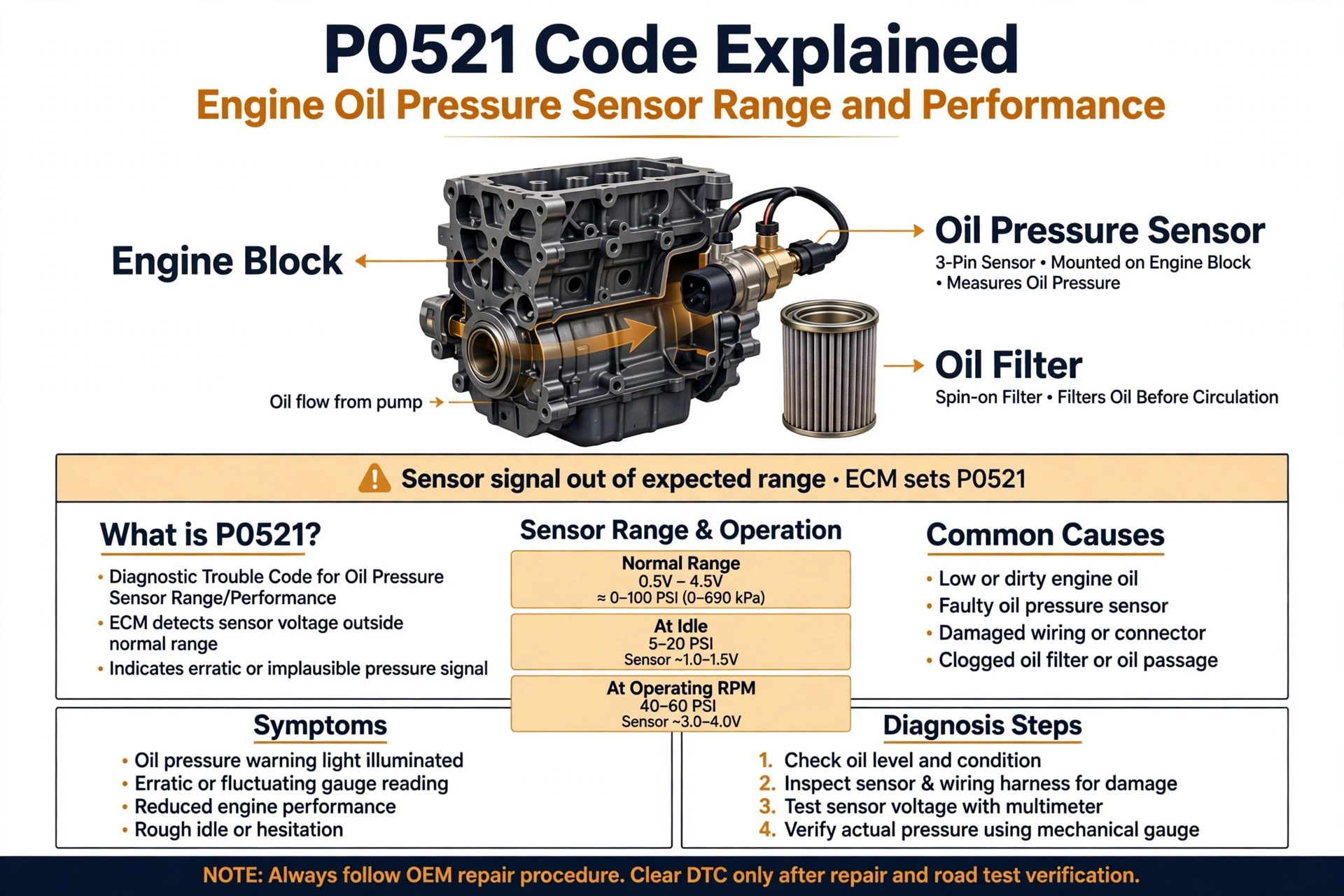
The p0521 engine code is a generic powertrain diagnostic trouble code (DTC) that stands for “Engine Oil Pressure Sensor/Switch Range/Performance.” It sets when the engine control module (ECM/PCM) decides the signal coming from the oil pressure sensor does not match the pressure the engine should be making.
Here is the logic in plain English. Your engine’s computer knows roughly what oil pressure to expect at any given RPM and oil temperature. The oil pressure sensor (sometimes called the oil pressure switch or sending unit) reports the actual pressure back as a voltage signal. When that reading drifts outside the expected window, sticks in one place, or jumps around erratically, the computer flags the mismatch and stores the p0521 code.
This is what makes P0521 trickier than most sensor codes: there are two completely different stories behind it. Either the sensor or its wiring is lying to the computer, or the engine genuinely has an oil pressure problem. A bad sensor is a cheap fix. Real low oil pressure can destroy an engine in minutes. That is why the golden rule of this code is to verify actual oil pressure with a mechanical gauge before assuming anything.
Symptoms of the P0521 Code
Sometimes the check engine light is the only clue. But because this code involves oil pressure, the symptoms can be more dramatic:
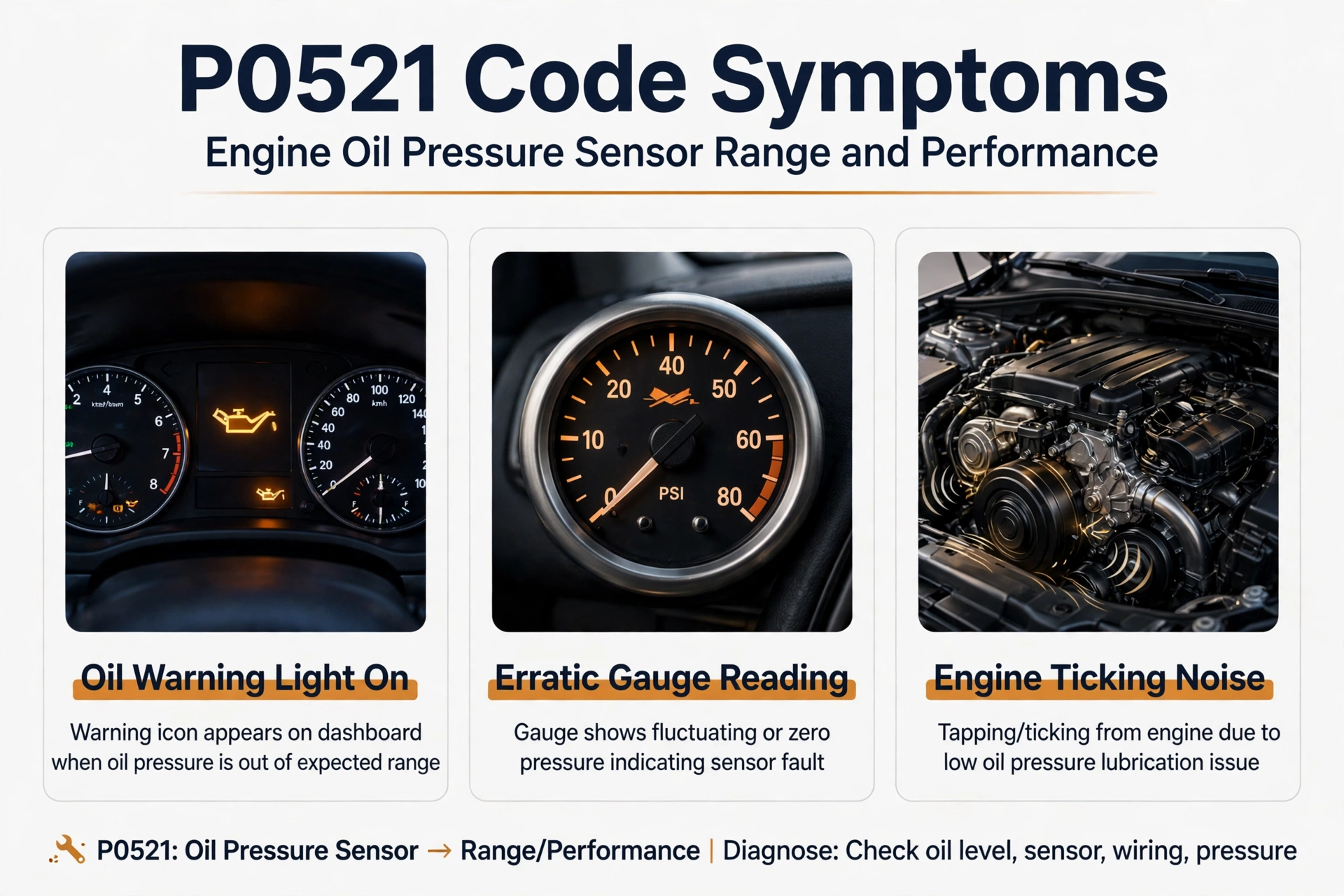
- Check engine light on (the p0521 code is stored)
- Oil pressure warning light or “low oil pressure” message on the dash
- Oil pressure gauge reading erratically, dropping to zero, or pinned at maximum
- Ticking, tapping, or knocking noises from the engine (a sign of real low pressure)
- Engine stalling or rough running in severe cases
What does the p0521 code feel like from the driver’s seat? If it is just a bad sensor, the car may drive perfectly normally while the gauge acts crazy. If pressure is truly low, you will usually hear it first: valve train ticking that gets louder with RPM is the classic warning. Never ignore new engine noise with this code.
Common Causes of P0521
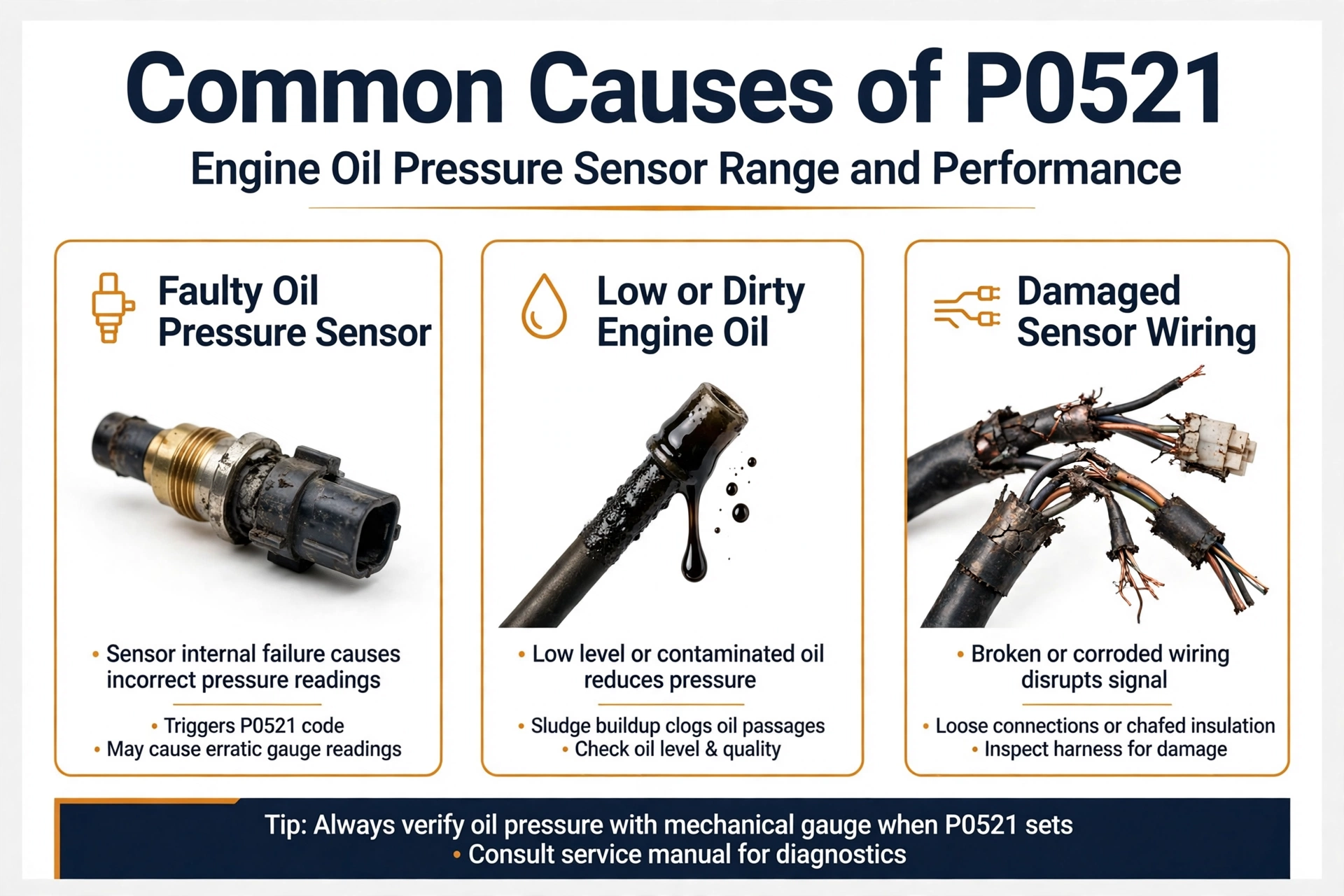
The most common cause of a P0521 code is a faulty oil pressure sensor or low/dirty engine oil. But the full list is longer:
- Low engine oil level: the simplest cause. If the pickup tube sucks air, pressure readings go erratic.
- Dirty or sludged oil: old, thick oil and sludge restrict flow and confuse the sensor.
- Faulty oil pressure sensor/switch: the sensor wears out internally and reports wrong voltages.
- Clogged oil pressure sensor screen: on GM 5.3L and 6.2L V8s, a tiny mesh screen under the sensor clogs with debris and starves the sensor of oil. This is an extremely common p0521 chevy cause.
- Wrong or clogged oil filter: a blocked filter or an incorrect aftermarket filter can skew pressure readings.
- Damaged wiring or connector: chafed wires, corroded pins, or oil soaking into the sensor connector corrupt the signal.
- Stuck oil pressure relief valve: called out in GM service bulletins; a sticking valve causes erratic pressure.
- Failing oil pump: a worn pump cannot build proper pressure, especially at idle.
- Worn engine bearings: excessive bearing clearance bleeds off oil pressure in high-mileage engines.
- PCM software issue: rare, but outdated calibration can misinterpret a good signal.
How to Diagnose P0521 (Do This Before Buying Parts)
P0521 is one of the most misdiagnosed codes because people replace the sensor first and skip the pressure test. Work this list in order:
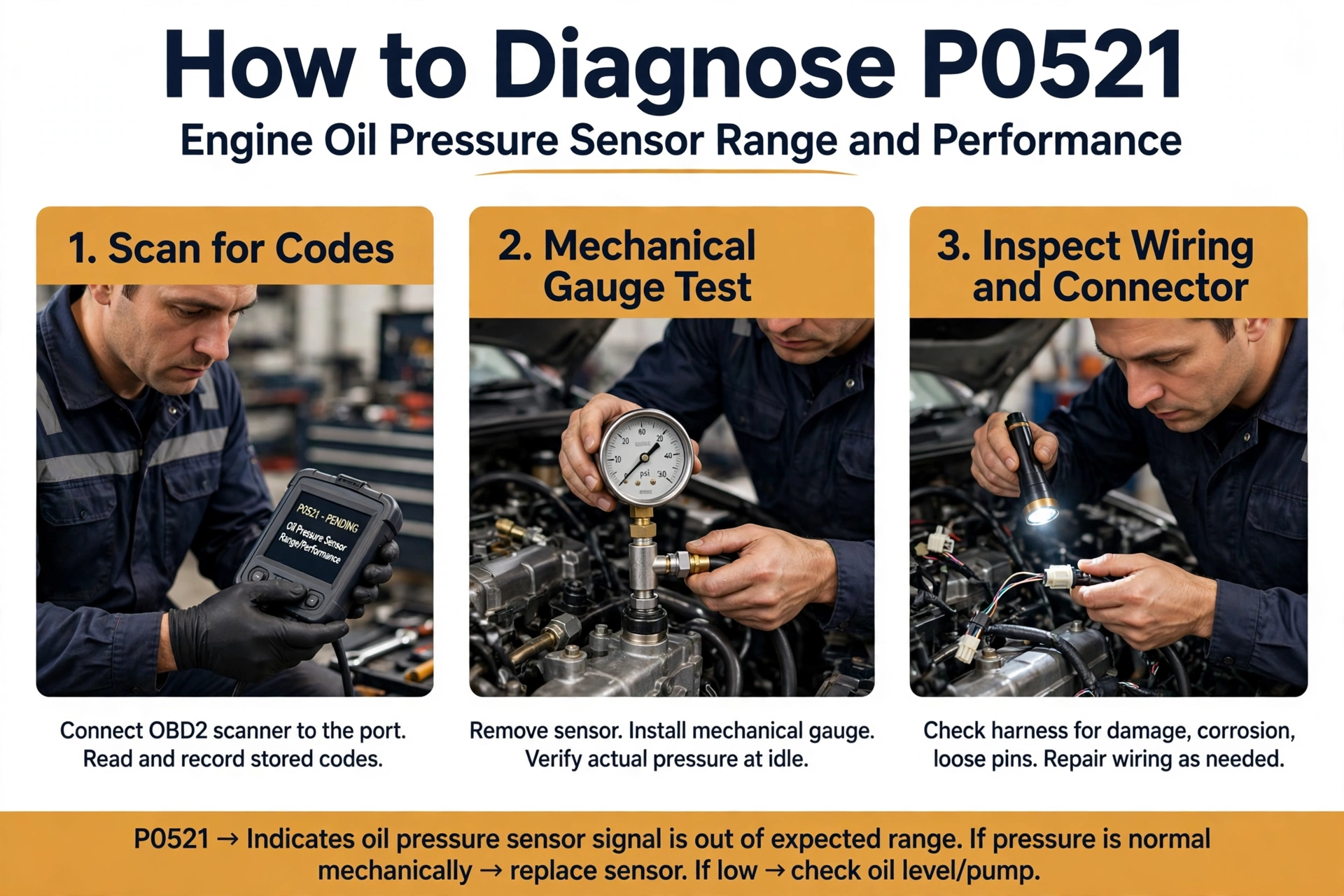
- Check oil level and condition. Pull the dipstick. If the oil is low, top it up with the correct viscosity. If it is black, gritty, or smells burnt, change the oil and filter, clear the code, and road test before doing anything else.
- Scan for companion codes. Note any other codes (especially P0520, P0522, or P0523) and check freeze-frame data for the RPM and temperature when P0521 set.
- Inspect the sensor, wiring, and connector. Look for oil leaking through the sensor body into the connector, chafed or melted wires, green corrosion on pins, and loose connections. On GM trucks, check the screen under the sensor.
- Test with a mechanical oil pressure gauge. This is the decisive step. Remove the sensor, thread in a mechanical gauge, and read actual pressure at idle and at operating RPM. Compare to spec.
- Interpret the result. If mechanical pressure is normal, the problem is the sensor, its screen, or the wiring: replace and retest. If mechanical pressure is genuinely low, stop. You have an engine problem (oil pump, relief valve, pickup tube, or bearings), not a sensor problem.
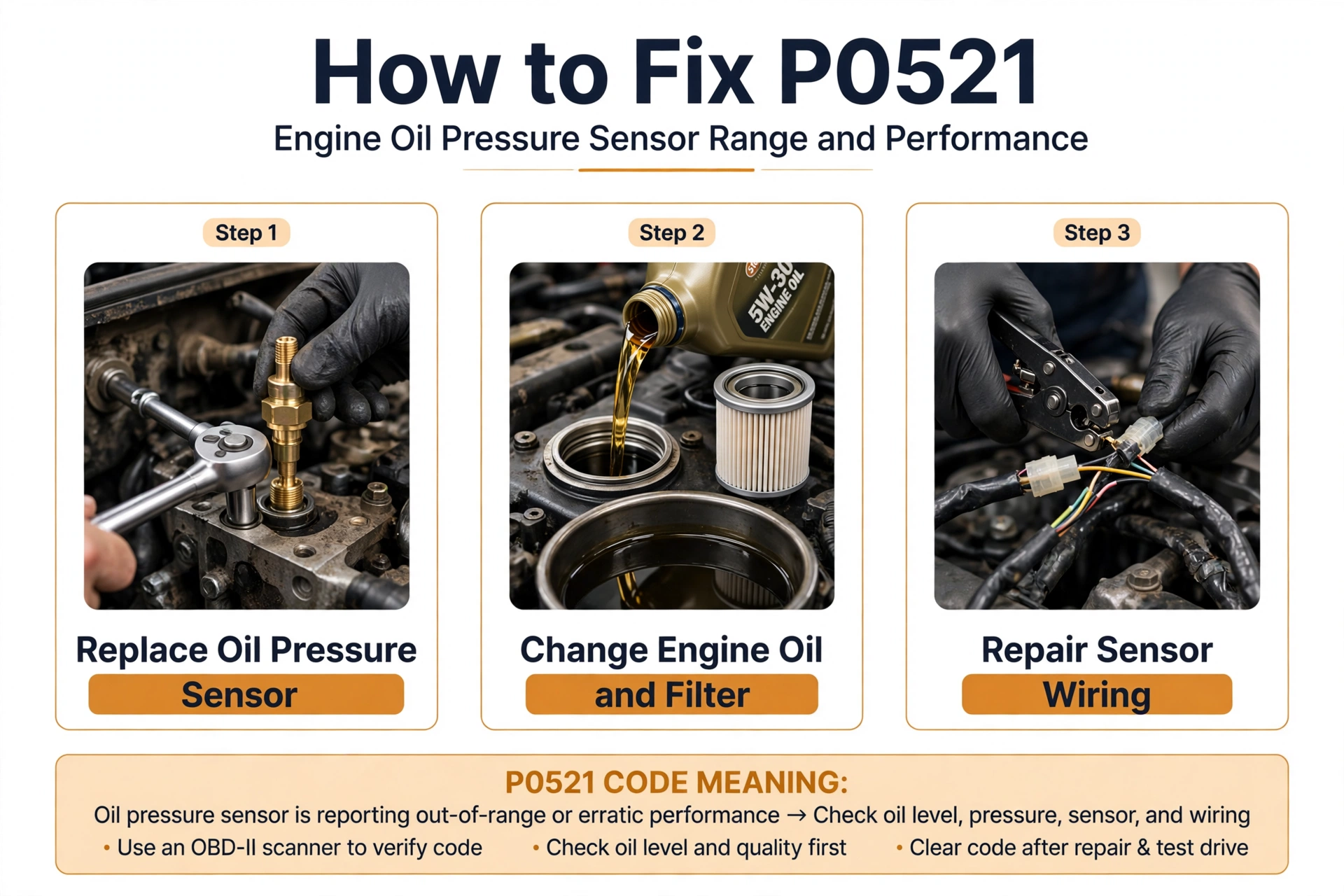
How to Fix the P0521 Code
The right fix depends on what your diagnosis found:
- Top up or change the oil: if the level was low or the oil was degraded, a fresh fill with the correct viscosity and a quality filter fixes many p0521 engine code cases.
- Replace the oil pressure sensor: if mechanical pressure tested normal, install a new sensor. On GM 5.3L/6.2L engines, replace the clogged screen underneath it at the same time (or the code will come right back).
- Repair wiring and connectors: clean corroded pins, replace oil-soaked connectors, and repair chafed harness sections.
- Replace a clogged or incorrect oil filter: use the OEM-spec filter for your engine.
- Free or replace a stuck relief valve: follow the applicable service bulletin for your vehicle.
- Replace the oil pump: when the mechanical gauge proves pressure is truly low and the pump is the culprit.
- Address internal wear: worn bearings or a restricted pickup tube mean internal engine work. Get a professional measurement before committing.
After the repair, clear the code with your scanner and road test through a full warm-up cycle, including idle and highway RPM, to confirm the p0521 code does not return.
P0521 Repair Costs
Drivers always ask how much it costs to fix P0521, and the answer depends entirely on whether it is a sensor issue or a real pressure problem. Here are realistic ranges:
| Repair | Cost Range |
|---|---|
| Oil and filter change | $50 – $120 |
| Oil pressure sensor (DIY part) | $25 – $80 |
| Oil pressure sensor replacement (shop) | $150 – $350 |
| Sensor screen replacement (GM) | $15 – $40 |
| Wiring/connector repair | $100 – $300 |
| Oil pump replacement | $400 – $1,200+ |
| Internal engine repair (bearings) | $1,500 – $4,000+ |
This is why the mechanical gauge test matters so much. A $30 sensor and a $3,000 engine job share the same code.
DIY vs Mechanic Verdict
You can do this at home: checking oil level and condition, changing oil and filter, reading codes and freeze-frame data with an OBD2 scanner, inspecting the sensor wiring and connector, and replacing the oil pressure sensor (plus the screen on GM V8s) on most vehicles with basic hand tools.
See a mechanic for: the mechanical oil pressure test if you do not own a gauge, any diagnosis where the gauge shows truly low pressure, oil pump replacement, relief valve service inside the engine, and any internal bearing or pickup tube work.
Bottom line: do the easy checks and the sensor swap yourself, but let a pro confirm actual pressure and handle anything inside the engine.
Can You Drive With a P0521 Code?
It depends on what is actually wrong, and you cannot tell without checking. If the oil level is full, the engine sounds normal, and only the check engine light is on, a short, careful drive to get it diagnosed is usually acceptable. But here is the hard rule: do NOT drive with a genuine low-pressure reading. If the oil pressure warning light is on, the gauge reads near zero, or you hear ticking or knocking, shut the engine off and tow it. Driving even a few miles with truly low oil pressure can wipe out bearings, seize the engine, and turn a sensor job into a full rebuild. When in doubt, check the oil and call a tow.
P0521 on Popular Vehicles
P0521 shows up across all brands, but some patterns are worth knowing:
- Chevy / GMC (Silverado, Sierra, Tahoe, Yukon): The p0521 chevy code (p0521 silverado, p0521 gmc, chevy p0521) is famously caused by the clogged mesh screen under the oil pressure sensor on 5.3L and 6.2L V8s. Replace the sensor and the screen together. A GM technical service bulletin covers this pattern on 2007-2013 trucks and SUVs.
- Dodge / Ram (Ram 1500, Charger, Durango): The p0521 dodge code (p0521 ram, code p0521 dodge ram, dodge p0521) on 5.7L HEMI engines is usually the sensor itself or low oil. Check the level first; these engines are sensitive to the correct oil viscosity.
- Jeep (Grand Cherokee, Wrangler): The p0521 jeep code (jeep p0521) on the 3.6L Pentastar often traces to the sensor or its connector. Inspect for oil intrusion into the connector.
- Ford (F-150, Mustang): The p0521 ford code (ford p0521) is less common. Start with oil level and condition, then the sensor, since Ford oil pressure circuits are straightforward.
- Cadillac (Escalade, CTS-V): The p0521 cadillac code falls under the same GM bulletin as the Chevy trucks: suspect the sensor screen on V8 models.
- Toyota / Honda: The p0521 toyota code (toyota p0521) and p0521 honda code are relatively rare. When they appear, wiring damage or a failing sensor is more likely than sludge.
DTC P0521 and OBD P0521 are the same code under different naming. EOBD P0521 is the European name for the identical fault.
P0521 vs P0520, P0522, P0523
These four codes all live in the oil pressure sensor circuit, but they mean different things. P0520 is a general oil pressure sensor/switch circuit malfunction. P0521 means the signal is present but out of its expected range or erratic (a performance problem). P0522 means the circuit voltage is stuck low, and P0523 means it is stuck high. In practice, P0522 and P0523 point at wiring or a dead sensor, while P0521 is the one that most often involves actual oil pressure problems, which is why the mechanical gauge test is non-negotiable for P0521.
Related Codes
- P0520: Engine Oil Pressure Sensor/Switch Circuit Malfunction
- P0522: Engine Oil Pressure Sensor/Switch Circuit Low Voltage
- P0523: Engine Oil Pressure Sensor/Switch Circuit High Voltage
- P06DE: Engine Oil Pressure Control Circuit Stuck On (a related oil pressure control fault)
Video Walkthrough
Watch the video above for a visual walkthrough of P0521 causes and diagnosis before you read on.
Frequently Asked Questions
What is the most common cause of a P0521 code?
A faulty oil pressure sensor and low or dirty engine oil are the two most common causes. On GM 5.3L and 6.2L V8s, a clogged mesh screen under the sensor is a notorious third cause. Always verify actual pressure with a mechanical gauge before replacing parts.
Can I drive with a P0521 code?
Only with caution, and never with a genuine low-pressure reading. If the oil pressure warning light is on, the gauge reads near zero, or the engine is ticking or knocking, shut it off and tow it. Driving with truly low oil pressure can destroy the engine in minutes.
Can low oil cause P0521?
Yes. Low oil level is one of the most common triggers. When the pickup tube draws in air, pressure readings turn erratic and the ECM sets P0521. Check the dipstick first; topping up or changing the oil fixes many cases.
How do you fix the code P0521?
Diagnose first: check oil level and condition, inspect the sensor wiring and connector, then verify actual pressure with a mechanical gauge. If pressure is normal, replace the sensor (and the screen on GM V8s) or repair the wiring. If pressure is truly low, repair the underlying engine problem such as the oil pump or relief valve.
How much does it cost to fix P0521?
A DIY sensor costs $25-$80, while a shop charges $150-$350 for sensor replacement. An oil change runs $50-$120. If the oil pump has failed, expect $400-$1,200+. Internal engine repairs for worn bearings can exceed $1,500.
Will P0521 clear itself?
Rarely. The code may disappear for a drive cycle if the glitch was momentary, but it almost always returns until the real problem is fixed. Clear it with a scanner after the repair and confirm it stays off through a full warm-up cycle.
What is the difference between P0521, P0520, P0522, and P0523?
P0520 is a general oil pressure sensor circuit malfunction. P0521 means the signal is out of its expected range or erratic. P0522 means the circuit voltage is stuck low, and P0523 means it is stuck high. P0521 is the one most likely to involve a real oil pressure problem.
Conclusion
The P0521 code looks like a simple sensor fault, but it is really your car asking a question: is the sensor lying, or is the engine actually losing oil pressure? Answer it in the right order: check the oil, inspect the wiring, and prove the pressure with a mechanical gauge. Do that, and you will either fix it cheaply with a sensor or catch a serious engine problem before it gets expensive. Either way, you stop guessing and start fixing.
About the author: Written by the OBD2 Code Hub editorial team. Our diagnostic guides are built from real OBD-II data, manufacturer service procedures, and hands-on troubleshooting experience, then reviewed for technical accuracy before publishing. We drive the same cars you do.