
P2138 Trouble Code: Meaning, Causes, Symptoms & Fixes
In This Guide
One-line meaning: P2138: Throttle/Pedal Position Sensor/Switch D/E Voltage Correlation.
What the P2138 Code Means
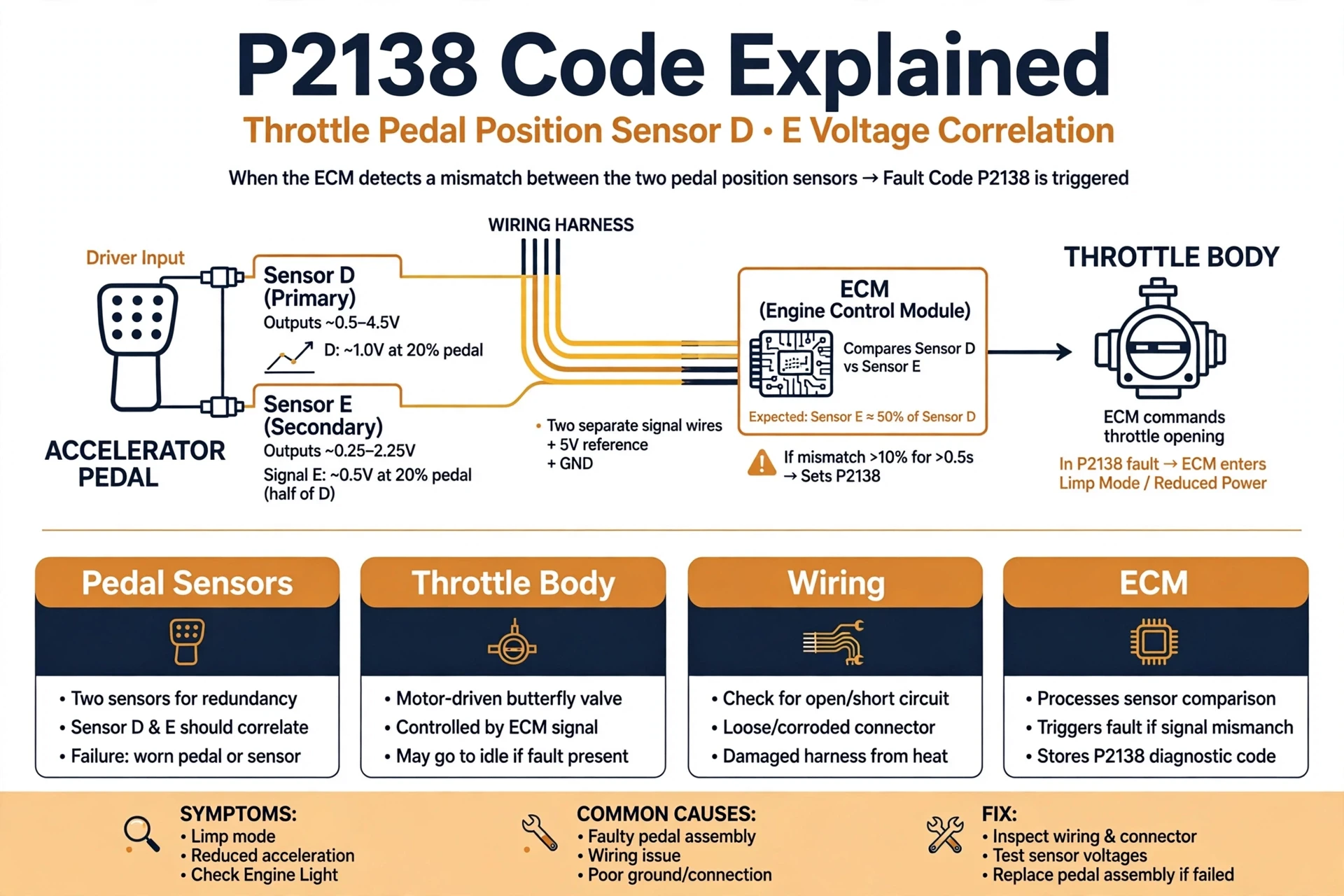
The P2138 code is one of the more alarming check engine light codes because it involves your throttle. Its full definition is “Throttle/Pedal Position Sensor/Switch D/E Voltage Correlation” (p2138 throttle pedal position sensor switch d e voltage correlation). In plain English, your car’s engine computer (ECM/PCM) has caught two throttle position signals disagreeing with each other, and it no longer trusts what your right foot is asking for.
Here is the background. Modern cars use drive-by-wire: there is no physical cable between the gas pedal and the throttle body. Instead, the accelerator pedal assembly carries two redundant position sensors (the APP sensors, labeled D and E on many vehicles), and the throttle body carries its own pair. The paired sensors exist as a safety measure. As you press the pedal, both sensors report position to the computer, and the computer constantly checks that the two signals agree within a narrow voltage window. When the mismatch between sensors D and E lasts more than a couple of seconds, the computer sets P2138.
P2138 (p2138 obd ii, p2138 code) is a generic powertrain code, which means it has the same meaning on every make and model, from a Chevy Cruze to a Nissan Altima to a Toyota Camry. Its close cousin is the P2135 code, which flags the same kind of correlation fault but for the sensor pair labeled A and B. Because the computer cannot verify your throttle request, it usually limits throttle response (limp mode) the moment this code sets.
Symptoms of the P2138 Code
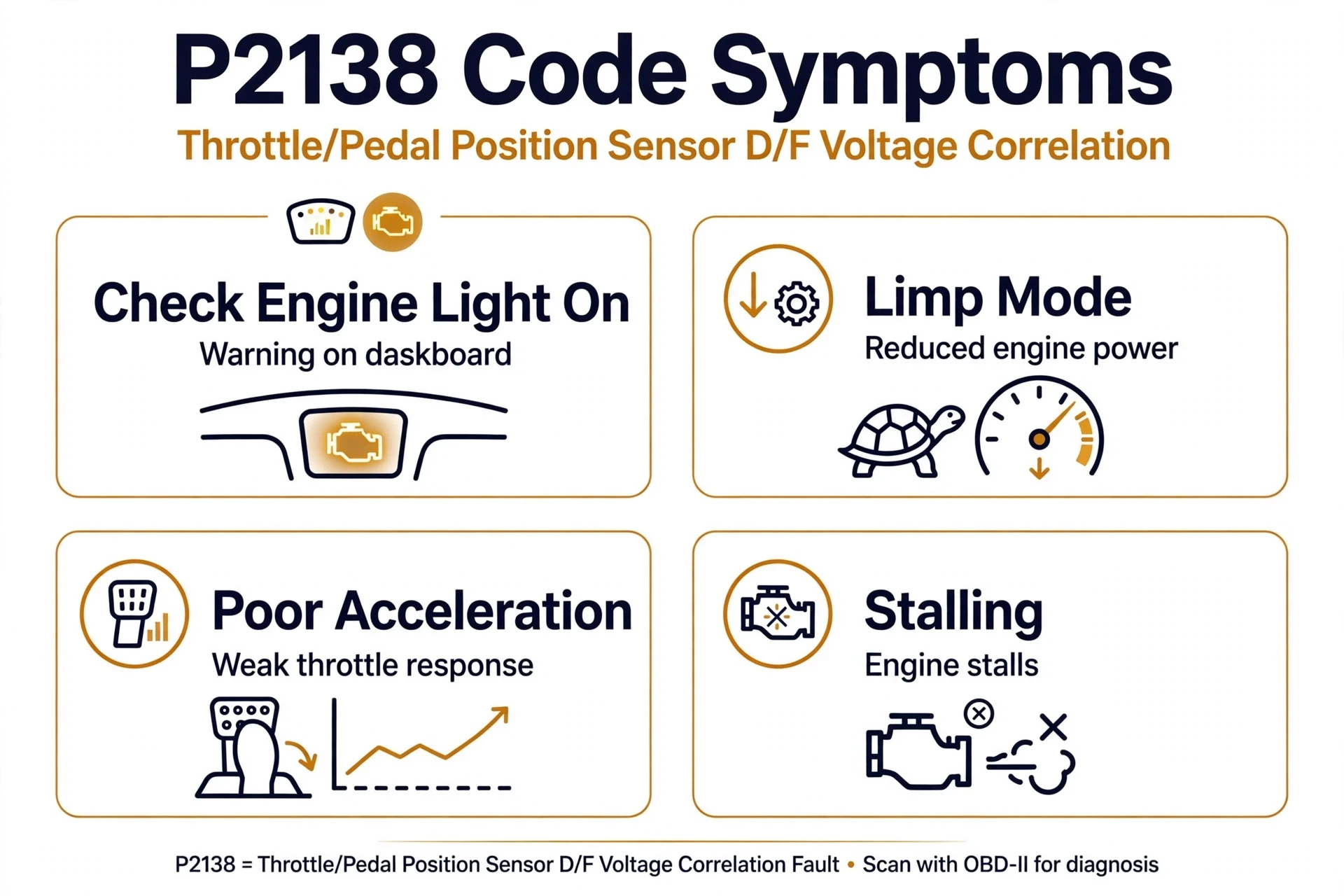
Unlike some codes that hide quietly, P2138 usually announces itself. The moment the computer loses trust in the throttle signals, it takes protective action, so you will feel it. Common symptoms include:
- Check engine light (MIL) turns on, often with a “reduced engine power” warning on the dash
- Limp mode: speed and acceleration are capped, and the throttle may be limited to under half no matter how far you press the pedal
- Hesitation, flat spots, or jerking when you press the gas pedal
- Sudden loss of power or unexpected slow-downs while cruising
- Engine stalling, or the engine failing to respond to throttle input at all
What is code P2138 trying to tell you? In short: the computer sees two conflicting reports of pedal position and is protecting the engine (and you) by limiting power until the disagreement is resolved.
Common Causes of P2138
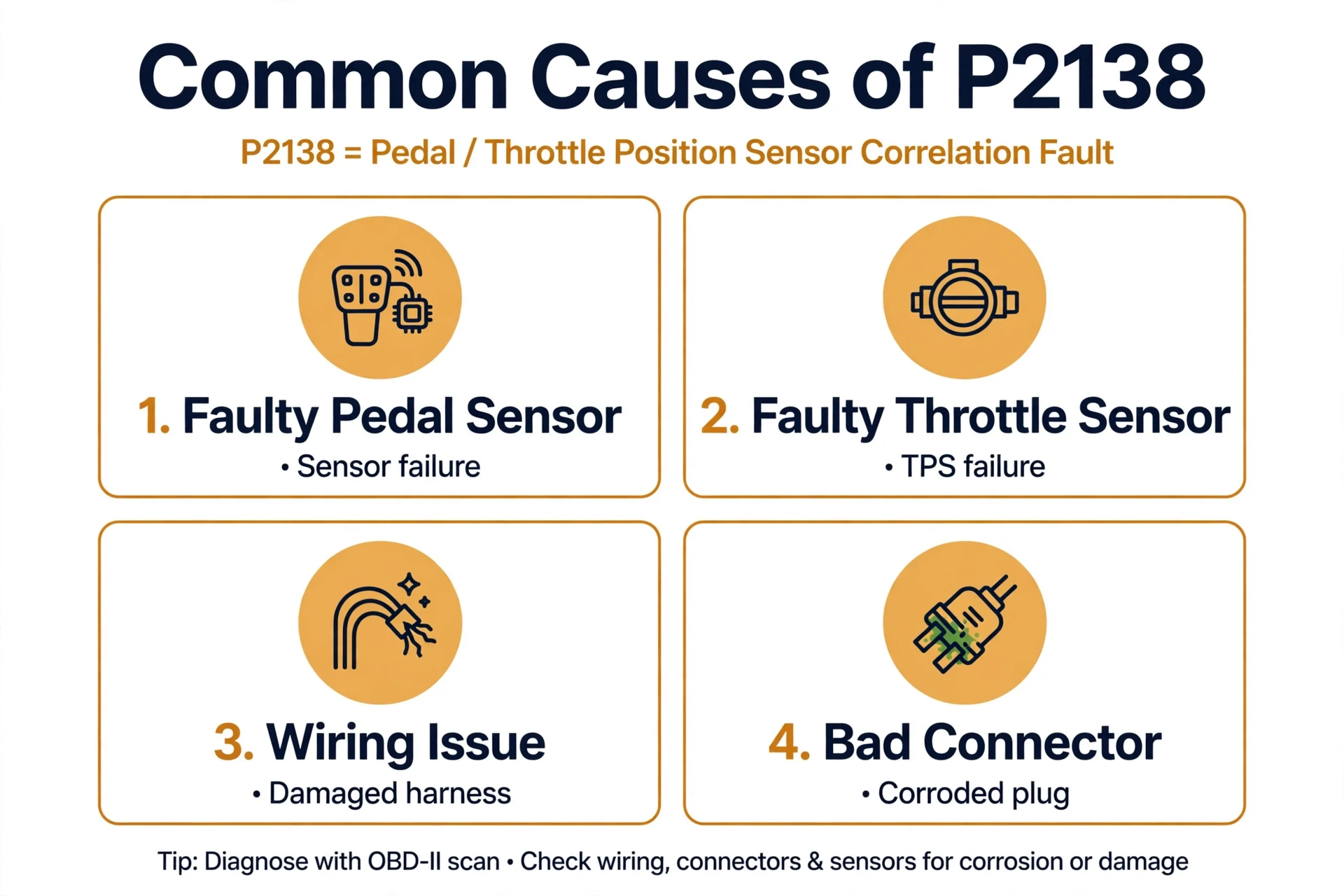
The most common cause of a P2138 code is a failing accelerator pedal position (APP) sensor assembly, where the two internal sensors wear out or lose synchronization with each other. But wiring faults run a close second, and condemning parts without testing is the most expensive mistake drivers make with this code. Here are the causes, roughly in order of likelihood:
- Failed accelerator pedal position (APP) sensor assembly: the internal potentiometers or Hall-effect sensors on the gas pedal wear out or drift out of sync. On most cars the sensors are built into the pedal assembly, so the whole assembly gets replaced.
- Damaged wiring or connectors: chafed wires, loose or spread pins, and corrosion at the pedal or throttle body connector interrupt one sensor’s signal and create the mismatch.
- Water intrusion: leaks around the windshield, firewall, or roof antenna can drip water onto the pedal harness connectors (a known issue on some GM trucks), causing intermittent correlation faults.
- Dirty or faulty throttle body: heavy carbon buildup on the throttle plate, or a failing throttle actuator motor, can confuse the throttle position readings.
- Faulty throttle position (TP) sensor: on vehicles where P2138 monitors the throttle body sensor pair, a bad TP sensor is the culprit.
- ECM/PCM problems: software calibration issues needing an update, or in rare cases a failing control module.
- Low system voltage: a weak battery or charging problem can skew sensor readings enough to set correlation codes.
How to Diagnose P2138 (Do This Before Buying Parts)
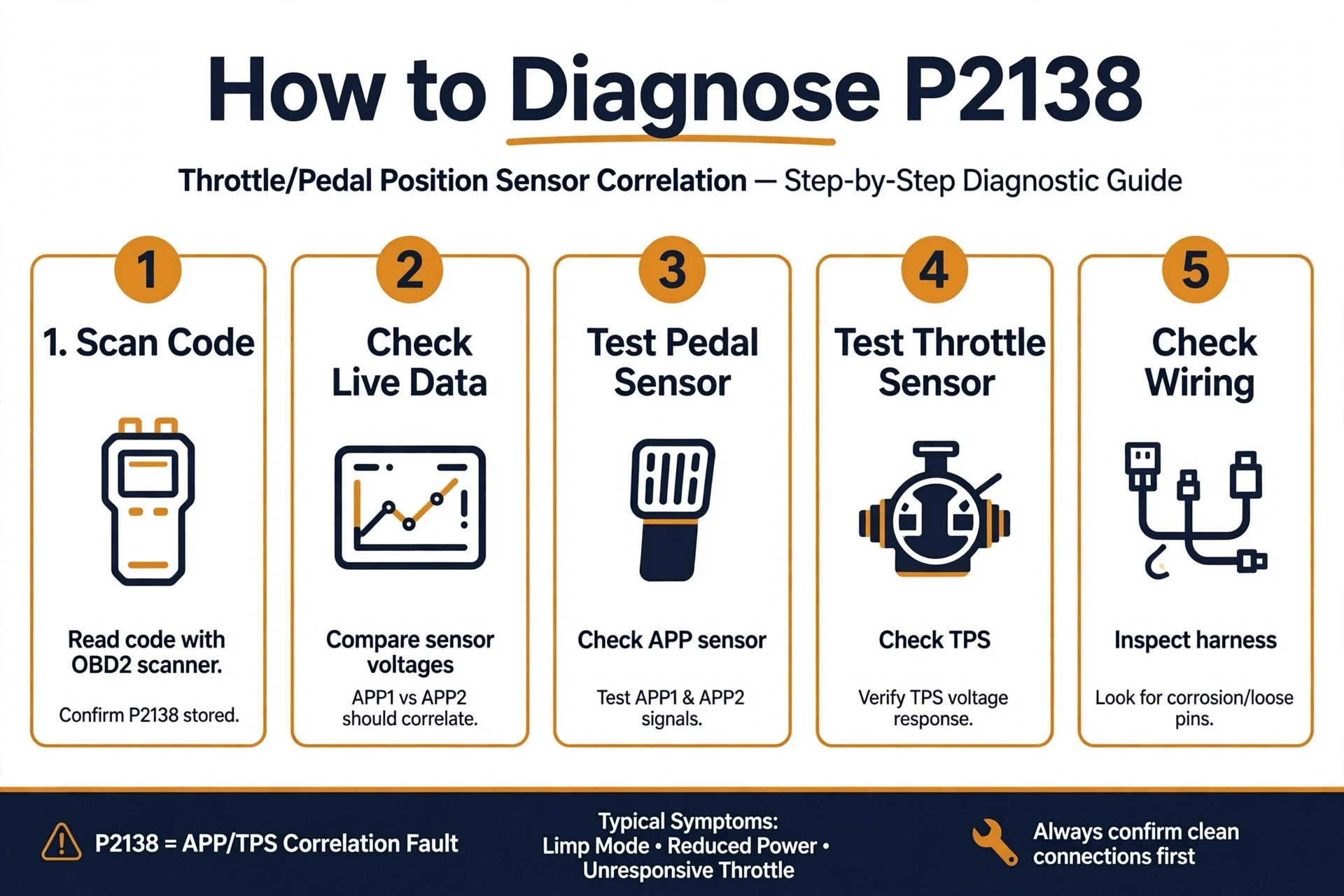
P2138 gets misdiagnosed when people throw a pedal assembly at it without checking the wiring first. Work through this order:
- Scan for other codes first. Companion codes like P2122 through P2128 (APP circuit codes) or P2135 point at the same area. Fix circuit codes before correlation codes.
- Check live data. With any OBD2 scanner that shows live data, graph the APP sensor D and E voltage PIDs while slowly pressing the pedal from closed to wide open. Both traces should move smoothly and keep their expected relationship. A signal that drops out, spikes, or flatlines reveals the bad sensor.
- Inspect connectors and wiring. Unplug the accelerator pedal connector and the throttle body connector. Look for loose terminals, broken or spread pins, green corrosion, and signs of water entry. Wiggle-test the harness with the scanner connected and watch for signal dropouts.
- Clean and test the throttle body. If carbon is caked on the throttle plate, clean it with dedicated throttle body cleaner. Check that the plate moves freely and the TP sensor signals track correctly.
- Test the pedal assembly. If the wiring is sound and the D/E voltages still disagree through the pedal sweep, the pedal sensor assembly has failed. Compare your readings against the manufacturer’s spec before replacing.
How to Fix the P2138 Code
The right fix depends on what your diagnosis found:
- Clean the throttle body: remove carbon buildup from the throttle plate and bore with throttle body cleaner. This alone resolves P2138 when sticking carbon is confusing the position readings.
- Repair wiring and connectors: fix chafed wires, tighten or replace loose pins, clean corrosion, and seal the water leak that let moisture in.
- Replace the accelerator pedal position sensor assembly: the most common repair. The sensors are usually integral to the pedal, so the assembly is swapped as a unit (typically a few bolts and one electrical connector under the dash).
- Replace the throttle body or TP sensor: when the throttle body side is at fault. Some vehicles need a throttle relearn procedure after replacement.
- Update or replace the ECM/PCM: rare, but a software update or module replacement is the answer when sensors and wiring all test good.

P2138 Repair Costs
Drivers always ask how much it costs to fix P2138, and the answer depends entirely on the cause. Here are realistic ranges:
| Repair | Cost Range |
|---|---|
| Throttle body cleaning | $80 – $180 |
| Accelerator pedal position sensor assembly replacement | $150 – $400 |
| Throttle body replacement | $250 – $650 |
| Wiring / connector repair | $100 – $300 |
| ECM/PCM reflash or replacement | $500 – $1,500 |
This is why diagnosis matters. A $15 can of throttle body cleaner and a $400 pedal assembly share the same code. Always verify the wiring and live data before buying parts.
DIY vs Mechanic Verdict
You can do this at home: reading codes and live sensor data with an OBD2 scanner, inspecting connectors for corrosion and water, cleaning the throttle body, and replacing the accelerator pedal assembly (usually just a few bolts and a connector). These are reasonable DIY repairs for anyone comfortable with basic tools.
See a mechanic for: wiring faults buried deep in the harness, throttle body replacement that needs a relearn procedure, and any ECM/PCM software or module issue. A shop can also run the pinpoint voltage tests faster if your scanner lacks live data graphing.
Bottom line: diagnose it yourself, fix the wiring and the easy parts yourself, but let a pro handle module-level faults.
Can You Drive With a P2138 Code?
This one is different from many codes: technicians generally do not recommend driving with P2138. The code directly affects acceleration control. Limp mode can cap your speed and leave you underpowered when merging or climbing, and the engine may hesitate, surge, or stall without warning. Get it diagnosed promptly, even if the car still moves.
P2138 on Popular Vehicles
P2138 shows up across all brands, but some patterns are worth knowing:
- Chevy (Cruze, Sonic, Malibu, Silverado): The p2138 chevy code (chevy p2138, p2138 code chevy) is common. On trucks, check for water intrusion from windshield or roof antenna leaks dripping onto the pedal harness.
- Nissan (Altima, Sentra, Rogue): For p2138 nissan (nissan p2138, p2138 code nissan), the pedal assembly itself is a frequent culprit.
- Toyota (Camry, Corolla): The p2138 toyota code (toyota p2138) is less common but usually traces to the APP sensor or throttle body.
- Honda (Accord, Civic): The p2138 honda code (honda p2138, p2138 code honda) often involves the throttle body or its wiring.
- Ford (F-150, Escape): The p2138 ford code (ford code p2138) can follow wiring damage near the pedal.
- GM trucks and SUVs: water intrusion onto interior connectors is a documented trigger, so look for damp carpets or windshield leaks.
DTC P2138 and OBD-II P2138 refer to the identical fault. Some scan tools describe it as “Accelerator Pedal Position Sensor 1-2 Correlation,” which means the same thing as the D/E voltage correlation definition.
P2138 vs P2135
P2135 is “Throttle/Pedal Position Sensor/Switch A/B Voltage Correlation” and P2138 is the D/E version. Same concept, different sensor pair: the letters identify which redundant pair disagreed. On many vehicles, A/B refers to the throttle body sensors and D/E to the accelerator pedal sensors, though naming varies by manufacturer. Diagnose and fix them the same way: check live data, inspect wiring, then replace the faulty sensor assembly.
Related Codes
- P2135: Throttle/Pedal Position Sensor/Switch A/B Voltage Correlation
- P2122: Throttle/Pedal Position Sensor/Switch D Circuit Low
- P2127: Throttle/Pedal Position Sensor/Switch E Circuit Low
- P2121: Throttle/Pedal Position Sensor/Switch D Circuit Range/Performance
Video Walkthrough
Watch the video above for a visual walkthrough of P2138 causes and diagnosis before you read on.
Frequently Asked Questions
What is the most common cause of a P2138 code?
A failing accelerator pedal position sensor assembly is the single most common cause. The two redundant sensors inside the pedal wear out or drift out of sync, so their voltage signals stop agreeing. Damaged wiring and corroded connectors are the next most common causes, which is why inspecting the harness before buying parts saves money.
Can I still drive my car with a P2138 code?
It is not recommended. P2138 can trigger limp mode, cap your speed, and cause hesitation, surging, or stalling. Because the computer cannot verify your throttle request, driving with this code is a safety risk. Get it diagnosed promptly.
How do you fix the code P2138?
Diagnose first: check live data for the D and E sensor voltages, inspect the wiring and connectors for damage or water, and clean the throttle body. Then repair what you find: fix the wiring, clean the throttle body, or replace the accelerator pedal position sensor assembly if the signals still disagree.
How much does it cost to fix P2138?
From about $80-$180 for a throttle body cleaning, $150-$400 for an accelerator pedal position sensor assembly replacement, $250-$650 for a throttle body replacement, and up to $1,500 if the ECM/PCM needs attention.
Will P2138 clear itself?
Rarely. The code sets when the sensor mismatch lasts more than a couple of seconds, and it usually returns on the next drive until the underlying fault is fixed. Clear it with a scanner after the repair and confirm the sensor signals agree.
Can a dirty throttle body cause P2138?
Yes. Carbon buildup on the throttle plate can confuse the throttle position readings enough to create a correlation fault. Cleaning the throttle body with dedicated cleaner is a cheap first step that resolves many cases.
How do I reset the accelerator pedal position sensor?
After replacing the pedal assembly or cleaning the throttle body, clear the code with an OBD2 scanner. Some vehicles then need a throttle relearn or idle relearn procedure, so check your service manual. Disconnecting the battery alone may not complete the relearn.
Conclusion
The P2138 code looks alarming because it takes away your throttle, but it is really your car protecting you from signals it cannot trust. Check the live sensor data, inspect the wiring for damage and water, clean the throttle body, and replace the pedal assembly only if the signals still disagree. Do that, and you will either solve it cheaply or know exactly which part failed. Either way, you stop guessing and start fixing.
About the author: Written by the OBD2 Code Hub editorial team. Our diagnostic guides are built from real OBD-II data, manufacturer service procedures, and hands-on troubleshooting experience, then reviewed for technical accuracy before publishing. We drive the same cars you do.