
P0012 Trouble Code: Meaning, Causes, Symptoms & Fixes
In this guide:
One-line meaning: P0012 means your car’s computer has detected that the intake (“A”) camshaft on Bank 1 is sitting too far retarded (delayed) compared to the position it was commanded to hold.
What the P0012 Code Means
When your scanner shows engine code p0012, your powertrain control module (PCM) is reporting that the variable valve timing (VVT) system cannot bring the Bank 1 intake camshaft to its commanded angle. Instead of advancing and retarding smoothly as speed and load change, the intake camshaft stays stuck too far in the retarded (delayed) direction. Once the gap between the desired and actual camshaft angle passes the factory limit, the computer stores P0012 and turns on the check engine light.
Reading the code letter by letter makes it easy to remember. The “A” stands for the intake camshaft, which makes P0012 the mirror image of P0013 (the “B”, or exhaust, camshaft over-retarded). “Over-retarded” means the valve timing lags behind where it should be, the exact opposite of the over-advanced condition in P0011. “Bank 1” is the side of the engine that contains cylinder number one: on a four-cylinder engine that is the whole engine, and on a V6 or V8 it is one cylinder head.
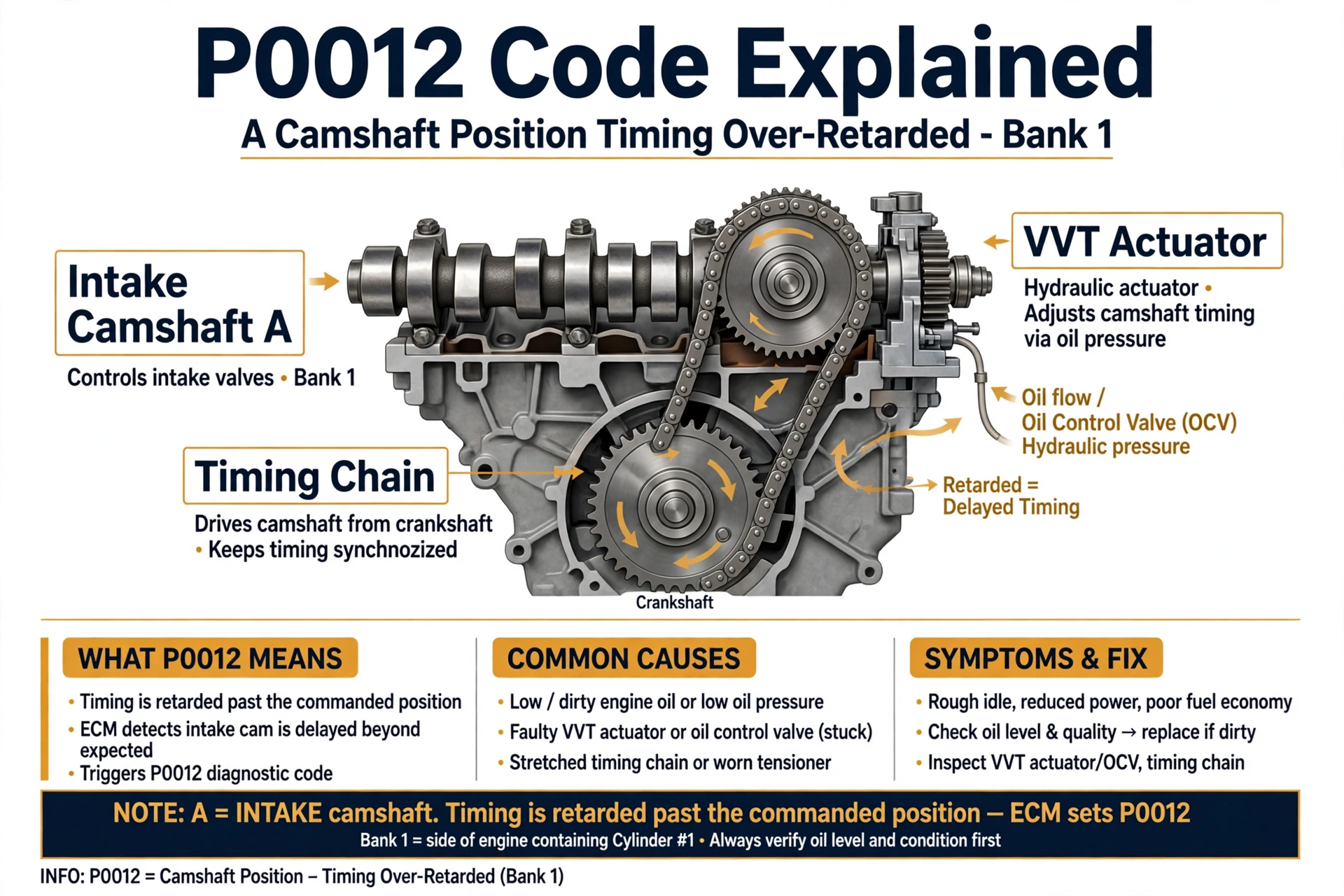
The VVT system changes camshaft timing with engine oil pressure. The PCM sends a pulsing electrical signal to the oil control valve (also called the VVT solenoid), which routes pressurized oil into the cam phaser, a gear-like actuator built into the camshaft sprocket. Oil pressure twists the phaser, rotating the camshaft slightly forward or backward so the intake valves open earlier or later. The camshaft position sensor reports the actual angle back to the computer, which keeps adjusting the solenoid until the two match.
When the oil is low, dirty, sludged, or the wrong viscosity, or when the solenoid, its filter screen, or the phaser itself is worn, the camshaft cannot reach its target. The PCM widens the solenoid command further and further, and when even full command cannot close the gap, it sets the P0012 code. Because the entire system runs on engine oil, the most common story behind this code is an oil problem, which is good news: the cheapest fix is also the first thing you should try.
Symptoms of the P0012 Code
A P0012 code almost always triggers the check engine light, and most drivers notice at least one drivability symptom because retarded intake timing directly affects how the engine breathes. Watch for these warning signs:

- Illuminated check engine light: This is the one symptom every P0012 case shares. The light may come and go at first, then stay on as the timing error grows.
- Rough idle or engine shaking: With the intake valves opening late, combustion becomes uneven at idle, and you may feel the engine stumble or vibrate.
- Sluggish acceleration and loss of power: Retarded intake timing reduces cylinder filling at higher rpm, so the car feels flat and unresponsive when you press the gas.
- Reduced fuel economy: The engine compensates for the wrong valve timing by burning extra fuel, and many drivers notice a drop of several miles per gallon.
- Hard starting or stalling: In more pronounced cases the engine cranks longer than normal, idles poorly after a cold start, or stalls at stoplights.
- Rattling noise from the engine: A worn timing chain or a sticking phaser can produce a rattle on startup or under load that points straight at the timing system.
- Limp mode in severe cases: If the PCM cannot trust the camshaft position at all, it may limit power to protect the engine until the fault is fixed.
Common Causes of the P0012 Code
The computer logs P0012 when the Bank 1 intake camshaft cannot reach its commanded angle. These are the usual reasons, roughly in order of how often they occur:
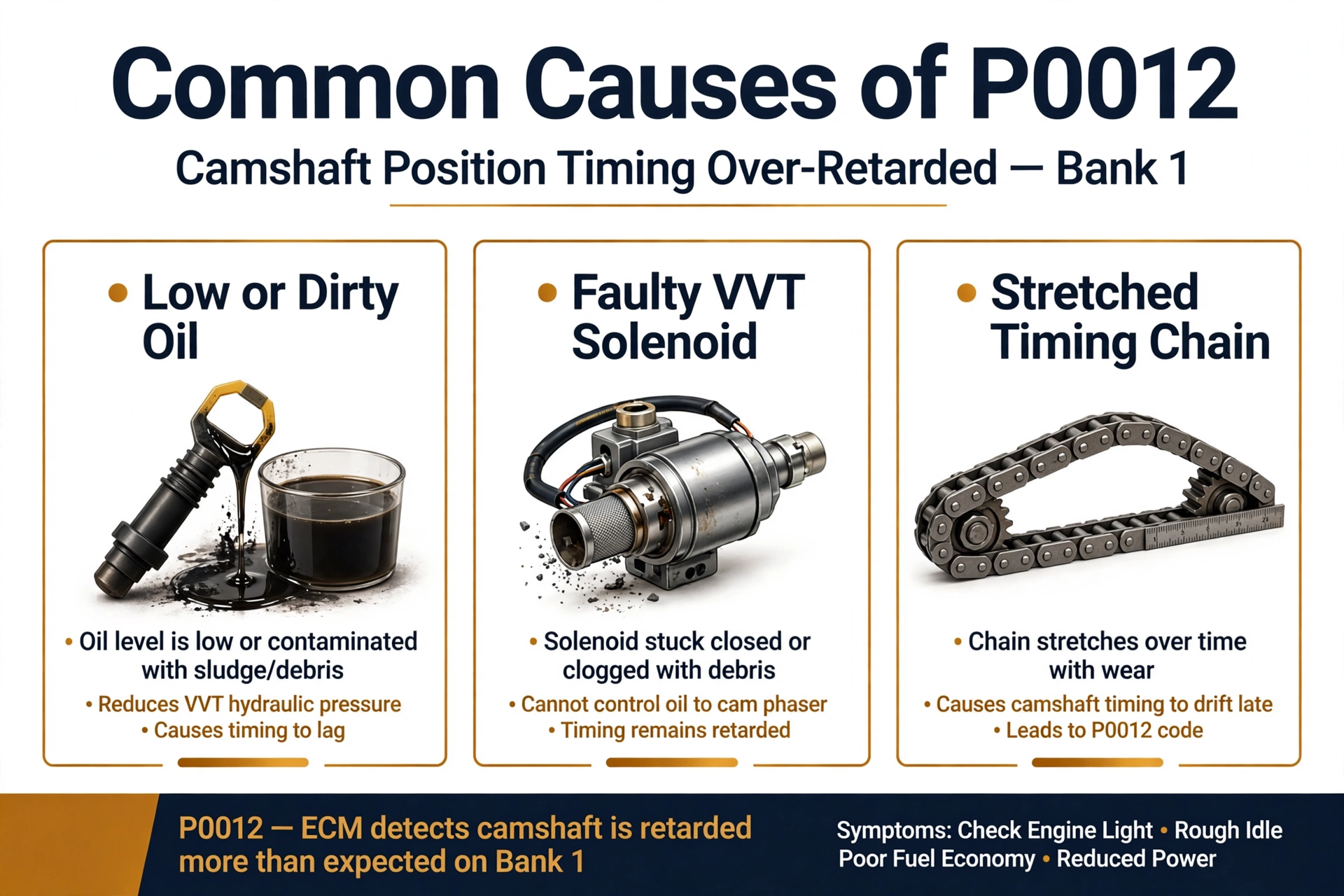
- Low or dirty engine oil: The number one cause. The VVT system needs clean oil at the correct level and pressure to move the cam phaser. Low oil, overdue oil, or sludge starves the phaser and the code follows.
- Failed or sticking VVT (oil control) solenoid: The solenoid can stick mechanically, fail electrically, or clog with sludge so it cannot meter oil to the phaser.
- Clogged VVT filter screen: Many engines have a small mesh screen in the oil passage feeding the solenoid. Debris and sludge block it, cutting oil flow to the phaser.
- Wrong-viscosity or non-spec oil: Oil that is too thick or too thin, or that does not meet the manufacturer’s specification, changes how the phaser responds and can set the code on its own.
- Worn or stretched timing chain: A chain that has elongated with mileage throws the base camshaft timing off, so the VVT system runs out of adjustment range.
- Failed timing chain tensioner or guides: A weak tensioner lets the chain slap and jump timing slightly, which the PCM reads as a retarded camshaft.
- Failed VVT cam phaser/actuator: The phaser itself can wear internally or fail to lock, so it cannot hold the commanded angle even with good oil pressure.
- Faulty camshaft position sensor: If the sensor reports the wrong angle, the PCM chases a target it can never verify and may set P0012 along with sensor codes.
- Wiring or connector problems: Damaged wiring, corroded pins, or a loose connector at the VVT solenoid interrupts the control signal.
How to Diagnose the P0012 Code
Work through these steps in order. The first two solve the majority of P0012 cases, so do not buy parts until the cheap checks are done.
- Scan and record all codes. Note P0012 plus any companion codes (P0010, P0011, misfires, sensor codes). Companion codes point at shared causes such as the solenoid circuit or the timing chain.
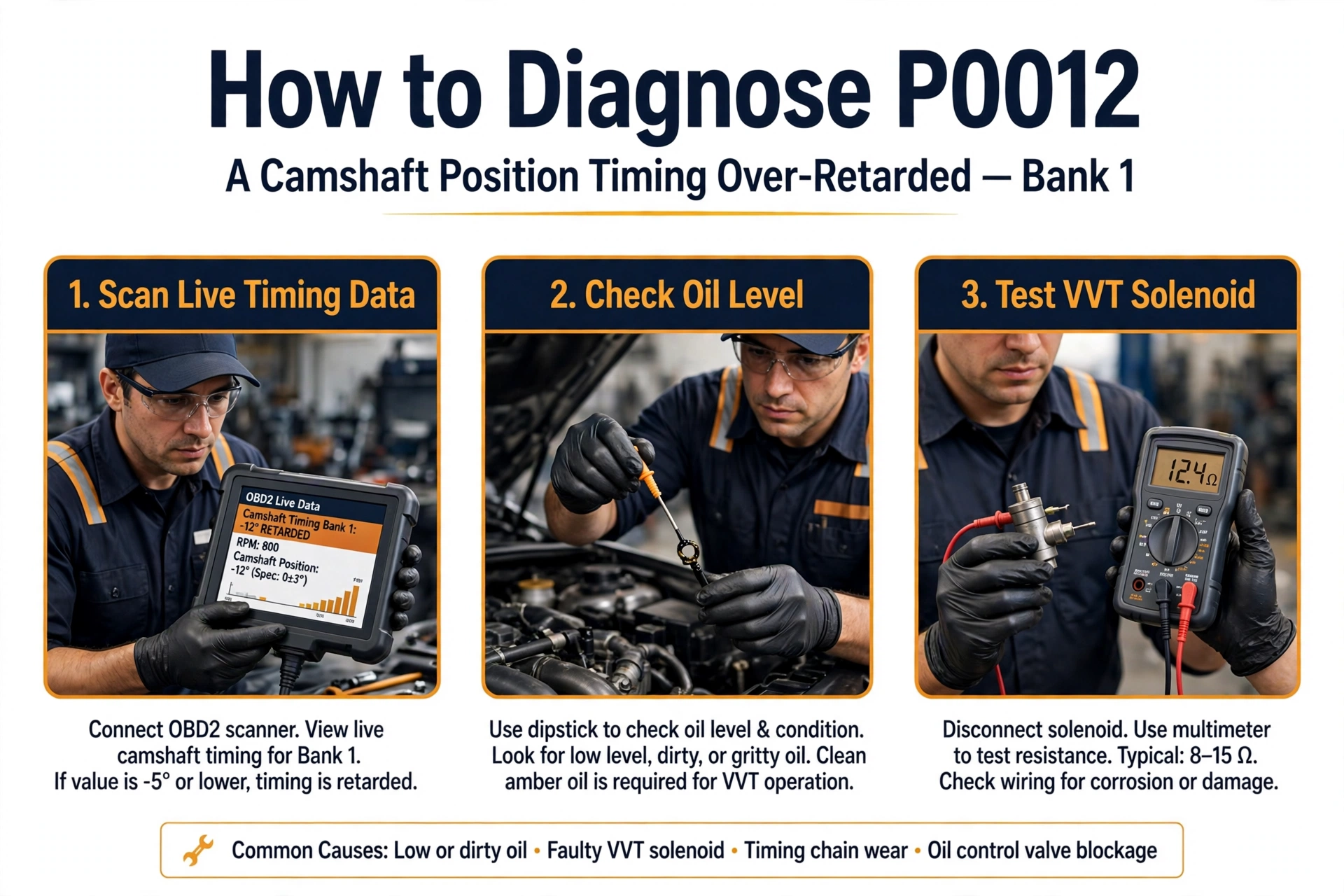
- Check the engine oil level and condition. Pull the dipstick with the engine off. If the level is low, top it up with the correct specification oil. If the oil is black, gritty, or smells burnt, change it and the filter before doing anything else.
- Inspect the VVT solenoid and its connector. Find the Bank 1 intake oil control valve (usually near the valve cover, held by one bolt). Look for oil leaks, sludge around the solenoid, and damaged or corroded wiring.
- Test the solenoid electrically. Unplug it and measure resistance across its terminals with a multimeter. On many Toyota and similar applications the reading should be 6.9 to 7.9 ohms at 68°F. No reading, or a reading far outside specification, means the solenoid is bad.
- Check the VVT filter screen. If your engine has an oil feed screen for the solenoid, remove it and look for sludge or debris. Clean it with solvent or replace it.
- Watch live camshaft timing data. With a scan tool that reads live data, compare desired versus actual intake camshaft angle on Bank 1 while a helper varies engine rpm. A large, constant gap confirms a mechanical or hydraulic fault rather than a sensor glitch.
- Inspect the timing chain. If the oil and solenoid check out but the timing will not come into range, check chain stretch, tensioner condition, and guide wear. A rattling chain on startup is a strong clue.
How to Fix the P0012 Code
Match the repair to what your diagnosis found. Most P0012 cases are resolved by one of the first two fixes below.
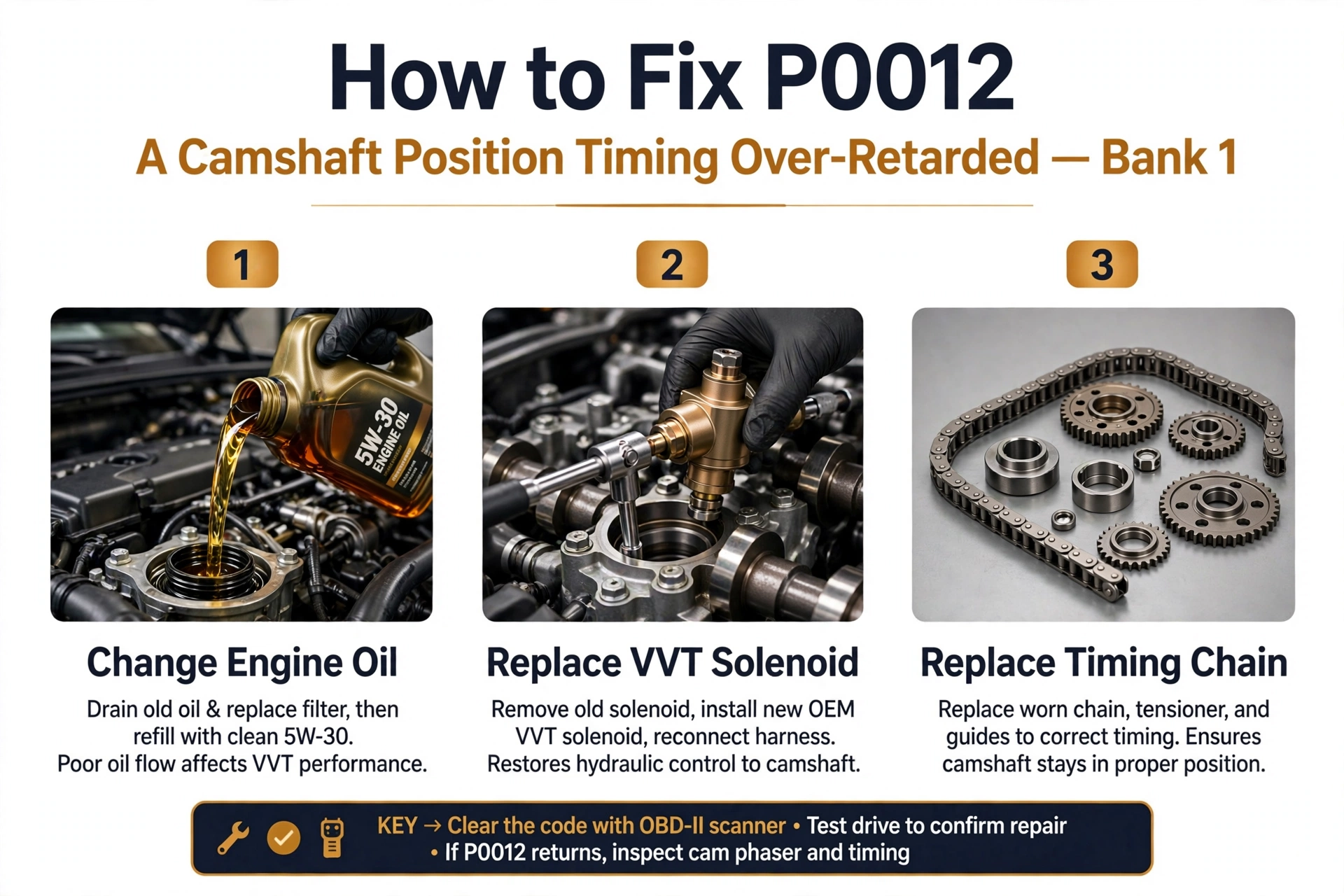
- Change the engine oil and filter: Use the exact viscosity and specification in your owner’s manual. Fresh, correct oil restores the pressure the phaser needs and often clears the code on its own.
- Clean or replace the VVT (oil control) solenoid: Remove the Bank 1 intake solenoid, clean it with valve cleaner, and wipe it dry. If the resistance test failed or cleaning does not help, install a new solenoid.
- Clean or replace the VVT oil screen: A clogged feed screen is a cheap fix that many DIYers overlook. Clear the blockage so full oil pressure reaches the solenoid.
- Replace the camshaft position sensor: If the sensor is sending erratic signals or has set its own code, a new sensor restores accurate feedback to the PCM.
- Replace the VVT cam phaser/actuator: When the phaser is worn or will not lock, replacement is the only fix. This job usually requires timing cover removal.
- Replace the timing chain kit: For a stretched chain or failed tensioner and guides, install a complete kit (chain, tensioner, guides, and often the phasers) and re-time the engine.
After the repair, clear the code with your scan tool and drive through a few warm-up cycles. If engine code p0012 returns, repeat the diagnosis rather than replacing more parts at random.
How Much Does It Cost to Fix P0012?
Repair cost depends on the root cause. An oil change is the cheapest fix, while timing chain work is the most expensive. Typical US price ranges:
| Repair | Cost Range |
| Engine oil and filter change | $45 – $90 |
| VVT (oil control) solenoid replacement | $150 – $350 |
| Camshaft position sensor replacement | $120 – $250 |
| VVT cam phaser/actuator replacement | $400 – $900 |
| Timing chain kit replacement | $800 – $1,800 |
| Professional diagnostic fee | $100 – $180 |
DIY vs. Mechanic Verdict
You can do this at home: checking and topping up the engine oil, performing an oil and filter change, removing and cleaning the VVT solenoid, testing the solenoid with a multimeter, cleaning the VVT filter screen, and inspecting wiring and connectors. These jobs need only basic hand tools.
See a mechanic for: timing chain, tensioner, or guide replacement; cam phaser replacement; any repair that requires opening the timing cover or re-timing the engine; and any P0012 code that returns after the oil and solenoid have been addressed.
Bottom line: Start with the oil. If fresh, correct-spec oil and a clean or new VVT solenoid do not clear the code, hand the timing-system work to a professional, because a mistimed repair there can cause expensive engine damage.
Can You Drive with the P0012 Code?
Short trips are usually fine, but you should not ignore this code. Retarded intake timing costs you power and fuel economy, and if the root cause is low oil or a failing timing chain, continued driving can turn a cheap fix into major engine damage. If the engine stalls, runs very roughly, or drops into limp mode, stop driving and have it towed. Otherwise, drive gently to a shop or your garage and start with the oil check described above.
P0012 in Popular Vehicles
Some models see this code more often because of known VVT or oil-system weaknesses:
- P0012 code Toyota Camry: On 2007–2011 Camry 2.4L models, a failed oil control valve or a clogged OCV filter is the classic trigger. Test the OCV resistance (6.9–7.9 ohms at 68°F) before replacing anything else.
- P0012 code Ford F150: On 2004–2010 F-150 trucks with the 5.4L 3-valve engine, sticking VCT solenoids are a well-known cause. Fresh oil plus new solenoids fixes most of them.
- P0012 code Chevy Equinox: On 2010–2017 Equinox 2.4L Ecotec models, oil consumption that lets the level run low, combined with a stretched timing chain, is the usual pair behind this code.
- P0012 code Hyundai Sonata: On 2011–2014 Sonata 2.4L models, a dirty or failing CVVT oil control valve often sets P0012. An oil change with the correct viscosity is the mandatory first step.
- P0012 code BMW: On BMW N52 and N20 engines, a sludged VANOS solenoid is the typical culprit. Cleaning or replacing the solenoid usually clears the code.
- P0012 code Nissan Altima: On 2007–2012 Altima 2.5L models, low oil level or a failing intake valve timing control solenoid is the most common cause.
- P0012 code Honda Accord: On 2008–2012 Accord 2.4L models, a clogged VTC oil screen or low oil can set this code. Check the oil level and condition first.
P0012 vs. Related Codes
P0011 vs. P0012: Both involve the Bank 1 intake (“A”) camshaft, but they are opposites. P0011 means the camshaft is over-advanced (too far forward), while P0012 means it is over-retarded (too far delayed). Both often trace back to oil or VVT solenoid problems.
P0012 vs. P0013: Same fault type, different camshaft. P0012 is the “A” (intake) camshaft over-retarded on Bank 1; P0013 is the “B” (exhaust) camshaft over-retarded on Bank 1. If both appear together, suspect a shared cause such as low oil or a stretched timing chain.
P0012 vs. P0014: P0014 is the “B” (exhaust) camshaft over-advanced on Bank 1. P0012 sits on the opposite corner of the timing map: intake side, retarded instead of advanced.
P0012 vs. P0021: P0021 is the “A” (intake) camshaft over-advanced on Bank 2. P0012 is the same intake-side concept on Bank 1, but retarded instead of advanced. On a V6 or V8, the bank number tells you which cylinder head to inspect.
Related Codes
P0010, P0011, P0013, P0014, P0015, P0021, P0022, P0340, P0341
P0012 Video Walkthrough
Watch this walkthrough from Car Mechanic USA covering P0012 causes, symptoms, and quick fixes:
P0012 Code FAQs
Is the P0012 code serious?
It is moderately serious. P0012 will not usually strand you immediately, but retarded intake timing hurts performance, fuel economy, and emissions. More importantly, the common causes (low oil, sludge, a worn timing chain) can cause real engine damage if you keep driving without fixing them. Get it diagnosed soon rather than ignoring it.
Can I drive with a P0012 code?
Short, gentle trips are usually acceptable while you arrange the repair. Avoid hard acceleration and long highway drives, and start with an oil check right away. If the engine stalls, idles very roughly, or enters limp mode, stop driving and have the vehicle towed.
How do I fix a P0012 code?
Check the oil level and condition first, then change the oil and filter with the correct specification oil. Next, inspect, clean, or replace the Bank 1 intake VVT (oil control) solenoid and its filter screen. If the code persists, test the camshaft position sensor, the VVT phaser, and the timing chain.
More P0012 Code Questions
What causes the P0012 code?
The most common causes are low or dirty engine oil, a failed or sticking VVT (oil control) solenoid, a clogged VVT filter screen, oil of the wrong viscosity, a stretched timing chain, a failed chain tensioner or guides, a faulty camshaft position sensor, or a worn VVT cam phaser.
Will a P0012 code clear itself?
Rarely. The light may go off briefly after an oil top-up, but it almost always returns until the root cause is fixed. After completing the repair, clear the code with a scan tool and confirm it stays off through several drive cycles.
How much does it cost to fix a P0012 code?
An oil change runs $45–$90, and a VVT solenoid replacement (the most common real fix) costs $150–$350. A camshaft position sensor is $120–$250, a cam phaser $400–$900, and a full timing chain kit $800–$1,800. A shop diagnostic typically costs $100–$180.
What is the difference between P0012 and P0011?
Both codes involve the Bank 1 intake (“A”) camshaft, but they describe opposite faults: P0012 means the camshaft timing is over-retarded (too far delayed), while P0011 means it is over-advanced (too far forward). Both frequently trace back to engine oil or VVT solenoid issues.
Conclusion
The P0012 code means the Bank 1 intake camshaft is stuck too far retarded, and in most cases the cause is refreshingly simple: low, dirty, or incorrect engine oil starving the VVT system. Start every P0012 diagnosis with the dipstick, and you will solve the majority of cases with an oil change or a VVT solenoid service. If engine code p0012 survives those fixes, work through the timing chain, phaser, and sensor checks before spending money on bigger repairs. Fix it promptly, and your engine will reward you with smooth idle, full power, and normal fuel economy.
About the author: OBD2 Code Hub is written and maintained by automotive DIY enthusiasts and reviewed for technical accuracy. Our code guides combine factory service information with real-world repair experience to help you diagnose and fix your vehicle with confidence.