
P0106 Trouble Code: Meaning, Causes, Symptoms & Fixes
In This Guide
One-line meaning: P0106: Manifold Absolute Pressure (MAP) Sensor Circuit Range/Performance Problem.
What the P0106 Code Means
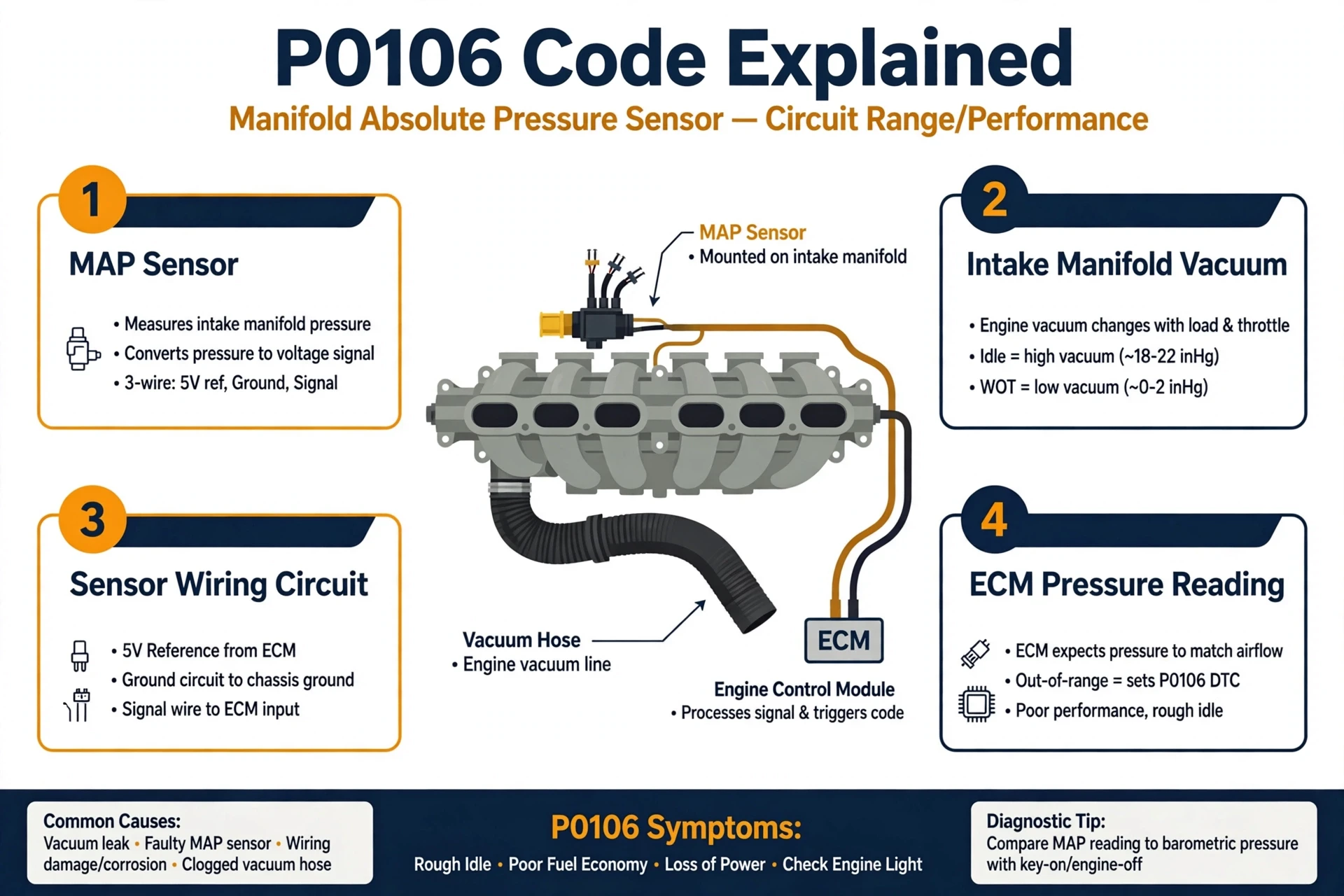
The P0106 code is one of the most searched check engine light codes for drivability problems. Its full definition is “Manifold Absolute Pressure (MAP) Sensor Circuit Range/Performance Problem” (p0106 manifold absolute pressure sensor circuit range performance problem). In plain English, your car’s engine computer (ECM/PCM) has decided that the signal coming from the MAP sensor does not match the pressure it expects inside the intake manifold.
Here is what that means in practice. The MAP sensor measures vacuum, or more precisely absolute pressure, inside the intake manifold and turns it into a voltage signal, usually somewhere between about 1 and 5 volts. Press the gas and manifold pressure rises, so the signal voltage rises with it. At idle, vacuum is high and the voltage drops. The computer constantly compares that signal against engine load, throttle position, and RPM. If the reading is stuck, erratic, or outside the expected range for the driving conditions, it stores the P0106 code and turns on the check engine light.
P0106 (p0106 obd ii, p0106 code) is a generic powertrain code, which means it has the same meaning on every make and model, from a Chevy Silverado to a Honda Civic to a Ford F-150. On many vehicles the MAP and BARO (barometric pressure) sensors are combined into one unit, and some engines use a mass airflow (MAF) sensor instead, but the code sets the same way: the computer no longer trusts the manifold pressure reading it is getting.
Symptoms of the P0106 Code
Unlike some codes that hide silently, P0106 often announces itself through the way the car drives. The computer uses MAP data to calculate fuel delivery and ignition timing, so a bad reading throws the whole air-fuel mixture off. You might notice:
- Check engine light, sometimes the only symptom at first
- Rough idle, or the engine stalls at stoplights and low speeds
- Hesitation or sluggish, weak acceleration when you press the gas
- Poor fuel economy, you are filling up more often than usual
- Black smoke from the exhaust (a sign the engine is running rich)
- Engine misfires or hard starting, especially when cold
What is code P0106? What is car code P0106 trying to tell you? In short: the computer is guessing at engine load because it cannot trust its manifold pressure reading, and the engine runs worse for it. Do not ignore it just because the car still moves.

Common Causes of P0106
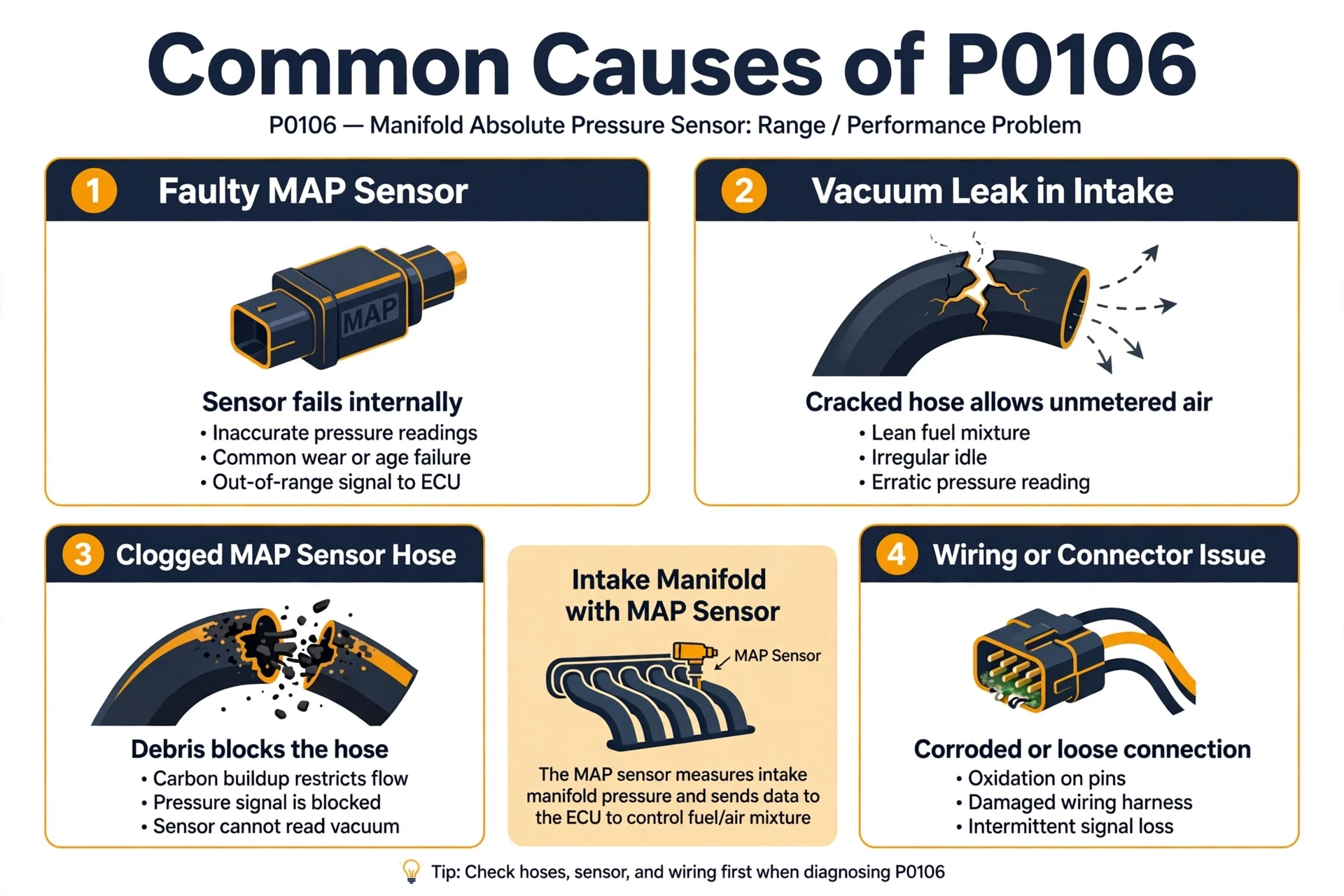
The most common cause of a P0106 code is a vacuum leak letting unmetered air into the intake, followed closely by a dirty or failing MAP sensor. Replacing the sensor without checking for leaks first is the most common and most avoidable money waster with this code. Here are the causes, roughly in order of likelihood:
- Vacuum leaks: cracked, collapsed, or disconnected vacuum hoses, a leaking intake manifold gasket, or loose clamps let extra air in and skew the pressure reading. This is cause number one.
- Dirty MAP sensor: carbon buildup or oil fouling on the sensor tip makes it read incorrectly even though the sensor itself is fine.
- Faulty MAP/BARO sensor: the sensor’s internal electronics fail, so it sends a stuck or erratic voltage.
- Wiring and connector problems: corroded, loose, shorted, or broken wires between the sensor and the computer corrupt the signal.
- Clogged or dirty air filter: restricted airflow changes manifold pressure readings, a common surprise cause.
- EGR system faults: a stuck-open EGR valve alters manifold pressure and can set the code.
- PCV system issues: a stuck PCV valve or diaphragm upsets intake vacuum.
- PCM software problems: rare, but some manufacturers have released updates for false MAP sensor codes.
How to Diagnose P0106 (Do This Before Buying Parts)
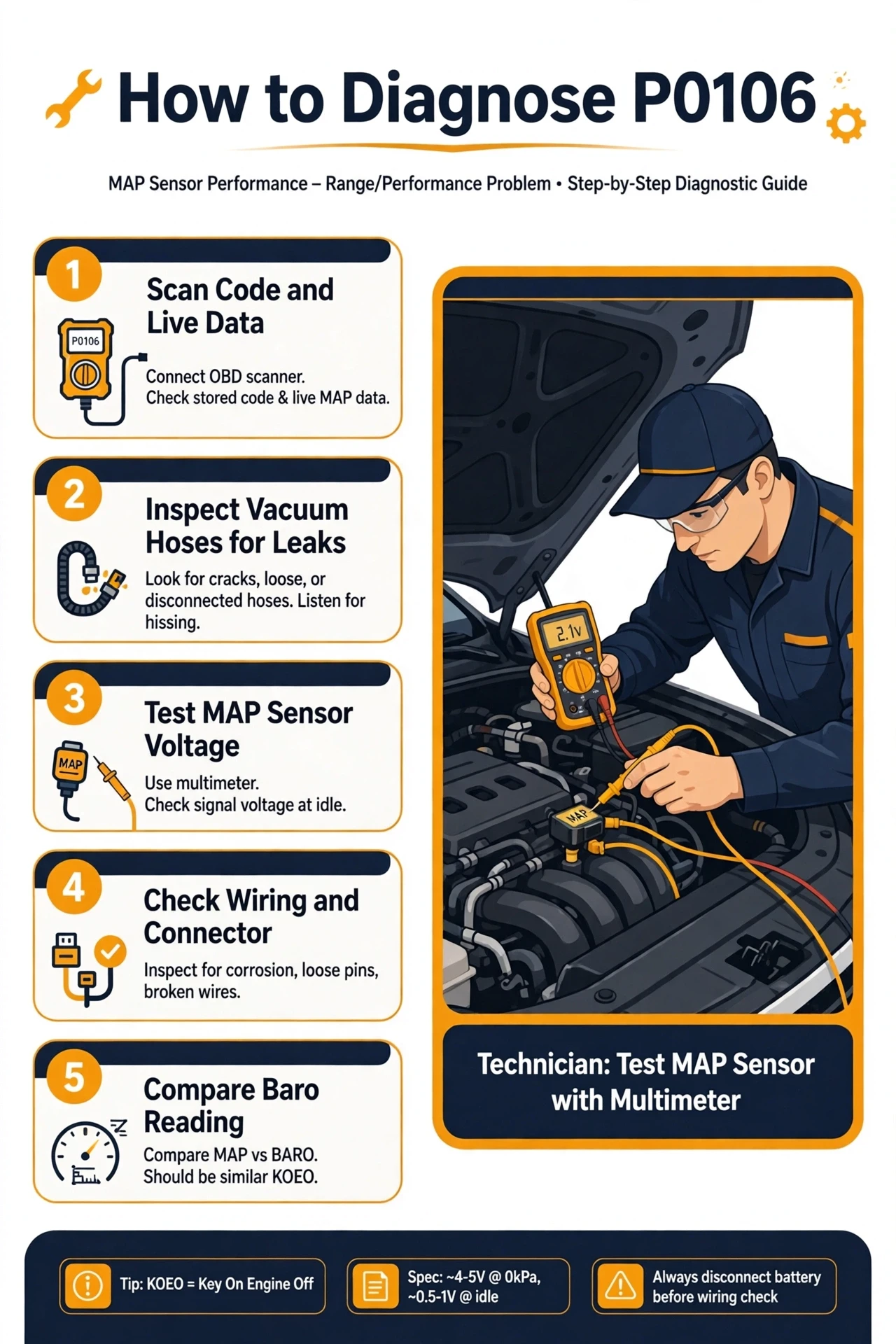
Mechanics see the P0106 code misdiagnosed a lot, usually as a guaranteed bad sensor. The sensor is only one suspect. Follow this order:
- Scan for other codes first. If you also have MAF codes, throttle position codes, EGR codes, or misfire codes (P0300 series), diagnose those first. They can easily be the real reason the MAP reading looks wrong.
- Inspect every vacuum hose and the intake tract. Look for cracked, collapsed, or disconnected hoses and loose clamps, and listen for hissing with the engine running. Check the intake manifold gasket area too.
- Check the air filter and clean the MAP sensor. A clogged filter is a two-minute check. If the sensor tip is fouled, clean it with dedicated electronics or MAF sensor cleaner. Never use brake or carburetor cleaner, which can damage the sensor.
- Test the sensor voltage. With a digital multimeter, check for a steady 5-volt reference at the sensor connector with the key on and engine off, then watch the signal wire while revving the engine. The voltage should move smoothly. A stuck or jumping signal condemns the sensor.
- Compare live data. With a scan tool that shows live data, compare MAP readings against throttle position and BARO readings at idle and under load. The numbers should track together logically.
- Inspect the wiring and connectors. Look for corrosion, frayed insulation, and pins that are loose or pushed back in the connector.
- Smoke test if needed. If you cannot find the leak by eye, a smoke test of the intake will reveal it fast.
How to Fix the P0106 Code
The right fix depends on what your diagnosis found:
- Fix vacuum leaks: replace cracked hoses, tighten clamps, or replace a leaking intake gasket. This is often the cheapest fix and solves many P0106 cases.
- Clean the MAP sensor: if it is only fouled, a proper cleaning can restore it for the cost of a can of cleaner.
- Repair wiring: clean corroded connectors, repair broken wires, and reseat loose pins.
- Replace the MAP sensor: only after testing shows it is actually bad. Many ask how to fix p0106 code without replacing the sensor; the answer is to rule out leaks, dirt, and wiring first (a p0106 code is often a hose or cleaning issue, not a dead sensor).
- Replace a clogged air filter: cheap maintenance that sometimes clears the code on its own.
- Fix EGR or PCV faults: new EGR valve, PCV valve, or related repairs, whatever the companion codes and tests point to.
- Clear the code and road test: erase the code with a scanner and drive through a full warm-up cycle to confirm it stays off.

P0106 Repair Costs
Drivers always ask how much it costs to fix P0106, and the answer depends entirely on the cause. Here are realistic ranges:
| Repair | Cost Range |
|---|---|
| MAP sensor cleaning (DIY) | $10 – $20 |
| Air filter replacement | $20 – $50 |
| Vacuum hose replacement | $50 – $150 |
| MAP sensor replacement | $100 – $300 |
| Intake manifold gasket replacement | $200 – $600 |
| Professional diagnosis | $100 – $150 |
This is why diagnosis matters. A $15 can of sensor cleaner and a $250 sensor replacement share the same code. Drivers looking for a p0106 code fix permanent easy cheap solution should always start with the hose inspection and sensor cleaning, not the parts catalog.
DIY vs Mechanic Verdict
You can do this at home: visual vacuum hose inspection, air filter check, cleaning the MAP sensor, reading codes and live data with an OBD2 scanner, and replacing the sensor itself, which is usually one bolt and one connector. If you find an obvious vacuum leak or a fouled sensor, those are reasonable DIY repairs for anyone comfortable with basic tools.
See a mechanic for: smoke testing for hidden vacuum leaks, intake manifold gasket replacement, wiring diagnosis deep in the harness, and any case where the code returns after you fixed the obvious suspects. A shop with a smoke machine can find a hidden leak in minutes, which is cheaper than guessing with parts.
Bottom line: this is one of the most DIY-friendly codes out there. Inspect, clean, and test first, and you will fix most P0106 cases in your own driveway.
Can You Drive With a P0106 Code?
Short distances, yes, but be careful. The car may hesitate, stall at idle, or lack power when you need it, which is a genuine safety concern in traffic. Driving long term with P0106 is not advisable either: fuel economy drops, emissions rise, and a rich-running engine can stress the catalytic converter, turning a small repair into a big one. Get it diagnosed soon, especially if the engine stalls or misfires.
P0106 on Popular Vehicles
P0106 shows up across all brands, but some patterns are worth knowing:
- Chevy / GM (Silverado, Equinox, Camaro): The p0106 chevy code (chevy p0106, p0106 code chevy) is one of the most common. Vacuum leaks and MAP sensor issues on the 5.3L V8 and 2.4L four-cylinder are frequent culprits, and GM trucks also set it after intake or catch-can work if a hose is left loose.
- Ford (F-150, Escape, Explorer): The p0106 ford code (ford code p0106) often traces to vacuum leaks or a dirty sensor. Check the PCV hose, a known weak spot.
- Nissan (Altima, Sentra, Rogue): For p0106 nissan (nissan p0106, p0106 code nissan), inspect the intake ducting and vacuum lines for cracks.
- Toyota (Camry, Corolla, RAV4): The p0106 toyota code (toyota p0106, p0106 code toyota) is less common but usually means a vacuum leak or an aging sensor.
- Honda (Civic, Accord, CR-V): The p0106 honda code (honda p0106) often follows intake work, so double-check every hose connection.
- VW: The p0106 vw code frequently involves cracked breather or PCV hoses.
EOBD P0106 and OBD P0106 are the same code under different naming (European vs generic OBD-II). DTC P0106 and OBD-II P0106 also refer to the identical fault.
P0106 vs P0107
P0106 means the MAP sensor signal is out of range or not performing as expected. P0107 is its close cousin: “Manifold Absolute Pressure/BARO Sensor Low Input,” meaning the signal voltage is stuck low. Both live in the same circuit, but P0107 points more specifically at a low-voltage condition, often a short to ground or a dead sensor, while P0106 is the broader range and performance complaint that includes erratic readings. Diagnose them the same way, starting with hoses and wiring.
Related Codes
- P0105: Manifold Absolute Pressure/BARO Circuit Malfunction
- P0107: Manifold Absolute Pressure/BARO Sensor Low Input
- P0109: Manifold Absolute Pressure/BARO Sensor Intermittent
- P0108: Manifold Absolute Pressure/BARO Sensor High Input
Video Walkthrough
Watch the video above for a visual walkthrough of MAP sensor testing and P0106 diagnosis before you read on.
Frequently Asked Questions
What does the P0106 code mean?
It means the engine computer has detected that the manifold absolute pressure (MAP) sensor signal is outside its expected range or is not performing correctly for the current engine load, throttle position, and RPM.
What is the most common cause of a P0106 code?
Vacuum leaks top the list, followed by a dirty or faulty MAP sensor. Cracked or disconnected vacuum hoses let unmetered air into the intake and skew the pressure reading, so always inspect the hoses before buying a sensor.
How do you fix the code P0106?
Diagnose first: check for other codes, inspect the vacuum hoses, check the air filter, clean the MAP sensor with electronics cleaner, test the 5-volt reference and signal with a multimeter, and inspect the wiring. Then repair what you find: seal leaks, clean or replace the sensor, fix wiring, and clear the code.
How much does it cost to fix P0106?
From about $10-$20 for DIY sensor cleaning and $20-$50 for an air filter, to $50-$150 for vacuum hose repairs and $100-$300 for a MAP sensor replacement. A professional diagnosis typically runs $100-$150.
Can you drive with a P0106 code?
Short distances, yes, but it is not recommended. The engine may hesitate, stall at idle, or lose power unexpectedly, which is unsafe in traffic. Get it diagnosed soon.
Can a dirty air filter cause a P0106 code?
Yes. A clogged air filter restricts airflow and changes the pressure inside the intake manifold, which can push the MAP reading out of range. It is one of the cheapest things to check.
Will P0106 clear itself?
Rarely. If the fault was temporary, the light may go off after several drive cycles, but the code usually returns until the underlying problem, a leak, a dirty sensor, or a wiring fault, is fixed. Clear it with a scanner after the repair and confirm it stays off.
Conclusion
The P0106 code looks technical, but it is really your car telling you it cannot trust its own manifold pressure reading. Check for other codes, inspect the vacuum hoses, clean and test the MAP sensor, and fix what you find. Do that, and you will either solve it cheaply in your driveway or know for certain the sensor needs replacing. Either way, you stop guessing and start fixing.
About the author: Written by the OBD2 Code Hub editorial team. Our diagnostic guides are built from real OBD-II data, manufacturer service procedures, and hands-on troubleshooting experience, then reviewed for technical accuracy before publishing. We drive the same cars you do.