
P0760 Trouble Code: Meaning, Causes, Symptoms & Fixes
In This Guide
One-line meaning: Your transmission computer found an electrical fault in the shift solenoid C circuit. This electro-hydraulic valve directs fluid pressure for gear changes.
What the P0760 Code Means
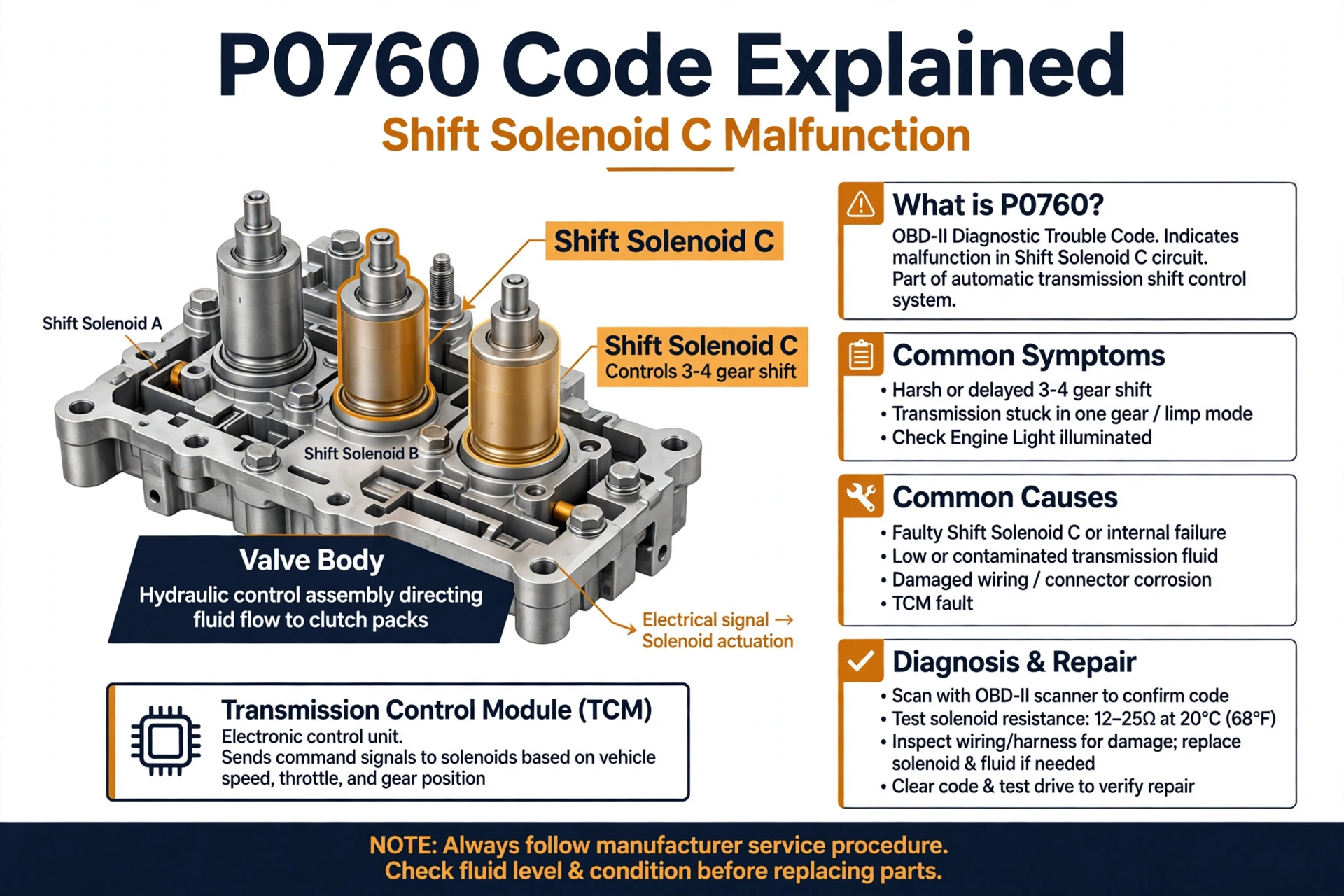
The P0760 code is a transmission trouble code that drivers often meet as a harsh shift and a check engine light at the same time. Its full definition is “Shift Solenoid C Malfunction” (p0760 shift solenoid c malfunction, dtc p0760). In plain English, the transmission control module (TCM) has detected a problem in the electrical circuit that operates shift solenoid C. On vehicles with a combined unit, the powertrain control module (PCM) handles this job.
Here is what that solenoid does. Inside your automatic transmission, small electro-hydraulic valves called shift solenoids direct pressurized fluid through the valve body. That fluid pressure engages the right clutches and bands for each gear. Shift solenoid C regulates hydraulic pressure and fluid flow needed to engage specific gears. It opens and closes many times per second on the computer’s command. The computer sends the command and watches the circuit’s electrical feedback. When that feedback does not look right, it stores the p0760 code and turns on the check engine light.
P0760 (p0760 obd2, p0760 code) is a generic powertrain code. It means the same thing on every make, from a Nissan Altima to a Ford F-150 to a Toyota Camry. One important nuance: this is a circuit code, not a mechanical failure code. It tells you the control circuit misbehaved, which is why smart diagnosis starts with fluid and wiring before anyone buys a solenoid.
Symptoms of the P0760 Code
Unlike some codes that hide quietly, p0760 usually announces itself through the way the car shifts. Watch for:
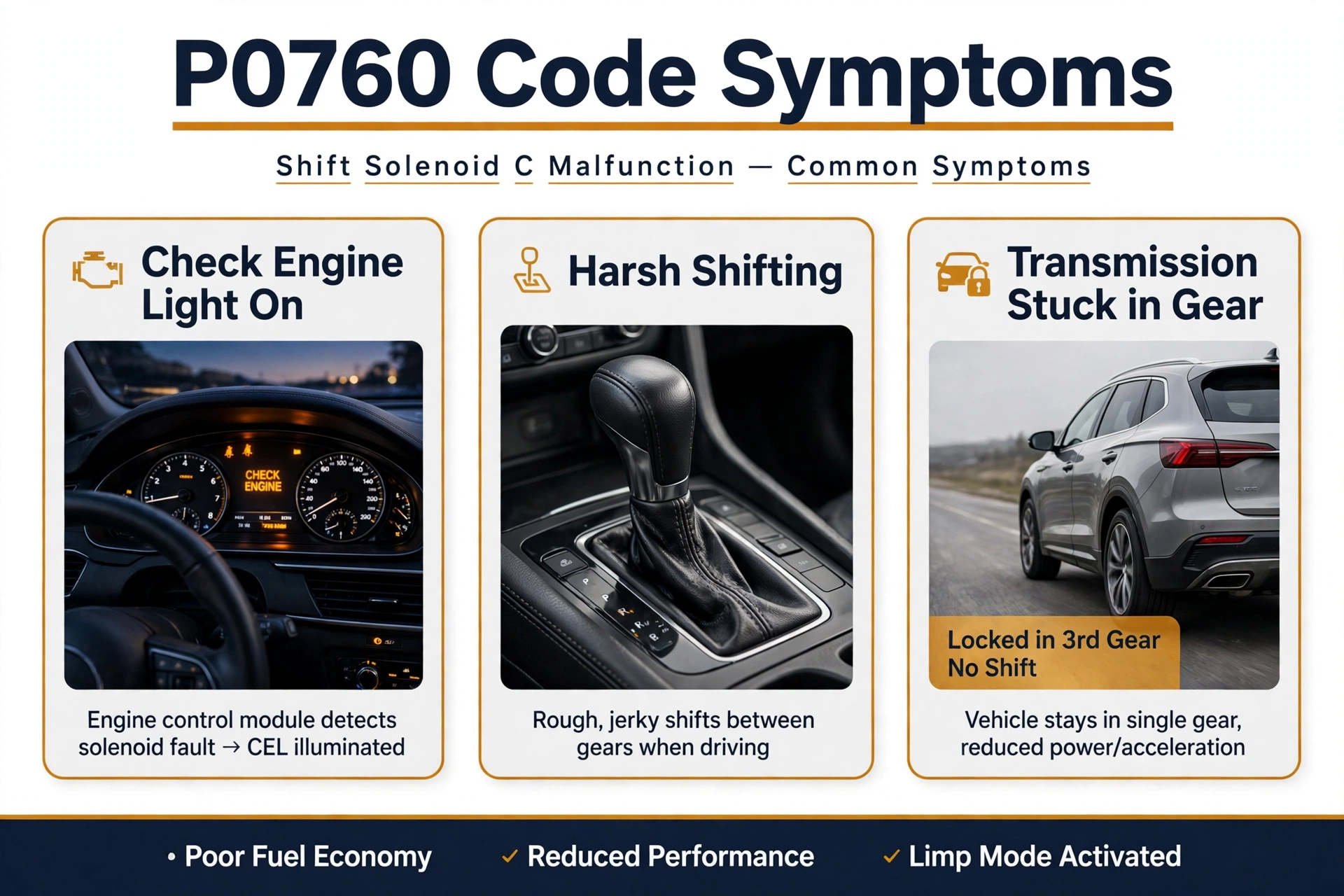
- Check engine light on, sometimes joined by a transmission warning light
- Harsh, rough, or delayed shifting between gears
- Transmission slipping or getting stuck in a single gear, often 3rd (limp mode)
- On some models, you cannot shift out of park
- Noticeably lower fuel economy than usual
- Reduced acceleration and sluggish overall performance
What is the p0760 code trying to tell you? In short: the transmission cannot trust one of its gear-change valves, so it shifts badly or protects itself with limp mode. The symptoms often appear suddenly, sometimes right after a fluid change or electrical work near the transmission.
Common Causes of P0760
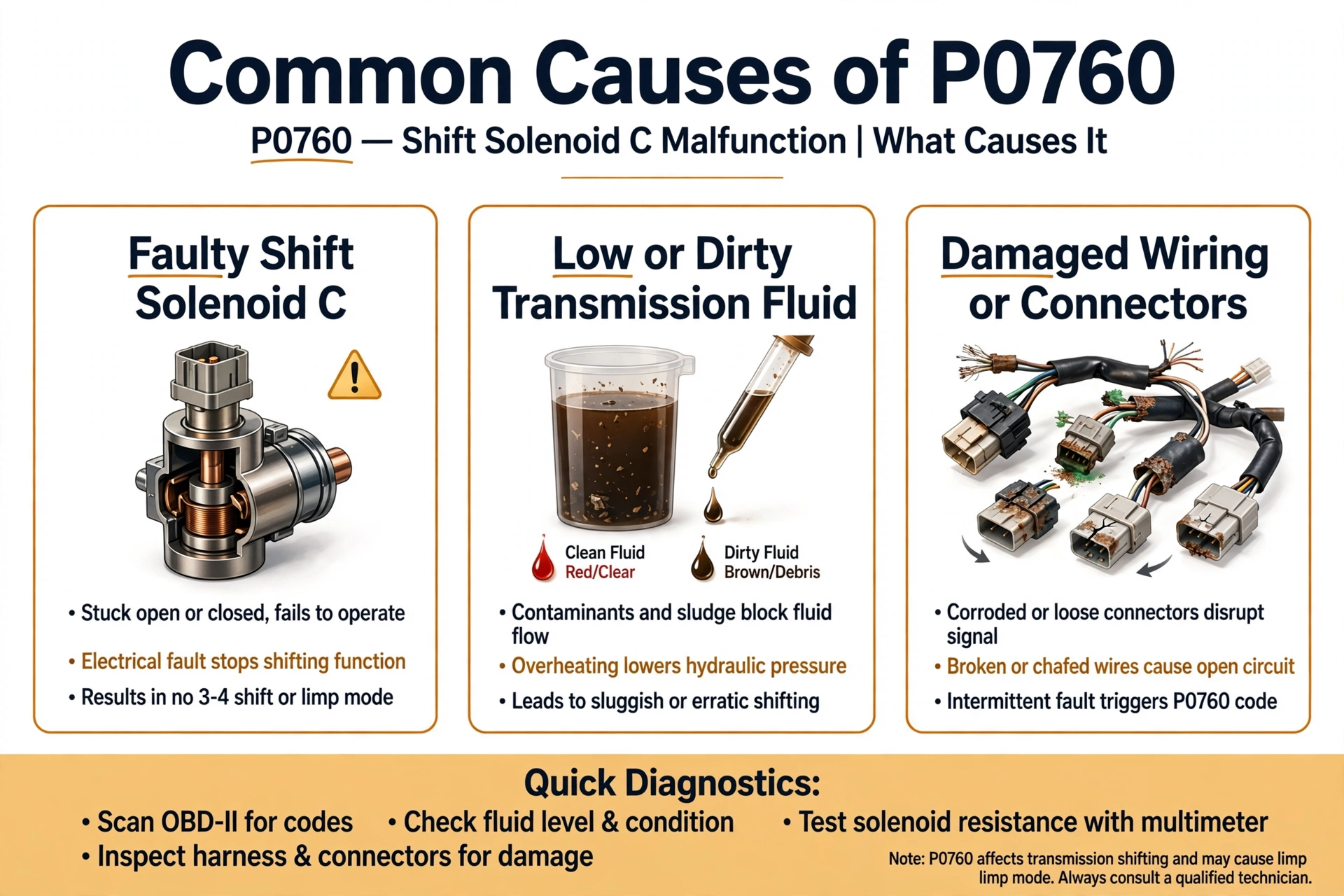
These are the causes, roughly in order of likelihood. Notice how many of them are not the solenoid itself:
- Faulty shift solenoid C: the internal electrical winding can burn out, or the mechanical plunger can stick. Then the valve no longer opens and closes on command.
- Wiring or connector problems: frayed, chewed, shorted, or corroded wires in the transmission harness interrupt the signal. A loose connector at the transmission case does the same.
- Low or dirty transmission fluid: old, burnt fluid or a clogged filter starves the solenoid of the clean hydraulic pressure it needs to work.
- Valve body trouble: restricted hydraulic passages or a worn valve body bore keep solenoid C from doing its job. This happens even when the solenoid tests fine.
- Failed control module: a fault in the PCM or TCM itself, rare but possible, can set a false solenoid circuit code.
How to Diagnose P0760 (Do This Before Buying Parts)
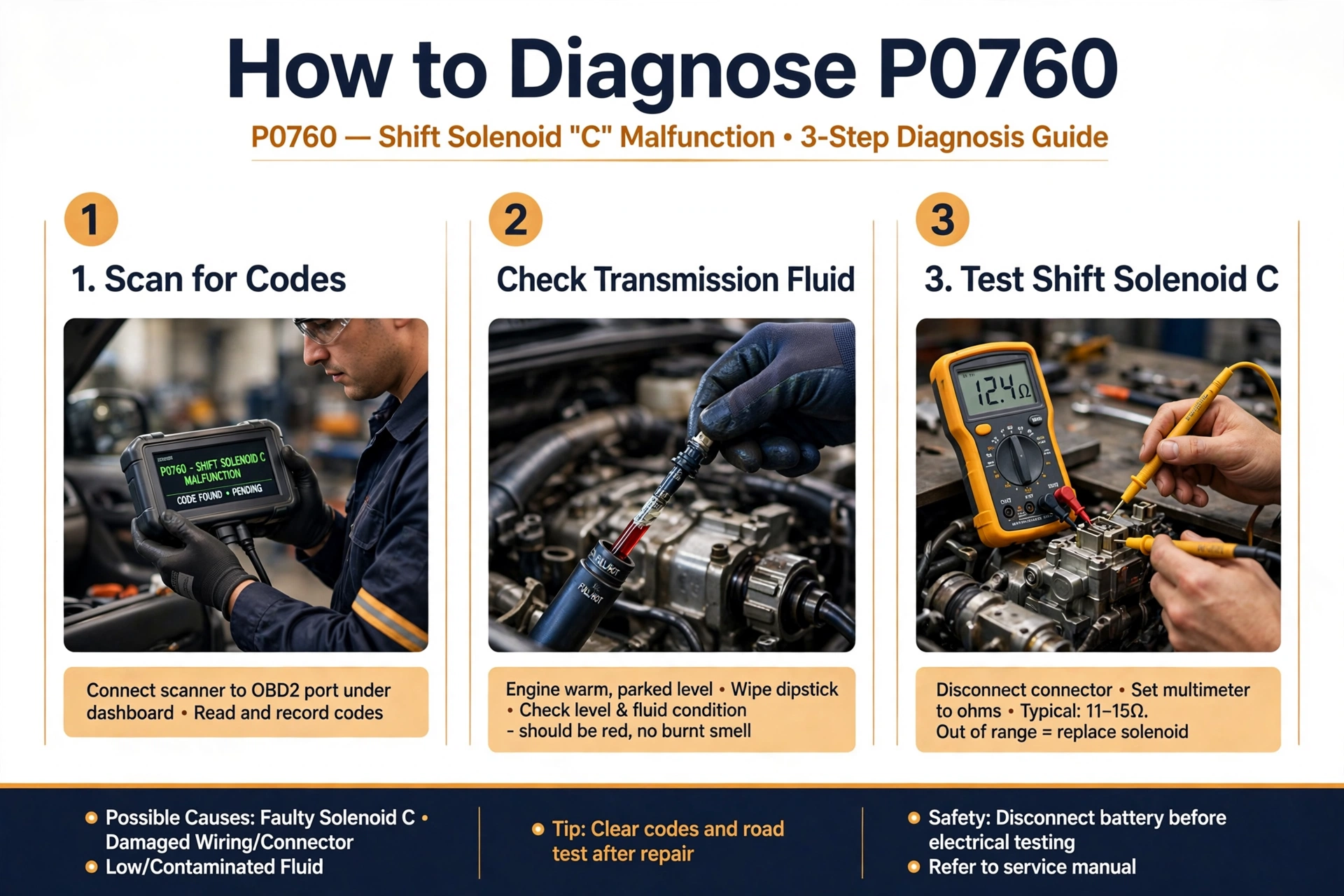
The p0760 code is misdiagnosed often, usually as a guaranteed bad solenoid. Work in this order and you will only replace what is actually broken:
- Check the fluid level and condition. With the transmission warm, check the dipstick (if equipped). Low level or dark, burnt-smelling fluid explains a lot of p0760 cases. Top up with the correct ATF or service it before anything else.
- Scan for codes with a tool that reads TCM data. A basic code reader shows P0760. A scanner that talks to the transmission module shows solenoid command versus actual state, plus companion codes like P0700 that add context.
- Inspect the wiring. Check the external transmission harness plug for corrosion, bent pins, and fluid intrusion. Then look for broken, pinched, or chewed wires along the harness. Wiggle-test the connector while watching live data if you can.
- Test solenoid C resistance. With a multimeter, measure the solenoid’s resistance at the transmission connector. Compare it to the factory spec in the service manual. An open circuit, a short, or resistance far out of range condemns the solenoid or its internal wiring.
- Drop the pan for a closer look. If the wiring and resistance test pass, the pan comes off. Inspect for debris and clutch material in the fluid, check the filter, and bench-test the solenoid. Then replace the individual solenoid or the complete solenoid block.
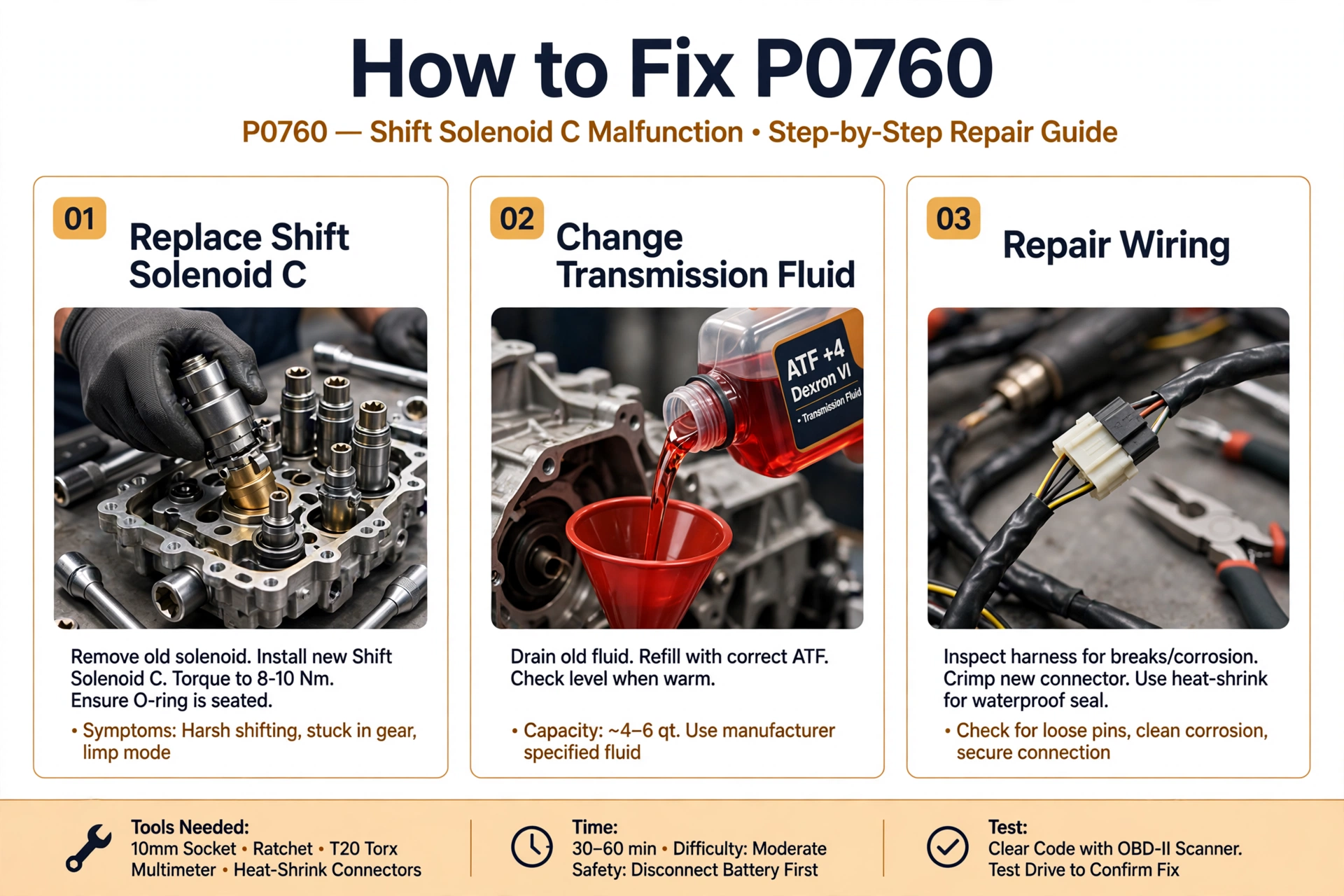
How to Fix the P0760 Code
The right fix follows the diagnosis:
- Service the fluid and filter: a drain, correct ATF refill, and new filter fixes p0760 when the cause is low or degraded fluid. This is the cheapest fix and the right first step.
- Repair wiring and connectors: clean corrosion, repair broken wires, and reseat the transmission connector with dielectric grease. Many intermittent p0760 codes end here.
- Replace shift solenoid C: if resistance testing proves it bad, replace the individual solenoid. On many transmissions the solenoids come as a block, so the whole solenoid pack gets replaced.
- Service or replace the valve body: if passages are restricted or bores are worn, the valve body needs cleaning or replacement. The new solenoid cannot work properly otherwise.
- Address the control module: reflash or replace the PCM/TCM only after everything else tests good, since module failure is the least common cause.
Repair Costs for the P0760 Code
Drivers always ask how much it costs to fix P0760, and the range is wide because the causes are so different:
| Repair | Cost Range |
|---|---|
| ATF fluid and filter service | $150 – $300 |
| Wiring or connector repair | $100 – $300 |
| Shift solenoid C replacement | $200 – $550 |
| Valve body replacement | $800 – $1,800 |
| Full transmission rebuild (rare) | $2,500 – $4,500+ |
This is why the diagnostic order matters. A $200 fluid service and a $1,500 valve body share the same p0760 code. Guessing the expensive part first is the classic mistake with this code.
DIY vs Mechanic Verdict
You can do this at home: checking and topping up transmission fluid, reading codes with an OBD2 scanner, and changing the fluid and filter on transmissions with a serviceable pan. You can also inspect the harness and connector for damage or corrosion.
See a mechanic for: solenoid resistance diagnosis that needs service-manual specs, dropping the pan and replacing solenoids inside the transmission, and valve body work. A shop can also command solenoids with a bi-directional scan tool, which pinpoints the fault in minutes.
Bottom line: handle the fluid and the visual checks yourself, but let a transmission shop prove the solenoid guilty before the pan comes off.
Can You Drive With a P0760 Code?
Short distances, carefully, but do not ignore it. Limp mode (often stuck in 3rd gear) is the transmission protecting itself, and it makes the car slow and thirsty. Driving far or fast with harsh shifting builds heat and can turn a solenoid or wiring problem into worn clutches. Get it diagnosed within days, not months. If the transmission will not shift out of park or slips badly, have it towed instead of driven.
Vehicles Commonly Affected by the P0760 Code
This code shows up across all brands, but some patterns are worth knowing:
- Nissan (Altima, Maxima, Pathfinder, Frontier): on these models, the p0760 nissan code (nissan p0760, p0760 code nissan) is common on the RE5R05A 5-speed automatic. The solenoid itself is often the culprit here.
- Toyota / Lexus (Camry, 4Runner, Tundra): for these vehicles, the p0760 toyota code (toyota p0760, p0760 code toyota) often follows neglected fluid. Service the transmission before condemning any parts.
- Ford (F-150, Explorer, Expedition): with the p0760 ford code (ford p0760, p0760 code ford), take a close look at the transmission harness connector. It is a known trouble spot.
- Honda (Accord, Odyssey, Pilot): the p0760 honda code (honda p0760, p0760 code honda) can involve the solenoid or its pressure circuit. Check for related pressure codes too.
- Dodge / Jeep / Chrysler (Ram, Grand Cherokee): on these, the p0760 dodge code (dodge p0760, p0760 code dodge) often leads to the solenoid pack. It is replaced as a unit.
- Chevrolet / GMC (Silverado, Tahoe, Sierra): for the p0760 chevy code (chevy p0760, p0760 code chevy), follow the usual order: fluid, wiring, then the solenoid.
Comparing P0760 With P0755, P0765 & P0780
Transmission solenoid codes come in a family, and the letters just name which solenoid reported the fault. P0755 means shift solenoid B malfunction, and P0765 means shift solenoid D malfunction. Both are the same kind of circuit fault as P0760, just on a different solenoid. P0780 is broader. Its “Shift Malfunction” definition means the transmission is not shifting correctly without pointing at one specific solenoid. Diagnose all of them the same way: fluid and wiring first, then the named solenoid.
Related Codes
- P0755: Shift Solenoid B Malfunction
- P0765: Shift Solenoid D Malfunction
- P0700: Transmission Control System Malfunction (often stored alongside P0760)
- P0780: Shift Malfunction
Video Walkthrough
Watch the video above for a visual walkthrough of P0760 causes and diagnosis before you read on.
Frequently Asked Questions
What does the P0760 code mean?
It means the transmission computer detected a malfunction in the shift solenoid C circuit. Solenoid C is an electro-hydraulic valve that controls fluid pressure for gear changes, and the computer saw electrical readings outside the expected range.
Which symptoms does a P0760 code cause?
The check engine light comes on, shifting turns harsh, rough, or delayed, and the transmission may slip or lock into a single gear (limp mode, often 3rd). Fuel economy drops, and on some models the shifter will not move out of park.
What causes a P0760 code?
The most common causes are a failed shift solenoid C, damaged or corroded wiring to the transmission, low or dirty transmission fluid, a restricted valve body, and, rarely, a faulty PCM or TCM.
How do I fix a P0760 code?
Check the fluid level and condition first, then inspect the transmission wiring and connector. Test solenoid C resistance with a multimeter against factory specs, and replace only the part that fails: the fluid service, the wiring repair, or the solenoid itself.
How much does it cost to fix P0760?
A fluid and filter service runs about $150-$300, wiring repairs $100-$300, and a shift solenoid C replacement $200-$550. A valve body replacement can reach $800-$1,800 if the hydraulic passages are the problem.
Can I drive with a P0760 code?
Short trips at moderate speed are usually possible, but avoid highway driving and long distances. Harsh shifting builds heat that can damage the transmission, so get it diagnosed within days.
Is low transmission fluid enough to trigger a P0760 code?
Yes. Low or degraded fluid cannot build the hydraulic pressure solenoid C needs, which can trigger the circuit code. Checking and servicing the fluid is always the first step before replacing any parts.
Conclusion
The P0760 code looks intimidating because it lives inside the transmission. Really, it is an electrical circuit code asking for an orderly diagnosis. Check the fluid, inspect the wiring, test the solenoid, and fix what fails the test. Do that, and you will either solve it with a service or know exactly which part earned replacement. Either way, you stop guessing and start fixing.
About the author: Written by the OBD2 Code Hub editorial team. Our diagnostic guides are built from real OBD-II data, manufacturer service procedures, and hands-on troubleshooting experience, then reviewed for technical accuracy before publishing. We drive the same cars you do.