
P0730 Trouble Code: Meaning, Causes, Symptoms & Fixes
In This Guide
One-line meaning: P0730: Incorrect Gear Ratio.
What the P0730 Code Means
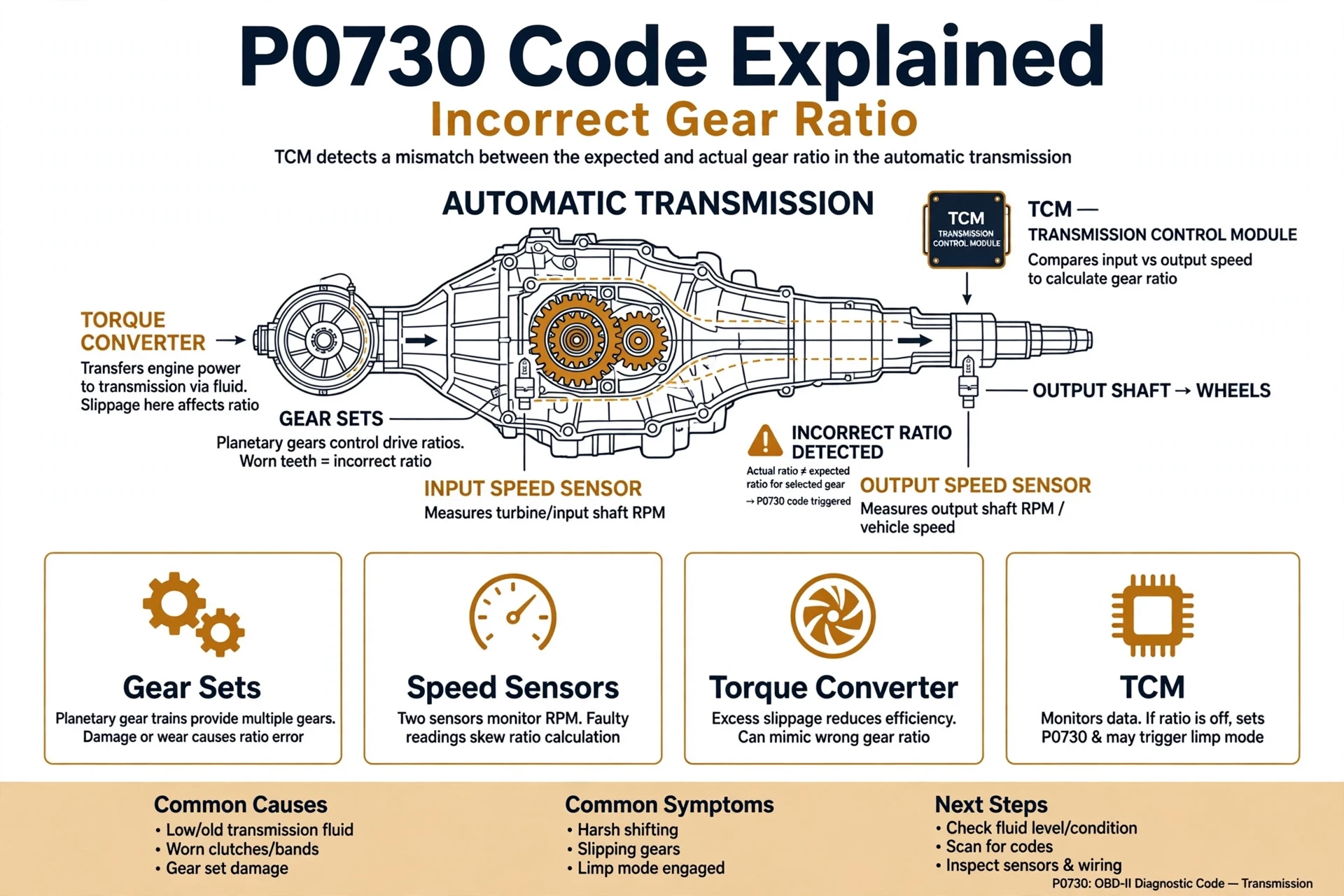
The P0730 code is a transmission diagnostic trouble code that tends to worry drivers more than most engine codes. Its full definition is “Incorrect Gear Ratio” (p0730 incorrect gear ratio). In plain English, your car’s computer has detected that the automatic transmission is not producing the gear ratio it commanded.
Here is how your car figures this out. An automatic transmission has an input speed sensor and an output speed sensor. For every gear, the computer knows the exact ratio between those two speeds, so it constantly compares the live sensor readings against the expected value. When the measured ratio falls outside the normal range, the computer concludes that the transmission is slipping or failing to hold the commanded gear, and it stores the P0730 code and turns on the check engine light.
P0730 (p0730 obd2, p0730 code) is a generic powertrain code, which means it has the same basic meaning on every make and model, from a Dodge Charger to a Honda Accord to a Ford F-150. At its core, the code points to internal transmission slippage, a drop in hydraulic pressure, or a malfunction in the transmission control system. Note that the exact definition and the conditions that set the code can vary slightly by manufacturer, so always check the service information for your specific vehicle.
Symptoms of the P0730 Code
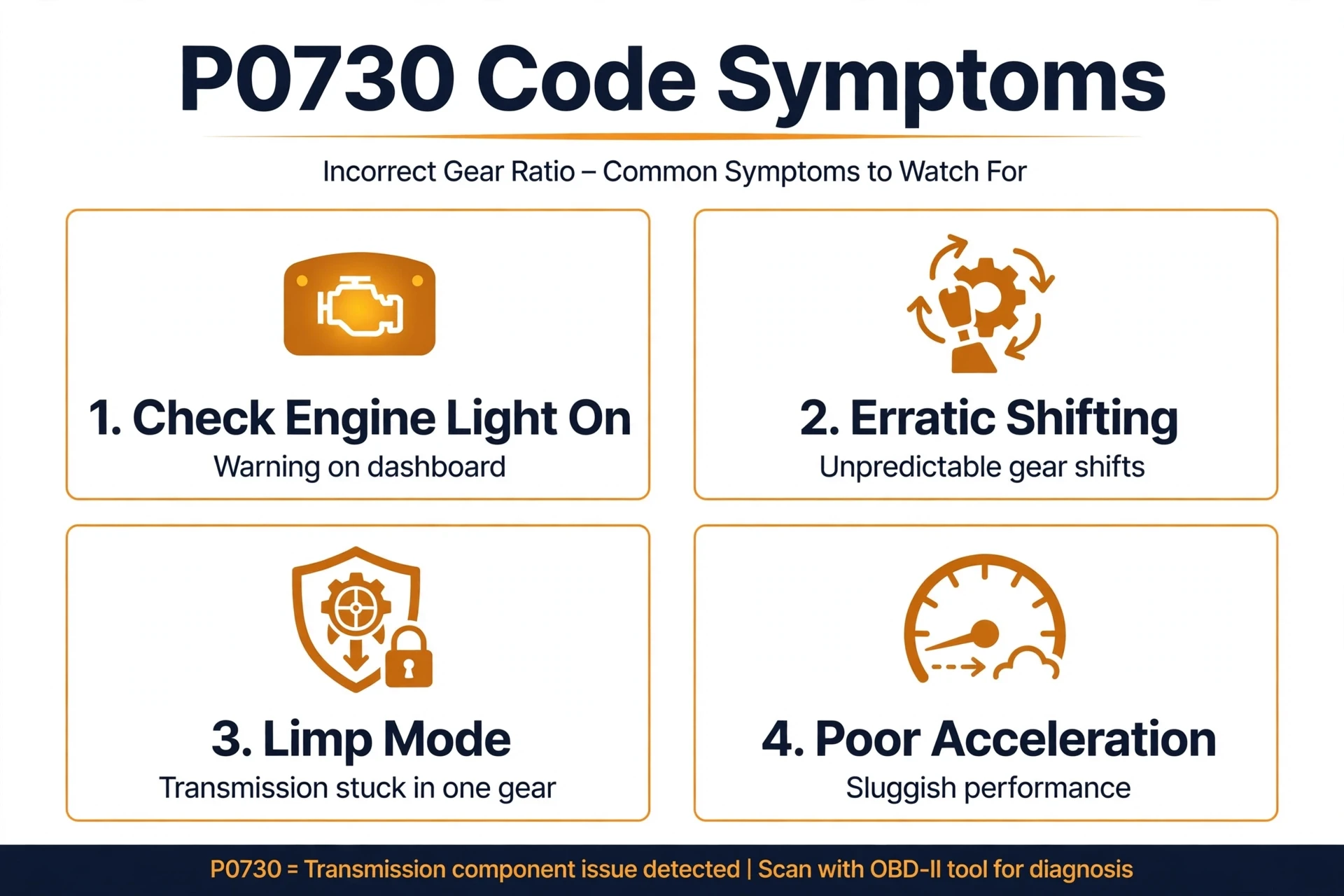
The P0730 code rarely hides quietly. Because it involves the gears you use every time you drive, you will usually feel it before you even plug in a scanner. Watch for:
- Check engine light illuminated on the dashboard, sometimes joined by a transmission warning light
- Transmission slipping: the engine revs climb, but the car does not accelerate the way it should
- Harsh, jerky, or delayed shifting between gears
- Getting stuck in a single gear, or the transmission dropping into “limp mode” to protect itself
- The vehicle slipping into neutral unexpectedly
- Stalling when coming to a stop after high-speed driving
- Noticeably high RPMs for the speed you are traveling
- Reduced fuel economy, since the slipping transmission wastes engine power
What is code P0730? What is the p0730 code trying to tell you? In short: the transmission cannot hold the ratio the computer asked for, and every mile driven like this risks deeper damage.
Common Causes of P0730
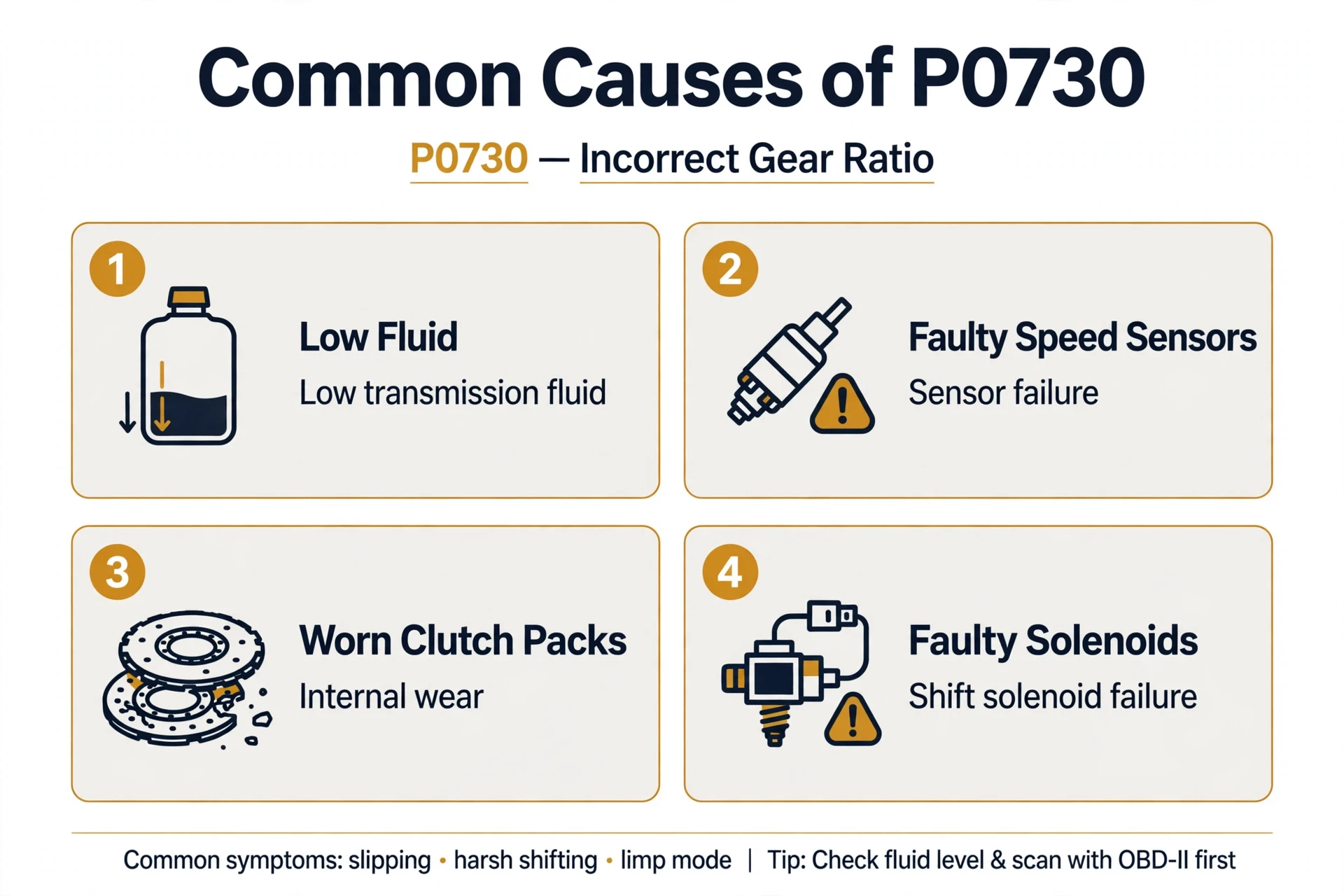
The most common cause of a P0730 code is low or dirty transmission fluid. Without enough clean fluid, hydraulic pressure falls and the clutches cannot grip firmly, so the gears slip and the measured ratio drifts out of range. Beyond fluid, these are the usual suspects:
- Low transmission fluid: the number one cause. Even being a quart low can starve the hydraulic circuits that engage the gears. Leaks at seals, gaskets, cooler lines, or the pan are the usual reason the level drops.
- Dirty or contaminated fluid: burnt, dark, or debris-filled fluid clogs the small hydraulic passages and the filter, so clean pressure never reaches the clutch packs.
- Clogged transmission filter: a restricted filter starves the pump and drops line pressure across every gear.
- Faulty shift solenoids: a bad or sticking solenoid fails to direct fluid to the right gear circuits at the right time.
- Defective valve body: wear, sticking valves, or cross-leaks inside the valve body disrupt the hydraulic routing the gears depend on.
- Worn clutches or internal mechanical wear: when the internal friction material wears out, the transmission slips no matter what the computer commands.
- Bad input or output speed sensor: a failing sensor sends false data, so the computer calculates a wrong ratio even when the gears themselves are fine.
- Wiring and connector problems: corroded, loose, or damaged wiring to the solenoids and speed sensors can trigger a false or real ratio error.
- TCM or PCM issues: less common, but a failing transmission control module or outdated software can set the code.
How to Diagnose P0730 (Do This Before Buying Parts)
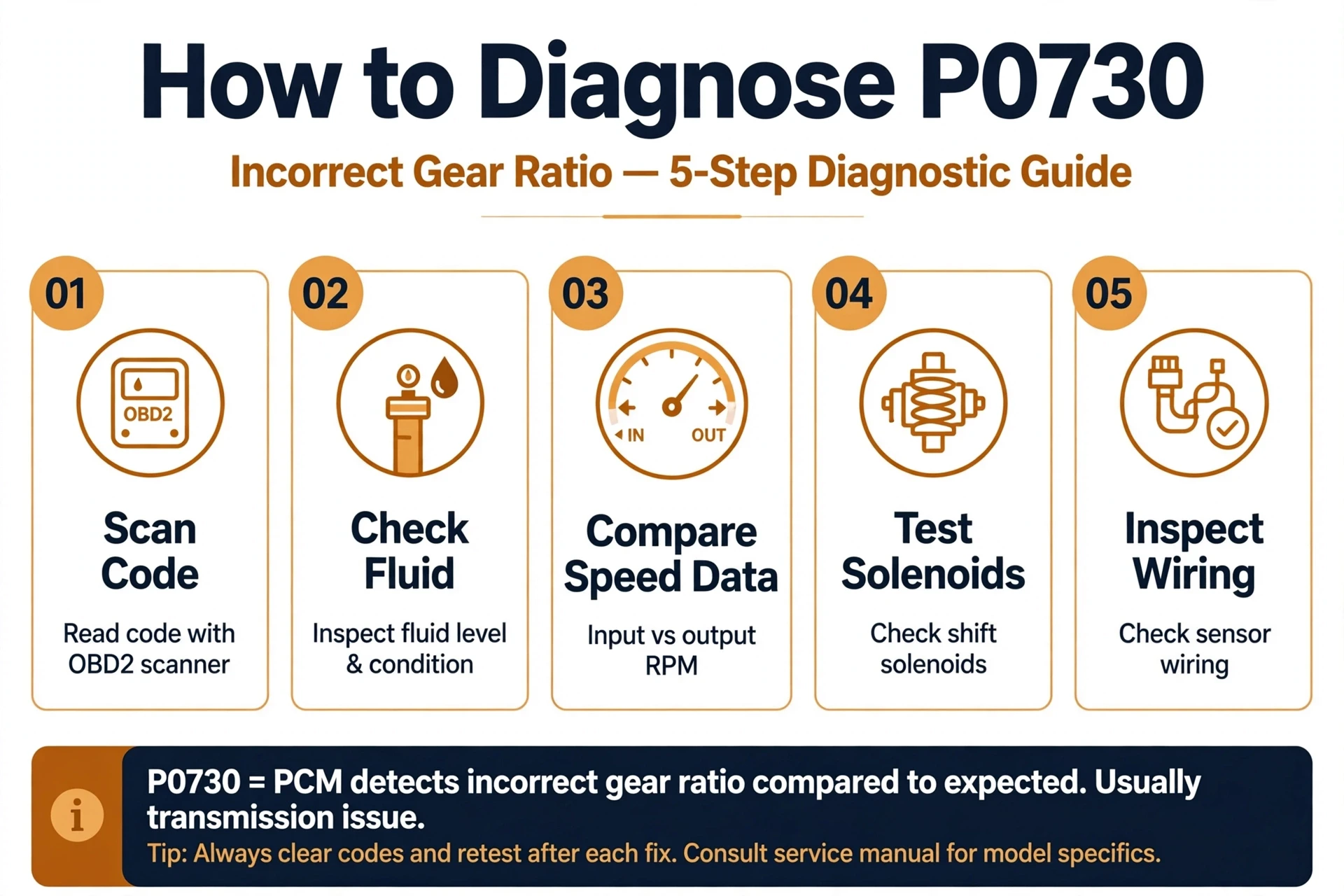
Mechanics see the P0730 code misdiagnosed constantly, often with a full transmission rebuild quoted before the simple checks are done. Work through these steps in order, cheapest first:
- Check the transmission fluid level and condition first. With the engine warm and running (if your vehicle has a dipstick; many newer cars use a check plug and a specific procedure), pull the dipstick and check the level, color, and smell. Low level, dark color, or a burnt odor explains a huge share of P0730 codes. If the fluid is low, top it off and retest before doing anything else.
- Scan for companion codes. Check whether other codes are stored alongside P0730, such as gear-specific ratio codes (P0731 through P0736), shift solenoid codes, speed sensor codes, or P0700 (transmission control system malfunction). Companion codes point straight at the failing circuit, so diagnose those related codes first.
- Inspect the wiring and connectors. Look at the connectors and wiring on the input and output speed sensors and the shift solenoids for corrosion, loose pins, oil contamination, or damaged insulation. Clean or repair any faults you find.
- Check live data with a scan tool. Monitor the input and output speed sensor RPM in each gear and compare the calculated ratio against the specification. If the sensors read erratically at a standstill or the values freeze, suspect the sensor, not the gears.
- Test the shift solenoids and valve body operation. Use a scan tool with bi-directional controls to command the solenoids and verify they respond, and check resistance against the specification. A solenoid that does not click or reads out of range is a prime suspect.
- Check line pressure if you have a gauge. Low line pressure points to a pump, filter, or internal leak problem rather than an electrical fault.
- Know when to stop. If the fluid is full and clean, the wiring and sensors test good, and the solenoids work, yet the ratio is still wrong, the problem is internal (worn clutches or hard parts). That is transmission-shop territory.
How to Fix the P0730 Code
The right fix depends on what your diagnosis found:
- Top up or change the transmission fluid: bring the level to specification with the correct ATF type for your vehicle, and fix any leaks you find. If the fluid is burnt or contaminated, a fluid and filter service is the right move. This alone resolves many P0730 cases.
- Replace the clogged transmission filter: a new filter restores flow and line pressure when the old one is packed with debris.
- Replace the faulty shift solenoid: if testing shows a solenoid is sticking or out of specification, replacing it restores proper hydraulic control of the gear circuits.
- Repair wiring and connectors: clean corrosion, repair broken wires, and replace damaged connectors on the speed sensors, solenoids, and TCM circuits.
- Replace bad speed sensors: a new input or output speed sensor is a straightforward fix when live data shows erratic or frozen readings.
- Service or replace the valve body: sticking valves or cross-leaks sometimes respond to a valve body service; severe wear calls for a replacement unit.
- Update or replace the TCM: if a software update is available for your vehicle, have it applied. A genuinely failed module needs replacement and programming.
- Rebuild or replace the transmission: when the clutch packs or hard parts are worn out, there is no shortcut. Get quotes from a trusted transmission shop, since this is the most expensive outcome.
After the repair, clear the code with your scanner and road test the vehicle under normal driving conditions, then re-scan to confirm the P0730 code does not return.

P0730 Repair Costs
Drivers always ask how much it costs to fix the p0730 code, and the answer depends entirely on the cause. Here is what each repair typically runs:
| Repair | Cost Range |
|---|---|
| Transmission fluid and filter change | $150 – $300 |
| Shift solenoid replacement | $200 – $600 |
| Input/output speed sensor replacement | $150 – $400 |
| Valve body replacement | $800 – $2,000 |
| TCM replacement and programming | $500 – $1,200 |
| Transmission rebuild | $2,500 – $5,000+ |
This is why diagnosis matters. A $200 fluid service and a $3,000 rebuild share the same code, so always rule out the cheap causes before authorizing major work.
DIY vs Mechanic Verdict
You can do this at home: checking the transmission fluid level and condition, reading codes and companion codes with an OBD2 scanner, visually inspecting wiring and connectors, and replacing an accessible speed sensor if you are comfortable working under the car.
See a mechanic for: shift solenoid testing, valve body service, line pressure testing, TCM programming, and any transmission removal or rebuild work. These jobs need a lift, special tools, and experience.
Bottom line: handle the fluid check, code scan, and visual inspection yourself, because those catch the most common causes. Hand the car to a transmission specialist the moment the evidence points inside the case.
Can You Drive With a P0730 Code?
You should avoid driving with an active P0730 code any more than necessary. A slipping transmission generates heat and debris that wear out clutches and hard parts fast, turning a fluid or solenoid problem into a full rebuild. Many vehicles will drop into limp mode, locking you into a single default gear, which makes the car sluggish and unsafe in traffic. If the code just appeared, drive gently straight to a shop or home, check the fluid level as soon as you can, and do not tow heavy loads or take long trips until it is fixed.
P0730 on Popular Vehicles
P0730 shows up across all brands, but some patterns are worth knowing:
- Dodge, Chrysler, and Jeep (Charger, 300, Ram 1500, Grand Cherokee): The p0730 dodge code (dodge p0730, p0730 code dodge) is common on vehicles with the NAG1 automatic, where the conductor plate speed sensors fail and corrupt the ratio calculation. Check those sensors before assuming internal damage.
- Honda and Acura (Accord, Odyssey, TL): The p0730 honda code (honda p0730, p0730 code honda) often appears on older automatics with worn 3rd and 4th gear clutch pressure switches, so test those switches before condemning the transmission.
- Chevrolet and GMC (Silverado, Tahoe, Sierra): The p0730 chevy code (chevy p0730, p0730 code chevy) frequently traces to the 4L60E, where a worn 3-4 clutch pack lets the ratio slip under load.
- Ford (F-150, Explorer, Mustang): The p0730 ford code (ford p0730, p0730 code ford) can follow neglected fluid service or overheating episodes, so look for burnt fluid and restricted cooler flow.
- Mercedes-Benz (C-Class, E-Class): The p0730 mercedes code shows up on the 722.6 transmission, usually a failing conductor plate or the 13-pin connector wicking fluid into the harness.
- Nissan (Altima, Maxima, Pathfinder): The p0730 nissan code (nissan p0730, p0730 code nissan) can follow neglected fluid service intervals on conventional automatics, so service history matters a lot here.
OBD P0730 and the manufacturer-specific descriptions all describe the same core fault: the measured gear ratio does not match the expected value. DTC P0730 is simply the standardized name for it.
P0730 vs Related Codes
P0730 is the general incorrect-ratio code: it means the computer detected a ratio mismatch without pinning it to one specific gear. Its closest relatives, P0731 through P0736, describe the same kind of fault isolated to a single gear (P0731 is gear 1, P0732 is gear 2, and so on through P0735 for gear 5, plus P0729 for gear 6 and P0736 for reverse). If you have P0730 together with one of the gear-specific codes, the specific code tells you where to look first. P0700 is different: it is a general “Transmission Control System Malfunction” code that simply tells you the TCM has stored its own codes, so always read the TCM codes behind a P0700. P0715 (input/turbine speed sensor circuit) and P0720 (output speed sensor circuit) are common companions, because a bad speed sensor signal is exactly what makes the ratio math go wrong.
Related Codes
- P0731: Gear 1 Incorrect Ratio
- P0732: Gear 2 Incorrect Ratio
- P0733: Gear 3 Incorrect Ratio
- P0734: Gear 4 Incorrect Ratio
- P0735: Gear 5 Incorrect Ratio
- P0700: Transmission Control System Malfunction (check TCM for stored codes)
- P0715: Input/Turbine Speed Sensor Circuit Malfunction (a common companion)
- P0720: Output Speed Sensor Circuit Malfunction (a common companion)
Video Walkthrough
Watch the video above for a visual walkthrough of P0730 causes and diagnosis before you read on.
Frequently Asked Questions
What is the most common cause of a P0730 code?
Low or dirty transmission fluid is the most common cause. When the fluid level drops or the fluid becomes burnt and contaminated, hydraulic pressure falls and the clutches cannot hold the commanded gear, so the ratio slips. Always check the fluid level and condition before replacing any parts.
Can I still drive my car with a P0730 code?
It is not recommended. Driving with a slipping transmission creates heat and debris that destroy clutches and hard parts, and the vehicle may drop into limp mode without warning. Get it diagnosed promptly and avoid towing or long trips until it is repaired.
How do you fix the code P0730?
Start with the basics: check and correct the transmission fluid level and condition, then scan for companion codes and inspect the wiring and connectors on the speed sensors and shift solenoids. Replace a faulty solenoid or a bad speed sensor if testing points to one, and leave valve body or internal repairs to a transmission specialist.
How much does it cost to fix P0730?
It ranges from about $150 to $300 for a fluid and filter service, $200 to $600 for a shift solenoid, and $150 to $400 for a speed sensor, up to $800 to $2,000 for a valve body and $2,500 to $5,000 or more for a full transmission rebuild. Proper diagnosis keeps you at the cheap end whenever possible.
Will P0730 clear itself?
Rarely. The code may clear after a successful repair and several drive cycles, but it will keep coming back until the underlying cause, such as low fluid, a bad solenoid, or internal wear, is actually fixed. Clearing the code without a repair does not solve anything.
Can low transmission fluid cause P0730?
Yes, and it is the first thing to check. Low fluid starves the hydraulic circuits that engage the gears, so the clutch packs cannot hold and the measured gear ratio falls out of range. Top up to the correct level with the right ATF type and fix any leaks.
What is the difference between P0730 and P0731?
P0730 is the general incorrect gear ratio code and does not name a specific gear, while P0731 means the incorrect ratio was detected specifically in first gear. Both point to slipping or a ratio mismatch, and they share most of the same causes and diagnostic steps.
Conclusion
The P0730 code looks scary, but it is really your car asking for a proper diagnosis, not an automatic transmission rebuild. Most cases trace back to low or dirty fluid, a tired shift solenoid, or a wiring issue, all far cheaper than internal work. Check the simple things first, follow the diagnostic order, and let a specialist handle anything inside the case. Catch it early and your transmission will thank you with many more miles.
About the author: Written by the OBD2 Code Hub editorial team. Our diagnostic guides are built from real OBD-II data, manufacturer service procedures, and hands-on troubleshooting experience, then reviewed for technical accuracy before publishing. We drive the same cars you do.