
P0733 Trouble Code: Meaning, Causes, Symptoms & Fixes
In This Guide
One-line meaning: P0733: Gear 3 Incorrect Ratio.
What the P0733 Code Means
The P0733 code is a transmission diagnostic trouble code that drivers usually meet right when they need third gear the most. Its full definition is “Gear 3 Incorrect Ratio” (p0733 gear 3 incorrect ratio). In plain English, your car’s powertrain control module (PCM) or transmission control module (TCM) has decided that third gear is not behaving the way third gear should.
Here is how your car figures this out. An automatic transmission has an input speed sensor and an output speed sensor. The computer knows the exact gear ratio third gear is supposed to produce, so it constantly compares the two sensor readings against that expected value. When the measured ratio in third gear falls outside the normal range, the computer concludes that the transmission is slipping or failing to hold third gear properly, and it stores the P0733 code and turns on the check engine light.
P0733 (p0733 obd2, p0733 code) is a generic powertrain code, which means it has the same basic meaning on every make and model, from a Chevy Silverado to a Jeep Grand Cherokee to a Ford Explorer. Note that the exact definition and the conditions that set the code can vary slightly by manufacturer, so always check the service information for your specific vehicle.

Symptoms of the P0733 Code
The P0733 code rarely hides. Because third gear handles the jump from stop to cruising speed, you will usually feel the problem every time you pull away. Watch for:
- Check engine light illuminated on the dashboard (sometimes a transmission warning light instead)
- Harsh or delayed shifting into third gear, a lurch, shudder, or hard clunk as the gear finally engages
- RPM flare during the 2-3 upshift, the engine revs higher than normal before third gear engages
- Transmission slipping, the engine revs but the car does not pick up speed the way it should
- Vehicle staying in a lower gear longer than normal, or skipping third gear entirely
- Limp mode, the vehicle locks itself into a default gear to protect the transmission
- Reduced fuel economy, since the engine spends more time at higher RPMs than necessary
- In severe cases, overheating transmission fluid caused by constant slipping
What is the p0733 code trying to tell you? In short: something is preventing third gear from engaging or holding the way the computer expects. Because third gear is the workhorse gear for city driving, this code deserves prompt attention.

Common Causes of P0733
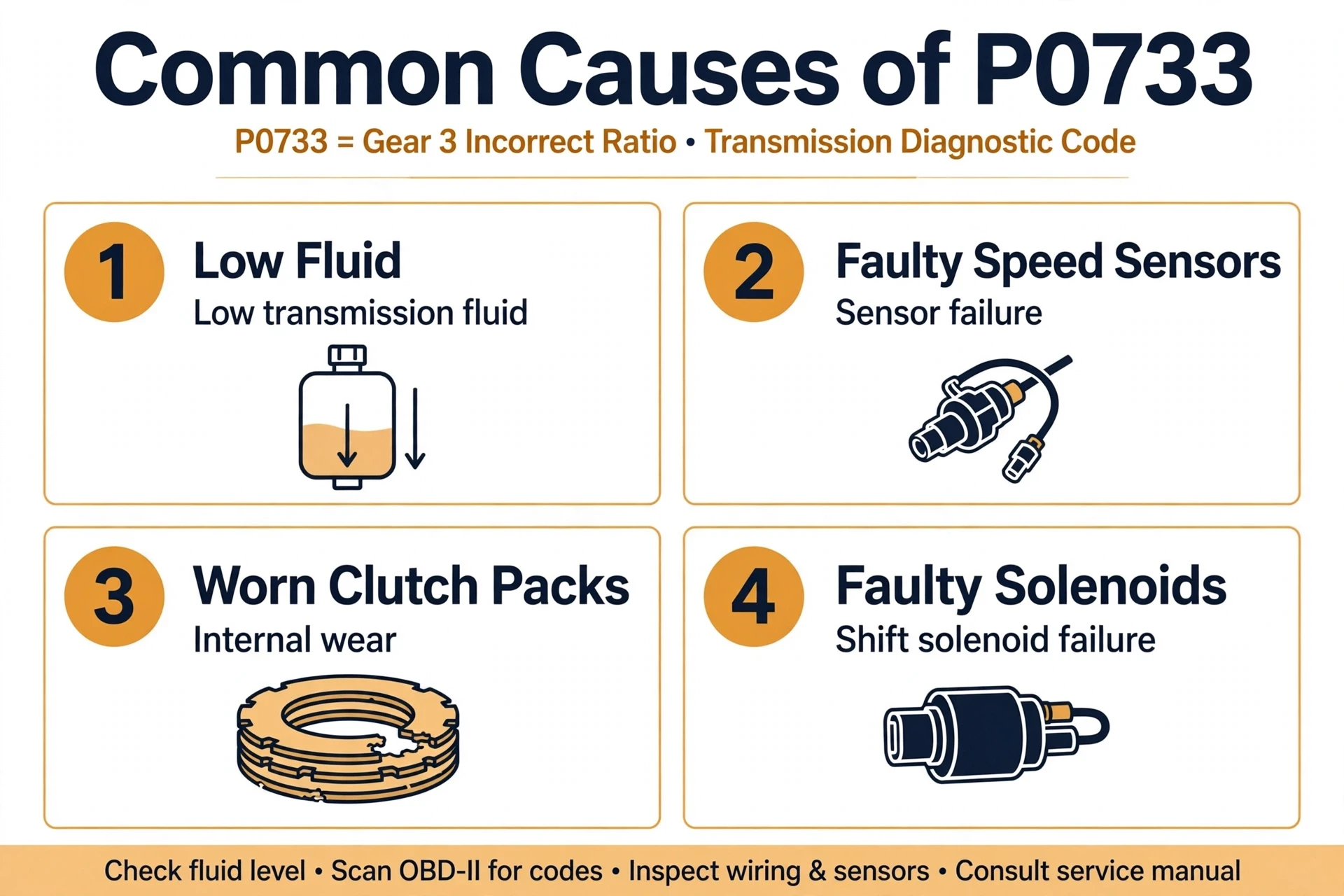
The most common cause of a P0733 code is low or degraded transmission fluid. Without enough clean fluid, hydraulic pressure drops and third gear cannot engage or hold properly. Beyond fluid, the usual suspects are electrical and hydraulic parts that serve the third gear circuit:
- Low transmission fluid: the number one cause. Even being a quart low can starve the hydraulic circuits that engage third gear.
- Dirty or contaminated fluid: burnt, dark, or debris-filled fluid restricts the small hydraulic passages and valves, so pressure does not reach the right place at the right time.
- Clogged transmission filter: a restricted filter chokes fluid flow to the pump and valve body, which lowers pressure across every gear.
- Faulty third gear shift solenoid: a bad or sticking shift solenoid fails to direct fluid to the right clutch pack or band at the right time, so third gear never fully applies.
- Defective valve body: wear, sticking valves, or cross-leaks inside the valve body disrupt the hydraulic routing that third gear depends on.
- Bad input or output speed sensor: a failing input speed sensor (ISS) or output speed sensor (OSS) sends false data, so the computer calculates the wrong ratio and sets the p0733 code even when the gear itself is fine.
- Wiring and connector problems: corroded, loose, or damaged wiring to the solenoids and speed sensors, including poor grounds, can interrupt the signals the TCM needs.
- Internal mechanical failure: a worn third gear clutch pack, a worn 2-4 band (a known weak point in GM 4L60E transmissions), or a fractured reaction sun shell means third gear physically cannot hold.
- TCM or PCM issues: less common, but outdated calibration, a missing re-learn after transmission service, or a failed transmission control module can set the code.
- Debris inside the transmission: friction material or metal particles restricting fluid flow, often a sign of deeper internal wear.
How to Diagnose P0733 (Do This Before Buying Parts)
Mechanics see the P0733 code misdiagnosed constantly, often with an expensive transmission rebuild recommended before the basics are checked. Work from the cheapest checks outward, and do not condemn the transmission until the electrical and hydraulic basics test good.
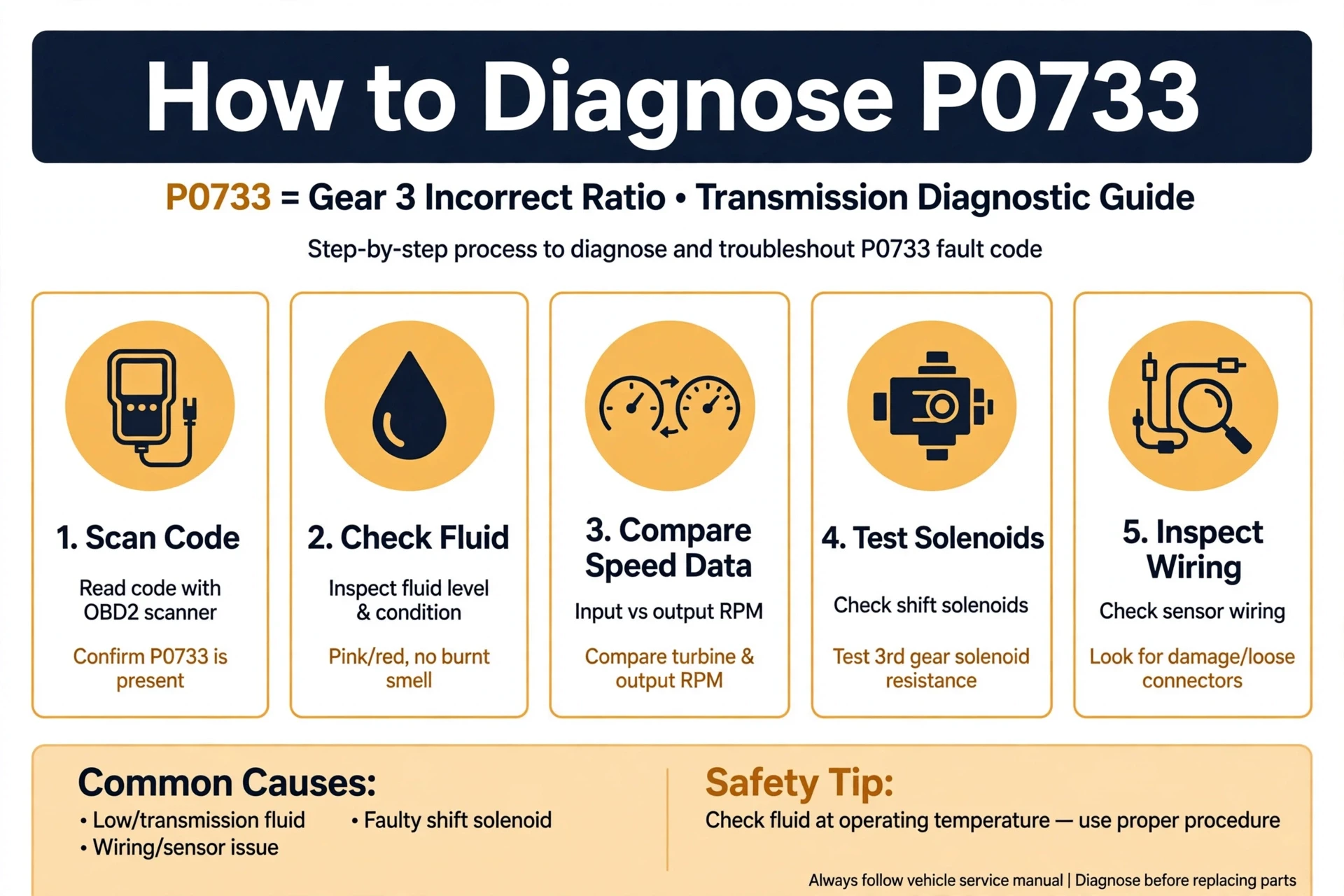
- Check the transmission fluid level and condition first. With the engine warm and running (if your vehicle has a dipstick), pull the dipstick, check the level, and look at the color and smell. Healthy fluid is pinkish-red. Dark, brown, or burnt-smelling fluid is a problem. Many modern vehicles have no dipstick, so follow the factory fill-check procedure for your model.
- Scan for companion codes. Check whether other codes are stored alongside P0733, such as other gear ratio codes (P0730, P0731, P0734), solenoid codes (P0750, P0751), or speed sensor codes (P0715, P0720). Companion codes point straight at the faulty circuit.
- Inspect the wiring and connectors. Look at the connectors and wiring on the input and output speed sensors and the transmission case connector. Clean off corrosion, check for bent pins, and look for chafed or melted wires.
- Monitor live data with a scan tool. Monitor the input and output speed sensor RPM while driving in third gear and compare the calculated ratio against the expected third gear ratio. If the sensors read erratically or freeze, suspect the sensors or their wiring before suspecting the transmission itself.
- Test the shift solenoids. Use a scan tool with bi-directional controls to command the third gear solenoid on and off, and check its resistance with a multimeter against the factory specification.
- Check line pressure if you have a gauge. Low line pressure points to a pump, filter, or internal leak problem rather than an electrical one.
- Know when to stop. If the fluid is full and clean, the wiring and sensors test good, and the solenoids respond correctly, the fault is likely inside the transmission (worn clutch packs, band, or valve body), and it is time for a transmission specialist.
How to Fix the P0733 Code
The right fix depends on what your diagnosis found:
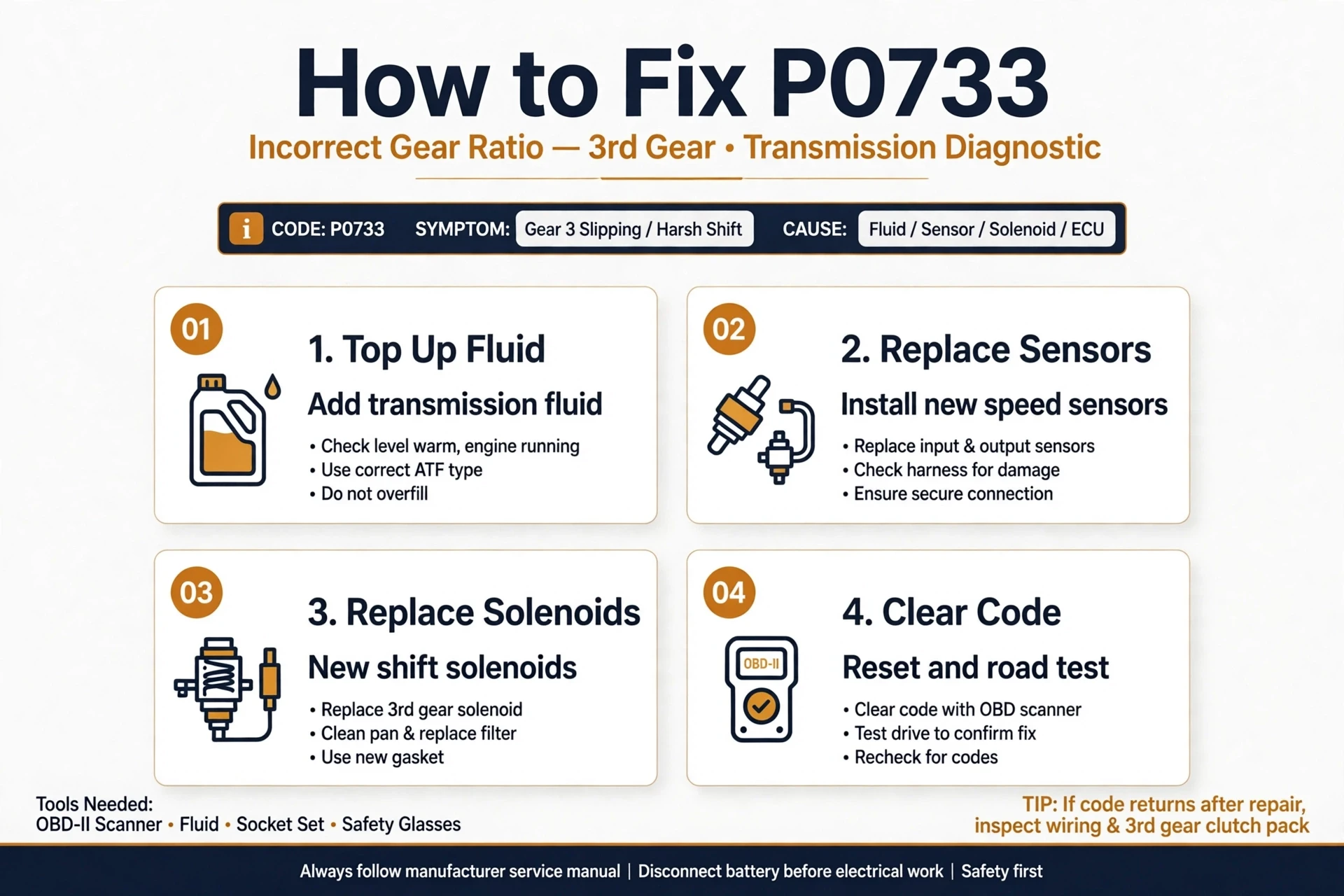
- Top up or change the transmission fluid: bring the level to specification with the correct ATF type for your vehicle, and fix any leaks you find. A fluid and filter service resolves the problem in a surprising number of P0733 cases.
- Replace the faulty shift solenoid: if testing shows the third gear solenoid is sticking or out of specification, replacing it (and its filter screen, where fitted) restores proper fluid routing to third gear.
- Repair wiring and connectors: clean corrosion, repair broken wires, and replace damaged connectors on the speed sensors, solenoids, and the transmission case connector.
- Replace bad speed sensors: a new input or output speed sensor is a straightforward fix when live data shows erratic or frozen readings.
- Service or replace the valve body: sticking valves or cross-leaks sometimes respond to a valve body service; severe wear calls for a replacement unit.
- Update or replace the TCM: if a software update or re-learn is available for your vehicle, have it applied. A genuinely failed module needs replacement and programming.
- Rebuild or replace the transmission: when the clutch packs, the 2-4 band, or the planetary gear set are worn out, there is no shortcut. Get quotes from a transmission specialist and an independent shop before deciding.
After the repair, clear the code with your scanner and road test the vehicle through several 2-3 upshifts to confirm the fix holds.
P0733 Repair Costs
Drivers always ask how much it costs to fix P0733, and the answer depends entirely on the cause. Here are realistic ranges:
| Repair | Cost Range |
|---|---|
| Transmission fluid and filter service | $150 – $300 |
| Shift solenoid replacement | $150 – $400 |
| Speed sensor replacement | $120 – $300 |
| Valve body rebuild or replacement | $500 – $1,500 |
| Third gear clutch pack repair | $1,000 – $2,500 |
| Transmission rebuild | $2,500 – $4,500+ |
| Transmission replacement | $3,500 – $8,000+ |
This is why diagnosis matters. A $200 fluid service and a $4,000 rebuild share the same code. In roughly 15 to 25 percent of cases, fresh fluid and a filter solve it, which is why the fluid check always comes first. A professional diagnostic usually runs $100 to $150 and is money well spent before authorizing big work.
DIY vs Mechanic Verdict
You can do this at home: checking the transmission fluid level and condition, reading codes with an OBD2 scanner, inspecting wiring and connectors for corrosion or damage, cleaning corroded connectors, replacing an external speed sensor, and topping up fluid with the correct ATF. If you find low fluid or a visibly damaged connector, those are reasonable DIY repairs for anyone comfortable with basic tools.
See a mechanic for: solenoid testing with a bi-directional scan tool, line pressure testing, valve body service or replacement, clutch pack or band repair, transmission rebuild or replacement, and TCM programming or re-learn procedures. Internal transmission work needs a lift, special tools, and experience.
Bottom line: diagnose it yourself, fix the simple stuff yourself, but let a pro open the transmission.
Can You Drive With a P0733 Code?
It depends on severity. If the code is intermittent and the transmission still shifts into third gear normally, short careful trips are usually fine while you arrange a diagnosis. But do not keep driving if the transmission has entered limp mode, is shuddering violently, is skipping third gear, or is slipping badly. Slipping creates heat, and heat destroys clutch packs fast, turning a solenoid or fluid job into a full rebuild. Even when the car feels okay, get it checked soon: every slipping shift wears the third gear clutch a little more.
P0733 on Popular Vehicles
P0733 shows up across all brands, but some patterns are worth knowing:
- Jeep (Commander, Grand Cherokee, Wrangler, Gladiator): The p0733 jeep code (jeep p0733, p0733 code jeep wrangler) is common on models with the 45RFE and 545RFE transmissions, where it often appears with P0731, P0732, and P0716. On 2018-2025 Wranglers with the ZF 8-speed, the D clutch pack is a known failure point.
- Ram (1500, 2500, Dakota, Durango): The p0733 ram code (ram p0733, p0733 code ram 1500) hits trucks with the 45RFE/545RFE units. Some owners report the transmission shifting 1-2-3 and then acting like it is in neutral, which points to internal wear.
- Dodge (Charger, Durango): The p0733 dodge code (dodge p0733, p0733 code dodge) sometimes arrives with P0734 (fourth gear ratio), which suggests a shared hydraulic or clutch problem rather than a single bad solenoid.
- Ford (Explorer, Mountaineer, Mustang, F-150, Ranger): The p0733 ford code (ford p0733, p0733 code ford) is well known on 2002-2010 models with the 5R55W/5R55S and 5R55E transmissions, where valve body and servo issues are frequent. The 7.3 Powerstroke trucks see it too.
- GM (Silverado, Sierra, Tahoe, Suburban): The p0733 code on a Chevy truck with the 4L60E transmission often means the 3-4 clutch pack, a documented weak point. Check the fluid first, but be ready for internal work.
- Honda (Accord, Civic): Early to mid-2000s automatics develop P0733 as clutch packs wear with mileage; a fluid service is worth trying before condemning the unit.
- Hyundai (Santa Fe): Reports point to the usual suspects: ATF level and condition, solenoids, and speed sensors.
- Nissan: The p0733 nissan code (nissan p0733, p0733 code nissan) follows the same pattern, with fluid condition and shift solenoids leading the suspect list.
P0733 is a generic OBD-II code, so the diagnostic logic is the same everywhere. What changes by vehicle is the expected third gear ratio, the transmission design, and the known weak points above.
P0733 vs Related Codes
P0733 belongs to a family of gear ratio codes that all use the same diagnostic logic but target different gears. P0730/p0730/ is the general “Incorrect Gear Ratio” code: the TCM detected a ratio error but has not pinned it to a specific gear. P0733 names third gear specifically, which narrows the suspects to the third gear hydraulic circuit, its solenoid, and its clutch pack. P0731, P0732, P0734, and P0735 are the same fault for first, second, fourth, and fifth gear. P0700 (Transmission Control System Malfunction) is almost always stored alongside any gear ratio code, because the TCM asks the ECM to turn on the check engine light.
If P0733 arrives with speed sensor codes (P0715, P0720) or shift solenoid codes (P0750, P0751), chase those first. Fixing the sensor or solenoid often clears the ratio code with it.
Related Codes
- P0730: Incorrect Gear Ratio (general, not gear-specific)
- P0731: Gear 1 Incorrect Ratio
- P0732: Gear 2 Incorrect Ratio
- P0734: Gear 4 Incorrect Ratio
- P0700: Transmission Control System Malfunction (usually stored with P0733)
- P0715 / P0720: Input/Turbine and Output Speed Sensor Circuit Malfunction
Video Walkthrough
Watch the video above for a visual walkthrough of P0733 symptoms and diagnosis on a real Jeep before you read on.
Frequently Asked Questions
What is the most common cause of a P0733 code?
Low or degraded transmission fluid is the single most common cause. Even being a quart low can starve the hydraulic circuits that engage third gear. After fluid, the next suspects are a faulty shift solenoid, a clogged filter, a worn valve body, and bad speed sensors.
Can I still drive my car with a P0733 code?
Short term, if the code is intermittent and the transmission still shifts into third gear. Stop driving it if the transmission is in limp mode, shuddering violently, skipping third gear, or slipping badly, because slipping creates heat that destroys clutch packs quickly.
How do you fix the code P0733?
Diagnose first: check the fluid level and condition, scan for companion codes, inspect the wiring and connectors, and monitor input and output speed sensor data in third gear. Then repair what you find: service the fluid and filter, replace a bad solenoid or sensor, repair wiring, service the valve body, or rebuild the transmission if the clutch packs are worn.
How much does it cost to fix P0733?
From about $150-$300 for a fluid and filter service, $150-$400 for a shift solenoid, $500-$1,500 for valve body work, up to $2,500-$4,500+ for a transmission rebuild depending on the vehicle and the root cause.
Will P0733 clear itself?
Rarely. If the fault was temporary, the code might stay away for a while after clearing, but it usually returns until the real problem is fixed. Do not mistake a cleared code for a repair.
Can low transmission fluid cause P0733?
Yes. It is the most common trigger. Low fluid means low hydraulic pressure, and without enough pressure the third gear clutch pack cannot fully apply, so the ratio the computer measures does not match what it expects.
What is the difference between P0733 and P0730?
P0730 is the general incorrect gear ratio code, meaning the TCM saw a ratio error without pinning it to a gear. P0733 names third gear specifically, which narrows the diagnosis to the third gear circuit, its solenoid, and its clutch pack.
Conclusion
The P0733 code means your transmission is slipping in third gear, but it does not automatically mean you need a new transmission. Check the fluid, scan for companion codes, inspect the wiring, and test the solenoids before authorizing big work. Do that, and you will either solve it cheaply with a fluid service or know for certain the fault is internal. Either way, you stop guessing and start fixing.
About the author: Written by the OBD2 Code Hub editorial team. Our diagnostic guides are built from real OBD-II data, manufacturer service procedures, and hands-on troubleshooting experience, then reviewed for technical accuracy before publishing. We drive the same cars you do.