
P0780 Trouble Code: Meaning, Causes, Symptoms & Fixes
In This Guide
One-line meaning: Your car’s computer has detected a shift malfunction: the automatic transmission did not complete a gear change the way it expected.
What the P0780 Code Means
The p0780 code is a check engine light code drivers often search for after noticing harsh or delayed shifting. It is a generic OBD-II powertrain code, so it means the same thing on every make and model sold in the United States.
P0780 stands for “Shift Malfunction.” The transmission control module (TCM), or the powertrain control module (PCM) on some vehicles, watches every gear change. It compares engine speed, hydraulic pressure, and the readings from the input and output speed sensors. When the transmission fails to land in the expected gear, or the numbers do not add up, the computer stores P0780 and turns on the check engine light.
Think of it this way: your transmission is an orchestra of clutches, bands, and fluid pressure, and the TCM is the conductor. P0780 means the conductor called for a gear change and the band did not play the right note.

Unlike a code that points at one bad part, P0780 is a general complaint. It tells you the shift went wrong, not exactly why. Low fluid, a lazy shift solenoid, a bad speed sensor, damaged wiring, or worn parts inside the valve body can all trigger it. That is why the diagnosis steps below matter more than the code alone.
Symptoms of the P0780 Code
Most drivers first meet the p0780 code through the check engine light. In many cases that is the only symptom at first. The transmission can still shift, but the computer has logged a shift it did not like. Do not ignore it, because the underlying problem often gets worse.
- Check engine light on, sometimes with a transmission warning light.
- Harsh, delayed, or erratic shifting between gears.
- Transmission slipping or failing to engage a gear.
- Transmission stuck in one gear (limp mode, usually second or third).
- Whining or unusual noises from the transmission.
- Difficulty accelerating or a noticeable loss of power.
- Reduced fuel economy from the transmission working harder than it should.
Drivers searching “what is code p0780” often ask whether the car will still move. Many vehicles enter limp mode, which locks the transmission in a single gear so you can limp to a shop. The car feels sluggish and the engine revs higher than normal. That self-protection is a clue, not a fix.

Common Causes of the P0780 Code
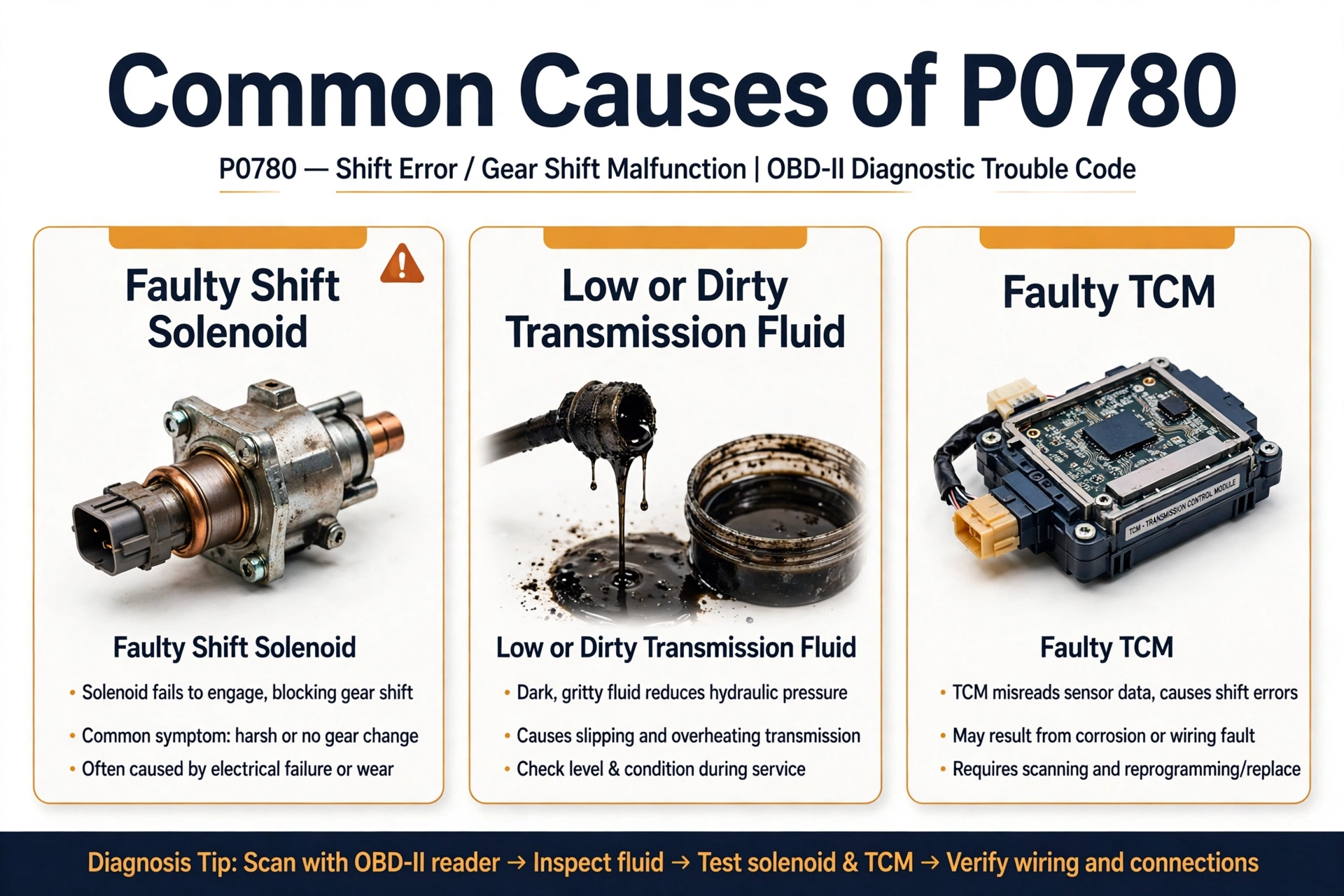
The p0780 code has several possible root causes, and they range from a bottle of fluid to a full transmission rebuild. Work through them from cheapest to most expensive.
- Low, burnt, or dirty transmission fluid: Old fluid loses its hydraulic punch, and a low level starves the shift circuits. A clogged transmission filter has the same effect. This is the most common and cheapest cause.
- Faulty shift solenoids: These small electric valves direct fluid to the right clutch pack for each gear. When one sticks or fails, the shift it controls never completes.
- Defective input or output speed sensors: The computer needs both shaft speeds to confirm a shift. A bad sensor feeds it bad data, so it calls the shift a malfunction.
- Wiring or connector problems: Shorted or open wires in the solenoid control circuits, corroded connectors, or loose pins interrupt the shift commands.
- Internal mechanical or hydraulic wear: A worn valve body, a weak transmission pump, or tired clutch packs cannot hold the pressure a shift needs.
- Faulty electronic pressure regulator: If line pressure cannot rise on demand, shifts get soft, late, or incomplete.
- Bad transmission pump: Low pump output means low pressure everywhere, so multiple shifts suffer at once.
- Defective PCM or TCM: Rare, but a failed control module can misread good data or send bad commands.
How to Diagnose P0780 (Do This Before Buying Parts)
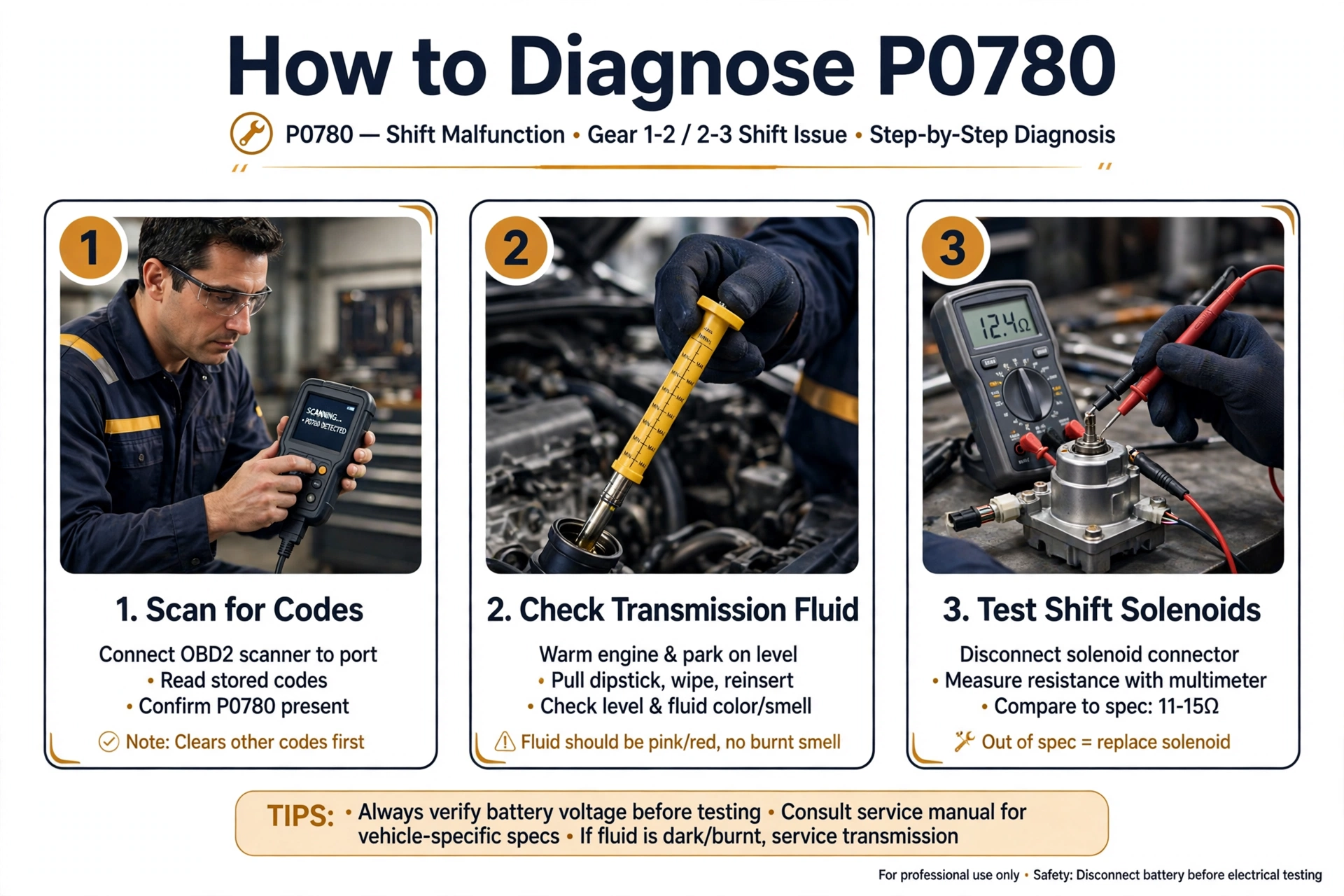
Diagnose the p0780 code in this order. Each step rules out the cheap causes before you spend money on parts.
- Scan for all codes. Read every stored code, not just P0780. Companion codes point at the real culprit. For example, a solenoid code plus P0780 means the solenoid is the prime suspect. Write the codes down, then clear them and see which ones return.
- Check the fluid level and condition. With the engine warm and the car on level ground, pull the transmission dipstick if your car has one. Healthy fluid is pink or red and smells slightly sweet. Dark, gritty, or burnt-smelling fluid is a red flag.
- Look at freeze frame data. Your scanner shows the conditions when the code set, such as speed, gear, and temperature. A fault that only appears when hot points at fluid or internal wear.
- Inspect wiring and connectors. Check the transmission harness for chafing, melted spots, and corrosion. Wiggle connectors with the engine running and watch for changes on the scanner.
- Test the shift solenoids. Unplug the solenoid and measure resistance with a multimeter. Compare the reading to the factory spec, often around 11 to 15 ohms. A reading far outside spec means the solenoid has failed.
- Test the speed sensors. Compare the input and output speed sensor signals on a test drive. A sensor that drops out or reads erratically needs replacement.
- Check line pressure. A gauge on the transmission test port shows whether the pump and pressure regulator are doing their job. Low pressure across all gears points inside the transmission.
- Clear the code and retest. After each repair, clear the code and drive through several shift cycles. The p0780 code should stay gone through city and highway driving before you call it fixed.
How to Fix the P0780 Code
Fix the p0780 code by matching the repair to what your diagnosis found. These are the repairs that actually resolve it, from most to least common.
- Change the transmission fluid and filter: If the fluid is low, dark, or burnt, a fluid and filter service restores the hydraulic pressure that shifts depend on. Top off a low level first and retest. Many P0780 cases end here.
- Replace the faulty shift solenoid: A solenoid that failed the resistance test gets replaced, usually by dropping the transmission pan to reach the valve body. Replace the pan gasket and filter while you are in there.
- Replace a bad input or output speed sensor: These sensors are often accessible from outside the transmission and swap out with basic hand tools.
- Repair damaged wiring or connectors: Clean corrosion, repair chafed wires, and reseat loose pins. Dielectric grease on the connectors keeps moisture out.
- Replace the valve body: When solenoids test fine but pressure is low or shifts stay harsh, a worn valve body is a common deeper cause.
- Replace the electronic pressure regulator or transmission pump: Low line pressure on the gauge test leads here.
- Rebuild or replace the transmission: Worn clutch packs or hard parts mean the transmission has to come out. This is the last resort, not the first guess.
After any repair, clear the code with your scanner and test drive until the transmission shifts smoothly through every gear. If the p0780 code returns right away, the real cause is still hiding. Go back to the diagnosis steps instead of throwing more parts at it.

P0780 Repair Costs
Repair costs for the p0780 code depend on the root cause. Use this table to set your budget before you approve any work.
| Repair | Cost Range |
|---|---|
| Transmission fluid and filter change | $150 – $300 |
| Shift solenoid replacement | $250 – $600 |
| Input or output speed sensor replacement | $200 – $450 |
| Wiring and connector repair | $100 – $400 |
| Valve body replacement | $600 – $1,500 |
| Transmission rebuild or replacement | $2,500 – $4,500+ |
Most p0780 code repairs land between $150 and $600, because fluid and solenoid issues cause the majority of cases. Internal transmission work is the expensive exception, which is another reason to diagnose before you authorize a rebuild.
DIY vs Mechanic Verdict
You can do this at home: Checking and topping off transmission fluid, changing fluid and filter on vehicles with a serviceable pan, scanning codes, and inspecting wiring and connectors are all solid DIY jobs. Replacing an external speed sensor is also beginner friendly.
See a mechanic for: Internal solenoid replacement on some models, valve body work, pressure testing, and anything that requires dropping the transmission. A shop also has the scan tools that command solenoids on and off for testing.
Bottom line: Start with the DIY checks, because they solve a large share of p0780 code cases for little money. If the fluid is fine and the code returns after a reset, let a transmission specialist take over before the problem turns into internal damage.
Can You Drive With a P0780 Code?
You can usually drive a short distance, but you should not keep driving with the p0780 code active. This is a serious code. Every bad shift wears the clutch packs a little more, and continued driving can turn a $300 solenoid job into a $3,000 rebuild. If the transmission is stuck in limp mode, slipping badly, or making noise, park it and call a tow. A short, gentle trip to the shop is the limit.
P0780 on Popular Vehicles
The p0780 code can appear on any automatic, but some models show up in owner reports more than others. Here is what to know for the most common ones.
- Honda (Accord, Civic, CR-V): The p0780 honda code (honda p0780, p0780 code honda) often traces to shift solenoids or pressure switches on higher mileage automatics. Check the fluid first. Honda transmissions are sensitive to fluid condition.
- Nissan (Rogue, Altima, Sentra): The p0780 nissan code (nissan p0780, p0780 code nissan) shows up on both conventional automatics and CVTs with shift complaints. Companion codes are common, so read them all before buying parts.
- Mazda (Mazda3, Mazda6, CX-5): The p0780 mazda code (mazda p0780, p0780 code mazda) uses a gear ratio check to detect the fault. Speed sensor and solenoid issues are the usual suspects.
- Acura (TL, TSX): The p0780 acura code (acura p0780, p0780 code acura) shares Honda hardware and failure patterns. Pressure switch and solenoid service fixes many cases.
- Ford (F-150, Explorer, Escape): The p0780 ford code (ford p0780, p0780 code ford) appears on trucks and SUVs with higher mileage automatics. Wiring chafing near the transmission is worth a close look.
- Chevrolet and GMC (Silverado, Tahoe, Sierra): The p0780 chevy code (chevy p0780, p0780 code chevy) often involves shift solenoids or the valve body on high mileage 4-speed and 6-speed automatics.
EOBD P0780 and OBD P0780 are the same code under different naming (European vs generic OBD-II). DTC P0780 and OBD-II P0780 also refer to the identical fault, so guides written for any of these names apply to your car.
P0780 vs Other Shift Codes
P0780 is the generalist of the shift code family. It says a shift went wrong without naming the gear or the part. Related codes are more specific, and they often appear together. P0755 points at shift solenoid B specifically, so a car with both codes almost certainly needs that solenoid. P0785 flags the shift timing solenoid circuit, while P0781 through P0784 each name a specific gear change (1-2, 2-3, 3-4, and 4-5). P0700 is even broader: it only means the transmission asked the engine computer to turn on the check engine light. When P0780 appears alone, work the diagnosis steps above. When it brings friends, let the more specific code lead.
Related Codes
- P0700: Transmission Control System Malfunction (often stored with P0780)
- P0755: Shift Solenoid B Malfunction
- P0785: Shift/Timing Solenoid Malfunction
- P0715: Input/Turbine Speed Sensor Circuit Malfunction
- P0720: Output Speed Sensor Circuit Malfunction
- P0781: 1-2 Shift Malfunction
Video Walkthrough
Watch the video above for a visual walkthrough of P0780 causes and diagnosis before you read on.
Frequently Asked Questions
What does the P0780 code mean?
The p0780 code means the transmission control module detected a shift malfunction. In plain English, the automatic transmission failed to complete a gear change correctly, so the computer turned on the check engine light.
Can I still drive with a P0780 code?
You can drive a short distance to a shop, but do not keep driving. P0780 is a serious transmission code, and continued driving can cause permanent internal damage that turns a cheap fix into a rebuild.
How do you fix the code P0780?
Start with the cheap causes: check and change the transmission fluid and filter, then test the shift solenoids and speed sensors, and inspect the wiring. Replace whichever part failed testing, clear the code, and confirm it stays gone on a test drive.
How much does it cost to fix P0780?
Most p0780 code repairs cost $150 to $600 for a fluid service, solenoid, or sensor. Wiring repairs run $100 to $400, a valve body costs $600 to $1,500, and a full rebuild runs $2,500 to $4,500 or more.
Will P0780 clear itself?
Rarely. The code may disappear for a few drive cycles if the fault was a one-time glitch, but a real shift problem will bring it back. Fix the cause instead of waiting for the light to go out on its own.
Can low transmission fluid cause P0780?
Yes. Low, dirty, or burnt fluid is one of the most common causes of the p0780 code because shifts depend on hydraulic pressure. Check the level and condition first. Topping off or changing the fluid fixes many cases.
What is the difference between P0780 and P0755?
P0780 is a general shift malfunction code that does not name a part, while P0755 specifically flags shift solenoid B. When both appear together, the solenoid is the likely culprit.
Conclusion
The p0780 code is your transmission asking for help, not delivering a death sentence. Check the fluid, read the companion codes, and work the diagnosis steps before you buy parts. Most cases end with a fluid service or a solenoid, and catching the problem early is what keeps it cheap.
About the author: Written by the OBD2 Code Hub editorial team. Our diagnostic guides are built from real OBD-II data, manufacturer service procedures, and hands-on troubleshooting experience, then reviewed for technical accuracy before publishing. We drive the same cars you do.