
Check Engine Light Codes by Vehicle: Brand-by-Brand Guide
In This Guide
- How Check Engine Light Codes Work by Vehicle
- How to Find Your Code by Vehicle
- Hyundai Check Engine Light Codes
- Honda Check Engine Light Codes
- Chevrolet Check Engine Light Codes
- European Brands: Mercedes-Benz and Volkswagen
- Ford Check Engine Light Codes
- Lexus Check Engine Light Codes
- How to Look Up Any Model Step by Step
- Video Walkthrough
- FAQs
- Conclusion
When the hyundai check engine light comes on, one question comes first: which code did the computer store? This guide to check engine light codes by vehicle answers the next question too. Specifically, it shows what that code usually means on your exact brand and model. Below are the most common codes for seven major brands, plus a simple lookup method for any model.
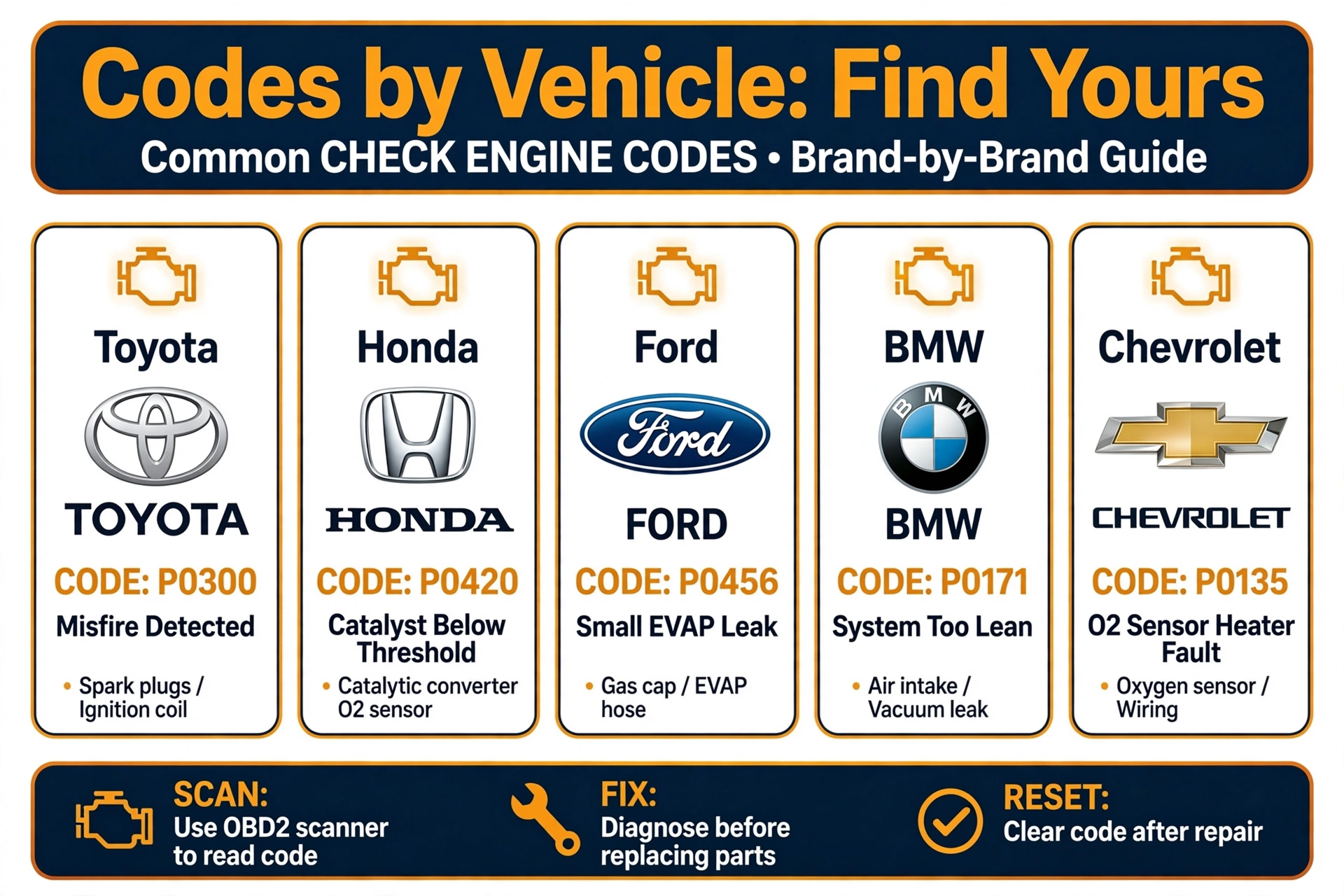
First, learn the rule that shapes this whole guide. Generic OBD-II codes start with P0, so they mean the same thing on every brand. For example, a P0420 means catalyst efficiency below threshold on a Hyundai Elantra and on a Ford Fusion. However, what changes by vehicle is how often each fault appears, which parts fail first, and the manufacturer-specific P1xxx codes that belong to one automaker only. Therefore, read the actual code with a scanner before trusting any brand section. The code comes first. Brand context comes second.
One more rule holds on every brand here. A steady check engine light means schedule service soon. In contrast, a flashing check engine light means stop driving. Pull over safely and shut the engine off, because a flashing light almost always signals a severe misfire. As a result, it can destroy the catalytic converter within minutes. This is true for a Honda, a Chevy, a Mercedes, and everything else.
How Check Engine Light Codes Work by Vehicle
Every 1996 and newer car sold in the United States uses the same OBD-II system. When a sensor reading falls outside its normal range, the engine computer stores a five-character trouble code. Then it turns on the light. Since the system is standardized, the code format works the same on every vehicle. Here is that format in plain language.
- First character: a letter for the system. P is powertrain, C is chassis, B is body, and U is network.
- Second character: who defined the code. A 0 means a generic code with the same definition on every brand. In contrast, a 1 means a manufacturer-specific code from one automaker.
- Third character: the subsystem. For instance, codes 1 and 2 cover fuel and air metering. Code 3 covers ignition and misfires. Code 4 covers emissions controls. Code 5 covers idle and speed control. Code 6 covers the computer itself. Finally, codes 7 and 8 cover the transmission.
- Last two digits: the exact fault. They pinpoint which cylinder misfired or which sensor circuit failed.
Drivers search a few code families most. For example, misfire codes run from P0300 through P0308. Lean codes are P0171 and P0174. Catalyst codes are P0420 and P0430. EVAP leak codes are P0442, P0455, and P0456. Other common ones are P0128 for coolant temperature and P0141 for the oxygen sensor heater. The brand sections below show where each of these strikes most often.
How to Find Your Code by Vehicle
Brand advice is useless without the code. So read it first. The diagnostic port sits under the dashboard on the driver side. This is true for every 1996 and newer vehicle. Next, plug an OBD-II scanner into the port. Turn the key to the on position with the engine off. Then read the stored codes. Write down every code exactly as shown. Include any that start with C, B, or U. Also save the freeze frame data if your scanner displays it. Finally, note that many auto parts stores will read your codes for free.
Finding your port: the connector is a standard 16-pin plug. Consequently, a single obd2 pin diagram covers every 1996 and newer car and light truck. Feel under the dash near the steering column. You will find it within reach of the driver seat.
Two habits make the reading more useful. First, do not clear the code until you have written it down. Clearing also erases the freeze frame snapshot. That snapshot shows what the engine was doing when the fault set. Second, scan with the engine fully warmed up when the light only appears on long drives. This is because some EVAP and catalyst monitors run only at full operating temperature.
Hyundai Check Engine Light: Elantra, Sonata, and Tucson
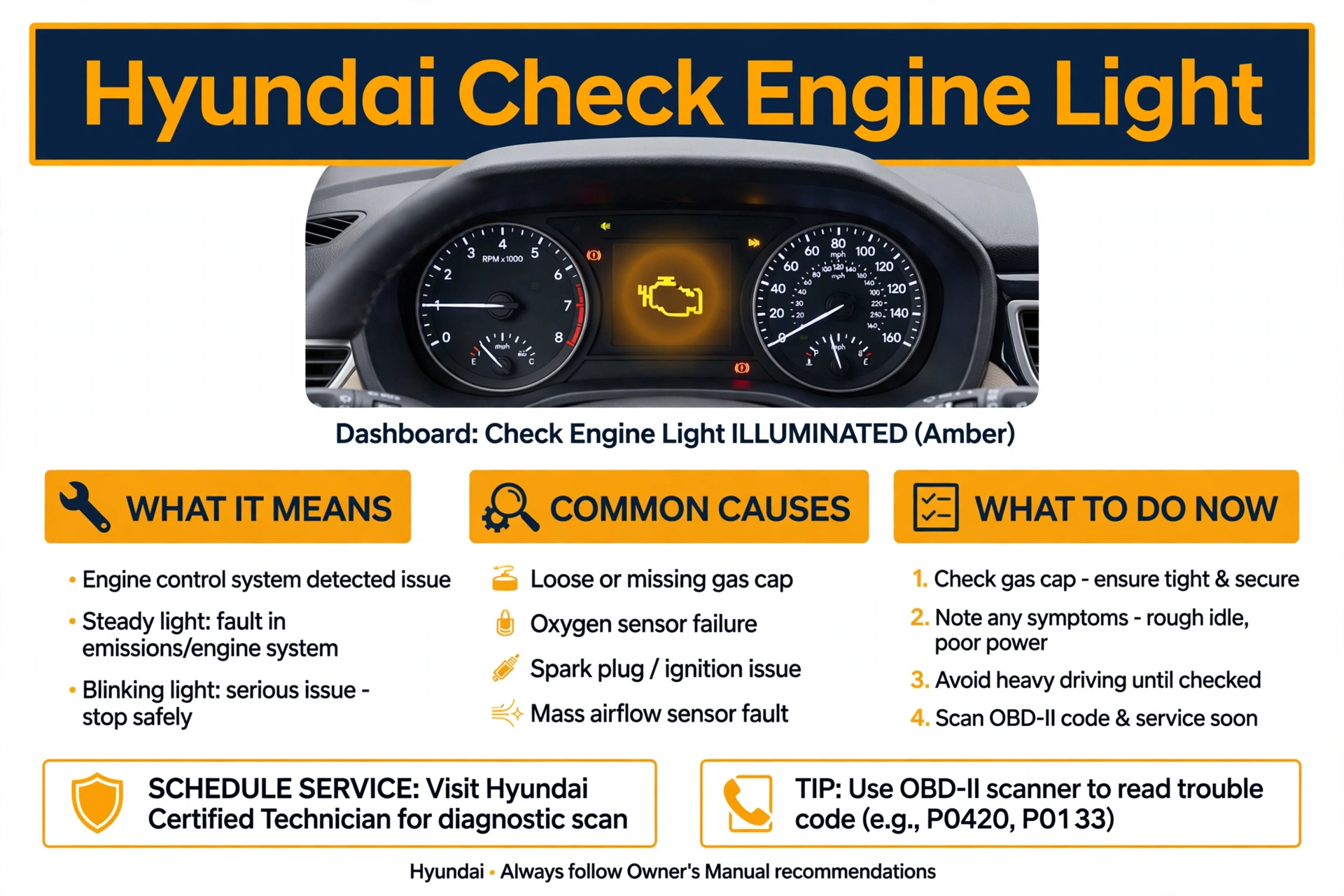
Searches for hyundai check engine light follow a consistent pattern. When the check engine light on hyundai models comes on, emissions and fuel vapor faults are the usual cause. Internal engine damage is rare. That is good news, because those faults are usually cheap to confirm and fix.
The hyundai elantra check engine light most often means a small EVAP leak. The codes are P0456 or P0442. Usually, a loose or aging gas cap is the cause. On higher-mileage cars, a catalyst efficiency code (P0420) is common too. On the Sonata, the hyundai sonata check engine light follows a similar pattern. EVAP leaks and oxygen sensor codes lead the list. For instance, P0133 is a slow-responding oxygen sensor code that many Sonata owners see. For the Tucson, the hyundai tucson check engine light adds misfire codes. These are the P0300 series. Typically, worn spark plugs cause them on older examples. The Tucson also gets the same EVAP and catalyst codes as its siblings.
Hyundai also uses manufacturer-specific codes. However, a basic parts-store scanner may show them as bare numbers with no definitions. The best-known example is P1326. It is the knock sensor detection system code on Theta II engines. As a result, it can put the car into a protective limp mode. When your scanner shows a P1xxx code with no definition, look it up as a Hyundai-specific code. Alternatively, have a shop with Hyundai-level software read it.
Honda Check Engine Light: Accord, CR-V, Pilot, Odyssey, and Fit
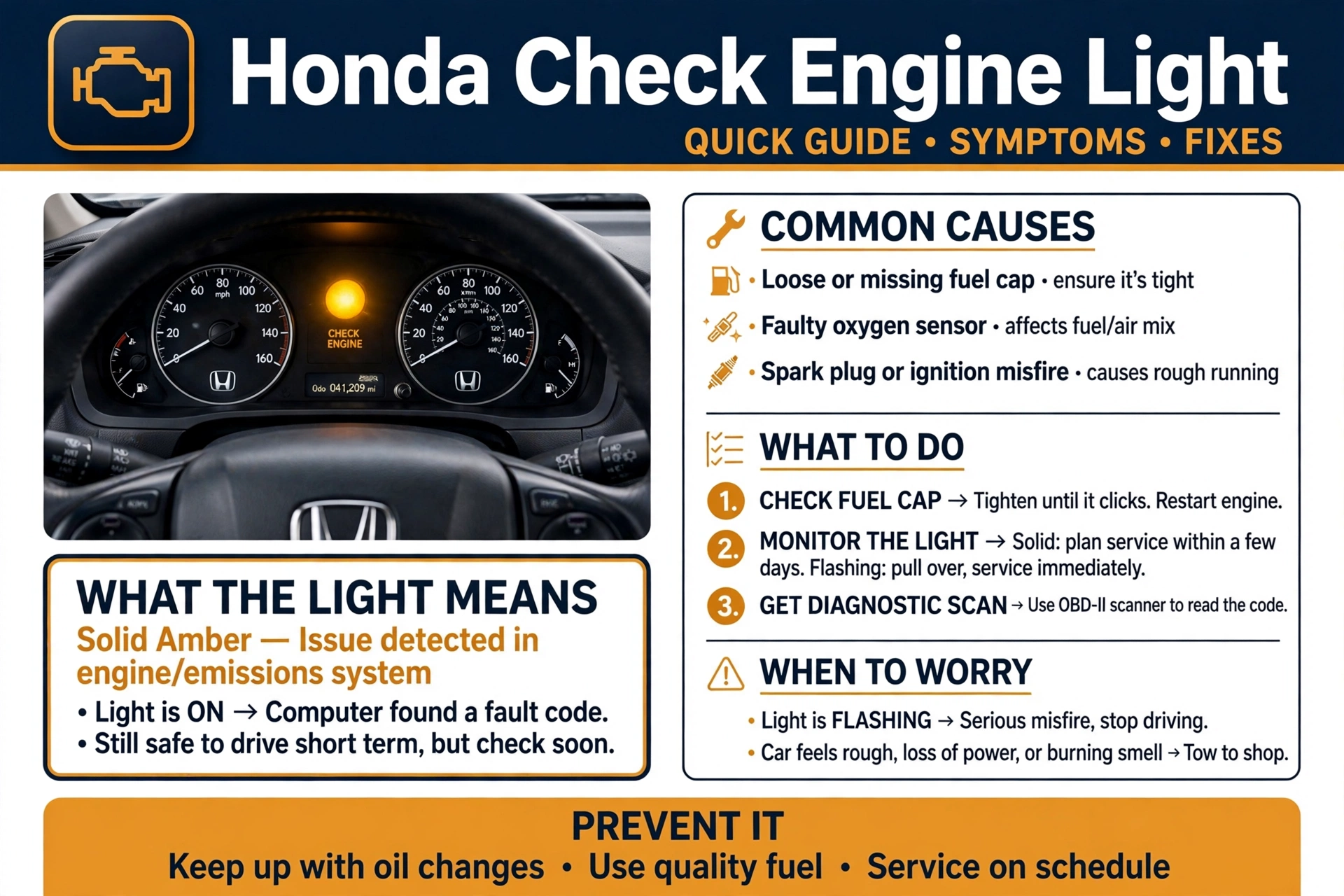
A honda check engine light rarely signals trouble inside the engine itself. Instead, Hondas often set emissions and vapor codes while the engine keeps running smoothly. Consequently, many Honda drivers keep driving for weeks with the light on. Read the code anyway. A smooth-running engine can still hide a catalyst code. Eventually, that code will fail an emissions test.
The honda accord check engine light most often points to P0420 catalyst efficiency. A small EVAP leak (P0456) is the other common cause. Typically, a loose fuel cap is the classic Accord trigger. When the honda crv check engine light appears, the same two families lead. On higher-mileage CR-Vs, oxygen sensor codes join them. The honda pilot check engine light and the honda odyssey check engine light lean toward misfires. These are the P0300 series. Usually, aging ignition coils and spark plugs cause them on V6 engines. VTEC system faults are a Honda signature too. The honda fit check engine light is usually the simplest of all. Generally, it means EVAP leaks from the fuel cap or the occasional oxygen sensor code.
One Honda-specific note: the VTEC variable valve timing system has its own set of faults. Therefore, Honda manufacturer-specific P1xxx codes read best on a scanner with Honda software. A generic scanner still reads every P0xxx code correctly. So a basic scan is the right first step.
Chevrolet Check Engine Light: Equinox, Malibu, Traverse, and Volt
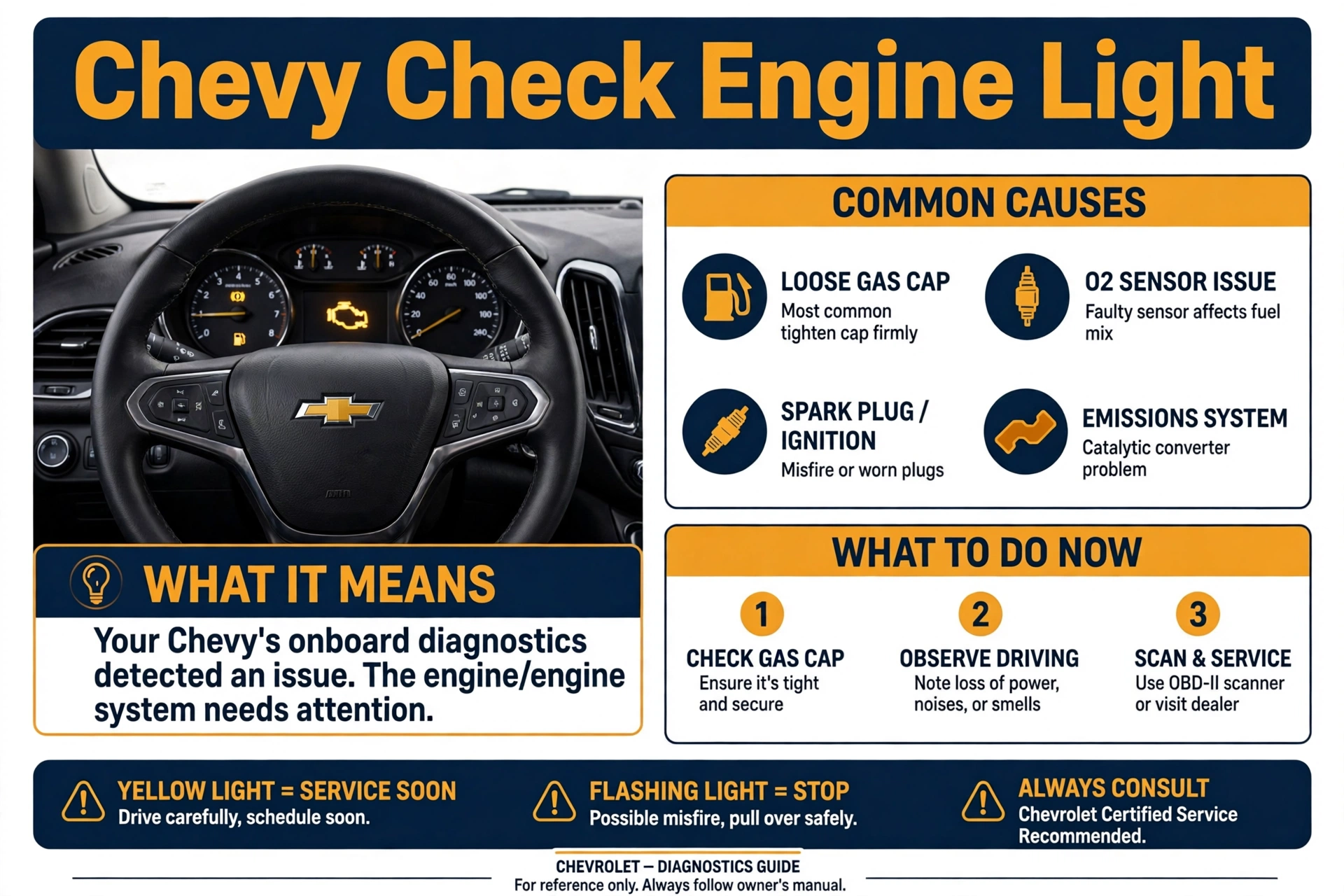
A chevrolet check engine light covers everything from compact cars to full-size trucks. However, this section focuses on the models drivers search most. Across them, misfires and EVAP leaks dominate. In addition, oil condition matters more on Chevys than on most brands.
The chevy equinox check engine light is famous for one thing. The 2.4L Ecotec engine uses oil at a rate that surprises owners. Consequently, low oil leads to timing and misfire codes. So check the dipstick before anything else on an Equinox. With the Malibu, the chevy malibu check engine light follows the same script on 2.4L versions. Next, P0300 misfires and EVAP codes (P0442, P0455) are common. The chevy traverse check engine light leans toward EVAP system leaks. On higher-mileage 3.6L models, timing-chain-related codes appear. As a result, those deserve prompt attention. For every chevy check engine light, start with the gas cap and the oil level. Those two free checks resolve a large share of cases.
The chevy volt check engine light deserves its own note. The Volt is a plug-in hybrid. Its gasoline range-extender engine runs far less often than a normal engine. Therefore, stale fuel, EVAP quirks, and a weak 12-volt auxiliary battery trigger lights that confuse owners. The Volt also sets hybrid-specific P1xxx codes for its high-voltage system. Only a capable scanner can define those. So read the code first. Never assume a Volt light means the big battery failed.
European Brands: Mercedes-Benz and Volkswagen
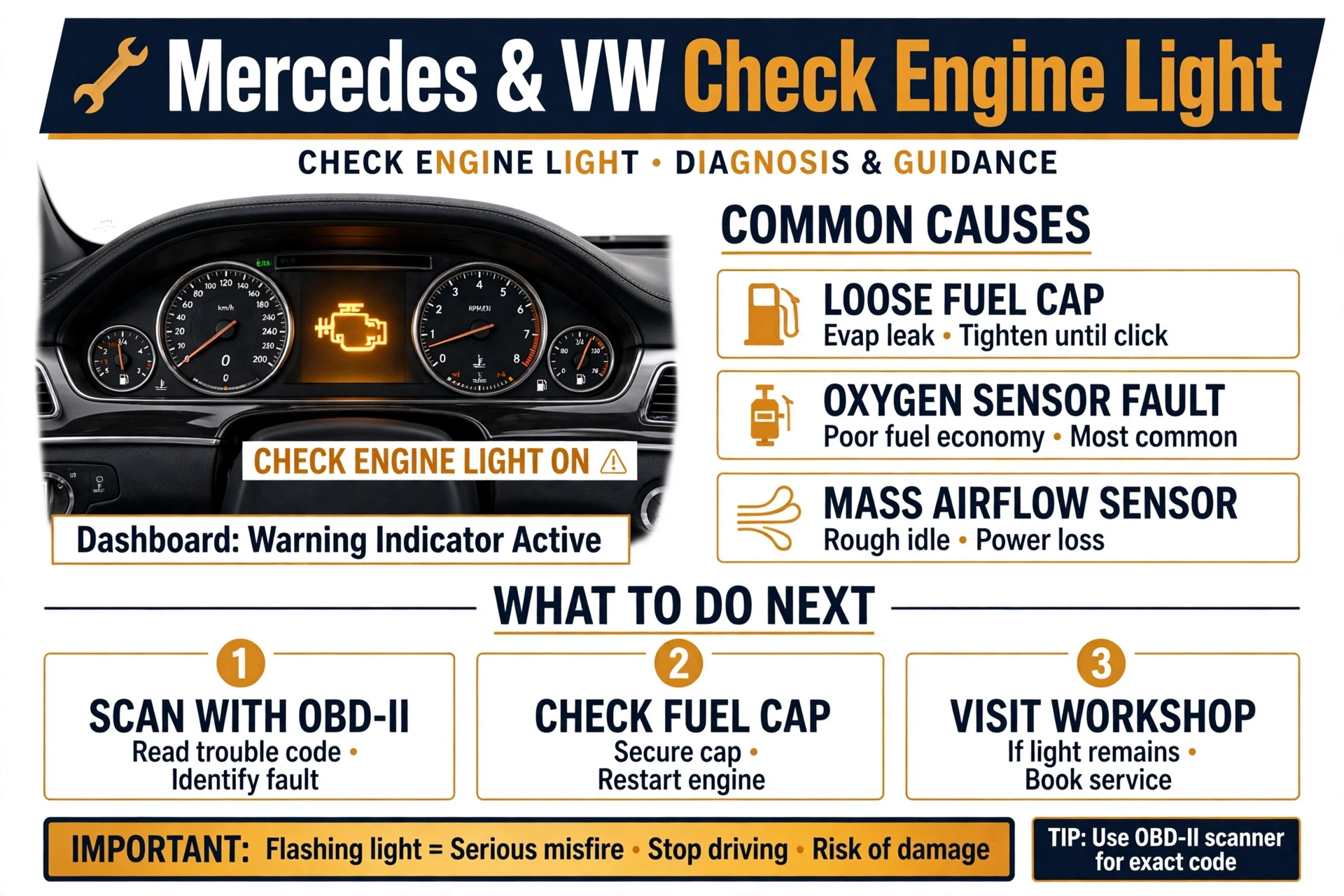
Mercedes-Benz Check Engine Light
A mercedes check engine light worries owners more than it should. In reality, Mercedes-Benz cars set the same generic codes as everything else. Most of the common ones are maintenance items, not disasters. For example, the mercedes benz check engine light most often means a lean condition. The codes are P0171 or P0174. Usually, a vacuum leak or aging intake seals cause them. A mass airflow sensor code (P0101) is common too. Similarly, a catalyst code (P0420 or P0430) appears on higher-mileage cars. Misfire codes show up as well, typically from worn spark plugs or coil packs.
Mercedes uses many manufacturer-specific codes for body, chassis, and network systems. Consequently, those read best on Mercedes XENTRY software or a high-end aftermarket scanner. For engine codes, however, a basic OBD-II scanner works fine. It gives you the same P0xxx definitions as the dealer tool.
Volkswagen Check Engine Light: Jetta and More
Drivers know the volkswagen check engine light for EVAP and ignition faults. The pattern behind it is real. Across VW models, the vw check engine light most often means a small EVAP leak (P0456). It can also mean a misfire from a failing coil pack. That is the P0300 series, a known weak point on 2.0T engines. Additionally, a lean code (P0171) from a torn PCV diaphragm is a common cause. The jetta check engine light follows this pattern closely. For instance, coil packs fail on the 1.4T and 2.0T. EVAP leaks are common. The occasional catalyst code appears too.
Volkswagen manufacturer-specific codes are famously detailed. As a result, VW specialists read them with VCDS software. A generic scanner still decodes every P0xxx code correctly. So a parts-store scan is a fine first step.
Ford Check Engine Light: Fusion and More
Ford check engine light patterns are straightforward. First come misfires, then EVAP leaks, then lean codes. For example, the ford fusion check engine light most often means a small EVAP leak (P0456). Usually, the fuel cap or EVAP purge valve is the cause. It can also mean a misfire code from the P0300 series. Typically, worn plugs or coils cause those. A lean code (P0171 or P0174) from a vacuum leak is another common trigger. Higher-mileage Fusions also show catalyst codes (P0420).
Across the wider Ford lineup, the same families repeat on the F-150 and Escape. In addition, Ford-specific P1xxx codes cover items like the electronic throttle body. As with every brand in this guide, generic codes mean the same on a Ford as anywhere else. So read the code before you shop for parts.
Lexus Check Engine Light Codes
A lexus check engine light surprises many owners. After all, Lexus cars have a reputation for running forever. They do run long. However, their emissions systems age like everyone else’s. The most common Lexus codes are catalyst efficiency codes. For instance, these are P0420 and P0430 on higher-mileage cars. Small EVAP leaks (P0456) come next, from the fuel cap or EVAP valves. Lean codes (P0171 and P0174) from air-fuel ratio sensors are common too. The occasional misfire code appears as well.
Lexus shares platforms and powertrains with Toyota. Consequently, Lexus manufacturer-specific codes overlap heavily with Toyota’s. A generic scanner reads every P0xxx code correctly on a Lexus. As a result, that covers the vast majority of check engine lights these cars set.
How to Look Up Any Model Step by Step
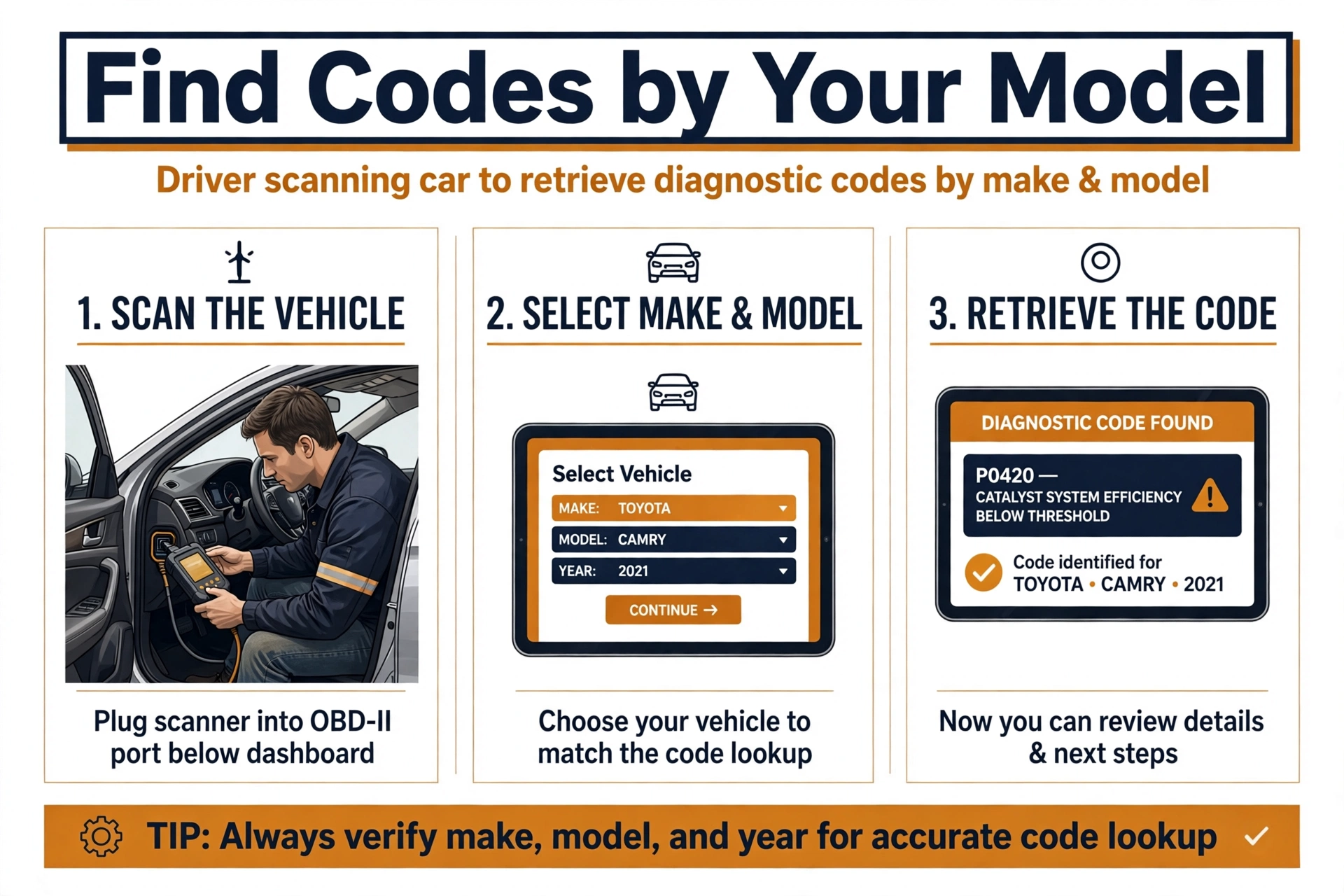
Use this five-step method for any car, truck, or SUV. It works whether or not its brand appears above.
- First, scan the vehicle. Plug your scanner into the OBD-II port under the driver-side dash. Then read every stored code. Write each one down exactly as shown.
- Second, note the exact vehicle. Record the year, make, model, engine size, and mileage. Accurate lookup depends on matching all of them.
- Third, decode the generic meaning. The P0xxx definition is the same on every brand. Therefore, any reputable code list gives you the baseline meaning.
- Next, add the brand context. Return to the brand section above. See which faults strike your vehicle most. Also check whether your code is a manufacturer-specific P1xxx code that needs brand-level software.
- Finally, decide the next move. A steady light means schedule service soon. In contrast, a flashing light means stop driving now. Never replace parts until testing points at one.
Video Walkthrough: Common Codes on Cars, Trucks, and SUVs
Watch 1A Auto, a USA-based creator, explain the most common check engine light codes. The video covers cars, trucks, and SUVs. For example, it includes misfires, catalyst codes, oxygen sensor codes, EVAP leaks, and lean codes.
Video: 1A Auto, a USA-based creator, explains the most common check engine light codes found on cars, trucks, and SUVs.
Check Engine Light Codes by Vehicle FAQs
Quick answers to the questions drivers ask most when the check engine light comes on.
What should I do first when my check engine light comes on?
Read the code with an OBD-II scanner before anything else. The light only tells you that a fault was stored. In contrast, the five-character code tells you which system reported it. Write down every code exactly. Also note whether the light is steady or flashing. Only then look up what the code means for your vehicle.
Do check engine light codes mean something different on each brand?
No. Generic codes that start with P0 carry the same definition on every brand. For instance, a P0420 is a catalyst efficiency code on a Hyundai, a Honda, and a Ford alike. What differs by brand is how often each fault occurs. It is also which parts tend to fail. Finally, it is the manufacturer-specific P1xxx codes that belong to one automaker.
What is the most common check engine light code?
Across all brands, a few codes appear most often. They are P0420 (catalyst efficiency), the P0300-series misfires, P0456 (small EVAP leak), P0171 and P0174 (lean condition), and P0442 (small EVAP leak). Often, a loose fuel cap alone accounts for a large share of EVAP lights. So check the cap before anything else.
Can I keep driving with the check engine light on?
A steady light usually means you can drive gently to a repair shop. Then schedule service soon. In contrast, a flashing light means stop driving on every brand. Pull over safely and shut the engine off. Typically, it signals a severe misfire. Consequently, that misfire can destroy the catalytic converter in minutes.
More Check Engine Light Questions
Why is my hyundai check engine light on?
On most Hyundais, a few suspects lead the list, including the Elantra, Sonata, and Tucson. Most often, a small EVAP leak from the gas cap (P0456 or P0442) is the cause. A catalyst efficiency code (P0420) follows on higher-mileage cars. Oxygen sensor codes appear too. Therefore, read the code first and check the gas cap. Remember that Hyundai-specific P1xxx codes may need a shop-level scanner to define.
How do I look up a code for my exact model?
First, scan the code. Write down your year, make, model, and engine. Then decode the generic P0xxx meaning from any reputable list. Next, add your brand’s common-fault pattern from the sections above. When the code starts with P1, look it up as a manufacturer-specific code for your brand.
Will the check engine light reset itself?
It can turn off on its own. This happens when the fault does not repeat after several drive cycles. However, the code usually stays in history. A light that returns means the fault is still present. Therefore, a light that resets itself is a reason to read the stored codes. It is not a reason to ignore them.
Conclusion: Read the Code First, Then Think by Vehicle
Check engine light codes by vehicle follow a simple two-step logic. First, the scanner gives you the code. Generic P0xxx codes mean the same thing on every brand. Second, your brand and model tell you which faults are most likely. They also show which manufacturer-specific codes to watch for. As a result, working in that order means you will rarely guess wrong.
Keep the safety rule with you as well. A steady light means a prompt appointment. In contrast, a flashing light is a stop-driving event on every vehicle in this guide. Read the code. Match it to your brand’s pattern. Fix what testing proves. Then the light will stay off.
About the author: Written by the OBD2 Code Hub editorial team. Our diagnostic guides are built from real OBD-II data, manufacturer service procedures, and hands-on troubleshooting experience, then reviewed for technical accuracy before publishing. We drive the same cars you do.