
How to Read Engine Codes Without a Scanner: 4 Real Methods
In This Guide
- How to Read Engine Codes Without a Reader: What Works and What Does Not
- Free Code Scan: Read Engine Codes Without a Reader
- The Key Dance Method (Older Chrysler, Jeep, and Dodge)
- Blink Codes on Older Cars (OBD1, Before 1996)
- Cheap Bluetooth Adapter: Read Engine Codes Without a Reader at Home
- Ford F150: Check Engine Light Codes Without a Scanner
- Toyota: How to Check Engine Codes Without a Scanner
- When You Still Need a Real Scanner
- Video: How to Read Engine Codes Without a Reader
- FAQs
- Conclusion
How to Read Engine Codes Without a Reader: What Works and What Does Not
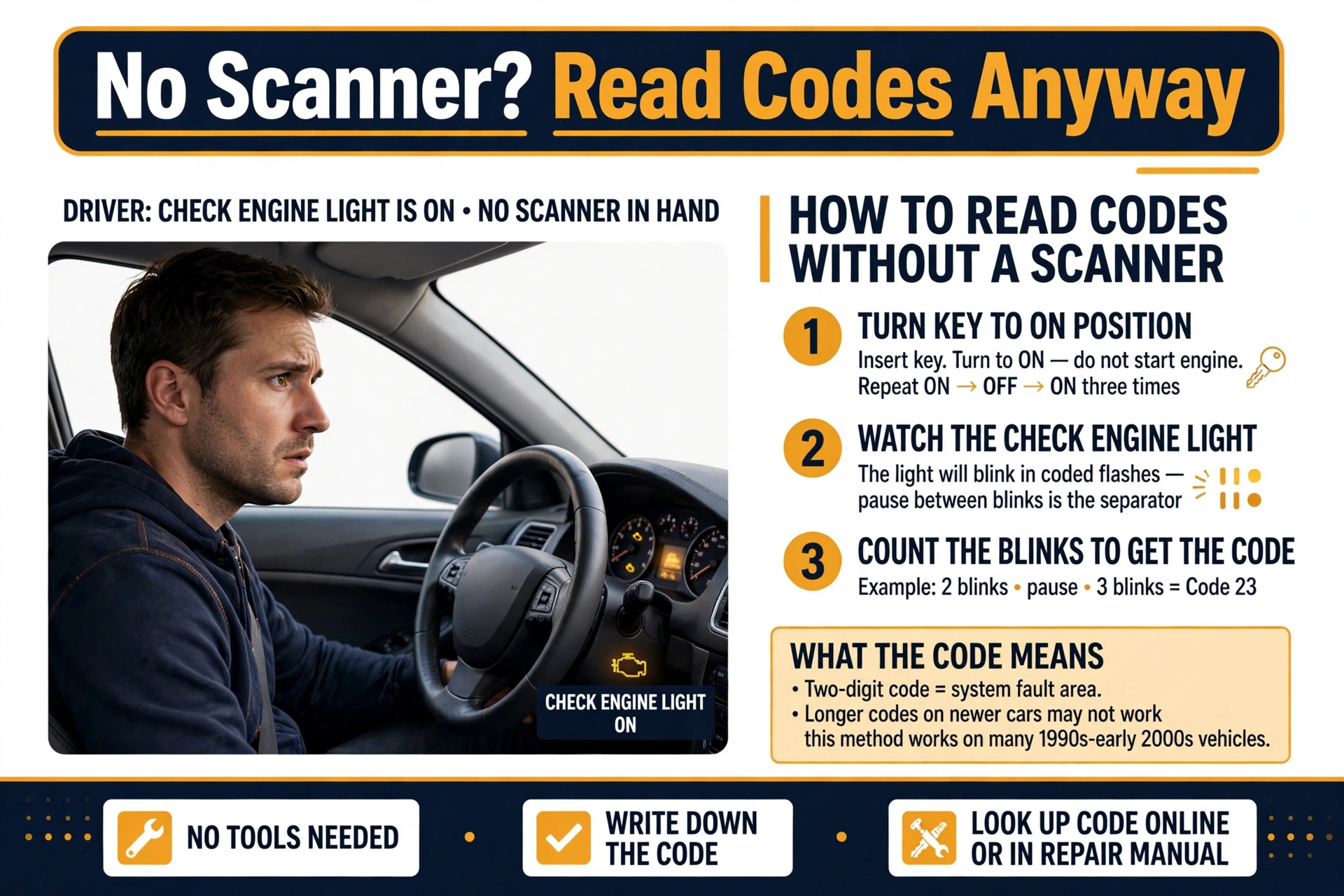
If your check engine light just came on and you do not own a scan tool, you are probably searching for how to read engine codes without a reader. The good news is that you have real options. The bad news is that each option only works on certain cars. This guide gives you the honest version: four methods that actually work, exactly which cars each one fits, and when you still need a real scanner.
First, here is the rule that shapes everything below. On modern OBD2 cars, meaning 1996 and newer, there is no universal no-scanner method. No key trick works on every car. Some older Chrysler, Jeep, and Dodge models show codes on the odometer with a key cycle. Some pre-1996 cars flash codes through the check engine light. Many Fords hide a diagnostic menu in the dashboard. For everything else, a free store scan or a cheap Bluetooth adapter is the answer. If a website promises one trick for all cars, it is not telling the truth.
Free Code Scan: Read Engine Codes Without a Reader
If you drive a 1996 or newer car, the easiest way to learn how to check engine light codes without a scanner is to let someone else do the scanning for free. Most AutoZone, O’Reilly, and Advance Auto Parts stores will plug a scanner into your car and read the codes at no charge. The visit takes a few minutes, and you leave with the exact trouble codes in hand. Ask the staff to write down every code they find, because related codes often appear together.
Now the honest limit. This free service usually covers engine codes only. The store scanner reads the codes behind your check engine light, but it normally does not read ABS, airbag, or transmission codes. Those systems need a more advanced scanner. So treat the free read for what it is: a fast, free look at your engine codes, and nothing more. In short, a free store scan is the easiest answer to how to read engine codes without a reader.

The Key Dance Method (Older Chrysler, Jeep, and Dodge)
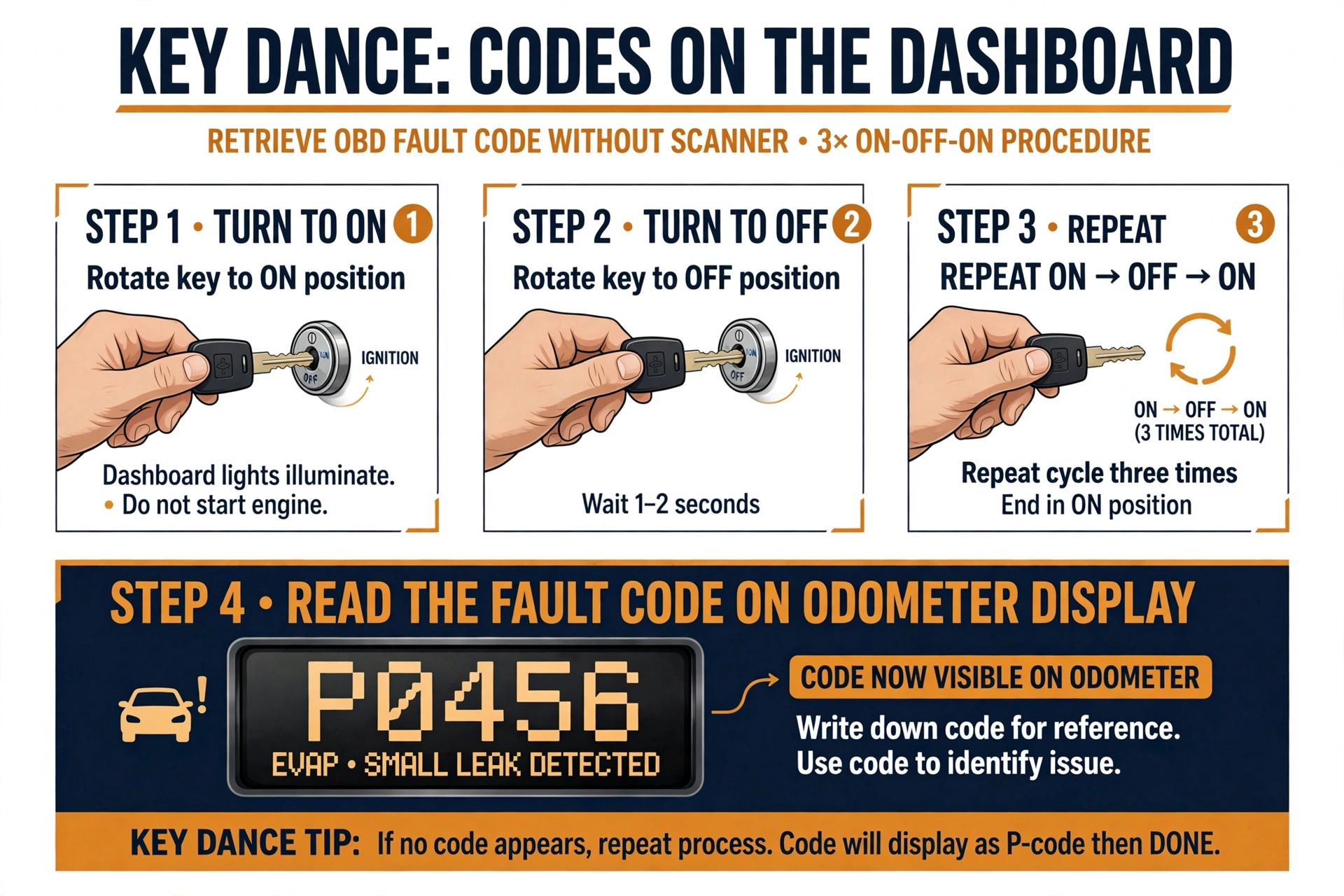
The key dance is the famous ON-OFF-ON trick, and it is also the most misunderstood method on this list. Here is the honest version: it works only on some older Chrysler, Jeep, and Dodge models. It does not work on most other brands, and it does not work on modern cars in general.
The procedure is simple. Sit in the driver seat and turn the key from OFF to ON three times in a row, leaving it in the ON position on the third cycle. Do not start the engine. On supported models, the stored codes appear one by one on the odometer display, and the sequence ends with the word “done.” Write down each code, then look up its meaning.
If nothing appears, your car simply does not support this trick. That is normal. Move on to the free store scan or the Bluetooth adapter below instead of repeating the key cycle all afternoon.
Blink Codes on Older Cars (OBD1, Before 1996)
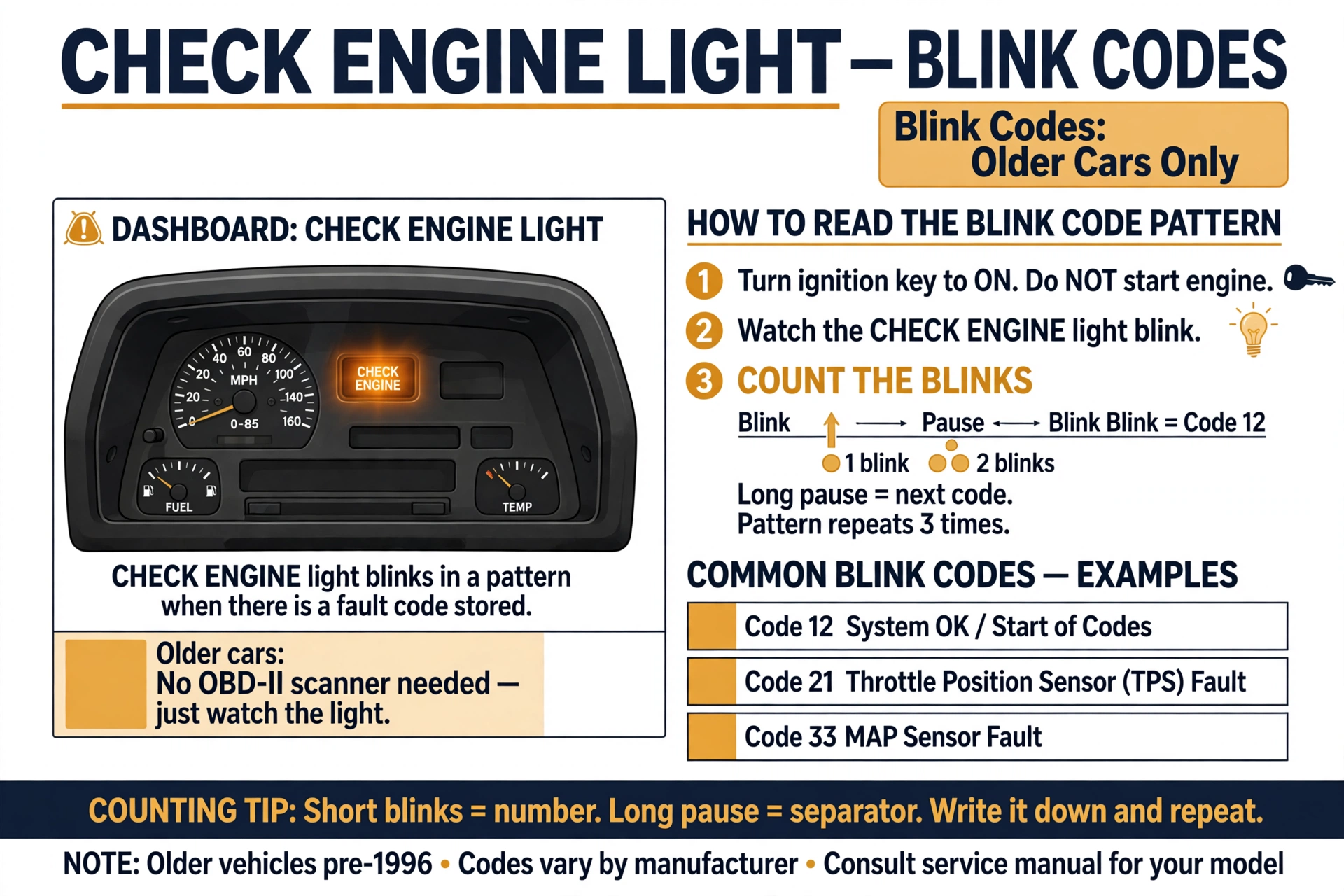
Blink codes belong to the OBD1 era, which means cars built before 1996. On these older cars, you can read fault codes with nothing but the check engine light itself, so this is a true no-tool method.
The exact steps vary by make, but the pattern stays the same. First, bridge two terminals in the diagnostic connector, often with a simple paper clip. Next, turn the ignition to ON without starting the engine. Then watch the check engine light. It blinks out each stored code as a series of flashes separated by pauses. For example, two flashes, a pause, and one flash means code 21. A longer pause separates one code from the next. Finally, translate each number with a service manual for your exact model.
Because this is an OBD1 and pre-1996 method only, it will not work on your 1996 or newer car. If your car is OBD2, skip this section and use one of the methods above.
Cheap Bluetooth Adapter: Read Engine Codes Without a Reader at Home
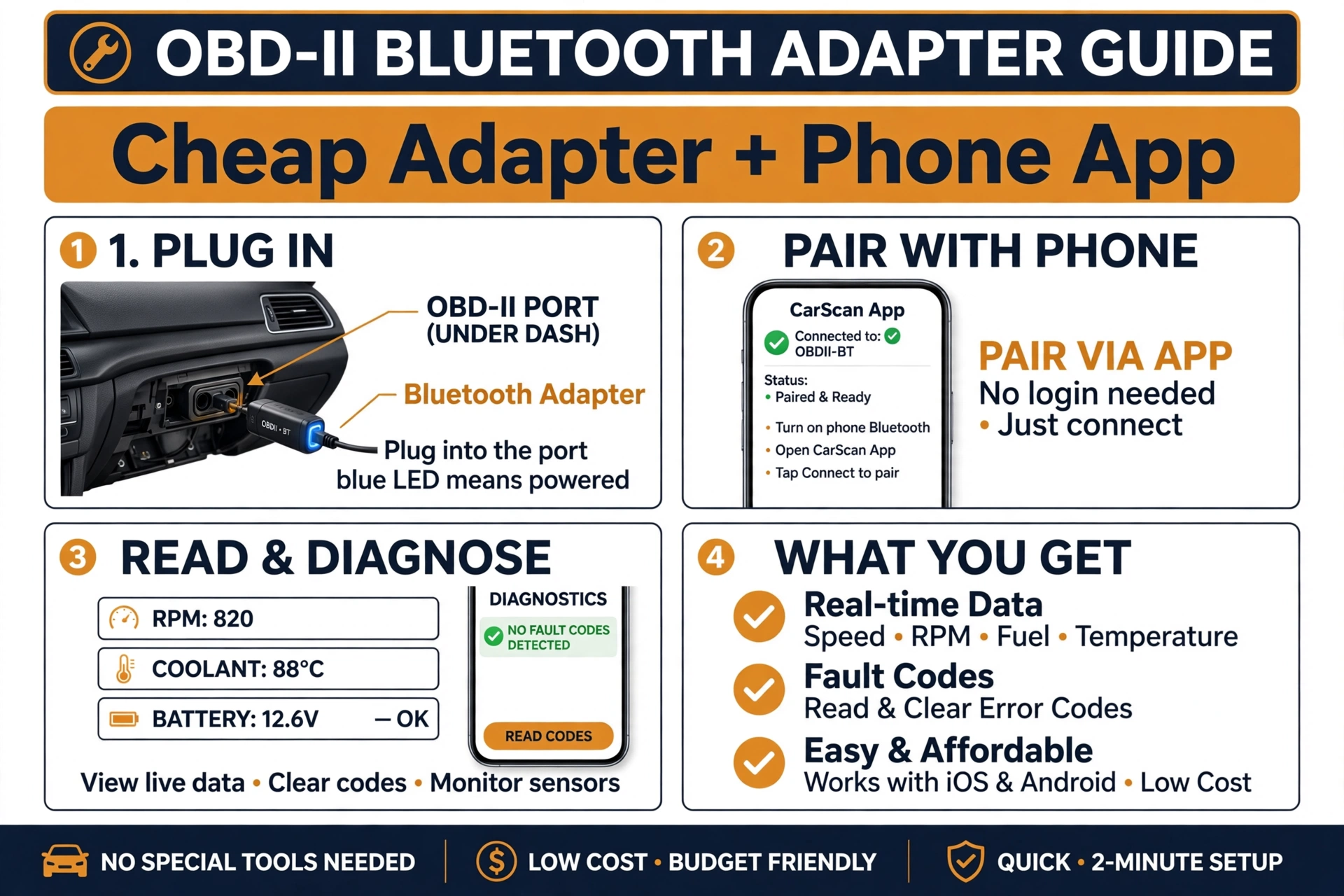
If you want your own tool without spending much, a Bluetooth OBD2 adapter plus a free phone app is the cheapest route. This point matters: it is a cheap tool, not a no-tool method. You buy a small adapter, usually for about $20 to $30, plug it into the OBD2 port under your dashboard, and pair it with a free app on your phone.
Once connected, the app reads and clears engine codes and shows live sensor data. Your phone becomes a basic scan tool. For most drivers, this small adapter pays for itself the first time the check engine light comes on, because it replaces the trip to the store and works on any 1996 or newer car. For drivers who want to solve how to read engine codes without a reader at home, this adapter is the best value.
Ford F150: Check Engine Light Codes Without a Scanner
Searching for ford f150 check engine light codes without scanner turns up one method worth knowing: Ford’s built-in Engineering Test Mode. Many modern F-150 trucks hide a diagnostic menu in the instrument cluster, and it can show stored trouble codes with no scan tool at all.
Here is the procedure that Ford sources describe. Press and hold the OK button on the steering wheel. While holding it, turn the ignition to ON without starting the engine. Keep holding for about five seconds until “Engineering Test Mode” appears on the dashboard display. Then release the button and scroll through the menu with the steering wheel controls to find the stored codes. Write down each code so you can look up its meaning later. To exit, cycle the ignition off and on.
Two honest notes. First, this mode can read codes but cannot clear them. Second, not every F-150 supports it, since older trucks and some trim levels lack the menu. If your truck never shows the test mode, use a free store scan or a cheap Bluetooth adapter instead.
Toyota: How to Check Engine Codes Without a Scanner
For drivers asking how to check engine codes without a scanner toyota, the answer depends on the age of the car, and the two cases are very different.
On older OBD1 Toyotas, generally built before 1996, there is a verified no-scanner method. Open the diagnostic box under the hood. Use a paper clip or jumper wire to bridge the TE1 and E1 terminals. Then turn the ignition to ON without starting the engine. The check engine light flashes out each stored code. Count the flashes, with a short pause inside a code and a longer pause between codes. Then look up the two-digit numbers in a Toyota repair manual.
On 1996 and newer Toyotas, which use OBD2, there is no confirmed no-scanner method. The jumper trick does not work on these cars. So here is the honest statement for a modern Toyota: no confirmed no-scanner method for this model, use a free store scan or a cheap Bluetooth adapter instead.
When You Still Need a Real Scanner
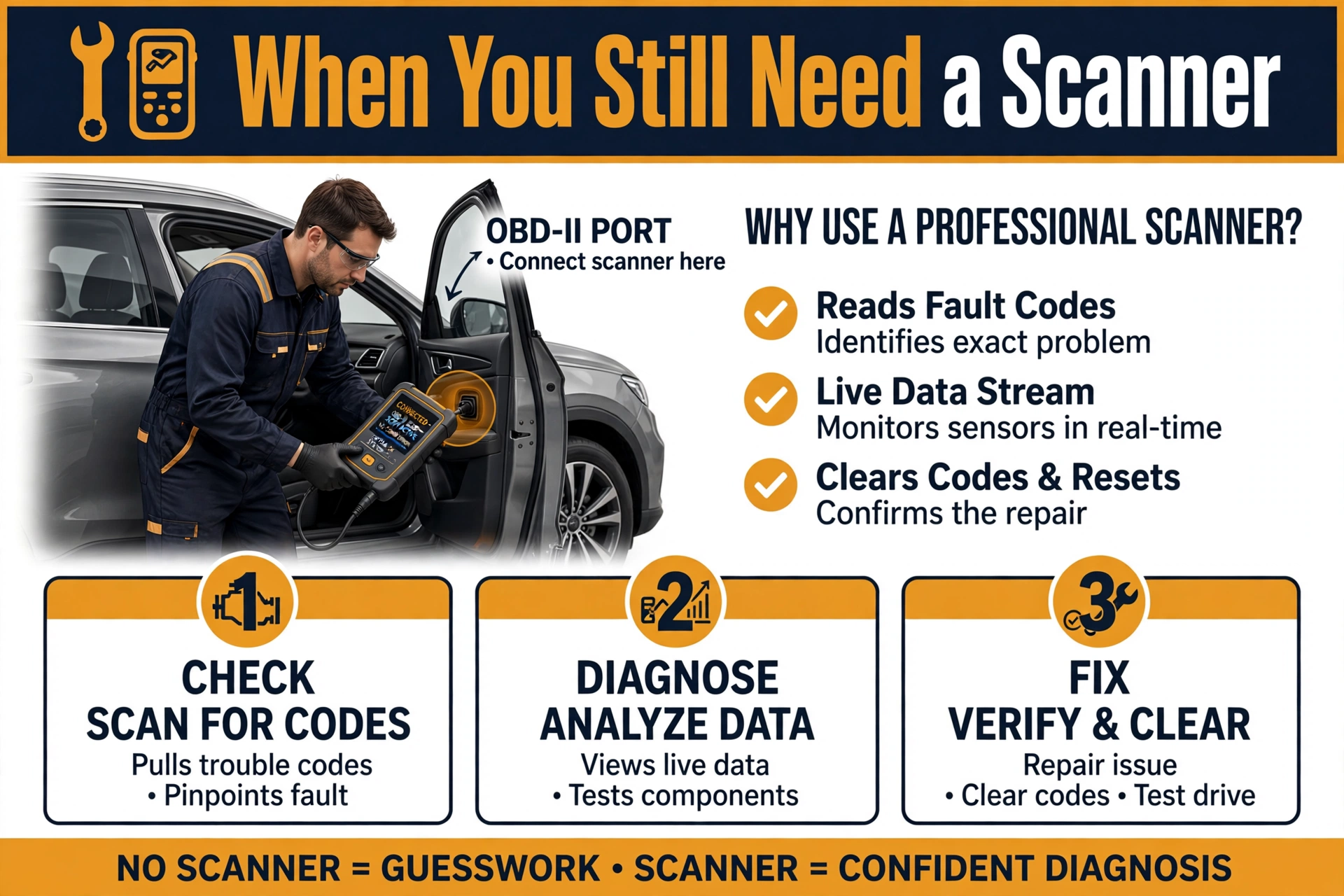
No-scanner methods have hard limits, and some jobs need a real tool. First, none of the tricks above can read ABS, airbag, or transmission codes on most cars. Those systems stay invisible without a capable scanner. Second, tricks cannot show live sensor data, and live data is often the difference between guessing and diagnosing. Third, most no-scanner methods cannot clear a code after a repair, so you cannot confirm that the fix worked.
A basic handheld scanner solves all three problems, and decent ones cost less than a single shop diagnostic fee. Think of the free methods as a fast first look. When the problem is complex, comes and goes, or sits outside the engine computer, reach for a real scanner.
Video: How to Read Engine Codes Without a Reader
If you want to see how to read engine codes without a reader in action, watch Andy Phillips of Phillips Vision, a USA-based creator, demonstrate the key-cycle method and explain when it works. Watch it on YouTube.
Video: Checking engine codes without a scan tool demonstrated step by step by Andy Phillips of Phillips Vision, a USA-based creator.
FAQs About Reading Codes Without a Scanner
Quick answers to the questions drivers ask most about reading codes without a scanner.
Can I read engine codes without a scanner on a modern car?
On 1996 and newer OBD2 cars, there is no universal no-scanner method. The key dance only works on some older Chrysler, Jeep, and Dodge models, and blink codes only work on pre-1996 cars. For a modern car, your realistic options are a free scan at an auto parts store or a cheap Bluetooth adapter with a phone app.
How does the key dance method work?
Turn the ignition key from OFF to ON three times and leave it ON on the third cycle without starting the engine. On supported Chrysler, Jeep, and Dodge models, the stored codes appear on the odometer display one by one, and the sequence ends with the word “done.” If nothing appears, your car does not support this method.
Do free auto parts store scans read ABS and transmission codes?
Usually not. The free scan at stores like AutoZone, O’Reilly, and Advance Auto Parts normally covers engine codes only. It will read the codes behind your check engine light, but ABS, airbag, and transmission codes need a more advanced scanner.
How can I check engine codes without a scanner on a Ford F-150?
Many F-150 trucks have a built-in Engineering Test Mode. Hold the OK button on the steering wheel, turn the ignition to ON without starting the engine, and keep holding for about five seconds until the test mode appears. Then scroll the menu to view the stored codes and write them down. Note that this mode can read codes but cannot clear them, and some trims do not support it.
How can I check engine codes without a scanner on a Toyota?
On pre-1996 OBD1 Toyotas, bridge the TE1 and E1 terminals in the under-hood diagnostic box with a paper clip, turn the ignition to ON, and count the check engine light flashes. On 1996 and newer Toyotas, there is no confirmed no-scanner method, so use a free store scan or a cheap Bluetooth adapter.
What is the cheapest way to read engine codes at home?
A Bluetooth OBD2 adapter with a free phone app, usually about $20 to $30. It plugs into the OBD2 port under your dashboard and turns your phone into a basic scan tool that reads and clears engine codes. It is the cheapest own-tool option, though it is a tool you buy rather than a no-tool trick.
When should I buy a real OBD2 scanner?
Buy one when you need ABS, airbag, or transmission codes, when you want live sensor data for real diagnosis, or when you need to clear codes after a repair. A basic handheld scanner costs less than one shop diagnostic fee and works on any 1996 or newer car.
Conclusion: Know Which Method Fits Your Car
If you searched for how to read engine codes without a reader, you now have four honest answers. Free store scans handle engine codes on any modern car. The key dance serves some older Chrysler, Jeep, and Dodge models. Blink codes serve pre-1996 cars. A cheap Bluetooth adapter covers everything else for about $20. You now know exactly which method fits your car, and just as important, which ones do not. Read the code, look it up, and fix the real problem instead of guessing.
About the author: Written by the OBD2 Code Hub editorial team. Our diagnostic guides are built from real OBD-II data, manufacturer service procedures, and hands-on troubleshooting experience, then reviewed for technical accuracy before publishing. We drive the same cars you do.