
P0741 Trouble Code: Meaning, Causes, Symptoms & Fixes
In This Guide
One-line meaning: P0741: Torque Converter Clutch Circuit Performance or Stuck Off.
What the P0741 Code Means
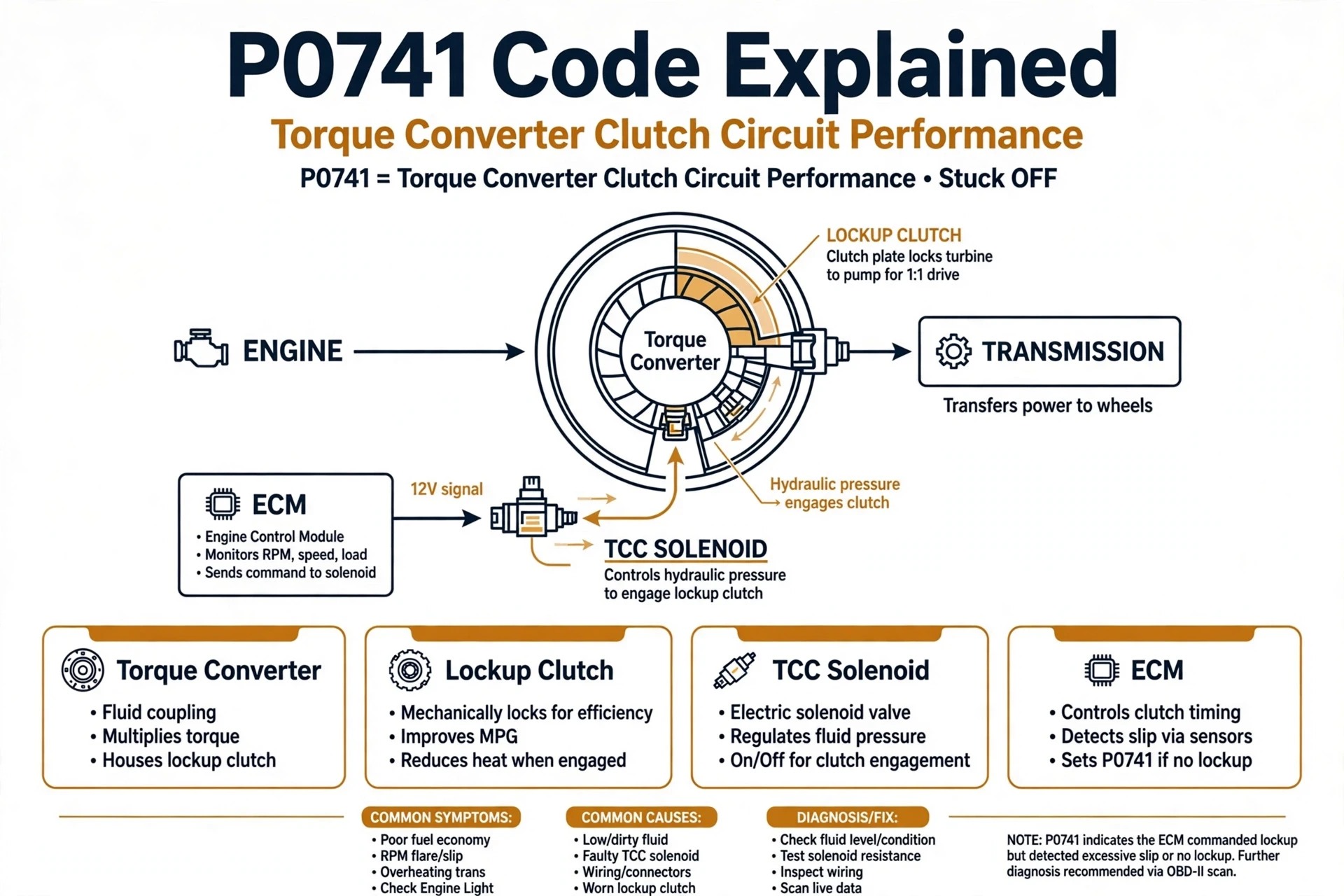
The p0741 code is the transmission code drivers dread seeing after a highway trip. Its full definition is “Torque Converter Clutch Circuit Performance or Stuck Off,” and it means your car’s computer has caught the torque converter clutch failing to do its one job: locking the engine and transmission together at cruising speed.
Here is what is actually happening. Inside your automatic transmission sits the torque converter, a fluid coupling between the engine and the gearbox. At highway speeds, a small friction clutch inside it, the torque converter clutch (TCC), engages to create a direct mechanical link. That lockup kills slippage and saves fuel. When the powertrain control module (PCM) or transmission control module (TCM) commands lockup, it watches the engine RPM and the transmission input speed. If the gap between them stays above roughly 200 RPM, meaning the clutch is slipping instead of locking, it stores the p0741 code and turns on the check engine light.
The name covers two failures. “Performance” means the clutch engages weakly or slips. “Stuck Off” means it never engages at all. When drivers search for engine code p0741, they usually want to know which one they have, and the answer is found in the live data, covered in the diagnosis section below.
P0741 (p0741 obd ii, engine code p0741) is a generic powertrain code, which means it has the same meaning on every make and model, from a Honda Accord to a Chevy Silverado.
Symptoms of the P0741 Code
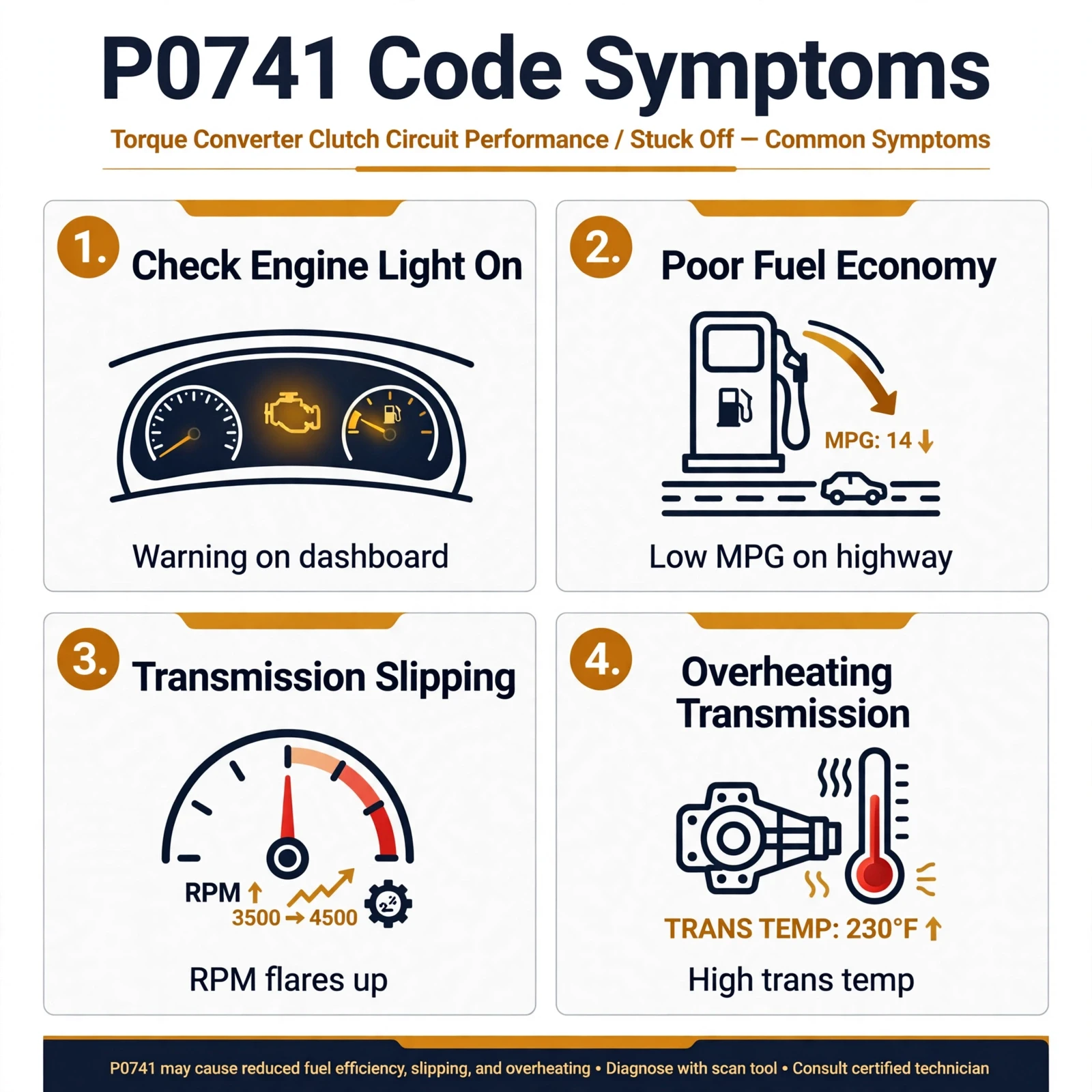
Sometimes the check engine light is the only symptom. The car can feel normal around town because the lockup clutch only works at steady cruising speeds. Watch for these signs:
- Check engine light with the p0741 code stored
- Engine RPM staying higher than normal at highway speed, or RPM not dropping when lockup should engage
- Noticeably worse fuel economy, often a 5 to 10 percent drop
- Shuddering or vibration under light acceleration or at cruising speed
- Transmission slipping, delayed shifts, or harsh shifting
- Transmission temperature warning or overheating, since a slipping clutch generates extra heat
What is code P0741 trying to tell you? In short: the lockup clutch is not holding, your transmission is working harder than it should, and your fuel bill is climbing.
Common Causes of P0741
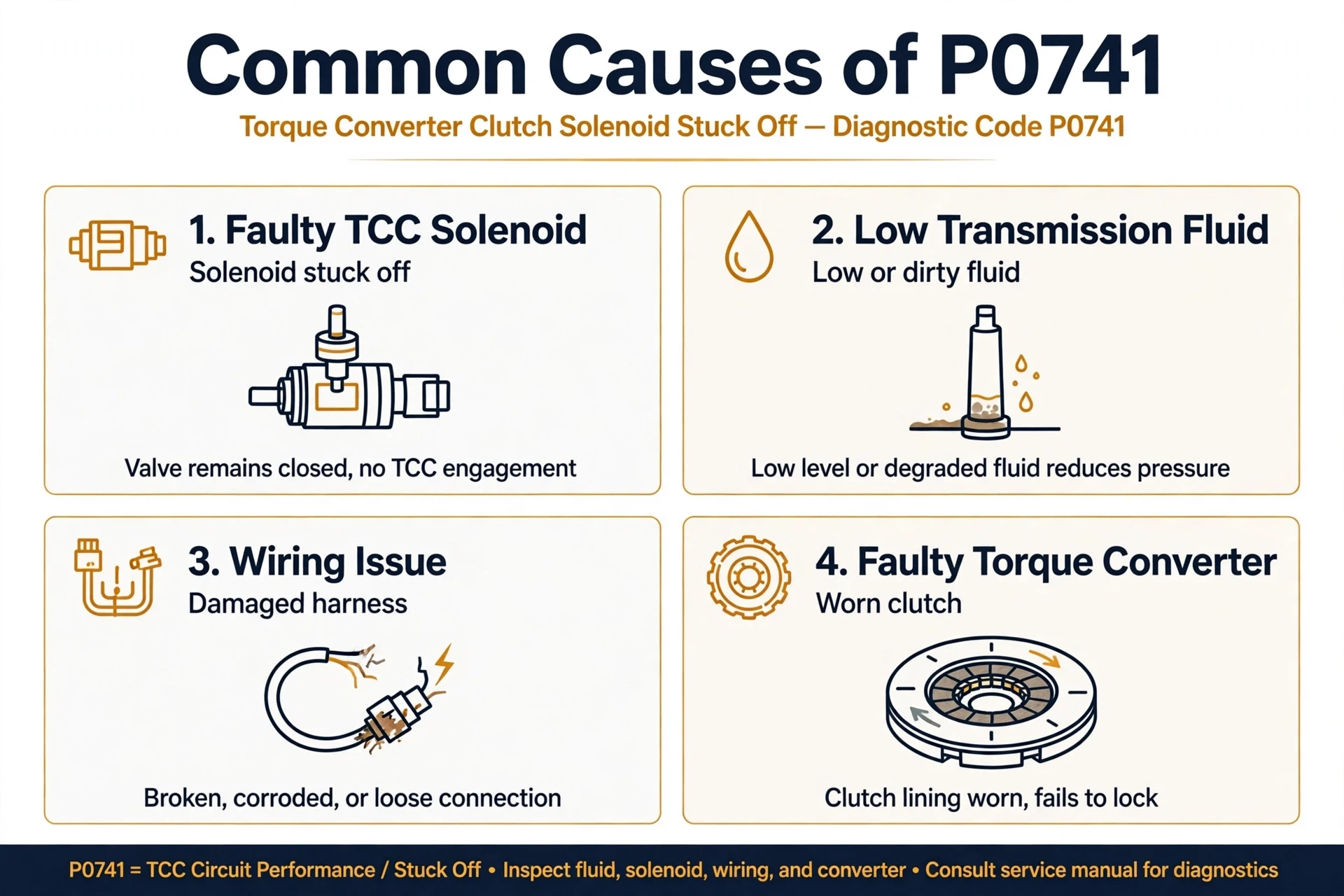
The most common causes of the p0741 code, from cheapest to most expensive:
- Low or degraded transmission fluid: dirty, burnt, or low fluid cannot build proper hydraulic pressure, so the clutch cannot clamp. This is the first thing to check and the cheapest fix.
- Faulty TCC solenoid: a stuck, clogged, or electrically failed torque converter clutch solenoid cannot route fluid to the clutch. One of the most common root causes.
- Wiring or connector problems: damaged, corroded, or loose wiring in the TCC circuit between the computer and the transmission.
- Valve body issues: a sticking lock-up valve or pressure regulator valve inside the valve body starves the clutch of pressure.
- Internal torque converter failure: the clutch lining itself is worn out from age or overheating, so it slips no matter what the hydraulics do.
- TCM or ECM software issue: rare, but some vehicles have software updates that change how lockup is commanded and monitored.
How to Diagnose P0741 (Do This Before Buying Parts)
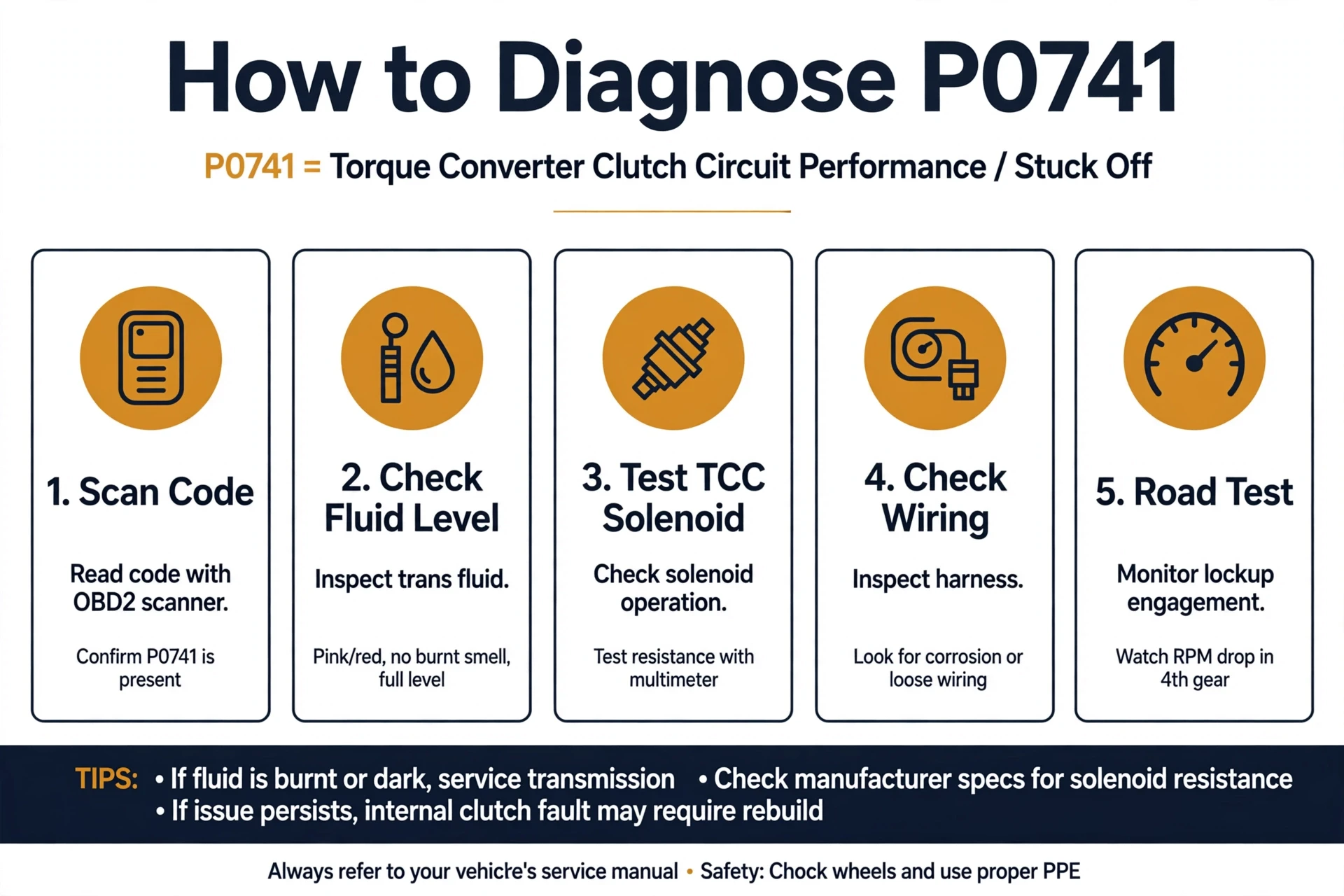
P0741 gets misdiagnosed often, with converters replaced when the real problem was a bad solenoid or low fluid. Work through these steps in order:
- Scan for all codes first. Note companions like P0700 (transmission control system), P0740, P0742, P0743, or P0744, which narrow the fault to the TCC circuit.
- Check the transmission fluid. Verify the level, color, and smell with the engine warm. Healthy fluid is pinkish-red. Dark brown or burnt-smelling fluid, especially with metal flakes, points to internal damage.
- Road test with live data. Using an OBD2 scanner that shows live data, watch the commanded TCC state and the actual slip RPM at steady highway speed. Near-zero slip means lockup is working. Persistent slip above about 200 RPM confirms the fault.
- Test the TCC solenoid. Measure its resistance and compare it to the manufacturer specification (many solenoids read roughly 10 to 30 ohms), and confirm the computer is sending the activation signal.
- Inspect the wiring and connectors. Check the harness running to the transmission for chafing, corrosion, bent pins, and loose connections.
- Test the valve body before condemning the converter. Pressure and vacuum testing can reveal a sticking lock-up valve, which is far cheaper to fix than a torque converter replacement.
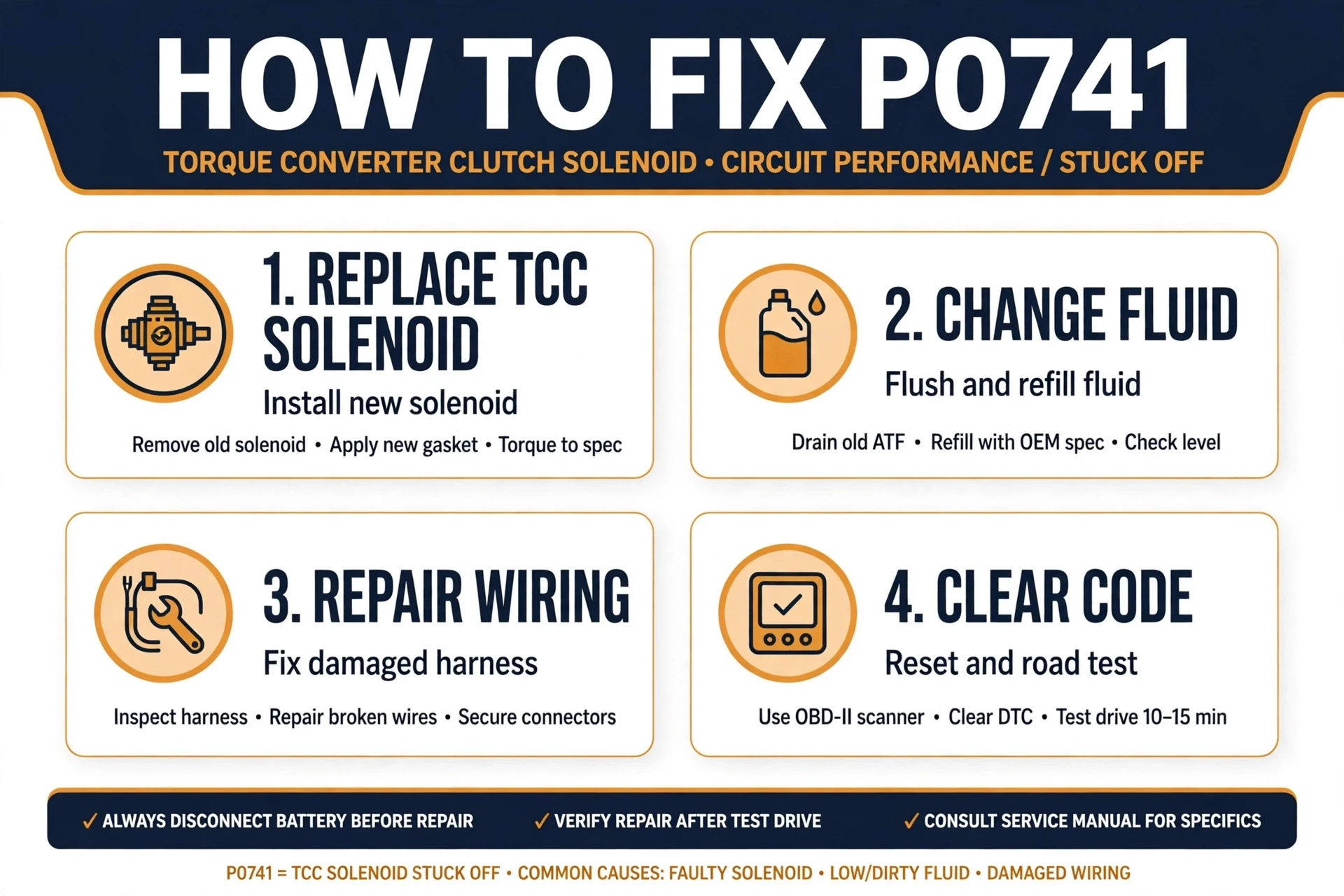
How to Fix the P0741 Code
The right fix depends on what your diagnosis found:
- Top off or replace the fluid and filter: a fluid and filter service fixes many p0741 cases caused by low or degraded fluid. Use the exact fluid specification for your vehicle.
- Replace the faulty TCC solenoid: if the solenoid is stuck, clogged, or out of electrical specification, replacement usually requires dropping the transmission pan.
- Repair the wiring: fix corroded connectors, chafed wires, or poor grounds in the TCC circuit.
- Service the valve body: clean or replace a sticking lock-up valve. In some cases the whole valve body gets replaced.
- Replace the torque converter: when the clutch lining is worn or the converter is damaged internally, replacement is the only fix. This requires removing the transmission.
- Software update: rare, but have the dealer check for TCM or ECM updates related to TCC operation.
- Clear and verify: after the repair, clear the code and drive through several lockup cycles at highway speed to confirm the slip stays near zero.
P0741 Repair Costs
Drivers always ask how much it costs to fix the p0741 code, and the range is wide because the same code covers a simple fluid service and a full transmission job. Typical ranges:
| Repair | Cost Range |
|---|---|
| Transmission fluid and filter service | $150 – $300 |
| TCC solenoid replacement | $250 – $650 |
| Wiring or connector repair | $100 – $350 |
| Valve body replacement | $600 – $1,500 |
| Torque converter replacement | $900 – $2,500 |
| Transmission rebuild (worst case) | $2,500 – $4,500 |
This is why diagnosis matters. A $250 solenoid job and a $2,500 converter job share the same p0741 code.
DIY vs Mechanic Verdict
You can do this at home: checking and topping off transmission fluid, scanning codes and reading live slip data with an OBD2 scanner, and visually inspecting the wiring and connectors at the transmission.
See a mechanic for: TCC solenoid replacement (involves dropping the pan and working with transmission internals), valve body service, and torque converter replacement (requires transmission removal). A transmission specialist is the right shop for this code.
Bottom line: diagnose it yourself and handle the fluid yourself, but let a pro open up the transmission.
Can You Drive With a P0741 Code?
Short trips at lower speeds are usually fine, since the lockup clutch only matters at cruising speed. But extended highway driving with the p0741 code is not advisable. The slipping clutch generates extra heat, fuel economy keeps dropping, and prolonged overheating can turn a solenoid or converter job into a full transmission rebuild. Get it diagnosed soon, and keep highway runs short until you do.
P0741 on Popular Vehicles
P0741 shows up across all brands, but some patterns are worth knowing:
- Acura and Honda (TL, Accord): The p0741 code is famously common on the Acura TL, where the torque converter clutch itself is often the culprit.
- GM (Silverado, Sierra, Tahoe): Higher-mileage trucks often need a TCC solenoid or torque converter. Shudder at cruising speed is the classic complaint.
- Ford (F-150, Edge, Explorer): Converter clutch shudder and the p0741 code appear regularly. Check for technical service bulletins covering your model year.
- Nissan (Altima, Maxima, Pathfinder): Fluid condition and valve body wear are frequent triggers, so start with a fluid service.
- BMW: Lock-up solenoid electrical faults can set the p0741 code. Solenoid resistance testing is the key check.
P0741 vs P0742
These two codes are mirror images. P0741 means the torque converter clutch will not engage (stuck off or slipping): high highway RPM, worse fuel economy, and possible shudder. P0742 means the clutch is stuck on: the engine may stall when you come to a stop, and you may feel harsh engagement at low speeds. Both point at the same TCC system, so diagnosis overlaps: solenoid, wiring, valve body, and the converter itself. The live data tells them apart. With P0741 the clutch never locks. With P0742 it never releases.
Related Codes
- P0740: Torque Converter Clutch Circuit Malfunction
- P0742: Torque Converter Clutch Circuit Stuck On
- P0743: Torque Converter Clutch Circuit Electrical
- P0744: Torque Converter Clutch Circuit Intermittent
- P0700: Transmission Control System Malfunction (often stored with P0741)
- P2769 / P2770: Torque Converter Clutch Solenoid Circuit faults
Video Walkthrough
Watch the video above for a visual walkthrough of P0741 causes and diagnosis before you read on.
Frequently Asked Questions
What is the most common cause of a P0741 code?
A faulty torque converter clutch (TCC) solenoid or low, dirty transmission fluid. Together these account for most P0741 cases, and both are far cheaper than a torque converter replacement, which is why fluid and solenoid checks come first.
Can I still drive with a P0741 code?
Short, low-speed trips are usually fine. Extended highway driving is not advisable because the slipping clutch builds extra heat and can damage the transmission, turning a minor repair into a rebuild.
How do you fix the P0741 code?
Diagnose first, then repair what failed: service the fluid and filter, replace a bad TCC solenoid, repair damaged wiring, service the valve body, or replace the torque converter if its clutch is worn. Then clear the code and verify lockup on a highway test drive.
How much does it cost to fix P0741?
Typically $150 to $300 for a fluid and filter service, $250 to $650 for a TCC solenoid, and $900 to $2,500 or more for a torque converter replacement. Diagnosis determines which one you need.
Will P0741 clear itself?
Rarely for long. The light may go off after some drive cycles, but the code returns as soon as the computer commands lockup and sees the slip again. The underlying fault has to be repaired.
Can low transmission fluid cause a P0741 code?
Yes. Low or degraded fluid is one of the most common causes of engine code p0741 because the clutch needs full hydraulic pressure to lock. Check the level and condition before anything else.
What is the difference between P0741 and P0742?
P0741 means the torque converter clutch will not engage (stuck off or slipping), causing high highway RPM and poor fuel economy. P0742 means it is stuck on, which can stall the engine at stops. Same system, opposite failures.
Conclusion
The P0741 code looks serious, and it deserves respect, because it involves your transmission. But it is really your car asking for a proper diagnosis, not an automatic transmission rebuild. Start with the fluid, test the solenoid, check the wiring, and most drivers find the fix costs far less than they feared. Handle it promptly, keep highway driving short until it is fixed, and your transmission will thank you.
About the author: Written by the OBD2 Code Hub editorial team. Our diagnostic guides are built from real OBD-II data, manufacturer service procedures, and hands-on troubleshooting experience, then reviewed for technical accuracy before publishing. We drive the same cars you do.