
P0175 Trouble Code: Meaning, Causes, Symptoms & Fixes
In This Guide
One-line meaning: P0175: System Too Rich (Bank 2).
What the P0175 Code Means
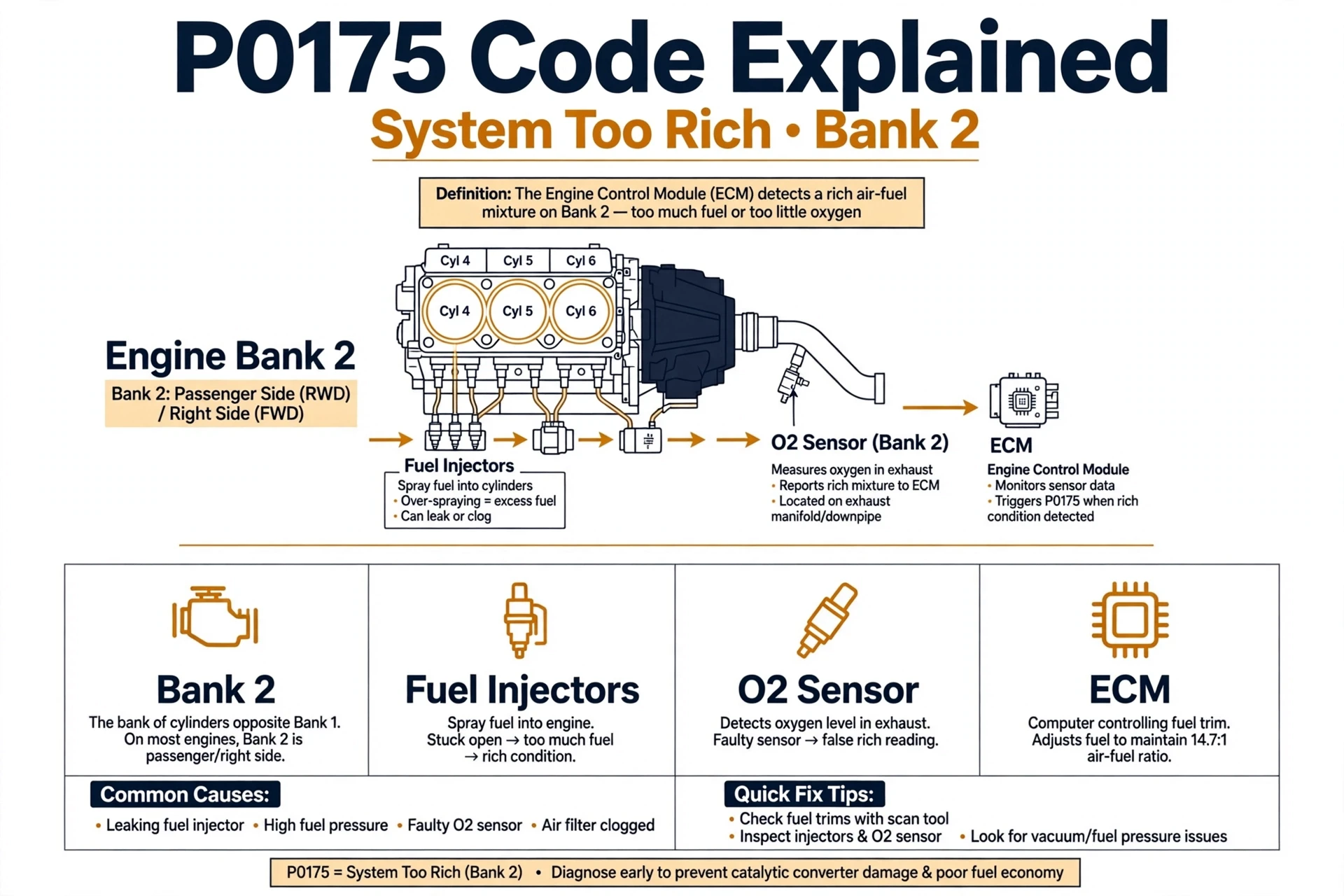
The p0175 code is one of the most searched fuel-system trouble codes, and its full definition is “System Too Rich (Bank 2).” In plain English, the engine computer has decided that bank 2 of your engine is burning too much fuel and not enough air.
Here is what “rich” means in practice. A gasoline engine makes its best power and cleanest exhaust at an air-fuel ratio near 14.7 to 1. Any mixture carrying clearly more fuel than that counts as rich. Bank 2 is the bank of cylinders opposite cylinder 1, which is why the p0175 code shows up almost only on V6 and V8 engines. An inline-four has a single bank, so it will just about never set this code.
Here is how your car figures this out. The bank 2 upstream oxygen sensor samples the exhaust stream nonstop. Exhaust from a rich burn carries very little leftover oxygen, so the sensor sends a rich signal. The engine computer answers with negative fuel trim, pulling fuel out of the mix. When the correction stays pinned beyond roughly -15% to -25% and the mixture still reads rich, the computer stops compensating and logs P0175 (also written as p0175 obd2 or p0175 code bank 2).
A detail that misleads many DIYers: an oxygen sensor senses oxygen, not fuel. When a cylinder misfires, raw fuel dumps into the exhaust and consumes the oxygen there, so the sensor reports “rich” while the true fault is ignition or compression. That is why you always pull the full code list before spending money on parts.
Symptoms of the P0175 Code
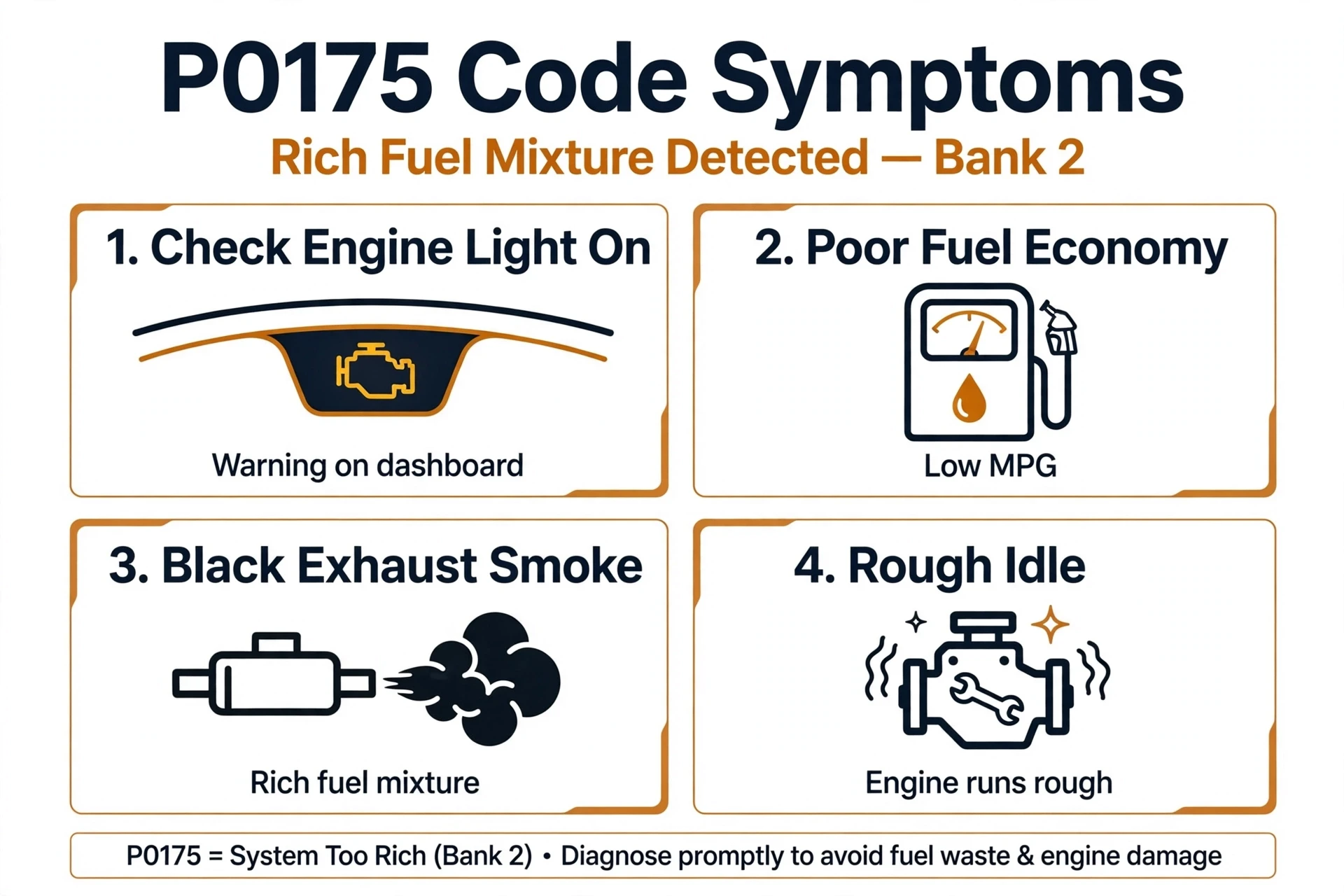
In many cases, the check engine light is the only symptom you will notice, and the car may drive almost normally at first. When symptoms do show up, they look like this:
- Strong fuel or exhaust smell, especially at idle
- Black smoke or dark soot from the tailpipe
- Noticeably worse fuel economy, with more frequent fill-ups
- Rough idle, stumbling, or stalling
- Hesitation or weak acceleration under load
- Engine misfire, sometimes with companion misfire codes
What is code P0175 trying to tell you? In short, bank 2 is getting more fuel than it can cleanly burn. Do not ignore the p0175 code just because the car still drives. A rich mixture punishes the catalytic converter and your wallet at the pump.
Common Causes of P0175
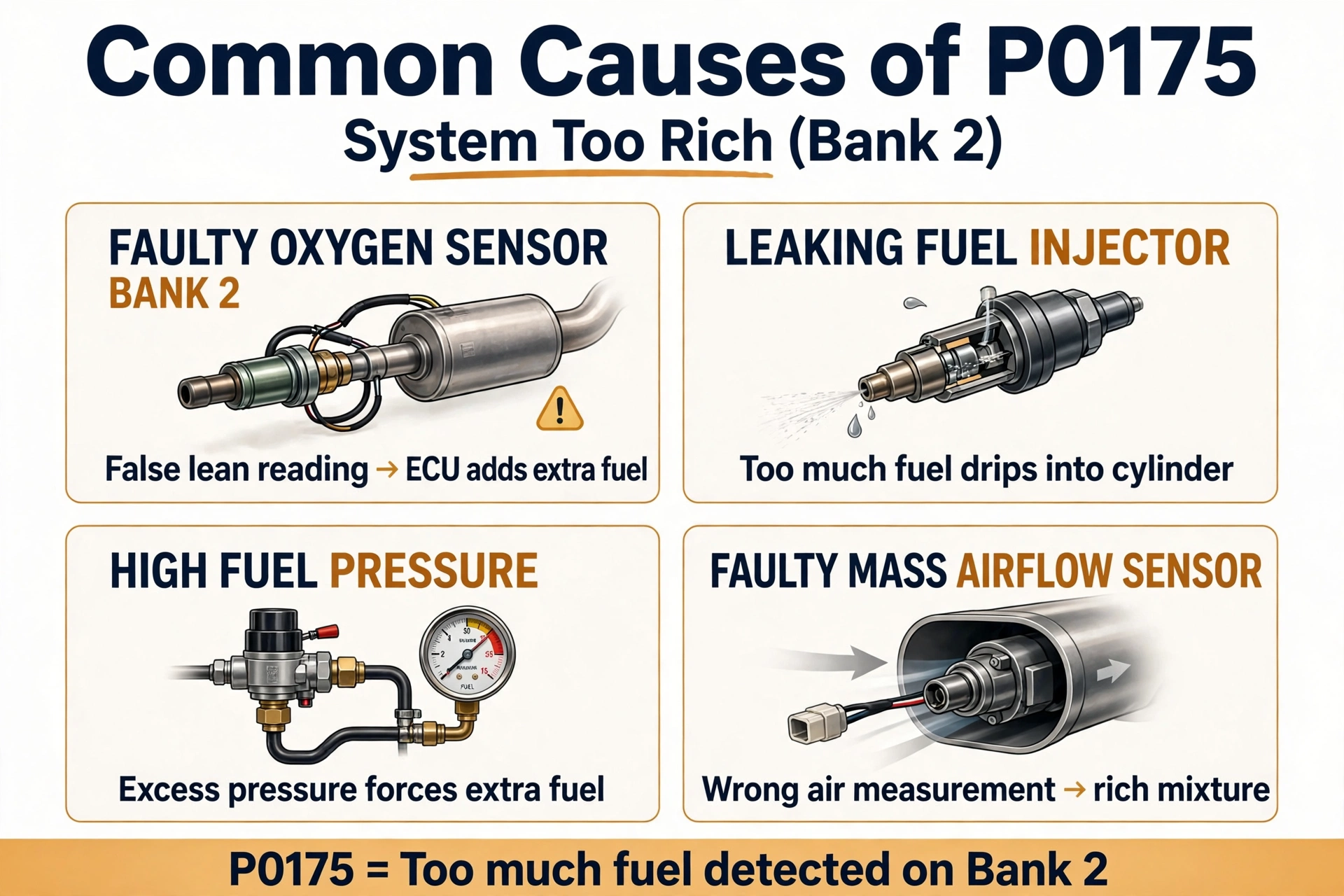
The most common cause of a P0175 code is a dirty or failing mass airflow (MAF) sensor. When it misreads incoming air, the computer miscalculates fuel delivery and bank 2 runs rich. But plenty of other faults can set it:
- Dirty or faulty MAF sensor: contaminated sensing wires, often from oiled aftermarket air filters, report less air than the engine really inhales.
- Clogged air filter or restricted intake: a choked filter or collapsed intake hose starves the engine of air.
- Leaking or stuck fuel injectors on bank 2: extra fuel drips or sprays into those cylinders.
- High fuel pressure: a stuck fuel pressure regulator pushes more fuel through every injector.
- Faulty bank 2 upstream O2 sensor: a lazy, biased, or heater-circuit-faulty sensor feeds the computer bad data.
- Wrong coolant temperature readings: a bad coolant temp sensor or a stuck-open thermostat keeps the engine in cold-start enrichment far too long.
- Vacuum leaks and cracked vacuum lines: unmetered air throws the fuel trim calculations off.
- EVAP purge valve stuck open: fuel vapors flood the intake at the wrong time.
- Exhaust leaks near the O2 sensor: outside air skews the sensor reading.
- Outdated PCM software: some models need a reflash covered by a technical service bulletin.
How to Diagnose P0175 (Do This Before Buying Parts)
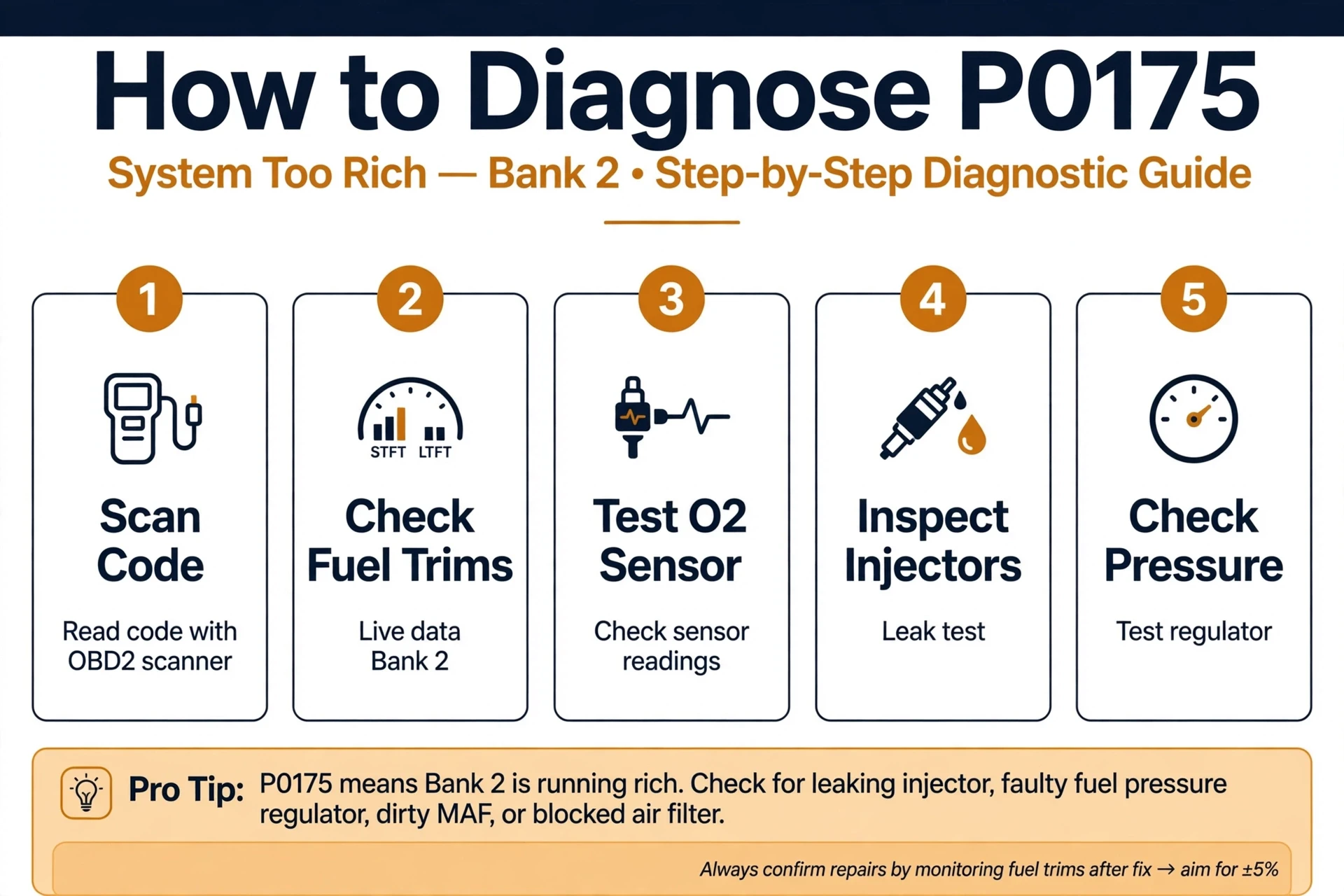
The p0175 code gets misdiagnosed constantly because people replace the oxygen sensor first and hope. Work through this order instead:
- Scan for other codes first. Misfire codes (P0300 series), O2 sensor codes, or P0172 next to P0175 change everything. If P0172 and P0175 appear together, suspect a shared cause like the MAF sensor, fuel pressure, or coolant temperature rather than one bank.
- Read live fuel trim data. With any OBD2 scanner that shows live data, check short-term and long-term fuel trims for bank 2 at idle and at cruise. Strongly negative numbers confirm the rich condition and show whether it follows one bank or both.
- Inspect the air intake. Pull the air filter and hold it up to the light. Check the intake tube for cracks, collapse, or debris.
- Check the MAF sensor. Unplug it and look at the sensing elements for an oil or dirt film. Oil from oiled cotton air filters is a classic trigger for how to fix p0175 code searches.
- Verify engine temperature. Compare the coolant temperature on the scan tool with an infrared thermometer at the thermostat housing. A sensor that reads cold while the engine is hot keeps fuel enrichment switched on.
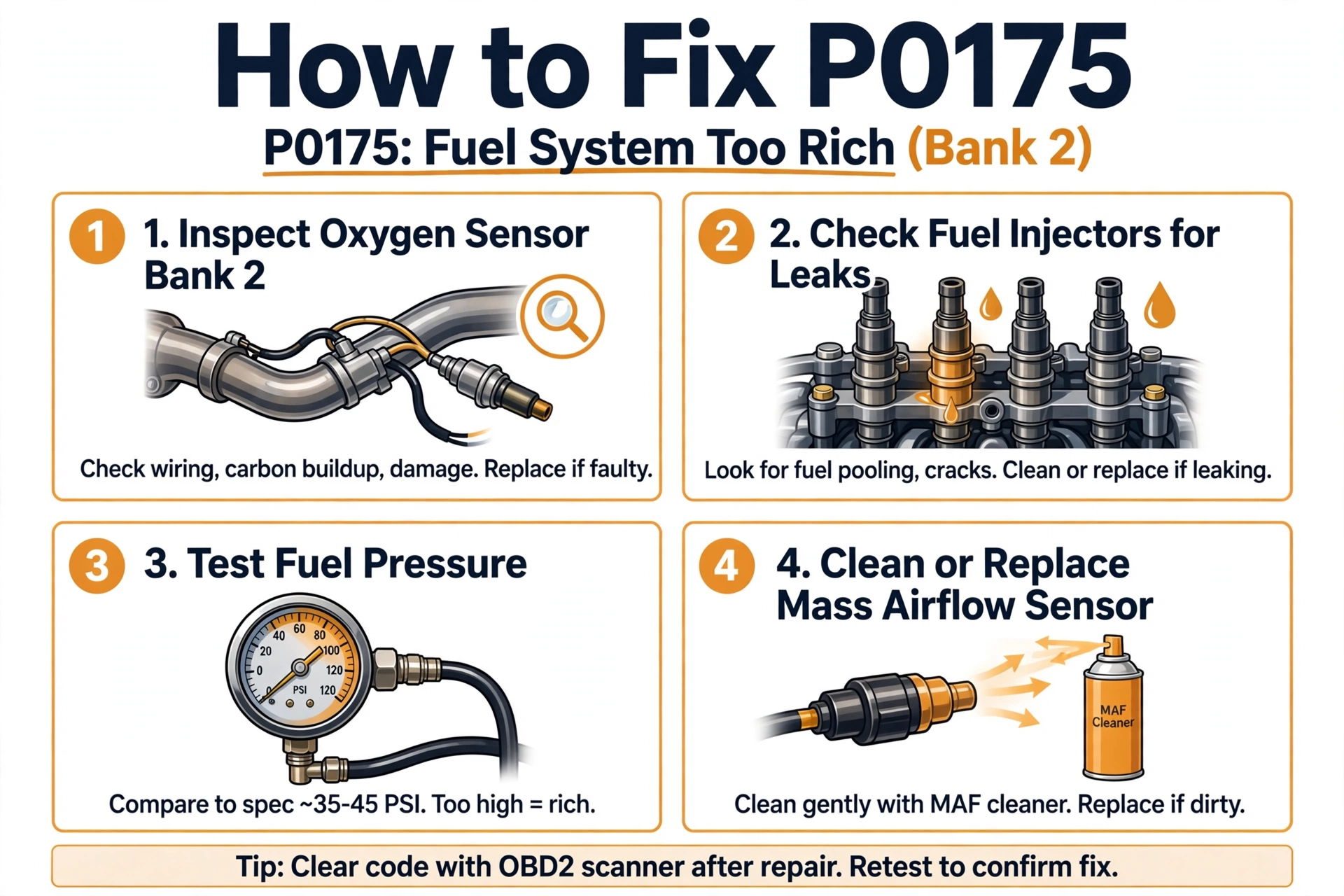
- Test fuel pressure. Hook up a gauge and compare against spec. Pressure above spec points at the regulator or a restricted return line.
- Inspect the bank 2 fuel injectors. Look and sniff for leaking injectors, and watch injector pulse data if your scanner supports it.
- Test the bank 2 upstream O2 sensor. Graph its voltage and confirm it switches briskly. A lazy or flatlined sensor is lying to the computer.
How to Fix the P0175 Code
The right fix depends on what your diagnosis found:
- Clean the MAF sensor: remove it and spray the elements with dedicated MAF cleaner, then let it dry fully. This cheap step resolves a large share of p0175 cases.
- Replace a clogged air filter: one of the simplest and cheapest fixes on the list.
- Replace a faulty MAF sensor: if cleaning does not restore accurate readings.
- Repair or replace leaking bank 2 fuel injectors: including seals and O-rings where applicable.
- Replace a stuck fuel pressure regulator: when fuel pressure tests above specification.
- Replace the bank 2 upstream O2 sensor: only after testing proves it lazy or biased.
- Replace cracked vacuum lines: cheap insurance for stable fuel trims.
- Fix cooling system faults: a new thermostat or coolant temperature sensor when the engine never reaches operating temperature.
- Update PCM software: when the manufacturer has released a calibration update for rich-running complaints.
Clear the code after the repair and road test the car, then recheck fuel trims to confirm they have returned near zero.
P0175 Repair Costs
Drivers always ask how much it costs to fix P0175, and the honest answer is that it depends on the cause. Here are typical US ranges:
| Repair | Cost Range |
|---|---|
| Diagnostic scan | $80 – $160 |
| Air filter replacement | $20 – $60 |
| MAF sensor cleaning (DIY) | $10 – $25 |
| MAF sensor replacement | $120 – $300 |
| O2 sensor replacement (per sensor) | $150 – $350 |
| Fuel injector replacement (per injector) | $200 – $600 |
| Fuel pressure regulator replacement | $150 – $400 |
| Thermostat or coolant temp sensor | $100 – $300 |
This is why diagnosis matters. A $15 can of MAF cleaner and a $600 injector job share the same p0175 code.
DIY vs Mechanic Verdict
You can do this at home: scanning codes and reading fuel trims with an OBD2 scanner, inspecting and replacing the air filter, cleaning the MAF sensor, and visual checks of vacuum lines, intake tubing, and sensor wiring.
See a mechanic for: fuel pressure testing, fuel injector diagnosis and replacement, O2 sensor circuit testing, and PCM software updates.
Bottom line: handle the airflow basics yourself, since they fix most P0175 cases, and let a pro take over when fuel trims stay negative after the simple stuff.
Can You Drive With a P0175 Code?
For short trips, usually yes. The car will often start and run. But driving long term with P0175 is a bad idea. A rich mixture forces the catalytic converter to burn off the extra fuel, which can overheat and melt its internals, turning a sensor or injector job into a four-figure converter replacement. Excess fuel can also wash oil off the cylinder walls and dilute the engine oil, which shortens engine life. Get it diagnosed within days, not months.
P0175 on Popular Vehicles
P0175 shows up across all brands, but some patterns are worth knowing:
- Chevy / GMC (Silverado, Sierra, Tahoe, Suburban): The p0175 chevy code (chevy p0175, p0175 code chevy silverado) is extremely common, often paired with P0172. Start with the MAF sensor and intake tract, especially if an oiled aftermarket filter is installed.
- Ford (F-150, Explorer, Fusion): For the p0175 ford code (ford p0175), check for vacuum leaks and test the MAF. Aging upstream O2 sensors are frequent culprits at high mileage.
- Honda (Pilot, Odyssey): On the p0175 honda code, verify the bank 2 upstream O2 sensor with live data before replacing anything, and rule out misfires first.
- Toyota / Lexus (4Runner, Sienna, GX470): The p0175 toyota pattern often resolves with a MAF cleaning and air filter service. Also inspect the intake tube for cracks.
- Jeep (Wrangler): The p0175 jeep code often arrives with misfire codes, so fix ignition faults before chasing fuel trim.
- Nissan: Check the MAF sensor and bank 2 O2 sensor operation first. Intake leaks get more common with age.
Owners search for the p0175 code on specific models so often that forums are full of threads. The diagnostic order above works for all of them.
P0175 vs P0172
P0175 means System Too Rich (Bank 2). P0172 is its mirror image: System Too Rich (Bank 1). Same fault, opposite sides of the engine.
When only P0175 is stored, concentrate on bank 2 hardware: its injectors and its upstream O2 sensor. When P0172 and P0175 appear together, the cause is almost certainly shared by both banks, so start with the MAF sensor, fuel pressure, coolant temperature, and air filter instead of chasing one side.
Related Codes
- P0172: System Too Rich (Bank 1)
- P0171 / P0174: System Too Lean (Bank 1 / Bank 2)
- P0300: Random/Multiple Cylinder Misfire Detected (a common companion)
- P2097 / P2099: Post Catalyst Fuel Trim System Too Rich (Bank 1 / Bank 2)
Video Walkthrough
Watch the video above for a visual walkthrough of P0175 causes and diagnosis before you read on.
Frequently Asked Questions
What is the most common cause of a P0175 code?
A dirty or failing mass airflow (MAF) sensor. It misreads the air entering the engine, the computer adds too much fuel to match, and bank 2 runs rich. Cleaning it with dedicated MAF cleaner fixes a large share of p0175 cases, which is why it is always the first thing to check.
Can I still drive my car with a P0175 code?
For short trips, usually yes, but get it checked soon. Running rich forces the catalytic converter to burn off extra fuel, which can overheat and destroy it. Excess fuel can also dilute the engine oil. Treat the p0175 code as a repair-this-week problem, not a repair-this-year one.
How do you fix the code P0175?
Diagnose first, then repair. Check fuel trims with a scanner, inspect the air filter, clean the MAF sensor, test fuel pressure, and verify the bank 2 upstream O2 sensor. There is no single universal fix for the p0175 code: the repair is whatever your testing proves faulty, from a $15 air filter to an injector replacement.
How much does it cost to fix P0175?
From about $10 to $25 for a DIY can of MAF cleaner, up to $400 or more for a fuel pressure regulator or injector work at a shop. A professional diagnostic scan typically runs $80 to $160. Most p0175 repairs land between $20 and $350.
Will P0175 clear itself?
Rarely. If the underlying fault disappears, the check engine light may turn off after several drive cycles, but the code usually stays stored until it is fixed and cleared. Do not count on a self-clear; find the cause instead.
Can a bad O2 sensor cause P0175?
Yes. A lazy or biased bank 2 upstream O2 sensor can report a false rich condition, or fail to report mixture problems accurately, either of which can trigger the p0175 code. Test the sensor with live data before replacing it, since sensors are often blamed for faults elsewhere.
Can a dirty air filter cause a P0175 code?
Yes. A clogged air filter chokes airflow into the engine, so the mixture goes rich on bank 2. It is one of the cheapest causes to rule out: pull the filter, hold it up to light, and replace it if you cannot see through it.
Conclusion
The P0175 code looks alarming, but it is really your car asking for a proper diagnosis rather than an automatic parts cannon. Start with the air filter and the MAF sensor, read your fuel trims, and fix whatever the data points to. Catching a rich condition early protects your catalytic converter, your engine oil, and your fuel budget at the same time.
About the author: Written by the OBD2 Code Hub editorial team. Our diagnostic guides are built from real OBD-II data, manufacturer service information, and hands-on shop experience, so you can fix it right the first time.